From the IEA 2010 World Energy Statistics, the country with the lowest electricity consumption is Haiti at 23 kWh /capita. The country with the highest consumption is Iceland with 49,818 kWh/capita. In between come Ethiopia at 42 kWh/capita, Kenya at 156, India at 566, Iraq at 1267, China at 2453, France at 7,703, the US at 13,647, Canada at 17,053 and Norway at 24,868 kWh/capita. For the world as a whole the average consumption is 2,782 kWh/capita.
The average is 18 times less than the maximum and the minimum is 120 times less than the average. And of course the average in every country itself represents an enormous spread between individuals.
To put this into the perspective of living standards and the quality of life, the electricity consumption of household goods is typically as follows:
- One 60 W light –bulb for 8 hrs per day consumes 175 kWh/annum,
- Typical 19” colour TV (70 W) for c. 5 hrs per day 125 kWh/annum
- Table fan (20 W) for c. 12 hours per day 88 kWh/annum
- Desktop computer (100 W) for 8 hours per day 290 kWh/annum
- Refrigerator (80 W), continuously, 700 kWh/annum
- Freezer 150 W continuously, 1300 kWh/annum
To have access to one 60 W light bulb when you have none is an enormous improvement in the quality of one’s life. To have access to a fridge so that shopping and cooking every day while also holding down a full-time job is no longer necessary is the difference between freedom and slavery for many women in the developing world. It is a sobering thought that if every Haitian used just one 60 W light bulb for 8 hours every day, the electricity consumption in Haiti (and therefore electricity generation) would increase seven-fold!
Electricity has been a force of liberation for the human spirit. It has been the availability of electricity which has allowed mankind to decouple living standards from the constraints that were set by the availability of sunlight, the prevailing weather, the perishability of food and the physical capacity of the human body. It is perhaps the single most important factor, after the discovery of fire and the advent of the wheel, which has allowed mankind to shift from being the slave of time available to actually having leisure time (defined as time not required for meeting basic survival and security needs). It is what has enabled education to spread and allowed industry and industrial development. And as humans have acquired leisure time, electricity is what has enabled the development of entertainment and other pastimes to fill the leisure time in a satisfying way.
There is no level of electricity consumption which can be said to be the minimum needed or the correct level or which can be condemned as being wrong. But what is incontrovertible is that the quality of life improves as the availability and consumption of electricity increases. It increases sharply upto some level above which the rate of perceived improvement of quality of life falls off. The initial sharp increase is where the electricity consumption impacts the fundamental needs of survival and security.
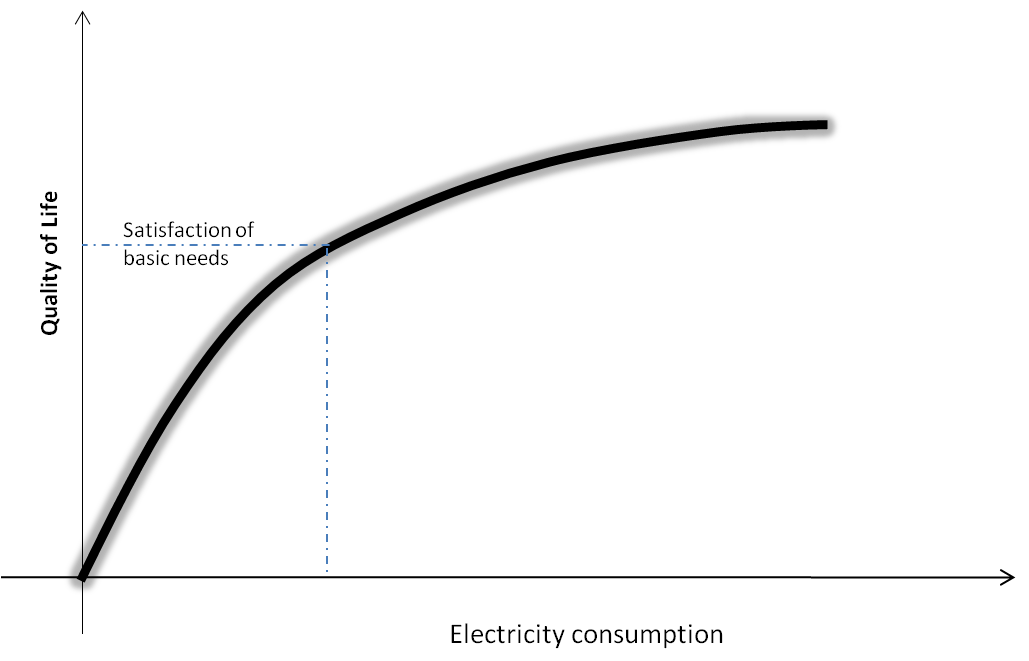
Electricity consumption and quality of life
It is then self-evident to me that the aspirations of the bulk of the 6 billion people on Earth to improve their quality of life by consuming electricity cannot, and must not, be hindered. For these people who have the least resources available it is imperative that electricity be generated and be made available as cheaply and as reliably and as quickly as possible. For their lives it is the present that matters.
This need for electricity is not going to go away. Its generation – at any instant in time – must be by the most economic means available. Technologies may develop and costs may well change over time but the simple reality is that the cheapest electricity will be provided by coal, hydropower, nuclear and natural gas for at least the next 50 years. For these 50 years or so, solar power and wind power for centralised power generation can only increase the cost of power generation. Subsidies in the form of guaranteed feed in tariffs only protect the developers, increase the total cost of electricity generation and do little to reduce the cost of these technologies.
The use of alarmist scenarios – generated by people sitting in the comfort of their own profligate electricity consumption – and having the leisure time to do so, about the effects of fossil fuels to prevent the use of fossil fuels does a disservice to common sense and to the billions who are desperately trying to improve their lives. Indulging in these hypothetical scenarios to deny the aspirations of billions is fundamentally immoral.
 The k2p blog