In May this year, one of Jupiter’s characteristic stripes – the South Equatorial Belt (SEB) disappeared.
http://science.nasa.gov/science-news/science-at-nasa/2010/20may_loststripe/
May 20, 2010: In a development that has transformed the appearance of the solar system’s largest planet, one of Jupiter’s two main cloud belts has completely disappeared. Known as the South Equatorial Belt (SEB), the brown cloudy band is twice as wide as Earth and more than twenty times as long. The loss of such an enormous “stripe” can be seen with ease halfway across the solar system.

These side by side images of Jupiter taken by Australian astrophotographer Anthony Wesley show the SEB in August 2009, but not in May 2010.Individual images: Aug. 4, 2009; May 8, 2010.
Anthony Wesley is a veteran observer of Jupiter, famous for his discovery of a comet hitting the planet in 2009. Like many other astronomers, he noticed the belt fading late last year, “but I certainly didn’t expect to see it completely disappear,” he says. “Jupiter continues to surprise.” Planetary scientist Glenn Orton of NASA’s Jet Propulsion Lab thinks the belt is not actually gone, but may be just hiding underneath some higher clouds.
“It’s possible,” he hypothesizes, “that some ‘ammonia cirrus’ has formed on top of the SEB, hiding the SEB from view.” On Earth, white wispy cirrus clouds are made of ice crystals. On Jupiter, the same sort of clouds can form, but the crystals are made of ammonia (NH3) instead of water (H2O).
But now the SEB may be breaking through again.
Tuesday, Nov. 16, 2010: A turbulent plume is breaking through the giant planet’s cloudtops in the south equatorial zone, heralding the emergence of … what? This Nov. 14th photo from astrophotographer Paul Haese of Glenalta, South Australia shows the plume.
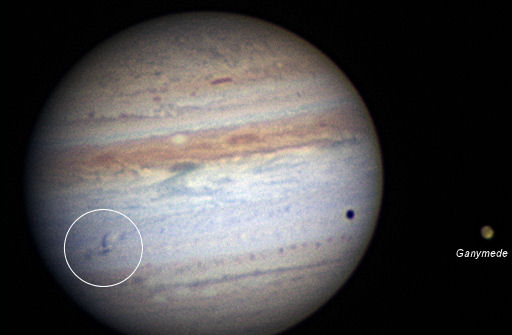
The SEB revival is now underway. Tonight I captured the revival transiting the face of Jupiter. To boot I was lucky enough to include Ganymede with detail and Europa's shadow after a double transit. What a night. Taken with peltier cooled C14 and Skynyx 2-0: Paul Haese
The plume, circled in Haese’s photo and known to astronomers as the “SEB Revival Spot,” is a sign that Jupiter’s South Equatorial Belt (SEB) is about to return. The great brown belt disappeared earlier this year, leaving Jupiter without one of its signature stripes. No one knows where the SEB went, although some researchers have speculated that it sank beneath high altitude clouds and might now be bobbing back to the top.
Christopher Go of the Philippines first noticed the Revival Spot on Nov. 9th. At first it was small and white and required careful astrophotography to detect. Only five days later, it is expanding rapidly and darkening; soon, it could become visible to novices in the eyepieces of backyard telescopes.
Tags: Jupiter, Jupiter's stripes, SEB, Solar System, South Equatorial Belt
 The k2p blog
November 26, 2010 at 3:04 pm
[…] In May this year one of Jupiter’s characteristic stripes (the South Equatorial Belt) disappeared. Then two weeks ago a turbulent plume was observed breaking through the giant planet’s cloudtops in the south equatorial zone heralding the possible re-emergence of the stripe. […]
November 26, 2010 at 3:06 pm
[…] New pictures show the return of Jupiter’s lost stripe By ktwop In May this year one of Jupiter’s characteristic stripes (the South Equatorial Belt) disappeared. Then two weeks ago a turbulent plume was observed breaking through the giant planet’s cloudtops in the south equatorial zone heralding the possible re-emergence of the stripe. […]