Archive for October, 2013

A new, profound insight into “climate change cooperation”

October 21, 2013

There is bad science and there is silly science and there is trivial science. There is also inane science.

And their are learned journals for all of them. This is a new paper published by Nature Climate Change. (One wonders why?). The authors though can be very pleased since they can each add another paper to their respective list of publications. “We learned from this experiment that even groups gravitate towards instant gratification” 

Wow!

Jennifer Jacquet, Kristin Hagel, Christoph Hauert, Jochem Marotzke, Torsten Röhl, Manfred Milinski. Intra- and intergenerational discounting in the climate gameNature Climate Change, 2013; DOI: 10.1038/nclimate2024

EurekAlert has this to say:

Delayed gratification hurts climate change cooperation

Time is a huge impediment when it comes to working together to halt the effects of climate change, new research suggests.

A study published today in the journal Nature Climate Change reveals that groups cooperate less for climate change mitigation when the rewards of cooperation lay in the future, especially if they stretch into future generations.

“People are often self-interested, so when it comes to investing in a cooperative dilemma like climate change, rewards that benefit our offspring – or even our future self – may not motivate us to act,” says Jennifer Jacquet, a clinical assistant professor at New York University’s Environmental Studies Program, who conducted the research while a postdoctoral fellow working with Math Prof. Christoph Hauert at the University of British Columbia.

“Since no one person can affect climate change alone, we designed the first experiment to gauge whether group dynamics would encourage people to cooperate towards a better future.”

Researchers at UBC and two Max Planck Institutes in Germany gave study participants 40 Euros each to invest, as a group of six, towards climate change actions. If participants cooperated to pool together 120 Euros for climate change, returns on their investment, in the form of 45 additional Euros each, were promised one day later, seven weeks later, or were invested in planting oak trees, and thus would lead to climate benefits several decades down the road – but not personally to the participants. Although many individuals invested initially in the long-term investment designed to simulate benefits to future generations, none of the groups achieved the target.

“We learned from this experiment that even groups gravitate towards instant gratification,” says Hauert, an expert in game theory, the study of strategic decision-making.

The authors suggest that international negotiations to mitigate climate change are unlikely to succeed if individual countries’ short-term gains are not taken into consideration.

Could there be any form of cooperation – in any field – where long-term gains are not out-weighed by instant gratification? For any investment – let alone a cooperative investment – given a choice of a short payback or a long payback, is there any case where the long payback period is chosen? 

This is so profound and so deep an insight it almost hurts!

How to write good!

October 21, 2013

Oh, very good. (via This Got My Attention)

The “Backfire Effect” and why Global Warmists ignore facts which contradict their opinions

October 21, 2013

This is about a study on how facts – especially corrective facts – are ignored when some opinion or perception is deeply held. The study is about political perceptions and it strikes me that it is very relevant to the IPCC and the alarmists for whom the Global Warming hypothesis (that man-made carbon dioxide emissions are the primary cause of Global warming) is a deeply held political belief.

Brendan Nyhan and Jason Reifler, When Corrections Fail: The persistence of political misperceptions

Abstract: We conducted four experiments in which subjects read mock news articles that included either a misleading claim from a politician, or a misleading claim and a correction. Results indicate that corrections frequently fail to reduce misperceptions among the targeted ideological group. We also document several instances of a “backfire effect” in which corrections actually increase misperceptions among the group in question.

The behaviour of the IPCC and the Global Warming coterie in ignoring or explaining away real observations in favour of their computer models has always smacked of religious fanaticism rather than scientific objectivity. They have shown a preference for coming up with ever more fanciful explanations about why their predictions are not panning out rather than accept that the basis of their predictions may be mistaken. The heat lurking in the deep oceans or Chinese pollution blocking out the sun or “old ice” declining invisibly while “new ice” increases have all been suggested as explanations for

  1. the recent lack of warming,
  2. the broken link between global temperature and carbon dioxide concentration, and
  3. increasing global ice extent.

It would seem that the global warming brigade are an “ideological sub-group” suffering from the “backfire effect”.

In this paper, we report the results of two rounds of experiments investigating the extent to which corrective information embedded in realistic news reports succeeds in reducing prominent misperceptions about contemporary politics. In each of the four experiments, which were conducted in fall 2005 and spring 2006, ideological subgroups failed to update their beliefs when presented with corrective information that runs counter to their predispositions. Indeed, in several cases, we find that corrections actually strengthened misperceptions among the most strongly committed subjects.

…. Political beliefs about controversial factual questions in politics are often closely linked with one’s ideological preferences or partisan beliefs. As such, we expect that the reactions we observe to corrective information will be influenced by those preferences. ……… Specifically, people tend to display bias in evaluating political arguments and evidence, favoring those that reinforce their existing views and disparaging those that contradict their views.

However, individuals who receive unwelcome information may not simply resist challenges to their views. Instead, they may come to support their original opinion even more strongly – what we call a “backfire effect.”

……

The backfire effects that we found seem to provide further support for the growing literature showing that citizens engage in “motivated reasoning.” While our experiments focused on assessing the effectiveness of corrections, the results show that direct factual contradictions can actually strengthen ideologically grounded factual beliefs – an empirical finding with important theoretical implications.

It is a little depressing that  just using facts (science) may not be of much use in getting people to correct their misperceptions when these take the form of religious belief.

Many citizens seem unwilling to revise their beliefs in the face of corrective information, and attempts to correct those mistaken beliefs may only make matters worse.

It is the sobering – and depressing – reality that facts (read science) are always subservient to even completely irrational religious beliefs.

Levitating drops in an ultrasonic field

October 20, 2013

Watch this through!

Absolutely mesmerizing. From the paper “Shape oscillation of a levitated drop in an acoustic field” (arXiv.orgPDF)

via Science is Beauty

Science is losing its ability to self-correct

October 20, 2013

With the explosion in the number of researchers, the increasing rush to publication and the corresponding explosion in traditional and on-line journals as avenues of publication, The Economist carries an interesting article making the point that the assumption that science is self-correcting is under extreme pressure. “There is no cost to getting things wrong,” says Brian Nosek, a psychologist at the University of Virginia who has taken an interest in his discipline’s persistent errors. “The cost is not getting them published.”

The field of psychology and especially social psychology has been much in the news with the dangers of “priming”.

“I SEE a train wreck looming,” warned Daniel Kahneman, an eminent psychologist, in an open letter last year. The premonition concerned research on a phenomenon known as “priming”. Priming studies suggest that decisions can be influenced by apparently irrelevant actions or events that took place just before the cusp of choice. They have been a boom area in psychology over the past decade, and some of their insights have already made it out of the lab and into the toolkits of policy wonks keen on “nudging” the populace.

Dr Kahneman and a growing number of his colleagues fear that a lot of this priming research is poorly founded. Over the past few years various researchers have made systematic attempts to replicate some of the more widely cited priming experiments. Many of these replications have failed. In April, for instance, a paper in PLoS ONE, a journal, reported that nine separate experiments had not managed to reproduce the results of a famous study from 1998 purporting to show that thinking about a professor before taking an intelligence test leads to a higher score than imagining a football hooligan.

It is not just “soft” fields which have problems. It is apparent that in medicine a large number of published results cannot be replicated

… irreproducibility is much more widespread. A few years ago scientists at Amgen, an American drug company, tried to replicate 53 studies that they considered landmarks in the basic science of cancer, often co-operating closely with the original researchers to ensure that their experimental technique matched the one used first time round. According to a piece they wrote last year in Nature, a leading scientific journal, they were able to reproduce the original results in just six. Months earlier Florian Prinz and his colleagues at Bayer HealthCare, a German pharmaceutical giant, reported in Nature Reviews Drug Discovery, a sister journal, that they had successfully reproduced the published results in just a quarter of 67 seminal studies.

The governments of the OECD, a club of mostly rich countries, spent $59 billion on biomedical research in 2012, nearly double the figure in 2000. One of the justifications for this is that basic-science results provided by governments form the basis for private drug-development work. If companies cannot rely on academic research, that reasoning breaks down. When an official at America’s National Institutes of Health (NIH) reckons, despairingly, that researchers would find it hard to reproduce at least three-quarters of all published biomedical findings, the public part of the process seems to have failed.

It is not just that research results cannot be replicated. So much of what is published is just plain wrong and the belief that science is self-correcting is itself under pressure

Academic scientists readily acknowledge that they often get things wrong. But they also hold fast to the idea that these errors get corrected over time as other scientists try to take the work further. Evidence that many more dodgy results are published than are subsequently corrected or withdrawn calls that much-vaunted capacity for self-correction into question. There are errors in a lot more of the scientific papers being published, written about and acted on than anyone would normally suppose, or like to think. …… Statistical mistakes are widespread. The peer reviewers who evaluate papers before journals commit to publishing them are much worse at spotting mistakes than they or others appreciate. Professional pressure, competition and ambition push scientists to publish more quickly than would be wise. A career structure which lays great stress on publishing copious papers exacerbates all these problems. “There is no cost to getting things wrong,” says Brian Nosek, a psychologist at the University of Virginia who has taken an interest in his discipline’s persistent errors. “The cost is not getting them published.” 

…… In 2005 John Ioannidis, an epidemiologist from Stanford University, caused a stir with a paper showing why, as a matter of statistical logic, the idea that only one such paper in 20 gives a false-positive result was hugely optimistic. Instead, he argued, “most published research findings are probably false.” 

The tendency to only publish positive results leads also to statistics being skewed to allow results to be shown as being poitive

The negative results are much more trustworthy; …….. But researchers and the journals in which they publish are not very interested in negative results. They prefer to accentuate the positive, and thus the error-prone. Negative results account for just 10-30% of published scientific literature, depending on the discipline. This bias may be growing. A study of 4,600 papers from across the sciences conducted by Daniele Fanelli of the University of Edinburgh found that the proportion of negative results dropped from 30% to 14% between 1990 and 2007. Lesley Yellowlees, president of Britain’s Royal Society of Chemistry, has published more than 100 papers. She remembers only one that reported a negative result.

…. Other data-heavy disciplines face similar challenges. Models which can be “tuned” in many different ways give researchers more scope to perceive a pattern where none exists. According to some estimates, three-quarters of published scientific papers in the field of machine learning are bunk because of this “overfitting”

The idea of peer-review being some kind of a quality check of the results being published is grossly optimistic

The idea that there are a lot of uncorrected flaws in published studies may seem hard to square with the fact that almost all of them will have been through peer-review. This sort of scrutiny by disinterested experts—acting out of a sense of professional obligation, rather than for pay—is often said to make the scientific literature particularly reliable. In practice it is poor at detecting many types of error.

John Bohannon, a biologist at Harvard, recently submitted a pseudonymous paper on the effects of a chemical derived from lichen on cancer cells to 304 journals describing themselves as using peer review. An unusual move; but it was an unusual paper, concocted wholesale and stuffed with clangers in study design, analysis and interpretation of results. Receiving this dog’s dinner from a fictitious researcher at a made up university, 157 of the journals accepted it for publication. ….

……. As well as not spotting things they ought to spot, there is a lot that peer reviewers do not even try to check. They do not typically re-analyse the data presented from scratch, contenting themselves with a sense that the authors’ analysis is properly conceived. And they cannot be expected to spot deliberate falsifications if they are carried out with a modicum of subtlety.

Fraud is very likely second to incompetence in generating erroneous results, though it is hard to tell for certain. 

And then there is the issue that all results from Big Science can never be replicated because the cost of the initial work is so high. Medical research or clinical trials are also extremely expensive. Journals have no great interest to publish replications (even when they are negative). And then, to compound the issue, those who provide funding are less likely to extend funding merely for replication or for negative results.

People who pay for science, though, do not seem seized by a desire for improvement in this area. Helga Nowotny, president of the European Research Council, says proposals for replication studies “in all likelihood would be turned down” because of the agency’s focus on pioneering work. James Ulvestad, who heads the division of astronomical sciences at America’s National Science Foundation, says the independent “merit panels” that make grant decisions “tend not to put research that seeks to reproduce previous results at or near the top of their priority lists”. Douglas Kell of Research Councils UK, which oversees Britain’s publicly funded research argues that current procedures do at least tackle the problem of bias towards positive results: “If you do the experiment and find nothing, the grant will nonetheless be judged more highly if you publish.” 

Trouble at the lab 

The rubbish will only decline when there is a cost to publishing shoddy work which outweighs the gains of adding to a researcher’s list of publications. At some point researchers will need to be held liable and accountable for their products (their publications). Not just for fraud or misconduct but even for negligence or gross negligence when they do not carry out their work using the best available practices of the field. These are standards that some (but not all) professionals are held to and there should be no academic researcher who is not also subject to such a standard. If peer-review is to recover some of its lost credibility then anonymous reviews must disappear and reviewers must be much more explicit about what they have checked and what they have not.

Corruption is in the genes of the EU

October 20, 2013

In the developing world venality is often a matter of survival. In Europe venal behaviour is a matter of choice. The EU bureaucracy in Brussels has corruption in its genes and tax-payer’s money running through its veins. It is remarkable that so many ostensibly democratic countries (at least in name) have so easily surrendered their powers to a bloated and corrupt group in Brussels.

It is not Best in Class that applies. The Least Common Factor applies in Europe. Brussels is as corrupt and as wasteful and as inefficient as the worst country in Europe. In this case the corruption and the condoning of corruption in Brussels is as bad as in Greece. And corruption in Greece was not a small contributor to their financial problems.

Der Spiegel writes:

Anti-corruption officials in Brussels have failed to investigate reports of squandered EU funds at a training institute in Greece, a German paper reported Friday. Well-connected teachers were allegedly paid up to €610 per hour for up to 225 work hours per month.

The European Anti-Fraud Office (OLAF) has reportedly ignored repeated tip-offs about squandered European Union funds in Greece, according to an article in the Friday edition of the Süddeutsche Zeitung. The German daily reports that a Greek civil servant uncovered multiple cases of nepotism and vastly inflated salaries while inspecting the finances of a vocational training institute. Officials in Brussels have apparently not acted on any of the whistleblower’s suspicions, which he communicated in several letters, the paper added.

According to the newspaper report, Giorgos Boutos, a government finance official in Athens, began auditing the books of the Organization for Vocation Education and Training (OEEK) in 2006. The institute receives and distributes EU funds earmarked for vocational training in Greece. Boutros repeatedly stumbled upon irregularities and documented the cases in numerous letters to OLAF.

…. The case involves at least €6 million ($8.2 million). It’s not an excessive sum of money, but it is well documented. Boutos was able to substantiate the irregularities in his letters to the EU with contracts, hotel bills and bank statements. He reportedly found that 75 percent of the misappropriated money had come from the EU.

The details provided by the Süddeutsche Zeitung are sure to raise eyebrows. Some of the instructors are said to have been paid for up to 225 hours per month, even during periods when they were abroad. Hourly wages for teachers were reportedly as high as €610. The alleged corruption was compounded by apparent instances of nepotism: The son of a cabinet member taught a course on silver-plating watches, the wife of a Socialist politician led classes on both dentistry and geography, and relatives of the institute’s leader held jobs there.

….. It wasn’t until seven months — and several more inquiries — later that Boutos received fresh news about the case. Still, that letter merely stated that OLAF was in the process of “a comprehensive reorganization,” and asked him to be patient. 

Meanwhile, Boutos told the newspaper, many similar cases of misspent EU funds now fall under the statute of limitations because the EU took too long to address them. Exactly €516,000 of misappropriated EU funds have been repaid. But Boutros stressed that the EU could demand that all such funds be paid back — that is, if it really wanted to.

Boutos also questioned whether investigations had been delayed because some suspected fraud cases involved relatives of government and party officials — or whether Brussels even cared at all about such instances.

Global Warming gone missing: Arctic ice back to “normal” and Antarctic ice at highest ever recorded levels

October 20, 2013

IF THE GLOBE IS WARMING, WHERE’S THE HEAT?

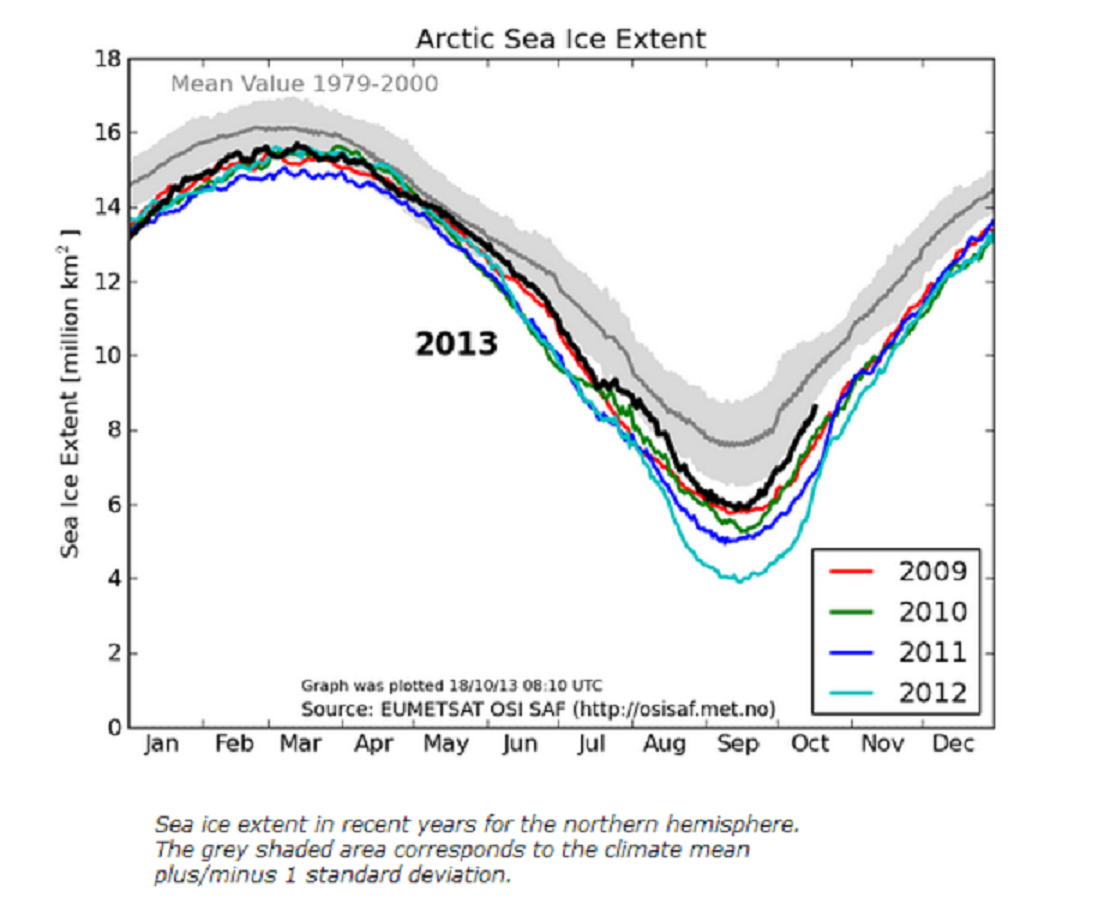
Arctic Ice levels are increasing fast and are within 1 standard deviation of the 1979-2000 mean.

Arctic Ice Extent 20131018 DMI Centre for Ocean and Ice

Arctic Ice Extent 20131018 DMI Centre for Ocean and Ice

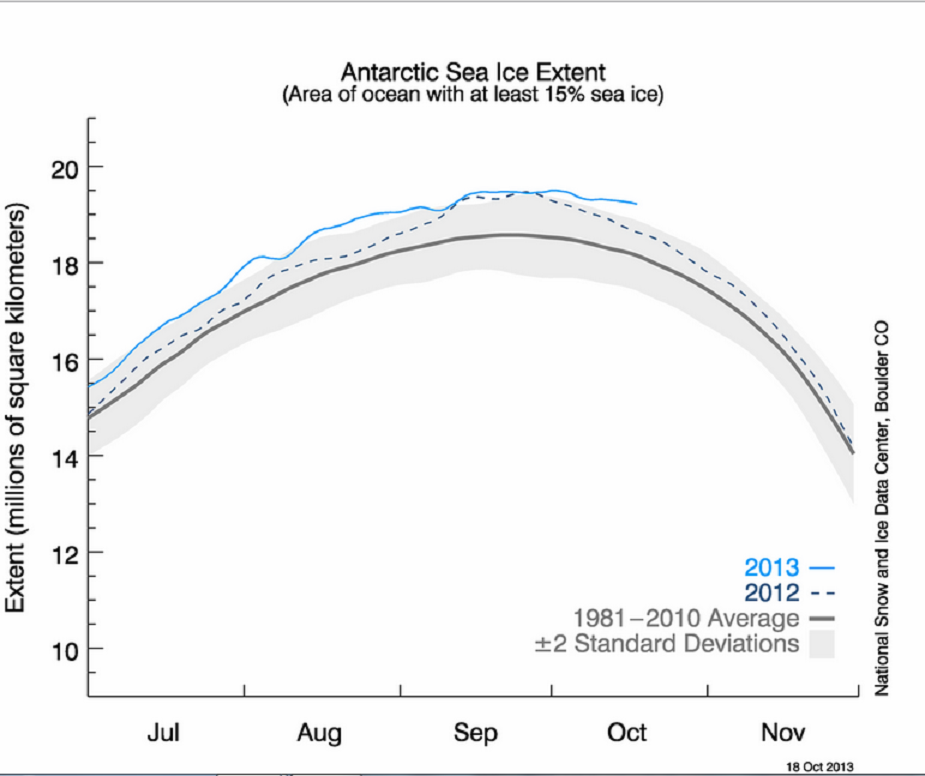
In the Anatrctic ice extent should normally have started reducing by 22nd Sepptember but kept increasing till about 1st October. At maximum it reached levels never recorded before. It is currently at a level more than 2 standard deviations higher than the long term 1981 – 2010 average.

Antarctic Ice Extent 20131018 NSIDC Boulder

Antarctic Ice Extent 20131018 NSIDC Boulder

This leads to obvious but simple conclusions:

  1. Over the last 34 years therefore, Arctic ice extent has shown great variability but is currently at values within one standard deviation of the 30 year average.
  2. Global warming – if it is taking place – has not left any significant signature in the extent of Arctic Ice which is larger than “natural variability”.
  3. Over the last 32 years Antarctic ice extent has consistently shown a small but steady increase.
  4. Global warming – if it is taking place – is completely absent in the record of the ice extent.

It could be argued – but it would stretch credulity – that heat is being stored in the deep ocean (having bypassed the surface waters by a hitherto unknown form of “deep sea radiation”)  and that this will all be released in a coming catastrophic event (to be known as the Ehrlich Rapture) in 2047.

Or, it could be argued – again with little credibility – that man-made particulate emissions from China in the Northern Hemisphere and from Indonesian forest fires in the Southern Hemisphere have reflected away the Sun’s radiation and prevented the warming that should have taken place. This argument then fails since it would appear to describe a very successful  application – if inadvertent – of geo-engineering.

Or we could choose the parsimonious explanation. There has been no global warming for the last 2 decades or so.

Any discussion about whether or how much warming is caused by carbon dioxide emissions becomes moot if there is no warming.

WHERE’S THE HEAT?

Snow sweeps in very early this year

October 19, 2013

Snow has already come to Bavaria. Parts of Russia and the US have also seen some very early snow. Now, in just the 3rd week of October, snow has swept over northern Sweden. I have not had to clear any snow yet but I have had ice to scrape of the windshield for the last few mornings. I had only planned to change to winter tyres at the end of the month but I might have to bring this forward (to prepone it).

It is only weather of course! I wish somebody could tell me of any effects of global warming that could actually be experienced.

Autumn over as winter snow sweeps Sweden

Snow and sub-zero temperatures hit widespread parts of Sweden on Thursday night and will carry on through Friday and beyond, with meteorologists warning motorists that now is the time to change to winter tyres.

The coldest temperature of the season was recorded on Thursday night in Karesuando, in far northern Sweden near the Finnish border, where the mercury dropped to -12.5ˆC. Snow fell in Västernorrland, Dalarna and Gävleborg, and in many areas further north, but experts said the snow is nothing to worry about. 
“I believe that in most places it’s only been a few centimetres of snow that have settled,” Sandra Andersson of Sweden’s weather agency SMHI told the TT news agency. SMHI issued a class 1 warning, stating that motorists should beware of slippery roads, although no damage was reported throughout the night.

The Amazon contains 390 billion trees of 16,000 species (approximately)

October 19, 2013

Something to remember for your next game of Trivial Pursuit.

The Amazon contains 390 billion trees and 16,000 species and half the trees are accounted for by just 227 species.

Nobody actually counted them.

The ~6-million-km2 Amazonian lowlands were divided into 1° cells, and mean tree density was estimated for each cell by using a loess regression model that included no environmental data but had its basis exclusively in the geographic location of tree plots. A similar model, allied with a bootstrapping exercise to quantify sampling error, was used to generate estimated Amazon-wide abundances of the 4962 valid species in the data set. We estimated the total number of tree species in the Amazon by fitting the mean rank-abundance data to Fisher’s log-series distribution.

The data is generated by a mathematical model.  It is not clear how the 16,000 species is estimated from just 4,962 valid species. “This is very valuable information for further research and policymaking” says Hans ter Steege. It must be – after all a paper has been published in Science! According to the mathematical model roughly 6,000 tree species in the Amazon have populations of fewer than 1,000 individuals, which automatically qualifies them for inclusion in the International Union for Conservation of Nature (IUCN) Red List of Threatened Species. But these species are so rare that scientists may never find them.

( I can’t help thinking that there must be very many species of tree coming to the end of their “natural” existence which we know nothing about. And does it matter?).

H. ter Steege et al, Hyperdominance in the Amazonian Tree FloraScience, 2013; 342 (6156): 1243092 DOI: 10.1126/science.1243092

Graphic

A map of Amazonia showing the location of the 1430 Amazon Tree Diversity Network (ATDN) plots that contributed data to this paper.

Field Museum Press Release: 

Researchers, taxonomists, and students from The Field Museum and 88 other institutions around the world have provided new answers to two simple but long-standing questions about Amazonian diversity: How many trees are there in the Amazon, and how many tree species occur there? The study will be published October 17, 2013 in Science.

The vast extent and difficult terrain of the Amazon Basin (including parts of Brazil, Peru, Columbia) and the Guiana Shield (Guyana, Suriname, and French Guiana), which span an area roughly the size of the 48 contiguous North American states, has historically restricted the study of their extraordinarily diverse tree communities to local and regional scales. The lack of basic information about the Amazonian flora on a basin-wide scale has hindered Amazonian science and conservation efforts.

“In essence, this means that the largest pool of tropical carbon on Earth has been a black box for ecologists, and conservationists don’t know which Amazonian tree species face the most severe threats of extinction,” says Nigel Pitman, Robert O. Bass Visiting Scientist at The Field Museum in Chicago, and co-author on the study.

Now, however, over 100 experts have contributed data from 1,170 forestry surveys in all major forest types in the Amazon to generate the first basin-wide estimates of the abundance, frequency and spatial distribution of thousands of Amazonian trees.

Extrapolations from data compiled over a period of 10 years suggest that greater Amazonia, which includes the Amazon Basin and the Guiana Shield, harbors around 390 billion individual trees, including Brazil nut, chocolate, and açai berry trees.

“We think there are roughly 16,000 tree species in Amazonia, but the data also suggest that half of all the trees in the region belong to just 227 of those species! Thus, the most common species of trees in the Amazon now not only have a number, they also have a name. This is very valuable information for further research and policymaking,” says Hans ter Steege, first author on the study and researcher at the Naturalis Biodiversity Center in South Holland, Netherlands.

The authors termed these species “hyperdominants.” While the study suggests that hyperdominants – just 1.4 percent of all Amazonian tree species – account for roughly half of all carbon and ecosystem services in the Amazon, it also notes that almost none of the 227 hyperdominant species are consistently common across the Amazon. Instead, most dominate a region or forest type, such as swamps or upland forests.

The study also offers insights into the rarest tree species in the Amazon. According to the mathematical model used in the study, roughly 6,000 tree species in the Amazon have populations of fewer than 1,000 individuals, which automatically qualifies them for inclusion in the International Union for Conservation of Nature (IUCN) Red List of Threatened Species. The problem, say the authors, is that these species are so rare that scientists may never find them.

Ecologist Miles Silman of Wake Forest University, another co-author of the paper, calls the phenomenon “dark biodiversity”.

“Just like physicists’ models tell them that dark matter accounts for much of the universe, our models tell us that species too rare to find account for much of the planet’s biodiversity. That’s a real problem for conservation, because the species at the greatest risk of extinction may disappear before we ever find them,” says Silman.

While the authors are confident that these hyperdominants also dominate the vast expanses of Amazonia where scientists have never set foot, they do not know why some species are hyperdominant and others are rare.

The authors note that a large number of hyperdominants – including Brazil nut, chocolate, rubber, and açai berry – have been used and cultivated for millennia by human populations in Amazonia.

“There’s a really interesting debate shaping up,” says Pitman, “between people who think that hyperdominant trees are common because pre-1492 indigenous groups farmed them, and people who think those trees were dominant long before humans ever arrived in the Americas.”

Bora’s gardening leave ends in resignation from Scientific American

October 19, 2013

Following the noise and the revelation that his sexual harassment was not just an isolated incident, Bora Zivkovic’s position was no longer tenable. The resignation from Scientific American was almost inevitable but editor-in-chief Mariette DiChristina cannot escape some reprimand. Both she and the magazine need to make some kind of public statement and acknowledgement that their support for their own DN Lee was wanting. The Press release about Bora’s resignation contains nothing about her initial censorship “Following recent events, Bora Zivkovic has offered his resignation from Scientific American, and Scientific American has decided to accept that resignation”.

IndyWeek:

Scientific American has an anti-harassment policy. We offer live and online anti-harassment training to those who manage employees. We’ve recently begun providing such training to individuals who work with freelancers and contractors as well. We take allegations, such as those that have appeared online this week, very seriously. When Monica Byrne contacted Scientific American a year ago, we investigated her report, offered the Company’s apologies and Ms. Byrne acknowledged in her blog that she was satisfied with our response. We were unaware of any additional allegations until this week.

Zivkovic, who lives near Pittsboro, has admitted to engaging in inappropriate and unwanted sexual advances toward Byrne. However, he claimed it was an isolated incident. In the last week, at least a half-dozen women have come forward with similar accounts of interactions with him.