Archive for the ‘Engineering’ Category

Musk’s SpaceX compared to Bezos’ Blue Origin

April 21, 2026

This is an AI comparison I asked for which I am posting because it is of interest and for trivial pursuits.


Blue Origin and SpaceX are the two primary leaders of the private space industry, but they differ significantly in their operational philosophy, development speed, and current capabilities. As of April 2026, here is a comparison of the two companies:

1. Foundational Philosophy & Leadership

  • SpaceX (founded 2002 by Elon Musk): Operates with a “fail fast, learn fast” mentality. They iterate rapidly, often testing hardware to destruction (as seen with early Starship prototypes) to gather data. Their ultimate goal is making life multi-planetary, specifically colonizing Mars.

  • Blue Origin (founded 2000 by Jeff Bezos): Follows the motto Gradatim Ferociter (“Step by Step, Ferociously”). Historically, they have been more secretive and methodical, focusing on long-term infrastructure. Their vision is to have “millions of people living and working in space” to preserve Earth, primarily through O’Neill-style space colonies.

2. Launch Vehicles

Feature SpaceX Falcon 9 / Heavy SpaceX Starship Blue Origin New Shepard Blue Origin New Glenn
Status Fully Operational In Advanced Testing Operational (Suborbital) Operational (Orbital)
Capability Orbital (LEO, GTO) Heavy Lift Orbital Suborbital (Space Tourism) Heavy Lift Orbital
Reusability Partially (First stage) Aiming for 100% Fully (Booster & Capsule) Partially (First stage)
Recent Milestone Over 600 booster landings. Regular orbital flight tests. Dozens of successful crewed suborbital flights. First booster reuse (April 19, 2026).

3. Key Technologies & Engines

  • Engines: SpaceX Raptor: A full-flow staged combustion engine using liquid methane and liquid oxygen (methalox). It is designed for high efficiency and extreme thrust.Blue Origin BE-4: Also a methalox engine, but uses a rich-oxidizer staged combustion cycle. While Blue Origin uses it for New Glenn, they also sell it to United Launch Alliance (ULA) for the Vulcan Centaur rocket.

  • Landing Capability: SpaceX pioneered landing orbital-class boosters at sea and on land. Blue Origin was the first to land a suborbital booster (New Shepard) and recently achieved its first sea-landing of an orbital-class booster (New Glenn) in early 2026.

4. Major Projects & Revenue Streams

  • SpaceX:

    • Starlink: A massive satellite constellation providing global high-speed internet.

    • NASA Contracts: Primary provider for ISS crew and cargo transport (Crew Dragon).

    • Artemis HLS: Awarded the first contract to build the Human Landing System for NASA’s return to the Moon.

  • Blue Origin:

    • Blue Moon: Developing a lunar lander for NASA’s Artemis V mission (contracted in 2023).

    • Orbital Reef: A planned commercial “mixed-use business park” in low Earth orbit to replace the ISS.

    • Project Kuiper: Amazon’s satellite internet competitor (partnered with Blue Origin for launches).

5. Current Standing (as of April 2026)

SpaceX remains the dominant force in terms of launch frequency and proven orbital reliability. However, 2025 and 2026 have been breakout years for Blue Origin. After years of development, Blue Origin’s heavy-lift New Glenn rocket has begun regular flights.

Notably, on April 19, 2026, Blue Origin successfully reused a New Glenn booster for the first time—a major step toward matching SpaceX’s cost-efficiency—though the mission faced a setback when the satellite payload was deployed into an incorrect orbit.

Both SpaceX and Blue Origin are currently private companies, but they operate under very different commercial structures and have vastly different outlooks regarding independence and public listings.

Commercial Structure Comparison

Feature SpaceX Blue Origin
Primary Owner Elon Musk (approx. 40% stake + majority voting control). Jeff Bezos (sole owner via Bezos Expeditions).
Funding Model Venture Capital & Revenue: Funded by private equity rounds (valued at $1.5T$1.75T in early 2026), NASA/DoD contracts, and Starlink subscriptions. Self-Funded: Historically funded by Bezos selling approx. $1B in Amazon stock annually, supplemented by NASA contracts and engine sales to ULA.
Vertical Integration High: Builds almost everything in-house, from software to engines, to keep costs low and move faster. Moderate: Strong focus on high-end engineering and acting as a supplier (e.g., selling BE-4 engines to other rocket companies).
Revenue Streams Diverse: Commercial/Gov launches, Starlink internet, and now AI computing via the xAI merger. Developing: Suborbital tourism, engine sales, and the massive Amazon Project Kuiper launch contract.

Future paths?

SpaceX: The IPO is “Go”

As of April 2026, SpaceX is no longer just a private experiment; it has reportedly confidentially filed for an Initial Public Offering (IPO).

  • The Plan: Unlike earlier speculation that Starlink would be spun off separately, current indicators suggest the entire company (including Starlink and its recently acquired AI division, xAI) will list as a single entity, likely in mid-to-late 2026.

  • The Reason: The capital required for “Moonbase Alpha” and the Mars colony exceeds what private markets can easily provide. A public listing would give SpaceX the massive war chest ($75B+ target raise) needed for Starship’s multi-planetary goals.

Blue Origin: Independent, but Private

Blue Origin is already “independent” in the sense that it is not a subsidiary of Amazon, despite the close ties between Bezos and both companies.

  • The Plan: There are currently no plans for a Blue Origin IPO. Jeff Bezos has expressed a preference for the “Step by Step” approach, which is easier to maintain without the quarterly pressure of public shareholders.

  • The Conflict: Blue Origin’s status is currently under scrutiny due to its relationship with Amazon. In 2025 and 2026, Amazon shareholders raised concerns over the $1.8B paid to Blue Origin for satellite launches, citing potential conflicts of interest. However, Bezos remains the sole financier, and the company is expected to remain private for the foreseeable future.

SpaceX is becoming a conglomerate. By merging with xAI and expanding into space-based data centers, it is positioning itself as the “infrastructure provider” for the future. Blue Origin remains a legacy project. It functions more like a traditional (though very well-funded) aerospace firm, focusing on becoming the “utility player” that provides engines and lunar landing services to others.

Summary Table

Category SpaceX Blue Origin
Headquarters Hawthorne, CA (Manufacturing) / Starbase, TX Kent, WA
Primary Launch Site Cape Canaveral, FL / Boca Chica, TX Van Horn, TX / Cape Canaveral, FL
Pace Rapid, iterative, high-risk Methodical, slower, engineering-heavy
Main Revenue Launch services, Starlink, NASA Bezos funding, NASA, BE-4 engine sales


The last car I buy to drive myself

May 19, 2019

My current car is 10 years old. So, I have ordered my new car for delivery in September.

A hybrid with a petrol engine. Range on batteries alone – 60 km. Range with full batteries and full fuel tank is over 2,000 km. Self-parking (but which must be activated by the driver). “Driving assistance” to keep me awake and stop me from drifting on the highway, but has to be manually engaged. Automatic maintenance of distance from other cars when engaged. 360º vision cameras. Live satellite navigation assistance.

I am 71 now. I can feel my reaction times are slowing. My eyesight is still fine but glare at night on wet roads is increasingly bothersome. My neck hurts sometimes when reversing. I feel my concentration dipping on long journeys. My attention strays. With the various “assistances” now available, I reckon that I should be able to keep and drive this car for another 5 – 6 years. At that time -if I am still around – my faculties would, no doubt, have deteriorated further. But advances in technology are surging ahead and will compensate for my deficiencies. By then I expect very smart, virtually self-driving cars to have come a long long way.

This may not be the last car I buy for myself. But it probably is the last car I buy to drive myself.


My next car – if there is a next – will drive me. 


A flying boat or a swimming aircraft? China rolls out the AG600

July 25, 2016

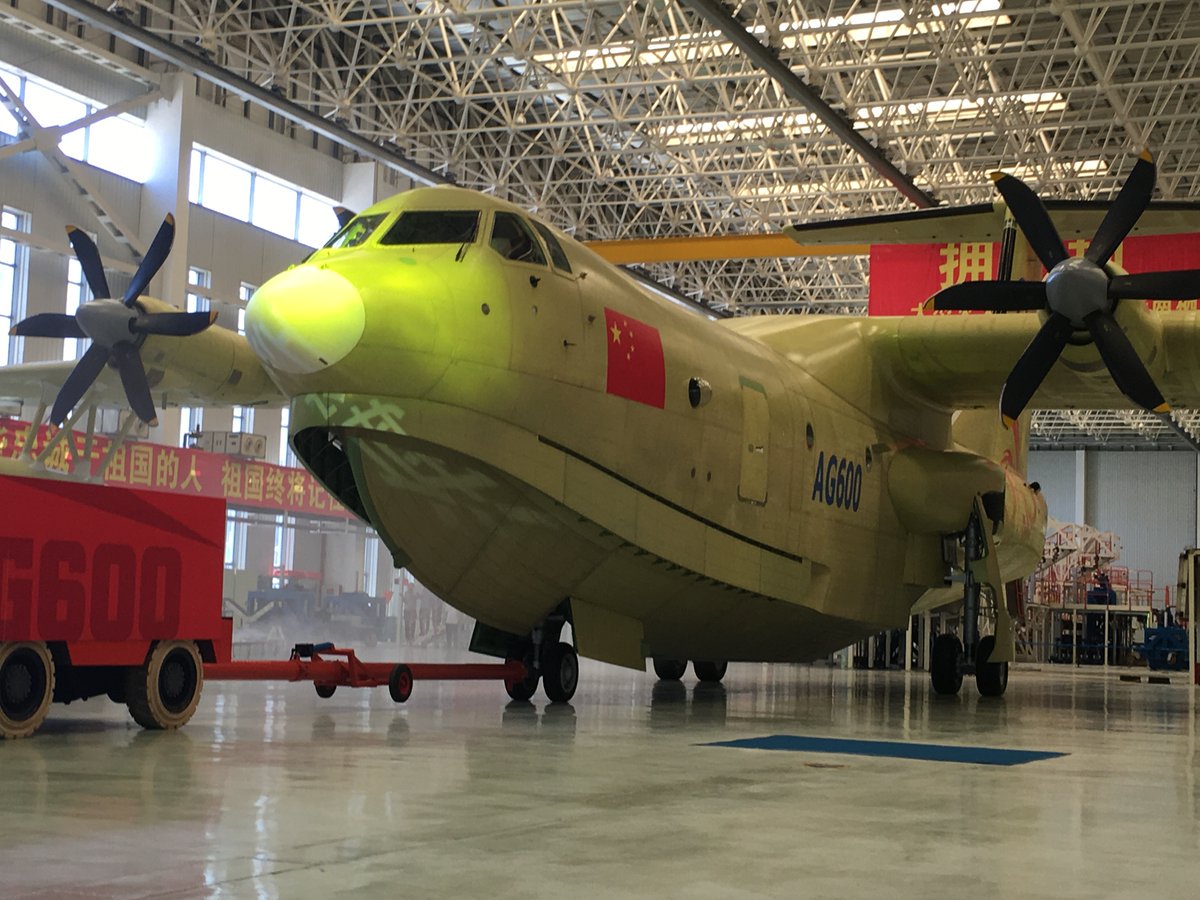
China unveils AG600 – Peoples Daily

AVIC TA-600, Flying boat
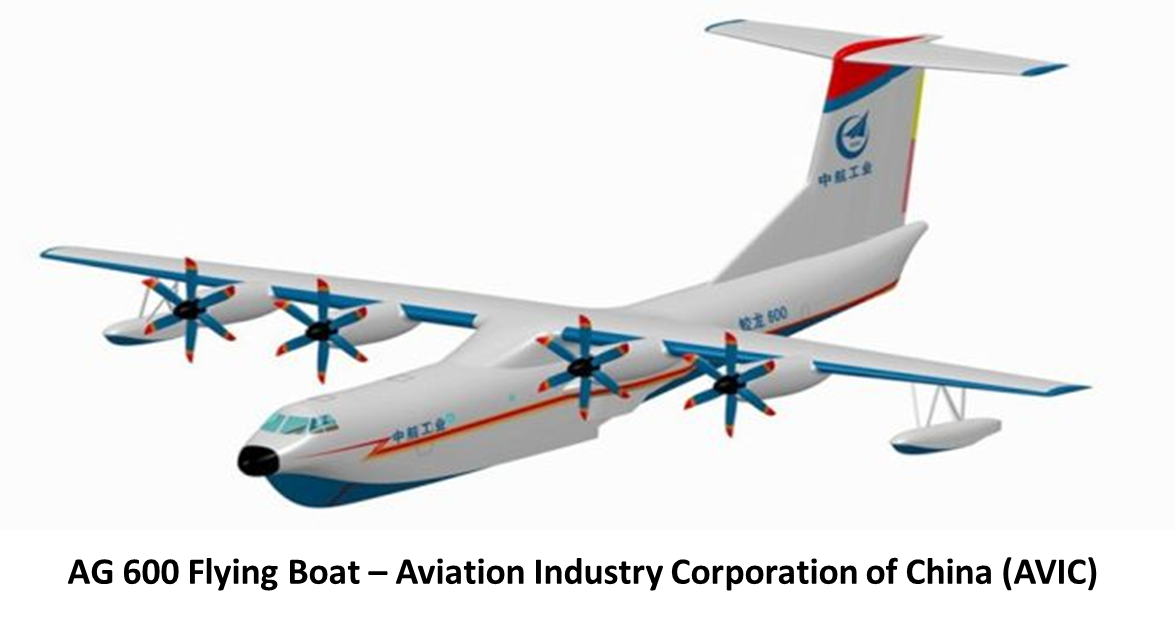
The AVIC TA-600, also known as AG-600, is a large amphibious flying boat that is being designed and built in China by the Aviation Industry Corporation of China.  
Top speed: 570 km/h, Wingspan: 40 m, Length: 40 m Maximum take-off weight 51.5 t.
Manufacturer: Aviation Industry Corporation of China Wikipedia
AG600 - AVIC
China has just rolled out the world’s largest amphibious plane, AVIC’s TA600 designated the AG600.  The AG600 is intended
to fight forest fires and be used for maritime search and rescue (SAR) operations. Being able to land on water means that they can quickly pump in tons of water to fight forest fires. For SAR purposes, the ability of large seaplanes like the TA-600 to land directly near survivors means more rapid rescue responses compared to slower helicopters, which will be attractive to Chinese maritime enforcement agencies. Perhaps most important to current regional tensions, the TA-600 may also offer a new scale and means to rapidly deploy or resupply any current or new remote island garrisons in the South China Sea. A number of islets and reefs are too small to have runways to accommodate conventional transport planes like the Y-8, but sited so as to have strategic value.
It is not as large as the eight-engined Howard Hughes H-4 “Spruce Goose”, the largest seaplane ever built, which weighed 180 tons in full and had a wingspan of 97 meters. But the Spruce Goose only flew a short distance on its maiden flight in 1947 and never lifted again.
But more to the point, the AG 600 can carry 50 passengers whether people being rescued, or troops on the move to a South China Sea island. Certainly the AG600 adds significant strategic capability to the Chinese claims in the South China Sea.
Nov. 2, 1947: The Hughes Aircraft H-4 Hercules "Spruce Goose" during short flight in the Long Beach-Los Angeles Harbor. This photo was published in the Nov. 3, 1947 LA Times.

Nov. 2, 1947: The Hughes Aircraft H-4 Hercules “Spruce Goose” during short flight in the Long Beach-Los Angeles Harbor. This photo was published in the Nov. 3, 1947 LA Times.


Hot air balloon does in 11 days and 6 hours what Solar Impulse 2 may do in 17 months

July 23, 2016

Solar Impulse 2 set off on its journey around the world on 9th March 2015. Tomorrow it sets off on its last leg from Cairo to Abu Dhabi and it should complete its journey in just under 17 months.

In the meantime, it is reported that Steve Fossett’s record of 13 days and 8 hours to circumnavigate the world in a hot air balloon, set in 2002 has been broken. A Russian balloonist has completed the journey in 11 days and 6 hours. Fedor Konyukhov has been using a Cameron balloon and set off on 12th July.

Flyer: Russian adventurer Fedor Konyukhov has set off on a solo round-the-world flight in a balloon, aiming to beat Steve Fossett’s 14-year-old record for the 33,000 kilometre trip.

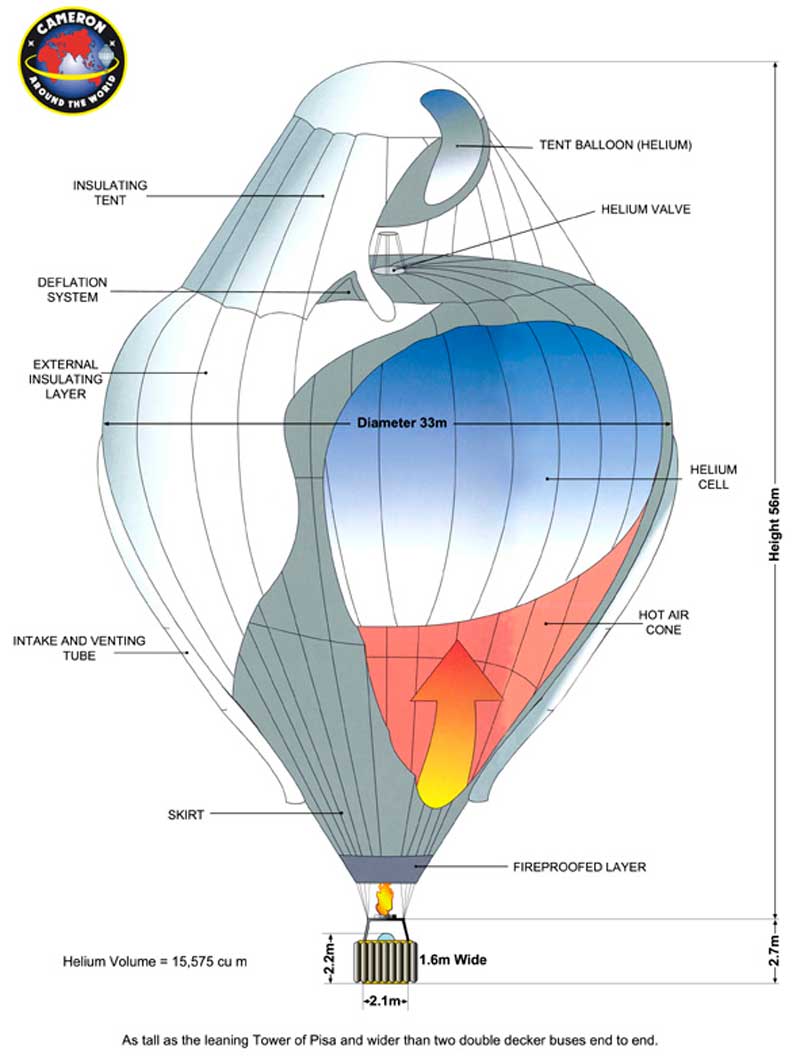
Konyukhov set off from Northam, Western Australia yesterday – the same place Steve Fossett set off from in July 2002. The record stands at 13 days 8 hours 33 minutes. Konyukhov is hoping to beat the record by a substantial amount using up-to-date technologies. He is, however, using a very similar balloon – a Roziere 550 built by British company Cameron Balloons.

“Nobody in the world makes better balloons that the Brits,” said Konyukhov, “so our balloon is being made by Cameron Balloons and it will fly on Russian helium.”

balloon australia

Fox News:

An official says a Russian balloonist has claimed a new 11-day round the world record. Support crew member Steve Griffin says Fedor Konyukhov’s balloon on Saturday passed directly over the airfield at the Australian town of Northam where he began his journey on July 12.

American Steve Fossett also started from Northam to set a record of 13 days and eight hours for his 33,000-kilometer (21,000-mile) journey in 2002.

Konyukhov has taken roughly 11 days and six hours. …… Konyukhov is expected to land later Saturday.

Cameron balloon

Structure of the Cameron balloon image via Flyer.co.uk


New exploration technique finds massive Helium reserve in Tanzania

June 28, 2016

The dwindling availability of helium and because it is so scarce in the earth’s atmosphere has led to conceptual plans – if not yet projects – for the extraction of Helium from the lunar topsoil.

Helium(4He) is the second most abundant element in the known Universe (after hydrogen) but only makes up 5.2 parts per million (ppm) of the Earth’s atmosphere. Helium-3 (3He) is an isotope of helium with two protons and one neutron. It is not radioactive and very rare on Earth (7 parts per trillion) but exists in recoverable concentrations in the lunar topsoil (in the top 2 -3 m of lunar regolith). It is even more abundant on the gas giants Jupiter, Saturn, Uranus and Neptune.

But a new exploration technique has been used to find old helium, trapped in ancient rocks underground, which after being released by volcanic activity, moves into shallower gas fields closer to the surface. Earth scientists from Oxford and Durham universities working together with Norwegian helium exploration company Helium One have found a vast reserve of Helium underground at the Rukwa Basin in the Tanzanian East African Rift Valley.

Helium One has applied for and secured 20 Prospecting Licences with a further two applications submitted. All licences are held 100% by the Company, have exclusive rights for helium and can be renewed for up to 9 years.

Within the portfolio are 3 distinct project areas, these are referred to as Rukwa, Eyasi and Balangida. All contain known helium occurrences with concentrations ranging between 2.5% – 10.5% helium and demonstrate the ideal geological conditions for large gas accumulations to be present.

Rukwa Basin – map Helium One

Helium One estimates a “Prospective Recoverable Helium Resource (P50) of 54.2 billion standard cubic feet. This resource occurs in 27 leads, defined by 2D seismic and is supported by data from two legacy exploration wells.”

ScienceAlert writes:

The find – estimated to be nearly seven times the total amount of helium consumed globally every year – will help allay concerns over Earth’s dwindling known supplies of the natural resource, which is crucial for things like MRI scanners, nuclear energy, and detecting industrial leaks.

…. Earth scientists from Oxford and Durham universities worked together with Norwegian helium exploration company Helium One in the Tanzanian East African Rift Valley. …. “We show that volcanoes in the Rift play an important role in the formation of viable helium reserves,” said researcher Diveena Danabalan from Durham University. “Volcanic activity likely provides the heat necessary to release the helium accumulated in ancient crustal rocks.”

But while the volcanoes help to free the trapped helium, depending on their proximity to the gas reserves, they can also end up wasting the precious element. …

…. “[I]ndependent experts have calculated a probable resource of 54 Billion Cubic Feet (BCf) (1.5 billion cubic metres) in just one part of the Rift Valley,” said Oxford University’s Chris Ballentine. “This is enough to fill over 1.2 million medical MRI scanners.”

“To put this discovery into perspective,” he added, “global consumption of helium is about 8 BCf per year (226 million cubic metres) and the United States Federal Helium Reserve, which is the world’s largest supplier, has a current reserve of just 24.2 BCf (685 million cubic metres). Total known reserves in the USA are around 153 BCf (4.3 billion cubic metres).”

But despite the massive potential of the new gas field, even more exciting is that the way we found it. Before now, helium had always been discovered accidentally, but with what the scientists now understand about volcanoes and helium geochemistry, researchers can now go looking for the gas, meaning Rift Valley could soon be followed by other massive hauls.

The team’s research is being presented this week at the Goldschmidt 2016 geochemistry conference in Yokohama, Japan.


Expanded Panama Canal opens today

June 26, 2016


The GT26 lives on with Ansaldo (for now)

June 21, 2016

I have previously expressed my doubts as to how long sequential combustion technology will continue for gas turbines after the technology has been transferred to Ansaldo Energia (as part of the acquisition of Alstom by GE).

Ansaldo has announced (in March this year) the sale of 2×2 GT26 machines as part of power islands for the Ibri and Sohar#3 combined cycle plants Oman.

Ansaldo Energia Switzerland has been awarded two contracts worth approximately 600 million Euros in total for the supply of major power plant equipment to two large IPP projects. The Ibri 1510 MW CCPP and Sohar III 1710 MW CCPP in the Sultanate of Oman are expected to be commissioned in early 2019. The Ibri and Sohar III CCPP IPP projects are developed by the sponsor consortium of Mitsui & Co. Ltd., ACWA – International Company for Water and Power Projects and DIDIC – Dhofar International Development and Investment Holding Company, following a simultaneous award of the two projects to the development consortium by Oman Power and Water Procurement Company SAOC of Oman earlier this month. The two power stations will operate and supply power under a PPA to the grid in the Sultanate of Oman. Ansaldo Energia will supply the main power train equipment components, including for each power plant, four of Ansaldo Energia’s newly acquired high-efficiency advanced GT26 class gas turbines, four heat recovery steam generators (HRSGs), two steam turbines and six turbo generators to SEPCOIII Electric Power Construction Cooperation of China (SEPCOIII), who will be responsible for engineering, procurement and construction (EPC) on a turnkey basis. Ansaldo Energia will also provide field services to SEPCOIII – under separate contracts – during the construction phase and long term maintenance services to the operator after commissioning. These projects mark Ansaldo Energia’s first success with its recently acquired and formerly Alstom owned GT26 gas turbine technology and will be one of the largest CCPP project awards in the Gulf region. Ansaldo Energia will certainly have a firm place the CCPP and IPP market where highly efficient, operationally flexible and reliable technology is required. With these two projects in execution in the region and Ansaldo Energia’s presence as a service provider in the Middle East area through Ansaldo Thomassen Gulf in Abu Dhabi, Ansaldo Energia’s position in the Gulf will be further strengthened. Juerg Schmidli, Ansaldo Energia Switzerland President, commented: “With its operating flexibility and high efficiency, the GT26 gas turbine will play a critical role in generating maximum project returns for our customer. This is the perfect start for our newly formed Company Ansaldo Energia Switzerland”.

I hope these machines from Baden/Birr will truly mean that Ansaldo has grabbed the sequential combustion ball and is running with it (and not that these are just machines already largely manufactured while under Alstom ownership and completed by Ansaldo).

What I still doubt is whether Ansaldo has the tradition, expertise and financial clout left to manage and implement any innovations. If they cannot, the Alstom version of the GT26 Ansaldo has acquired is already outdated. Especially since Siemens, GE and Mitsubishi have H-class machines in operation and are already moving on to H+ engines. GE’s HA-class machine (9HA) is operational in France for EdeF (62.22% claimed efficiency). The GT26 is still probably only at the G+ level and Ansaldo will need to get beyond the H-class efficiency level to be a realistic fourth player. If not the GT26 will be consigned – at best – to some niche markets. The 60Hz (including US) market and the GT24 are not available to Ansaldo and that does not help in the experience stakes.

How long it may take to get a commercial version of the next generation GT36 to market, or whether it will ever see the light of day, is an open question. I have a soft spot for sequential combustion and would like to see it continue. But I will stay pessimistic and remain doubtful that Ansaldo Energia has the wherewithal to remain a serious player with this technology.

And hope to be proved wrong.

Alstom GT26

Alstom GT26


The “design life” of humans

March 25, 2016

The “design life” of a component or system is generally a boundary condition before starting to design. It is an inherent part of the design. The human body can be taken to be a system based on the organs as major components and a myriad of other components. Our genes are the design for our bodies and they exhibit a “design life”. Whatever we may assign as the purpose of our DNA, our bodies exhibit a design life of between 50 and 60 years. 

In engineering, when an artefact or component or system is created, it is quite usual to have a “design life” as one of the key boundary conditions for designing the artefact. The artefact-lifetime to be designed for determines the choice of materials for strength and resistance to corrosion and erosion, and for their cycling properties and their resistance to fatigue and creep. The lifetime to be designed for leads to a choice for the level of redundancies to be included, the ease of maintenance to be allowed for and a choice of a maintenance strategy which includes a replacement “philosophy”. The “design life” is then usually defined as the time for which the artefact will be fully functional and can often be the lifetime guaranteed by the manufacturer. The designer makes his choices based on the probability of failures. For example the quoted design-life may be based on the time when the probability of failure or loss of functionality is – say – less than 10% or 1% or 0.1%.

The concept of “design-life” is different to the concept of “obsolescence” or the “mean time between failures” (MTBF). Obsolescence, whether introduced intentionally or not, is the time when when the defined functionality is no longer relevant. It could be intentionally “built-in” as a marketing strategy or it may result from the appearance of new technologies. The MTBF is a measure of the time between random – not due to wear – failures of a particular component. The MTBF of single components will generally be orders of magnitude longer than the design-life of that component.

Most components or systems can – with proper maintenance – be used with full functionality long beyond their quoted design life. A power plant may have a design life of 25 years, guarantees for only 2 years but may be used for 50 or 60 years. A digital camera may have a design life of 5 years but could be obsolete after just three. A Swatch may have a design-life of 5 years and materials to suit, whereas a Rolex may use materials and manufacturing quality to be able to come with a lifetime guarantee (with suitable caveats for the user’s negligence). When analysing reliability, the life of components and systems is often illustrated by the generic “bathtub curve”, where the total failure rate is given by the addition of random failures, failures due to “infancy problems” and failures due to wear. Infancy issues are those which are caused by quality of materials, manufacturing tolerances, manufacturing processes and the like.

Modes of failure

On the bathtub curve the design life used to create a design will always fall within the section where the total failure rate is at its lowest – that is after the initial period where “teething” and other infancy problems arise and before the sharp increase in failure due to wear. Generally, to change the design life the basic design itself must be changed.

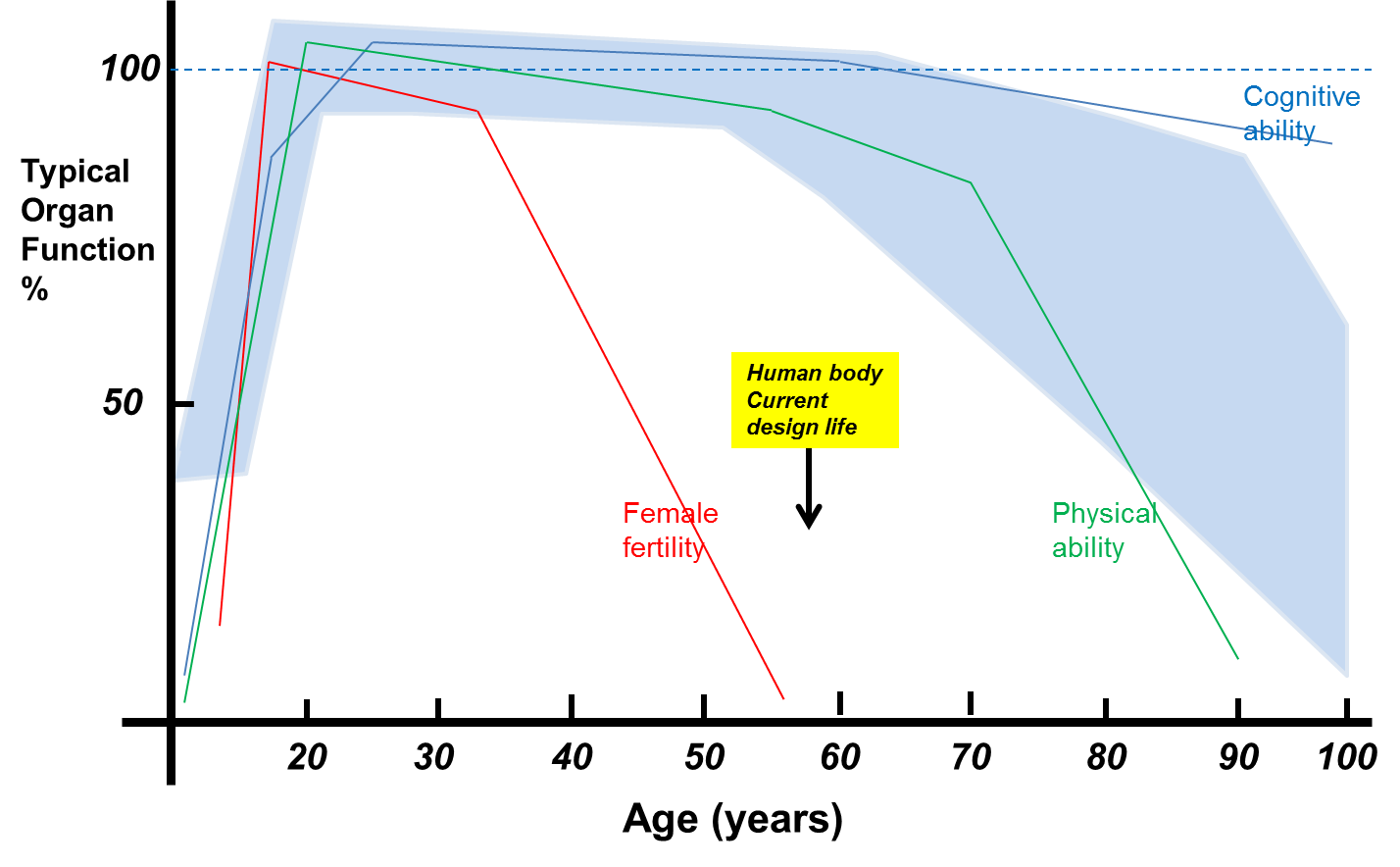
Consider the human body as a system where the organs are the key components making up the system. The functionality of human organs and of different human functional abilities also exhibit a form very similar to a reversed “bathtub” curve. Failure of a human body occurs when one or more of the functionalities falls below some threshold minimum. In the diagram below, the shaded area represents the behaviour of most organs with age. The lines represent the variation of some of the complex human functional abilities with age.

Functionality of organs with age

Functionality of organs with age

The reverse bathtub curve suggests that the human body has a design life of between 50 and 60 years.

“Infancy problems” in this context include birth and genetic defects which can influence the development and failure rate of organs. “Wear” would be the physical and mental wear and tear but would now also include the effects of aging which curtail the replacement of cells. Average, global, life expectancy is now around 80 years and the longest verified age is about 122 years. Average life expectancy has increased over the last 200 years at the rate of about 3 months every year. Over the next 100 years this may level off to perhaps add another 20 years to life expectancy. Already in 2012 the UN estimated that there were more than 300,000 centenarians alive. By 2100 perhaps global life expectancy would have reached 100 years and the maximum age attained may then be around 140-150 years.

Using the engineering analogy, the main advances in life expectancy have so far come due to improving maintenance and replacement processes but have not improved on the “basic design”. The “improved quality” at birth and in infancy and medical advances have meant that “maintenance” processes have improved drastically. Modern health care is to a large extent the application of “preventive maintenance”.

But, the the basic design is unchanged. The materials used in making up the human body have not changed but “maintenance and repair” strategies have improved out of all recognition. The life of our various organs have not changed inherently, except as a result of the much improved maintenance regime. With no change in basic design, the design life has not changed either. The increasing lifetime of the system (the body) is now beginning to approach the lifetime of the components (the organs) it is made up of.

Currently the design life of a human body could be said to be about 50-60 years. Studies suggest that though we live longer we also have longer periods at the end of our lives when our functionality is severely impaired. The ” basic design” has not changed and the “design life” is not increasing. Life spans of 200 years will not be possible without some change in the “basic design”. For our design life to change it will need advances which allow our cells to keep replicating without the aging effects of the shortening of the telomeres. When that happens (not if), then we would effectively have altered the “basic design” of the human body and its design life.


Remember Solar Impulse 2? Walking around the world would be faster

January 18, 2016

Remember all the hype last year?

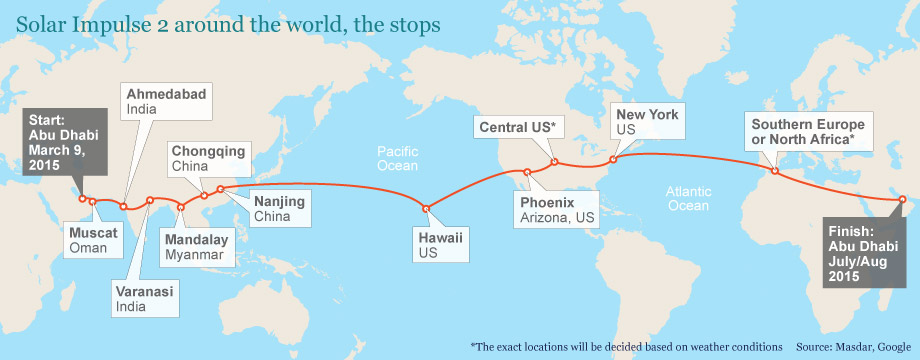
The journey around the world started in March 2015 and was supposed to be completed in August 2015.

solar impulse 2 planned track

solar impulse 2 planned track

Leaving from Abu Dhabi they reached Hawaii in mid-July. But their batteries overheated and they are now stuck there till April 2016.  The flight is more hype than substance though there is some clever engineering and pilot endurance involved. It is supposed to be a flight which uses no fuel though reports that the batteries (when working) were recharged at every stop using grid power persist. What is not appreciated is the enormous support entourage that travels with Solar Impulse 2. Tony Thomas has an article about the “stranded monster” in The Spectator, and he points out:

To keep this gossamer confection airborne, an Ilyushin 76 strategic airlifter flies ahead with a blow-up hangar and all the high-tech servicing gear. Aviation buffs call the airlifter a ‘bad-ass’, not just because of its ugly nose and four droopy jets, but because its takeoffs are real Russian screamers. Once aloft, it burns eight tons of CO2-spewing avgas per hour.

This behemoth is accompanied by a   twin-turboprop ATR72 which can carry a support crew of up to 60, apart from the dozens left at Monaco mission control. The ATR burns a more modest tonne of fuel per 90 minutes.

Not quite ‘without using a drop of fuel’. It is “green delusionism” as Tony Thomas names it.

What is also worth noting is

This futuristic plane cruises at about the top speed of a postie’s bike, but can sometimes accelerate away to 90km/h.

Charitably assuming the plane does make it round the world in 18 months, that compares with other round-the-worlders such as:

  •  The Graf Zeppelin in 21 days in 1929.
  • Wiley Post in his Winnie Mae, in nine days in 1933
  • The Rutan Voyager, non-stop non-refuelled in nine days in 1986
  • Bertrand Piccard and Brian Jones by balloon in 20 days in 1999.
  • Solo yachter Francis Joyon, in 58 days in 2008, using that other clean fuel, wind.

Someone could walk the plane’s route (somehow) in two years, not much longer than the flight time.

The flight and the engineering involved for Solar Impulse 2 are not unimpressive. But there is not very much which demonstrates anything which is new about solar energy. The entire enterprise is really about battery technology rather than solar energy. And what it does show is that battery technology has still quite some way to go.

I do dislike the ridiculous hype and the manner in which the “politically correct” and the fame-seekers jump on board.


GE gets approval from the EC and Ansaldo gets Alstom GT technology

September 8, 2015

UPDATE:

More details are now emerging of what exactly will go to Ansaldo. It seems that Ansaldo will get PSM, technology for the GT26 and the GT36 (which does not exist yet) including the test facilities at Birr and the LTSA’s for 34 GT26s sold by Alstom. It is good that it is settled but the European Commission has not – in my opinion – got it quite right.

  1. The technology seems to be restricted to 50Hz technology (after all, all of Europe is 50Hz). So a current GT26 and its potential upgrades should – theoretically – be available from Ansaldo but not the GT24 (60 Hz). It is the US market (60 Hz) which has access to cheap gas and the 50Hz market will take a while and will be dependant on fracking taking off in Europe. Ansaldo will probably need to take all liabilities to get their first 2 or 3 GT26 engines placed. And even then finding a suitable utility customer to host the machines will pose a challenge.
  2. GE will face no competition in the US from an Ansaldo GT24 and probably Ansaldo is not permitted to enter 60 Hz markets except with engines they develop themselves.
  3. The development of the GT36 is a long way from being commercialised and the assumption by the EC that this development will be completed by Ansaldo is almost “pie in the sky”. Of course it is theoretically possible! A 60Hz GT34 is even less likely.
  4. The EC’s assumption that PSM will be able to service engines like the GE 9FA under Ansaldo ownership is flawed. It is one thing to have an Alstom owned PSM servicing such engines considering that Alstom was the main source of GE 9FA until 2000 (when they acquired the ABB gas turbine business), and quite another to have an Ansaldo owned PSM doing such service.

I suspect that GE and Alstom have talked down the difficulties that Ansaldo will face and the EC have bought the sales pitch. Or it could be that the EC does know that this commercialisation of the GT36 (and maybe even the production of the GT26) by Ansaldo will likely not happen, but it gives them a face saving way of approving the GE bid.

Money talks. And we need to bear in mind that GE pays only €300 million less which must now presumably come to Alstom from Ansaldo. Just €300 million as the price for the ongoing service business and the assets at the R &D facilities at Birr does not leave much over actually for the technology that has been purchased.

But

  1. does Ansaldo have the additional €500+ million that they will need to get a GT26 into production?
  2. And do they have another €2 billion (at least), along with the will and the capability, to bring a commercial GT36 into being??

PowerMag:

The commission’s in-depth review, which focused on markets for the sale and servicing of heavy-duty gas turbines operating at 50 Hz, revealed that a GE-Alstom merged entity would have accounted for more than 50% of the European Economic Area market.

It was also specifically concerned that the merger would have risked eliminating an important innovator. “The transaction as notified would have reduced customer choice, R&D [research and development] and innovation, with serious risks that certain Alstom heavy duty gas turbine models would be discontinued and that the newly developed and most advanced model (GT 36) would not be commercialised. This was of concern for many market participants, including major European power utilities,” the commission said.

The merger was approved on the condition that the parties offered to divest Alstom’s GT 26 and GT 36 turbine technology, existing upgrades and pipeline technology for future upgrades, a large number of Alstom R&D engineers, and two test facilities for the GT 26 and GT 36 turbine models in Birr, Switzerland.

The parties will also need to divest long-term servicing agreements for 34 GT 26 turbines recently sold by Alstom, and Alstom’s Power System Manufacturing (PSM) subsidiary. The commission was concerned that if GE absorbed PSM, it would have eliminated competition for the servicing of GE’s mature heavy-duty gas turbines (like its 9FA model) that are installed in existing plants. “As GE is the dominant player in this market and PSM its most significant potential competitor, this would have created a risk of higher prices and less innovation,” it said.

34 gas turbines is a small part of Alstom’s fleet but it may be enough to give Ansaldo a fighting chance of building up experience over – say – 5 years or so.

I remain of the opinion that this is a good deal for Alstom and GE. However, I also remain of the opinion that some 8,000 jobs of those being transferred from Alstom to GE or to Ansaldo will be at risk. Ansaldo surely has a chance for becoming one of the “big 4”. But they may have difficulty chewing or swallowing what they have just bitten off.

Another thought that occurs to me is that the EC process is itself flawed. The solution (divestment to Ansaldo), which has delayed the deal by a year, smacks more of ego and politics rather than protection of competition. The actual protection of competition achieved is minimal.

WSJ: ……. GE already manufactures gas turbines of corresponding size to the two Alstom models, and the company says it will retain licenses that will enable it to compete for business servicing turbines made by other manufacturers—an opportunity for future earnings growth.

The U.S. company will also divest the long-term servicing contracts for 34 turbines that have already been installed by Alstom. GE has said that Alstom’s servicing contracts were a key attraction of the deal, but a person close to the deal said the divested contracts amounted to only 4% of Alstom’s total installed base.

“I am glad that we can approve this transaction, which shows that Europe is open for business and that Europe-based technology can thrive and attract foreign investment,” Ms. Vestager said.


Well, the European Commission has given GE approval for the acquisition of Alstom’s power and grid businesses. But Ansaldo will now get Alstom’s large GT technology (it’s not clear to what extent), the testing facilities in Birr and some substantial service business. Whether Ansaldo actually gets the GT24 and GT 26 engines or just technology is not clear yet.

Previous posts: https://ktwop.com/tag/alstom/

Bloomberg:

As part of GE’s offer, Ansaldo will acquire Alstom’s technology for large and very large gas turbines. Alstom will also cede two test facilities for these turbine models in Birr, Switzerland, the EU said.

“Ansaldo will have a true fighting chance” of competing in the European market, Margrethe Vestager, the EU’s competition commissioner, told reporters in Strasbourg, France.

The Italian firm should gain a foothold in the maintenance business by taking over long-term contracts Alstom holds to service 34 previously-sold gas turbines, the commission said. Ansaldo will also acquire Alstom’s Power Systems Manufacturing unit which can service gas turbines of different makes, the regulator said.

With PSM going to Ansaldo, Shanghai (via PSM) gets a foothold in the US for 3rd party engine service – for whatever that may be worth. But I am not very hopeful. As an owner, I would not be very keen on asking an Ansaldo owned PSM to service a Siemens or a GE engine or even an old Westinghouse engine.

Good luck to Ansaldo anyway.

It will be interesting to see if Shanghai Electric can provide sufficient influence to make this work. Ansaldo on its own would have very little chance to make it, I think. It will still take them the best part of a decade and by then GE, Siemens and Mitsubishi would have moved on. I think the EC’s competition commissioner is fooling herself more than a little when she states that “Ansaldo will have a true fighting chance”. She is being far too optimistic, but maybe Shanghai can make the difference.

The Ec’s conditions does not have a great impact on the jobs that will be lost. This will stay at around 8,000 I think for GE. Of the jobs shifted to Ansaldo, I am not very optimistic.

A pity, because I think this marks the end of sequential combustion with a viable player.

I wouldn’t mind being proved wrong – but the probability is rather low.

But it’s good news for both Alstom and GE. For Ansaldo, it may be too much of a mouthful.