Archive for September, 2015

Another case of promoting a drug with “incorrect reporting and distorted data”

September 17, 2015

There is a Catch 22 situation here.

Clinical trials for new drugs are all funded – of necessity – by the pharmaceutical companies. It is only to be expected that negative results are downplayed and positive results are highlighted. Positive results get published. Negative results for drugs not yet approved are rarely published. Those conducting clinical trials are looking to enhance their lists of publications. Furthermore there is an incentive to invent “medical conditions” which can be “treated” by otherwise useless – or even damaging – compounds. My perception is that the pharmaceutical companies sometimes discover compounds unintentionally or by accident or as a compound which fails its originally intended purpose. Then – by defining (or inventing) new medical disabilities – they try and find a use for these compounds.

So how many of the new, psychiatric drugs are really of no benefit? And how many of the supposed “illnesses” – which can only be diagnosed by subjective methods – and which these new drugs are supposed to to treat – are really medical conditions?

A University of Adelaide led study has found that a psychiatric drug – paroxetine – which was claimed to be a safe and effective treatment for depression in adolescents is actually ineffective and associated with serious side effects is published today in the BMJ.

Joanna Le Noury, John M Nardo, David Healy, Jon Jureidini, Melissa Raven, Catalin Tufanaru, Elia Abi-Jaoude. Restoring Study 329: efficacy and harms of paroxetine and imipramine in treatment of major depression in adolescence. BMJ, 2015 DOI: 10.1136/bmj.h4320

there is also an editorial in the BMJ:

No correction, no retraction, no apology, no comment: paroxetine trial reanalysis raises questions about institutional responsibility

UofAdelaide press releaseProfessor Jon Jureidini, from the University of Adelaide’s newly created Critical and Ethical Mental Health Research Group (CEMH) at the Robinson Research Institute, led a team of international researchers who re-examined Study 329, a randomised controlled trial which evaluated the efficacy and safety of paroxetine (Aropax, Paxil, Seroxat) compared with a placebo for adolescents diagnosed with major depression.

Study 329, which was funded by SmithKline Beecham (now GlaxoSmithKline), was reported in 2001 as having found that paroxetine was effective and safe for depression in adolescents. However, Professor Jureidini’s reanalysis showed no advantages associated with taking paroxetine and demonstrated worrying adverse effects.

“Although concerns had already been raised about Study 329, and the way it was reported, the data was not previously made available so researchers and clinicians weren’t able to identify all of the errors in the published report,” says Professor Jureidini. “It wasn’t until the data was made available for re-examination that it became apparent that paroxetine was linked to serious adverse reactions, with 11 of the patients taking paroxetine engaging in suicidal or self-harming behaviours compared to only one person in the group of patients who took the placebo,” he says. “Our study also revealed that paroxetine was no more effective at relieving the symptoms of depression than a placebo.”  ……

……. “Study 329 was one of the trials identified as in need of restoration, and because the original funder was not interested in revisiting the trial, our research group took on the task. 
“Our reanalysis of Study 329 came to very different conclusions to those in the original paper,” he says. “We also learnt a lot about incorrect reporting and the considerable fall out that can be associated with distorted data.”

If all doctors treating patients were truly independent the system would be self-correcting. Overhyped and unnecessary drugs would wither away. But many doctors have a vested interest in the continued use of the drugs they prescribe. (And note that even some members of the WHO panels who recommend mass vaccination programs have been found to have vested interests).

As the editorial in the BMJ writes:

But in the case of Study 329 no epistemological acrobatics would seem able to reconcile the differences between the 2001 JAACAP paper and the RIAT republication. They cannot both be right. …

Such stark differences between the original paper and the rewrite are bound to put particular pressure on Andrés Martin, Yale University professor and current editor in chief of JAACAP. Martin has been under pressure to retract the paper for years, including from within his own society. Last October, Martin was compelled to address the academy’s assembly about Study 329. According to the minutes, members heard how Martin had investigated the matter thoroughly by consultation with the authors, the Committee on Publication Ethics (COPE), clinical experts, “a whole range of attorneys, and more.” Martin’s assessment, completed in July 2010, concluded that no further action was necessary. A follow-up inquiry, again by Martin, in 2012, after GSK was fined $3bn, similarly concluded “no basis found for editorial action against the article.” ……

It has proved no easier to get the professional society to talk. Several of the authors of the JAACAP paper are members of the American Academy of Child and Adolescent Psychiatry (AACAP). The BMJ sent four requests for comment to the academy’s president, Paramjit Joshi, and past president Martin Drell, but received no response.

Scientists behaving badly and psychiatrists behaving very badly. A can of worms no doubt.

The economy is to a car as interest rates are to the suspension

September 16, 2015

Cutting interest rates is the traditional method of fighting deflation and stimulating an economy. Just as increasing interest rates was the way to go with overheated economies with high inflation. But as Japan found out, and now much of the industrialised world is finding out, when interest rates are already very low, they are no longer a tool to fight deflation with. In fact going to even negative interest rates dampens all economic activity.

The physical analogy I like is of the economy being a vehicle on tensioned springs. I prefer the suspension analogy to that of interest rates acting as either accelerator or brake. As long as the springs are in tension the suspension can be tightened (hard springs) or loosened (soft springs) to suit the bumps and type of bumps on the road. Take this simple description from a suspension tuning blog:

The purpose of the springs are to control wheel movement and keep the tyre in contact with the road over bumps and undulations. Stiffening the springs front and rear will reduce body roll and make handling more responsive, but cause a loss of traction over bumpy surfaces. Likewise, softening all of the springs will give more grip on bumpy tracks, but increase roll and reduce responsiveness.

Paraphrasing in terms of the economy I get:

The purpose of the interest rate is to control movement in the economy and keep the entire economy steady despite the bumps and undulations in different sectors. Increasing interest rates will restrict overspeeding in economies growing fast, but will cause a loss of control when growth is low or sectors are growing at uneven rates. Likewise, reducing interest rates will give more traction in low speed economies to sectors with low growth, but can give rise to uncontrolled expansion (bubbles) in other sectors.

Of course, it is only an analogy, but taking it just a little further, the low-interest rate regimes that are prevailing are akin to having no tension at all in the suspension. Trying to tune a floppy, tension-less suspension on a very bumpy road is futile. Taking interest rates negative is equally futile. My take-away is that the floppy springs have to be changed-out or you have to go off-road or get onto another road. Right now the springs are broken – not just floppy. We are in interest-rate territory where they no longer function. If this analogy holds, then it is not messing about with very low interest rates which can help. It needs a fundamental change in the way taxes are raised to change the economic road being travelled.

So my recipe for stimulating economies now stuck in the doldrums, would leave interest rates alone for the time being, but provide tax-cuts or tax-credits to real activity that increased turnover or jobs – but only after the increased turnover or jobs had been delivered. The benefits should be for growth delivered. Increasing profit while turnover is reducing should be a sin. So should be increasing spending when there is no growth. Changes to public expenditure should then be made contingent upon – but lagging – actual growth. Wages and salaries ought then to be in line with growth achieved and not with inflation. The same job in a successful business should pay more than in a failing business. How not?

Nothing is as simple as it seems but the idea that public expenditure can lead growth is totally flawed. Equally, just cutting public expenditure (austerity), without also providing for economic stimulation – in the form of judicious tax benefits (after the event), is a cul-de-sac. Going back to a horse-and-cart might sound idyllic but resolves nothing and only increases misery.

Don’t mess with negative interest rates. Instead, stimulate jobs. Cut the cost and long-term liabilities of employing people and more people will inevitably be employed. A too high entry wage and long-term employment commitments when the future is uncertain, are the biggest barriers to creating new jobs. Profits are for the shareholders but the turnover is for the economy. Focus then on turnover as the deliverable from any business to the economy at large and provide real tax benefits for generating such turnover.  Cut the crippling costs for establishing or expanding turnover and both growth and employment will benefit.


There was no biodiversity to begin with

September 15, 2015

I was listening to some conservationists on the radio discussing the rate of loss of species and how this was a catastrophe in the making for biodiversity. It was an unsatisfactory talk mainly because they all made what I thought were quite unjustified assumptions. It was more about political advocacy rather than any attempt to argue based on evidence.

The “politically correct” view is that biodiversity (measured as the number of species in existence) is a “good thing” and that more species is “good” and fewer species is “bad”. Saving endangered species is also a “good” thing. That species are becoming extinct at an alarming rate means catastrophically that a 6th mass extinction is nigh. But I find this viewpoint lacking in substance. We have more species existing today than ever before. Probably too many. Mass extinctions have helped “clean out” the rubbish that evolution throws up. Extinction rates may be high but that is hardly surprising when the number of species is so high. A 6th mass extinction may, in fact, be necessary. More species and more biodiversity is not always a good thing.

The fossil record shows that biodiversity in the world has been increasing dramatically for 200 million years and is likely to continue. The two mass extinctions in that period (at 201 million and 66 million years ago) slowed the trend only temporarily. Genera are the next taxonomic level up from species and are easier to detect in fossils. The Phanerozoic is the 540-million-year period in which animal life has proliferated. Chart created by and courtesy of University of Chicago paleontologists J. John Sepkoski, Jr. and David M. Raup.

The fossil record shows that biodiversity in the world has been increasing dramatically for 200 million years and is likely to continue. The two mass extinctions in that period (at 201 million and 66 million years ago) slowed the trend only temporarily. Genera are the next taxonomic level up from species and are easier to detect in fossils. The Phanerozoic is the 540-million-year period in which animal life has proliferated. Chart created by and courtesy of University of Chicago paleontologists J. John Sepkoski, Jr. and David M. Raup.

An endangered species is one whose population is low and dangerously in decline. If numbers of individuals of a species are that low, then that species has already become irrelevant in its contribution to the functioning of the biosphere. It may well be a matter of regret, just as there is always regret when a language becomes extinct from disuse. But apart from providing entertainment value for humans, the saving of a few members of a doomed species provides no real benefit for the functioning of the biosphere. I would be very sorry to see tigers becoming extinct, but the reality is that their numbers are so low that they play no significant part in the sustenance of the biosphere. The role of a predator species is primarily to control the population of its prey. From a biodiversity point of view they are already irrelevant. Saving the tiger has nothing to do with maintaining a healthy biodiversity and everything to do with human entertainment (including that of the conservationists) and “feeling good”.

(I am of the opinion that helping an endangered species to survive can be desirable but then “conservation” should be based on helping that species to adapt genetically rather than to freeze it into an artificial habitat – zoos and reserves – to which it is not suited).

At one time there was just a single species that all life derives from – perhaps even just one living cell. (And even for creationists, all the diversity of humankind has derived from a single mating pair – and the raging incest that that implies). There was no biodiversity to begin with. Genetic variation with each generation and genetic mutations then caused new species to come into being, first to fill up the spaces that the prevailing environment allowed and then to adapt to changing environments. If each generation of the first species had bred true there would, of course, be no biodiversity. Genetic variation and empty space in the environment led to growth of species. Overcrowding of a given space or drastic environment change cause the decline and extinction of species. The prevailing level of “biodiversity” at any time is not then some target to be achieved, but just the current balance between the birth and death of species.

It seems almost self-evident to me that, for any given environment there must be an optimum number of species, with particular combinations of characteristics, which allow the ecosystem or biosphere to be in a self-sustaining equilibrium (not growing or declining but self-sustaining). This optimum will vary depending upon the characteristics and interactions between the particular species existing and the available space in the prevailing environment. Then, having fewer than the optimum number of species in that environment would mean that all the complex interdependent, interactions between species that seem to be necessary for sustaining each of the participating species would not be fully developed. I say “seem” because it is not certain that all interdependencies are necessarily of benefit to individual species. “It is the entire ecosystem which benefits” I hear some say, but even that is more an assumption than a conclusion.

But what would happen in such a situation?  If the interactions are truly necessary, then some of these sub-optimal number of species should logically be on the way to stagnation or to extinction. But it is not certain that some new equilibrium will not be reached. One species too few for a given environmental space will only lead to the space being occupied by an existing or a new species. One species too many for a given space will lead to the extinction of a redundant species or of a number of species existing under genetic stress, until genetic variation reduced the stress. The interactions between species in any environment are not planned in advance. They are just those that happen to prevail and survive because they succeed in the environmental space available. Too few species will give an increase of species until overcrowding reduces the number of species. A rapid change of environment and a reduction of the space available must give a decrease in the number of species making up the optimum for a self-sustaining biosphere.

Generally species of plant life have increased in the wake of human habitations.

For example, more than 4,000 plant species introduced into North America during the past 400 years grow naturally here and now constitute nearly 20 percent of the continent’s vascular plant biodiversity.

But then we try to eradicate “invasive” species even though that represents a decrease in biodiversity. Clearly some biodiversity “is not good”. We hunt down successful species as pests when they reach and thrive in new or empty environmental spaces. We protect and support unsuccessful (failed) species in the name of conservation and biodiversity. We have no qualms in trying to eradicate insects, microbes and bacteria which cause human disease even if biodiversity is consequently reduced. From the perspective of the biodiversity of the genetic pool, losing a species of some unknown bacteria may be just as significant as the extinction of the elephant.

The rate of growth of the human species has meant that other species have not been able to adapt fast enough – genetically – to their loss of habitat or the increase of competition. The environmental space available to them has drastically reduced. But that is reality. Creating artificially unsustainable habitats will not change that. The optimum level of biodiversity for the environmental space today is different to that of 100 years ago. Biodiversity cannot be considered independently of the environmental space available. Conservationism which seeks to maintain the wrong level of biodiversity for the available space seems to me to be both futile and stupid. Especially when conservationism has no idea what the “optimum” level of biodiversity is and whether the current level lies above or below the optimum level.


The origins of base 60

September 14, 2015

I like 60. Equilaterals. Hexagons. Easy to divide by almost anything. Simple integers for halves, quarters, thirds, fifths, sixths, tenths, 12ths, 15ths and 30ths. 3600. 60Hz. Proportions pleasing to the eye. Recurring patterns. Harmonic. Harmony.

The origins of the use of base 60 are lost in the ancient past. By the time the Sumerians used it about 2,500 years ago it was already well established and continued through the Babylonians. But the origin lies much earlier.

hand of 5I speculate that counting – in any form more complex than “one, two, many….” – probably goes back around 50,000 years. I have little doubt that the fingers of one hand were the first counting aids that were ever used, and that the base 10 given by two hands came to dominate. Why then would the base 60 even come into being?

The answer, I think, still lies in one hand. Hunter-gatherers when required to count would prefer to use only one hand and they must – quite early on and quite often – have had the need for counting to numbers greater than five. And of course using the thumb as pointer one gets to 12 by reckoning up the 3 bones on each of the other 4 fingers.

a hand of 12 - image sweetscience

a hand of 12 – image sweetscience

My great-grandmother used to count this way when checking the numbers of vegetables (onions, bananas, aubergines) bought by her maid at market. Counting up to 12 usually sufficed for this. When I was a little older, I remember my grandmother using both hands to check off bags of rice brought in from the fields – and of course with two hands she could get to 144. The counting of 12s most likely developed in parallel with counting in base 10 (5,10, 50, 100). The advantageous properties of 12 as a number were fortuitous rather than by intention. But certainly the advantages helped in the persistence of using 12 as a base. And so we still have a dozen (12) and a gross (12×12) and even a great gross (12x12x12) being used today. Possibly different groups of ancient man used one or other of the systems predominantly. But as groups met and mixed and warred or traded with each other the systems coalesced.

hands for 60

And then 60 becomes inevitable. Your hand of 5, with my hand of 12, gives the 60 which also persists into the present.  (There is one theory that 60 developed as 3 x 20, but I think finger counting and the 5 x 12 it leads to is far more compelling). But it is also fairly obvious that the use of 12 must be prevalent first before the 60 can appear. Though the use of 60 seconds and 60 minutes are all pervasive, it is worth noting that they can only come after each day and each night is divided into 12 hours.

While the use of base 10 and 12 probably came first with the need for counting generally and then for trade purposes (animals, skins, weapons, tools…..), the 12 and the 60 came together to dominate the measuring and reckoning of time. Twelve months to a year with 30 days to a month. Twelve hours to a day or a night and 60 parts to the hour and 60 parts to those minutes. There must have been a connection – in time as well as in the concepts of cycles – between the “invention” of the calendar and the geometrical properties of the circle. The number 12 has great significance in Hinduism, in Judaism, in Christianity and in Islam. The 12 Adityas, the 12 tribes of Israel, the 12 days of Christmas, the 12 Imams are just examples. My theory is that simple sun and moon-based religions gave way to more complex religions only after symbols and writing appeared and gave rise to symbolism.

Trying to construct a time-line is just speculation. But one nice thing about speculation is that the constraints of known facts are very loose and permit any story which fits. So I put the advent of numbers and counting at around 50,000 years ago first with base 10 and later with base 12. The combination of base 10 with base 12, I put at around 20,000 years ago when agricultural settlements were just beginning. The use of 60 must then coincide with the first structured, astronomical observations after the advent of writing and after the establishment of permanent, settlements. It is permanent settlements. I think, which allowed regular observations of cycles, which allowed specialisations and the development of symbols and religion and the privileged priesthood. That probably puts us at about 8 -10,000 years ago, as agriculture was also taking off, probably somewhere in the fertile crescent.

Wikipedia: The Egyptians since 2000 BC subdivided daytime and nighttime into twelve hours each, hence the seasonal variation of the length of their hours.

The Hellenistic astronomers Hipparchus (c. 150 BC) and Ptolemy (c. AD 150) subdivided the day into sixty parts (the sexagesimal system). They also used a mean hour(124 day); simple fractions of an hour (14, 23, etc.); and time-degrees (1360 day, equivalent to four modern minutes).

The Babylonians after 300 BC also subdivided the day using the sexagesimal system, and divided each subsequent subdivision by sixty: that is, by 160, by 160 of that, by 160of that, etc., to at least six places after the sexagesimal point – a precision equivalent to better than 2 microseconds. The Babylonians did not use the hour, but did use a double-hour lasting 120 modern minutes, a time-degree lasting four modern minutes, and a barleycorn lasting 313 modern seconds (the helek of the modern Hebrew calendar), but did not sexagesimally subdivide these smaller units of time. No sexagesimal unit of the day was ever used as an independent unit of time.

Today the use of 60 still predominates for time, for navigation and geometry. But generally only for units already defined in antiquity. A base of 10 is used for units found to be necessary in more recent times. Subdivision of a second of time or a second of arc is always using the decimal system rather than by the duodecimal or the sexagesimal system.

If we had six fingers on each hand the decimal system would never have seen the light of day. A millisecond would then be 1/ 1728th of a second. It is a good thing we don’t have 7 fingers on each hand, or – even worse – one hand with 6 fingers and one with 7. Arithmetic with a tridecimal system of base 13 does not entice me. But if I was saddled with 13 digits on my hands I would probably think differently.


To each as he deserves

September 13, 2015

(Based loosely on the Latin Suum cuique rather than the German Jedem das Seine with its connections to Buchenwald).

  1. Monarchy/ Dictatorship: To each as the King may determine
  2. Communism: To each, as the State determines
  3. Socialism: To each, as the State determines he needs
  4. Liberal Socialism: To each, as he desires or as the State determines he needs (whichever is lower)
  5. Liberalism: To each, as he desires
  6. Liberal Conservatism: To each, as the State determines he deserves or needs (whichever is higher)
  7. Libertarianism: To each, as he deserves
  8. Conservatism: To each, as he earns or the State determines he deserves
  9. Capitalism: To each as he earns
  10. Fascism: To each of us, a brown (or black) shirt, and whatever the whim of the State may determine and as the mood takes the State

Other Variations:

  1. Christian State: To each, as much as he can accumulate and hold but with the right to suffer mentally to gain eternal salvation
  2. Islamic State: To each true Muslim male, a road to paradise paved with the corpses of infidels
  3. Jewish State: To each Jew, as much as he can take or earn and hold
  4. Buddhist State: To each, a right to maintain the status quo for Nirvana in the next life
  5. Hindu State: To each true Hindu male, a white shirt, baggy khaki shorts, a staff and a night out with a Bollywood starlet


Bill Clinton probably forgot to wash the server before Hillary wiped it

September 13, 2015

It is probably a good idea to wash before you wipe.

The Washington Post is now reporting that Hillary Clinton’s private e-mail server may not have been “wiped” after all and that all her e-mails may well be recoverable. Hillary is probably not very amused. A month ago Clinton was being rather sarcastic about her “wiping” servers with a cloth. The FBI had reported that attempts had been made to wipe her server and Clinton responded at a press conference

When asked specifically if she wiped the server, she ‘ummed’ and ‘ahhed’ then jokingly said “what with a cloth or something?

washing up

But perhaps her dishcloth reference was based on reality. Perhaps she really did think that that was how servers were “wiped” clean.

Clinton probably just forgot that you must wash your server first before wiping it. Or was it that Bill, who she shared the server with, was supposed to do the washing while Hillary wiped?

WaPo:

The company that managed Hillary Rodham Clinton’s private e-mail server said it has “no knowledge of the server being wiped,” the strongest indication to date that tens of thousands of e-mails that Clinton has said were deleted could be recovered.

Clinton and her advisers have said for months that she deleted her personal correspondence from her time as secretary of state, creating the impression that 31,000 e-mails were gone forever. ……… To make the information go away permanently, a server must be wiped — a process that includes overwriting the underlying data with gibberish, possibly several times.

That process, according to Platte River Networks, the ­Denver-based firm that has managed the system since 2013, apparently did not happen. “Platte River has no knowledge of the server being wiped,” company spokesman Andy Boian told The Washington Post. “All the information we have is that the server wasn’t wiped.”

The server that Clinton used as secretary of state was stored at her home in Chappaqua, N.Y., and was shared with her husband, former president Bill Clinton, and his staff. The device was managed during that time by a State Department staffer who was paid personally by the Clintons for his work on their private system. ……….

All the e-mails from Clinton’s tenure at the State Department were on the server when the device was taken over in June 2013 by Platte River Networks, four months after Clinton left office. ………

A company attorney has said that all of Clinton’s e-mails were then migrated to a new server. The e-mails were removed from the second server in 2014, with Clinton’s attorneys storing those they deemed work-related on a thumb drive and discarding those that they determined were entirely personal. Copies of 30,000 work e-mails were turned over to the State Department in December and are being released to the public in batches under the terms of a court order.

So if it was all Bill’s fault maybe Hillary can turn this around.

3 wins, 2 walkovers and the US open goes to Hingis and Paes

September 12, 2015

They had a relatively “easy” draw in that they had 2 walkovers in their 5 wins to the mixed doubles title.

Mixed doubles is the afterthought in any tennis tournament and sometimes just a consolation prize for losing out in the singles, but for Martina Hingis (35) and Leander Paes (42), the mixed doubles is “mainstream”. They have just won their 3rd grand slam title of the year with the US Open title following their wins at the Australian Open and at Wimbledon. For Paes it was his 9th mixed doubles grand slam title and the highest number for any man. Martina Navratilova has 10 md titles – and two of those were with Paes (Australian and Wimbledon in 2003). It was Paes’ 17th Grand Slam title overall and Hingis’ 19th.

The combination of Martina Hingis and Sania Mirza which won Wimbledon, has also reached the finals of the ladies doubles at the US Open.

USOpenLeander Paes has now won more Grand Slam mixed doubles titles (9) than any other man in the Open era with his victory in Friday’s championship match. Teaming with Martina Hingis, the No. 4 seeds defeated Bethanie Mattek-Sands and Sam Querrey, 6-4, 3-6, [10-7]. …….. The win gives Hingis her first title at the US Open since 1998 and her first mixed doubles title here. It also marks Paes’ second mixed doubles title at the US Open, having last won in 2008 with Cara Black, and the ninth mixed doubles title of his career.

The HinduThe fourth seeded India-Swiss pair, edged past unseeded Americans Bethanie Mattek-Sands and Sam Querrey 6-4 3-6 10-7 in a tricky final to win their third Major title together this season. ………. With this win, Paes and Hingis, who also won Australian Open and Wimbledon titles early this season, have become the first mixed doubles team since 1969 to win three Grand Slam mixed doubles titles in the same year. 

It was Paes’ 17th Grand Slam title overall and Hingis’ 19th.


UK MPs vote for the duty to suffer and reject the right to die

September 12, 2015

We live longer but – as a recent study suggested – have longer periods of disabling conditions at the end of life. It was suggested that – on average – our increase in longevity meant that we also had an increasing period of “vegetable-like living” and that this period was of the order of 10 years. Life expectancy is increasing faster than “healthy life expectancy”.

Science Daily: Global life expectancy at birth for both sexes rose by 6.2 years (from 65.3 in 1990 to 71.5 in 2013), while healthy life expectancy, or HALE, at birth rose by 5.4 years (from 56.9 in 1990 to 62.3 in 2013).

That is 9.2 years of “unhealthy life” in a total of 71.5 years (12%). It would seem that each increase in life expectancy consists of about 90% of that increase being “healthy”.

But UK MPs believe the elderly have a duty to suffer. Virtually every organised religion lobbied against the bill to allow assisted dying and the bill was duly quashed yesterday. Yet about 80% of the UK population support such a bill. Perhaps this bill did not have enough safeguards but that was not the reason the bill was rejected. The real reason, I think, is the puritanical view of suffering being a duty – especially when it is the suffering of others.

There is no parliament in the world where the over-70s are not grossly under-represented. There is something illogical when medical assistance is available to terminate a foetus – with no consent by the foetus – but medical assistance is denied to people who are suffering and who, not merely consent, but wish to terminate their suffering.

Perhaps it is the views of the sufferers which should come into play?

BBC: 

MPs have rejected plans for a right to die in England and Wales in their first vote on the issue in almost 20 years.

In a free vote in the Commons, 118 MPs were in favour and 330 against plans to allow some terminally ill adults to end their lives with medical supervision.

In a passionate debate, some argued the plans allowed a “dignified and peaceful death” while others said they were “totally unacceptable”.

Pro-assisted dying campaigners said the result showed MPs were out of touch.

Under the proposals, people with fewer than six months to live could have been prescribed a lethal dose of drugs, which they had to be able to take themselves. Two doctors and a High Court judge would have needed to approve each case.

Dr Peter Saunders, campaign director of Care Not Killing, welcomed the rejection of the legislation, saying the current law existed to protect those who were sick, elderly, depressed or disabled.

He said: “It protects those who have no voice against exploitation and coercion, it acts as a powerful deterrent to would-be abusers and does not need changing.”

But Sarah Wootton, the chief executive of Dignity in Dying, said it was an “outrage” that MPs had gone against the views of the majority of the public who supported the bill.

But this will come. Currently life expectancy increases by about 2 -3 months  every year. By 2100 most people will be living to over 100 years. More than half will not suffer significant degradation for any lengthy periods at the end of their lives. But up to half will – unless they have the option to choose.


By the numbers – Trump plus Carson could be formidable

September 12, 2015

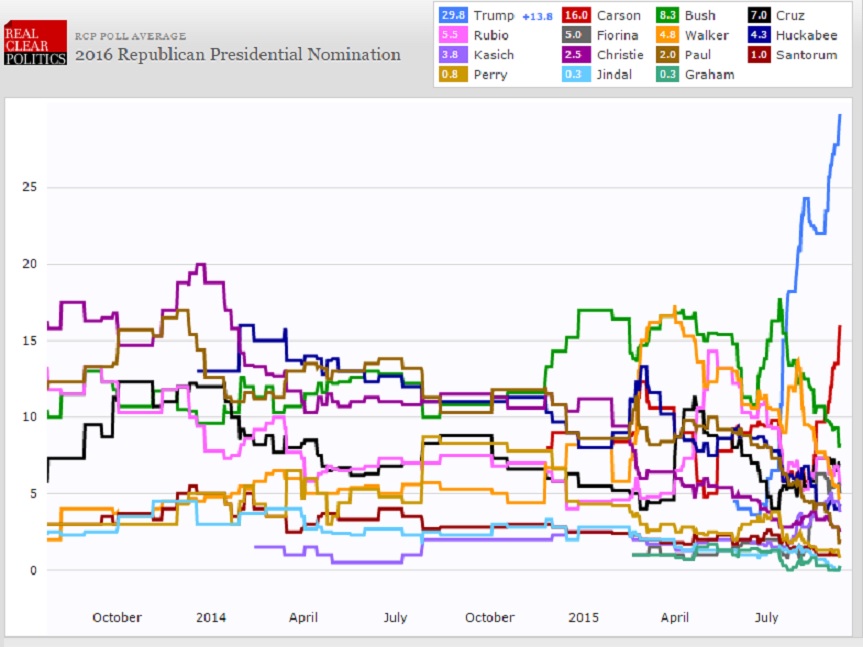
Trump-CarsonProbably unthinkable, but from the outside looking in, the numbers suggest to me that a Trump + Carson ticket could overwhelm all the other Republican candidates. One Republican candidate has left the race (Rick Perry). Huckabee and Santorum will probably be the next to leave. And the Trump bubble is not imploding as all expected. In fact, the polls suggest that Trump is still gaining strength.

From RCP:

trump plus carson

GOP polls on 12th September 2015 — Real Clear Politics

The Republican establishment has proven to be a most ineffectual opposition to a weak indecisive President. They have not been able to use their strength in the house to actually do anything except to try and block Obama. Trump and Carson could ride an anti-establishment wave (tsunami?).

Against the Democrats, it is then difficult to see what permutation or combination of Clinton, Sanders, Biden and anybody else could withstand a Trump + Carson ticket.

The entertainment continues.

Natural selection is about “good enough”, but artificial selection could be about excellence

September 11, 2015

“Natural” selection is brainless.

I am always irritated by the assumption that natural selection and its resultant evolution is a “good thing”. After grinding my teeth for a while I tend to switch off when a “scientist” starts assigning values of goodness or badness to something that just is. So this comes as a reaction to an idiot scientist I just heard on radio, gushing about how wonderful evolution is.

Natural selection has no direction. In fact it is unintended selection. It just allows for the survival and the reproduction of the “just good enough” individuals (not of the best individuals). “Evolution” is then just the resulting changes in species, where some individuals have had the genetic variation (errors or abnormalities) to be able to survive in a changed environment (habitat and/or competing species). Paradoxically, species which display a wide genetic variation in individuals (large errors), have a greater chance of surviving change. Of course, many abnormal individuals fail to survive, which is the price paid for the survival of the species. In that sense, “natural selection” sacrifices individuals for the sake of the species. The unplanned, unintended “selection” occurs primarily by the deselection of the unfit individuals. You could say it was unethical, since the end (species survival), justifies the means (deselection of unfit individuals). There is no compassion for deselected individuals in natural selection.

Excellence of a particular attribute is never selected for. Survivors are those just good enough, to live long enough, to reproduce. Evolution by this “natural selection” clearly works, but it is not intentional, is not very efficient and can only cope with slow, small changes to the environment. Rapid or large changes cannot be matched by the available genetic variation. When the genetic variation (errors) among individuals does not throw up some which can survive some external change, species go extinct. It is the selection not by a pro-active choice but by whatever is left surviving after a multitude of trials of the errors.

It is said that 99% of all species that ever existed are now extinct. It follows, then – by that measure – that evolution has a pretty dismal 1% success rate. A process with 99% of the production being rejected. It is hardly six-sigma. It also follows that many of the species alive today are not quite suitable, are intended for rejection and must go extinct. (I have always thought that this embarrassing level of inefficiency is in itself a powerful denial of any “intelligent design”).

The “wondrous evolution” of the eye, for example, is not all that wondrous considering the length of time involved (3.8 billion years from light sensitive algae to the human eye), and the mamillions of generations of trial by error. (A mamillion is the mother of all millions and is one million raised to the one millionth power). The eye is no doubt wonderful, but as a sensor of electro-magnetic radiation, it is only just “good enough”. It could have been much “better”, if excellence of the sensor was a purpose. The long, slow process by which the human eye has evolved is pretty unimpressive as a process, even if the result is not that bad. Natural selection does not even have survival as a purpose. It just throws up a multitude of possibilities and survival of some lucky few is the result. It is this shotgun approach of natural selection which is so inefficient – but to its credit, I have to admit it is a low-cost process which has been sufficiently effective to keep the selfish genes alive.

My contention is that an “artificial selection” approach, which had purpose, intelligence and direction, could have produced a superior eye and in much less time. Having direction means that excellence of an attribute could explicitly be sought. “Artificial selection” would be the precisely targeted, rifle-shot, giving a better eye with every generation, compared to  the “something should hit the barn sometime” approach of natural selection’s shot-gun, where a better eye was only one of many possibilities for the coming generations.

Consider then what “artificial selection” might have achieved – may yet still achieve – for the human form. Surround-sight eyes seeing deep into the uv and ir spectra. Ears able to discern pressure waves from the rumble of elephants and whales and upto the ultrasound of some creatures. Skin with an ability to absorb solar energy. Retractable gills. Cells for photosynthesis. Intelligent, armed, police cells patrolling the body for nasty, criminal cancers. Generalist antibodies. Regenerating cells. Rebooting capabilities for the mind. A brain which could beat a supercomputer at chess. Auto-translation cells between the ear and the brain. A hooded “third eye” to detect the undetectable. A heightened olfactory sense. A shielded “inner ear” to detect gravitation waves. A multi-tasking, retractable tail. Tunable radio receivers in our heads.(And many more desirable attributes I cannot even imagine).

Natural selection is about being just good enough. Artificial selection could be about excellence, an excellence as perceived at the time of selection. Artificial selection would then indeed be the application of intelligence to design. It would not take a million years for an “all seeing eye”.

That would be a Brave New World for a brave new species of homo sapiens superior.