Archive for the ‘Technology’ Category

Three Gorges Dam to reach full water level this month

October 4, 2010

The Three Gorges Dam is a hydroelectric dam that spans the Yangtze River by the town ofSandouping, located in the Yiling District of Yichang, in Hubei province, China.

Map of the location of the Three Gorges Dam, Sandouping, Yichang, Hubei Province, China and major cities along the Yangtze River

Three Gorges Dam location: Wikipedia image

The dam body was completed in 2006. Except for a ship lift, the originally planned components of theproject were completed on October 30, 2008, when the 26th generator in the shore plant began commercial operation. Each generator has a capacity of 700 MW. Six additional generators in the underground power plant are not expected to become fully operational until 2011. Coupling the dam’s 32 main generators with 2 smaller generators (50 MW each) to power the plant itself, the total electric generating capacity of the dam will eventually reach 22,500 MW.

Xinhua reports  from Yichang, Hubei that the water level at the Three Gorges Dam, the world’s largest water control project, reached 164.59 meters on Sunday, only 10 meters short of its full capacity of 175-meters. The dam in central China started to hold back water this September by discharging less to the lower reaches of the Yangtze River, the country’s longest river.

When the water level is at its maximum of 175 metres over sea level (110 metres above the river level downstream), the dam reservoir is about 660 kilometres  in length and 1.12 kilometres  in width on average, and contains 39.3 km3 of water. The total surface area of the reservoir is 1,045 km². The reservoir flooded a total area of 632 km² of land, compared to the 1,350 km² of reservoir created by the Itaipu Dam on the border of Brazil and Paraguay (which has a  generating capacity of 14,000 MW).

File:Yangtze longitudinal profile upstream.JPG

Yangtze longitudinal profile: Wikipedia image

Reaching the 175-meter water level would enable the Three Gorges Dam to fulfill its functions of flood control and generating electricity to the fullest extent, symbolizing the total success of the massive water project. This is the reservoir’s third attempt to reach full capacity since 2008. However, water levels stopped at 172.8 meters in 2008 and 171.43 meters in 2009 due to droughts on the lower reaches.

However, this time officials believe the dam will reach full capacity by the end of October.

Changed Landscape of the Three Gorges Dam region. (NASA/Goddard Space Flight Center Scientific Visualization Studio).

Airbus engineering to grow in India

October 3, 2010
Airbus A320 (9M-AFA) der Air Asia

Airbus A 320: Wikipedia

The Telegraph:

Airbus expects India to need around 1,000 new planes over the next 20 years, compared with 3,000 in China. Air traffic has expanded by 16pc in India this year.

Airbus, which has 68 per cent Indian market share, as measured by orders, believes it can build on its current success by selling more aircraft. The European plane maker is also building relationships on the ground. It has 25 partners in India, eight of them top-tier suppliers. Airbus is also leaning more and more on Indian engineers.

The company will decide this week whether to go ahead with its next development programme, a new engine for the single-aisle A320 plane that generates much of Airbus’s profit. “Airbus has never made a secret that our engineering resources are stretched thin,” Mr Enders said during a two-day visit to Airbus’s Indian operations in Bangalore last week. “We’re taking this decision very seriously because we cannot afford that other programmes, especially the 350, should suffer.”

At its base in Bangalore, Airbus has 160 engineers working on the A350 and A380 programmes in conjunction with staff in France, Germany and Britain. The company plans to have 200 staff at the engineering centre by the end of the year and 400 by 2013. India produces around 350,000 engineering graduates a year, about 25pc of which Airbus describes as “employable”. “I don’t think 400 is going to be the final number, there is a huge pool of talent we can tap into,” said Mr Enders. “In terms of the work we sub-contract, there’s a lot more to come.”

In the past, most of the work done for Airbus by external suppliers has been making parts of the airframe, and while some manufacturing work is now being done in India, it is the engineering and technology base that is more attractive, Mr Enders said. “IT, simulations, technical publication – all these are things which India is particularly good at,” he said.

It makes sense and is inevitable that more will shift to India and China – where the market is.

Rain and lack of wind hit UK renewable generation

October 1, 2010

The Guardian reports that

The UK has suffered a second fall in renewable energy production this year, raising concern about the more than £1bn support the industry receives each year from taxpayers.

Wind turbine accident

Lower than expected wind speeds and rainfall led to a 12% fall in renewable electricity generated between April and June, compared to the same period in 2009. This setback follows a smaller but still notable decline between January and March, again compared to last year.

The DECC admits that “The intermittent nature of wind means that we do need alternative back-up generation, for when wind speeds drop” but should have added that alternative capacity is also necessary when it blows too hard and when it is too cold and when the foundations are cracking and …

Seasonal power generation can contribute marginally to energy needs but cannot provide base-load power generation.

Wind is not always as benign as it is made out. The “Summary of Wind Turbine Accident Data to 31 December 2008” reports 41 worker fatalities.

Russian hotel enters space tourism race

September 30, 2010

Virgin Galactic

In 2007, Genesis II, an experimental spacecraft designed to test the viability of a space hotel, was successfully sent into orbit by Bigelow Aerospace. Boeing have announced that they will be able to take tourists into space in 5 years.

The Galactic Suite

Virgin Atlantic has announced its intention to begin redeeming tickets on commercial space flights within the next 18 months – by some time in early 2012. In 2009 the Barcelona-based developers of The Galactic Suite Space Resort said their orbiting hotel was on target to accept its first paying guests by 2012.

Today the BBC reported that a Russian company has unveiled an ambitious plan to launch a “cosmic hotel” for wealthy space tourists. Orbital Technologies says its “comfortable” four-room guest house could be in orbit by 2016, Russia’s RIA Novosti news agency reports. Guests would be ferried to the hotel on a Soyuz shuttle of the type used to transport cosmonauts to the International Space Station (ISS). The new hotel would offer greater comforts, according to Sergei Kostenko, chief executive of Orbital Technologies. “Our planned module inside will not remind you of the ISS. A hotel should be comfortable inside, and it will be possible to look at the Earth through large portholes,” he told RIA Novosti.

It is not clear how the “cosmic hotel” would be built, but the company’s website names Energia, Russia’s state-controlled spacecraft manufacturer, as the project’s general contractor. Energia builds the Soyuz capsules and Progress cargo ships which deliver crew and supplies to the ISS.

China’s second moon probe Chang’e-2 to launch this weekend

September 30, 2010

From Space.com:

On Thursday, workers will begin fueling the Long March rocket that will blast the unmanned Chang’e-2 probe into space from Xichang Satellite Launch Center in Sichuan province, Xinhua reported. Launch will occur “at an appropriate time” between Friday — China’s National Day, when the country marks 61 years of Communist rule — and Sunday (Oct. 3).


Chang'e-2 lunar probe


Chang’e-2 is the second step in China’s three-phase Chang’e moon exploration program, which is named after China’s mythical moon goddess. Chang’e-2 will test out technology and collect data on possible landing sites for the Chang’e-3 spacecraft, which is scheduled to land on the moon in 2013. According to the state news agency, Chang’e-2 should arrive at lunar orbit about five days after launch. It will eventually swoop down to an orbit just nine miles (15 km) above the lunar surface to take high-resolution pictures of landing areas for Chang’e-3. After snapping the photos, Chang’e-2 will retreat to an altitude of about 62 miles (100 km) to conduct a study of the lunar surface and dirt.

The Chang’e-1 probe  launched in October 2007 and conducted a 16-month moon observation mission, after which it crash-landed on the lunar surface by design, in March 2009.


The launch of Long March 3B Rocket, Xichang Sa...

Image via Wikipedia:Long March 3B Rocket launch


Michibiki navigation satellite in position over Japan

September 30, 2010

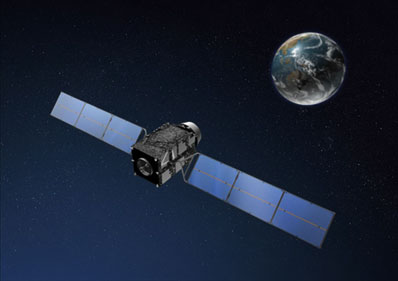
Japan’s first navigation satellite has arrived on station more than 20,000 miles over Asia to improve positioning coverage in mountainous terrain and urban centers.

Artist's concept of the Michibiki satellite. Credit: JAXA

MICHIBIKI injected into the quasi-zenith orbit with its center longitude of about 135 degrees.

The First Quasi-Zenith Satellite MICHIBIKI, which was launched by the H-IIA Launch Vehicle No. 18 on Sept. 11 (JST,) has been maneuvered to shift its orbit from the drift orbit to the quasi-zenith orbit starting on the 21st. The satellite is now confirmed to be inserted into the quasi-zenith orbit over Japan with its center longitude of about 135 degrees through the final orbit control performed at 6:28 a.m. on Sept. 27. The MICHIBIKI was launched from the Tanegashima Space Center at 8:17 p.m. on September 11, 2010 (JST.)

Yoshinobu Launch Complex

Yoshinobu Launch Complex at the Tanegashima Space Center: JAXA

JAXA’s press release is here:

http://www.jaxa.jp/press/2010/09/20100927_michibiki_e.html

A ramble through electricity consumption and aspirations.

September 29, 2010

From the IEA 2010 World Energy Statistics, the country with the lowest electricity consumption is Haiti at 23 kWh /capita. The country with the highest consumption is Iceland with 49,818 kWh/capita. In between come Ethiopia at 42 kWh/capita, Kenya at 156, India at 566, Iraq at 1267, China at 2453, France at 7,703, the US at 13,647, Canada at 17,053 and Norway at 24,868 kWh/capita. For the world as a whole the average consumption is 2,782 kWh/capita.

The average is 18 times less than the maximum and the minimum is 120 times less than the average. And of course the average in every country itself represents an enormous spread between individuals.

To put this into the perspective of living standards and the quality of life, the electricity consumption of household goods is typically as follows:

  • One 60 W light –bulb for 8 hrs per day consumes 175 kWh/annum,
  • Typical 19” colour TV (70 W) for c. 5 hrs per day 125 kWh/annum
  • Table fan (20 W) for c. 12 hours per day 88 kWh/annum
  • Desktop computer (100 W) for 8 hours per day 290 kWh/annum
  • Refrigerator (80 W), continuously, 700 kWh/annum
  • Freezer 150 W continuously, 1300 kWh/annum

To have access to one 60 W light bulb when you have none is an enormous improvement in the quality of one’s life. To have access to a fridge so that shopping and cooking every day while also holding down a full-time job is no longer necessary is the difference between freedom and slavery for many women in the developing world. It is a sobering thought that if every Haitian used just one 60 W light bulb for 8 hours every day, the electricity consumption in Haiti (and therefore electricity generation) would increase seven-fold!

(more…)

Rolls Royce Trent 1000 fix is in place

September 28, 2010

RR Trent 1000 cutaway

On August 2nd a  production standard ‘Package A’ Rolls-Royce Trent 1000 engine suffered an engine failure while on the test stand at the company’s Derby, UK facility. The ‘Package A’ engines do not incorporate upgrades planned for the ‘Package B’ engines, which will bring the specific fuel consumption target within 1% of planned spec. The failure – which has been described as an “uncontained failure” – of the Trent 1000 engine, which powers the Dreamliner, resulted in “limited debris being released into the test facility,”
At the time a Rolls-Royce spokesman rejected speculation that the unavailability of the engine that Boeing required was related to the incident earlier this month at one of its test facilities in Derby, England, saying the events were “unrelated,” though he declined to elaborate.

Aviation Week: Rolls-Royce says it is already testing an upgrade to the Trent 1000 engine to mitigate a component problem that caused a failure of one of the turbofans this month. The engine maker suffered a Trent 1000 engine failure this month on a test stand in Derby, England, with the powerplant in a sea-level testbed configuration at high power. The engine suffered an intermediate pressure turbine-related failure because of what is being called an “inappropriate operating regime.”

Rolls officials note that ground and flight trials have not been affected, nor is the miscue expected to affect the larger 787 schedule. Rolls supplies the Trent 1000 to Boeing 787 lead customer All Nippon Airways.

Although some elements of what transpired are understood, a Rolls-Royce official notes that “we are now investigating in detail and have made good progress in understanding the issue.” The company was aware of the issue, so later model Trent 1000 builds already have a fix in place, which is now also being installed on engines built to the earlier standard.

The grapevine as to what transpired on August 2nd points to an oil fire in the high pressure compressor drum leading to a failure of the intermediate pressure (IP) shaft. One industry source says once the IP shaft failed, the mounted IP turbine disk moved rearward, causing its blades to impact the low pressure (LP) turbine inlet guide vanes. The result was the separation of the IP turbine disk, which subsequently spun out of the casing and into the test stand.  The same source adds that the “non-adherence to test procedures” was the root cause of the failure, saying that the “stand crew ran more cold starts in close succession than allowed without purging of fuel and oil that accumulate within the engine in places these fluids are not supposed to be.”

Bloomberg reports today that Boeing delayed the 787’s first delivery last month for the sixth time, saying Rolls-Royce wasn’t going to be able to supply an engine needed to finish flight testing. A $17 million Trent 1000 blew up during testing on Aug. 2, forcing Rolls-Royce to close the plant for repairs to the Derby, England, site used to test engines for the 787 and the Airbus SAS A350.

Dreamliner with RR Trent 1000 engines

Boeing Co. said Rolls-Royce Group Plc has a remedy for the August blowout of a jet engine for the 787 Dreamliner aircraft and the two companies will discuss it in meetings in Seattle this week.

A Rolls-Royce team will brief Boeing on a plan that supports the latest target for delivering the delayed Dreamliner at the beginning of next year, Boeing Commercial Airplanes President Jim Albaugh said. Boeing parked one of its five Dreamliner test jets earlier this month to replace one of its two Rolls-Royce Trent 1000 engines that had experienced a power surge before takeoff. Albaugh said a fix is already in place to address the issue, which Boeing has said was unrelated to the engine blowout.

“We don’t want to be poor any more” – but the WWF is not listening

September 26, 2010

Laos says it rejects calls for a dam moratorium on the Mekong River because it wants cheap power to develop its economy despite threats to fish habitats. The Southeast Asian nation moved this week to secure regional approval for the first major hydropower plant on its stretch of the lower Mekong in the face of protests from international conservation groups. The Sayaboury dam is to be built across a part of the Mekong that flows through Laos.

Mekong and its main tributaries.

Wikipedia: Mekong and tributaries

The backers of the 1260 MW Sayaboury Hydro project include the World Bank and the Electricity Generating Authority of Thailand (EGAT), a state utility that signed an agreement in Laos in June to buy power once the new dam’s turbines come to life. The BBC reports that the World Bank would provide loans and guarantees for the $1.2bn project. The decision comes after nearly 10 years of discussions with the Laos government.

Laos is a poor, landlocked country which has few viable industries. But it does have plenty of mountains and rivers, and that is why it is pinning its hopes for the future on hydroelectric power. Nam Theun 2 is the country’s largest dam project, on a tributary of the mighty Mekong. It is designed to produce electricity for export to neighbouring Thailand, earning valuable foreign currency that Laos says it will use to alleviate poverty.

“We don’t want to be poor any more,” said Viraphone Viravong, director general of the country’s energy and mines department. “If we want to grow, we need this dam.”

But needless to say the WWF and The Guardian are opposed:

Giant Catfish _Pangasianodon gigas_ ©Sut.jpg

Giant dog-eating Catfish

Catfish the length of cars and stingrays that weigh more than tigers are threatened by the proposed 800m barrier.

“This dam is the greatest challenge the Mekong River Commission has faced since it was formed. It is the most serious test of its usefulness and relevance,” said Marc Goichot, of the WWF. “It is already very clear this dam would amplify and accelerate the negative impacts of Chinese dams to the Mekong delta. What are the other impacts?”

It has taken 10 years to get this far, but WWF supports a delay in the approval of the mainstream dams, including the Sayabouly hydropower dam in Sayabouly Province, Laos — and let the poverty and misery continue.

Biometric identification inherently fallible

September 25, 2010

Cave paintings created some 30,000 years ago include hand-prints which are thought to identify the artist. Babylonian merchants included finger prints on clay tablets perhaps to identify those involved in particular transactions. In early Egypt physical descriptions were appended to the names of traders also presumably as a means of indisputable identification. Hand and foot-prints were used in China about 600 years ago to identify children and this method is still used today.

Modern biometrics started in the mid-19th century with Bertillon’s anthropometrics and his system was called Bertillonage.

Edward Henry

The use of fingerprints by police started in Asia, S. America and Europe. By the late 19th century systems for recording, storing and retrieving finger prints were being established. The first such robust system of classification was developed in Bengal, India by Azizul Haque for Edward Henry who was the Inspector General of Police. The Henry System caught on and variations are still in use today.


Development of modern day biometric systems took off in the second half of the 20th century and with the advent of computers has exploded since the 1990’s.

Face recognition

But a new report by the National Research Council warns that no single trait has been identified that is stable and distinctive across all groups.

http://www.eurekalert.org/pub_releases/2010-09/naos-bit092410.php

Biometric systems — designed to automatically recognize individuals based on biological and behavioral traits such as fingerprints, palm prints, or voice or face recognition — are “inherently fallible,” says a new report by the National Research Council, and no single trait has been identified that is stable and distinctive across all groups.

“For nearly 50 years, the promise of biometrics has outpaced the application of the technology,” said Joseph N. Pato, chair of the committee that wrote the report and distinguished technologist at Hewlett-Packard’s HP Laboratories, Palo Alto, Calif. “While some biometric systems can be effective for specific tasks, they are not nearly as infallible as their depiction in popular culture might suggest. Bolstering the science is essential to gain a complete understanding of the strengths and limitations of these systems.”

Biometric systems are increasingly used to regulate access to facilities, information, and other rights or benefits, but questions persist about their effectiveness as security or surveillance mechanisms. The systems provide “probabilistic results,” meaning that confidence in results must be tempered by an understanding of the inherent uncertainty in any given system, the report says. It notes that when the likelihood of an imposter is rare, even systems with very accurate sensors and matching capabilities can have a high false-alarm rate. Biometric characteristics may vary over an individual’s lifetime due to age, stress, disease, or other factors. Technical issues regarding calibration of sensors, degradation of data, and security breaches also contribute to variability in these systems.

The study was funded by the Defense Advanced Research Projects Agency, the Central Intelligence Agency, and the U.S. Department of Homeland Security, with assistance from the National Science Foundation. The National Academy of Sciences, National Academy of Engineering, Institute of Medicine, and National Research Council make up the National Academies.