Archive for the ‘US’ Category

Obama’s empty speech should increase gun sales

December 7, 2015

Obama’s much heralded Oval office speech said nothing very much. He made it standing up rather than sitting down to show that he was a man of action. But then he didn’t mention any actions of any significance. Perhaps somebody should tell him that symbols of action are not the actions themselves. He was more concerned that innocent Muslims not be discriminated against, rather than that virulent, Muslim terrorists already embedded in the US be rooted out. If I lived in the US I would have to conclude that

  1. the State could not – and would not – protect me by preventing future San Bernardino events, and therefore
  2. I should acquire a weapon, some training on how to use it and take to carrying it.

I watched some extracts from his speech and have just read the transcript. What struck me was all that he didn’t say. He didn’t say

  1. that he would get Turkey to stop trading in ISIS oil,
  2. that he would get Saudi Arabia to stop sending funds to radical Sunni groups in Syria and Iraq,
  3. that he would get Saudi Arabia and the Gulf States to stop exporting funds and sick ideologies to mosques and madrassas abroad,
  4. that he would, and how he would, find the ISIS sleepers and the radicalised Muslim youth already embedded within the US,
  5. that he called on the Muslim communities in the US to themselves cease protecting such people hiding within their communities,
  6. that he would get the social media giants to use their undoubtedly, sufficiently capable algorithms to apply some ethical standards to radicalisation rooms,
  7. that he would work with Russia and Iran – even if Saudi Arabia or Israel opposed it – to leave ISIS with no territory in Iraq or in Syria,
  8. that he would prevent ISIS from developing an alternative base of operations in Libya.

But I heard none of that.

Instead he presented his empty,  already bankrupt, do-nothing, four-part “strategy”

  1. “First, our military will continue to hunt down terrorist plotters in any country where it is necessary”. (but not apparently in the US)
  2. “Second, we will continue to provide training and equipment to tens of thousands of Iraqi and Syrian forces fighting ISIL on the ground so that we take away their safe havens”. (and we have seen how $500 million managed to train a handful of fighters and provided ISIS with the weapons of a whole brigade).
  3. “Third, we’re working with friends and allies to stop ISIL’s operations”. (but not if Turkey or Saudi Arabia or Israel disapprove).
  4. “Fourth, with American leadership, the international community has begun to establish a process — and timeline — to pursue ceasefires and a political resolution to the Syrian war”. (we are prepared to have a ceasefire with ISIS but we will not talk to Assad).

In other words, “we will continue not doing what we are already not doing and which we are so good at not doing”. And then he waffled on about gun control. Does he really think that an ISIS, terrorist kill-squad would have any difficulty in obtaining clandestine guns and explosives?

There was one paragraph he got right.

That does not mean denying the fact that an extremist ideology has spread within some Muslim communities. This is a real problem that Muslims must confront, without excuse. Muslim leaders here and around the globe have to continue working with us to decisively and unequivocally reject the hateful ideology that groups like ISIL and al Qaeda promote; to speak out against not just acts of violence, but also those interpretations of Islam that are incompatible with the values of religious tolerance, mutual respect, and human dignity.

But then he even ruined that by shifting direction and emphasised the “avoiding of discrimination”

But just as it is the responsibility of Muslims around the world to root out misguided ideas that lead to radicalization, it is the responsibility of all Americans — of every faith — to reject discrimination.

He ends with the ridiculous statement “Let’s not forget that freedom is more powerful than fear”. 

The country was I think looking for Obama to show them that they could enjoy freedom without fear. Instead, he just provided all Americans with the freedom to fear. And with a perfect reason to go out and buy a gun.

ISIS mobilisation in America “unprecedented”

December 6, 2015

George Washington University’s Program on Extremism has just published a report “ISIS in America – from retweets to Raqqa”.

ISIS in America

ISIS in America George Washington University

ISIS in America – Full Report

Some extracts from the Executive Summary:

  • ƒ WHILE NOT AS LARGE as in many other Western countries, ISIS-related mobilization in the United States has been unprecedented. As of the fall of 2015, U.S. authorities speak of some 250 Americans who have traveled or attempted to travel to Syria/Iraq to join the Islamic State in Iraq and Syria (ISIS) and 900 active investigations against ISIS sympathizers in all 50 states.
  • …….
  • Social media plays a crucial role in the radicalization and, at times, mobilization of U.S.-based ISIS sympathizers. The Program on Extremism has identified some 300 American and/or U.S.-based ISIS sympathizers active on social media, spreading propaganda, and interacting with like-minded individuals. Some members of this online echo chamber eventually make the leap from keyboard warriors to actual militancy. ƒ
  • American ISIS sympathizers are particularly active on Twitter, where they spasmodically create accounts that often get suspended in a never-ending cat-and-mouse game. Some accounts (the “nodes”) are the generators of primary content, some (the “amplifiers”) just retweet material, others (the “shout-outs”) promote newly created accounts of suspended users.
  • ISIS-related radicalization is by no means limited to social media. While instances of purely web-driven, individual radicalization are numerous, in several cases U.S.-based individuals initially cultivated and later strengthened their interest in ISIS’s narrative through face-to-face relationships. In most cases online and offline dynamics complement one another. ƒ
  • The spectrum of U.S.-based sympathizers’ actual involvement with ISIS varies significantly, ranging from those who are merely inspired by its message to those few who reached mid-level leadership positions within the group.

Membership of ISIS members within the US legal system is spread across the US but New York, Minnesota, California and Texas seem to be preferred states.

ISIS members in US legal system

ISIS members in US legal system

All religions operate in the space of Ignorance. So when members of one religion criticise a follower of another, it is essentially “my ignorance” claiming to be better than “your ignorance”. However, I don’t think it is just blind prejudice or “Islamophobia” to say that the teachings of Islam are inherently more suited to be perverted and to be used to glorify and inspire gratuitous violence against “non-believers”, than the teachings of any other, current, major religion.

If the threat of ISIS death-squads is real, then it is the wrong time for gun controls in the US

December 5, 2015

There is a renewed rhetoric in favour of gun controls after the California rampage, just as there is after every mass killing, but which never leads to any action. I am always amazed that Barack Obama, who is so fond of executive actions in other areas where he is opposed by Congress, has been so ineffective in implementing any actions to reduce the access to what are essentially military weapons. But this rhetoric may be misplaced if the killings were by what now looks to have been a husband-wife death squad, operating fairly autonomously(?),  but for ISIS, and possibly led by the wife, who was indoctrinated mainly in Saudi Arabia and Multan. A lot of ifs and buts in that sentence, of course.

It has been the contention of the gun lobby that the citizenry having guns is a deterrent to such massacres and they have pointed to statistics showing that more of these mass killings take place in gun-free zones. The argument seems disingenuous in that not having availability to guns would probably avoid many of these incidents from taking place. There is some truth, I think, in the argument that once an incident has started, the magnitude of the incident can be limited by some of the intended victims being armed and capable of resisting.

Gun controls then ought to reduce the number of incidents but once an incident is underway, then the scope of the incident can be limited by the intended victims having the possibility to resist.

But if this incident turns out to be a terrorist action by a kill-squad, then it would not have been avoided by having gun controls in place. And if some of the victims had been armed maybe the death toll would not have been as high as it was. If this death-squad was just one of many such and the next incident could come at any time, 2 things follow:

  1. The death squads will most likely attack in gun-free zones, and
  2. An armed person is safer in the event of a random attack than an unarmed one.

I think the US now faces this dilemma. Introducing gun controls should reduce the number of the conventional, single perpetrator, mass-killing events which have become almost a “usual” and – on average – daily occurrence. However, gun controls cannot prevent terrorist squads from arming themselves and gun-free zones will be more attractive for a terrorist attack. And if an incident cannot be prevented, then it is safer for people to be armed.

Without any terrorist threat I think the value of restrictions on access to, at least, automatic weapons seems obvious and there would be no serious argument against gun controls. However, if a threat of terrorist death-squads suddenly popping up for a rampage is real, then it would be quite the wrong time to prevent potential victims from being armed.

It is a Bermuda triangle for policy; between a rock, a hard place and the devil.

Trump’s got his music right and his words don’t matter

November 25, 2015

Trump has got his music right and as long as the beguilement of the music holds, his words don’t matter.

How else to explain Trump’s position? He seems to be immune to the rational consequences of what he says.

The only conclusion I come to is that it is the mood he evokes that people are responding to rather than what he actually says. It is the almost abstract notions of being for less government rather than more, for common sense rather than political correctness, for pragmatism rather than high ideology and for being untarnished by “sponsors” or the establishment which are keeping Trump going.

It is becoming difficult to see how anybody else could overtake him now to the GOP nomination. And that is not something that was even worthy of contemplation 6 months ago.

Trump 25Nov2015 RCP Poll of Polls

Trump 25Nov2015 RCP Poll of Polls

So far, Trump is not penetrating much beyond disaffected Republicans. But he is capturing a mood and riding feelings and emotions in a way not seen since Obama’s first campaign against Hillary Clinton. But Obama had the words too. (It’s just that Obama has not been able to match his actions to the mood he evoked).

If now Trump can get his words right and continues to sustain the right music, then who knows what happens next November.

“ISIS first, Assad later” gains traction but St. Jeremy makes UK the weakest European actor against ISIS

November 18, 2015

Most of Europe is now falling behind the Russian strategy of “ISIS first, Assad later” as being the only viable way forward in Syria. The UK is also acquiescing with this line, but only verbally, since it is prevented from making any strikes in Syria without parliamentary authority to do so. With the self-canonised St. Jeremy Corbyn now in charge of the Labour party, such a vote may be a long time coming. After Paris, Hollande – though a St. Jeremy soul-mate in normal times – is forced to go all out against ISIS and is now coordinating attacks with Russia. Even Germany is considering supporting military action against ISIS. France has invoked a treaty provision for the first time ever and called for support from the other EU countries. All EU countries have promised that – as yet undefined – support. But the UK is now perceived as the weakest European actor against ISIS terrorism. The instant and automatic opposition of the SNP to any government motion and the naivete of St. Jeremy (which is not so innocent) has seen to that.

The Barack Obama – US led coalition’s “strategy”, if it can be called a strategy, has been to get rid of Assad at all costs. What was to happen afterwards or the question of whether Syria, as a nation , could even exist was left to the future to determine. It has been Russia’s reluctance to abandon Assad and his regime which has prevented any UN resolutions of any significance. Before the Russians recently started their attacks on ISIS they tried to rally support for the strategy of attacking ISIS and other rebels/terrorists first (which would help Assad) and then arranging for Assad to leave the scene after ensuring a transition to something sustainable. Obama and Kerry virtually dismissed that idea but did not go so far as to set themselves up against any Russian strikes on ISIS. The US and their coalition partners did, however, try and project the view that Russian intervention was more harmful than helpful.

After the Russian passenger plane was destroyed by – it is claimed – ISIS, the Western objections to the targets of the Russian strikes were a little more muted. Now after Paris, France has signed up to the line of “ISIS first, Assad later”. The rest of Europe is falling-in line with the notable exception of the UK. The Kurds love this, the Turks don’t. Saudi Arabia is very apprehensive that even if Assad eventually goes, a Shia government could still remain in place. Besides, they are reluctant to be seen to be accepting the demise of a Sunni organisation, even if it is as murderous as ISIS. From Kerry’s recent statements it seems as if the US is preparing the ground to also accept this strategy though the US, of course, can never be seen to falling-in behind Russia.

One way for the UK to save face and even get involved in Syria, would be if a UN resolution establishing “ISIS first, Assad later” could be accepted in the Security Council. Possibly the UK could propose it and recover some of the face they have already lost. Neither the Russians or the US would then veto such a resolution, though one or both might abstain depending upon the text. But it should not be impossible in the present climate. That would give the hapless St, Jeremy something to hide behind when a vote is called for in parliament. But he has already cost the UK a great deal of political clout in the fight against ISIS.

Trend reversal and sharp increase of mortality of 45-54 year old, US white population

November 3, 2015

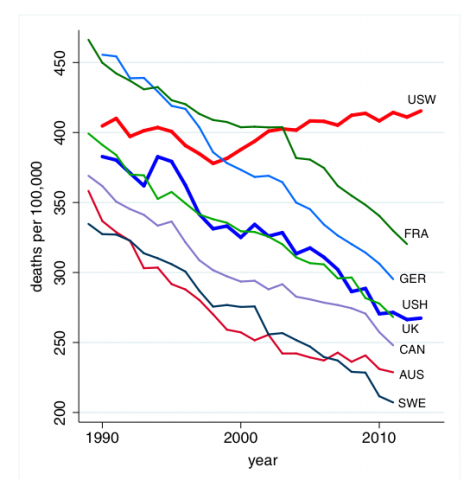
A new paper by Nobel winner Angus Deaton and his wife Anne Case points out a trend reversal and a sharp increase of mortality rates among 45-54 year old, non-Hispanic whites in the US between 1999 and 2013. This is highest among the less educated, less well-off population. It is the reversal of a previous trend and that is both perplexing and a little alarming. It suggests a deeper social malaise prevalent in this group.

A rather deadly – and morbid – case of “White Flight”.

Anne Case and Angus DeatonRising morbidity and mortality in midlife among white non-Hispanic Americans in the 21st century, PNAS, doi: 10.1073/pnas.1518393112

All-cause mortality, ages 45–54 for US White non-Hispanics (USW), US Hispanics (USH), and six comparison countries: France (FRA), Germany (GER), the United Kingdom (UK), Canada (CAN), Australia (AUS), and Sweden (SWE) Case & Deaton

All-cause mortality, ages 45–54 for US White non-Hispanics (USW), US Hispanics (USH), and six comparison countries: France (FRA), Germany (GER), the United Kingdom (UK), Canada (CAN), Australia (AUS), and Sweden (SWE)  – Case & Deaton

Abstract

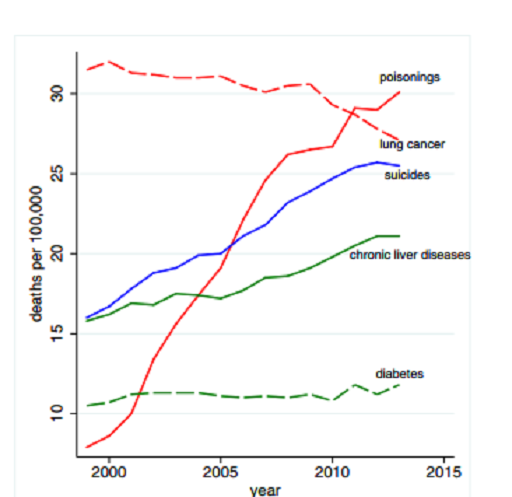
This paper documents a marked increase in the all-cause mortality of middle-aged white non-Hispanic men and women in the United States between 1999 and 2013. This change reversed decades of progress in mortality and was unique to the United States; no other rich country saw a similar turnaround. The midlife mortality reversal was confined to white non-Hispanics; black non-Hispanics and Hispanics at midlife, and those aged 65 and above in every racial and ethnic group, continued to see mortality rates fall. This increase for whites was largely accounted for by increasing death rates from drug and alcohol poisonings, suicide, and chronic liver diseases and cirrhosis. Although all education groups saw increases in mortality from suicide and poisonings, and an overall increase in external cause mortality, those with less education saw the most marked increases.

The sharpest increase has been in “poisonings” which is essentially the use of drugs (including pain related opiates) and alcohol.

Mortality by cause, white non-Hispanics ages 45–54.

Mortality by cause, white non-Hispanics ages 45–54.

American Prospect comments:

Case and Deaton’s data indicate that the white midlife mortality reversal was due almost entirely to increased deaths among those with a high school degree or less. Mortality rates in that group rose by 134 per 100,000 between 1999 and 2013, while there was little change among those with some college, and death rates fell by 57 per 100,000 for those with a college degree or more.

Death rates from suicide and poisonings such as drug overdoses increased among middle-aged whites at all socioeconomic levels (as measured by education). But the increases were largest among those with the least education and more than sufficient in that group to wipe out progress in reducing other causes of death. Deaths from diabetes rose slightly but did not account for a significant part of the white midlife mortality reversal.

  ……. Among blacks, midlife mortality has been higher than among whites. But over the period 1999-2013, according to Case and Deaton, midlife mortality declined by more than 200 per 100,000 for blacks while it was rising for whites. As a result, the ratio of black to white mortality rates dropped from 2.09 in 1999 to 1.40 in 2013. Contrary to what many Americans may still believe, drug overdoses are no longer concentrated among minorities; in fact, among the 45-54 age group, drug-related deaths are now higher among whites. …..

American Prospect goes on to suggest that this might be a loss of hope among the white, middle-aged, less educated population, which is part of the malaise which is showing up politically as support for Trump and Carson.

The declining health of middle-aged white Americans may also shed light on the intensity of the political reaction taking place on the right today. The role of suicide, drugs, and alcohol in the white midlife mortality reversal is a signal of heightened desperation among a population in measurable decline. ……  The phenomenon Case and Deaton have identified suggests a dire collapse of hope, and that same collapse may be propelling support for more radical political change. Much of that support is now going to Republican candidates, notably Donald Trump. Whether Democrats can compete effectively for that support on the basis of substantive economic and social policies will crucially affect the country’s political future.

Senility at the GOP: A pity and a shame

October 29, 2015

I only watched some extracts of last night’s “debate”.

It was badly organised (CNBC) and the moderators were not very good. (Couldn’t organise a p***up in a brewery). But even so they were better than a sorry bunch of “candidates”. There wasn’t much shock and awe here. For the Republicans, it was a pity and a shame. The sad part for the Republicans is that – based on the “debate” – one of this pitiful bunch is going to be their flag-bearer and their candidate for President.

There wasn’t much entertainment either. Trump’s clown make-up needs refreshing. Jeb Bush was convinced he was going to lose. Ben Carson said nothing of any import as usual – probably intentionally. Carly Fiorina demonstrated she was a one-debate woman. The establishment figures were the two sitting Senators, Rubio and Cruz, and maybe the GOP will back them as those most likely to stop a Trump or Carson bid. They were possibly the least worst of a pretty awful bunch.

Are these really the best that the Republicans can come up with?

The Grand Old Party is showing signs of senility.


Clinton, Trump, Sanders & Carson – not really spoilt for choice

October 22, 2015

So Biden is not running.

This leaves the US electorate now with the less than enviable prospect of having to vote in one of the motley group of Trump, Clinton, Carson or Sanders as their next President. Not the most inspiring group of names. If leadership is the criterion then Donald Trump is the only one who qualifies. If “politicking” and manipulating the political establishment is what is required then Hillary Clinton is best suited. Ben Carson will come into his own when lobotomising sections of the government or in excising unwanted parts of the bureaucracy. Bernie Sanders could count as the “intellectual” in this group but he is best at opposing and blocking others rather than taking his own initiatives.

The choice is one of firsts. Either the first non-politician, or the first woman, or the first (real) black, or the first socialist as President. It could be the dullest election ever. The only glint of some entertainment in the process is provided by Trump. Of course the criteria for winning the election are different to the qualities needed for being President for 4 years. Of the four I don’t see that Carson or Sanders have what it takes to be even a reasonably successful President.

So I would expect Carson to lose handily to Clinton and Sanders to Trump. But a Carson versus Sanders election could be a bizarre battle to see who was worse. It could be difficult to forecast the contest to lose. Paradoxically it is the bizarreness of such a contest which could inject some interest. The prospect of having an incompetent incumbent in the White House will bring some despair to friendly countries.

That leaves a Clinton versus Trump contest which could actually be a close and fascinating fight. It would pit stability versus volatility and political manipulation against a leader charging in where angels fear to tread. It would be Big government set against Small. Both would be extremely pragmatic though Clinton may be swayed by ideology a little more. Trump will protect the bottom line while Clinton will tend to protect the spending level. Trump’s foreign policy will be openly focused on short-term advantages to the US whereas Clinton’s will be all about long-term geopolitical machinations.

The more I consider a Trump versus Clinton battle, the more difficult I find it to predict how the American voters may decide. But Trump has a real chance of winning even if he does start as the underdog.

That Trump could be the GOP candidate was unthinkable just 3 months ago. It seems the most likely outcome now. That Trump could win the election still seems a little far-fetched, but it has now to be considered more than just a theoretical possibility.

If a not very good actor could become a State Governor and one of the more successful US Presidents, I suppose there is no reason why a real estate mogul could not also make it. 2016 could be the year of the clowns. And the US and the world may just need a clown in the flagging global play.

But with just these 4 names in the hat, the US electorate is not really spoilt for choice.

Clinton has just 20% chance of winning against any Republican says incumbency model

October 14, 2015

According to a model based on how an incumbent fares in an election from 450 elections in 35 democratic countries, any Democrat has only a 20% chance of beating any Republican for the US Presidential election.

Clinton's chances

Clinton’s chances

The model shows that Barack Obama’s current approval ratings are not high enough to allow a successor to get elected, though he would, as an incumbent, have an 80% chance of being reelected himself. With his current approval rating of 45-47%, any successor would only have a 20% probability of winning. Even if Hillary Clinton is an exceptional candidate, it will not be enough to overcome the inexorable hand of this incumbency effect.

Clifford Young and Julia Clark in Reuters:

Elections are not mysterious events subject to the whimsy of unpredictable candidates and voters. They’re actually highly predictable, with a set of variables that influence outcomes in familiar ways. Because of that, we can say, with reasonable confidence, that a Republican will be moving into the White House in 2017.

That conclusion is based on the results of a data model we created, and is primarily the result of two factors, both related to the challenges faced by “successor” candidates — candidates from the same party as the incumbent. First, a Republican will win because voters typically shy away from the party currently in power when an incumbent isn’t running. In fact, a successor candidate is three times less likely to win. Second, President Barack Obama’s approval ratings are too low to suggest a successor candidate will take the White House.

At this point in the election cycle, poll data asking the “horserace” question (“Who will you vote for in November 2016?”) can be very misleading. This far from Election Day, published poll data is off by an average of 8 percentage points compared with the true election outcome. That’s an enormous number when we’re used to elections where candidates win by two to three points.

Time Before Election

Average error of polls (compared to final results)

One week

1.7%

One month

2.7%

Two months

3.8%

Three months

4.8%

Six months

5.8%

Nine months

6.9%

Twelve months

7.9%

Source: Ipsos analysis of 300 polls across 40 markets from 1980 through current

So we created a much larger database of elections by looking beyond the United States to hundreds of presidential and parliamentary elections in democratic countries around the world. This exercise gave us far more data to work with: a sample size of more than 450 elections from 35 countries.

The most important finding from our model is the power of incumbency: if you already hold the office you seek, you are far more likely than not to retain it. Our model showed that incumbents have a threefold greater chance of beating their opponent. When no incumbent is running, successor candidates (in this case, Democrats) are three times less likely to win.

From our database of global elections we also learned about the importance of knowing where the public stands on the direction their country and leadership are going. Are they generally happy or unhappy with the government? There are a few ways to measure this, but the most universal (and therefore the one we use) is approval ratings of the sitting leader or president.

Our model proves the power of presidential approval ratings. It determines that in order for a successor candidate to have better than even chances of winning, the sitting president must have an approval rating of above 55 percent. Because Barack Obama’s average approval rating is now at 45 percent, a successor candidate (i.e. Democrat) is unlikely to win. …….

…… In the coming months, Obama’s approval ratings may tick up. But they would have to pass the 55 point mark to give the Democrats even odds of keeping the White House. This is extremely unlikely, given the fact that presidential approval typically declines over time, and Obama’s ratings are no exception.

Some will argue that Hillary Clinton is special; that her chances are significantly better because, given her popularity and status as a “legacy” candidate, she seems more like an incumbent. But if we go along with that hypothesis and run it through our model, at Obama’s current approval ratings, Clinton’s chances of winning the general election are still less than half.

The Democrats have quite a mountain to summit to retain power past 2016.

The best strategy for Hillary would now be to stop throwing any money down the election drain until Obama improves his approval rating to at least 55%. That would at least give her a 50% chance of being elected.

Is the US now tacitly accepting the Russian strategy?

October 9, 2015

The US has abandoned its fiasco of a $500 million program for the training of “moderate rebels” who could then have provided the physical presence in Syria for getting rid of ISIS (and Assad). So while the rhetoric against the Russian line continues, it seems apparent that the US is not prepared to work directly for the removal of Assad any more. They seem to have reluctantly accepted that Assad need to stay for some indefinite transition period. But that is precisely the path that the Russians are trying to follow. So even if the US has not exactly thrown the “moderate rebels” under a bus, it seems that they are not going to go very far out of their way to support them with more than some arms and some money.

The US may not have completely abdicated, but seems to be taking a political back seat. Regime change is on hold. They may well content themselves – like any good back-seat driver – with criticising the competence of, and the direction being taken by, the Russian driver.

There is a risk now that Saudi Arabia, and the Gulf states will start throwing large sums of money into Syria. Ostensibly it will be for Sunni rebel groups, but much will end up with ISIS and other extreme groups. Iraq of course has joined Iran, Hezbollah and the Assad regime in the Russian coalition.

BBC:

The US is to end its efforts to train new Syrian rebel forces and says it will shift to providing equipment and weapons to existing forces.

Its $500m (£326m) programme was heavily criticised after it emerged that US-trained rebels had handed vehicles and ammunition over to extremists. ……. 

Quoting an anonymous US Department of Defense source, the New York Times reported that the US would no longer recruit Syrian rebels to go through its training programmes in Jordan, Qatar, Saudi Arabia or the United Arab Emirates.

Instead, it would establish a smaller training centre in Turkey, where “enablers” – mostly leaders of opposition groups – would be taught operational manoeuvres like how to call in airstrikes, the newspaper said. 

The failure of the programme underscores the wider problem of the inability to create large and effective moderate forces on the ground. It will also have wider repercussions since the programme helped to coordinate support activities between the Americans, the Gulf states, Turkey, and Jordan. The risk now is that those countries may push on with more separate initiatives backing individual client groups.

The end-game is not certain but the Russian end-game is the only one around.