Archive for the ‘US’ Category

Clinton, Trump, Sanders & Carson – not really spoilt for choice

October 22, 2015

So Biden is not running.

This leaves the US electorate now with the less than enviable prospect of having to vote in one of the motley group of Trump, Clinton, Carson or Sanders as their next President. Not the most inspiring group of names. If leadership is the criterion then Donald Trump is the only one who qualifies. If “politicking” and manipulating the political establishment is what is required then Hillary Clinton is best suited. Ben Carson will come into his own when lobotomising sections of the government or in excising unwanted parts of the bureaucracy. Bernie Sanders could count as the “intellectual” in this group but he is best at opposing and blocking others rather than taking his own initiatives.

The choice is one of firsts. Either the first non-politician, or the first woman, or the first (real) black, or the first socialist as President. It could be the dullest election ever. The only glint of some entertainment in the process is provided by Trump. Of course the criteria for winning the election are different to the qualities needed for being President for 4 years. Of the four I don’t see that Carson or Sanders have what it takes to be even a reasonably successful President.

So I would expect Carson to lose handily to Clinton and Sanders to Trump. But a Carson versus Sanders election could be a bizarre battle to see who was worse. It could be difficult to forecast the contest to lose. Paradoxically it is the bizarreness of such a contest which could inject some interest. The prospect of having an incompetent incumbent in the White House will bring some despair to friendly countries.

That leaves a Clinton versus Trump contest which could actually be a close and fascinating fight. It would pit stability versus volatility and political manipulation against a leader charging in where angels fear to tread. It would be Big government set against Small. Both would be extremely pragmatic though Clinton may be swayed by ideology a little more. Trump will protect the bottom line while Clinton will tend to protect the spending level. Trump’s foreign policy will be openly focused on short-term advantages to the US whereas Clinton’s will be all about long-term geopolitical machinations.

The more I consider a Trump versus Clinton battle, the more difficult I find it to predict how the American voters may decide. But Trump has a real chance of winning even if he does start as the underdog.

That Trump could be the GOP candidate was unthinkable just 3 months ago. It seems the most likely outcome now. That Trump could win the election still seems a little far-fetched, but it has now to be considered more than just a theoretical possibility.

If a not very good actor could become a State Governor and one of the more successful US Presidents, I suppose there is no reason why a real estate mogul could not also make it. 2016 could be the year of the clowns. And the US and the world may just need a clown in the flagging global play.

But with just these 4 names in the hat, the US electorate is not really spoilt for choice.

Clinton has just 20% chance of winning against any Republican says incumbency model

October 14, 2015

According to a model based on how an incumbent fares in an election from 450 elections in 35 democratic countries, any Democrat has only a 20% chance of beating any Republican for the US Presidential election.

Clinton's chances

Clinton’s chances

The model shows that Barack Obama’s current approval ratings are not high enough to allow a successor to get elected, though he would, as an incumbent, have an 80% chance of being reelected himself. With his current approval rating of 45-47%, any successor would only have a 20% probability of winning. Even if Hillary Clinton is an exceptional candidate, it will not be enough to overcome the inexorable hand of this incumbency effect.

Clifford Young and Julia Clark in Reuters:

Elections are not mysterious events subject to the whimsy of unpredictable candidates and voters. They’re actually highly predictable, with a set of variables that influence outcomes in familiar ways. Because of that, we can say, with reasonable confidence, that a Republican will be moving into the White House in 2017.

That conclusion is based on the results of a data model we created, and is primarily the result of two factors, both related to the challenges faced by “successor” candidates — candidates from the same party as the incumbent. First, a Republican will win because voters typically shy away from the party currently in power when an incumbent isn’t running. In fact, a successor candidate is three times less likely to win. Second, President Barack Obama’s approval ratings are too low to suggest a successor candidate will take the White House.

At this point in the election cycle, poll data asking the “horserace” question (“Who will you vote for in November 2016?”) can be very misleading. This far from Election Day, published poll data is off by an average of 8 percentage points compared with the true election outcome. That’s an enormous number when we’re used to elections where candidates win by two to three points.

Time Before Election

Average error of polls (compared to final results)

One week

1.7%

One month

2.7%

Two months

3.8%

Three months

4.8%

Six months

5.8%

Nine months

6.9%

Twelve months

7.9%

Source: Ipsos analysis of 300 polls across 40 markets from 1980 through current

So we created a much larger database of elections by looking beyond the United States to hundreds of presidential and parliamentary elections in democratic countries around the world. This exercise gave us far more data to work with: a sample size of more than 450 elections from 35 countries.

The most important finding from our model is the power of incumbency: if you already hold the office you seek, you are far more likely than not to retain it. Our model showed that incumbents have a threefold greater chance of beating their opponent. When no incumbent is running, successor candidates (in this case, Democrats) are three times less likely to win.

From our database of global elections we also learned about the importance of knowing where the public stands on the direction their country and leadership are going. Are they generally happy or unhappy with the government? There are a few ways to measure this, but the most universal (and therefore the one we use) is approval ratings of the sitting leader or president.

Our model proves the power of presidential approval ratings. It determines that in order for a successor candidate to have better than even chances of winning, the sitting president must have an approval rating of above 55 percent. Because Barack Obama’s average approval rating is now at 45 percent, a successor candidate (i.e. Democrat) is unlikely to win. …….

…… In the coming months, Obama’s approval ratings may tick up. But they would have to pass the 55 point mark to give the Democrats even odds of keeping the White House. This is extremely unlikely, given the fact that presidential approval typically declines over time, and Obama’s ratings are no exception.

Some will argue that Hillary Clinton is special; that her chances are significantly better because, given her popularity and status as a “legacy” candidate, she seems more like an incumbent. But if we go along with that hypothesis and run it through our model, at Obama’s current approval ratings, Clinton’s chances of winning the general election are still less than half.

The Democrats have quite a mountain to summit to retain power past 2016.

The best strategy for Hillary would now be to stop throwing any money down the election drain until Obama improves his approval rating to at least 55%. That would at least give her a 50% chance of being elected.

Is the US now tacitly accepting the Russian strategy?

October 9, 2015

The US has abandoned its fiasco of a $500 million program for the training of “moderate rebels” who could then have provided the physical presence in Syria for getting rid of ISIS (and Assad). So while the rhetoric against the Russian line continues, it seems apparent that the US is not prepared to work directly for the removal of Assad any more. They seem to have reluctantly accepted that Assad need to stay for some indefinite transition period. But that is precisely the path that the Russians are trying to follow. So even if the US has not exactly thrown the “moderate rebels” under a bus, it seems that they are not going to go very far out of their way to support them with more than some arms and some money.

The US may not have completely abdicated, but seems to be taking a political back seat. Regime change is on hold. They may well content themselves – like any good back-seat driver – with criticising the competence of, and the direction being taken by, the Russian driver.

There is a risk now that Saudi Arabia, and the Gulf states will start throwing large sums of money into Syria. Ostensibly it will be for Sunni rebel groups, but much will end up with ISIS and other extreme groups. Iraq of course has joined Iran, Hezbollah and the Assad regime in the Russian coalition.

BBC:

The US is to end its efforts to train new Syrian rebel forces and says it will shift to providing equipment and weapons to existing forces.

Its $500m (£326m) programme was heavily criticised after it emerged that US-trained rebels had handed vehicles and ammunition over to extremists. ……. 

Quoting an anonymous US Department of Defense source, the New York Times reported that the US would no longer recruit Syrian rebels to go through its training programmes in Jordan, Qatar, Saudi Arabia or the United Arab Emirates.

Instead, it would establish a smaller training centre in Turkey, where “enablers” – mostly leaders of opposition groups – would be taught operational manoeuvres like how to call in airstrikes, the newspaper said. 

The failure of the programme underscores the wider problem of the inability to create large and effective moderate forces on the ground. It will also have wider repercussions since the programme helped to coordinate support activities between the Americans, the Gulf states, Turkey, and Jordan. The risk now is that those countries may push on with more separate initiatives backing individual client groups.

The end-game is not certain but the Russian end-game is the only one around.

US/Nato lack of strategy being shown up by the Russians

October 8, 2015

The US started its regime change efforts in Syria 4 years ago, in 2011,  with the financing, training and encouragement of selected “moderate rebels”. They have no doubt weakened Assad but have also been instrumental in creating ISIS.

The US and Nato have been taking great pains to avoid providing any support to Assad’s regime, and only providing support to their favoured “moderate rebel” groups. Even though it has always been the fanatic groups who have muscled the “moderate rebels” out of the way whenever they have achieved any gains. US and Nato have had no clear strategy. They have attempted regime change with no idea of what is to come afterwards. They have not been able to even contemplate any plausible end-game scenario, because the “moderate rebels” they support are too fractured and diverse in themselves to form any clear alternative to the regime.

By contrast, the Russians have an end-game in view though it is not clear if that can be achieved. But it does at least provide a clear direction and a focus which is lacking in the US/Nato approach.

  1. rendering ISIS and al-Nusra and Al Qaida and other fanatics impotent, even if it means supporting Assad,
  2. a managed withdrawal of Assad, with the regime still in place but without leaving any power vacuum
  3. a political settlement between the regime (sans Assad) and the other “moderate rebels”

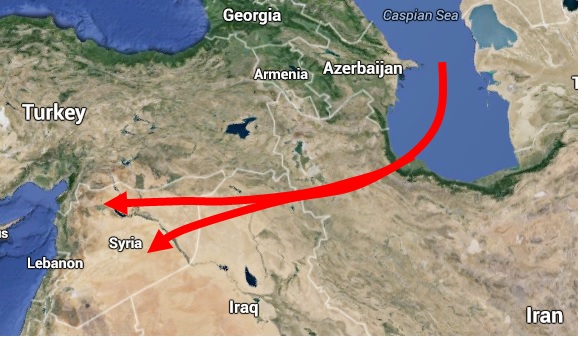
Needless to say, the US and NATO are not amused, though they have no alternatives to suggest when they criticise the Russian cruise-missile strikes from the Caspian Sea. These missiles flew over Iran and Iraq and the strikes were clearly coordinated with them.

4 Russian warships launch 26 missiles against ISIS from Caspian Sea

4 Russian warships launch 26 missiles against ISIS from Caspian Sea

RT:

“Four missile ships launched 26 cruise missiles at 11 targets. According to objective control data, all the targets were destroyed. No civilian objects sustained damage.”

Frigate Dagestan image shipspotting.com

The missiles flew some 1,500 km before reaching their targets. …. Four warships of the Caspian fleet were involved in the missile attacks, the Gepard-class frigate Dagestan and the Buyan-M-class corvettes Grad Sviyazhsk, Uglich and Veliky Ustyug. They fired cruise missiles from the Kalibr NK (Klub) VLS launchers. The missiles used are capable of hitting a target within 3 meters at a range of up to 2,500 km.

Nato countries and the US are highly indignant at these attacks and the Russian violations of Turkish air space, which I suspect, were deliberate and were meant to test limits even if they had no hostile intent.

Nato defence ministers are promising to support Turkey and the Baltic States as if they were directly being threatened by Russia. But that, I think, is because they have no strategy of their own. The US also does not like the Russian strategy but has none of its own.

BBC:

A US-led coalition has been carrying out air strikes against IS in both Syria and Iraq for months. But Western countries support rebels who have been fighting to oust Mr Assad since 2011. ….

But US Defence Secretary Ash Carter said coalition forces fighting IS in Syria would not co-operate with Russia. “We believe Russia has the wrong strategy,” he said. “They continue to hit targets that are not IS.”

Protesting too much, I think.

The problem for the US is that the boots on the ground to defeat ISIS are not going to come from their pet “moderate rebels”. They can only come from the Assad regime, Hezbollah, Iran and Iraq (along with a thousand or two Russian “advisors”).


Whose boots will prevail in Syria?

October 5, 2015

It does not require rocket science to see that ISIS will only, can only, be defeated finally by boots on the ground.

The US and its partners assumed that “moderate rebels” in Syria would provide the boots on the ground to take over, once they had managed to get rid of Assad. But the assumption that the “moderate rebels” formed any sort of cohesive group which could bring stability has proven to be grossly wrong. They are so splintered and fractured and cover such a wide range of objectives that they can only ensure instability. The further assumption that the rag-tag being supplied with weapons and money to effect regime change, did not also include radical and fanatic Sunnis and Wahabis has been at best, incompetent, and at worst, disastrous. The Russians are, it seems, making a different calculation.

Any scenario which pictures the defeat of ISIS will require that their followers are left with no physical or political space to occupy and control. And that is going to require that their space is then occupied by someone else. Air attacks by the US led coalition or by Russia can only prepare the way, but without a real physical presence the effects of such air attacks can only be temporary. Without filling up the space with some form of political stability, any political vacuum will always provide room for the fanatics.

Of a Syrian population of about 23 million, 9 million are displaced and are refugees within Syria or abroad. Around 3 million are estimated to have left Syria. Around 75% of the Syrian population were Sunni muslims, 12% were Alawites (a secretive branch of Shia Muslims) and about 8% were Christians. Assad is of course an Alawite. As Shias the regime is supported by the Hezbollah from Lebanon and from Iran’s Shia (90% of Iran’s population are Shia and about 9% are Sunni). If Assad were to step down, but was replaced by another Alawite, then the Alawites, many of the Christians and even some of the moderate Sunnis, could probably live with a regime which provided stability. The fly in the ointment is financial support for the various Sunni and Wahabi rebel groups in Syria (including the hard-line terrorist groups such as Al Qaida, al-Nusra and ISIS) which comes mainly from Saudi Arabia and the Gulf States. US support for rebel groups in Syria has, under Saudi influence, often supported the Sunni line. ISIS cannot be politically suffocated as long as its external financing continues.

Even with a defeated ISIS, sympathisers will still remain. But they will not be in control. A “defeat” can only mean that they no longer have any control over any settlements within which they might still exist, and that they have no safe havens within which to hole-up. That cannot happen unless control over all geographical areas effectively lies with some body – or bodies – that reject the fundamental claims of the Islamic State.

The mutual hatred between ISIS and Shia Muslims is a key factor. No Sunni rebel group fighting against Assad is not without some sympathy for ISIS. This virtually disqualifies any of the current rebel groups being supported by the US coalition, from being capable of supplying the political control needed to squeeze out ISIS. Certainly the US and its coalition partners are not going to supply the physical presence on the ground. The Russians are not going to send in troops beyond military advisors to Assad either.

So who does that leave? Whose boots on the ground are going to prevail?

The Russian calculation seems to be that the regime (later without Assad) together with Hezbollah, Iraqi Shias and some Iranian presence will be sufficient to defeat ISIS and squeeze them out. It is not impossible, but the Saudis will not take kindly to that. That would be seen as an unacceptable blow to the Sunni ego.

And then whether such an end-game is allowed to stand will depend upon whether the US is prepared to satisfy the Saudis by challenging the Russians (and the Iranians and Hezbollah) in their support of the Assad regime. I suspect that the Russians are calculating that Obama will only keep shifting his red line rather than actually cross it. As long as the Russians keep the eventual stepping down of Assad as being inherent in their plans, Obama will, reluctantly, go along.

It seems a highly dangerous path to this end-game where the regime (without Assad) but with help from Hezbollah and Shias from Iraq and Iran supply the boots on the ground to get rid of ISIS. But at least it is an end-game which is not impossible. And it seems to be the only one available. The US and their European partners seem not to have thought very far beyond the removal of Assad.


Last gun shop in San Francisco – and so what?

September 29, 2015

Saw this:

san francisco gun shops

and then I saw this:

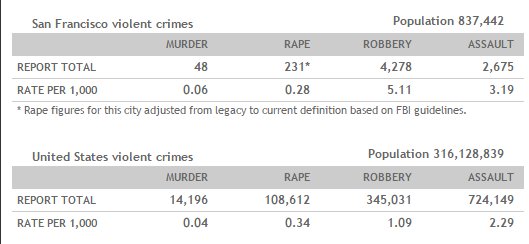
san francisco crime rates

Murder rate is 50% higher in San Francisco than in the US as a whole and robbery rates are almost 5 times higher.

Not much of a correlation then.


Now, suppose it was President Donald Trump…

September 27, 2015

With even Jeremy Corbyn “elected” as leader of the UK Labour Party, it is quite within the realm of possibility that Donald Trump could be the 45th President of the United States.

Of course, he may not even be the Republican candidate. But, just suppose, by some quirk of fate and a “perfect electoral storm”, he did become President.

It might, in fact, be just what the US needs (and maybe also what the voters deserve). The pendulum between “establishment politics” at one end needs to swing back towards individualism and leadership. “Establishment politics” where the party machinery dominates gives followers not leaders – and not just in the US. Ultimately, Barack Obama cannot be blamed for non-achievement – it is the voters who put him there who perceived a substance under the flattering surface which just wasn’t there. Trump may not be in the same “academically intellectual” class as Obama, but he may have a lot more substance under his unflattering exterior than Obama has. Even a clown like Trump could be more of a leader than an Obama “paralysed by analysis”. Trump’s only real claim to fame – or track record – is the money he has made. A non-politician in the White House who breaks the stranglehold that “party politics” has on government might be more than just refreshing. He might – for a time – actually be more successful.

No more apologies, no preaching, no more moralistic and sanctimonious pronouncements, no “ideologies” to pay lip-service to, no ambition to save the world from imaginary dangers, just a supreme pragmatism to serve the bottom line. The US could well do with looking at its bottom line  – for at least one presidential term.

His loyalty to his cabinet members would only stretch as far as their performance. On domestic policy (and he doesn’t have one at the moment), he would probably spend half a term in “fire-fighting” (immigration, health care, employment) and then focus on downsizing government (and public expenditure) and tax revisions. He might actually increase taxes at the highest end while reducing taxes for middle-income entrepreneurs. The banks and the finance houses could see some drastic curtailment of their privileges and tax-breaks. There could be a welcome shift in social and welfare matters away from “what you need” to “what you deserve”. Every government agency would be held to Key Performance Indicators.

Foreign policy (and he doesn’t have one at the moment) would be fascinating. It would be entirely pragmatic and the “politically correct” requirement of being sanctimonious would be removed. The double standards normally required in conventional diplomacy (supporting Saudi Arabia militarily while pretending to condemn their human rights, for example), would be thrown out of the window. Trade and geopolitical needs, untrammelled by any need to “demonstrate” a morally superior position, would dominate. Even the US military might find that their cosy, protected and privileged existence is suddenly shaken up by “performance reviews”. The US diplomatic corps would need to start looking at their “deliverables”.

One term of a CEO – rather than a “seasoned” politician – being President of the US could be just what the US, and US politics, needs.

POTUS: Socialists, atheists and Muslims need not apply

September 21, 2015

Ben Carson is getting a lot of flack – but what he said was that those whose values are not consistent with the US constitution should not be President, and that he believed that Muslim values were not consistent with the constitution. (I just heard an idiot BBC radio correspondent parse this to say that Carson had said that the Constitution disallowed Muslims and that was patently wrong). Carson could have chosen his words better and said instead that the “values of radical Muslims would not be consistent with the Constitution” and nobody would have been able to quarrel with that. Donald Trump is being criticised for not defending Barack Obama against someone who charged him with being a Muslim. (He countered – but later – that it was not his job to defend Obama).

But the real point here is that even all the mainstream media and all the “conventional” politicians see the characterisation of being a Muslim as negative and as an attack. Now why would that be? Why object to Obama being called a Muslim if that was not perceived as being derogatory?

In June this year, Gallup conducted a poll about the acceptability of different categories of people as President of the US (a question which apparently was first asked in 1937). The results are quite clear. For the country as a whole, socialists, atheists and Muslims need not apply.

Between now and the 2016 political conventions, there will be discussion about the qualifications of presidential candidates -- their education, age, religion, race and so on. If your party nominated a generally well-qualified person for president who happened to be _____, would you vote for that person? June 2015 results

The 3 least acceptable categories and their relative positions are the same across Democrats, Independents and Republicans.

Willingness to Vote for President of Various Backgrounds, by Political Party, June 2015

When looking at the differences by age, opinions are very soft for those between 18 and 29 ( which is to be expected since those under 25 have brains where the critical cognitive faculties are not fully developed). Opinions harden with age. But even here the 3 categories least acceptable across all age groups are always socialists, atheists and Muslims.

Willingness to Vote for President of Various Backgrounds, by Age, June 2015

Across all political parties and across all age groups, socialists, atheists and Muslims – in that order – need not apply. Of course what Gallup does not show is who the socialists, atheists and Muslims find least acceptable.

Bill Clinton probably forgot to wash the server before Hillary wiped it

September 13, 2015

It is probably a good idea to wash before you wipe.

The Washington Post is now reporting that Hillary Clinton’s private e-mail server may not have been “wiped” after all and that all her e-mails may well be recoverable. Hillary is probably not very amused. A month ago Clinton was being rather sarcastic about her “wiping” servers with a cloth. The FBI had reported that attempts had been made to wipe her server and Clinton responded at a press conference

When asked specifically if she wiped the server, she ‘ummed’ and ‘ahhed’ then jokingly said “what with a cloth or something?

washing up

But perhaps her dishcloth reference was based on reality. Perhaps she really did think that that was how servers were “wiped” clean.

Clinton probably just forgot that you must wash your server first before wiping it. Or was it that Bill, who she shared the server with, was supposed to do the washing while Hillary wiped?

WaPo:

The company that managed Hillary Rodham Clinton’s private e-mail server said it has “no knowledge of the server being wiped,” the strongest indication to date that tens of thousands of e-mails that Clinton has said were deleted could be recovered.

Clinton and her advisers have said for months that she deleted her personal correspondence from her time as secretary of state, creating the impression that 31,000 e-mails were gone forever. ……… To make the information go away permanently, a server must be wiped — a process that includes overwriting the underlying data with gibberish, possibly several times.

That process, according to Platte River Networks, the ­Denver-based firm that has managed the system since 2013, apparently did not happen. “Platte River has no knowledge of the server being wiped,” company spokesman Andy Boian told The Washington Post. “All the information we have is that the server wasn’t wiped.”

The server that Clinton used as secretary of state was stored at her home in Chappaqua, N.Y., and was shared with her husband, former president Bill Clinton, and his staff. The device was managed during that time by a State Department staffer who was paid personally by the Clintons for his work on their private system. ……….

All the e-mails from Clinton’s tenure at the State Department were on the server when the device was taken over in June 2013 by Platte River Networks, four months after Clinton left office. ………

A company attorney has said that all of Clinton’s e-mails were then migrated to a new server. The e-mails were removed from the second server in 2014, with Clinton’s attorneys storing those they deemed work-related on a thumb drive and discarding those that they determined were entirely personal. Copies of 30,000 work e-mails were turned over to the State Department in December and are being released to the public in batches under the terms of a court order.

So if it was all Bill’s fault maybe Hillary can turn this around.

By the numbers – Trump plus Carson could be formidable

September 12, 2015

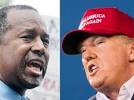
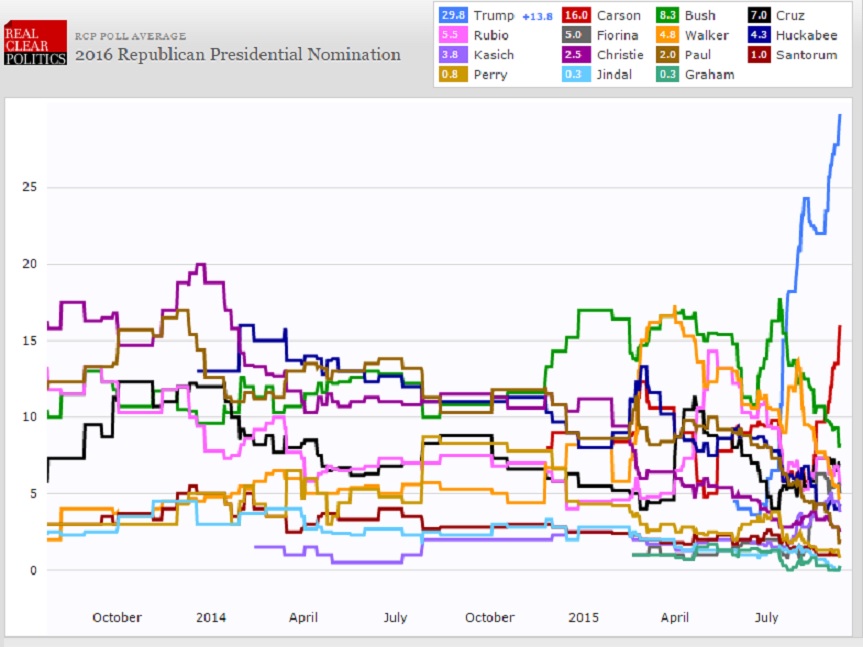
Trump-CarsonProbably unthinkable, but from the outside looking in, the numbers suggest to me that a Trump + Carson ticket could overwhelm all the other Republican candidates. One Republican candidate has left the race (Rick Perry). Huckabee and Santorum will probably be the next to leave. And the Trump bubble is not imploding as all expected. In fact, the polls suggest that Trump is still gaining strength.

From RCP:

trump plus carson

GOP polls on 12th September 2015 — Real Clear Politics

The Republican establishment has proven to be a most ineffectual opposition to a weak indecisive President. They have not been able to use their strength in the house to actually do anything except to try and block Obama. Trump and Carson could ride an anti-establishment wave (tsunami?).

Against the Democrats, it is then difficult to see what permutation or combination of Clinton, Sanders, Biden and anybody else could withstand a Trump + Carson ticket.

The entertainment continues.