Europe has to decide – immigration or tax incentives for having children

April 1, 2018

The latest fertility statistics in Europe present an unsustainable picture. Nowhere is the fertility rate at or higher than the replenishment rate of 2.1 live births per women. The average for Europe is under 1.6 with a mean age of 29 for a woman having her first child. France and Ireland have the highest rates but still less than 2.0 followed by Sweden, the UK and Iceland (all between 1.8 and 1.9). The lowest rates are in Poland, Portugal, Greece, Spain and Italy (all less than 1.4).

These levels are unsustainable.

A declining population if left to itself would lead to a catastrophic population implosion. The Black Death in England (1348-1350) reduced the population by over 30% and it took the country almost 100 years to recover. Europe today is relying on immigration to compensate for the low fertility. Initially, immigrants have a higher fertility rate than the society they move in to but within one generation they too display the prevailing fertility rates. Just relying on immigration creates social stresses and is also unsustainable.

Within the next twenty years most European countries will have no choice but to introduce tax incentives for having more children. In fact it is necessary now.


The speed of time (2)

April 1, 2018

The magical speed of an inconstant time (1).

Once upon a time (till about the 15th century) timeless meant badly timed. Since the 16th century it has been used almost exclusively to mean eternal and untimely is now used for badly timed. What puzzles me is that a time period – however measured – is not – and cannot be – time itself. A time period is to distance as time is to length. Time periods are all measured by observing a change which is assumed to be regular. We once thought the length of a day to be unchanging and took the day to be a period of time. We made the second fixed part of an unchanging day. Then we found that the rotation of the earth around its own axis was not regular. The period called a day was not an absolute measure. We have now shifted to the assumed regular frequency of vibration of a caesium atom in a particular state. This frequency is itself a time derivative – a change assumed to be regular (constant over time). But the regularity is an assumption. But even if this frequency eventually decays, and a second becomes longer than it is today, what is it that actually passes?

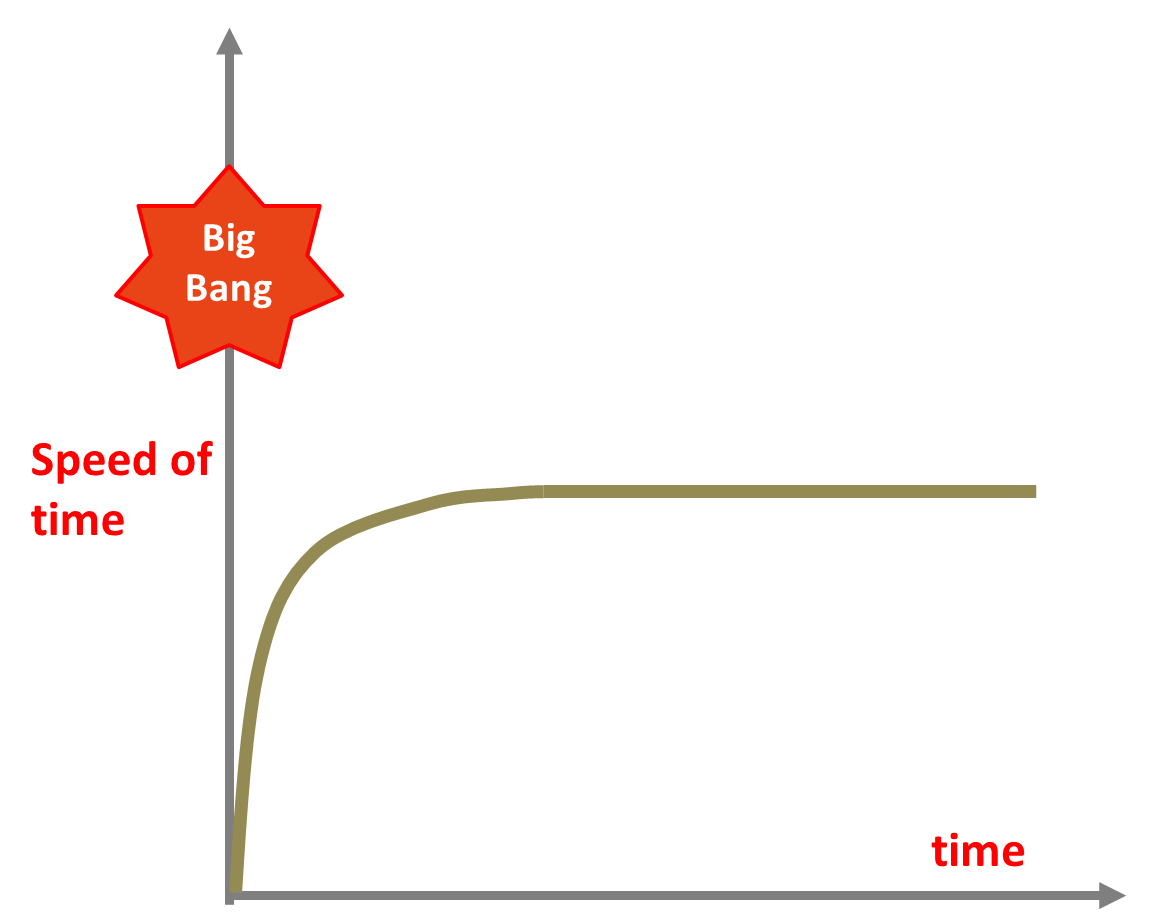
Does time flow? If it does, something called time must flow with respect to something else and it must therefore have a speed (a derivative).  Modern cosmology would have us believe that space and time are inextricably intertwined to make up a continuum – a la Einstein. Before the Big Bang there was no space and there was no time. And then came the Big Bang Singularity and both space and time were created (which is remarkably like a Creation Event). Time began to pass and there was space for the universe to expand into. But if time was not flowing, and then began to flow, it follows that it accelerated from a zero speed to whatever speed it flows at now. If the speed of time changed once, it can change again. It could go negative. In some other universe the omelette would give rise to the egg. But this brings us no closer to what time is.

We have to distinguish between the consequences of the flow of time (duration) and time itself. Without the flow of time there is no change, there is no motion. There is no life without the flow of time. It could be that if no change occurs, then time has not flowed, that the flow of the thing called time is necessary for change to occur. But change and motion are not themselves time. If the postulated space time continuum exists then there is no flow of time without space. If time does not flow there is only stasis. For matter of any kind to exist, even a fundamental particle, time must flow. For energy to exist, time must flow. And even if the wave theory prevails, the flow of time is required. Causality depends upon the flow of time. Not time, but the flow of time, is necessary for before and after and cause and effect.

Whether time is an intrinsic property of the universe or an emerging property it would seem to be a quantity that is unknowable within the dimensional constraints of the human mind. Perhaps the flow of time we observe is merely the shadow cast by something from a higher, unknowable dimension. But there is nothing that requires the flow of time to be constant or regular. As the universe and space expand perhaps the speed of time slows down.

It’s just magic.


Another fundamental human right?

March 26, 2018

This could be added as the 31st Article in the UN Declaration of Universal Human Rights but would probably need to be placed between the current Articles 18 and 19.

Freedom of identity choice:

Everyone has the right to freedom of choice of identity regarding race, colour or gender regardless of actual race, colour or gender. This right includes the freedom to change his/her/its identity of choice and the freedom to manifest his/her/its chosen identity in all his/her/its actions, behaviour, thought and observance.

A new fundamental human right?


Dwarf planets demand full planetary rights and an end to discrimination

March 26, 2018

The five dwarf planets (Ceres in the asteroid belt, and the trans-Neptunian planets led by Pluto)) have demanded that discrimination against them  cease immediately and that they be afforded full planetary rights along with the “Big 8”. Over 150 bodies are trans-Neptunian planets (TNPs) but only four are recognised as dwarf planets (Pluto, Eris, Haumea, and Makemake).

A spokesman for the TNP’s complained that the International Astronomical Union was being blatantly unfair against the “small and the distant” and was guilty of violating the fundamental, God-given rights of every planetary body. “The members of the IAU are all earthlings and small-minded and biased”, he said. “It is a travesty that even a planet as near the Sun as Ceres could be treated with such disdain”, he continued. He claimed that actually there were over 250 TNP’s but many had yet to be contacted. He accused the IAU of gross geocentrism. “It is morally unacceptable to deny these ancient planets their full rights and to stigmatise them by calling them dwarfs”. “Do we not all orbit the same Sun?”, he asked. ”

The International Astronomical Union denied any discrimination. A spokesman angrily refused to comment when accused of being geocentric. He denied that the IAU was steeped in dwarfism.


Real rights are dependent upon behaviour (part 4)

March 20, 2018

My behaviour strongly influences the behaviour of others towards me.

Any “right” I may have can only exist if the behaviour of others is, at worst, not opposed to my exercise of the right.

Therefore,

Any “rights” I may have are dependent upon my behaviour.


Stephen Hawking 1942 – 2018

March 14, 2018

It was Fred Hoyle who first used the term “Big Bang” but it is difficult not to associate Stephen Hawking with the Big Bang Theory.

But for me Stephen Hawking will forever be my inspiration for considering the ultimate question — What is time?

The magical speed of an inconstant time


Gendered aspects of the universe

March 12, 2018

The Canadian Environment Minister (how stupid can you get?) recently expressed concern for the “gendered aspects of climate change”.

I am no doubt incorrigibly sexist but I thought I would try and look at the gendered aspects of the Universe.

Mother Earth must be female and Father Sun must be male. Hydrogen must be male so that makes oxygen female in a polygamous relationship. I put Fire and Air as male which leaves Earth and Water to be female. Summer is male and so is Winter. Spring and Autumn are obviously female. Trees are male and grass is female. Weeds are male and Flowers are female. Beef, potatoes, asparagus and onions are male while chicken, cheese, tomatoes and cauliflower are female. Mushrooms are transgender.

Of the planets it is apparent that Mercury, Mars, Jupiter, Neptune and Saturn are male. Which leaves Venus, the Earth and Uranus (sort of) as female. Pluto has been neutered. Comets are male but galaxies are female. Double stars are gay. H, Li, Na, K, Rb, Ca and Fr are obviously male. It follows that He, Ne, Ar, Kr, Xe and Rn are all female. The rest of the periodic table falls in line. (Elements with odd atomic numbers are male and those with even atomic numbers are female).

If Physics is male then Chemistry is female. Metallurgy is male and Biology is female. Mathematics must be transgender. Sociology must be deviant.


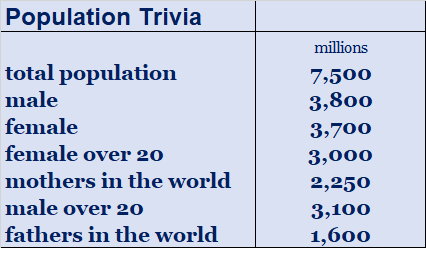
More mothers than fathers in the world

March 12, 2018

Just playing with the numbers.

Population trivia.

A very crude estimate suggests that about 1,000 million of the world’s 7,500 million are “only” children and have no siblings.


The New Eugenics

March 11, 2018

Eugenics, because of the way it was practised by the Nazis, has become a bit of a taboo word. But it has been practised in silence and by default for some time now.

ktwop (2013):

The trends I think are fairly clear. The proportion of “artificial births” is increasing and the element of genetic selection by screening for desired charateristics in such cases is on the increase. The number of abortions after conception would seem to be on its way to some “stable” level of perhaps 25% of all conceptions. The genetic content of the decision to abort however is also increasing and it is likely that the frequency of births where genetic disorders exist or where the propensity for debilitating disease is high will decrease sharply as genetic screening techniques develop further.

It is still a long way off to humans breeding for specific charateristics but even what is being practised now is the start of eugenics in all but name. And it is not difficult to imagine that eugenics – without any hint of coercion – but where parents or the mothers-to-be select for certain characteristics or deselect (by abortion) to avoid others in their children-to-be will be de rigueur.

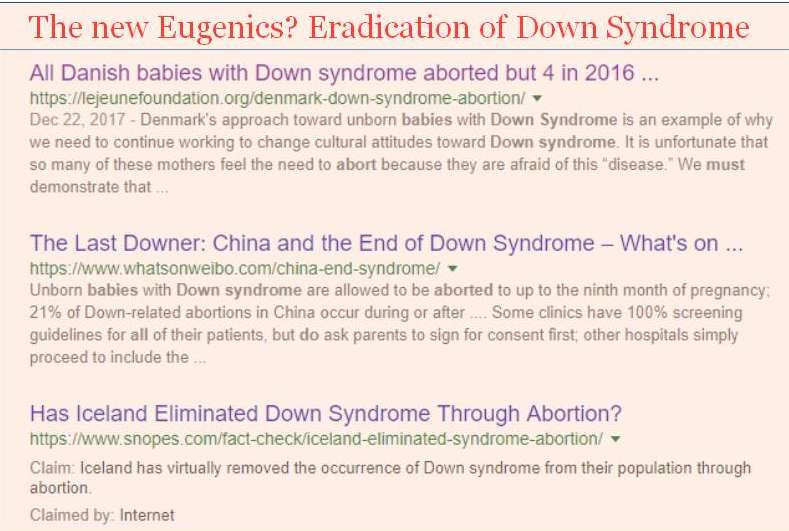
As neonatal screening techniques improve, eugenics is no longer just by default but is increasingly due to an active choice being made. Down syndrome is already well on the way to being eradicated.


Human rights are not universal and they are not free: The fatal flaw in the UN “Universal Declaration of Human Rights” (part 3)

March 10, 2018

In part 1  I proposed as a definition:

A right is entirely a social construct. .. I take a right to be an entitlement. It is a possession of status within some specified human society which gives its owner a privilege to act or not act in some specific manner, and/or a claim on other entities within the relevant society to act or not act in some specified manner. …… Rights can not – and do not – exist except when vested by a competent grant-giver in a qualified recipient.

A unilateral proclamation or declaration does not create a right. A human right can therefore only be created between two human parties, where the parties are identified and competent to fulfill their obligations (see part 2). For a right to truly exist, the behaviour of both parties in fulfilling the social contract is crucial. Any right which is an entitlement of one party is utterly dependant upon the behaviour of other involved parties. Without an acknowledged and accepted obligation of the other parties, no right exists. It is meaningless – and entirely insufficient – for third parties to declare that relevant other parties should or ought to have such obligations. A fundamental tenet of all valid contracts is that the parties involved commit to their obligations. It is not valid or acceptable for any party to create commitments for other parties. A contract can only be valid if the relevant parties freely enter into and commit to their own obligations.

Purported rights do not create or overcome behaviour. Actual behaviour creates real rights.

A true right can only exist if a valid social contract between a qualified party on the one hand and a competent party on the other, is in force.

The UN’s “Universal Declaration of Human Rights” (UDHR) was a knee-jerk reaction to the horrors of the Second World War and the state of the world immediately afterwards. Certainly intentions were good. But it was more a listing of pious hopes than any kind of a contract which could be a tool to change human behaviour. The UDHR was a document born of the Holocaust and a desire that such grotesque repression would never happen again. It was intended to be a compass for human behaviour. It has been the wrong tool at the wrong time.

It is my contention that the UDHR has not only failed to be an instrument for “improving” human behaviour, it has also legitimised the idea that purported rights are “free” and not linked to any qualifications or duties or standards of behaviour.

In the 70 years since it was formulated, the UDHR has been used as the “bible” for human rights legislation. But the state of humankind today in respect of the real rights accorded to an individual by surrounding society is in most cases no better than in 1948. In many instances it is very much worse. Human behaviour is not any better now, than it was then.   It is my contention that the UDHR has done more harm than good. It frees one party (“everyone”) from any obligations or duties or qualifications in the ownership of an entitlement. The other party which must grant and guarantee the right is never defined. As a “contract document” it is not fit for purpose. It has been counterproductive to its own goals because its very lack of rigour has given mere wishes and desires the false status of rights. This in turn has led to the dilution of the necessary requirements for real rights to exist. It has led us down the wrong path. It has provided a very shaky foundation for the legislation that follows which – not surprisingly – is then poor legislation.

Since it was formulated in 1948 and ratified in 1951, there have been more deaths due to recognised “genocides” than during the Holocaust. Religious fanaticism has increased. Freedom of belief has become the freedom to indoctrinate. Barbarism and terror is the new normal for an extremist. The nuclear family has been stripped of its dignity in many parts of the world. To not offend carries more weight than the voicing of true opinion. Mere accusations (especially on social media) now contain a presumption of guilt. Depravity is glorified in the name of “human rights”. Anti-social behaviour is “protected” by purported rights. Having signed up to the UDHR does not stop nations from cruel and unusual treatment of political opponents. States confiscate more of their citizens’ property than ever before under the guise of taxation. The depths to which human behaviour sinks (whether by Mexican drug cartels or by ISIS) has not changed since the Nazi atrocities.

The UDHR fails as a contract document because

  1. it does not address what constitutes a right, and
  2. it does not define the parties to the contract, and
  3. it does not define the obligations and liabilities of the parties, and
  4. it states that the subject of the contract (human rights) are universal, and therefore
  5. contains no commitment from the involved parties

The UDHR ends up being a good-intentioned but banal collection of maudlin platitudes. The entire content can just as well be summarised as Jack Nicholson’s character puts it in Mars Attacks, “Why can’t we all just get along?”. The UDHR was a document of its time. It had the best of intentions but it does not stand the test of time. If the goal was to improve human behaviour, it has led the world down the wrong path.

There is one fundamental, insidious, and corrosive flaw in the UDHR. It is a fatal flaw. This is the legitimising of the view that human rights are “free” and universal and unconnected to duties and obligations and standards of behaviour. It is this claim, that every individual, regardless of qualifications or duties, has entitlements which must be honoured by the rest of humanity without any obligations in return, which is the fatal flaw. Universality requires that the purported rights be “free” and that is why – as declared – they have no value in the real world. The perceived and the true value of any right depends upon the parties involved. Different rights have different values not only to the right-holder but also to the party granting and guaranteeing a right. Rights have a value for the right-holder and rights have costs for the guarantor. These values and costs are profoundly impacted by human behaviour.

There is also a philosophic failure in the UDHR. This is the adoption of the fantasy that human behaviour can be changed by proclamation and declarations in a top-down approach. There is an arrogance – albeit good-intentioned – in a text written by an elite purporting to represent all of mankind. Declaration of purported rights do not create behaviour. It is behaviour which creates and allows the manifestation of real rights. Human behaviour must of necessity begin with the individual, evolve locally and nationally and build up to the international. A top-down approach as in the UDHR is conceptually and fundamentally in error. If human rights are to be real they must first be created and ensured and exercised locally. They must first be rights which are clearly defined (not amorphous as in the UDHR) and specific (not universal and valueless) such that their ownership is clear and their exercise can, in fact, be guaranteed. Implementation at the local level can then be allowed and encouraged to grow to become global to the extent that shared values produce similar behaviour. Universal, amorphous rights as envisaged in the UDHR are necessarily non-existent and unenforceable. If human rights exist at all they start with my behaviour and yours, not with a sanctimonious declaration from the UN. Freedom of speech starts with what I am willing to allow my neighbour to say without triggering any opposing behaviour. If he slanders me then I find the cost of guaranteeing his free speech too much to bear and do what I can to silence him. Every right has a value and a cost. Behaviour creates the rights that are exercised. The rule of law has a part to play – but no system of law can guarantee compliance. In any event it can only begin with laws created at the local or national level to suit local or national rights which themselves have to be created and guaranteed. Global laws imposed on local societies is the cart before the horse.

Human rights are not “free”. They have value to the right-holder and a cost for the guarantor. And if they were “free” – as universality implies – then they have no value. It is by insisting on universality that the connection between rights and behaviour is lost. I suppose it really boils down to whether it is more important to make sanctimonious proclamations about what “human rights” ought to be, or whether it is more important to change human behaviour so that “human rights” are exercised and actually delivered.

The UDHR is written in the form of a contract with seven “whereas” clauses in the preamble, a proclamation clause and thirty Articles. But it is no treaty and no contract. It is just a declaration. As a contract document it is not fit for purpose since the parties to the contract, their obligations and liabilities are all undefined. Even the subject of the declaration – “human rights” are undefined. To its credit it has served as the basis of much legislation. But it has failed in its purpose of improving human behaviour – if that in fact was its purpose. It undermines itself by declaring human rights to be free and universal (and therefore of no real value).

As the UDHR is written even a divine power, if one existed, could not guarantee the purported rights


This is a commentary on why I find the UDHR not fit for purpose as a contract document.

UDHR commentary

The UDHR is not fit for purpose as a contract document because 

  1. The parties to the contract are undefined.
  2. Neither are the concepts of “rights” and “dignity”.
  3. In a contract document the whereas clauses in the preamble are introductory statements of fact that mean “that being the case.” In the UDHR the preamble and its whereas clauses are, at best, ungrounded statements, and at worst, statements of religious belief.