Archive for June, 2017

The inherent logic of the universe – but not language – was established by the Big Bang

June 16, 2017

You could call this the First Law of Everything.

Logic is embedded in the universe.

At the Big Bang we have no idea what the prevailing laws were. Physicists merely call it a singularity where the known laws of physics did not apply. It was just another Creation Event. But thereafter – after the Big Bang – everything we observe in the universe is logical. We take logic to be inherent in the Universe around us. We discover facets of this embedded logic empirically and intuitively (and intuition is merely the synthesis of empiricism). We do not invent logic – we discover it. If logic was ever created it was created at the time of the Big Bang.

Language, on the other hand, is invented by man to describe and communicate the world around us. We build into the framework of our languages, rules of logic such that the use of language is consistent with the embedded logic of the universe. But language is not always equal to the task of describing the universe around us. “I have not the words to describe ….”. And then we imbue old words with new meanings or invent new words, or new grammar. But we never make changes which are not consistent with the logic of the universe.

Reasoning with language is then constrained to lie within the logical framework so constructed and therefore, also always consistent with our empirical observations of the universe around us. Given certain assumptions – as expressed by language – always lead to the same logical inferences – also as described by that language. Such inferring, or reasoning, works and – within our observable universe – is a powerful way of extrapolating from the known to the not-yet-known. The logical framework itself ensures that the inferences drawn remain consistent with the logic of the universe.

In the sentence “If A is bigger than B, and if B is bigger than C, then A is bigger than C”, it is the logic framework of the language which constrains if, then and bigger to have meanings which are consistent with what we can observe. The logic framework is not the grammar of the language. Grammar would allow me to say: “If A is bigger than B, and if B is bigger than C, then A is smaller/louder/faster/heavier than C”, but the embedded logic framework of the language is what makes it ridiculous. The validity of the reasoning or of inferring requires that the logic framework of the language not be infringed. “If A is bigger than B, and if B is bigger than C, then A is smaller than C” is grammatically correct but logically invalid (incorrect). However, the statement “If A is bigger than B, and if B is bigger than C, then A is heavier than C” is grammatically correct, logically invalid but not necessarily incorrect.

Mathematics (including Symbolic Logic) also contains many languages which provide a better means of describing facets of the universe which other languages cannot. But they all contain a logic framework consistent with the embedded logic of the universe. That 1 + 1 =2 is a discovery – not an invention. That 2H2 + O2 = 2H2O is also a discovery, not an invention. The rules for mathematical operations in the different branches of mathematics must always remain consistent with the embedded logic of the universe – even if the language invented has still to find actual application. Imaginary numbers and the square root of -1 were triggered by the needs of the electrical engineers. Set theory, however, was only used in physics and computing long after it was “invented”.

Languages (including mathematics) are invented but each must have a logical framework which itself is consistent with the inherent logic of the universe.


Number theory was probably more dependent upon live goats than on raindrops

June 14, 2017

It used to be called arithmetic but it sounds so much more modern and scientific when it is called number theory. It is the branch of mathematics which deals with the integers and the relationships between them. Its origins (whether one wants to call it a discovery or an invention) lie with the invention of counting itself. It is from where all the various branches of mathematics derive. The origin of counting can be said to be with the naming of the integers, and is intimately tied to the development of language and of writing and perhaps goes back some 50,000 years (since the oldest known tally sticks date from some 30,000 years ago).

How and why did the naming of the integers come about?  Why were they found necessary (necessity being the cause of the invention)? Integers are whole numbers, indivisible, complete in themselves. Integers don’t recognise a continuum between themselves. There are no partials allowed here. They are separate and discrete and number theory could as well be called quantum counting.

Quite possibly the need came from counting their livestock or their prey. If arithmetic took off in the fertile crescent it well may have been the need for trading their live goats among themselves (integral goats for integral numbers of wives or beads or whatever else they traded) which generated the need for counting integers. Counting would have come about to fit their empirical observations. Live goats rather than carcasses, I think, because a carcass can be cut into bits and is not quite so dependent upon integers.  Quanta of live goat, however, would not permit fractions. It might have been that they needed integers to count living people (number of children, number of wives …..) where fractions of a person were not politically correct.

The rules of arithmetic – the logic – could only be discovered after the integers had been named and counting could go forth. The commutative, associative and distributive properties of integers inevitably followed. And the rest is history.

But I wonder how mathematics would have developed if the need had been to count raindrops.

After all:

2 goats + 2 goats = 4 goats, and it then follows that

2 short people + 2 short people = 4 short people.

But if instead counting had been inspired by counting raindrops, they would have observed that

2 little raindrops + 2 little raindrops = 1 big raindrop.

They might then have concluded that

2 short people + 2 short people = one tall person

and history would then have been very different.


Conservation denies tigers a future as a species

June 13, 2017

There are, it is thought, around 4,000 tigers still living in the “wild”. There may be as many as 8 – 9,000 in captivity (3,000 in China and perhaps 5,000 in the US). The tigers in captivity are in zoos and parks and are, in the US, often bred for “hunting”. Very few (< 100 perhaps) of those in captivity are returned to the “wild” every year. Breeding hybrid tigons and ligers once used to be very popular in zoos but less so now though it is still prevalent for entertainment purposes. The numbers are not very significant.

Tigers are magnificent animals and a cultural icon for humans. No doubt the sabre-toothed tiger was an even more magnificent creature. It is surely a matter of regret that they became extinct a long time ago. As a species they were replaced by others which were more suited to the changing world. If present-day tigers (considered endangered) were to become extinct, it would also be a matter of much regret. But I find the rationale for “conservation” efforts flawed and illogical. The WWF (which is close to being one of my least favourite organisations) writes in a typical woolly-headed, gushing style:

Yet they are more than just a magnificent animal – they are also crucial for the ecosystems in which they live. As top predators of the food chain, tigers keep populations of prey species in check, which in turn maintains the balance between herbivores and the vegetation upon which they feed. Balanced ecosystems are not only important for wildlife, but for people too – both locally, nationally and globally. People rely on forests, whether it is directly for their livelihoods or indirectly for food and products used in our daily lives. ……… Tigers not only protect the forest by maintaining ecological integrity, but also by bringing the highest levels of protection and investment to an area. Tigers are an “umbrella species” – meaning their conservation also conserves many other species in the same area. They are long-ranging and require vast amounts of habitat to survive; an adult male’s home range varies from 150 km2 – 1000 km2.

Tigers are endangered because their habitats are disappearing. That habitat loss is fundamentally irreversible. As a species they already have no significant role to play in the ecosystem prevailing. They have already become a redundant species biologically even if the concept of majestic tigers roaming wild forests still has a massive emotional impact on the selfish human psyche. Creating new tiger reserves – constrained in area by various means –  is little more than creating glorified zoos. They are just parks where the cages are a little bigger.  The tigers themselves are “frozen” into their current, unsuccessful, unsuitable, failed genetic state. They are doomed to continue unchanged and unchanging in a shrinking and ever more unsuitable habitat. There are no natural selection pressures (or artificial selection measures) in play which would make their descendants more capable of surviving in the new habitats due to changes that have already happened and have yet to come. This “conservation” is not about helping the tiger to survive by evolving but is only about freezing them into an increasingly untenable form. It is backwards looking and all about preserving failure.

I am even more convinced that traditional “conservation” is misguided and is done just to satisfy the emotional needs of humans, and not, in any way, forward-looking to help endangered species to adapt and survive into the future.

Fighting against species extinction is to deny evolution   – (ktwop – 2013)

So what then is the objection to – say – tigers becoming extinct which is not just an emotional reaction to the disappearance of a magnificent but anachronistic creature?  The bio-diversity argument is not very convincing and is of little relevance. To artificially keep an unsuccessful species alive in a specially protected environment has no genetic value. It increases the mis-match between the existing environment and the genetic profile needed to survive in that environment. In fact the biodiversity argument is only relevant for “life” in general and never for any particular species or group of species.  It can serve to maintain a very wide range of genetic material in the event of a catastrophe such that some form of life has a chance of continuing. But given a particular environment biodiversity in itself is of little value. …

…. All those species which succeed into the future will be those which continue to “evolve” and have the characteristics necessary to thrive within the world as it is being shaped and changed by the most successful species that ever lived (though we cannot be sure how far some particular species of dinosaur may have advanced). Putting a tiger into a zoo or a “protected” environment actually only preserves the tiger in an “unsuccessful” form in an artificial environment. Does this really count as “saving the species”? We might be of more use to the future of the tiger species if we intentionally bred them to find a new space in a changed world  – perhaps as urban tigers which can co-exist with man.

Smilodon image DinoAnimals.com

I’ll still make a donation to Project Tiger but that is about helping individuals to survive and has nothing to do with saving the species.


First nothingness was not, then came the Big Bang and the Gods came later

June 12, 2017

The Rig Veda was probably written between 1500 and 1200 BC and consists of 10 mandalas (books). The first and tenth books were probably written last. The 129th verse of the tenth mandala contains what is called The Hymn of Creation. Nasadiya sukta

It begins:

Then even nothingness was not, nor existence,
There was no air then, nor the heavens beyond it.
What covered it? Where was it? In whose keeping?

It is not difficult to equate this “then” to “before” the Big Bang and the “it” to all the compressed matter which participated in the Big Bang. (Accepting, of course, that “before” is meaningless when time does not flow).

Then there was neither death nor immortality
Nor was there then the torch of night and day.
The One breathed windlessly and self-sustaining.
There was that One then, and there was no other.

At first there was only darkness wrapped in darkness.
All this was only unillumined water.
That One which came to be, enclosed in nothing,
arose at last, born of the power of heat.

arose at last, born of the power of heat” sounds very like a modern description of the Big BangEven though the Rig Veda’s main 8 mandalas are in praise of various deities, the first and tenth books take a much more agnostic position – perhaps written to bring some balance. The plethora of gods are effectively made subservient to an unknowable, unfathomable creation event. “An atheist interpretation sees the Creation Hymn as one of the earliest accounts of skeptical inquiry and agnosticism”.

Who really knows?
Who will here proclaim it?
Whence was it produced? Whence is this creation?
The gods came later, with the creation of this universe.
Who then knows whence it has arisen?”

First even nothingness was not and existence was not. Then came the creation of the Universe whether by Big Bang or otherwise. And the Gods came later (made by man in the image of man).


The Big Bang singularity is indistinguishable from an Act of Creation

June 11, 2017

Most modern physicists and cosmologists who believe (note – believe) in the Big Bang theory of the Universe believe implicitly in an Act of Creation (the Big Bang Singularity) but then usually ignore the question of how and why the singularity occurred. They focus on the Act of Creation and after but do not address the cause of the singularity or a Creator. Religions of all kinds have their own Creation myths but focus on the presumed Creator much more than on the Act(s) of Creation.

(My own belief is that all religions live in the space of ignorance and physics – like all religions – is ultimately dependent upon Magic).

Stephen Hawking describes the Big Bang Singularity thus:

The situation was different, however, when it was realised that the universe is not static, but expanding. Galaxies are moving steadily apart from each other. This means that they were closer together in the past. One can plot the separation of two galaxies, as a function of time. If there were no acceleration due to gravity, the graph would be a straight line. It would go down to zero separation, about twenty billion years ago. One would expect gravity, to cause the galaxies to accelerate towards each other. This will mean that the graph of the separation of two galaxies will bend downwards, below the straight line. So the time of zero separation, would have been less than twenty billion years ago. 

At this time, the Big Bang, all the matter in the universe, would have been on top of itself. The density would have been infinite. It would have been what is called, a singularity. At a singularity, all the laws of physics would have broken down. This means that the state of the universe, after the Big Bang, will not depend on anything that may have happened before, because the deterministic laws that govern the universe will break down in the Big Bang. The universe will evolve from the Big Bang, completely independently of what it was like before. Even the amount of matter in the universe, can be different to what it was before the Big Bang, as the Law of Conservation of Matter, will break down at the Big Bang. 

Since events before the Big Bang have no observational consequences, one may as well cut them out of the theory, and say that time began at the Big Bang. Events before the Big Bang, are simply not defined, because there’s no way one could measure what happened at them. This kind of beginning to the universe, and of time itself, is very different to the beginnings that had been considered earlier. These had to be imposed on the universe by some external agency.

He goes on, however, to make an unsupportable conclusion.

There is no dynamical reason why the motion of bodies in the solar system can not be extrapolated back in time, far beyond four thousand and four BC, the date for the creation of the universe, according to the book of Genesis. Thus it would require the direct intervention of God, if the universe began at that date. By contrast, the Big Bang is a beginning that is required by the dynamical laws that govern the universe. It is therefore intrinsic to the universe, and is not imposed on it from outside. 

Genesis requires time to begin at 4004 BC and the Big Bang is no different in concept. It too defines the start of time and takes us back to 13.8 (give or take a few) billion years ago. Time is not defined before the Act of Creation – whether by the Big Bang or by the hand of God.

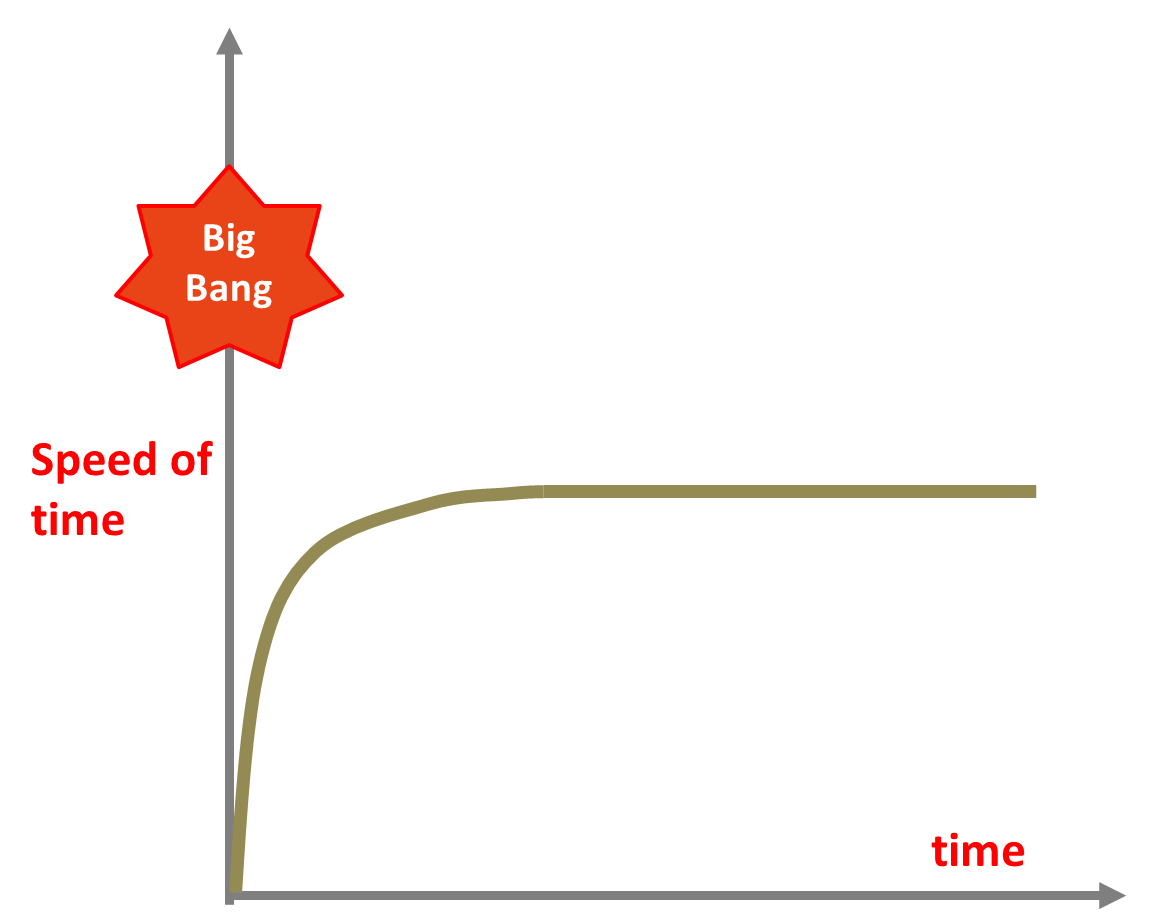
(Note that if the flow of time has a beginning then the concept of a before or an after has no meaning before the beginning of time.  The magical speed of an inconstant time).

Hawking concludes:

The conclusion of this lecture is that the universe has not existed forever. Rather, the universe, and time itself, had a beginning in the Big Bang, about 15 billion years ago. The beginning of real time, would have been a singularity, at which the laws of physics would have broken down. Nevertheless, the way the universe began would have been determined by the laws of physics, if the universe satisfied the no boundary condition. This says that in the imaginary time direction, space-time is finite in extent, but doesn’t have any boundary or edge. The predictions of the no boundary proposal seem to agree with observation. The no boundary hypothesis also predicts that the universe will eventually collapse again. However, the contracting phase, will not have the opposite arrow of time, to the expanding phase. So we will keep on getting older, and we won’t return to our youth. Because time is not going to go backwards, I think I better stop now. 

It seems to me that he contradicts himself when he says “The beginning of real time, would have been a singularity, at which the laws of physics would have broken down. Nevertheless, the way the universe began would have been determined by the laws of physics, …..” 

The Big Bang singularity where the laws of physics do not apply is just another Act of Creation. If the laws of physics do not apply at the singularity then, which laws or whose laws do? Or do the laws of physics change? Do they vary in different universes such as that which may have existed before the Big Bang?

Even a singularity must follow some laws. It is disingenuous of physicists and cosmologists to claim that the laws of physics break down at the Big Bang singularity and not address which or whose laws apply at the singularity. If, however, no laws apply at the singularity then the Singularity is Omnipotent (or Magic or God or whatever other label suits you).

I prefer to think it’s Magic.

The fundamentals of physics are just magic.