Archive for December, 2017

The magic which makes the speed of light what it is

December 8, 2017

Through the process of science we have discovered a great many “natural” constants that apply to our reality. These include  the speed of light in vacuum c, the gravitational constant G, Planck’s constant h, the electric constant ε0, and the elementary charge e. But why these constants are what they are – and not greater or smaller – still escapes us.

Physicists do not like to be contaminated by magic, but they do in fact invoke magic every time they use any of these so-called natural constants. That they are constant over time is itself an assumption without rhyme or reason as to why they should be so. That the passage of time is regular is itself a magical assumption. That a second now is of the same duration as a second 9 billion years ago or of the same duration as a second 10 billion years from now or at the other end of our universe are all just magical assumptions.

And so it is with the speed of light.

We have now fixed the speed of light in a vacuum at exactly 299,792.458 kilometres per second. Why this particular speed and not something else? Or, to put it another way, where does the speed of light come from?

……. Whether it was the ‘hand of God’ or some truly fundamental physical process that formed the constants, it is their apparent arbitrariness that drives physicists mad. Why these numbers? Couldn’t they have been different?  ……. leads us to the anthropic principle, the philosophical idea that what we observe in the Universe must be compatible with the fact that we humans are here to observe it. 

…… Why should the multiverse work like this, and not that? Perhaps it isn’t possible for the intellect to overcome a sense of the arbitrariness of things. We are close here to the old philosophical riddle, of why there is something rather than nothing. That’s a mystery into which perhaps no light can penetrate.

We don’t know why the speed of light is what it is. We don’t know what would have to be different in our universe for this speed to be different. We do not know if this value was always what it is now and will always be so. We don’t know if there are regions in our universe where it does not apply. It is what it is by magic.

I take the view that to the finite human mind some things are unknowable.

And as long as the unknowable exists in physics, physics must take recourse to magic. Giving magic a name or a label does not reduce its magicality.

 

Five decades

December 8, 2017

One ages and one gets nostalgic.

The past gets compressed into some kind of a zip-file in my memory and sometimes the file is difficult to open.

But five decades of a working life does not take much space to summarise.


Laws are made to be broken

December 7, 2017

This is from a before-dinner talk I gave recently.

image – open parachute

Today I return to a little paradox which leads to quite subversive thoughts. 

A few weeks ago I had a conversation with a lawyer. Have you noticed that even small talk with a lawyer takes on the character of an inquisition? If only laws were simpler we would not need lawyers, I thought. In any event, it made me think of the nature of the quality of laws. How should we define a good law? And what would be a bad law? 

Now, after a long evening you all need to wake up and follow my reasoning. 

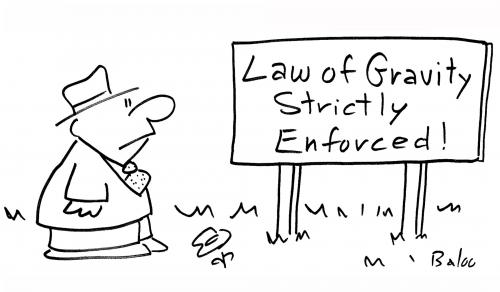
There are only two types of laws. We have either the natural laws of the universe or we have the myriad laws invented by humans. Even the so-called laws of the various gods have all been invented by humans. Note that the universe does not bother with proclaiming its laws. They just are. The universe does not even care if humans get the formulation wrong. No threat or punishment is required because it is impossible to violate these laws. Without any compulsion, it is guaranteed that everyone will comply with these perfect laws. 

So we can say that if everybody complies with a law it is an indication of a law of the highest quality. Perfect laws are those which – without any compulsion – are followed by everyone. As are the natural laws. Worthless laws are those not followed by anybody. Like the speed ​​limits on some motorways in Norrland, for example. But, a law that is followed by everybody, without compulsion, is not needed – is unnecessary, is redundant. 

All laws written by humans always fall between these limits of being useless on the one hand or unnecessary on the other. It may seem logical that a society makes a law so that everyone will comply. But that thinking is in error. If everyone does follow the law, it becomes a redundant law. Without laws there are no law breakers. It is not only that law breakers are created by human laws, human laws need law breakers. Laws are established in the first place to prevent some human behaviors which society judges to be undesirable. But if everyone follows a law then that law is unnecessary, and if no one follows that law it is worthless. One could well say that law breakers perform a fundamental and necessary service for society. They keep laws alive. Without law breakers, there would be no need for laws or legislators or lawyers. In a heaven without law breakers, and therefore, without any law makers or lawyers, there is no room for a legal system to exist. Without a system of justice, society collapses. 

The paradox for today is that if everyone followed all laws, the legal justice system would vanish and society would implode.

A society and its legal justice system depend – existentially – upon its law breakers.

I am forced to the inevitable but very subversive conclusion that human laws are all made – not to be followed – but to be broken.

Now it’s time for dinner.