Looking at some old class photographs I realised that about 15% of my school class has passed away.

Looking at some old class photographs I realised that about 15% of my school class has passed away.
The Universe was subject to a “Creation Event”. It was not, and then it was, (and if it always was it is even more troublesome). The Origin of Life is also a Creation Event. These two “creations” (of the universe and of life) are the great existential questions which require Magic.
Religion relies on the “inexplicable” to justify the invocation of Gods. God-magic. Atheism relies on the “power of reason” giving the lie to the existence of Gods. But atheism is merely a rejection of one set of labels and explains nothing. Religions vest their Gods with sufficient attributes to explain away what cannot be explained. Atheism merely ignores the inexplicable or claims the inexplicable to be a consequence of random events. Theologians and physicists alike merely give labels to what they cannot explain – as if the label is in itself an explanation. Anything inexplicable is what Magic is. Of course, Magic itself is just a label. I take the view that the nature of humans is such that some things are unknowable. The Universe exists in dimensions we cannot access or even perceive. We can, through the process of science and reason, discover the laws applying to the universe we perceive but, at every step of increased knowledge, we find new “whys” we cannot address. We now believe there are four fundamental forces of nature (gravitation, electromagnetism, strong nuclear, weak nuclear) but have no idea why they should be just four and not five or a thousand. Depending on how you classify them there are 12 or 57 fundamental particles. Why 12 or why 57 is just as much magic as when the universe was considered to consist of just fire earth water and air. Gravity and electromagnetism are just as magical now as they ever were. You could as well have a gravity-god or space-time magic. “Why time” is the essence of magic. The Origin of Life is also just a label for a Creation Event. There are weird and wonderful theories about this, ranging from a random event in the primordial soup to extra-terrestrial intervention.
All religions and theologians – at best – indulge in lazy thinking. Creation Events are just assigned to an appropriately defined God. Gods are just labels generated to answer unanswerable questions. Physicists and biologists are not quite as intellectually lazy but still resort to labels to explain away inexplicable Magic. Physics and cosmology define their own Creation Event and call it the Big Bang. To resolve all the problems with the Big Bang theory, it is deemed a singularity where the laws of known physics did not apply. It is then stated to be the start of known time which neatly dismisses any need to consider what came before. We still have no idea of how life came to be, or can be, created from non-life. Theologians merely put it down to a convenient God.
Magic = inexplicable.
The universe was created by a magical event and dances to magical tunes played by magical instruments. Life was magically created by other magical music within this universe. Atheists and priests and physicists and theologians all actually believe in Magic. God-magic is no different to Big-Bang-magic or origin-of-life-magic. A belief in a God is just as much a belief in Magic as a belief in the Big Bang is.
The global crude mortality rate is just under 1% (around 8/1,000 in developed countries with some countries up to about 15/1,000). As population ages the global rate will be around 9-10/1,000 by 2100.
Of those aged 50, the annual mortality rate is about 300/100,000. By the age of 60 this has increased to about 800/100,000 and then increases sharply to around 25,000/100,000 by 90 and encompasses virtually everybody by the age of 100. (There are currently about 300,000 people world-wide who are 100 years old and a handful who have reached 115 years old). On average women live around 4 -5 years longer than men.
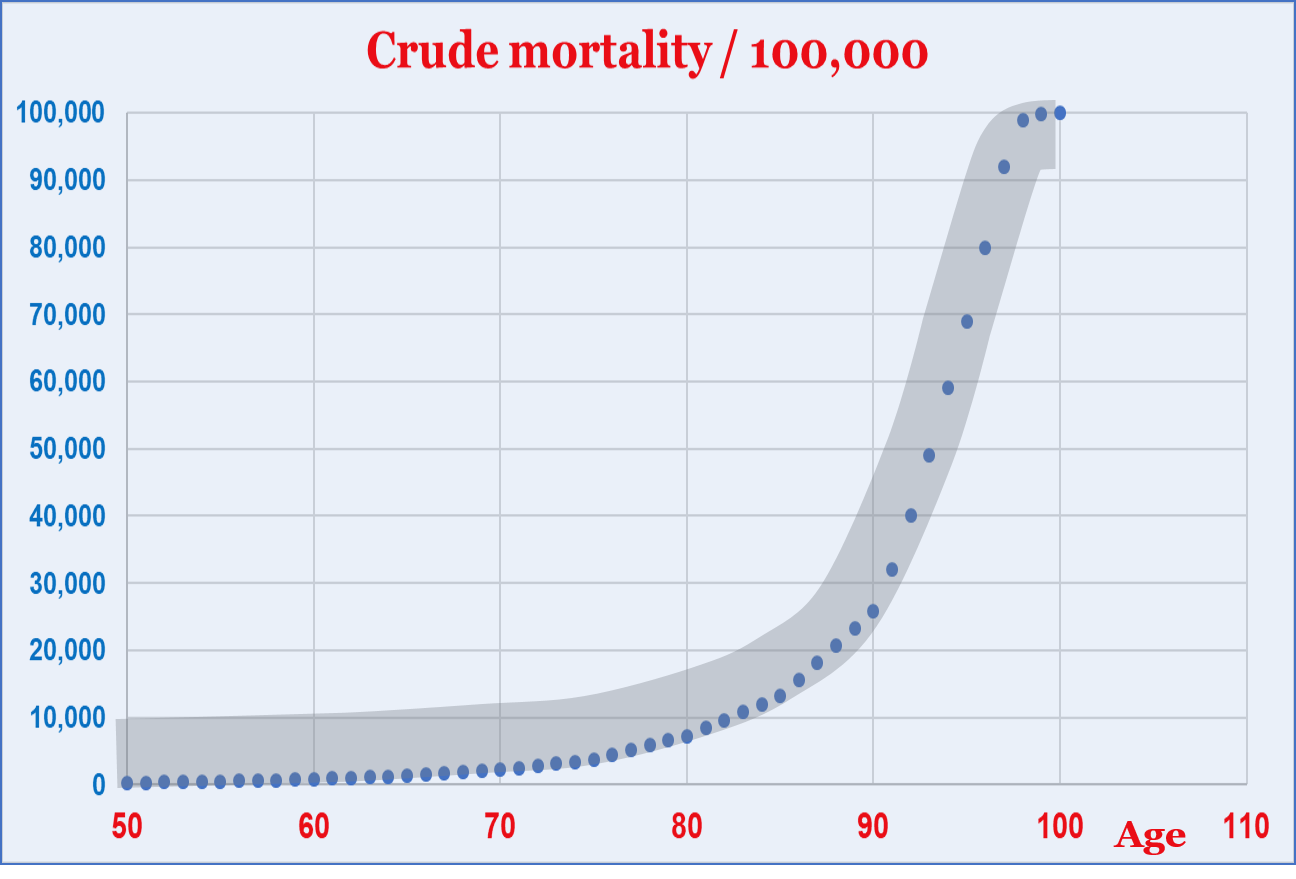
Defining “peers” to be those of a similar age, I assume that most people probably reach a maximum number of peer-acquaintances at a little over the age of 50. In my own case I would guess that this was probably when I was around 55.
An increasing mortality then applies to a dwindling cohort of peer-acquaintances. The longer one survives the faster one’s peer-acquaintances shrivel.

Setting peer-acquaintances to be 100% at 50 (and ignoring accretion of new peer acquaintances), their number has dropped to around 80% at 70, and have halved by the time one has reached 80. At our 50th school graduation anniversary when we were all around 65, around 10% of our classmates had passed away. By the age of 90, peer-acquaintances have dwindled to less than 10% of those who were alive at 50. Those who live to 95 have virtually no acquaintances of their own age left alive.
For those who survive to 80, half their peers have died by then. Loneliness is I think governed, not by the number of people surrounding you, but the number of peers one can communicate with. It is a cliche of course, but the longer you survive the dwindling number of your peers ensures the increase of your loneliness. If loneliness is inversely proportional to the number of peer acquaintances, then between 70 and 90 loneliness increases by a factor of 8.
The logic is rather simple.
It is not at all surprising then that the anti-fracking movement in Europe is both funded and covertly directed by Russia. The biggest success for the Russian campaign was in 2014 when many European countries succumbed to the Russian-backed, “environmental” lobbies and banned fracking. And Gazprom’s exports to Europe continue to increase steadily. Since 2014 annual exports have grown from about 145 to 190 billion cubic meters.
National Review: In 2014, after multiple European countries banned fracking following protests, NATO secretary general Fogh Anders Rasmussen warned that “Russia, as part of their sophisticated information and disinformation operations, engaged actively with so-called non-governmental organizations — environmental organizations working against shale gas — to maintain dependence on imported Russian gas.”
In 2015 alone, the intelligence community found that RT, Russia’s state-run media outlet, produced over 60 anti-fracking stories. “There are a lot of studies that say fracking is dangerous,” one RT segment began, “So why do you think some countries and companies think it’s worth the risk?” RT conveniently left out the fact that over 60 percent of Russian exports are oil and natural gas, and that countries that “risk” fracking would no longer be dependent on the Kremlin. In addition to peddling anti-fracking propaganda in the U.S., Russia is allegedly using an offshore shell company to directly fund American environmental groups. On June 29, Republican representatives Lamar Smith and Randy Weber wrote a letter to U.S. Treasury Secretary Steve Mnuchin demanding an investigation into the shell company:
According to the reports, entities connected to the Russian government are using a shell company registered in Bermuda, Klein Ltd. (Klein), to funnel tens of millions of dollars to a U.S.-based 501(c)(3) private foundation, the Sea Change Foundation (Sea Change). This money appears to move in the form of anonymous donations. Sea Change then passes the money originating in Russia to various U.S. 501(c)(3) organizations such as the Sierra Club, League of Conservation Voters Education Fund, and others. These funds are dispersed as grants that will be used to execute a political agenda driven by Russian entities. The purpose of this circuitous exchange of foreign funds is to shield the source of the money.
Before it was revealed publicly, members of the Sierra Club, et al., were likely clueless that Putin and the Russians had been funding their anti-fracking initiatives.

Russian gas exports to Europe are at record levels.
Russia is working to keep natural gas exports to Europe near record levels in 2018 after the continent’s biggest supplier, Gazprom said its deliveries this year signal it is achieving on its ambitions to expand. The state-controlled gas giant plans to ship a minimum of 180 billion cubic meters next year, Deputy Chief Executive Officer Alexander Medvedev said in an interview in St. Petersburg. That volume would be the second highest ever after at least 190 billion cubic meters expected this year, which is a record.
Gazprom meets more than a third of Europe’s demand for natural gas, Russia’s biggest and most lucrative market worth some $37 billion in revenue this year. Tighter trade links with the Kremlin-backed company contrast with increasing tensions on the military and political front.

source Gazprom
There is no generally accepted “theory of tradition”. In fact, there are few theories – psychological, social or anthropological – which explain why we follow tradition. Edward Shils presented his book Tradition (1981) as the first extensive study of the subject. James Alexander in his article writes:
Shils observes, as everyone does, that the word tradition comes from traditio, which is derived from the verb tradere, a combination of trans and dare, meaning to surrender, deliver or hand over. Tradition is not as simple as trade, that is, simple exchange: it is a word which for about two thousand years has been particularly associated with the handing over of something in time, by some sort of deliberate act of preservation or repetition or recollection, so that the something is not lost to the past. Traditions enable us to inherit things from our ancestors, bestow them on our successors. Shils understands tradition in terms of tradita (the plural of traditum): things which are handed over. These, he argues, can be objects, or beliefs, or simply the ways things are done. He defines tradition simply as “anything which is transmitted or handed down from past to present”
Shils definition of tradition is all encompassing
It includes buildings, monuments, landscapes, sculptures, paintings, books, tools, machines. It includes all that a society of a given time possesses and which already existed when its present possessions came upon it and which is not solely the product of physical processes in the external world or exclusively the result of ecological and physiological necessity.
This is too wide a definition of what tradition is and is not convincing. It is however clear that actions or behaviour or things that are “solely the product of physical processes in the external world or exclusively the result of ecological and physiological necessity” cannot be tradition. We breathe because we must and breathing is not “tradition”. But the manner in which we name ourselves is not dictated by necessity but by choice. Our names are established by, and are the continuation of, tradition.
But I observe that if what is/was necessity cannot be a tradition, then it must also mean that to become a tradition, some choice must have been made. An alternative to that tradition is, or must have been, available. The “handing down” across generations has not been eliminated from the definition of what tradition is but “repetition” even within the same generation has greater emphasis for any custom or behaviour to be considered tradition.
This leads me to the hypothesis that only such actions or behaviours or production of artefacts which can later become traditions are those which involved a choice. Thereafter, repetition by others is necessary. Repetition by sufficient “others” and over a sufficient length of time converts those actions or behaviours first to customs and thence to traditions. Traditions eventually die and so, my hypothesis continues, every tradition has a life cycle. It is born, it grows up, it continues and it dies.

Why then do some actions, customs, behaviours become traditions and others do not? I suspect it is an existential thing and has to do with the preservation of our identity. Where our identity, as an individual or as a group, is reinforced or enhanced by the repetition of some custom or action or behaviour, then that survives under the label of being a tradition. Every example I can think of as “the following of a tradition”, is, at source, a statement of identity. Traditions underscore differences. Different traditions define different groups. They may be family, or social group or caste or class or ethnic or national traditions. Traditions may involve choice of dress or food or music or literature or behaviour or a method of proceeding, but they all exhibit choice. They each have something to say about the identity of the practitioner and the group he associates with or belongs to. A Sunday roast is an identifying family tradition. A school uniform or military dress is identifying. The Pyramids are identifying of the Pharaonic culture. A suit in japan identifies the salary-man.
Whenever we follow a tradition we identify ourselves and the group we belong to. Every tradition is a primal statement of identity. We follow tradition to reinforce identity.

 The k2p blog