First you have nothing.
But let’s assume that a smooth and homogeneous “nothing” can spontaneously and inexplicably produce lumps of “something” provided it also produces equivalent amounts of “not-something”, where
something + not-something = nothing
On balance it would still be a global nothing but with local clumps of somethings and not-somethings.
This is a very handy subterfuge often used in science and mathematics. When looking for something unknown, zero can always be converted into the sum of something and not-something. So it is always possible to imagine what the something is, evoke it from zero and claim that the not-something exists but cannot be found.
0 = X + ~X
Anything can be derived from nothing provided its negative counter-part can also be tolerated (in absentia if necessary).
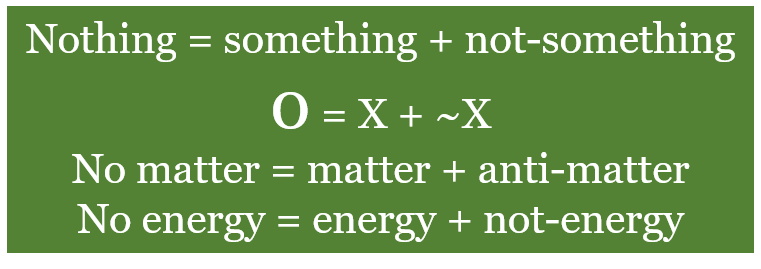
Nothing can be anything
We observe matter.
We haven’t a clue as to where this matter came from. So we devise the concept of matter and an equivalent amount of anti-matter at the origin of everything. But we cannot find this anti-matter in sufficient quantities to negate all the matter we observe. The global nothing is not preserved. That leads to the next subterfuge. It was all energy to begin with. Some of that energy converted itself into matter. That does not quite explain where that energy came from. Of course “nothing” might have decomposed into lumps of energy and of not-energy. The energy, it is then surmised, is that which is driving the expansion of the universe or the inflation of the universe or both. The lumps of not-energy are more elusive. Where that might be is not yet part of the next subterfuge.
It might be that matter has always existed, but in that case where did the energy moving that matter around come from? And why?
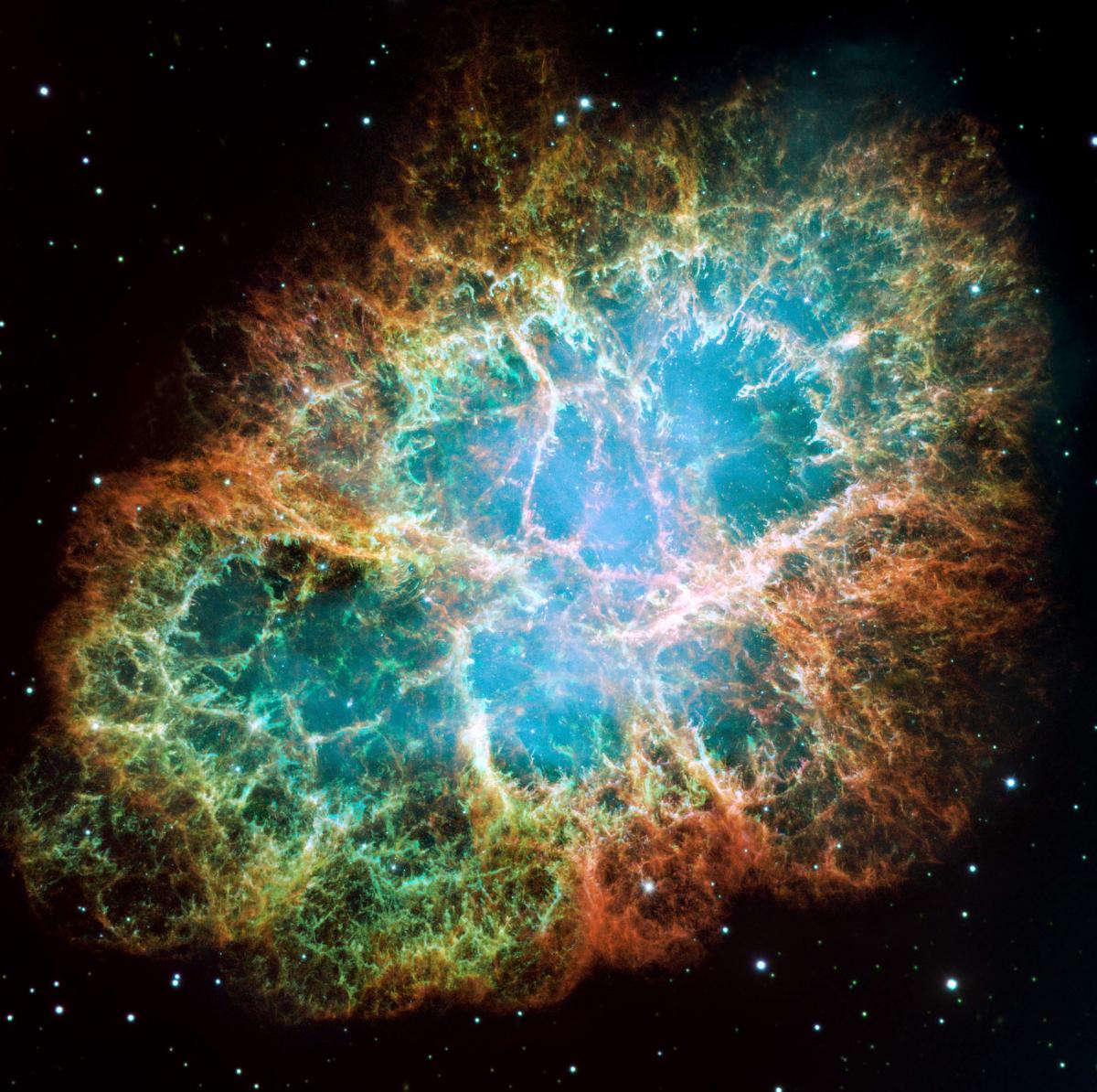
Where did all the antimatter go?
Scientists suspect that the Big Bang was a huge tear the fabric of space that ripped equal amounts of matter and antimatter into existence. But today, everything we see is made almost entirely of matter.
Physicists know that something must have happened to tip the balance in favor of matter during the formation of the universe. But the question remains, what was it? Antimatter particles are reflections of their matter counterparts. They are practically identical, except they have opposite electric charges. For instance, the antimatter twin of the negatively charged electron is the positively charged position. If an electron and positron were to meet and metaphorically ‘shake hands,’ they would annihilate each other into pure energy.
Scientists are left with this puzzle: If equal amounts of matter and antimatter were created in the Big Bang—and if matter and antimatter annihilate each other into a ball of pure energy on contact—then the universe should contain nothing but free, unorganized energy. But we exist, and therefore something must have happened to allow matter to survive and antimatter to all but disappear.
Scientists suspect that a tiny portion of matter—about one particle per billion—survived from the early universe to create all the planets, stars and galaxies we see today. And while matter and antimatter look almost identical, scientists discovered that the laws of nature do not apply to them equally.
Researchers found that some matter and antimatter particles can spontaneously transform into their matter and antimatter counterparts. They also found that matter and antimatter particles decay at slightly different rates. Scientists suspect that there is some hidden process influencing the behavior of matter and antimatter—a hidden process that could explain these puzzling observations. US scientists and our international collaborators study the subtle differences in the behavior of matter and antimatter particles at the LHC to paint a clearer picture of why our universe is matter-filled.
The bottom line is that modern physics hasn’t the faintest idea of where the matter and energy in the observable universe came from or why.
At least physics attempts to find answers. Religions brush aside the question and just assume a Creator where the question of where the Creator came from is disallowed.


 The k2p blog