Archive for June, 2021

Why don’t dogs do philosophy?

June 30, 2021

Philosophy is a product of idle minds.

First and foremost, minds are concerned with survival and the basic necessities of staying alive. Breathing, escaping predators, food and shelter – in that order. Having experienced severe asthma attacks many years ago, I put breathing unequivocally first. When struggling for breath there is no other thing, no pain, no emotion, no other higher-order need which can, or does, occupy the mind. The entire focus of the brain and the body is solely on getting the next gulp of air. It is only after the basic physiological need are satisfactorily met that the mind has the time over to be idle. It is only then, and providing that the body is not so exhausted or under physical stress such that the mind does not embrace sleep, that the mind feels free to wander down non-essential – but interesting – paths. And that leads to philosophy.

The word philosophy originates from the Greek meaning for love of wisdom. In practice, it is the formulation of fundamental, unnecessary, unanswerable questions about life, existence, reality and everything. Having formulated the unanswerable question, philosophy then spends hours of thought, circular arguments, a mountain of verbiage, a flood of circumlocution and reams of paper in proposing unsatisfactory answers. The greater the number of paradoxes that can be introduced into an argument, the deeper and more profound is the philosophy. (Metaphysics is merely a particularly obscure – but not necessarily more obtuse – part of philosophy). There is no philosophical question which can not be put off till another time; which cannot be interrupted for more important survival tasks; which cannot be abandoned for a glass of wine. However, a glass or two can aid the production of even deeper, more incomprehensible answers to the unanswerable questions. There is no answer which needs an action to be taken. There is no philosophy which cannot be replaced by another. Philosophical questions may be about the fundamental nature of life but they are not questions which need answers for day-to-day living. There is no urgency or deadline for finding answers. A professional philosopher has no deliverables – or at least none which need to make sense. Philosophy is an occupation for minds which are free from the burden of resolving the basic physiological needs of the bodies they inhabit. Philosophy is an occupation for idle minds.

But this raises another philosophical question. (Unanswerable of course).

Domesticated dogs have found a sustainable solution for their basic physiological needs. They are protected from predatory threats, have food provided at regular intervals and are well sheltered from the elements. They are not used by their human master-slaves as food (except in Korea). They are generally well respected by their master-slaves in sickeness and in health. The solution does not come free. They have to accept the curtailment of many freedoms. Their human master-slaves control their movement, their diet, their friends and their breeding partners. Nevertheless, their minds are entirely and wonderfully free from the burdens of meeting their fundamental physiological needs. Their idle minds have all the time they could possibly need for unnecessary, unanswerable questions.

So why don’t dogs do philosophy?


How do I know I know what I know?

June 28, 2021

Most of what I say I know is actually what I only believe I know. It is only what I know by my own experience or reasoning or argument or calculation that has a higher status  – in my mind – than a belief. When I say I know the Earth is an oblate spheroid, it is not from my own experience but from that of others who I believe. In reality I believe I know that the Earth is an oblate spheroid. All that I know that is within my own experience is – at least in my own mind – a higher level of knowing than all that I believe I know from the experience of others.

It has always been a little, irritating niggle at the back of my brain that I can never know that what I interpret and experience as red in my mind may be what somebody else experiences in the same way as I experience brown. What I can communicate with another person are the labels red or brown. My brain has no other means of communicating what I experience as red except by the labels that language allows. What exactly does knowing mean? 

When a tree falls in a forest and there is nobody to hear, there is no sound.

A sound is an interpretation by a brain of electrical signals generated by an organ for the detection of pressure fluctuations (vibrations) in air. When the tree falls it generates air pressure fluctuations. If there is no ear to detect the signals, there is no sound. If a deaf person is in the forest there are vibrations but there is no sound. If the vibrations are detected, but there is no brain to interpret the signals, there is no sound. A recording device detects air vibrations and converts them into something else which can be stored. The stored signals can later be used to reproduce those air vibrations through another device, which can then be interpreted as sound by a brain which has an ear to hear. But the recording device does not detect or record sound. A tape recording replayed on the moon’s surface has no atmosphere to vibrate and would create no sound, even if an intrepid astronaut with both an ear and a brain was standing next to it. Sound is in the brain and is both enabled and constrained by the physical capabilities of the hearing organ connected to that brain. The same pressure fluctuations may generate different interpretations of sound in different human brains. Cacophony to me is what is called modern music by others. The connection between the human ear and the human brain are similar to, but not the same as, the connection between a canine ear and a canine brain. My inability to fully appreciate a wolf’s howl is the same type of inability as of a wolf listening to Beethoven. Who knows what the other hears?

Sound is a cognitive thing. It is of the brain and necessarily subjective. 

And so it is with knowing. To know is a cognitive thing. It is of the brain and necessarily subjective.

My best, considered definition of knowledge goes like this: Knowledge is anything and everything, but only those things, that a brain can comprehend to be knowledge

This is a somewhat circular definition and is a little unsatisfactory because it does not say very much more than that knowledge is what knowledge is. But it is still the best that all our 10,000 years of philosophy and metaphysics has been able to come up with. Knowledge and knowing are not quite the same thing. As a noun knowledge is difficult enough but as a verb, to know is even more elusive. Knowing in philosophy is generally classified into three kinds of knowing:

  1. Knowing that – some proposition is true,
  2. Knowing how – to do something, and
  3. Knowing by acquaintance – by personal experience

I note that I cannot share my knowing. I can share a piece of knowledge (and that encompasses whatever my brain tells me I know) but another brain has to judge for itself whether it knows that piece of knowledge. How does my brain know that it knows? How do I know if what I know is true? Ultimately it seems to come down to what my brain believes that it knows and what it believes to be true.

The whole branch of epistemology is concerned mainly with the first kind of knowing where a brain knows that some proposition is true.  Knowing cannot, in itself, be conflated with being true. Many people once knew that the earth was flat. A brain may know what it knows but that knowing does not confer truth. Any such knowing is, no doubt, a piece of knowledge for that brain. Even if a certain knowing (say that the earth was flat) is shared by multitudes of people, that multiplicity of knowing is no less subjective and carries no greater truth value. Any brain may know many things which are, in fact, false. Many brains, because they are so similar, may know the same false things. The fact of knowing does not carry a truth-value, but it does carry a belief of truth for that particular brain. And that leads me to conclude that no truth can exist except as a subjective belief in a brain.

Knowing and truth are both subjective. They are both beliefs.

I had forgotten that I had written this about belief a few years ago:

Primordial Belief:

Most of what we therefore consider to be “our” knowledge is actually somebody else’s knowledge and not “known” to ourselves. However our belief in these persons leads to us claiming that knowledge as our own as being part of the body of knowledge available to humanity. The longer some statement has been within the body of knowledge, the stronger is our belief in that statement. Most of our actions are based then, not on our own personal knowledge, but on the belief that whatever lies within the body of knowledge of humanity is true.

But it strikes me that there is an assumption, a belief, which underlies every thought, every perception. This “primordial belief” is in fact implicit in every living thing. In fact it is so intrinsically intertwined with life that it may well be a part of the definition of what life is. This “primordial belief” is that the flow of time is unhindered and that a future exists. I breathe because there is future to breathe for. I cannot know when I take a breath that there will not be another one. Every living thing – a cell, a microbe, a virus, a tree or a human –  does what it does because there is a future (explicitly or implicitly) it believes it can live in. Even the very last breath I take will be taken in the belief that there will be another one to come. A belief in my future is existential.

A belief in a future is inherent in life. There can be a future without life (and there probably will be), but there is no form of life which does not have an implicit belief in its own future.

So every conscious mind (and that includes atheists, agnostics, religious fanatics, scientists and even economists) has this primordial, fundamental belief that a future exists. That, that future exists, can not be within the space of knowledge. All religions exist in the space of ignorance. But long before any of the “beliefs” they adopt comes the primordial belief that every living thing has  – that it has a future.

The G7 rule by the minority

June 13, 2021

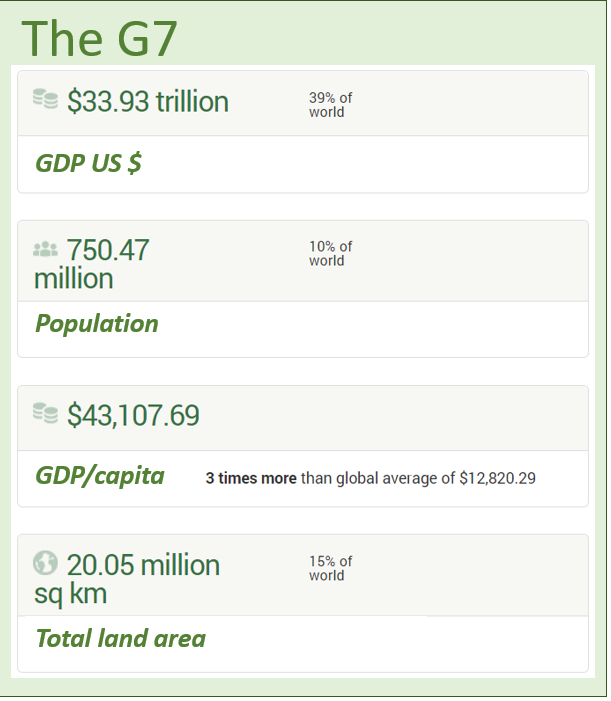
The G7 nations are meeting in Cornwall. Several terms come to mind:

  • Minority rule
  • Oppression by the minority
  • Redefining democracy
  • Undemocratic
  • Realpolitik
  • Non-violent, economic coercion

Source: Nationmaster.com

Oppression by the minority is self-evident. But we can rest easy since they are a virtuous lot. And we can be sure of that since virtually every press statement is about what good guys they are!

Ah well!


“Fakery” whether in art or documentaries is the norm but meaningless

June 12, 2021

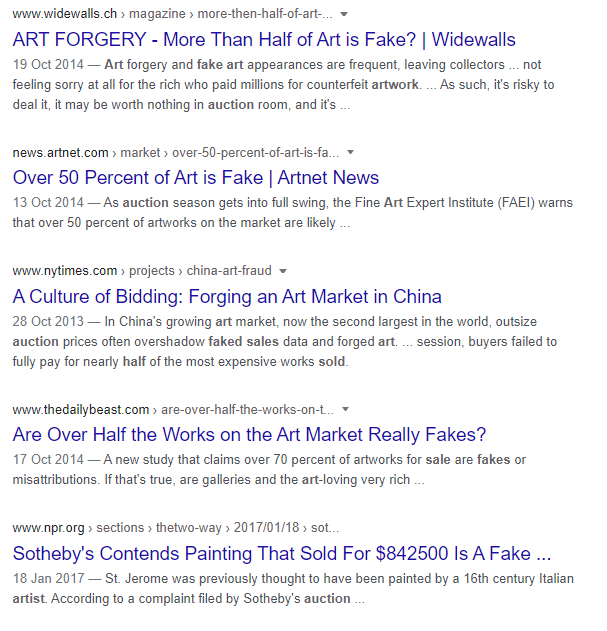
It has become almost a cliche to say that half of all the art in circulation is fake.

Of course this is about art forgery where some painting or sculpture is attributed to some famous (but usually dead) artist. It applies in the main to paintings (and sometimes to sculptures).  But value and artistic merit are quite different things. The value of a painting may differ by many orders of magnitude depending upon the artist or the attribution of the artist. But artistic merit is entirely subjective. There is no intrinsic artistic merit in anything other than that perceived in the mind of an observer.

Art Forgery:

Fake artworks are not unique to collectors and buyers. Museums and art galleries have fallen victim to this problem with some cases being on an epic scale. For instance, the Étienne Terrus Museum discovered that 82 pieces of art were fake! The museum held a dedicated showing for Étienne Terrus with 140 pieces of his art up for viewing. It was unveiled that almost 60% were fake. 

Cinema can be an art form. Cinema documentaries though are always about telling a story purporting to be the truth. But documentaries in cinema are faked and have always been faked.

The New Yorker: Documentaries have always been fake

Already in 1895, the primordial documentary, the Lumière brothers’ film of employees leaving the company’s factory, was staged by the filmmakers. And the film that turned their invention, the “cinématographe,” into a terrifying spectacle, “Arrival of a Train at La Ciotat,” contains the definitive and enduring gesture of acknowledged mutual implication, the glance at the lens of the camera. ..

Rouch became the exemplary reflexive filmmaker, and his view of the cinema began with the notion of performance. In “Les Maîtres Fous” (The Mad Masters), from 1955, he filmed members of a Ghanaian sect whose rites involved elaborate, politically influenced play-acting. Soon thereafter, in his seminal feature, “Moi, Un Noir” (Me, a Black Man), from 1958, he recruited a group of Abidjan residents, who had emigrated from Niger, to act out scenes from their own lives—which they did not merely under pseudonyms but in the guise of movie actors and character (named Edward G. Robinson, Eddie Constantine, Dorothy Lamour, and Tarzan). Filming with lightweight equipment and no synch sound, he then brought them into a studio to add dialogue that, with the lapse of time, also became a retrospective commentary on their own lives.

All TV documentaries are story-telling for entertainment or for an agenda. They lie on the borderline of claiming to be art. They are all faked in that images are chosen or manipulated to fit a narrative. There is no wildlife documentary which is not in fact faked in this way. (It is worth noting that much as I may like the David Attenborough documentaries there is not a single one where the narrative is not determined long before the images and audio are stitched together to bolster the narrative).


How Nature Documentaries Are Fake from DSLRguide on Vimeo.

Fake art is not generally used to describe pieces of music or literature though fake attributions to famous writers or composers (usually dead) are not unknown. Plagiarism is quite prevalent in producing new works of music or writing. Photoshopping or manipulating of images and then passing of the image as unmanipulated is also a way of faking art. Faked cinema is not so common. Advertising and fake reviews of cinema are the norm but they do not constitute faking of art. Of course, fakery is sometimes involved in cinema purporting to be art but that applies to anything claiming to be art rather than being perceived as art.

I take the simple view that what art is lies in the mind of the observer and is entirely subjective. Fake art then is about deceiving an observer into thinking that what he is purchasing – or merely admiring – is something other than what it is. But that too is a subjective perception. Fakery and art are both subjective value judgements but they lie on entirely different axes. A perception of being art always implies a judgement of admiration.

If an individual perceives something to be art then whether it is fake or not is irrelevant. An individual who perceives something to be fake may still perceive it to be art and may even perceive the fakery to be art. Perception of value is an entirely different thing.

An individual whose perception of artistic merit lies in whether something is fake or not is an idiot.


“To die will be an awfully big adventure” – or will it?

June 8, 2021

“To die will be an awfully big adventure.”  –  J.M. Barrie, Peter Pan

I have never been quite sure if the quote from Barrie’s Peter Pan is terribly profound or utterly banal.

Not because Peter Pan is not a brilliant and captivating reflection on losing innocence and on timelessness and that Neverland – in one way or another – is not something that has been imagined, in some form, at some time, in everybody’s mind. But because I am not sure if death can actually be considered a state at all. Certainly it is not a state that can be observed by the subject. Equally, before birth is not a state that is observable by the subject in question.

The philosophical difficulty I have is in trying to equate negations; to equate different kinds of zeros. Can the not being before birth be equated to the not being after death. In fact, can not being be considered a state at all? The state of the world in 1900 will be some thing other than the state of the world in 2100. Neither of these two states of being will include me. However, in the second case an identity that once was me would be present in records or in memory. That suggests that my not being after my death is somewhat different to my not being before I was born. But they both need an observer – who is not me.

Why does the universe go from a (presumed) simple ground state to a much more complex condition? Not to be – it seems – must always be simpler (in energy and complexity) than to be. Non-existence must be more parsimonious in the scheme of things than existence. Is it time which is the great disruptor? Why existence rather than non-existence remains the greatest mystery of all. “I think therefore I am” may be an indicator of consciousness but it is silent about being. We get tangled between language and philosophy, between philosophy and metaphysics. Nothing or no thing causes problems of language and of metaphysics. A thing must first be defined for a state of no thing to be discerned. Not any thing is quite different – in language – to no thing. It is much wider and encompasses all things. But even not any thing is restricted by human cognition to just those things that can be imagined. What is beyond human comprehension cannot even be addressed. A thing presupposes existence. The state – if it is a state – of not being is equally dependent upon first having in place the concept of being. Shakespeare’s Hamlet was questioning living rather than not living, and the meaning of life. But his “To be or not to be? That is the question ..” is probably more profound than Shakespeare ever intended and is the most fundamental question of philosophy and metaphysics. Why existence at all? What could be the question that existence is the answer to?

The living are irrelevant to a person not yet born. They are equally irrelevant to the dead. But note the inherent contradictions in the use of language. A person not yet born, or a person who is dead, is not a person at all – a non-person. We cannot, logically, speak about relevance to a person who is a non-person. As we age, it is not the state of being dead that causes much concern. The state of others as a consequence may be of concern. The process of dying and the accompanying pain and indignities give concern to many. But being dead is both linguistic and metaphysical nonsense. Being dead translates logically to the self-contradictory being a not-being. Just as an after-life translates to a logically nonsensical life after the end of life. Just as before the beginning is not logically sustainable. A person being dead causes ripples and even large waves in the surrounding world and among other people, but is never of any concern to persons who do not exist.

To be born is indeed an adventure.

I am not sure that to die is any kind of anything.


A learned judge is a biased judge

June 6, 2021

O learned judge!

An upright judge. A learned judge.

What you know you know is what you take to be true.

You do not know how you know what you know.

You cannot know that what you know you know is true. 

‘(All truths are subjective).

The more you learn the more you think you know.

(All learning does not necessarily lead to more knowledge).

The more you know the more learned you are.

The more learned you are the more you don’t know how you know what you know.

A bias is a predilection in favour of what you know or against denial of what you know.

An empty mind is free of any predilections.

The more you know, the more biased you are towards what you know.

To judge is to form conclusions based on what you know.

The more learned you are, the more biased you are.

A learned judge is a biased judge.


Bias is always a consequence of little learning.

All learning is little learning

Having more learning is always having more of little learning.


What’s so bad about bias?

A learned judge is a biased judge. An unbiased music critic with no prior opinions is a useless critic. A food critic without taste preferences would be unbiased but would also be worthless as a critic. Unbiased parents would show no preference for their own children. Without bias, “good” and “bad” start with equal value. I am incurably biased against what I consider “bad” and against people I don’t like. Bias is merely the current state of a functioning brain.


Statistical trivia if you are 70+

June 2, 2021

Triggered by somebody I know turning 70 today.

  • You are one of around 500 million people today who are over 70.
  • You were one of just 2.5 billion when you were born but are one of 7.5 billion today (therefore 3 times less important?).
  • However, you are also one of the Elders of the World and among the 7% of the world population over 70 (15% in Sweden, 14% in the US, 8% in China and 4% in India).
  • Globally the over 70s (7%) own about 40% of the world’s household wealth. (For reference, Bill Gates is not yet 70).
  • You are 4 times more likely to own your own home than the average adult.
  • It is more likely that your medical costs exceed what you spend on your car.
  • You are among the safest drivers on the roads but renting a car gets more difficult.
  • At an airport you are 10 times less likely to be profiled as dangerous.
  • You know what a slide rule was used for, can remember receiving a telegram and can recognise a telex machine.
  • The American Civil war was to you as World War 1 is to someone born today. 
  • Somebody who was 70 when you were born had lived through 2 World Wars.
  • 70 years before you were born there were no aircraft, no radios, no refrigerators, no X-ray machines, no steam turbines, no automobiles, no diesel engines and no zippers. But the telephone had been invented (just).