Archive for the ‘Academic misconduct’ Category

Publish to Retract: A new paradigm for research?

October 11, 2013

Retraction Watch has a story about a retraction accompanied by a blog post by the senior author – who requested the retraction. The senior author receives great credit for her transparency and integrity – no doubt well deserved.

Pamela Ronald does the right thing again, retracting a Science paper

But this is not the first time that a senior author has found a “mistake” in a publication and has then initiated a retraction. I observe that a paper retracted at the request of the author(s) usually leads to the general and admiring approval of the Journal and of peers. It has none of the stigma attached to a paper retracted by the Journal for plagiarism or data falsification or some other wrongdoing.

But looking through my jaundiced and cynical eyes, I wonder if this is just the start of a new paradigm in a brave new transparent world of research publication and retraction. Publish or Perish then gives way to Publish to Retract (or more accurately Publish quickly – to Retract if bad) which is then the name of the game.

  1. Dispense with time consuming data replication and other quality checks
  2. Rush to publication (but keep the retraction request ready)
  3. If any mistakes are subsequently suspected, warn the learned journal  that something is untoward and which is being investigated (best for the senior author to raise the suspicion about a potential mistake)
  4. Maximise citations of the work in question
  5. Find the mistake and request a retraction
  6. Retract in a blaze of publicity and gain brownie points for transparency and integrity

Junior authors – especially post-docs – are of course to be thrown under the proverbial bus. They only represent an acceptable level of collateral damage. Lists of publications may continue to include the retracted paper as long as it is done in the proper form

Author1, author 2….,Senior author x, Journal, Vol., page, date (retracted on date at the request of Senior author x)

Publication can then be very much faster and the potential downsides of mistakes or faulty analysis getting through to publication can be converted into the perceived benefits of transparency and integrity if the failings are ever discovered.

A hundred or so years ago it was not unknown for applicants to the Indian Civil Service to include something like this in their CV’s.

BA, Aligarh University, 1909, (fail)

It was of value for the applicant then to show that he had been accepted to sit for the exam. Having successfully run the gauntlet of peer-review in getting a paper accepted for publication (even if later retracted) could similarly be of some value.

Upstate Medical University researcher fabricated data to benefit his own company

October 10, 2013

UPDATE!!

Stem cell scientist says data in retracted paper “is not falsified or fabricated”

=========================

Researchers are not angels.

Just normal human behaviour from a man in a white coat.

GeroldFeuer2.jpg

Gerold Feuer, a professor of microbiology and immunology at Upstate Medical University

Syracuse.com:

A scientific journal has retracted a study by an Upstate Medical University researcher accused of using fake data.

The paper was authored by Gerold Feuer, who was found guilty last year of using state money and employees to benefit his private biotechnology company.

The article, first published in 2008, was retracted Oct. 4 by the journal Stem Cells. It focused on a virus that causes cancer in humans.

The retraction notice was published today by Retraction Watch, a blog that reports on retractions of scientific papers. The notice said the article was retracted after an investigation by Upstate’s research misconduct committee showed data used in the study had been “fabricated and/or falsified.”

Feuer, 53, of the town of Onondaga, landed $6.2 million in state grants in 2009 for stem cell research at Upstate. He oversaw a lab that bred mice without immune systems, then “humanized” them with stem cells to mimic the human immune systems. The mice are used in research studies.

Upstate suspended Feuer without pay in late 2010 while investigating his management of a research contract and the way he was operating his lab at Upstate. In 2008 Feuer had started his own private company to develop the same kind of mice for use in testing by universities and companies.

Upstate brought 53 charges of misconduct against Feuer, accusing him of using Upstate’s employees to perform services for his company and charging the cost to a state grant.

An arbitrator reviewed the case and in an Aug. 20, 2012 decision found Feuer guilty of 30 of the 53 misconduct charges. But the arbitrator said Feuer never intended to personally profit from the arrangement and should be reinstated.

Upstate reinstated Feuer, a tenured professor of microbiology and immunology, Feb. 18 at an annual salary of $116,196 and placed him in an undisclosed off-campus assignment.
It’s unknown what effect the latest misconduct finding will have on his employment status, said Darryl Geddes, an Upstate spokesman.

Upstate officials said they completed a separate investigation in April that found Feuer and Prabal Banerjee, a co-author of the paper, guilty of scientific misconduct. Banerjee now works for Feuer’s company, HuMurine Technologies Inc. Upstate officials said two other researchers involved in the study, Michelle Sieburg and Elizabeth Samuelson, did not do anything wrong.

Upstate has requested retractions of two other papers by Feuer published in other journals.

Marc Hauser publishes on “Evil”

September 27, 2013

Following in the footsteps of other fraudsters (Diedrik Stapel for one), Marc Hauser has published a new book on “Evil”. Since he left Harvard he has been involved with “brain training  (brain-washing?) of children at risk.

I suppose that a transgressor cannot be said to have no practical experience of morality though to say that he is particularly qualified to write about “Evil” is perhaps pushing it a bit. What constitutes “Evil” is of course rather subjective. Just as with Stapel there is no shortage of his advocates and apologists now rushing to praise his book. Just as with Stapel the New York Times (Nicholas Wade) appears to be providing some free promotion. Good Luck to him though I shall not be acquiring a copy.

Boston.com: 

Marc Hauser, the former Harvard University psychology professor who was found by federal officials to have fabricated and manipulated data, is publishing a book on the nature of evil, “Evilicious: Desire + Denial = Cruelty.”

The former professor, who has worked with at-risk youth on Cape Cod since leaving Harvard, announced on Twitter his book would be available October 15. On his blog, he said that the book will be available through Kindle Select, as an audio book, or as a print-on-demand book. ….

At the blog Retraction Watch, two who blurbed the book—Nicholas Wade, a New York Times science reporter and science writer Michael Shermer—said that they believe in second chances.

Another fraudster unmasked in Dutch academia: Anthropologist Mart Bax

September 23, 2013

After the unmasking of the massive scientific misconduct committed by Dirk Smeesters, Don Poldermans and Diedrik Stapel, the Netherlands can ill afford yet another scandal. But that would be living in hope. Now comes this scandal involving an anthropologist, Mart Bax, which appears to be just as massive a fraud.

It does seem that Dutch Universities are cleansing their academic stables. And by the amount of excrement being found it seems to be quite a task! I don’t think that attitudes and pressures in Dutch scientific research are much different to those in other parts of Europe. Which only suggests that while the Dutch are cleaning house, there is a great deal of muck waiting to be found in other countries.

(The picture in the earlier posting was not of Mart Bax but of the journalist who exposed him. The picture has been removed. My thanks to thinkerandtinker for pointing out my error and my apologies to Mr. Frank van Kolfschooten).

Bax retired as a Professor from the Free University (Vrije Universiteit) of Amsterdam in 2003. But for 15 years – at least – he has been making up data. He has invented places where he has claimed to have carried out research, he has made up titles for himself along with claims of non-existent teaching at prestigious universities. Some 64 papers of his 161 claimed publications do not exist.

  • Of the 161 publications claimed by Bax, 64 are non-existent.
  • The book Medjugorje: Religion, Politics, and Violence in Rural Bosnia (1995) mentions a blood feud for which there is no evidence at all. None of the inhabitants of the area are aware of anything like this happening.
  • Shortly after the publication of book mentioned above, Bax acknowledged that he misinterpreted some information, but claimed he did not have the chance to make any rectifications.
  • The commission established he did have the opportunity to rectify these errors at various occasions, yet never did.
  • After the publication of Medjugorje: Religion, Politics, and Violence in Rural Bosnia, Bax referred to the blood feud in three other articles, after he already acknowledged to be aware of the misinterpretation, which the commission labeled as “serious scientific misconduct”.

Retraction Watch: Bax, who studied an Irish town he called Patricksville, a Dutch pilgrimage site he called Neerdonk, and Medjugorje, a Bosnian pilgrimage site, retired from the Free University in 2002. The university began investigating Bax’s work last year after science journalist Frank van Kolfschooten published Ontspoorde Wetenschap (“Derailed science”). In that book, van Kolfschooten raised questions about Bax’s work into an alleged massacre at Medjugorje during the Bosnian War.

 NRC Handelsblad: Again fraud in science is exposed by a university inquiry. Former professor of political anthropology Mart Bax from the Free University has invented research, published nonexistent items put on his list of publications and  committed forgery in university documents. That concludes a commission of inquiry headed by historian Prof. Michiel Baud from the University of Amsterdam.

Volkskrant: The retired professor of political anthropology at the Vrije Universiteit Amsterdam Mart Bax has committed at least 15 years of serious scientific misconduct, forgery and plagiarism itself. That is the conclusion of the inquiry led by historian Michiel Baud in a report released today.  ….

The committee also calls it “very likely” that Bax has made up much of his fieldwork in Brabant and the Bosnian pilgrimage site of Medjugorje from his imagination. But the committee can not formally call it science fraud since Bax insists he was misled by informants themselves. Notes have been destroyed and the informants themselves are untraceable or deceased. The Committee therefore holds it as “serious scientific misconduct “,” deception” and “unethical scientific behavior”.

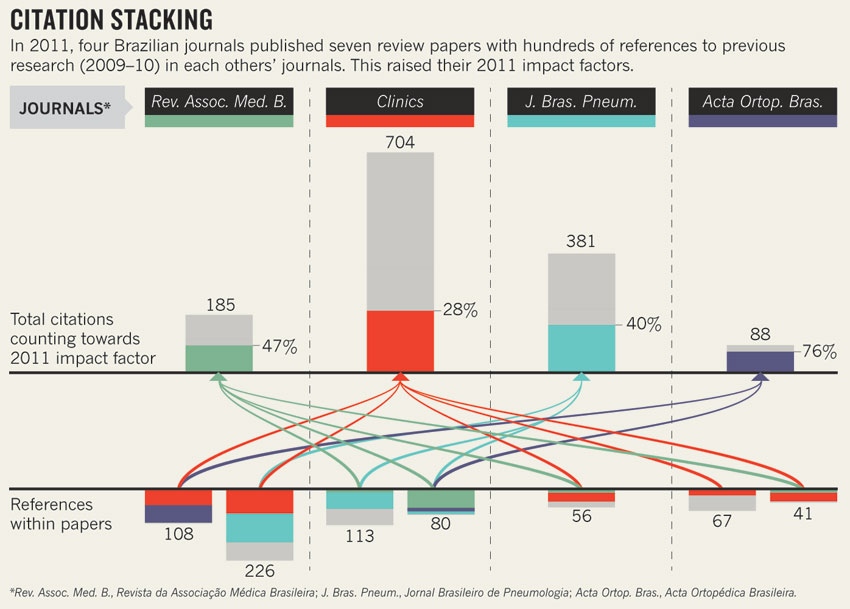
Citation stacking rife in Brazil

September 3, 2013

The impact factor of an academic journal is a measure of the average number of citations for articles in the journal. In the academic world it is always better to have your papers published by a “high impact” journal. For editors and publishing houses, impact factor is directly related to revenues earned. Over the years the methods of increasing the number of citations (not self citations, by articles in other journals and preferably from a different publishing house) and the impact factors of journals have become increasingly sophisticated.

Citation stacking has been the method that has developed where editors of journals – sometimes even from quite different publishing houses – have colluded to see to it that articles in their journals cited articles in the others. This has been going on for some time and a year ago THE reported that Thomson Reuters had suspended 26 journals for citation stacking.

“Anomalous citation patterns” is a euphemism for excessive citation of other articles published in the same journal. It is generally assumed to be a ruse to boost a journal’s impact factor, which is a measure of the average number of citations garnered by articles in the journal over the previous two years.

Impact factors are often used, controversially, as a proxy for journal quality and, even more contentiously, for the quality of individual papers published in the journal and even of the people who write them.

When Thomson Reuters discovers that anomalous citation has had a significant effect on a journal’s impact factor, it bans the journal for two years from its annual Journal Citation Reports (JCR), which publishes up-to-date impact factors.

In Brazil the Ministry of Education is obsessed by impact factor. In consequence publishing in high impact factor journals has become a matter of survival in academia.  Journals have been caught in a vicious cycle where nobody wants to publish in their pages because their impact factor is too low and their impact factor falls further because they have insufficient citations.

“By 2009, editors of eight Brazilian journals decided to take measures into their own hands”. 

Ciencia Brasil has been pointing out dubious cases in Brazilian journals for some time. The Brazilian scam has now reached the pages of Nature as Thomson Reuters suspends some Brazilian journals from its rankings for ‘citation stacking:

Brazilian citation scheme outed

Mauricio Rocha-e-Silva thought that he had spotted an easy way to raise the profiles of Brazilian journals. From 2009, he and several other editors published articles containing hundreds of references to papers in each others’ journals — in order, he says, to elevate the journals’ impact factors.

Because each article avoided citing papers published by its own journal, the agreement flew under the radar of analyses that spot extremes in self-citation — until 19 June, when the pattern was discovered. Thomson Reuters, the firm that calculates and publishes the impact factor, revealed that it had designed a program to spot concentrated bursts of citations from one journal to another, a practice that it has dubbed ‘citation stacking’. Four Brazilian journals were among 14 to have their impact factors suspended for a year for such stacking. And in July, Rocha-e-Silva was fired from his position as editor of one of them, the journal Clinics, based in São Paulo.

…. Editors have tried before to artificially boost impact factors, usually by encouraging the citation of a journal’s own papers. Each year, Thomson Reuters detects and cracks down on excessive self-citation. This year alone, it red-flagged 23 more journals for the wearily familiar practice. But the revelation that journals have gained excessively from citations elsewhere suggests that some editors may be searching for less detectable ways to boost their journals’ profiles. In some cases, authors may be responsible for stacking, perhaps trying to boost citations of their own papers.

The journals flagged by the new algorithm extend beyond Brazil — but only in that case has an explanation for the results emerged. Rocha-e-Silva says the agreement grew out of frustration with his country’s fixation on impact factor. In Brazil, an agency in the education ministry, called CAPES, evaluates graduate programmes in part by the impact factors of the journals in which students publish research. As emerging Brazilian journals are in the lowest ranks, few graduates want to publish in them. This vicious cycle, in his view, prevents local journals improving.

Abel Packer, who coordinates Brazil’s system of free government-sponsored journals, known as SciELO, says that the citation-stacking venture was “unfortunate and unacceptable”. But he adds that many editors have long been similarly critical of the CAPES policy because it encourages local researchers to publish in high-impact journals, increasing the temptation for editors to artificially boost their own impact factors, he says.

Nature 500, 510–511 (29 August 2013) 

Read the articledoi:10.1038/500510a

University of Queensland asks for a paper to be retracted and returns a grant!

September 3, 2013

An unusual event in the academic world. Commendable and exemplary – I think.

The University of Queensland (not to be confused with the Queensland University of Technology – QUT – which has also recently been in the news) has taken the unusual step of asking a major journal to retract a paper published by a former staff member and has returned a grant from an NGO thought to have been awarded on the basis of the discredited paper.

The University Press Release ;

The University of Queensland (UQ) is investigating events that have led to the retraction of a paper published in an academic journal. 

As a result of its investigation to date, UQ has asked the journal that published the paper to retract it on the grounds that: “no primary data can be located, and no evidence has been found that the study described in the article was conducted.” 

A former UQ staff member from the Centre for Neurogenic Communication Disorders Research was corresponding author on the paper. 

Published online in October 2011 in the European Journal of Neurology, the paper was titledTreatment of articulatory dysfunction in Parkinson’s disease using repetitive transcranial magnetic stimulation

The journal has agreed to the retraction. 

The paper in question seems to be this one:

B. E. Murdoch(1), M. L. Ng(2) and C. H. S. Barwood(1), Treatment of articulatory dysfunction in Parkinson’s disease using repetitive transcranial magnetic stimulation,  European Journal of Neurology, 19: 340–347. doi: 10.1111/j.1468-1331.2011.03524.x

The paper has been cited 8 times.

Author Information

  1. Centre for Neurogenic Communication Disorders Research, School of Health and Rehabilitation Sciences, The University of Queensland, St. Lucia, Qld, Australia
  2. Speech Science Laboratory, Division of Speech and Hearing Sciences, The University of Hong Kong, Hong Kong, China

*B. E. Murdoch, School of Health and Rehabilitation Sciences, The University of Queensland, St. Lucia, Qld 4072, Australia

ABC News reports:

The University of Queensland says a Parkinson’s disease study published by a former staff member may not have actually been carried out.

The university released a statement today saying that “no primary data can be located, and no evidence has been found that the study described in the article was conducted.”

UQ has asked the academic journal that published the research to retract the article, and the journal has agreed. The university said Professor Bruce Murdoch, a former staff member from the university’s Centre for Neurogenic Communication Disorders Research, was one of the authors of the article.

… The investigation is continuing and the Crime and Misconduct Commission has been informed, the statement said.

UQ has also returned a $20,000 grant from “a non-government organisation” because it fears the money was allocated on the basis of information in the article.

It said there was no National Health and Medical Research Council (NHMRC) funding for the paper.

“By having the paper retracted, the university enables the global scientific community to learn that the research reported in the paper has no place in the body of scientific knowledge and so cannot be used as a basis for further research,” the statement said.

Mathematical turbulence at Ege University, Turkey

August 28, 2013

Back in June I had reported on the strange case at Ege University

Retraction Watch reports on the retraction of a paper by a Turkish mathematician for plagiarism. The author did not agree with the retraction.

But what struck me was the track record of this amazing Assistant Professor at Ege University.

Ahmet Yildirim Assistant Professor, Ege University, Turkey

Editorial Board Member of International Journal of Theoretical and Mathematical Physics

  • 2009       Ph.D      Applied Mathematics, Ege University (Turkey)
  • 2005       M.Sc      Applied Mathematics, Ege University (Turkey)
  • 2002       B.Sc        Mathematics, Ege University (Turkey)

Since 2007 he has a list of 279 publications!

That’s an impressive rate of about 50 publications per year. Prolific would be an understatement.

But the link to his 279 publications is now broken which now only goes to a blank page.

Upon a little further investigation it became clear that not only does he no longer work at Ege University but that his PhD has also apparently been revoked.

Paul Wouters writes:

In mathematics and computer science, Ege university has produced 210 publications (Stanford wrote almost ten times as much). Because this is a relatively small number of publications, the reliability of the ranking position is fairly low, which is indicated by a broad stability interval (an indication of the uncertainty in the measurement). Of the 210 Ege University publications, no less than 65 have been created by one person, a certain Ahmet Yildirim. This is an extremely high productivity in only 4 years in this specialty. Moreover, the Yildirim publications are indeed responsible for the high ranking of Ege University: without them, Ege University would rank around position 300 in this field. This position is therefore probably a much better reflection of its performance in this field. Yildirim’s publications have attracted 421 citations, excluding the self-citations. Mathematics is not a very citation dense field, so this level of citations is able to strongly influence both the PP(top10%) and the MNCS indicators.

An investigation into Yildirim’s publications has not yet started, as far as we know. But suspicions of fraud and plagiarism are rising, both in Turkey and abroad. One of his publications, in the journal Mathematical Physics, has recently been retracted by the journal because of evident plagiarism (pieces of an article by a Chinese author were copied and presented as original). Interestingly, the author has not agreed with this retraction. A fair number of Yildirim’s publications have been published in journals with a less than excellent track record in quality control.  ….. 

How did Yildirim’s publications attract so many citations? His 65 publications are cited by 285 publications, giving in total 421 citations. This group of publications has a strong internal citation traffic. They have attracted almost 1200 citations, of which a bit more than half is generated within this group. In other words: this set of publications seems to represent a closely knit group of authors, but they are not completely isolated from other authors. If we look at the universities citing Ege University, none of them have a high rank in the Leiden Ranking with the exception of Penn State University (which ranks at 112) that has cited Yildirim once. If we zoom in on mathematics and computer science, virtually all of the citing universities do not rank highly either, with the exception of Penn State (1 publication) and Gazi University (also 1 publication). The rank position of the last university, by the way, is not so reliable either, as indicated by the stability interval that is almost as wide as in the case of Ege University.

And a commenter at Poul Waters site adds:

kuantumcartcurt Says:
July 4, 2013 at 12:30 PM

Thanks for this detailed post. It seems that Ahmet Yıldırım’s PhD was recently revoked since it was a direct translation of a book of Ji-Huan He who is also quite a questionable figure in academia (http://elnaschiewatch.blogspot.com.es/2011/02/ji-huan-he-loses-ijnsns.html). It also seems that he was dismissed from the university (again without any official statement).

Here is Ahmet Yıldırım’s PhD ‘thesis’:https://docs.google.com/file/d/0BxUoSj9K4YfeNDIwUUZGRWU1R2c/edit?pli=1
And this is Ji-Huan He’s book: https://docs.google.com/file/d/0BxUoSj9K4YfeZmZvdGpDQUVWY0E/edit?pli=1

It would seem that Ege University is carrying out some house cleaning but neither the University nor the International Journal of Theoretical and Mathematical Physics is saying anything.

Nature: “US behavioural researchers exaggerate findings”

August 27, 2013

The field of behaviour within social psychology has not covered itself with glory in recent times. The cases of Diedrik Stapel and Dirk Smeesters and Marc Hauser are all too recent. But I have the perception that the entire field – globally – has been subject to exaggerations and the actions of narcissists. I had not perceived it as being a particular issue just for the US. But I would not be surprised if the “publish or perish” pressure is stronger in the US than in many other countries.

But a  new study publsished in PNAS has ” found that primary studies whose outcome included behavioral parameters were generally more likely to report extreme effects, and those with a corresponding author based in the US were more likely to deviate in the direction predicted by their experimental hypotheses, particularly when their outcome did not include additional biological parameters. Nonbehavioral studies showed no such “US effect” …”

Fanelli, D. & Ioannidis, J. P. A.,US studies may overestimate effect sizes in softer research,  Proc. Natl Acad. Sci. USA  (2013), doi.org/10.1073/pnas.1302997110

Nature reports

US behavioural researchers have been handed a dubious distinction — they are more likely than their colleagues in other parts of the world to exaggerate findings, according to a study published today.

The research highlights the importance of unconscious biases that might affect research integrity, says Brian Martinson, a social scientist at the HealthPartners Institute for Education and Research in Minneapolis, Minnesota, who was not involved with the study. “The take-home here is that the ‘bad guy/good guy’ narrative — the idea that we only need to worry about the monsters out there who are making up data — is naive,” Martinson says.


The study, published in Proceedings of the National Academy of Sciences, was conducted by John Ioannidis, a physician at Stanford University in California, and Daniele Fanelli, an evolutionary biologist at the University of Edinburgh, UK. The pair examined 82 meta-analyses in genetics and psychiatry that collectively combined results from 1,174 individual studies. The researchers compared meta-analyses of studies based on non-behavioural parameters, such as physiological measurements, to those based on behavioural parameters, such as progression of dementia or depression.


The researchers then determined how well the strength of an observed result or effect reported in a given study agreed with that of the meta-analysis in which the study was included. They found that, worldwide, behavioural studies were more likely than non-behavioural studies to report ‘extreme effects’ — findings that deviated from the overall effects reported by the meta-analyses.
 And US-based behavioural researchers were more likely than behavioural researchers elsewhere to report extreme effects that deviated in favour of their starting hypotheses.


“We might call this a ‘US effect,’” Fanelli says. “Researchers in the United States tend to report, on average, slightly stronger results than researchers based elsewhere.”

This ‘US effect’ did not occur in non-behavioral research, and studies with both behavioural and non-behavioural components exhibited slightly less of the effect than purely behavioural research. Fanelli and Ioannidis interpret this finding to mean that US researchers are more likely to report strong effects, and that this tendency is more likely to show up in behavioural research, because researchers in these fields have more flexibility to make different methodological choices that produce more diverse results.

The study looked at a larger volume of research than has been examined in previous studies on bias in behavioural research, says Brian Nosek, a psychologist at the University of Virginia in Charlottesville. ….. 

Abstract

Many biases affect scientific research, causing a waste of resources, posing a threat to human health, and hampering scientific progress. These problems are hypothesized to be worsened by lack of consensus on theories and methods, by selective publication processes, and by career systems too heavily oriented toward productivity, such as those adopted in the United States (US). Here, we extracted 1,174 primary outcomes appearing in 82 meta-analyses published in health-related biological and behavioral research sampled from the Web of Science categories Genetics & Heredity and Psychiatry and measured how individual results deviated from the overall summary effect size within their respective meta-analysis. We found that primary studies whose outcome included behavioral parameters were generally more likely to report extreme effects, and those with a corresponding author based in the US were more likely to deviate in the direction predicted by their experimental hypotheses, particularly when their outcome did not include additional biological parameters. Nonbehavioral studies showed no such “US effect” and were subject mainly to sampling variance and small-study effects, which were stronger for non-US countries. Although this latter finding could be interpreted as a publication bias against non-US authors, the US effect observed in behavioral research is unlikely to be generated by editorial biases. Behavioral studies have lower methodological consensus and higher noise, making US researchers potentially more likely to express an underlying propensity to report strong and significant findings.

Related: Retraction Watch

Update on the Dorta-Drinkel paper

August 20, 2013

To “close” the story on my previous posts (here and here), this post at the Chemistry blog brings a kind of “closure” though some more details will no doubt surface.

Prof Dorta has apparently responded recognising that his “just make up an elemental analysis..” comment was “inappropriate”. The Editor of Organometallics has also made a lengthy response – quite unusual for an Editor to be so forthcoming and to “step-up”:

….

Best wishes,

John Gladysz
(on whose desk “the buck stops” for everything, good and bad, at Organometallics)

He also leaves a comment at ChemBark (which itself is worthy of note as an interaction between the Editor of a Peer-reviewed Journal and a blog)

…..

Thus, with respect to the Dorta manuscript and Drinkel thesis, we will be focusing (apart from many other questions) on whether the reported procedures give solvated or unsolvated products (it cannot be both), and then whether the yields given are correct (we have done the calculations both ways, and also looked at the NMR spectra per the group handout).

Quite possibly there has been carelessness and there are clearly some mistakes, but – hopefully –  not much in the way of “underhand behaviour” or misconduct.

The full responses from Prof. Dorta and John Gladysz are over at the Chemistry blog.

Fallout from the Dorta – Drinkel paper

August 18, 2013

When publishing a paper based on her thesis, Professor Reto Dorta apparently “instructed” Emma Drinkel to “make up an elemental analysis” which – to her credit – she did not. But the “instruction” was inadvertently left in the supplemental information to the paper (which itself was rather sloppy editing and by her but his responsibility as the corresponding author).

Apparently since the news came out in ChemBark and RetractionWatch and other sites, Emma Drinkel’s reputation and career are severely threatened and the attention and “hounding” she has received has caused much distress. Quite probably much of the criticism is the usual anonymous abuse in the blogosphere and quite unjustified.

But what is missing as far as I am aware is any “explanation” from Prof. Reto Dorta who wrote the “instruction” and was the senior author and – presumably – her supervisor. Though it was a very long time ago since I was subject -academically – to the whims and the power of a supervisor, I know how difficult it is to resist a supervisor’s instructions. Was he in the habit of giving such “instructions” to his students?

Synthetic Remarks carries an admirable post entitled “In Defense of Emma with an email from Emma’s mother which does not need any commentary.

From: Mary-Anne Drinkel [mailto:xxxxa@xxxx.co.uk]
Sent: 15 August 2013 21:04
To: Fredrik von Kieseritzky ‘xxx@xxx.com’
Subject: Emma Drinkel – the Dorta Affair

Dear Dr Kieseritzky

I hope you don’t mind me contacting you, but I would just like to thank you for your comment on ChemBark. My name is Mary-Anne Drinkel, and I am mother of Emma. We are very proud of our daughter she has worked hard and conscientiously to earn her first class degree at Durham, her PhD at Zurich, and presently her Post doctorate work in Brazil- we know that fabricating data would be alien to her. I cannot believe that her good reputation, built up over these years can be destroyed in a week. I know nothing of the academic community, but the hostile and aggressive comments left on the blog sites are unbelievable. I don’t know if Reto Dorta was careless or has done a very bad thing, but I do know that Emma is the innocent party in this affair. How many PhD thesis could withstand the hostile scrutiny that Emma’s has been subjected to, with these bloggers determined to find evidence of wrongdoing – boasting about who broke the news first.

Emma’s husband has a new industry position in Switzerland, and they will be moving back to Europe very soon; this means Emma will be applying for jobs – she fears this affair will affect her chances, as she would be honest with prospective employers about her situation. They had decided to leave the academic world long before this episode because the competitiveness and political environment of university life was not for them. Emma is devastated that her good name at Durham and Zurich University will be forever tarnished by this affair.

My husband and I have felt so sad and so helpless as these events have developed – when I saw your comment that was sympathetic to Emma’s plight, it was the first bit of humanity I had witnessed in the whole affair, and I am grateful to you for that. Emma will get through this, she is resilient and has the support of her husband, family and friends – but we feel so angry that Emma has been subjected to this through no fault of her own.

Once again thank- you,

Best wishes,

Mary-Anne Drinkel