Archive for the ‘Agriculture’ Category

Water levels in the Murray-Darling basin are highest since 2001

November 14, 2010
Second version of a Murray catchment map

Murray Darling Basin: image via Wikipedia

After 10 years of drought, heavy rainfall has left the Murray-Darling Basin now so full of water that controlled spillages are having to be made to prevent levels becoming too high. The Sydney Morning Herald:

AFTER years of drought, there are dams and reservoirs across the Murray-Darling Basin where controlled spilling is taking place to keep levels within specified limits. The amount of water stored in the basin is close to 19,000 gigalitres, the highest level since November 2001. The Bureau of Meteorology water storage website, which monitors more than 25,000 gigalitres of storage, reports that basin storages are now more than 74 per cent full, compared to 29 per cent a year earlier.

Several reservoirs have reached capacity, including the Menindee Lakes, Burrendong Dam and Blowering Reservoir in NSW, and the Hume Dam on the NSW-Victoria border near Albury. A year ago the Hume Dam was at 39 per cent and the Blowering Reservoir at 36 per cent.

A spokeswoman for the Murray-Darling Basin Authority confirmed it had been forced to spill water from the Hume Dam and Lake Menindee to prevent the storages rising above specified levels. More rain is forecast for the Murray-Darling Basin tomorrow and on Monday, but the bureau’s deputy director for water, Robert Vertessy, said it was ”50/50” whether storages would break through the 75 per cent mark because a lot of the rain was expected to fall in areas that have no further capacity.

”What is spectacular is how much it has gone up in the last year,” Dr Vertessey said. In the long term it was very unlikely that basin storages would ever reach 100 per cent because rainfall patterns varied across the basin and some dams, such as the Dartmouth in north-eastern Victoria, had enormous capacity compared to the drainage area they serviced, Dr Vertessey said.

Replenished water storages mean that many farmers are now receiving their full general allocation of water. Trading of temporary water allocations has ground to a halt in many areas and the price of water in one exchange has fallen to $45 per megalitre, down from $200 a year ago and a peak of about $1200 in late 2007.

Meanwhile the Guide prepared by The Murray-Darling Basin Authority came under fire because the computer models used to prepare the Guide did not (or could not) account for some 20% of the water flows in the basin. The Guide has proposed drastic cuts in irrigation flows and this not at all popular with farmers. The Australian reports:

KEY assumptions about water flows in the Murray-Darling Basin guide are under challenge from newly released figures. It emerged that 20 per cent of basin water flows were not included in scientific models. The models were used to recommend cuts of up to 37 per cent in irrigators’ water entitlements.

In technical volumes published with the guide, the Murray-Darling Basin Authority said the complexity of hydrologic modelling made it difficult to consider a large range of scenarios on sustainable diversion limits in a timely way. Hydrologic models have been developed for all major rivers in the basin in conjunction with the states and the CSIRO. “Overall, about 80 per cent of current surface water use under current diversion limits in the basin is explicitly represented in the hydrologic modelling framework,” the guide says.

The National Farmers Federation seized on the concession, saying it would challenge key assumptions in the guide. NFF chief executive Ben Fargher said he would challenge how the plan had identified environmental assets for protection and the modelling for environmental water requirements. “They are saying because of the complexity of all the hydrological models it has been difficult for them to do the modelling, and so they’ve used analytical tools,” he said. “We are not confident in that. In our view it is not robust, not good enough and we are going to challenge it.” NSW Irrigators Council chief executive Andrew Gregson said the guide’s modelling “has holes in it” and the authority needed to be 100 per cent certain, given the enormous ramifications for the communities along the river.

Last night the authority defended the guide and Wentworth Group of Concerned Scientists chief executive Peter Cosier described the science behind it as “some of the best in the world”. The authority said the 20 per cent of water flows not represented in hydrologic models would not affect recommendations about water allocations or environmental flows.

The 10 years of drought have often been attributed to climate change but rainfall records over the last 100 years  suggest that the variation of rainfall and of the subsequent water levels are nothing unusual. Online opinion has this to say:

The Australian Bureau of Meteorology has information on rainfall right back to 1900. The rainfall record for the Murray Darling Basin (see chart below) shows there have been periods of as low rainfall in the past. The 11-year rolling average, the trend line shown in chart, indicates there has been no general increase or decrease in rainfall over the last 100 years. Carbon dioxide levels have increased by about 30 per cent over this same period.

Indeed the rainfall record for the Murray Darling Basin would suggest it is drawing a long bow to blame the current drought on climate change.
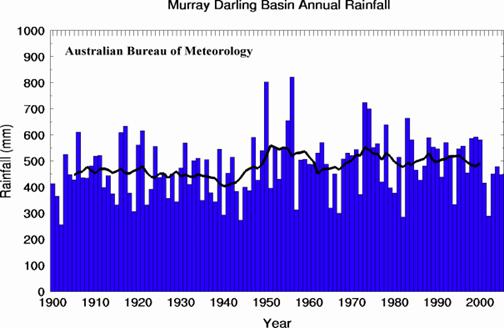
Murray Darling Basin Annual Rainfall

Almonds help fight viruses – but don’t peel them!

November 2, 2010
Shelled (right) and unshelled (left) almonds

Shelled and unsheld almonds: Image via Wikipedia

I love almonds anyway but I note that this research is funded by the Almond Board of California. I cannot help wondering what negative effects of eating almonds have been observed but will never be reported.

The Telegraph:

Researchers found almond skins improved the ability of the white blood cells to detect viruses while also increasing the body’s ability to prevent viruses from replicating and so spreading inside the body. They discovered that even after the almonds had been digested in the gut, there was still an increase in the immune system’s defence against viruses.

The scientists, who are based at the Institute of Food Research in Norwich and the Policlinico Universitario in Messina, Italy, said their findings suggest that the nuts can increase the immune system’s ability to fight off a wide range of viruses, including those that cause flu and the common cold.

Dr Giuseppina Mandalari, from the Institute of Food Research, said: “Almond skins are able to stimulate the immune response and thus contribute to an antiviral immune defence.”

The researchers, whose work is published in the scientific journal Immunology Letters and was funded by the Almond Board of California, found that even after digestion in a laboratory simulation of a human gut, the almonds skins were still able to increase the immune response.

They tested the immune response to infection by the Herpes Simplex Virus 2, which can cause cold sores and is a notoriously difficult virus to treat due to its ability to evade the immune system by dampening down the body’s inflammatory response.

They found that almond skin extracts were effective against even this virus.

But they found that almond skins that had been removed through blanching in boiling water, which is common process to remove skins from almonds, had little effect on the immune system.

The researchers say they are still to identify exactly what it is in almond skins that cause the antiviral activity, but they believe it could be due to compounds known as polyphenols.

It is thought they increase the sensitivity of white blood cells known as helper T cells, which are involved in fighting off viruses. They said it was likely that other nuts may also have this sort of activity.

Dr Martin Wickham, who was also involved in the study at the Institute of Food Research, said: “It is an area of huge interest to find natural alternatives that will have an antiviral activity. Nutritional guidelines recommend eating around three ounces a day to benefit from the fibre and other nutritional components in almonds, but we have still to do the work to see whether this would be enough to have an antiviral affect. This was just an initial study to find out if almond skins have this antiviral activity. The herpes simplex virus is a very good model of viral infection because it is known to evade the immune system, so because the almonds had an impact on this virus, it is fair to assume that it will have an impact on other viruses.”

Socio-economic measures can help adapt crops for climate change

October 8, 2010

The headline in the Telegraph is both remarkable and irresponsible.

Climate change threatens UK harvest

The article is about a new paper in Environmental Research Letters:

Increased crop failure due to climate change: assessing adaptation options using models and socio-economic data for wheat in China

Andrew J Challinor, Elisabeth S Simelton, Evan D G Fraser, Debbie Hemming and Mathew Collins Environ. Res. Lett.5 034012  doi: 10.1088/1748-9326/5/3/034012

This paper deals with simulations of  crop failures due to heat and water stress in North east China, where the simulations are themselves based on climate model output taken from the coupled atmosphere–ocean simulations of the Hadley centre for the period 1990 – 2099. The base-line for climate was for the period 1950-1989.


Grain crops China: Xinhua News Agency


The authors conclude that based on their simulations

The results from this study suggest that climate change will result in increasing spring wheat crop failure in northeast Chinadue to increasing extremes of both heat and water stress.

But the authors also studied socio-economic adaptation factors. Access to capital and land, increasing fertilizer, per capita investments in agriculture, and falling numbers of rural households all of which reduce vulnerability. They find that “measures to adapt may include institutional policies to support adaptation; schemes to ensure that the requisitecrop varieties are available to farmers; crop insuranceschemes or weather derivatives to aid management ofclimate variability; plant breeding; and building capacity foragricultural extension services to effectively prepare farmers for extreme events”. They go on to conclude that

The simulations show significant potential for adaptation throughboth socio-economic and biophysical measures. The methods used could form part of a methodology to link climate andcrop models, socio-economic analyses and crop variety trialdata. By examining at the regional scale the range of abioticstresses likely to be experienced by crop production systemsin the future, the relative importance of these stresses couldbe determined using a risk-based or probabilistic framework.This work could in turn be used with analyses of current andpotential future germplasm, and socio-economic conditions,in order to prioritize efforts to adapt regional-scale cropproduction to climate change, using a range of measures suchas policy, plant breeding and biotechnology.

But The Telegraph somehow can only see the alarmist side. They also manage to bring the UK Met Office into the story and create a remarkable headline from these simulations of North East China! Louise Gray writes:

Climate change threatens UK harvest

Climate change could push up food prices by causing large-scale crop failures in Britain, the Met Office has warned. Rising temperatures could mean events such as the drought in Russia this summer, which pushed up grain prices, hit countries like the UK.

“CO2 is a valuable resource” – New Scientist

September 29, 2010
Carbon dioxide

CO2 molecule

Greenhouses to negate greenhouse effects?

The New Scientist today saysCarbon dioxide may be bad for the climate, but it’s good for the roses. Perhaps it’s time we rehabilitated this gaseous villain”.

While plenty of commercial greenhouses top up their air with extra CO2, what is unusual about this one is where its CO2 comes from. Until a few years ago, the greenhouse’s operators used to burn natural gas for the sole purpose of generating CO2. Today it is piped from a nearby oil refinery. Each year, 400,000 tonnes of CO2 are captured and then piped to around 500 greenhouses between Rotterdam and The Hague, where it is absorbed by the growing plants before they are shipped for sale around the world .

“It’s time we stopped thinking of CO2 solely as a pollutant and viewed it as a valuable resource,” says Gabriele Centi, a chemist at the University of Messina, Italy.

Cash for carbon

Capturing carbon dioxide from smokestacks and then pumping it underground is going to be an expensive way to combat climate change. For a coal-fired power plant, for instance, the process is expected to add 30 per cent to the cost of generating electricity. However, a handful of entrepreneurs are already beginning to turn a costly waste product into a valuable commodity.

Wikipedia

Take some flower-growing greenhouses in the Netherlands. There, CO2 emitted from a nearby oil refinery is piped to the plants, boosting their growth (pictured, and see main story). The scheme began in 2005, when Organic Carbon Dioxide for Assimilation of Plants (OCAP), a newly formed gas supplier, began pumping waste CO2from the refinery to the greenhouses along a disused oil pipeline. The refinery sells the CO2 to OCAP at a profit, which then sells the gas to greenhouses at a price lower than what they were paying to burn natural gas to generate CO2. “I think the best way to fight climate change is making money out of it, otherwise our efforts wouldn’t survive in the long term,” says OCAP director Hendrik de Wit.

Source: http://www.newscientist.com/article/mg20727791.100-emission-control-turning-carbon-trash-into-treasure.html?full=true

Tile Drainage: A boon for farming but cause of dead zones in the gulf

September 28, 2010

Tile drainage is an agriculture practice that removes excess water from soil subsurface to enable farming in wetlands. Whereas irrigation is the practice of adding additional water when the soil is naturally too dry, drainage brings soil moisture levels down for optimal crop growth.

Tile drainage ditch (Credit: Todd Royer)

A new paper in the Journal of Environmental Quality by Mark B. David, Laurie E. Drinkwater and Gregory F. McIsaac, Sources of Nitrate Yields in the Mississippi River Basin confirms that the run-off Nitrates from farming in the Missisipi river basin into the Gulf of Mexico leads to seasonal hypoxia. In the summer of 2010 this dead zone in the Gulf spanned over 7,000 square miles. The increased production of crops in this region for ethanol production has only exacerbated the problem. The dead zone in the gulf is a yearly event to be compared to those caused by sporadic oil spills.

gulf of mexico dead zone image

Gulf areas affected by hypoxia: NOAA

(Journal of Environmental Quality 2010 39:1657-1667) via EurekAlert

Tile drainage in the Mississippi Basin is one of the great advances of the 19th and 20th centuries, allowing highly productive agriculture in what was once land too wet to farm. In fact, installation of new tile systems continues every year, because it leads to increased crop yields. But a recent study shows that the most heavily tile-drained areas of North America are also the largest contributing source of nitrate to the Gulf of Mexico. Scientists from the U of I and Cornell University compiled information on each county in the Mississippi River basin including crop acreage and yields, fertilizer inputs, atmospheric deposition, number of people, and livestock to calculate all nitrogen inputs and outputs from 1997 to 2006. For 153 watersheds in the basin, they also used measurements of nitrate concentration and flow in streams, which allowed them to develop a statistical model that explained 83 percent of the variation in springtime nitrate flow in the monitored streams. The greatest nitrate loss to streams corresponded to the highly productive, tile-drained cornbelt from southwest Minnesota across Iowa, Illinois, Indiana, and Ohio.

Farmers are not to blame,” said University of Illinois researcher Mark David. “They are using the same amount of nitrogen as they were 30 years ago and getting much higher corn yields, but we have created a very leaky agricultural system. This allows nitrate to move quickly from fields into ditches and on to the Gulf of Mexico. We need policies that reward farmers to help correct the problem. A lot of people just want to blame fertilizer, but it’s not that simple,” David said. “It’s fertilizer on intensive corn and soybean agricultural rotations in heavily tile-drained areas. There is also an additional source of nitrogen from sewage effluent from people, although that is a small contribution. It’s all of these factors together.”