Archive for the ‘Alarmism’ Category

Young coral reefs will be unaffected by any ocean acidification due to increased carbon dioxide

August 14, 2013

Well now!

File:PH Scale.svg

pH scale : Wikipedia

While I have no belief in the fanciful theory that man-made carbon dioxide emissions will have any significant effect on global warming, I have no doubt that an increasing carbon dioxide concentration in the atmosphere will lower the pH of the ocean (and they will only be more acidic in the sense of reducing alkanity though with a pH remaining well over 7.0). In fact it is likely that oceans will maintain a pH over 8.0 even in the worst scenarios. (Liquid solutions are usually described as acidic with a pH of less than 7.0 and as alkaline with a pH over 7.0 though on the continuous pH scale any reduction of alkanity is per force an increase of acidity and vice versa).

A new paper shows that the hypothesised catastrophic scenarios about ocean “acidification” (more correctly – a reduction of alkanity) and the consequent effects on coral reefs are little more than fantasy because they find that “there will be no direct ecological effects of ocean acidification on the early life-history stages of reef corals, at least in the near future”.

CM Chua, W Leggat, A Moya, AH Baird. Near-future reductions in pH will have no consistent ecological effects on the early life-history stages of reef coralsMarine Ecology Progress Series, 2013; 486: 143 DOI:10.3354/meps10318

Abstract: Until recently, research into the consequences of oceanic uptake of CO2 for corals focused on its effect on physiological processes, in particular, calcification. However, events early in the life history of corals are also likely to be vulnerable to changes in ocean chemistry caused by increases in the atmospheric concentration of CO2 (ocean acidification). We tested the effect of reduced pH on embryonic development, larval survivorship and metamorphosis of 3 common scleractinian corals from the Great Barrier Reef. We used 4 treatment levels of pH, corresponding to the current level of ocean pH and 3 values projected to occur later this century. None of the early life-history stages we studied were consistently affected by reduced pH. Our results suggest that there will be no direct ecological effects of ocean acidification on the early life-history stages of reef corals, at least in the near future.

ScienceDaily:

Corals can survive the early stages of their development even under the tough conditions that rising carbon emissions will impose on them says a new study from the ARC Centre of Excellence for Coral Reef Studies. …. 

Dr Andrew Baird, Principal Research Fellow at the ARC Centre of Excellence for Coral Reef Studies and James Cook University, was part of the research team and explains their findings.

“The prevailing view is that ocean acidification will act like a toxin to corals, but we were unconvinced by results from previous work on young corals and ocean acidification so we tested critical early stages of development in several coral species at several different acid (or ‘pH’) concentrations of seawater.

“Our results showed no clear response to increasing ocean acidification in any of the stages, or for any of the coral species,” says Dr Baird. “In fact, in only one of nine experiments did we get the response expected if CO2 was acting like a toxin. More often than not we found no effect.”

By bubbling CO2 through seawater the research team was able to simulate future levels of ocean acidification expected to result from rising human carbon emissions. They tested the success of embryo development, the survival of coral larvae and finally their success in settling on coral reefs.

The rest of the reporting by ScienceDaily is almost embarassing as they try to pay lip-service to the orthodoxy of the “the carbon dioxide is evil” fantasy. They waste space in trying to emphasise that even if young corals are not affected this “study does not discount the possibility that coral larvae may suffer other ill-effects from increasing ocean acidification, for example, their swimming speeds may slow down, but because coral larvae typically settle on the reef two or three weeks after birth it is unlikely that these effects will have a major impact on the survival or settlement of coral larvae”.

Apocalypse delayed – Himalayan researchers reverse earlier predictions of water shortages

August 6, 2013

I sense that some of the alarmism and the apocalyptic futures always associated with global warming hysteria are beginning to moderate.

Earlier predictions of water shortages due to the shrinkage of Himalayan glaciers are being reversed by new research which now predicts increased water flow in two Himalayan watersheds.

W. W. Immerzeel, F. Pellicciotti & M. F. P. Bierkens, Rising river flows throughout the twenty-first century in two Himalayan glacierized watersheds, Published online 04 August 2013, Nature Geoscience  (2013) doi:10.1038/ngeo1896

EnergyWire comments:

One of the big unknowns of climate change predictions — and one that has led to considerable contention — lies in knowing the future of water runoff from the Himalayas. The snow- and ice-rich region supplies water for billions of people in Asia and is sometimes referred to as the Earth’s “Third Pole.”

For years, scientists struggled to understand how precipitation will change in these mountains (ClimateWire, Oct. 24, 2011). They have also had difficulty determining how much glacier melt from the mountains contributes to water supply. 

A study out yesterday in Nature Geoscience by Walter Immerzeel, a physical geographer at Utrecht University, suggests that, in at least two major Himalayan watersheds, river flows and runoff should rise until 2100.

“We show that the peak in meltwater is later than we previously thought, which in combination with a projected increase in precipitation results in an increase in water availability until the end of the century,” he said.

The two watersheds Immerzeel reports on in the paper are those of the Baltoro and Langtang glaciers, which feed the Indus and Ganges rivers, respectively. In the Baltoro watershed, this is largely due to more glacier runoff from melt. In the Langtang, increased precipitation drives the extra runoff.

Immerzeel and his co-authors used the output of the latest global climate models from the Coupled Model Intercomparison Project (CMIP5) to look at temperature and precipitation projections. They combined that data with a hydrologic model of glacier responses to climate change.

They found that in both watersheds, runoff from glaciers should increase until the 2040s or 2060s, later than previous estimates, depending on which climate scenarios are applied.

….. In the paper, Immerzeel points out that his new finding contradicts previous work he has published, suggesting that runoff in the Indus and Ganges basin would decrease. At least for now, this is good news for people and farmers who rely on that water, he said.

“Strong increases in water demand are projected in the Indus as the food production needs to grow to feed the quickly rising population,” Immerzeel said. “An increased water availability from the mountains may help to sustain this growing demand.”

Abstract: Greater Himalayan glaciers are retreating and losing mass at rates comparable to glaciers in other regions of the world. Assessments of future changes and their associated hydrological impacts are scarce, oversimplify glacier dynamics or include a limited number of climate models. Here, we use results from the latest ensemble of climate models in combination with a high-resolution glacio-hydrological model to assess the hydrological impact of climate change on two climatically contrasting watersheds in the Greater Himalaya, the Baltoro and Langtang watersheds that drain into the Indus and Ganges rivers, respectively. We show that the largest uncertainty in future runoff is a result of variations in projected precipitation between climate models. In both watersheds, strong, but highly variable, increases in future runoff are projected and, despite the different characteristics of the watersheds, their responses are surprisingly similar. In both cases, glaciers will recede but net glacier melt runoff is on a rising limb at least until 2050. In combination with a positive change in precipitation, water availability during this century is not likely to decline. We conclude that river basins that depend on monsoon rains and glacier melt will continue to sustain the increasing water demands expected in these areas.

Internet chatter leads to US diplomatic lockdown

August 5, 2013

Following my post a few days ago, it would seem that others also question the US Global Terror Alert.  I discern a faint whiff of alarmism and a strong smell of “CYA”.

Reblogged from Bloomberg

Warning to Americans: Be Afraid, Very Afraid

By Jeffrey Goldberg Aug 5, 2013 2:40 AM GMT+0200

Jeffrey Goldberg is a Bloomberg View columnist. He is the author of “Prisoners: A Story of Friendship and Terror” 

It seems as if al-Qaeda, or its Arabian Peninsula branch, has succeeded in terrorizing the United States of America again, but this time without – as of this writing – detonating an ounce of C4. It doesn’t strike me as a wise idea to preemptively shutter 21 different American embassies across the Middle East and North Africa in response to NSA-collected terrorist chatter. What message does this post-Benghazi, “don’t say we didn’t tell you” move send to the citizens of the Middle East, who, it is our hope, understand the United States to be a powerful and fearless country dedicated to openness and to the defeat of fanaticism? We have already muddied any message of fearlessness by turning our embassies into bunkers. Now, we are admitting that these bunkers aren’t safe. What next? Virtual embassies on Facebook? Ambassadors who never leave Washington?

The Administration tells us that the heightened threat of al-Qaeda terror extends through the end of the month. Is the State Department going to keep its diplomatic fortresses closed through September 1? Late this afternoon, State announced that 19 diplomatic posts are going to stay closed until August 10; others, including those in Baghdad, and Kabul, of all places, are scheduled to reopen Monday. It is unclear if these closings will be extended, or if the reopening embassies and consulates will again be closed. It could be that many of our diplomats — who, by the way, are still living in the target countries, just in less secure locations, generally, than embassy compounds – will not be at work for awhile. 

It is plausible that the intelligence community is fearful of this weekend in particular, because, as Bloomberg’s Nicole Gaouette and David Lerman have noted, Sunday is the Muslim holiday known as the Night of Power, and al-Qaeda-type extremists sometimes mark important holidays on the Muslim calendar by trying to kill people. So after the holiday passes, things could return to normal. It will be interesting to watch how the State Department manages this crisis – and, this time, it is being managed directly out of Washington. Usually, diplomatic posts are allowed to make their own judgments about security, independent of State Department headquarters. Not any more.

It will also be interesting to watch whether State clarifies its travelers’ alert to the American public. A couple of days ago, the department issued a warning to American travelers that was notable both for its implied dread and its maddening vagueness: “Terrorists may elect to use a variety of means and weapons and target both official and private interests,’ the warning reads. “U.S. citizens are reminded of the potential for terrorists to attack public transportation systems and other tourist infrastructure. Terrorists have targeted and attacked subway and rail systems, as well as aviation and maritime services. U.S. citizens should take every precaution to be aware of their surroundings and to adopt appropriate safety measures to protect themselves when traveling.”

As a public service, let me translate this warning for you: “Dear U.S. citizen: So, it turns out that al-Qaeda has not been defeated. In fact, its operatives want to kill you. Mainly, they want to kill you if you happen to be in one of the following 21 countries. Also, by the way, they want to kill you in the U.S., but right now let’s not talk about that, and focus on the immediate threat. We don’t know where, when or how al-Qaeda is going to try to kill you – probably August, if it makes you feel any better. In the past, al-Qaeda terrorists have targeted planes, trains, and automobiles, as well as large buildings, and small buildings. Also, boats. Our suggestion is that you not leave your hotel. And stay out of the lobby! Lobbies are dangerous. Actually, come to think of it, al-Qaeda has also targeted hotels in the past, so maybe you should just leave your hotel now, but through the kitchen, or the service entrance. But try to avoid people, and also places where there are people, once you have left your hotel. If you want to come home, please do so, but just be very careful at the airport. Thank you for your attention to this matter.”

In truth, the State Department is in a tough spot: If it doesn’t publicly issue warnings, and something dreadful, God forbid, does happen, the Obama Administration will be blamed by opportunists for not telling Americans they were in danger. But perhaps there is a way to issue these warnings in way that doesn’t fear-monger, and in a way that helps Americans make informed decisions. And perhaps there is a way to manage diplomatic security so as to avoid conveying to the world the idea that al-Qaeda can unhinge us quite so easily.

Europe is paying the price for its infatuation with renewable energy

July 30, 2013

Electricity and the price of its generation is now one of the most fundamental parameters which steers the economy and industry and ultimately the level of unemployment in any country. It ought not to be subject to the misguided whims and fancies of “feel-good” environmentalism, but for the last 2 decades much of Europe has been travelling down a cul-de-sac chasing a mirage. Instead of just focusing on generating electricity at the lowest possible cost while keeping the air and water sufficiently clean, politicians have been lured down the renewable energy path in a fantasy of saving the world from the imaginary dragon of carbon dioxide emissions. Instead of just using wind and solar energy in the special niches they are suited to, they have been subsidised and promoted as basic generation which is a role they cannot fulfill.

The US with its much lower electricity prices now has a significant competitive advantage over Europe and will come out of the  recession much faster as it creates jobs.

As David Garman and Samuel Thernstrom write in the Wall Street Journal:

Europe has bet big on wind and solar energy, and many environmental advocates would like America to follow. Wind and solar have a role in the U.S. energy economy, but we would be wise to see the cautionary tale in the European experience and adjust our plans accordingly.

Wind and solar generate 3.5% of America’s electricity today, but Denmark gets 30% of its electricity from wind and hopes to produce 50% by 2020. Germany, Europe’s largest national economy, produces roughly 12% of its electricity from wind and solar today, and it wants renewable energy to account for 35% of electricity generation by 2020.

Clean energy powered by renewable resources is understandably attractive. But the honeymoon with renewables is ending for some Europeans as the practical challenges of the relationship become clear.

The first challenge is cost. Germany has reportedly invested more than $250 billion in renewable energy deployment, and its households pay the highest power costs in Europe—except for the Danish. On average, Germans and Danes pay roughly 300% more for residential electricity than Americans do.

But it is not just price that is at issue. The reliability of electricity supply is not helped by the inherent instabilities of having too much dependence on intermittent and unforeseeable sources.

Another challenge of Europe’s growing dependence on renewable energy is far more serious: the potential loss of reliable electrical supply. It’s one thing to ask consumers to pay more for cleaner energy; it’s another to force them to endure blackouts. …..

……. Grid operators generally rely on coal and nuclear plants to meet baseload demand while modifying gas and hydroelectric power output to meet shifting demand. But electricity from wind and solar is variable and intermittent. Nature determines when and how much power will be generated from available capacity, so it is not necessarily “dispatchable” when needed.

When intermittent renewables are small players in the grid, they can be easily absorbed. But as they reach European levels of penetration, the strain begins to show. There are increasing reports of management challenges resulting from wind and solar across the European grid, including frequency fluctuations, voltage support issues, and inadvertent power flows. Anxious operators are concerned about potential blackouts.

In an April 17, 2012, letter to EU Commissioner for Energy Gunter Oettinger, for example, Daniel Dobbeni, the European Network of Transmission System Operators president, said grid operators are “deeply concerned about the difference in speed between the connection of very large capacities of renewable energy resources and the realization in due time of the grid investments needed to support the massive increase of power flows these new resources bring.” He also expressed great concern “about the potential destabilizing effect of outdated connection conditions for distributed generation that are not being retrofitted anywhere fast enough.”

The article continues with a warning to the US about unhealthy subsidies.

There is also an important lesson in the European experience with energy subsidies: Focus incentives so they reward the right behavior. Lavish subsidies for wind and solar have changed Europe’s generation mix, but the costs have been high because the subsidy structure prioritized mass deployment rather than efficiency, reliability and innovation. Even in the U.S., the wind-production tax credit has occasionally produced “negative pricing”—that is, turbine operators pay grid operators to take their power even though it isn’t needed, just so the wind generators can collect tax credits.

Peter Ziegler RIP

July 29, 2013
PAZiegler s.jpg

Prof. Peter A Ziegler

Professor Peter Ziegler passed away a few days ago aged 84.

RIP

Prof. Peter Ziegler (1928 – 2013) was a Swiss geologist  and Titular Professor of Global Geology at the Geological-Paleontological Institute, University of Basel. He is a member of the Royal Netherlands Academy of Sciences, the Polish Academy of Arts and Sciences, the Russian Academy of Natural Sciences and the Academia Europaea.

I posted in March about his presentation on the “Mechanisms of Climate Change” from February this year.

Climate Change Ziegler 2013 (pdf)

Earthquakes release methane from methane hydrates

July 29, 2013

“Natural” release of methane from methane hydrates by earthquakes is more common and more significant than has been thought or accounted for in climate models.

The inescapable conclusion is that effects  being attributed by the demonisation of carbon to man made carbon dioxide emissions (even if real) may well be partly due to the natural release of such methane.  The global temperature pause for the last 17 years or so and the clear but small decline in global temperatures for the last 5 years is quite clear. At the same time emissions from fossil fuel combustion have been steadily increasing. These are a clear indication that the supposed linkage between carbon dioxide concentration and man-made carbon dioxide emissions on climate is very suspect if not completely broken.

It is also becoming increasingly clear that climate models – even though very complicated – are far too simplistic and just don’t (can’t) take all factors into account. Clouds, aerosols, particulates, solar effects, lunar cycle effects through the tides, ocean cycles and now earthquakes are all poorly understood and largely ignored in climate models. There is far more in the realms of the unknown about the climate than is known. We don’t even know what we don’t know.

David Fischer, José M. Mogollón, Michael Strasser, Thomas Pape, Gerhard Bohrmann, Noemi Fekete, Volkhard Spiess & Sabine Kasten, Subduction zone earthquake as potential trigger of submarine hydrocarbon seepage, Nature Geoscience (2013) doi:10.1038/ngeo1886

Here we present geochemical analyses of sediment cores retrieved from the convergent margin off Pakistan. We find that a substantial increase in the upward flux of gas occurred within a few decades of a Mw 8.1 earthquake in 1945—the strongest earthquake reported for the Arabian Sea. Our seismic reflection data suggest that co-seismic shaking fractured gas-hydrate-bearing sediments, creating pathways for the free gas to migrate from a shallow reservoir within the gas hydrate stability zone into the water column. We conservatively estimate that 3.26×10⁸ mol of methane have been discharged from the seep site since the earthquake. We therefore suggest that hydrocarbon seepage triggered by earthquakes needs to be considered in local and global carbon budgets at active continental margins.

New York Times:

Dr. Fischer and his colleagues analyzed sediment cores taken in 2007 from two locations in the northern Arabian Sea where hydrates were present and seepage was occurring. They found chemical signatures in the cores suggesting that the methane flow greatly increased sometime in the mid-20th century. Looking through seismic records, Dr. Fischer found that a magnitude 8.1 quake occurred in the area in 1945. The quake, which was centered less than 15 miles from where the cores were taken, and a resulting tsunami, killed up to 4,000 people.

The conclusion was inescapable, Dr. Fischer said. “The quake broke open gas-hydrate sediments and the free gas underneath migrated to the surface.” The hydrates themselves did not dissolve. “They remain there,” he said.

Dr. Fischer said the researchers chose the core locations in the Arabian Sea because they wanted to get a better understanding of how methane seepage was related to tectonics, and the area is in an active zone where one of the earth’s tectonic plates slides beneath another. But they were not thinking about the effect of individual earthquakes, and his discovery of the 1945 quake in the records “was probably a moment I’ll never forget,” he said.

The upward flow of methane is continuing today, and the researchers do not know when it might stop. All told, they estimate that nearly 10 million cubic yards of methane have been released from the core sites over the years. But that is a conservative figure, Dr. Fischer said, because immediately following the quake the flow would have been much higher.


Fun and games at the US Senate hearing on Global Warming

July 21, 2013

A US Senate hearing has just been held under the Chairmanship of Senator Barbara Boxer “to focus on Climate Change and the serious threat it poses to our nation”.

(As an aside – I wonder if the proponents of global warming are so nervous and uncertain about their own creed that they need to use “Climate Change” as a euphemism. If they mean “global warming” why don’t they just say “global warming”? Or could they be just preparing their own fall-back positions in case “global warming” turns out to be “global cooling”?).

But if the good Senator’s hope was that the case for global warming (aka Climate Change) was going to be established beyond all reasonable doubt then it seems the hearings have spectacularly backfired.

From WUWT:

Quite a performance yesterday. Steve Milloy is calling it the “Zapruder film” implying it was the day the AGW agenda got shot down. While that might not be a good choice of words, you have to admit they did a fantastic job of shooting down some of the ridiculous claims made by panelists prior to them. While this may not be a Zapruder moment, I’d say that it represented a major turning point.

…..

Video link and links to PDF of testimonies follow.

Here is the video link, in full HD:

http://www.senate.gov/isvp/?type=live&comm=epw&filename=epw071813

Dr. Spencer writes about his experience here and flips the title back at them:

http://www.drroyspencer.com/2013/07/senate-epw-hearing-climate-change-its-happened-before/

The PDF’s of each person’s testimony can be accessed by click on their names below:
Panel 1

Dr. Heidi Cullen
Chief Climatologist
Climate Central
Mr. Frank Nutter
President
Reinsurance Association of America
Mr. KC Golden
Policy Director
Climate Solutions
Ms. Diana Furchtgott-Roth
Senior Fellow
Manhattan Institute for Policy Research
Dr. Robert P. Murphy
Senior Economist
Institute for Energy Research

Panel 2

Dr. Jennifer Francis
Research Professor
Institute of Marine and Coastal Sciences, Rutgers University
Dr. Scott Doney
Director, Ocean and Climate Change Institute
Woods Hole Oceanographic Institution
Dr. Margaret Leinin
Executive Director, Harbor Branch Oceanographic Institute
Florida Atlantic University
Dr. Roger Pielke, Jr.
Professor, Center for Science and Technology Policy Research
University of Colorado
Dr. Roy Spencer
Principal Research Scientist IV
University of Alabama, Huntsville

The profligacy of “green” power is not sustainable

July 16, 2013

Chasing “green” fantasies about renewable energy are proving to be among the most profligate of all the misguided policies which build on alarmist scenarios. Renewable energy has its place but it is the “green” belief that it could replace fossil fuels which has proven to be nonsense. And what is worse is that the pursuit of “low carbon” energy serves no purpose whatsoever. It is just waste which has cost Europe many millions of jobs and has unnecessarily prolonged the recession. Perhaps as many as 15 million jobs in Europe have been “lost” based on the growth that has been suppressed by high energy prices.

Financial Times: 
RWE npower became the first of the big six power suppliers publicly to warn that the government’s green policies will cost consumers more, saying energy bills would rise by more than 19 per cent by the end of the decade.

The Telegraph:

A household’s energy bill will rise from £1,247 today to £1,487 by 2020 in real terms – not taking into account inflationary increases – if usage remains static, npower warns in a report. Costs caused by government policies such as subsidies for new wind farms and energy efficiency schemes will be the main driver, adding £144, it claims.

…. The report finds that the costs of upgrading Britain’s ageing gas and electricity networks would be the next biggest driver of bills, adding £114, while the costs of the nationwide roll-out of “smart meters” that send automatic meter readings back to suppliers will add £24.

Profits will account for £71, or just under 5pc, of the bill by 2020, up £12 from today, but a significant jump from £18 in 2007.

What food crisis?

July 16, 2013

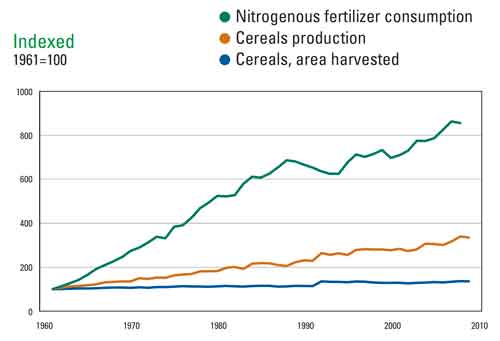
In 1961 the world population was just over 3 billion. Now it is 7 billion. The UN Food and Agriculture Organisation’s 2013 Statistical Year Book is now out and shows that during this period:

Agricultural production has increased  

  • Global crop production has expanded threefold over the past 50 years, largely through higher yields per unit of land and crop intensification.
  • Global per capita food supply rose from about 2 200 kcal/day in the early 1960s to over 2 800 kcal/day by 2009
  • Buoyed by high commodity prices, agriculture has demonstrated astonishing resilience during global economic turmoil. In 2010, agricultural value-added at the world level rose by 4 percent, in contrast to a 1 percent increase in overall GDP.

image UNEP/GEAS

So while population has increased by a factor of 2.3, the food available per person has increased by about 30%. Of course there are many millions who still suffer from malnutrition but this is primarily due to poverty and a failing of distribution systems. It is not the availability of food which has failed. The proportion of the population which is under-nourished continues to steadily decline.

(more…)

Now “peak-copper”- like “peak oil” and “peak gas” – disappears from view

July 6, 2013

Following peak oil and peak gas  it now seems that “peak copper” is also disappearing over the horizon. Researchers at Monash University show that known copper reserves with existing recovery technologies are sufficient at least for 100 years and not just 30.

The fundamental fault with the alarmist image of resources running out – following a classic M. King Hubbert curve – is that alternatives to the resource and new discoveries of the resource are not taken into account. Added to this is the changes to consumption patterns that come about with changes of technology and with changes of price as a resource dwindles in availability. In fact it is the price change which itself acts a spur to the finding of alternatives and new technologies which do not even need that particular resource. “Peak” scenarios are a consequence of using numbers without the exercise of mind.

MU Press ReleaseNew research shows that existing copper resources can sustain increasing world-wide demand for at least a century, meaning social and environmental concerns could be the most important restrictions on future copper production. 

Researchers from Monash University have conducted the most systematic and robust compilation and analysis of worldwide copper resources to date. Contrary to predictions estimating that supplies of this important metal would run out in around 30 years, the research has found there are plenty of resources within the reach of current technologies.

The database, published in two peer-reviewed papers, was compiled by Dr Gavin Mudd and Zhehan Weng from Environmental Engineering and Dr Simon Jowitt from the School of Geosciences. It is based on mineral resource estimates from mining companies and includes information vital for carbon and energy-use modelling, such as the ore grade of the deposits.

Dr Jowitt said the database could change the industry’s understanding of copper availability.

“Although our estimates are much larger than any previously available, they’re a minimum. In fact, figures for resources at some mining projects have already doubled or more since we completed the database,” Dr Jowitt said. 

“Further, the unprecedented level of detail we’ve presented will likely improve industry practice with respect to mineral resource reporting and allow more informed geological exploration.”

Dr Mudd said the vast volumes of available copper meant the mining picture was far more complex than merely stating there were ‘x’ years of supply left. …..

….. 

The researchers will now undertake detailed modelling of the life cycles and greenhouse gas impacts of potential copper production, and better assessment of future environmental impacts of mining.

They will also create similar databases for other metals, such as nickel, uranium, rare earths, cobalt and others, in order to paint a comprehensive picture of worldwide mineral availability.