Archive for the ‘Aviation’ Category

Norwegian returns a Dreamliner to Boeing to be fixed

September 28, 2013

I suppose it must be under guarantee. It is further publicity that Boeing could well do without. Boeing have been asked to take back one of Norwegian’s two Dreamliners currently stuck in Bangkok with a hydraulic pump failure. Boeing will carry out the repairs in Stockholm. But what must be particularly galling for Boeing is that Norwegian is leasing an Airbus A340 while the Dreamliner is being fixed. No doubt the leasing cost will be billed to Boeing but EADS will be pleased that the Airbus has the better perception of reliability.

The Dreamliner runs the risk of becoming  a Nightmareliner if Boeing cannot get the plane away from its many “teething” troubles.

Boeing 787-8JP Dreamliner

Norwegians first Dreamliner Air Team Images : Photo by Lee A. Karas

Boeing 787-8JP Dreamliner

Manufacturer: Boeing   Type/Model: 787-8 Dreamliner   Registration: LN-BKA   Colour Scheme: Norwegian Air Shuttle
Location: Everett, United States  Taken By: Lee A. Karas   Date Taken: 3rd April 2013
Reuters: Budget airline Norwegian Air Shuttle  is returning one of its brand new Dreamliners to Boeing demanding repairs after the jet has suffered repeated breakdowns, it said on Saturday.Norwegian Air Shuttle will instead lease an Airbus A340 from HiFly to keep its long-haul business going and will not take back the Boeing 787 Dreamliner until it is more reliable, a spokesman said.“The aircraft’s reliability is simply not acceptable, our passengers cannot live with this kind of performance,” spokesman Lasse Sandaker-Nielsen told Reuters.“We are returning the aircraft to Boeing to improve its reliability.” ….Norwegian launched long-haul operations this year and hoped to capitalize on Dreamliner’s lower operating cost as the jet’s lighter-weight engines promised a 20 percent savings on fuel.

But its first two Dreamliners, part of a planned fleet of eight, broke down over half a dozen times in September, forcing it to lease back-up planes on short notice or cancel flights.

Norwegian summoned Boeing’s management this week and the aircraft manufacturer promised to locate spare parts centers at all of the airline’s long-haul destinations and send a team of engineers to the Nordics to monitor the planes.

The aircraft that will be returned is still stuck in Bangkok after a hydraulic pump failure this week and will be flown back to Stockholm where Boeing will carry out the work.

Flying Railway Wagons

June 23, 2013

Logo EPFL

Many times when boarding large aircraft I have fantasised about having a cabin module instead of the waiting lounge, where passengers could take their places at leisure. When filled, the module would slide into the aircraft and lock into place just like the modular containers containing baggage. Now Swiss researchers are realising my fantasies with a futuristic concept for a modular aircraft consisting of

  1. A flying wing that includes the cockpit, the motors, and the fuel and
  2. Up to three flexible modules (capsules) that can carry either passengers, freight, or fuel.

Clip Air concept from Ecole Polytechnique Federale de Lausanne

They see their “Clip-Air” craft having modules where the  maximum dimensions of each capsule would becomparable to the fuselage of an A320 with a maximum weight of 30 tons and a length of 30 meters (the length of a train wagon) and where:

  • Dimensions of the flying wing: wing-span of 60 meters
  • Motors: 3, identical to those of the A320 (Swiss version)
  • Passengers: Together, the three modules can carry a total of 450 passengers.

The aircraft would allow passengers to board a module at a railway station and disembark at their destination without ever setting foot in an airport.

Clip Air EPFL

Rail transport’s flexibility in air transport?

How could this conundrum be unraveled? Clip-Air proposes a revolutionary air transport concept based on a flying wing that can carry mobile and interchangeable capsules. On the one hand, the Clip-Air plane is made up of a support structure including wings, engines, fuel and a cockpit. On the other hand, there is the load to be transported: passengers and freight.

The capsule is the equivalent to a conventional airplane’s fuselage, but without motors, without a cockpit, without fuel, without landing gear, or any of the other parts that usually make up a plane. The premise behind Clip-Air is to bring rail transport’s flexibility to air transport and to make airports reach all the way into railway stations.

Potential
Theoretical studies have shown Clip-Air’s potential in terms of transport capacity. In the scenarios that were analyzed, Clip-Air was able to transport more passengers than a standard fleet thanks to a more efficient allocation of the available capacity.

Based on various hypotheses, the estimated costs of Clip-Air are also competitive. In 89% of the analyzed cases, Clip-Air generates a profit. According to the model that is currently being considered, carrying passengers without combined cargo transport, Clip-Air is actually less expensive than a standard fleet, as long as it operates carrying three capsules. The architecture of modular aircraft is remarkably vast, and a flying wing carrying three capsules is but one possible choice. However, whether the aircraft is designed to carry one, two, or three capsules, its modularity is what makes this project strong.

Architecture and design
How should a flying wing be designed? How can the capsules be made as functional as possible? The extraordinary challenge lies in finding the most adapted architecture that incorporates all of the compromises involved in achieving such a project. A team of engineers is working on finding the most optimal design, rethinking everything from the materials used to the details of the attachment system, so that the latest technologies can be leveraged whenever possible.

Energy
Clip-Air is revolutionary in its design, but it must also be so in its choice of fuel. In the current stage of the project, Clip-Air has clearly proven its potential to adapt to tomorrow’s renewable energy challenges. Numerous alternative paths have been explored internally and have demonstrated the utility of a modular architecture (with liquid hydrogen, biofuels, classical fuel).

Security
The complete separation of the cockpit (located under the wing) and the passengers (in the capsules) opens new doors in terms of security with, most notably, a reduced risk due to the decoupling between the fuel reservoirs and the passengers.

Aeronautics
Aeronautical engineers assure that Clip-Air can fly, but many questions remain to be addressed. Future developments of the project will involve aerodynamic simulations and a six meters long flying prototype equipped with propulsion engines to explore the aircraft’s flight performance and the overall feasibility of the project.

Clip Air in “flight”: EPFL

Delta Airlines sues US Ex-IM for supporting Boeing sales to foreign airlines

April 4, 2013

I think Delta doth protest too much and is clutching at straws. Loss of jobs at Boeing is of much more consequence to the US economy than Delta’s dubious claim of loss of competitiveness against foreign airlines.

Of course the real problem is that Delta is weak competitively. Its costs are too high and its service is too inferior. By the end of trading session, Delta Air Lines, Inc. shares slumped 8.06% to US$14.94 with more than 41.03 million shares traded, compared to its average volume of 12.11 million shares. Delta Air Lines’s unit revenues increased only 2% in March, and most of it came from its trans-Atlantic and Latin offerings.  Delta were expecting a March growth of 4 – 5%. And they are more than a little worried by the US Air merger with American Airlines.

(Reuters)Delta Air Lines Inc has sued the Export-Import Bank of the United States over loan guarantees given to support purchases of Boeing Co’s widebody planes by certain foreign airlines, according to a court filing.

Delta are claiming that Ex-Im bank’s guarantees (to Boeing) and/or buyers credits (to foreign airlines) for aircraft sales to foreign airlines, including Emirates Airlines, Etihad Airways and Korean Air Co Ltd, amount to subsidies and would cause a loss of competitiveness and adverse economic effects on Delta and its employees.

Ex-Im Bank, a government agency, provides loan guarantees and direct loans to help companies maintain and create jobs.

In a complaint filed in federal court in Washington D.C. late on Wednesday, Delta said one of the types of exports that Ex-Im Bank subsidizes is the export of aircraft by U.S. manufacturers, especially ones made by Boeing.

“In 2012, the bank’s total exposure to outstanding financial commitments was $106.6 billion. About 46 percent of this amount was for air transportation loans and loan guarantees, more than the three next largest industrial sectors combined,” Delta said in the filing.

Delta said the Ex-Im Bank loan guarantees help lower the cost of capital for foreign airline companies.

“These foreign airlines will recoup their investment in their new aircraft faster or reduce ticket prices on competing routes without adversely impacting their relative rate of return on those investments,” Delta said in the filing.

Delta argued that unsubsidized U.S. airlines will be forced to respond by “reducing their prices and reducing or altogether eliminating their capacity to serve those routes where they compete with bank-subsidized foreign airlines.”

I don’t think I will be buying any Delta stock any time soon.


Boeing’s PR upsets Japanese Civil Aviation Board – and this will delay the Dreamliner flying again

March 16, 2013

Boeing’s upbeat announcement that the Dreamliner could be flying in a matter of weeks has upset the Japanese Civil Aviation Board. It would seem that Boeing did not clear their PR blitz in Tokyo in advance with the CAB. Their optimistic statements about the Dreamliner flying again “in a matter of weeks” to try and reassure the market place may prove to be a PR blunder and could backfire.

ET: Japanese regulators immediately warned that the timetable was impossible to predict, in part because investigators still do not know what had caused lithium-ion batteries to overheat on two 787s. 

“At this time we are not yet in a position to say when flights will restart,” said Shigeru Takano, the air transport safety director at Japan’s Civil Aviation Board (CAB), which will assess and approve Boeing’sproposed fix. …

…. “If we look at the normal process and the way in which we work with the FAA, and we look at the testing that’s ahead of us, it is reasonable to expect we could be back up and going in weeks, not months,” the 787’s chief engineer, Mike Sinnett, said at an earlier briefing in Tokyo. 

But the CAB, the FAA’s counterpart in Japan, dismissed Sinnett’s prediction, saying it was too early to predict when 787 operations could resume, since regulators in the United States and Japan are still investigating. Takano, the air transport safety director at the CAB, said Sinnett’s comment on the battery probe was “inappropriate.”

To call Boeing’s statement “inappropriate” is tantamount to an outright rejection. I think Boeing has shot itself in the foot since the CAB clearly perceives their role being usurped by Boeing’s PR pronouncements. There is now no way that the CAB can or will allow any “fast-tracking” of approvals.

Reuters: Japan is Boeing’s biggest customer for the fuel-efficient aircraft, which has a list price of $207 million. JAL and ANA combined account for almost half the global Dreamliner fleet. Japanese firms also build 35 of the aircraft.

And until the CAB approves, other countries will also hold off their approvals. It is going to be at least 2 months now before Dreamliners fly again commercially.

Boeing’s three-layered fix for the Dreamliner batteries approved for testing

March 16, 2013

Boeing’s planned fix for the Dreamliner’s lithium-ion battery has been approved by the FAA and while this is only approval of the plan it at least represents the start of the process to get the Dreamliner back into the air. The FAA approval will allow two Dreamliners to return to the air to test various aspects of the proposed fix. Results from both in-flight and laboratory tests will have to be evaluated to obtain the new certifications and approvals necessary to get back into the air.

NY Times: The F.A.A. could still demand changes if problems develop in the laboratory and flight tests. While Boeing hopes to begin fitting its redesigned batteries in the grounded 787 fleet by mid- to late April and resume commercial flights quickly after that, government officials are not sure the process will move that fast. …

….. the tests would subject the battery to the most extreme conditions it was likely to face and determine if the case could withstand a battery explosion. The tests will include bursts of power to put stress on the battery and check its flammability as well as how it performs in hot weather.

The F.A.A. has also approved limited test flights for two aircraft. One plane will test the old battery, while the other will test how the new system performs under normal flight conditions. The flight tests will begin within a week.

The agency will approve the redesign only if the company successfully completes all required tests and analyses. The F.A.A. said it was continuing a review of the 787’s design, production and manufacturing.

But there is a downside. The fixes being introduced will increase the weight of the aircraft by 150 lbs which almost nullifies the advantage gained by using the lighter lithium-ion batteries in the first place. The fuel efficiency gains – at least those due to the lighter battery – will no longer be available and no doubt customers will want compensation for this. An extra 150 lbs is just about equivalent to one passenger and compensation claims could also be for the equivalent of one passenger less for every commercial flight through the life of the aircraft. This would be in addition to any compensation claims for losses suffered during and because of the grounding  and for delivery delays.

The three-layered approach that Boeing is taking consists of

  1. preventing a fire within any individual battery cell,
  2. preventing the fire from spreading to other cells in the event that a fire does occur, and
  3. preventing the fire from spreading or impacting anything outside the battery enclosure in the event that the fire does spread to multiple cells
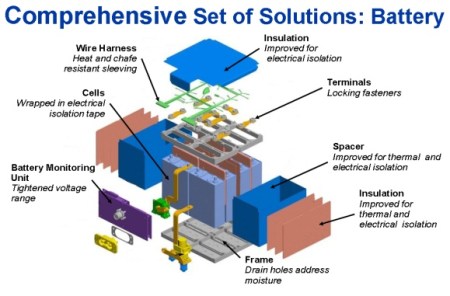
Dreamliner Battery Fix (via Aviation Week, Credit Boeing)

Dreamliner Battery Fix (via Aviation Week, Credit Boeing)

The Dreamliner still has a way to go to complete all the testing and while Boeing is talking about “weeks rather than months”, it seems unlikely that the planes will be released for commercial flying before June.

Aviation Week: Among the tougher tests to be conducted will be an evaluation of the containment system’s ability to withstand a deliberately induced thermal runaway. This self-propagating phenomenon was cited by the National Transportation Safety Board (NTSB) in its March 7 interim report on the first battery failure on a Japan Airlines 787 in early January. Although not identifying a specific cause, the report described several shortcomings in both the baseline battery system design and the original means of testing and certification of the device.

The NTSB has announced plans to hold a forum and investigative hearing in April to review the battery’s technology, safety and process used in its certification. The agency’s investigation found—among other things—no record of the final production-standard charging system having been tested with the actual GS Yuasa-made battery. According to the NTSB report, Securiplane, the charging system developer, tested the unit with a simulated electric load instead of an actual battery. The company apparently took this precaution after having earlier suffered a fire at its facility during battery testing.

The three layers of the Boeing fix are structured as below:

1. The first layer of improvements is taking place during the manufacture of the batteries in Japan. Boeing teamed with Thales, the provider of the integrated power conversion system, and battery maker GS Yuasa to develop and institute enhanced production standards and tests to further reduce any possibility for variation in the production of the individual cells as well as the overall battery.  … Four new or revised tests have been added to screen cell production, which now includes 10 distinct tests. Each cell will go through more rigorous testing in the month following its manufacture including a 14-day test during which readings of discharge rates are being taken every hour. This new procedure started in early February and the first cells through the process are already complete. There are more than a dozen production acceptance tests that must be completed for each battery. Boeing, Thales and GS Yuasa have also decided to narrow the acceptable level of charge for the battery, both by lowering the highest charge allowed and raising the lower level allowed for discharge. Two pieces of equipment in the battery system – the battery monitoring unit and the charger are being redesigned to the narrower definition. The battery charger will also be adapted to soften the charging cycle to put less stress on the battery during charging.

2. Changes inside the battery will help to reduce the chances of a battery fault developing and help to further isolate any fault that does occur so that it won’t cause issues with other parts of the battery. To better insulate each of the cells in the battery from one another and from the battery box, two kinds of insulation will be added. An electrical insulator is being wrapped around each battery cell to electrically isolate cells from each other and from the battery case, even in the event of a failure. Electrical and thermal insulation installed above, below and between the cells will help keep the heat of the cells from impacting each other. Wire sleeving and the wiring inside the battery will be upgraded to be more resistant to heat and chafing and new fasteners will attach the metallic bars that connect the eight cells of the battery. These fasteners include a locking mechanism. Finally, a set of changes is being made to the battery case that contains the battery cells and the battery management unit. Small holes at the bottom will allow moisture to drain away from the battery and larger holes on the sides will allow a failed battery to vent with less impact to other parts of the battery.

3. The battery case will sit in a new enclosure made of stainless steel. This enclosure will isolate the battery from the rest of the equipment in the electronic equipment bays. It also will ensure there can be no fire inside the enclosure, thus adding another layer of protection to the battery system. The enclosure features a direct vent to carry battery vapors outside the airplane. New titanium fixtures are being installed in the electronics equipment bays to ensure the housing is properly supported. “Our first lines of improvements, the manufacturing tests and operations improvements, significantly reduce the likelihood of a battery failure. The second line of improvements, changes to the battery, helps stop an event and minimize the effect of a failure within the battery if it does occur. And the third line of improvements, the addition of the new enclosure, isolates the battery so that even if all the cells vent, there is no fire in the enclosure and there is no significant impact to the airplane,” said Sinnett.

Two aircraft will be used for the testing:

Flight tests of the prototype revised battery containment system will be conducted using Line No. 86, an aircraft designated for LOT Polish Airlines. Aviation Week was the first to report this same aircraft being previously used for ground tests of the battery system in mid-February (AW&ST Feb. 18, p. 32). The modified battery has also been installed in test aircraft ZA005, though Boeing says this is to allow testing to resume of the planned General Electric GEnx performance improvement package (PIP) II engine upgrade. The FAA says flight tests will validate instrumentation for the battery and testing its enclosure in addition to improvements for other systems.

Airbus invokes “Plan B” while Dreamliner remains grounded till the summer

February 20, 2013

The Boeing Dreamliner which was grounded globally on January 16th will remain grounded at least till the end of March and possibly till the summer. United Airlines has removed the Dreamliner from all its schedules till March 30th. But LOT Polish Airlines which flies Boeing 767’s and was hoping for these to be replaced by 5 Dreamliners at the end of March has extended the lease for the 767’s (apparently at Boeing’s insistence) for a further 6 months till October 2013.

All Nippon Airways, which has 17 Dreamliners in its fleet says it has lost 15.4 million of sales revenues just in January. But ANA has kept its profit forecast for the fiscal year through March unchanged at about $44 million.

All Nippon has not asked Boeing for compensation linked to the grounded 787s but will discuss the issue once the total financial effect is more clear, said the executive vice president, Kiyoshi Tonomoto, according to Reuters.

The battery problem has yet to be resolved but there was further evidence that the cells are prone to overheating and thermal runaways.

Bangkok Post: On January 16, the 50 Dreamliners in service around the world were grounded after a battery fire on a Japan Airlines plane parked in Boston, and battery smoke on an All Nippon Airways flight forced an emergency landing. On Tuesday, a Japanese safety board official said that investigators found a battery on the ANA flight that initially was believed to be intact had also been damaged. Detailed examination of the auxiliary power unit battery revealed that two of its eight cells were misshapen.

One market-matching family

The Airbus A350 family . image airbus.com

In the meantime Airbus has invoked Plan B and decided to drop the lithium-ion batteries for the A 350 so as not to jeopardise the intoduction of the aircraft in 2014. With the Dreamliner delays and teething problems, Airbus has a golden opportinity to break into the Dreamliner market with a timely introduction of the A350.

Reuters:  Airbus has dropped lithium-ion batteries of the type that forced the grounding of Boeing’s 787 Dreamliner and will use traditional nickel-cadmium batteries in its crucially important next passenger jet, the A350.

The European planemaker said on Friday it had taken the decision to adopt the batteries used on existing models such as the A380 superjumbo in order to prevent delays in the A350’s entry to service next year. ….. 

“We want to mature the lithium-ion technology but we are making this decision today to protect the A350’s entry-into-service schedule,” an Airbus spokeswoman said. ….

The A350 is due to enter service in the second half of 2014 compared with an initial target of 2012 when it was launched as Europe’s answer to the lightweight 787 Dreamliner. ….

….. Airbus will use the lithium-ion batteries for a maiden flight in mid-year and early flight trials but switch to traditional batteries in time for certification and delivery. …

The lithium-ion battery industry is concerned but not unduly so, since the market for aircraft batteries is just a tiny portion of their market.

Boeing Dreamliner batteries could be “inherently unsafe” while Airbus says it has a Plan B

February 1, 2013

The fault with the Boeing Dreamliner Batteries/electrical systems has not yet been found. This is not good news for Boeing since the grounding of 50 aircraft continues. Each grounded aircraft poses a potential claim on Boeing for about $2.5 million per month. The delay in finding the fault also correspondingly delays the selection of a “fix” and the deployment of that “fix”. And since some 850 aircraft have been ordered and production has not been stopped, the fix has to be deployed on a large number of aircraft.

In the absence of any identified fault Boeing are continuing to defend the 787 batteries and I read this as Boeing defending both the design of the chosen batteries and their decision to select these for use. They cannot really do anything else since they cannot acknowledge any potential liability while compensation claims are up in the air (or down on the ground may be more appropriate!).

Airbus apparently has developed a Plan B in the event an alternative to lithium-ion batteries must be found for the A350.

Airbus warned about the risks of lithium-ion batteries at a closed meeting of airlines in March 2011, according to a presentation first reported by Reuters this week.

“We identified this fragility at the start of development and we think we resolved it about a year ago,” Bregier said. “Nothing prevents us from going back to a classical plan that we have been studying in parallel.”

But there is a view that the design chosen by Boeing is fundamentally unsound – that the design lends itself to the possibility of thermal runaways with overheating and subsequent fires. If the design itself is flawed and there are better designs available, then Boeing’s decision process which resulted in using a flawed design could be more damaging  than any monetary compensation for the actual groundings. Boeing can ill afford a suggestion that their design or decision process itself is flawed. The current investigation is focused on finding any faults in the units as built and not – yet – on the fundamental design itself.

They can probably absorb the financial hit but my guess is that Boeing will lose considerable ground to the Airbus A350 which could take a long time to recoup.

FlightGlobal: 

The lithium ion batteries installed on the Boeing 787 are inherently unsafe, says Elon Musk, founder of SpaceX and owner of electric car maker Tesla.

“Unfortunately, the pack architecture supplied to Boeing is inherently unsafe,” writes Musk in an email to Flightglobal.

“Large cells without enough space between them to isolate against the cell-to-cell thermal domino effect means it is simply a matter of time before there are more incidents of this nature,” he adds.

Both Boeing and Tesla use batteries fueled by lithium cobalt oxide, which is among the most energy-dense and flammable chemistries of lithium-ion batteries on the market. While Boeing elected to use a battery with a grouping of eight large cells, Tesla’s batteries contain thousands of smaller cells that are independently separated to prevent fire in a single cell from harming the surrounding ones.

“Moreover, when thermal runaway occurs with a big cell, a proportionately larger amount of energy is released and it is very difficult to prevent that energy from then heating up the neighboring cells and causing a domino effect that results in the entire pack catching fire,” says Musk.

…. “They [Boeing] believe they have this under control, although I think there is a fundamental safety issue with the architecture of a pack with large cells,” writes Musk in an email. “It is much harder to maintain an even temperature in a large cell, as the distance from the center of the cell to the edge is much greater, which increases the risk of thermal runaway.” 

Musk’s assessments of battery cells were confirmed by Donald Sadoway, a professor of electrical engineering at the Massachusetts Institute of Technology.

“I would have used the same words,” says Sadoway. “I’m glad someone with such a big reputation put it on the line.”

“He’s engineered [Tesla’s battery] to prevent the domino effect, while Boeing evidently doesn’t have that engineering,” adds Sadoway. ….. 

787 battery graphic

from Boeing

Design News:

The issue of battery cooling has been at the forefront of the Boeing story for a week. Donald Sadoway, the John F. Elliott professor of materials chemistry at MIT who is involved in a battery startup with Bill Gates, told us last week that a forced air cooling system and sensors may be needed to monitor and cool the battery in the event of overheating. Elton Cairns, a professor of chemical and biomolecular engineering at the University of California, Berkeley, and a fuel cell designer for NASA’s Gemini spaceflights, also suggested that an air- or liquid-cooled system would be necessary.

Boeing 787 Dreamliner story gets green and murky

January 24, 2013

What seemed to be “normal” teething problems with a new aircraft now seems to be something more. Two stories this week suggest that

  1. pressure from the green lobbies pushed Boeing into using inherently unsafe, large, lithium-ion batteries long before the technology was ready for such use, and
  2. the battery chargers used for charging the lithium-ion batteries did not meet product specifications and were prone to short-circuiting but were shipped anyway to Boeing

If these stories have any substance, Boeing could be forced to replace the lithium-ion batteries with alternative batteries. The consequences could be that that weight will increase and/or the batteries will not be rechargeable (an operating cost increase). Moving away from lithium-ion should not therefore be technically too difficult or prohibitive as far as cost is concerned. Dealing with the compensation to airlines for the grounding of 50 of their aircraft and for an indeterminate length of time could be the main economic hit for Boeing. There will, of course, be a cost for redesigning a “fix” and introducing the fix into the entire fleet but that should not be catastrophic. What may be more significant in the long run will be the loss of customer confidence and the potential loss of sales (or delay of sales) which would help Airbus to improve its competitive position.

Washington Examiner:

Boeing Dreamliner fires spark new doubts about a green energy technology

…. Technologists and safety experts had long warned of problems with the lithium ion battery when in 2009 the president began betting billions of tax dollars that it should be the green power of choice for cars, trucks, and even aircraft. …. Small lithium ion batteries are widely used in consumer electronics, but powering vehicles like a car or an aircraft is a much greater challenge. The 787, for example, has to generate 1.5 megawatts of electrical power, enough to light up several hundred homes. …. 

The problem, according to the MIT Technology Review, is that “because the electrolyte materials used are flammable, no lithium-ion batteries are completely safe.” And last April, the National Fire Protection Association warned that “as lithium-ion battery use increases, so do the concerns related to the fire-safety hazards of these devices.” Some experts believe the batteries have been oversold to the public. “Lithium ion batteries just won’t do the trick in the kind of mass vehicle applications that the environmental community is pushing for,” said Jon Entine, founder of ESG Media Metrics, a Cincinnati-based environmental consulting firm. “It’s kind of glib environmentalism or kind of enviro-romanticism,” said Entine, who is also a senior fellow at George Mason University’s Center for Health and Risk.

…. Before the Dreamliner’s troubles, a Chevrolet Volt caught fire during its crash tests by the National Highway Traffic Safety Administration in May 2011. The agency gave the Volt a clean bill of health after an investigation. Then last year, electric truck manufacturer Smith Electric Vehicles warned potential investors that the lithium ion batteries “on rare occasions have been observed to catch fire or vent smoke and flames” in the firm’s prototype military trucks.

Even in the smaller consumer electronics applications, lithium ion battery fires were reported in Apple and Dell laptop computers in 2005 and 2006.

Reuters:

U.S. NTSB reviewing whistleblower claims in 787 case

The U.S. National Transportation Safety Board is looking at issues raised by more than one whistleblower as it investigates battery failures that have grounded the global fleet of 50 Boeing Co 787 Dreamliners for a week.

Michael Leon, one of the whistleblowers, said he spoke with an NTSB investigator this week and gave him extensive materials about his claim that he was fired around six years ago for raising safety concerns about Securaplane Technologies Inc., an Arizona company that makes chargers for the highly flammable lithium-ion batteries at the heart of the probe. In an interview with Reuters on Wednesday and in earlier court papers, Leon said Securaplane was rushing to ship chargers that by his assessment did not conform to specifications and could have malfunctioned. …..

…… Securaplane hired Leon as a senior engineering technician in 2004, the same year it won the contract to work on the 787 parts. The company, which was taken over by Meggitt in April 2011, makes three important battery-related systems for the 787 as a subcontractor to France’s Thales SA .

The lithium-ion battery is made by Japan’s GS Yuasa Corp, while Thales is responsible for electric power conversion on the 787, the world’s newest and most electricity-driven airliner. The auxiliary power unit (APU), which powers the airplane’s systems when it is on the ground, is built by a unit of United Technologies Corp.

The Securaplane spokeswoman declined to give details about the value of the company’s contract with Thales for work on the 787, saying those details were confidential. She said she was not aware of any other whistleblower case filed by a Meggitt or Securaplane employee.

Securaplane said it makes two battery charging units used on the 787, one for the APU battery in an aft bay, and one for the main ship battery used in a forward bay, which provides backup power for flight critical controls. …

…… Leon said he refused to ship chargers that he believed had short-circuits, but company officials told him they needed to rush out the orders or risk losing the contract with Thales.

Airport security is now more about business than about security

January 19, 2013

I can still remember arriving at airports, checking in and strolling quietly to my departure gate without undressing along the way or unpacking my bag or spending up to an hour standing in a “security” queue. The “airport experience” was still something to look forward to. But that is in my memory like a long-lost dream. Those days seem to have gone forever.

In the name of security we now accept the routine degradation that comes with intrusive pat-downs, small children being frisked by strange men and the impassive reluctance of security staff to use their minds (which is of course what is required of them). I have yet to come across an airport where the time and inconvenience  and hassle of the security process has actually decreased but many where extra layers of hassle with new equipment are added. And it is getting worse. 

We accept the inconvenience to the many in the hope of finding the -presumed – very few who wish to destroy the plane they are travelling on. Airport security has over the years managed to deprive me of two bottles of whiskey, a few lighters, two nail clippers, a bottle of after-shave lotion, one of perfume and a bottle of extra-hot chilli sauce. At Paris my son has been reduced to an incoherent rage when a security female of little mind confiscated his multi-function “Swiss card”. I have been taken out of the security line and hassled for 90 minutes at Frankfurt when I tried to read the name-tag (purposely worn upside down to avoid identification) of the security moron on duty . At Delhi airport I have been taken aside and questioned why I needed two lighters in my bag. At Singapore they confiscated my nose-hair scissors! Twice – at Dresden – my trousers have fallen down without the support of my belt when I was holding up my arms to be patted down.

The idea is that passengers are both protected from potential terrorist attacks and/or at least are reassured that their safety is being considered. In 2010, the BBC lauded the results of a survey that found that the majority of the flying public was in favour of the measure. But can we trust the results? What the BBC failed to mention was that the consulting company which carried out the survey, Unisys, had financial interests in the body scanner industry.

But I wonder whether all this “security” works and even whether it has ever worked? Is there any evidence at all that all this security has ever found an intending saboteur? It seems remarkably convenient that the security industry has no performance criteria to be judged on – for security reasons of course.

And then I comprehend that the airport security “business” is now worth about $100 billion per year and over $30 billion of that is just in Europe. It becomes obvious then that the “security industry” will not permit the easing of the plethora of unnecessary regulations if this volume of business might decrease. They will never admit to how ineffective they are.

So it is encouraging to read that TSA to pull revealing scanners from airports. But I am afraid that my cynical view remains that  after 9/11: airports ‘wasting billions’ on needless security checks for passengers. As Business Week put it Airport Security Is Killing Us.

It is time  to demand that the “security industry” reports on and proves its effectiveness.

24 aircraft grounded as persistent teething problems with Boeing 787 Dreamliner are impacting operations

January 16, 2013

UPDATE!

Now all Boeing Dreamliners in US and India have also been grounded indefinitely. Boeing’s ongoing dispute with unions will not make matters easier. This could be an expensive delay for Boeing.

=============

Japanese airlines are grounding all their Boeing 787 Dreamliners for inspection: ANA are grounding 17 aircraft and JAL is grounding a further 5 to add to the 2 already undergoing inspections. Last week the Federal Aviation Authority ordered a review of the design procedures as well as the manufacturing processes for the Dreamliner but they stopped short of ordering any general grounding of the aircraft. But this review comes just 15 months after the plane was certified by the FAA which is not very usual. The Japanese Transport Ministry has also set up a team to review the design and manufacture of the Dreamliner. Official government reviews are a major setback for airline operations since it shifts the onus onto the airlines and the manufacturer. They now have the daunting task of  “proving a negative” – of “proving” that nothing can occur –  before operating “as normal.

Air India has 6 Dreamliners but so far neither the airline nor the Indian Government have grounded any planes but are following the lead of the US authorities. The other airlines with the 787 in operation are Ethiopian Airlines, LAN Airlines, LOT, Qatar Airways and United Airlines. In all Boeing has some 850  Dreamliners on order.

So far the problems with the Boeing 787 Dreamliner are system problems (electrical and fuel systems) and there is nothing to suggest that the use of composite materials for the  fuselage or that any other structural issues are of concern. But, of course, structural problems take longer to show up.

This baby is going to give Boeing many more sleepless nights.