Archive for the ‘Aviation’ Category

75th anniversary of the first Spitfire flight

March 5, 2011

To celebrate the 75th anniversary of the first Spitfire flight, a replica of the plane will be flying over Kent.

Spitfire

The Spitfire Society's facsimile of the prototype Spitfire: image The Spitfire Society

The first Spitfire prototype took off on 5 March 1936 from Eastleigh airfield, which is now Southampton airport. This weekend, a replica spitfire is making frequent flypasts over the Battle of Britain Memorial site at Capel-le-Ferne. Visitors will also be able to see a facsimile of a Spitfire K5054.

The Spitfire Society is working with the Battle of Britain Memorial Trust to mark the anniversary of the Spitfire’s first flight on 5 and 6 March. A group of Spitfire Society members built the K5054 which will be on display over the weekend at the Battle of Britain Memorial site and visitors will be able to sit in its cockpit. There will also be technical experts and pilots at the memorial in Capel-le-Ferne on hand to talk to the public. There is also the opportunity to fly alongside the airborne Spitfire (Mark Five) BM597 in a helicopter.

Supermarine Spitfire: image mstation.org

Essential for British air defence in the Second World War the Spitfire’s wing design allowed for a higher top speed than many of its contemporaries and afforded the plane a manouverability that many pilots credited with saving their lives.

Designed by R.J Mitchell in 1931 the Spitfire initially saw action as an interceptor though it’s popularity with pilots soon led to it finding roles as a fighter-bomber, photo-reconnaisance and training plane.

About 25 Spitfires are still in flying condition.

Surprise! Boeing wins $35 billion tanker order

February 25, 2011

Airbus will no doubt protest but if they really expect to displace Boeing for the US Air Force  tankers they are living in a dream world. They should have seen the writing on the wall when the whole contract was re-tendered even after they had won the order for 179 aircraft in 2008. There is no US politician who would have the courage to place such an order outside of the US.

Bloomberg reports:

Boeing Co., the sole supplier of aerial refueling tankers to the U.S. Air Force since 1948, beat European Aeronautic, Defence & Space Co. for a $35 billion program to build 179 new tankers, the Pentagon said yesterday.

It was the Chicago-based company’s third try at the contract since Congress and the Air Force first proposed the tanker replacement program in late 2001 — a contest in which Boeing was viewed as an underdog, said an analyst.

“Boeing’s victory was a major upset, and not at all what the industry was expecting,” Richard Aboulafia, a military aircraft analyst with the Fairfax, Virginia-based Teal Group, said in an e-mail.

Boeing will manufacture basic 767-model aircraft in Everett, Washington, and convert them into tankers in Wichita, Kansas, during the first stage of a three-part Air Force program stretching decades to replace its tanker fleet.

The initial contract for the development phase was valued at $3.5 billion. The entire first phase covers 13 production lots through 2027. The Pratt & Whitney unit of United Technologies Corp. will provide the engines. Boeing says the win will create and sustain 50,000 jobs among 800 suppliers in 40 states.

Related:

$35 billion US tanker decision imminent: Boeing and Airbus prepare to protest a loss

$35 billion US tanker decision imminent: Boeing and Airbus prepare to protest a loss

February 24, 2011

The much awaited winner of the order for 179 tanker aircraft for the US Air Force worth about $35 billion will be announced after markets close this evening (Thursday 24th February) reports Reuters (via the NYT):

KC-767-200ER/300ER is a credible replacement for the KC-135R: image ausairpower.net

The decision, expected after U.S. financial markets close, marks another pivotal point in the Air Force’s nearly decade-long struggle to begin replacing its 50-year-old KC-135 Stratotankers, which refuel fighter planes and other aircraft in mid-flight to extend the range of military operations.

But analysts say there is no guarantee an epic industry battle will end there. The losing bidder is likely to file a protest that could delay — or overturn — the contract.

The competition to supply 179 air-to-air tankers has sparked sporadic transatlantic tensions and clashes in Congress among lawmakers eager to bring jobs to their states. …. Now, the Pentagon is close to giving its decision on the third attempt to replace aging Eisenhower-era tanker planes and senior defense officials say the choice between Boeing and EADS could come on Thursday.

A330 MRTT tanker (EADS)

A330 MRTT tanker (EADS)

Both Boeing and EADS, through its North American subsidiary, are offering specially adapted versions of existing twin-engined wide-body passenger jets: the Boeing 767 and the Airbus A330.

Analysts widely expect the losing side to file a protest against the decision with the Government Accountability Office, the arm of Congress which rules on federal contract disputes.

The Air Force has been trying since 2001 to begin replacing its Boeing-built KC-135 tankers.

An initial $23.5 billion plan to lease and then buy 100 modified Boeing 767s as tankers, fell apart in 2004. …. EADS, partnered with Northrop Grumman Corp, won a 179-plane deal in February 2008, only to have it canceled after government auditors upheld parts of a protest by Boeing.

Northrop subsequently pulled out, leaving the European aerospace and defense company to bid alone.


Rolls Royce engine failure will eat up $80 million of Qantas profits

February 17, 2011

Qantas half-year profits have already been hit to the tune of $55 million by the failure of the Rolls Royce Trent 900 and the subsequent grounding of their A380 aircraft in November last year. They also stated that there would be a charge of $ 25 million for the second half-year which gives a total cost to Qantas – for this financial year – of at least $ 80 million.

BBC News:

Qantas Airways said its first half net profits had risen four-fold, but it added that last year’s explosion in one of its Rolls-Royce engines had wiped off $55m (£34.4m). The breakdown led to the grounding of its A380 aircraft last year.

The Australian airline predicted 2011 full year profits would be much higher than last year. But it warned that these would be held back by high fuel prices and the recent floods in Queensland.

Qantas said there would be another $25m charge in the second-half results from the A380 problems.

Rolls Royce has already announced  a hit on profits for direct costs of £56 million (about $89 million) for the engine explosion and related events for the year till December 2010. No doubt the losses suffered by Qantas will be part of their compensation claim against the engine maker.

With compensation claims due also from Airbus (EADS), Singapore Airlines and Lufthansa and with the additional costs spilling over into 2011, the total cost of the engine mishap will likely exceed my estimate of  $300 million.

Estimated costs for Rolls Royce:

  • Direct costs $130 million
  • Indirect (servicing) costs thru 2011 – $50 million
  • Qantas claim – $70 million
  • Airbus claims – $50 million
  • Singapore Airline claims – $25 million
  • Lufthansa claims – $10 million

What impact the loss of potential sales could have is anybody’s guess – but it would be interesting to see if Pratt & Whitney shows a better than expected order intake.

Indian MMRCA decision in two weeks – Eurofighter Typhoon still leads

February 13, 2011

A decision on the winner of the $10 billion Indian MMRCA deal for 126 fighters could be announced in two weeks and the contract signed by September. But in the normal way of these things I expect that a number of the losing contractors will object to whoever is chosen and some of the objections may well be in Court. There is no large Government contract placed in India without allegations of biased and “fixed” evaluations by the losers. But eventually the number of decisions overturned by such objections is very few. Whoever is called for negotiations when the winner is announced is 95% certain of being awarded the contract.

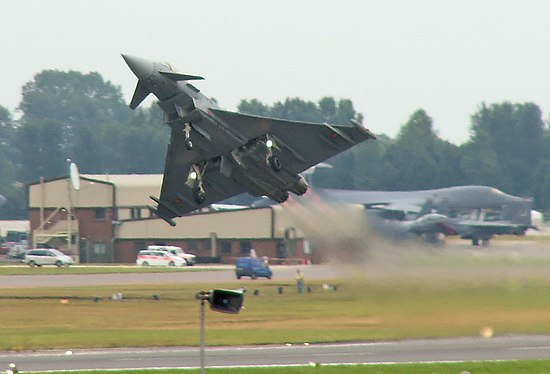
Eurofighter take-off: image india-defence.com

The word on the street is that the 4-nation European consortium’s Eurofighter Typhoon still leads after the commercial and strategic evaluation having already won the technical evaluation . But all the offset proposals put forward by the contractors may not have been fully evaluated yet. It would seem that technical considerations for one ( Lockheed Martin’s F-16IN Super Viper) and strategic considerations for the other ( Boeing’s F/A-18 Super Hornet) may disallow the choice of the US fighters. The Saab JAS 39 Gripen is probably running second.

But there may yet be a surprise.

Business Standard reports:

Electrifying aerospace vendors at Aero India 2011 in Bangalore, Indian Air Force chief, Air Chief Marshall PV Naik, announced today that New Delhi would decide within two weeks about which medium multi-role combat aircraft (MMRCA) it would buy, and actually sign the US $10 billion contract by September.
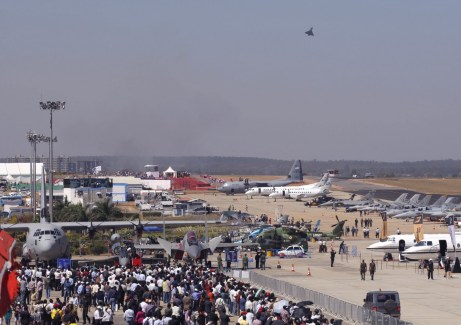
A panoramic view of Aero India 2011: image Broadsword (4.bp.blogspot.com)

“The CNC (Cost Negotiation Committee) is likely to start in a week or two. Taking that as the datum and giving [the CNC] another 6-8 months, the contract is likely to be signed in September”, declared Naik.
The CNC is a group of officials that negotiates, between the Ministry of Defence and the winning vendor, a final price for the sale.
Naik’s boss, defence minister AK Antony, had stated at Aero India 2011 yesterday that the globally-watched contract would be finalised by the end of the next financial year 2011-2012, i.e. by March 2012. By setting the deadline six months earlier, Naik appears to have put the MoD under pressure.
Asked for a clarification by Business Standard, Naik’s officiating deputy, Air Marshall RK Sharma, confirmed his chief’s announcement. Sharma clarified that the winning vendor would be issued an invitation within two weeks to appear for cost negotiations, while the CNC would actually meet within two months. An invitation to a vendor to appear in a CNC is tantamount to announcing the winner of a contract.
“The DAC (the MoD’s apex Defence Acquisition Council) will formalise the winner soon; we will then invite that company for negotiations”, said Sharma.
Six fighters are competing for the IAF contract: Boeing’s F/A-18 Super Hornet; Lockheed Martin’s F-16IN Super Viper; the MiG Corporation’s MiG-35; Saab’s Gripen NG; Dassault’s Rafale; and a four-nation European consortium’s Eurofighter. Executives from these companies say they are baffled by Naik’s announcement. Asked in late-2010 to rework their offset bids, and with no date yet given for resubmission, the MoD does not have a key element needed to decide a winner.
“Is the MoD going to decide the contract winner without examining the offset bids?” asks a bemused executive, from one of the competing aircraft manufacturers.
……….

The air chief also voiced his apprehension that the contract could be delayed by “dissatisfied vendors (who) put a spoke in the wheel”, using allegations of wrongdoing to trigger long-running probes by investigation agencies.
Yesterday, a defensive Antony had announced that political considerations would play no role in deciding the winner. That seemed to suggest that the Cabinet Committee on Security (CCS), which will be required to approval the contract after the CNC negotiates a final price, would merely rubber-stamp the IAF/MoD decision.
Other than the impending contract for 126 medium fighters to boost the IAF’s dwindling numbers, the IAF chief also announced the impending conclusion, “within this financial year”, of the contract to upgrade the air force’s 20-year-old fleet of 52 Mirage-2000 medium fighters. This upgrade, which has been the subject of bitter negotiations between the IAF and French contractor, Thales, will give the Mirage-2000 another 20 years of service life by fitting on a new radar and a modern cockpit with state-of-the-art avionics and electronic warfare equipment.
While Thales had initially demanded US $52 million per aircraft, the deal has been concluded, say IAF sources to Business Standard, at US 39 million per aircraft.
Related:
https://ktwop.wordpress.com/2010/11/07/eurofighter-typhoon-leads-after-technical-evaluation-but-still-not-the-favourite-for-indian-m-mrca-contract/
https://ktwop.wordpress.com/2011/01/04/no-surprise-secret-technical-evaluation-in-indian-mmrca-deal-found-on-the-street/

Rolls Royce profits down 76% as Trent 900 costs start to kick in

February 10, 2011

BBC reports:

Manufacturing giant Rolls-Royce has said the mid-air failure of one of its Trent 900 engines on a Qantas superjumbo had led to costs of £56m. The explosion in the engine forced an emergency landing of the A380 in November last year. The one-off cost contributed to annual pre-tax profits dropping 76% to £702m in 2010 from £2.96bn. Foreign exchange costs and interest rate and fuel hedging contracts also contributed to the profit fall.

But the Derby-based company said that underlying pre-tax profits – which strip out one-off costs – were up by 4% to £955m in 2010 and were a better indication of its performance.

Rolls Royce say that the may face further “modest costs” but this seems to be far too optimistic considering that all the engine servicing costs have yet to show up and all the various compensation claims from Qantas, Airbus, Lufthansa, and Singapore Airline will take some time to work their way through. Once all the claims are presented there is an even chance that some will need arbitration before settlement which will take some time.

Jorn Madslien also writes:

Investors will be scrutinising Rolls-Royce’s financial figures to try to find out how the recent engine failure that led to the grounding of six Qantas Airbus A380 aircraft affected the company. ……..

….. The long-term effects of the engine failure, for instance a potential fall in new orders over the months and years ahead, cannot be measured at this stage. Consequently, the final impact on the company’s bottom line is not yet known.

It does not seem as if Rolls Royce have made any provision for further costs which is a little worrying and I stay with my estimate of around $300 million as the total hit that Rolls will have to swallow for the Trent 900 for the A380 in addition to any impact on engine sales.

Judging from the delays the development cost of the Trent 1000 for the Dreamliner is also likely to be significantly more than budgeted or expected.

It will be at least 2012 before the full financial impact is known though some residual impacts will continue for many years.

The wrecked engine after QF32 landed in Singapore in Nov. 2010:Photo: AFP


Aero India 2011 kicks off tomorrow: MMRCA and technology transfer are the issues of the day

February 8, 2011

The 5 day Aero India 2011 airshow kicks off tomorrow in Bangalore and is expected to attract over 600 equipment vendors from over 60 countries. It also brings to a head the discussions within India as to how to stimulate the indigenous aviation industry and whether offset requirements in defence procurement are effective. There is a school of thought that technology transfer should be used and that offset requirements do not contribute to developing the industry. In the background is the competition for the $10 billion, 126 MMRCA aircraft contract that must be decided in March / April.

DNA reports:

In the premier Indian defence journal, Maj Gen (Retd) Mrinal Suman — who retired from the Indian Army in 2003 and currently heads the defence technical assessment and advisory service of Confederation of Indian Industry (CII) — prescribes that India, at present, urgently needs FDI in the defence and military aviation sector which is technology-centric with inherent flexibility. He has suggested that FDI could be 26% for low-tech products, while it could be 51%-74% for matured systems, and 75%-100% for cutting edge technologies.

Maj Gen Suman has decried the drastic fall in defence exports from ordnance factories from Rs41.07 crore in 2008-09 to a mere Rs12.28 crore in 2009-10, and has called it “a reflection of the nature of quality items being produced indigenously”. He has called for significantly increasing FDI and private sector’s participation in defence production and manufacture instead of just restricting to doors and frames of aircraft bodies. Suman also blasted India’s offset policy which envisages Indian companies to manufacture components worth 30% of any deal bagged by a foreign company as a seller to India. He termed it a “flawed policy” as it was not contributing to upgrading the indigenous technological base. He instead suggested that the current offset policy be amended to make transfer of technology the preferred mode.

While this is expected to take centre-stage at Aero India 2011, the intensifying contest for winning India’s $10 billion contract to procure 126 medium-weight multi-role combat aircraft (MMRCAs) will undoubtedly be the second most important issue in focus.

Not surprisingly, this is the first time ever that all six contenders for the contract are participating at an Aero India show — Boeing’s F/A-18 Super Hornet, Lockheed Martin’s F-16 Super Viper (both from USA), MiG Corporation’s MiG-35 (Russian), Dassault’s Rafale (French), EADS’s Eurofighter Typhoon (European Union’s) and SAAB’s Grippen (Swedish).

The contest between these six, this time round, will be there for all to see with these aircraft displaying their skills and manoeuvrability to win the hearts of the Indian Air Force and ministry of defence experts who are expected to place a finger on one of them for procurement.

The IAF is procuring the 126 MMRCAs to bolster its depleting squadron strength. The IAF squadron strength is at present below the sanctioned strength — just 34 squadrons as against the sanctioned strength of thirty-nine-and-a-half.

There is a formidable Russian presence at the air show.

Russia will exhibit over 80 types of weaponry and will be represented by 35 companies at the upcoming Aero India 2011 air show, state-run arms exporter Rosoboronexport said in a statement.
Russia will be represented by 35 companies, including MiG , Sukhoi, Almaz-Antei and Engineering Design Bureau.
Russia will traditionally promote MiG-35 and Su-35 fighter jets, the Yak-130 combat trainer, two versions of Il-76MD transport plane (with different engines), the Il-78MK aerial tanker and MiG-29K and MiG-29KUB naval fighters.
The Be-200 amphibious aircraft will most likely be one of the top attractions of the Russian exhibit as its popularity with foreign customers steadily grows. The plane could be used in a wide variety of roles, from maritime reconnaissance and rescue to firefighting.
Rosoboronexport and Russian helicopters will show the Mi-28NE attack helicopter, the light multirole Ka-226T and the heavy transport Mi-26. All three helicopters are currently taking part in separate Indian helicopter tenders.
The visitors will also be able to receive information about the Mi-35M combat transport helicopter, the Kamov Ka-31 radar surveillance helicopter and the Ansat and Kamov Ka-32A11BS multi-role helicopters.
The air defence part of the Russian exhibit will be represented by the Tor-M2E, the S-300VM, the Buk-M2E and the Tunguska-M1 systems.

Relatedhttps://ktwop.wordpress.com/2010/11/07/eurofighter-typhoon-leads-after-technical-evaluation-but-still-not-the-favourite-for-indian-m-mrca-contract/

First Sukhoi Superjet 100 to be delivered this month – 2.5 years late

February 3, 2011

Embraer E-Jet: Wikipedia

The Sukhoi Superjet 100 is a modern, fly-by-wire regional jet in the 75- to 95-seat category. The Superjet 100 will be produced by Russian aerospace firm Sukhoi’s civil division, of which Finmeccanica of Italy owns 25%. The jet airliner is being developed in collaboration with Finmeccanica subsidiary Alenia Aeronautica.

The SSJ is designed to compete against the Embraer E-Jets and the Bombardier CRJ programs. The SSJ aims for lower operating costs than its Embraer or Bombardier counterparts for the price of $31.7 million.

The deliveries were first scheduled to begin in late 2008, and Sukhoi predicted that 163 units of all variations of the Superjet 100 would be delivered by the end of 2016. On 7 July 2008, Sukhoi officially confirmed that the original schedule was too optimistic, and first deliveries would begin in December 2009.

Bombardier CRJ: image altairva-fs.com

In September 2010, the CEO of SuperJet International said that certification was expected in November 2010. In October 2010, the Sukhoi Superjet 100 (SN95004) passed noise testing carried out under the auspices of Russian and European certification authorities (AR IAC and EASA respectively). On 4 November 2010, the first production Superjet (SN95007) intended for Armavia was test flown.

Now the first delivery is scheduled for this month but – ominously – only after  “further tests”. This schedule is likely to slip but perhaps not by much.

Ria Novosti reports:

File:Sukhoi Superjet 100.jpg

Sukhoi Superjet 100 at the MAKS 2009 Airshow. image Wikimedia

The delivery of the first Sukhoi Superjet 100 to Armenian Armavia airlines is scheduled for next month, officials in the Russian Far Eastern Khabarovsk region said on Wednesday.

The SN 95007 will be handed over to Armavia after further tests, regional transport minister Sergei Ivashkin said, adding that 64 test flights had already been conducted.

The Superjet 100 is a family of medium-haul passenger aircraft developed by Sukhoi in cooperation with U.S. and European aviation corporations, including Boeing, Snecma, Thales, Messier Dowty, Liebherr Aerospace and Honeywell.

The tally for orders for the plane has reached 170, with more regional airlines expected to line up as customers. Russian flagship carrier Aeroflot has signed for 40 Superjets.


Once again: Qantas + RR engine + B747 = return to base

January 26, 2011

The Rolls Royce Engine Syndrome (RES) strikes again.

This time – one very thirsty engine

Qantas

Another drama ... A Qantas 747 was forced to return to Bangkok yesterday. image: http://www.news.com.au

Flight QF2 carrying 352 passengers was about 30 minutes into its flight from Bangkok International Airport when one of its engines began “consuming fuel more quickly than normal” a Qantas spokesman said.
It was forced to return to Bangkok where it landed safely about 7pm local time (11pm AEST). Affected passengers are expected to spend a second night in temporary accommodation with Qantas scrambling to send a replacement engine from Sydney for the troubled Boeing 747 today.
“As far as possible we will try and get passengers who need to return to Sydney urgently on other flights but that will be dependent on availability on other airlines,” the spokesman said.

“It was not actually an engine failure, (the pilots) did not shut the engine down they just reduced the thrust.” However one passenger on the flight says the engine “blew”.

The spokesman said there were no other replacement Qantas aircraft available in Bangkok.

Read more: http://www.news.com.au/travel/news/another-engine-problem-for-qantas/story-e6frfq80-1225994833407#ixzz1C7bLqCgl

Dreamliner delayed again and Qantas dramatics continue – now with B747 engines

January 19, 2011

Boeing has delayed the Dreamliner again — for the seventh time!

The Telegraph reports:

Boeing told investors on Tuesday that the 787 will now be delivered to launch customer All Nippon Airways in the third quarter of the year, rather than the first, after a fire on one of the test planes in November. All test flights were suspended for six weeks after the fire.

The 787, which seats 210 to 250 passengers and has a list price of $202m, promises to be the company’s greenest and most efficient airliner yet and uses advanced composite materials to achieve these savings. However, technical problems have pushed the aircraft behind schedule and it is now into its third year of delays. Boeing is under pressure to deliver the 787, which has become the company’s fastest-selling airliner.

Shinichiro Ito, the president of All Nippon, said last week the airline is having a “hard time” dealing with the delay. Boeing has secured 847 orders for the 787, which took its maiden flight in December 2009. Boeing insisted the latest setback will not have a “material impact” on its results, something investors appeared to agree with.

Meanwhile Qantas experiences further problems with its Rolls Royce engines . AFP reports on two Boeing 747 Qantas flights with engine problems:

A Qantas passenger jet bound for New York made an unscheduled stop in Fiji after it developed a problem with one of its engines, the Australian airline said Wednesday.

Qantas said flight QF107, a Boeing 747, carrying 375 passengers from Sydney to New York via Los Angeles, touched down in Nadi on Tuesday for repairs to a fuel valve supplying one of its engines…..

…… The hitch comes just days after another Qantas Boeing 747, QF11 to Los Angeles, experienced a contained engine failure on the runway of Sydney airport due to a turbine blade defect.

Media reports on that incident said that passengers heard “a loud bang” and saw black smoke pour from the affected engine, with the captain reportedly telling those on board that the engine had “cooked itself” over the plane’s intercom.

The “contained”  engine failure is the more serious issue. The Boeing 747 long-reach aircraft flown by Qantas uses  Rolls-Royce RB211-524G-T engines. The “T” at the end signifies that it includes some of the Trent modifications. The Trent 900 engines are used on the Airbus A380s while the Trent 1000 is  planned for the Boeing Dreamliner.

A Trent 1000 experienced an uncontained failure on the test-bed last year while the Trent 900 has had an uncontained failure and a number of other difficulties on the A380.

Related:

https://ktwop.wordpress.com/2010/09/28/rolls-royce-trent-1000-fix-is-defined/

https://ktwop.wordpress.com/2010/10/25/in-flight-failure-of-rb-211-524-engine/

https://ktwop.wordpress.com/2010/11/04/qantas-a-380-suffers-in-flight-rr-trent-900-engine-failure/

https://ktwop.wordpress.com/2010/11/05/trent-900-vs-gp7200-competitive-pressures-getting-too-hot/

https://ktwop.wordpress.com/2010/11/07/further-boeing-dreamliner-delays-and-rolls-royce-shares-feeling-the-heat/