Archive for the ‘Aviation’ Category

Rolls Royce and EADS shares take a beating

November 4, 2010

London South East reports on the aftermath of Qantas grounding its A 380 fleet and Singapore Airlines delaying all A 380 flights for extra checks of the their Trent 900 engines:

Shares in Rolls-Royce fall 3.2 percent after Qantas Airways suspends flights of its Airbus A380 fleet after the failure of a Rolls Trent 900 engines triggers an emergency landing in Singapore.

Shares in Airbus parent EADS were 3.7 percent down after what is one of the most serious incidents for the world’s largest passenger plane in three years of commercial flight.

‘If it is a design fault on the engines it would be embarrassing because Rolls is the number two engine manufacturer in the world and has a fantastic reputation,’ says BGC Partners senior strategist Howard Wheeldon.

‘These type of things take a fairly lengthy time to investigate,’ he said, adding that ‘it will be costly to address those issues’ if it is a serious fault with the engine.

The intense competition between the two engines for the A 380, the Trent 900 and its rival the GP7200 manufactured by the General Electric/Pratt & Whitney Engine Alliance is centred around fuel efficiency. The GP7200 is generally thought to have a 1% advantage. It also seems to be the strategy for the U.S. engine makers to constantly maintain this performance gap over their competitor as each tries to improve performance.

From Aviation Week:

Of course Rolls-Royce disputes the existence of that fuel-burn performance lead and says its improvement plan for the Trent 900EP (enhanced performance) will lead to more substantial efficiency modifications by around 2013. Still in the early stages, these plans will incorporate advanced technology from the most recent iterations of the Boeing 787’s Trent 1000 and the Trent XWB for the A350.

The core of the package will be the introduction of elliptical leading-edge modifications throughout the entire compression system, including improved high- and intermediate-pressure (HP/IP) compressor blades and vanes. The modification, which also applies to the fan and outlet guide vanes, improves flow interactions by altering boundary layer thickness and increasing laminar flow. The changes are similar to elliptical leading-edge modifications made to the HP compressor introduced recently to International Aero Engines’ V2500 in the SelectOne program, as well as the Trent 700EP. The elliptical feature also is part of the baseline fan design for the Trent 1000 and XWB.

“The package includes tweaks to the air management system, and that also affects fuel burn,” says Crawford. “We’re very confident in being able to achieve the 1% post-2011. The program is already defined, the detailed design is being done and bits are in manufacture. Testing is next year and will cover maturity modifications to upgrade areas we’ve seen on early engines.” These include “potential ‘wear out’ areas we want to address, such as seal segments and optimized tip clearance.”

As with the Trent 700EP, the 900EP enhancement will be offered as an upgrade kit for existing engines. “The modifications are all optional and are completely interchangeable. You will get the full 1% if you install all the parts,” says Richard Keen, Airbus programs marketing director. “From 2011 this will be the production standard for all new Trent 900 orders,” he adds.

With the problems being experienced by the Trent 900 and also with the Trent 1000 for Boeing’s Dreamliner, one obvious question is whether the cut-throat competition for fuel efficiency is leading to a trade-off between efficiency on the one hand and reductions in clearances and compromises on wear considerations on the other.

Update! Singapore Airlines delays all A 380 flights for extra engine checks

November 4, 2010
Rolls-Royce Trent 900 on the prototype Airbus ...

Trent 900: Image via Wikipedia

Update!

After earlier saying they would continue all flights normally, Singapore Airlines Ltd. has delayed flights on Airbus A380 planes after engine trouble forced a Qantas superjumbo to make an emergency landing at Changi Airport. “Our engine manufacturer Rolls Royce and aircraft manufacturer Airbus have advised us to conduct precautionary technical checks on our A380 aircraft, following today’s incident involving another operator’s A380,” Singapore Airlines said in a statement late Thursday evening. “Resulting from this development, Singapore Airlines will be delaying all flights operating our A380 aircraft.”


Lufthansa and Singapore Airlines keep their Trent 900s flying

November 4, 2010


Singapore Airlines (SIA/SQ) Airbus A380 (9V-SK...

ISingapore Airlines A 380: Image via Wikipedia


While Qantas has grounded its A380 fleet, Lufthansa and Singapore Airlines – who also use the Rolls Royce Trent 900 engines of the type which failed on the Qantas jet – are watching the situation but are keeping their A380’s flying.

Bloomberg reports:

Deutsche Lufthansa AG and Singapore Airlines Ltd. said they’ll keep their Airbus SAS A380s flying after Qantas Airways Ltd. grounded its six-strong superjumbo fleet following an engine explosion in mid-flight.

Lufthansa is operating its four A380s as normal, spokesman Boris Ogursky said by telephone, as is Singapore Airlines, which has 11 of the planes, according to a statement. The pair are the only other carriers with superjumbos powered by the same Rolls- Royce Group Plc Trent 900 engines used on the Qantas jet.

Australia’s Qantas will keep its fleet out of service “as long as it takes” after one of the four engines on an A380 failed en route from Singapore to Sydney, Chief Executive Officer Alan Joycesaid today. The pilots performed an emergency landing at Singapore at 11:46 a.m. local time.

Singapore Airlines was the first carrier to operate the A380 and has nine more on order, plus six options, according to its website. All will be powered by Trent 900 turbines.

Lufthansa, based in Cologne, Germany, has ordered 15 A380s, with those already delivered used for services to Tokyo, Beijing and Johannesburg. The Rolls engine passed compulsory tests “with flying colors” before delivery, the airline said in May.

Nicholas Ionides, head of corporate communications for Singapore Airlines, told Reuters the airline was liaising closely with its engineering team and manufacturers.

Meanwhile

Dubai’s flag carrier Emirates Airline, the biggest single customer of the Airbus A380 aircraft, said Thursday all of its superjumbos are operational and on schedule, after an A380 owned by Qantas Airways (QAN.AU) was forced to make an emergency landing due to an engine failure.

“All of our Emirates A380s are operating as scheduled. Emirates has 13 A380s in operation, powered by Engine Alliance GP7200 engines,” the company said in an emailed statement.

Related posts:

https://ktwop.wordpress.com/2010/11/04/rolls-royce-trent-900-engine-was-subject-of-airworthiness-directive-on-17th-september/

https://ktwop.wordpress.com/2010/11/04/qantas-grounds-all-a-380-flights-following-in-flight-failure-of-rr-trent-900/

https://ktwop.wordpress.com/2010/11/04/qantas-a-380-suffers-in-flight-rr-trent-900-engine-failure/

Rolls Royce Trent 900 engine was subject of Airworthiness Directive on 17th September

November 4, 2010

http://rgl.faa.gov/Regulatory_and_Guidance_Library/rgAD.nsf/list/2010-16-07?OpenDocument

The Federal Aviation Administration issued an AD concerning the RR Trent 900 engine recently:

ACTION: Final rule; request for comments.

SUMMARY: We are adopting a new airworthiness directive (AD) for the products listed above. This AD results from mandatory continuing airworthiness information (MCAI) issued by an aviation authority of another country to identify and correct an unsafe condition on an aviation product. The MCAI describes the unsafe condition as:

Wear, beyond Engine Manual limits, has been identified on the abutment faces of the splines on the Trent 900 Intermediate Pressure (IP) shaft rigid coupling on several engines during strip. The shaft to coupling spline interface provides the means of controlling the turbine axial setting and wear through of the splines would permit the IP turbine to move rearwards.

Rearward movement of the IP turbine would enable contact with static turbine components and would result in loss of engine performance with potential for in-flight shut down, oil migration and oil fire below the LP turbine discs prior to sufficient indication resulting in loss of LP turbine disc integrity.
We are issuing this AD to detect rearward movement of the IP turbine, which could result in loss of disc integrity, an uncontained failure of the engine, and damage to the airplane.

DATES: This AD becomes effective September 17, 2010.

Of course it is far too early to say if this has anything to do with the Trent 900 engine failures experienced by Singapore Airlines and Qantas on their A 380’s but the AD does talk about the possibility of an “uncontained failure of the engine”.

Qantas grounds all A 380 flights following in flight failure of RR Trent 900

November 4, 2010

Reuters:

Qantas Airways suspended flights of its Airbus A380s on Thursday after one of the aircraft was forced to land in Singapore with engine trouble, one of the most serious incidents for the world’s largest passenger plane in its three years of commercial flight.

Qantas, which operates six A380s, said it was grounding the aircraft pending a full investigation. “We will suspend all A380 takeoffs until we are fully confident we have sufficient information about (flight) QF32,” Qantas Chief Executive Alan Joyce told reporters in Sydney.


Main Image

Indonesian police examine fallen debris from a Qantas jet collected from several areas on Batam island, an Indonesian territory near Singapore November 4, 2010. :Credit Reuters/Stringer


Singapore Airlines also uses Rolls Royce Trent 900 engines in its A 380s.

Related posts on Rolls Royce engine failures:

https://ktwop.wordpress.com/2010/11/04/qantas-a-380-suffers-in-flight-rr-trent-900-engine-failure/

https://ktwop.wordpress.com/2010/10/25/in-flight-failure-of-rb-211-524-engine/

https://ktwop.wordpress.com/2010/09/28/rolls-royce-trent-1000-fix-is-defined/

Qantas A 380 suffers in-flight RR Trent 900 engine failure

November 4, 2010

Updatedhttps://ktwop.wordpress.com/2010/11/04/qantas-grounds-all-a-380-flights-following-in-flight-failure-of-rr-trent-900/

Sydney Morning Herald

A Qantas A380 has been forced to return to Singapore’s Changi Airport after pilots were forced to shut down one of its four engines. QF32 was bound for Sydney with 443 passengers and 26 crew on board when the engine failed. “Qantas flight QF32 was en route from Singapore to Sydney, the number two engine has shut down, so as a precautionary measure we are taking it back to Singapore,” a Qantas spokeswoman said.


The wrecked engine after the plane landed in Singapore.

The wrecked engine after the plane landed in Singapore.Photo: AFP


Indonesian authorities said there had been some sort of explosion over the island of Batam, just south of Singapore. Elfhinta radio quoted a police officer in Batam, Eryana, saying parts of the plane had been found. “We are still collecting debris,” he said.

In a recent similar incident, an engine exploded on a Qantas flight to San Francisco on August 30, with debris tearing holes in the engine cover.

The Qantas A 380’s have 4 Rolls Royce Trent 900 engines.

The RR Trent 1000 destined for Boeing’s Dreamliner has had some problems during testing.

A month ago on 28th September, a Singapore Airlines A380 also suffered a failure of one of it’s 4 Trent 900 engines.

An engine problem on a Singapore Airlines A380 superjumbo airliner was a “non-event” in technical terms, the chief executive of the company that built it said yesterday. Singapore Airlines said the plane carrying 444 passengers from Paris to Singapore was forced to return to the French capital on Sunday when the as-yet unspecified problem was detected two and a half hours into the flight.

The A380 is the world’s largest passenger airliner and Singapore Airlines (SIA) is the first to take delivery of it, having ordered 19 with an option for six more. Speaking in Paris, Louis Gallois, chief executive of Airbus manufacturer EADS, called the incident “a complete non-event”.

“Engine failure on a four-engine aircraft does happen and nobody should think of it as a drama,” Gallois told journalists. “In technical terms, it is not an event.”

Background: (Wikipedia)

The A380 can be fitted with two types of engines: A380-841, A380-842 and A380-843F with Rolls-Royce Trent 900, and the A380-861 and A380-863F with Engine Alliance GP7000 turbofans. The Trent 900 is a derivative of the Trent 800, and the GP7000 has roots from the GE90 and PW4000. The Trent 900 core is a scaled version of the Trent 500, but incorporates the swept fan technology of the stillborn Trent 8104. The GP7200 has a GE90-derived core and PW4090-derived fan and low-pressure turbo-machinery. Only two of the four engines are fitted with thrust reversers.

Indra Dhanush 2010 concludes but UK hopes of selling Harriers is dashed

November 3, 2010

By all accounts both the IAF and the RAF are very satisfied with the joint exercise Indra Dhanush 2010 which has just concluded. But UK hopes of selling the Harrier seem to have stalled. The Financial Times reports that

Britain has hit an early obstacle in its bid to sell its fleet of Harrier jump jets after India, the most promising potential buyer, described the aircraft as “iffy” and obsolete.

Air Chief Marshall PV Naik, the head of the Indian Air Force, said on Tuesday he would be looking to acquire modern aircraft of fourth-generation capabilities or better. “The Harrier doesn’t fit into that category,” the Air Chief Marshall said. His dismissive remarks over the “iffy” Harrier came soon after Air Chief Marshal Sir Stephen Dalton, the chief of the UK air staff, acknowledged the possibility of a sale while paying a visit to India to boost military co-operation and exports.

The distinct lack of interest shown in the Harrier, which was decommissioned in the defence review primarily on grounds of cost, will be a blow to ministers who are seeking to generate some much-needed revenue from the disposal.

Air Chief Mashall Naik’s words will particularly sting because the Ministry of Defence has spent more than £500m upgrading the Harrier avionics over the last five years and the jets could potentially remain in service until the mid 2020s.

Sify News reports the conclusion of the exercise:

The joint air force drill between India and United Kingdom (UK) held under the banner of ‘Indradhanush’-III at Air Force Station Kalaikunda in West Bengal’s West Midnapore District concluded on Tuesday. The Royal Air Force of UK participated with modern Typhoon Eurofighters, the E-3D Sentry, and VC-10 mid air re-fueller, while the Indian Air Force (IAF) fielded the SU-30 MKIs, Mirage 2000s, Mig 27s and its AWACS for the first time in a joint Air Exercise.


Eurofighter Typhoon

Eurofighter Typhoon: Image by Destinys Agent via Flickr


Pilots of the Royal Air Force said that the purpose of this exercise was to enhance understanding between the Royal Air Force and the Indian Air Force. “The whole purpose of the exercise of the ‘Indradhanush’ has been to enhance understanding between the Royal Air Force and the Indian Air Force and whosoever increase…competence as an Air Force and it’s been on air front a very, very successful exercise,” said Guy Lockwood, a pilot of the Royal Air Force of United Kingdom.

“We have learned good things from them. They follow the NATO procedures, we follow our own. When we fought together we realised they have got some good things, they realised that we have also got some good tactics, we fought together, so it was a good experience,” said Susil Kumar, a pilot of the IAF.

During the initial two-days of the exercise on October 18 and 19, elaborate briefings on standard operating procedures, rules of exercise and familiarisation of the local flying area was carried out.

The exercise ‘Indradhanush’ began on October 21 and continued for 12-days.


Day 3 at Kalaikunda: image http://chhindits.blogspot.com


Joint RAF / IAF exercise Indra Dhanush 2010 enters final phase

October 31, 2010
Eurofighter Typhoon

Eurofighter Typhoon: Image via Wikipedia

The joint UK / India air exercise Indra Dhanush 2010 which began on October 18th at Kalaikunda Airbase in West Bengal’s West Midnapur District has entered its final phase and is due to end on November 3rd.  The RAF is participating with its Euro-fighters, VC-10 mid- air refuellers and E 3 D Sentry Airborne Early Warnings and Control Systems (AWACS) while the IAF is flying the SU 30s, Mirage 2000s, Mig-27s and their newly acquired AWACS.

So far some 120 flying missions have been flown. In the final phase a large number of aircraft in offensive and defensive roles are expected to be launched in ‘Waves’ in a limited airspace to test the skills of the fighter pilots, the AWACS and the ground controllers. High Value Air Asset (HVAA) protection missions which require a large number of aircraft are also to be carried out.

The exercise takes place with the backdrop of the 11 billion $ order for 126 MMRCA fighters that is to be placed soon by the Indian Air Force. The six competing fighters that the IAF has flight-tested over the last year include Boeing’s F/A-18 Super Hornet, Lockheed Martin’s F-16IN Super Viper, Dassault’s Rafale, the Russian MiG-35, the Swedish Saab Gripen NG and the Eurofighter.

In flight failure of RB 211-524 engine

October 25, 2010

WA Today reports:

Air safety investigators have found extensive turbine damage in the jet engine that exploded on a Qantas jumbo at 25,000 feet near San Francisco in August this year. Engine parts that were flung outwards tore not only a gaping hole on the far side of the engine cover but also peppered the near-side with holes, air safety investigators have revealed. As the engine vibrated, debris ejected through the engine hole hit the underside of the wing, puncturing the wing flaps, investigators have found.


A Qantas jet was forced to turn back to San Francisco after a hole was blown in the shell of the engine.

Flight QF74 failure of RB211-524 engine:Photo: Channel Ten


The findings are contained in a preliminary report by the Australian Transport Safety Bureau (ATSB) into the explosion on flight QF74, carrying 213 passengers and 18 crew, on August 30. The incident occurred 15 minutes after take-off.

The pilots shut down the engine, sought landing clearance, dumped fuel and landed safely at San Francisco, where the plane was met by fire crew, inspected and allowed to taxi to the terminal. This was an exceptionally rare event and the first time Qantas has experienced this type of engine failure,” a Qantas spokesman said.

All of the engine’s turbine blades had either fractured or broken away, investigators said. There was also damage of other engine internals including vanes, bearings, speed probes and a turbine shaft. Further testing of engine components will be undertaken by Rolls-Royce, overseen by UK air safety investigators. The Rolls-Royce RB211-524 engine was removed from the aircraft and taken to Hong Kong for examination. The investigation is continuing.


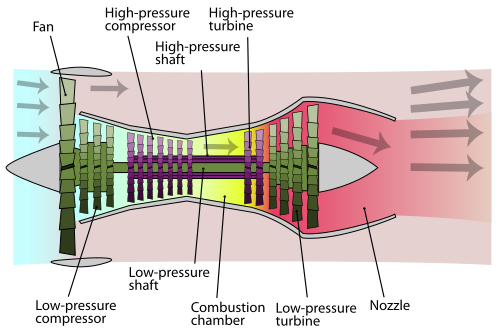
Turbofan engine operation: Wikimedia


RB 211-524: aircraftenginedesign.com


The RB 211 family is a high bypass turbofan engine originally designed for the Lockheed Tristar. The 211-524 engine was developed with increased thrust and efficiency for the Boeing 747-200 and further improvements led to the 211-524 G and 211-524H for the Boeing 747-400 and for the 767. The 211 family has led to the Trent engines and some features of the Trent could be retrofitted to create the 211-524G-T and the 211-524H-T. A newer version of the same family the 211-535 series is used in Boeing 727’s and 757’s.

An industrial version of the RB211 is used for power generation and another inter-cooled version is used in marine applications.

The Rolls Royce Trent 1000 engine designed for Boeing’s Dreamliner has had some initial testing setbacks which seem to be fixed but which has caused some of the delays to the Dreamliner.


Indra Dhanush 2010: Sukhoi vs Eurofighter and 10 B$ at stake

October 11, 2010


F3, Eurofighter, SU-30MKI


In 2006, and for the first time in over forty years the Royal Air Force and the Indian Air Force carried out exercises at bases in northern India, with Tornado F3s, E3-D AWACS and a VC10 making up the bulk of the RAF air presence. The bi-lateral Exercise INDRA DHANUSH (which means rainbow in Hindi), was held at IAF Gwalior and IAF Agra.The IAF platforms included the Sukhoi-30 MKIs, Mirage 2000, MiG-21 ‘Bison’ and MiG-27 aircraft.


Indra Dhanush 2007


Exercise Indra Danush moved to RAF Waddington in July 2007. On one side was Britain’s Eurofighter Typhoon, whose advanced aerodynamics and intuitive controls and avionics have led to it being rated as the second-best air superiority aircraft in the world. Its supporting cast included 1980s era Tornado F3 air defense variants, and upgraded GR9 Harriers from the Royal Navy. On the other side was India’s SU-30MKI, the most evolved variant of Sukhoi’s outstanding Flanker family, with aerodynamics that allow unique maneuvers, and full thrust vectoring besides.The Eurofighter is smaller, and is generally agreed to have more “shaping” than the SU-30 to reduce its radar profile (though neither aircraft is in the same class as the F-22A Raptor or even the less-stealthy F-35 Lightning II).

(See http://jetwashaviationphotos.com/wwwjetwashaviationphotosindradhanush.aspx)

Now the Indian Air Force and the Royal Air Force “meetat Exercise Indra Dhanush 2010 from October 20th  at Kalaikunda, West Bengal. The exercise will be held in an AWACS (airborne warning and control systems) environment, with air defence being a major thrust area. Both the Indian and British forces are also expected to use their mid-air refuelling aircraft, like the IL-78 and VC-10 tankers, during the combat manoeuvres.

The exercise comes at a time when the $10.4 billion project to acquire 126 medium multi-role combat aircraft (MMRCA) for the IAF is in the final stages of the selection process. Apart from the Eurofighter, the other five contenders in the hotly-contested race for the lucrative MMRCA project are the F/A-18 `Super Hornet’ and F-16 `Falcon’ (both US), Gripen (Swedish), Rafale (French) and MiG-35 (Russian).

A major Indo-UK defence deal has been the `Hawk’ AJT (advanced jet trainer) project. India is going in for another 57 Hawks as a “follow-on” order to the ongoing Rs 8,000 crore (about 1.75 B $) AJT project, finalised in March 2004 with BAE Systems, under which the IAF is already getting 66 Hawks.

The Royal Air force is going to field its Eurofighter Typhoon aircraft, AWACS (E-3D) and Air to Air refuellers (VC-10). The IAF will field SU-30 MKI, Mirage 2000’s, Mig 27’s and Airborne Early Warning and Control Systems(AWACS) Aircraft.