Archive for the ‘Behaviour’ Category

Being on-line and anonymous does not eliminate accountability and responsibility

March 6, 2013

The Washington Post considers the pluses and minuses of anonymity in the on-line world but typically just stays on the fence. “It’s complicated”. In an abundance of indecision and of  “political correctness” it reaches no conclusion.

But I take a rather simplistic and uncomplicated view. “On-line” is just one more medium through which “publishing” can take place. This medium may be much more immediate and with greater global spread than other media. But whatever the medium may be, responsibility and accountability for what is published cannot just vanish. It cannot just disappear into some black hole between an author and his publisher. Either the publisher or the author must take responsibility and be accountable for whatever is published. The publisher controls the medium. Whether he wishes to allow anonymity or not is his prerogative. But if the publisher (the on-line web-site host) allows his authors to keep their identities secret from the public then he must take responsibility and be accountable for what is published.  It is also then his call as to whether he himself wishes to know the identity of those using the platform he provides. Where, however, the author is publicly identified then the publisher is effectively indemnified.

Where comments (on a blog or a web-site or a forum) are allowed anonymously then applying moderation is the host’s call but he cannot escape the responsibility or the accountability for the content he allows.

Anonymity does not eliminate responsibility and accountability. It merely shifts responsibility from the author to the publisher. The buck has to stop somewhere.

Washington Post: It shields the whistleblower from blowback and the deep-background source from getting deep-sixed. It helped women publish novels way back when . . . when that was a pretty novel idea. But it can also embolden the kook to get kookier and the racist to get . . . well, you get the picture.

….. Fey and Pexton, whose thoughts have gotten the viral launch that only a lengthy discussion on NBC’s “Today” show can provide, veer toward an age-old question. Does anonymity make us good? Or does it make us bad? And now that we’ve had a good long while to get used to splashing around online, there’s another question to ponder: Does the Internet make it easier for us to be anonymously bad or anonymously better?

The answer isn’t so simple. Consider 4Chan, a hugely popular and emphatically anonymous Internet board that began as a place to discuss Japanese anime and has swelled into dozens of boards focused on everything from “science & math” to “Sexy Beautiful Women.”

The site can get raunchy. The posters can get rough with each other. Anonymity has the effect of making the users less inhibited, said Michael S. Bernstein, who studied the site’s “/b/ – random” board with colleagues at MIT and the University of Southampton in Britain. That lack of inhibition has led to plenty of “gore, pornography and racism,” Bernstein, now a computer science professor at Stanford University, said in an interview.

But amid all the offensive behavior, Bernstein and his fellow researchers also found that anonymity had a lot of positive effects. One of the most notable was the creation of a culture that fostered experimentation and new ideas. Since no names were being used, the users felt more comfortable taking risks. They’ve ended up contributing to the creation of an Internet culture and to a proliferation of memes. ….

…. The American Association for the Advancement of Science (AAAS), publisher of the respected journal Science, was concerned enough to commission a study that concluded anonymity was something worth striving to preserve. “There was talk at the time about making anonymity difficult or impossible,” said Albert H. Teich, a professor at George Washington University who was director of science and policy programs at AAAS when the study was released.

The scientists wanted the Internet to be a place where political opinions could be expressed freely without fear of repercussions; where, say, a teen struggling to come to grips with his sexuality could discreetly seek advice.

…. Still, he’s torn. Terrorism gives him an argument against anonymity. Protecting contacts who were helping AAAS combat human rights violations in Central America gives him a reason to protect anonymity. …..

Junkies versus Non-junkies: Junk genes are not junk — or maybe they are

February 24, 2013

Myopic “scientists” bitching about each other is always interesting. Scientific theories have their own evolutionary life as some wither and die and some – gradually – become accepted and “proven”.  But it is the behaviour of the protagonists of rival theories which is entirely human. Rivalry, back-biting and childish insults in the world of evolutionary biology between junk-gene supporters and junk-gene debunkers are now getting entertaining.

Animation of the structure of a section of DNA...

from wikipedia

In September last year the ENCODE Project made a major splash when they published some 30 papers in front-line journals showing that most of the human genome dismissed earlier as as “junk genes”  did in fact show biological activity and probably had some as yet unknown function. They reported that they had transcribed some 76% of “junk” DNA and that more than 50% of all genes could be accessible to proteins which can control genetic behaviour and they concluded that over 80% of human DNA serves some purpose.

The term “non-coding” DNA, then popularised as”junk” genes, was coined in 1972. This idea  gradually gained favour and by 2003 the human genome was supposed to consist of some  26,000 protein-coding genes within a large amount of non-coding DNA where the non-coding or “junk” DNA represented some 98% of the whole genome. The results of the ENCODE project turned this idea on its head. The junk gene supporters were not amused. It has taken them a little while to circle the wagons and formulate a response to the flood of papers published in September. And the response resorts to unusually harsh language for scientific discourse. It would seem that the “junk” gene protagonists have been prodded in their vitals and feel their life-work and their livelihoods being threatened!

Junkies versus Non-junkies! The battle-lines have been drawn. They have now published an open-access diatribe: On the immortality of television sets: “function” in the human genome according to the evolution-free gospel of ENCODE

The Guardian: “Everything that Encode claims is wrong. Their statistics are horrible, for a start,” the lead author of the paper, Professor Dan Graur, of Houston University, Texas, told the Observer. “This is not the work of scientists. This is the work of a group of badly trained technicians.”

Scientists are being called technicians — no less!

The junkies write:

From an evolutionary viewpoint, a function can be assigned to a DNA sequence if and only if it is possible to destroy it. All functional entities in the universe can be rendered nonfunctional by the ravages of time, entropy, mutation, and what have you. Unless a genomic functionality is actively protected by selection, it will accumulate deleterious mutations and will cease to be functional. The absurd alternative, which unfortunately was adopted by ENCODE, is to assume that no deleterious mutations can ever occur in the regions they have deemed to be functional. Such an assumption is akin to claiming that a television set left on and unattended will still be in working condition after a million years because no natural events, such as rust, erosion, static electricity, and earthquakes can affect it. The convoluted rationale for the decision to discard evolutionary conservation and constraint as the arbiters of functionality put forward by a lead ENCODE author (Stamatoyannopoulos 2012) is groundless and self-serving.

Would the Junkies  – I wonder – allow 98% of their DNA – or that of their children – to be excised if it could be?

On being 65!

February 23, 2013

If I’d been out till quarter to three
Would you lock the door,
Will you still need me, will you still feed me,
When I’m sixty-four?

I was 65 last Sunday and still sometimes go out till quarter to three. But I carry a key.

I am now officially “past-it” and this is wonderful. Nothing of earth-shattering significance is any longer expected of me. Anything I can manage to do now makes me an over-achiever.

People ask whether I have “retired” and here in Sweden I am asked if I am a “pensioner”, but I never know how to reply correctly. A “pensioner” is used here as a kind of a label which I find less than flattering. While I have activated some “pensions” as sources of income, I take on consultancy assignments and lecture and write and that also generates some income.  So, yes I have stopped being an “employee” but  no – I have not retired from life  – yet!. I don’t mind if strangers offer me a seat in crowded places!  I don’t mind being called “uncle” when I am visiting India but I’m still getting used to being addressed as “the old man” or as “Grandfather”. I am expected to be opinionated – which I was anyway. My natural arrogance is less offensive or perhaps I have mellowed and have lost some of my cutting edge. I am not dishevelled but I don’t worry much about how I look any more or if my colour combinations are bizarre. I only need to – or wish to – wear a tie once or twice a month. I can even get away with wearing my old shoe-string ties from the 60’s or broad flowered ties from the 70’s. If I could have gotten into some of my old bell-bottomed trousers I would have (and I don’t know why I am still preserving them). I get reminders about influenza vaccinations but they don’t convince me. I get diabetes diets sent to me by post and e-mail but they don’t offer anything better than what common sense tells me. I get special health insurance offers but they are just junk-mail. Investment opportunities for “seniors” come through tele-marketeers or drop through the letter box but I suspect that they use “senior” as a euphemism for “senile”.

Back in my youth when I turned 60 my son – very dispassionately – said to me, “You studied for 20 years , worked for 40 and you have 20 years left. Why would you want to do anything you did not want to?”. At that time I was deciding whether to continue working for a large multi-national or to do my own thing. With the question formulated as my son did, the answer became a “no-brainer”. Well I have been doing what I wanted to since then. Now I have 15 years to go and don’t intend to do anything I don’t want to. I may be past-it but the list of things I want to do – and can do – keeps expanding. Fifteen years won’t come close to being long enough to get through the entire list so I will have to make priorities. Paradoxically, I am in no rush though.

I wrote my first book a couple of years ago and 3 more are burgeoning in my head. I want to get at least a couple of these written and published. I have idle thoughts about combining onions and red chillies with management theory. It will have to be a cookery book on odd numbered pages and management analogies on even numbered pages! That will take some doing and I have no idea  – yet – of how to make it work. I must still organise my books and establish my “library”. I have still to be fully converted to Kindle. Over the years I have visited some 100 countries while “on business” but now I want to see some of those places without the constraints of having “business” to do. I want to retrace my father’s steps in 1942 when he journeyed 3000 miles to freedom and that is a major project spanning 6 countries which may take a year or so to set up. I want to continue lecturing and especially to young graduates as long as I can still maintain relevance and connect with them. I want to continue holding workshops and seminars for managers as long as I can stay abreast of what is happening in industry and I can add value. I want to drive slowly across what was once called Eastern Europe but I have no desire to sacrifice comfort while doing so. I want to go on a leisurely safari in South Africa. I would like to cruise to the Galapagos and Easter Island. I would like to participate – for a day or two – in an archaeological dig. I would like to truly find a fossil in the field (and not from a museum shop).

I don’t believe in catastrophe theories. Generations to come will solve their own problems far more effectively than us trying to anticipate and eliminate their challenges. The world is far from perfect. But more people are being fed and clothed then ever before in the history of humanity. The glass is more than half-full.

To be without the burden of the expectations of others is a luxury and being 65 looks like fun!

The world is lovely, dark and deep,
But I have promises to keep
and miles to go before I sleep

(apologies to Robert Frost)

Noted in Passing – why I write this blog

February 23, 2013

A few weeks ago I started a “Noted in Passing” feature which I hoped would become a regular weekly post with interesting links to other sites about subjects I did not have time to blog about. I find I have now missed a couple of weeks and a weekly post is going to be too onerous and this will now become an occasional feature.

However my failure to be able to keep up the weekly feature led me to review why I actually write this blog and I find that:

  1. I write primarily for myself on any and all topics that interest me and this interest varies over time and with my reading.
  2. I write when time allows and my posts reduce when I am on assignment or if I am travelling abroad.
  3. My posts here increase in frequency when I get “stuck” with my other writing projects but I find that just writing a blog post can often “relieve” the “writer’s block”. (And that I think is because a blog post is not directed at anyone in particular but my other writing is).
  4. I have no commercial interests or consequences connected with this site.
  5. Posts that are vaguely connected to my “6,000 Generations” project are posted on that site – sometimes with a link from this site.
  6. Sometimes what starts out as a blog post then becomes a longer essay which moves into one of my other projects.
  7. I don’t have any particular target profile of my readers because my own views seem to cut across all traditional religious and political boundaries and are often “politically incorrect”.
  8. Where I have actively formed an opinion it is the only opinion of consequence – for me. A consensus view – on anything – is inherently worthy of suspicion. Democracy has no place in science.
  9. I look at blog statistics from time to time but I  find I am not much motivated to “tailor” my posts in response to the statistics. (Typically this site has 400-500 visitors per day – 300 over the weekend – and occasionally a few thousand with 5,000 visitors being the peak for a single day).
  10. I have no political ambitions even though I am quite certain that if everybody agreed with me, all the world’s problems would be solved.
  11. I am content to observe and have no desire to be an “activist”, a “do-gooder” or “unprofessional” (which – it should be obvious – are the 3 most insulting epithets I can imagine).

So this blog is just a place for letting off steam, for getting my thoughts in order, for keeping my writing flowing and generally for developing my own views in areas that are relatively new to me. It is merely an extension of my space in the world – for good or ill.

When posts are of sufficient interest to attract many (or even any) readers then that is just an added bonus.

Callous UN claims immunity to escape compensation for introducing cholera to Haiti

February 22, 2013

The UN has claimed immunity to avoid any compensation for introducing cholera to Haiti.

Sometime in October / November 2010, cholera was introduced into Haiti by Nepali UN troops. These troops were not sufficiently screened by the UN before being deployed and many were carriers of a Nepali strain of cholera. Even though they were being introduced into a region recovering from an earthquake the troops received no information or training regarding good practices regarding sewage handling or preventing the spread of infection.  The outbreak of cholera that was caused by broken sewage pipes from their camp developed into a virulent and catastrophic epidemic  in the infrastructural chaos that prevailed in Haiti after the January 2010 earthquake.  There is little doubt that this was the cause of the outbreak though this has never been acknowledged by the UN. The subsequent efforts made by the UN and the WHO  to fight the epidemic were not also free of criticism. Cheap but untested vaccines were deployed to contain costs. Till UN cholera arrived, Haiti had been free of cholera for over 100 years. Some 600,000 were infected in currently the largest outbreak in the world and almost 8,000 people have died. This virulent South Asian strain of cholera is now established in the Americas.

UN Cholera: image Reuters - Allison Shelley

UN Cholera: image Reuters – Allison Shelley

And now the UN has claimed immunity to avoid having to pay any compensation. The immunity is claimed under its own “UN’s Convention on the Privileges and Immunities of the UN”. Of course the moral compass of the UN is only as good as that of its worst member but considering the overwhelming poverty in Haiti, invoking this convention seems a particularly callous and cowardly path to follow. It would seem that the UN (read the “world community”) does not put a very high value on a Haitian life. Cheap troops, cheap vaccines, cheap practices and no compensation! Perhaps the “world community” represented by the UN believes that Haiti has already received more than its fair share of economic support?

BBC: 

The United Nations has formally rejected compensation claims by victims of a cholera outbreak in Haiti that has killed almost 8,000 people. UN Secretary General Ban Ki-moon called Haitian President Michel Martelly to inform him of the decision.

The UN says it is immune from such claims under the UN’s Convention on the Privileges and Immunities of the UN. Evidence suggests cholera was introduced to Haiti through a UN base’s leaking sewage pipes. The UN has never acknowledged responsibility for the outbreak – which has infected more than 600,000 people – saying it is impossible to pinpoint the exact source of the disease, despite the mounting evidence the epidemic was caused by poor sanitation at a camp housing infected Nepalese peacekeepers. 

In a terse statement, Mr Ban’s spokesman said damages claims for millions of dollars filed by lawyers for cholera victims was “not receivable” under the 1947 convention that grants the UN immunity for its actions. …… 

……. The lawyer, Brian Concannon, said the victims’ legal team would challenge the UN’s right to immunity from Haitian courts, on the grounds that it had not established an alternative mechanism for dealing with accountability issues, as stipulated in its agreement with the government.

He also said lifting immunity would not challenge UN policy, which is protected by the convention, but its practice, such as how to test troops for disease and properly dispose of sewage.

Mississippi abolishes slavery!

February 19, 2013
Dr. Ranjan Batra

Dr. Ranjan Batra

I am not sure if this means that it would have been perfectly legal – until now – to have kept slaves in Mississippi.  A clerical error in 1995 is blamed for this “oversight”. The wheels of bureaucracy grind exceedingly slow but I cannot believe that such an “error” was not without motive. I also suspect that this was not addressed till as late as 1995 because – deep down – Mississippi still hankered for the “good old days”.

NY Daily News: Mississippi ratifies 13th Amendment abolishing slavery almost 150 years after its adoption.

The state thought it had approved the amendment in 1995, but a clerical error left the ratification unresolved, learned Dr. Ranjan Batra of Ole Miss, who was inspired by the film ‘Lincoln.’ The state took action, and its support for the amendment became official this month

The State of Mississippi officially ratified the 13th Amendment, which outlawed slavery … nearly 150 years after most of the states in the union did.

The gross delay, fixed earlier this month, was the result of a clerical error that left unrecorded what many state officials thought was its official ratification nearly 20 years ago.

The Mississippi Legislature had actually formally ratified the historic amendment in 1995, which even then was more than a century late, but because the ratification document was never presented to the U.S. archivist, it was never considered official.

According to The Clarion-Ledger, the bizarre error was discovered by a pair of patriotic Mississippians, who, after seeing the movie “Lincoln,” looked up historical accounts of Mississippi’s action and brought to the attention of state officials that they had never, in fact, ratified one of the most important documents in modern history.

The 13th Amendment, which outlawed all slavery and involuntary servitude except as punishment for a crime, was passed by the U.S. Senate on April 8, 1864, and by the House of Representatives on Jan. 31, 1865. …… 

Indignation over N. Korea’s 3rd nuclear test rings hypocritical and hollow

February 12, 2013

(Reuters)North Korea conducted its third nuclear test on Tuesday in defiance of U.N. resolutions, angering the United States and Japan and likely to infuriate its only major ally, China, and increase penalties against Pyongyang.

But I find the indignation from all countries and the castigation of the North Koreans for a “provocative” and “dangerous” and “destabilising” action less than convincing. “This is in defiance of the UN Security Council resolutions” is the current refrain but it smacks of bully politics and is not rational. Of course the prevailing reality of international affairs is that “might is right”. Whether it is Iraq invading Kuwait or the US invading Iraq or France invading Mali or Russia invading Georgia or Chinese and Japanese  maneuverings around their disputed islands, the ultimate arbiter of international relations is still military strength and the readiness to use force. Force of argument comes a poor second and simple lying a la Bush/Blair is used to bolster military actions.

Israel and her friends are understandably disturbed about the possibility of Iran testing and deploying nuclear weapons. But their threats and exhortations for Iran to refrain from the nuclear path obviously is to maintain their military advantage. But it smacks of hypocrisy and carries little logical weight so long as they maintain their own stocks of nuclear weapons.

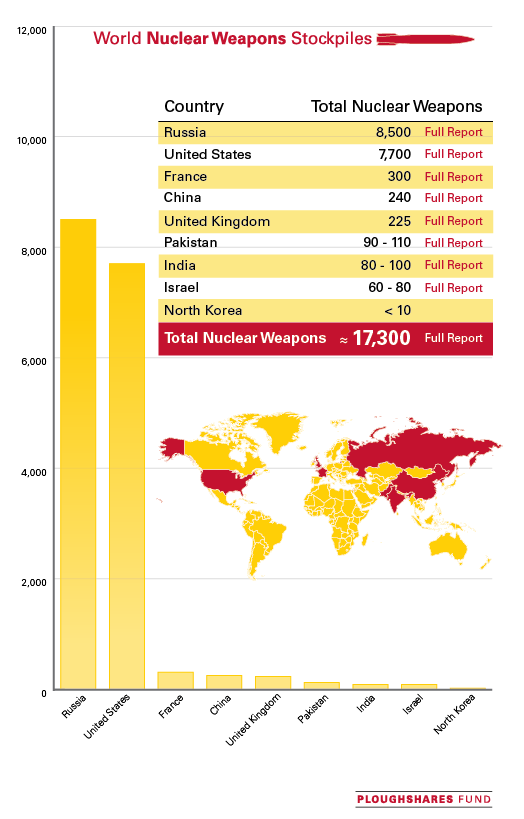
The US and Russia maintain their overwhelming stockpiles of weapons while China maintains (and even increases) its own. Pakistan and India will not give up their weapons and there is domestic pressure for India to be at least as “strong” as China and for Pakistan to be at least as “strong” as India. Israel, of course,  will not even admit to having a stockpile and will never permit its crushing military superiority in the Middle East to be undermined. For the UK and France it is now just a matter of lost pride and national ego to maintain their remaining nuclear weapons capability.

Since 16th July 1945 over 2,000 nuclear tests have been carried out all over the world by 10 countries.

  • The United States conducted 1,032 tests between 1945 and 1992.
  • The Soviet Union carried out 715 tests between 1949 and 1990.
  • The United Kingdom carried out 45 tests between 1952 and 1991.
  • France carried out 210 tests between 1960 and 1996.
  • China carried out 45 tests between 1964 and 1996.
  • Israel and South Africa carried out a nuclear test in the South Atlantic in 1979
  • India conducted two tests in 1998 (India had also conducted one so-called peaceful nuclear explosion in 1974.)
  • Pakistan conducted two tests in 1998.
  • The Democratic People’s Republic of Korea announced that it had conducted a nuclear test in 2006 and again in 2009 and now one in 2013.

One estimate of nuclear weapons worldwide (as of December 2012) is here.

World Nuclear Stockpile Infographic

World Nuclear Stockpile Infographic: http://www.ploughshares.org

Moreover

Under NATO nuclear weapons sharing, the United States has provided nuclear weapons for Belgium, Germany, Italy, the Netherlands, and Turkey to deploy and store. This involves pilots and other staff of the “non-nuclear” NATO states practicing, handling, and delivering the U.S. nuclear bombs, and adapting non-U.S. warplanes to deliver U.S. nuclear bombs.

Personally I believe that the N. Korean nuclear program is due to 2 things:

  1. a paranoia about what the South will do, and
  2. an attempt to develop a better bargaining position before opening up

But I have difficulty to see their 3rd nuclear test as any great threat to world peace (compared say to the possibility of Israel bombing Iran or the Arab Spring going wrong or an expanding African adventure for France and other European countries longing for a return to colonial times).

Pope Abdicates – Just old age or is a new church scandal about to break?

February 11, 2013

English: Pope Benedict XVI during general audition

He will be the first Pope to resign since Pope Gregory XII in 1415. A full list of current cardinals is here and his successor will come from those younger than 80 years.

BBC

Pope Benedict XVI is to resign

The Pope is to resign at the end of this month in an entirely unexpected development, the Vatican has confirmed.

The 85-year-old became Pope Benedict XVI in April 2005 following the death of John Paul II. The reasons behind the pontiff’s surprise resignation have yet to emerge. At 78, the former Cardinal Joseph Ratzinger was one of the oldest new popes in history when elected.

Certainly the Pope is not a young man but a health issue was not apparent. He says it is due to his age but I wonder.

Dear Brothers,

I have convoked you to this Consistory, not only for the three canonisations, but also to communicate to you a decision of great importance for the life of the Church. After having repeatedly examined my conscience before God, I have come to the certainty that my strengths, due to an advanced age, are no longer suited to an adequate exercise of the Petrine ministry.

I am well aware that this ministry, due to its essential spiritual nature, must be carried out not only with words and deeds, but no less with prayer and suffering. However, in today’s world, subject to so many rapid changes and shaken by questions of deep relevance for the life of faith, in order to govern the bark of Saint Peter and proclaim the Gospel, both strength of mind and body are necessary, strength which in the last few months, has deteriorated in me to the extent that I have had to recognise my incapacity to adequately fulfil the ministry entrusted to me.

For this reason, and well aware of the seriousness of this act, with full freedom I declare that I renounce the ministry of Bishop of Rome, Successor of Saint Peter, entrusted to me by the Cardinals on 19 April 2005, in such a way, that as from 28 February 2013, at 20:00 hours, the See of Rome, the See of Saint Peter, will be vacant and a Conclave to elect the new Supreme Pontiff will have to be convoked by those whose competence it is.

Dear Brothers, I thank you most sincerely for all the love and work with which you have supported me in my ministry and I ask pardon for all my defects. And now, let us entrust the Holy Church to the care of Our Supreme Pastor, Our Lord Jesus Christ, and implore his holy Mother Mary, so that she may assist the Cardinal Fathers with her maternal solicitude, in electing a new Supreme Pontiff. With regard to myself, I wish to also devotedly serve the Holy Church of God in the future through a life dedicated to prayer.

From the Vatican, 10 February 2013

BENEDICTUS PP XVI

30 million pilgrims seek salvation at the Maha Kumbh Mela today

February 10, 2013

This years Kumbh Mela – which is a “Maha” Kumbh being a one in 144 year event – started on 14th January and will continue  for 55 days. So far there have been 3 fires of significance in the various tent cities that have sprung up to cater for the 100 million visitors expected and some 20 people have been injured. Remarkably, considering the sheer volume of people, there have not been many other serious incidents or any fatalities attributable to the crowds.

(Update! 11th February

It is reported that 36 people – mainly women and children – died in a crush at the railway station on Sunday)

The Kumbh Mela web site tries to explain the fervor (but I don’t share the fervor and am not much the wiser):

The highlight for most pilgrims during a Kumbhmela festival is the observance of a holy bath at the sangam. A holy bath in either of a sacred river has purifying effects, but where the three rivers meet, the purification is said to increase one hundred times. It is further believed that when one takes a sacred bathe at the sangam during the Kumbhmela the potency of the holy water increased one thousand times. For this reason Indians believes that the Kumbhmela is the most auspicious place in the universe to take a holy bath. Armed with this faith pilgrims attend the Kumbhmela and bathe in the Ganges in a mood of solemn reverence.

Today is Mauni Amavasya  and is apparently a particularly auspicious day for these rituals. The Times of India also tries to explain the significance of the day – but their language is rather cryptic:

Astrologers believe that it’s a rare position when Sun and Moon enter and the zodiac sign of Capricorn, because of the transit, on this day. This day is also celebrated as the birthday of Manu Rishi. While Capricorn sign has the yoga of Sun and Moon which increases the significance of this Amawasya, taking a holy dip in Sangam will be giving virtues to an individual, on this day.

kalpavasi

A Kalpavasi

In Hindu mythology Mauna (silence) comes from Muni an ascetic who practised total silence in an effort to achieve a state of oneness with the self. It is therefore supposed to be a day of calmness, of silence and for the stilling of restless minds. It ought to be a day of meditation and contemplation and pilgrims are not supposed to talk to each other. Mauni Amavasya occurs annually on the 15th day of the dark fortnight of Magh (January-February) when both the Sun and the Moon are in Capricorn. It has a special relationship with the Kumbh Mela at Allahabad, being one of its major bathing days. This is reinforced in the annual Magha Mela of the Kalpavasis which views bathing on this day as extremely rewarding.

But I expect there may be some frayed tempers today when 30 million try to wash their sins away.

In any event some 30 million visitors are expected today and some 18,000 security personnel have been deployed. The Parliament House attacker Afzal Guru was executed yesterday in Delhi’s Tihar jail and there are some fears of a reaction

Good grief! “Unfriending” leads to avoidance in real life

February 5, 2013

This may not be bad science but it could be a gross exaggeration of its importance to call it trivial science. A study based on 582 responses gathered by Twitter no less! Unfriending someone on social media can apparently lead to real life avoidance. Almost a profound finding.

How does such nonsense get funded? And why does it ever get published? and reported? But it got presented at a Conference in Hawaii. All is explained.

Science Daily:

Unfriending someone on Facebook may be as easy as clicking a button, but a new study from the University of Colorado Denver shows the repercussions often reach far beyond cyberspace.

People think social networks are just for fun,” said study author Christopher Sibona, a doctoral student in the Computer Science and Information Systems program at the University of Colorado Denver Business School. “But in fact what you do on those sites can have real world consequences.”

Sibona found that 40 percent of people surveyed said they would avoid in real life anyone who unfriended them on Facebook. Some 50 percent said they would not avoid the person and the remaining 10 percent were unsure. Women said they would avoid contact more than men.

At this point I had to throw up.

This rubbish comes out of the University of Colorado department of Computer Science and Information Systems.

More shame to them.