Looking at some old class photographs I realised that about 15% of my school class has passed away.

Looking at some old class photographs I realised that about 15% of my school class has passed away.
There is no generally accepted “theory of tradition”. In fact, there are few theories – psychological, social or anthropological – which explain why we follow tradition. Edward Shils presented his book Tradition (1981) as the first extensive study of the subject. James Alexander in his article writes:
Shils observes, as everyone does, that the word tradition comes from traditio, which is derived from the verb tradere, a combination of trans and dare, meaning to surrender, deliver or hand over. Tradition is not as simple as trade, that is, simple exchange: it is a word which for about two thousand years has been particularly associated with the handing over of something in time, by some sort of deliberate act of preservation or repetition or recollection, so that the something is not lost to the past. Traditions enable us to inherit things from our ancestors, bestow them on our successors. Shils understands tradition in terms of tradita (the plural of traditum): things which are handed over. These, he argues, can be objects, or beliefs, or simply the ways things are done. He defines tradition simply as “anything which is transmitted or handed down from past to present”
Shils definition of tradition is all encompassing
It includes buildings, monuments, landscapes, sculptures, paintings, books, tools, machines. It includes all that a society of a given time possesses and which already existed when its present possessions came upon it and which is not solely the product of physical processes in the external world or exclusively the result of ecological and physiological necessity.
This is too wide a definition of what tradition is and is not convincing. It is however clear that actions or behaviour or things that are “solely the product of physical processes in the external world or exclusively the result of ecological and physiological necessity” cannot be tradition. We breathe because we must and breathing is not “tradition”. But the manner in which we name ourselves is not dictated by necessity but by choice. Our names are established by, and are the continuation of, tradition.
But I observe that if what is/was necessity cannot be a tradition, then it must also mean that to become a tradition, some choice must have been made. An alternative to that tradition is, or must have been, available. The “handing down” across generations has not been eliminated from the definition of what tradition is but “repetition” even within the same generation has greater emphasis for any custom or behaviour to be considered tradition.
This leads me to the hypothesis that only such actions or behaviours or production of artefacts which can later become traditions are those which involved a choice. Thereafter, repetition by others is necessary. Repetition by sufficient “others” and over a sufficient length of time converts those actions or behaviours first to customs and thence to traditions. Traditions eventually die and so, my hypothesis continues, every tradition has a life cycle. It is born, it grows up, it continues and it dies.

Why then do some actions, customs, behaviours become traditions and others do not? I suspect it is an existential thing and has to do with the preservation of our identity. Where our identity, as an individual or as a group, is reinforced or enhanced by the repetition of some custom or action or behaviour, then that survives under the label of being a tradition. Every example I can think of as “the following of a tradition”, is, at source, a statement of identity. Traditions underscore differences. Different traditions define different groups. They may be family, or social group or caste or class or ethnic or national traditions. Traditions may involve choice of dress or food or music or literature or behaviour or a method of proceeding, but they all exhibit choice. They each have something to say about the identity of the practitioner and the group he associates with or belongs to. A Sunday roast is an identifying family tradition. A school uniform or military dress is identifying. The Pyramids are identifying of the Pharaonic culture. A suit in japan identifies the salary-man.
Whenever we follow a tradition we identify ourselves and the group we belong to. Every tradition is a primal statement of identity. We follow tradition to reinforce identity.
Bad decisions, wrong decisions, stupid decisions, promulgation of ridiculous laws, mayhem and murder are all justified today if they were decisions taken, or actions performed, “democratically”. “Democratic” applies as an adjective for any action or decision supported by a majority.
Democracy may be the best political system available for a society at a given time. But it is not sacrosanct and it is definitely not the best system for all societies at all times. Corporations and other enterprises prefer not to use “democratic” management for very good reasons. Armies and police forces and even bureaucracies cannot operate democratically. The worst schools are those where teachers are subject to the whims of the incompetent. No family company operates democratically. It is self-deception to imagine that the UN or the EU are democratic organisations. The idea that all countries must always be better off with a “democratic” system is flawed.

baying for democracy
We have deified “democratic” to the extent that the number of bodies is always given precedence over the existence – let alone the quality – of minds or the behaviour of those bodies. We have made a god of “universal suffrage” and a religion of systems that seem “democratic”. Even if the critical faculties of the human brain are not fully developed till the age of 25, voting age is being reduced everywhere to give half-developed minds the vote. Even if a true democracy can only be a form of anarchy, the semblance of majority choice of political parties is considered sufficient to attain a state of grace. A numerical majority in favour can validate falsity. Behaviour has no part to play. Experience and knowledge have no part to play.
…. it is mere existence as an individual that suffices to have an “equal vote”. And if everyone has the vote it is assumed that “democracy” has been attained – as if it were some sort of state of grace. The only real criterion is that of age, even if some countries still have some other criteria in force. The merit of the individual is irrelevant. Votes can and are bought by promises or by free meals or by money or by a bus-ride. A “bought” or coerced vote weighs as heavy as one that is freely given. (There is nothing wrong in buying or selling votes – the flaw lies in that the seller has a vote equal to that of free elector). A fool has the same vote as a wise man. A large tax contributor is equated to a small tax contributor. Government servants paid for by taxes have the same weight of vote as the tax payers. Priests and politicians have the vote. The behaviour of an individual does not affect his vote. Experience, intelligence, wisdom, competence or criminality are all considered equally irrelevant. A majority vote is considered to be the “will of the people” where “constitutions” are supposed to prevent excesses against minorities. But constitutions are subject to the same majority vote. One hundred and one idiots take precedence over one hundred wiser men. And we inevitably get the politicians that universal suffrage deserves. This democracy and its universal suffrage needs also to be tempered by merit. But meritocracy smacks of elitism and no self-respecting socialist could tolerate that.
Universal Suffrage which ignores merit has led to the Lowest Common Factor becoming what counts and not the Highest Common Multiple that is being sought.
The primary flaw lies in the assumption that all humans are “equal” – whatever that is supposed to mean. No one disputes that people behave differently, have varying competence, have varying intelligence, have varying value to the society they are in and yet there is a mindless regurgitation of the litany that “all humans are equal”.
Equality and excellence cannot coexist.
I doubt if any US President has ever had such concerted opposition from the media and the establishment (Democrat and Republican) as Trump has.
It has become a pastime for “liberals” both in the US and globally to mindlessly dump on Trump. But after one year of the “liberal” world dumping on Trump, his actual record is fairly impressive:

ISIS execution in Kirkuk Al-Masdar News
I doubt that any Democrats will reject their tax decreases. I doubt that any enterprise will reject the reduction of corporate tax. I doubt that any growing US enterprise will not consider investment and job creation. The EU does not like the US tax reform because they see a growing disadvantage to European industry and a loss of jobs to the US.
Whether Trump can survive the continuing onslaught remains to be seen. Whether the UN can return closer to honesty remains to be seen. Whether bilateralism can overcome politically correct but bankrupt multilateralism remains to be seen.
But the reality is that the world is a better place after one year of Trump than it would have been with Hillary Clinton.
There is nothing in my life or in my genetics or in my behaviour for which I blame my grandparents. Three of the four had passed away before I was born. But I had some interaction with my grandmother and my great-grandmother. I am thankful for a few pleasant memories I have of them. When my great-grandmother passed away, it was just a blip on my consciousness. When my grandmother passed away I remember a feeling of some relief that the suffering of her last few years had ended. But I have never felt any need to attribute any blame or credit to them – or their generation – for the state of the world or for my state in it. Should I blame my father or his generation for World War II? Or his father’s generation for World War I?
So I am mildly irritated when I hear arguments for this political policy or that, “for the sake of our children’s children”. Any generation has only a very vague idea – if any – of the challenges to be faced by the next. My grandfathers had no conception of the world even my father faced let alone the world that I live in. For any of my grandparents to have made decisions about their own lives for the “sake of their children’s children” would have been both arrogant and stupid. To predict the challenges to be faced by the next generation is imperfect enough that, trying to predict the challenges two generations hence, is both futile and arrogant. Every succeeding generation is inevitably better equipped with technology and knowledge (but not necessarily with brain power), to handle its own challenges than the previous one. Solutions available tomorrow, with the knowledge and technology of the day, are not available now.
Would the world be a better place if the dodo was not extinct? Or if World War II had not taken place? Or if aircraft had never been invented? The questions are meaningless. Decisions at the individual or the collective level must be made at the time, for that time, by that time. To anticipate the questions to be faced by future generations and make decisions now – to save future generations from some problem we predict for them – is just as meaningless. The majority of political predictions from just half a generation ago (10 years) were wrong. There is no doubt a causal link between what we do now and the challenges which will be faced by our descendants, but we can neither anticipate those problems nor are we better equipped to solve their problems than they will be. There is also no doubt that decisions taken now choose not only the path for the future but also those who will walk that path. But we cannot – now – walk that path for them. World War II terminated the path for many millions but also enabled the existence of all the survivors and their descendants. But whichever path it is, and whoever the travellers are, they will be better able to define and solve their problems than their grandparents.
Suppose that some decision made today leads to some catastrophic decline in human population. As happened before WW II. Suppose further that the survivors eventually thrive again. As the population is thriving today. Many possible children’s children will not – and did not – even see the light of day. But some thousands of years hence, the population of the day would have no blame to attach to the generation of today. It would have been the catastrophe which enabled their very existence. Just as the occurrence of WW II enabled the population and the world of today. And there is no blame to be attached to those who took the fateful decisions which led to WW II.
So when somebody tells me that he is doing something “for the sake of his children’s children”,

A politician who is stupid enough to propose some action for the sake “of our children’s children” should be ignored.
We speak glibly about free will, about the four human freedoms of speech, of religion, from want and from fear. For any entity, living or otherwise, we can define “freedom” as being the “unconstrained power to do”. With that definition, there are no freedoms anywhere because nothing is unconstrained. Nothing, in this universe, has freedom. An electron is not free to be wherever it wishes to be. Even a “free” electron, untethered to any atom, can only move in compliance with the gravitational and magnetic fields it is subject to, and never faster than the speed of light. The universe itself is inextricably chained to the arrow of time.
At the most fundamental level, the chains of the “natural laws” thus imprison all matter and energy. All living things are then held by the further chains of their genes. Their physical form and attributes and behaviour must lie within the envelopes of possibility fixed by their genes. These chains ensure that a birch tree can never be an oak or a zebra a lion. From the time a seed is planted, it merely reacts to its environment and the changes to that environment. It chooses nothing. In fact, there are no choices to be made.
But humans have free will, it is said. Humans have choices available, it is said. They can choose how they will behave. But I am no longer sure if this is true. Certainly each one of the seven+ billion humans can imagine violating what we understand to be the “natural laws” but not a single one can actually do so. I can imagine myself running faster than Usain Bolt, but it never does, and never will, come to pass. All the chains connecting me to my past are unbreakable. All my possible future states of being are anchored to my current state by another unbreakable chain. All human actions are constrained by
Free will, if it exists, is involved in imagining the action and in providing the driving forces for action. Causal Determinism of course allows of no free will. All future events are determined by past events and so on ad infinitum. Some forms of philosophical determinism allow some freedom of choice within a narrow envelope of possible behaviours, though others suggest that the choice of actual behaviour made is, in fact, also predetermined.
I think we need to distinguish between thought and action even if thinking itself is an action. The exercise of free will requires an action. But thinking itself is constrained. Thinking about violating the laws of nature is clearly an act which does not, itself, violate the laws of nature. Thinking about travelling backwards in time itself moves forward in time. Moreover, thinking has its own unbreakable chains. I cannot think, for example, in a language I do not know. What I cannot imagine I cannot even think about. What I cannot imagine is what, to my mind, is unknowable. What is knowable for any mind is a consequence of its capacity, its speed of learning and its knowledge base (experience). Even our possible thoughts then are limited and thus a constraint on our subsequent actions (if any).

image STAR
Every single human is in fact condemned to a life sentence on a prison planet called Earth from which there is no escape. We are in fact prisoners of
These chains are not susceptible to being broken. Each one of us is so enmeshed in constraining chains that we have few, if any, real freedoms of action.
I am about to make myself a cup of coffee. That was probably determined long before I was born. But I have the illusion that it is a choice I am making freely.
It is the classic dilemma of our age which shows up everywhere.
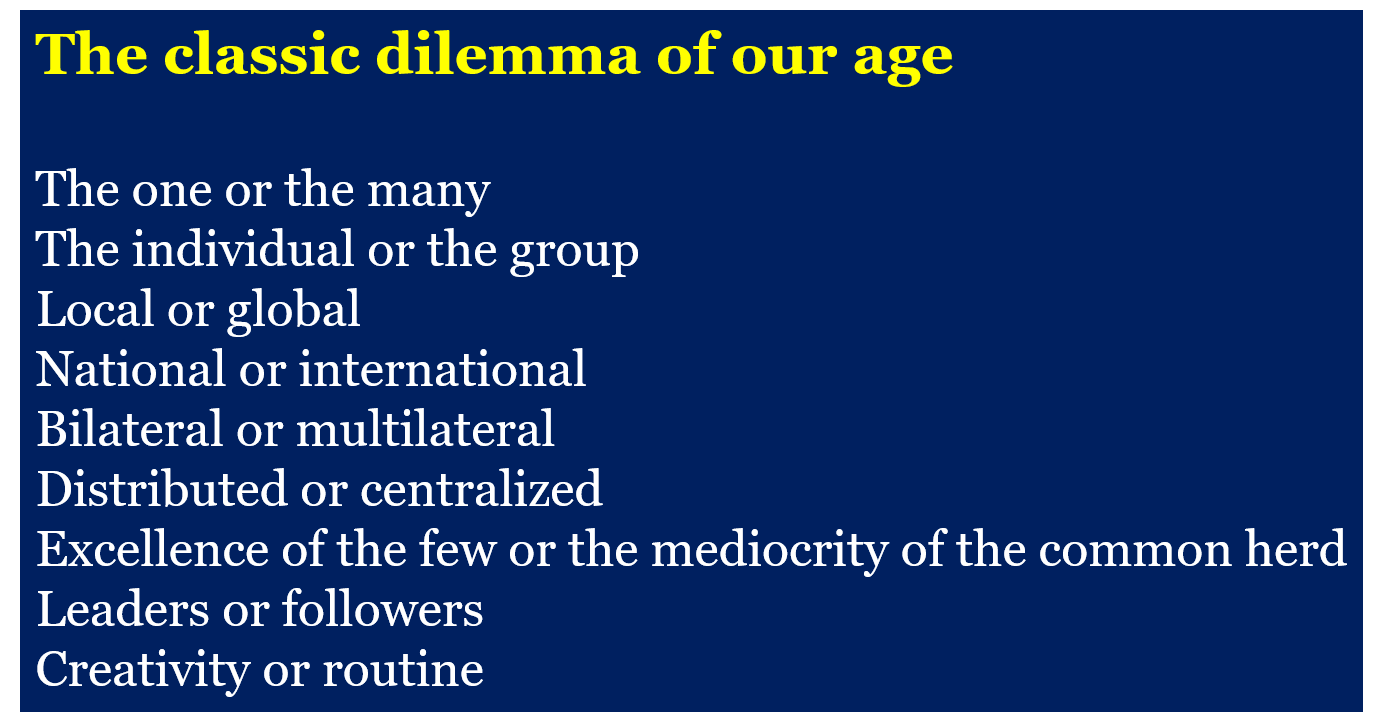
I nearly always tend towards prioritising the one primarily because without the one there cannot be the many, without the local you cannot get to global, without the national there is no international and without the excellence of the few you cannot get the good of the herd. I prefer the highest multiple possible to the lowest common factor. It colours my politics. I prefer the search for excellence rather than the common mediocrity of socialism. I prefer the the internationalism which comes as a consequence of strong nationalism to the bullying of the UN or the EU.
I side with “to each as he deserves” rather than to “each as he desires”. Freedoms flow bottom up from the individual to the group rather than privileges and sanctions flowing from the group down to the oppressed individual.
In a survey published in 2008 of the 18 (now 20) countries in EUROCAT, 88% of neural tube defects were detected prenatally and 88% of these were aborted. Of Downs Syndrome cases, 68% were detected prenatally and 88% of these too were aborted.
Iceland (population of 330,000) has virtually eliminated Downs Syndrome births though in such a small population there are only one or two cases every year. However in Denmark around 98% of Downs Syndrome fetuses are aborted , in France around 77% and even in the US around 67% are aborted.
The mother chose to terminate the pregnancy in 88 percent of cases when the child had anencaphaly, when part of the child’s brain is missing. They also chose abortion in 75 percent of cases where doctors detected bilateral renal agenesis – when the child is missing both kidneys.

Artificial selection
As technology develops, and more fetal abnormalities can be detected, and as abortion becomes less stigmatised, it is not only serious abnormalities which lead to abortion. With abortion on demand, even conditions which are eminently treatable (cleft palate for example) are leading to the choice to abort. The availability and practice of abortion is itself becoming the main vehicle of artificial selection. Correction of fetal defects is usually not possible. Even if genetic “tailoring” for designer babies is not quite there yet, the incidence of fetuses being born with even minor defects is inevitably declining.
Selective abortion is artificial selection, and that is, after all, just eugenics.
Related:
On birth rates, abortions and “eugenics by default”
A little irritated today by some stupid behaviour.

The part comes before the whole.
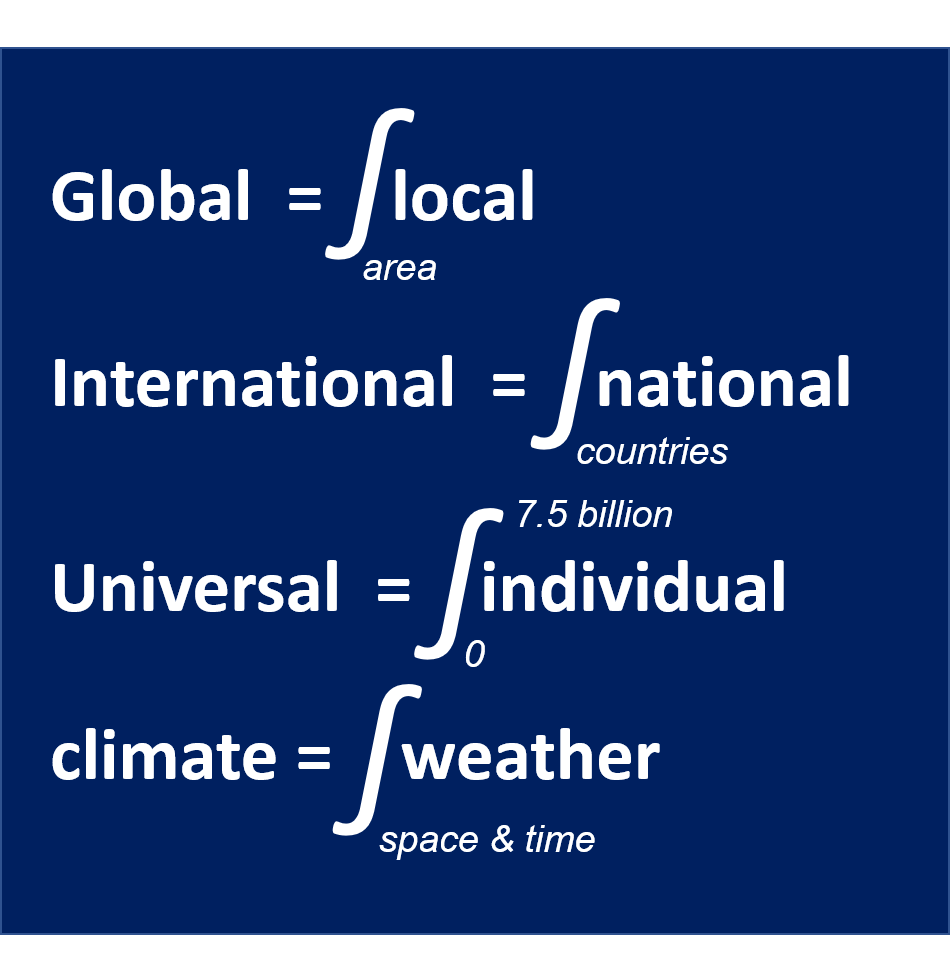
Without a definition of the number “one” there is no Number theory. Without the establishment of a single cell there is no life. No bricks no house. When an atom overwhelms an electron, it leaves and the atom is no more. Without weather there is no climate.
Multinational institutions are particularly prone to forgetting what their fundamental building blocks are. To be global one must first be local. To apply universally means first applying to each of the 7.5 billion on earth. Without a strong and healthy nationalism there is no internationalism.
The EU and the UN are excellent examples of how the “large” loses track of its roots. The EU much more than the UN tries to bully its smaller member countries and that cannot be sustained.