Archive for the ‘Behaviour’ Category

French socialists trying to rescue their Greek comrades

July 9, 2015

That Yanis Varoufakis was a marxist economist is no great secret though he likes to call himself a libertarian marxist. (I have no great opinion of the black magic of economists in general and especially since they are all theorists which backcast but can never make a forecast. But a marxist economist pushes the bound of credulity).  His forced resignation from the post as Finance Minister was the token, cosmetic gesture made by Tsipras to the creditors. Syriza is a strange blend of socialism and marxism and nationalism. Among the group of creditors it has become apparent that the French socialists are going out of their way to try and save Tsipras and they are desperately trying to help Tsipras come up with a good “socialist” plan that can pass muster with the other creditors.

Now it seems that French econmists are actuually helping Tsipras draft proposals which must be presented today.

BBC: 

The Greek media have reported that financial experts from France are helping Greece put together its reform plan. It’s a story that has been backed up in the French press too.

But France – which has taken a largely conciliatory tone towards Greece – has denied any of its officials were involved.

AFP quoted one un-named official as saying: “France wants to help things along and very much backs an agreement, but in no way are we helping them draft the proposals.”

That French officials will not be acting in the name of France is obvious. But it is equally obvious that French nationals – acting in an “unofficial” capacity, but with the probable knowledge and blessing of the French government – are helping the Greeks to draft their proposal.

Good luck to them. But the best for all is for Greece to leave the Euro and stay in the EU.

Chinese crash gives new investing opportunity

July 9, 2015

The 2015 Chinese stock market crash has different drivers but resembles the 2007/2008 crash in investor behaviour.

Many domestic Chinese investors made a great deal of money with the recovery in late 2008/ early 2009. My guesstimate is that any real recovery from the current crash cannot come until the 6 month freeze just introduced on large stockholders selling shares is withdrawn. But since investing in the Chinese market is now possible through a variety of funds, there is an opportunity coming. My estimate is that the bottom is when the Shanghai Composite Index is driven down to about 3,100 at which point the market will be grossly undervalued. The opportunity will come in the subsequent “bull” market when stocks will be driven up into “overvalued” territory again.

I am a strong believer in “track record” and that past behavioural patterns repeat or, at least, change very slowly.

My investments are far too small to be of any significance in the big picture. My strategies are therefore all based on detecting and riding the waves of behaviour exhibited by others. And so I will be looking to making some investments in about 4 – 6 months with a target of 30-40% growth over the following 6 months.

China investing opportunity

China investing opportunity


Cosby admitted in 2005 that he was a sexual predator

July 7, 2015

No further defense is possible.

Why are the courts delaying? Why not put him in the same cell as Rolf Harris?

Reuters:

Comedian Bill Cosby testified in 2005 that he had obtained Quaaludes with the intent of giving the sedatives to young women in order to have sex with them, according to court documents unsealed on Monday. Cosby, 77, made the admission during testimony in a civil case brought by a former Temple University employee, Andrea Constand, who alleged that Cosby tricked her into taking drugs before he sexually assaulted her.

The case was settled for an undisclosed sum in 2006 but the documents in the case were unsealed on Monday after the Associated Press went to court. ……….

Cosby testified that in the 1970s he had obtained seven prescriptions for Quaaludes, the brand name for a sedative and muscle relaxant that was widely abused as a recreational drug in the 1970s. 

“When you got the Quaaludes, was it in your mind that you were going to use these Quaaludes for young women that you wanted to have sex with?” Cosby was asked in the 2005 deposition.

“Yes,” he replied.

Cameron is the unlikely winner of the Greek referendum

July 6, 2015

There will be millions of words written about the Greek “No” to the conditions set by its international creditors and what it means. But what strikes me is that the only real winner is David Cameron.

For Greece and the EU it is a lose-lose situation. If the creditors soften their conditions, the Euro and the EU loses. If the creditors stand firm and Greece leaves the Euro, the sanctity of the Euro and membership of the Eurozone is gone forever. My view remains that the best for Greece and the EU is for a return to the drachma, an EU which shrinks its ambitions and a dissolution of the Euro.

If the creditors now soften their conditions and a Grexit from the Eurozone is avoided, it will demonstrate that the IMF, ECB and EU conditions will never be the final word again for any member country. Each will always have the option in any negotiation of calling a “referendum” to reject the terms. Any negotiation by a member country with the EU can use a referendum to finally reject an EU position. Any country can then reserve the right to put any EU Directive to a referendum and EU Directives will become merely guidelines to be accepted or rejected by member countries at will.

If, on the other hand, a Grexit does occur and the fatally flawed Euro experiment begins to come to an end, it will be emphatic evidence also that the entire concept of a new Holy European Empire is something only in the minds of a very few in Bonn and Paris and Brussels, but is not shared – at this time – by the general population (represented by the general Greek public). It is a concept either too far ahead of its time or possibly which will never be real. At any rate, for this time, it would demonstrate that it is fundamentally flawed.

And what strikes me is that this helps David Cameron both within the EU in his quest for renegotiation and even for treaty change. It even helps him domestically. He has had an issue of credibility in that he has called for an In/Out referendum where he will surely have to call for an “In” vote. His problem lies in being able to show that he has won enough during negotiations to justify an “In” recommendation. But now, with the Greek precedent, he can even demand the most drastic changes in Europe without being thrown out of any room. He is likely to get changes which were unthinkable yesterday. He can even go to a referendum ostensibly demanding an “Out” as a negotiating ploy, get an “Out” vote and then return to the negotiating table. He can call a second or even a third referendum (and if a bankrupt Greece can carry out a referendum within a week then surely the UK can manage something similar).

Referenda are now just a step in the EU negotiating process.

A drastic haircut for Greek middle-class as savers are set to lose 30% of their deposits over €8,000

July 4, 2015

The Greek problem is very complicated I am told. It is an ideological battle between right and left, I also read. It is austerity versus profligacy. But I think it has been unnecessarily “complexified”. It is not about which ideological gods are to be worshipped but it is about good house-keeping. It is essentially, basic “home economics” applied to a household of 11 million people. It is about how a deeply indebted household with expensive habits and many non-contributing members is to continue. It is about what lenders are justified in demanding from the household to continue lending. It is about abdication of responsibility by the householder. It is about lending to a prudent householder or to one who will neither clean his house or commit to good house-keeping.

Whichever way it goes at the referendum tomorrow, there is going to be a great deal of pain for the “middle class” who have paid their taxes and have managed to save and who keep their savings in Greek banks. Those who don’t usually pay their taxes (and I have seen one estimate that these are around one third of those who should be paying taxes), keep the “black” economy thriving and they don’t usually bother with banks. The visible rich probably pay a significant amount of the taxes they should but they keep their money mainly outside of Greece (but probably in the Eurozone or in dollars). Since Tsipras came to power they have been quietly getting out of the Greek banks. They are well aware of how all depositors in Cyprus had their savings in Cypriot banks arbitrarily written down over one day while the banks were closed. The very rich of course are well versed in all methods of tax evasion and they are not so stupid as to have kept their money as deposits with the Greek banks.

The total Greek debt is about €328 billion which is about €30,000 per capita. In theory if €30,000 could be confiscated from every Greek citizen, Greece could be debt free. Of course if creditors accept that some level of debt write-down is inevitable – and this seems unavoidable – they will certainly insist that Greece and its banks also accept a “haircut”. The question becomes how much debt write-down is necessary and how much of that will be confiscated by those with substantial deposits in Greek banks. If the IMF analysis is to believed (and they have been wrong many times) then the debt must be reduced by around €60 billion for a growing(?) Greek economy to have a chance of servicing the remaining debt.

Yesterday a report in the Financial Times (since vehemently denied by Syriza) stated that a swingeing 30% of all deposits over €8,000 would be confiscated. As a comparison the Cypriot haircut finally became a dissolution of Laiki Bank and the confiscation (with part conversion to equity) of 47.5% of all deposits above 100,000 euros in the Bank of Cyprus. There are not enough deposits at Greek banks of over €100,000 to milk and hence the figure of €8,000 seems credible.

The critical point is how much debt can 30% of these deposits wipe out. Suppose the lenders agree to write-off (or write down) debts equivalent to about €30 billion. Then Greek savers would need to cough up an equivalent amount if the IMF target of €60 million is to be reached. That is about €3,000 per capita. Greece has an average monthly wage of about €1000 per month (2014). Of course unemployment is high and it is not the average wage earner who exhibited the profligacy or evaded taxes which created the Greek debt mountain. From Syriza’s perspective, confiscating the money of the rich would be best for this purpose. But since that may not be within reach, it is better to soak the middle-class than the bulk of their supporters who are average wage earners or unemployed.

So whichever way it goes in the referendum tomorrow, the middle-class in Greece are going to get badly hit. They are in for a full Brazilian wax job and not just a neat short back-and-sides.


Is embarrassing Gujarat data holding back the Indian Health and Nutrition Survey?

July 3, 2015

According to the BBC, the massive undertaking that is the Indian Health and Nutrition Survey has been completed, should have been released in October 2014, was last issued in 2007 and even has an encouraging story to tell. But the data on Gujarat is not an edifying tale in comparison to other states. Economic growth in the state has not translated into any major advance compared to other states. In fact the Gujarat performance is worse than most. 42% of all children are stunted and half of all children are malnourished.

Is the report too damaging to Modi’s Gujarat story? And is it therefore being held back by Modi’s public relations managers? The official position is that the methodology is being reviewed. But it is more likely being held back to somehow massage the Gujarat figures. It will be difficult because copies of the completed – but not officially released – report are now available widely.

BBC:

Good health data is rare in India. The last time the country published a comprehensive, state-wide survey was back in 2007. So why hasn’t a vast survey of women and children carried out by the Indian government with the UN agency for children, Unicef, been released?

India’s so-called Rapid Survey of Children was a huge undertaking. Almost 100,000 children were measured and weighed and more than 200,000 people interviewed across the country’s 29 states. The final report was due for publication in October last year, the BBC understands. Yet, more than half a year later, the important body of data remains secret.

Leading development economist Jean Dreze describes the delay in publication as “an absolute scandal”. “All the neighbouring countries including Bangladesh, Nepal, Sri Lanka, Bhutan, Pakistan and even Afghanistan have up to date nutritional surveys,” he says. “It is hard to account for a 10-year gap without attributing some sort of political reluctance.” …..

Looking just at the overall figures, India’s reluctance to publish the survey is rather surprising. It shows the country has an encouraging story to tell. Indicators of malnutrition are still very high, far higher than most African nations, but they are improving. Ten years ago, two-fifths of children under five were underweight, now it is more like a third.

However, the survey confirms large and enduring discrepancies between states, including the continuing strikingly poor performance of the Indian prime minister’s home state, Gujarat. As chief minister, Narendra Modi ran the state for more than a decade. His general election campaign was based on the promise that he would do for India what he had done for Gujarat.

Is anybody surprised?

GE makes its pitch for Alstom acquisition to the EC this week

July 1, 2015

The European Commission must make its decision by early August regarding GE’s proposed acquisition of Alstom’s energy and grid business. The EC’s concerns have held this deal up for the best part of a year. I estimate that financial closure for this deal is now no longer possible at least till the end of 2015. The EC sent GE its “statement of objections” in the middle of June. This week (tomorrow) GE will be attending “hearings” at the EC at its own request. The hearings are to be “oral” and the meetings are “closed-door”.

It seems to me that this is more of a negotiation rather than a “formal” hearing. Clearly GE will be exploring how far it needs to go in its final, written submissions which will be needed before the EC can make any formal adjudication in August. I suspect that GE might be considering “creative” alternatives for making IP from Alstom, which it judges it does not – and will not – need, available to other “serious” players. One difficulty is that a lot of IP has value in creating a barrier for others, rather than being usable in its own right. I also suspect that GE is looking to ensure that the revenue stream from the service of Alstom’s fleet of operating gas turbines is not impaired by being forced to give up part of that business. And to do that GE may be considering ways and means of assuring the EC that the pricing of such service business will be “reasonable” and not predatory.

Personally I think that many of the EC’s fears are imaginary or theoretical. They are quite insignificant compared to some of the predatory pricing and price-fixing that is evident in other industries. But then my own opinion is that it is better not to have a competitor in the market place rather than for a “sick” or reluctant competitor to be forced to continue. That only encourages distortion of the market place to the ultimate detriment of OEM’s and customers and eventually consumers. Moreover, R & D for advanced gas turbine technology will, I think, be served best by the deal going through.

According to Reuters, General Electric, the EC, other EU agencies, and parties opposing the deal will take part in a closed door hearing this Thursday, July 2.

Reuters:

Senior officials from the EU competition authority, their counterparts from EU agencies and rivals are expected to attend the closed-door hearing.

“We have requested an oral hearing,” GE spokesman Jim Healy said. He said the hearing would be on July 2.

French Economy Minister Emmanuel Macron has said the deal should be viewed in a global perspective and take into account Chinese rivals following the EU regulator’s decision to exclude the Chinese market from its scrutiny of GE’s market power.

The Commission is concerned the takeover would leave just two gas turbine companies in Europe, with GE competing only with Germany’s Siemens.

The EC has not announced who the objectors are but I expect that Ansaldo Energia (40% owned by Shanghai Electric) and Siemens are among those opposing. I can well see that Ansaldo/Shanghai would be looking to be able to access some of Alstom’s IP to help them to bridge the not inconsiderable technology gap they must overcome to even have a chance of becoming a major player in the Heavy Duty Gas Turbine market. Siemens, I am sure, would object as a matter of principle even if they will actually benefit from the deal. I am not sure if Mitsubishi-Hitachi has a presence large enough to have any locus standi as an objector in Europe. The Siemens/Wood Group JV (Turbo Care) which focuses on the service of non-Siemens gas turbines is likely to be a principle objector but in this case it is essentially a “pirate” and, hopefully, will not be given too much credence.

Patrick Kron, CEO of Alstom is very bullish – but then, of course, he can hardly be anything else.

Bidnessetc: Alstom SA chief executive Patrick Kron remains bullish that General Electric Company will successfully acquire its energy unit and will also have the European Union (EU) regulatory authorities’ approval. Mr. Kron’s statement came as General Electric has requested the EU antitrust authorities to conduct a hearing with the aim to get their approval.

The EU has been holding back General Electric’s request to acquire Alstom’s energy unit for the last few months, as it is investigating the effects of the acquisition on the European market. However, Mr. Kron said in an interview to a newspaper yesterday: “I hope that we are now in the final leg and I am confident … My position is very clear. I do not see why Plan A would not work out.”

A Grexit is the best option as the government hides behind a new referendum

June 28, 2015

It seems to me that modern democracies – and especially those with coalitions produced by proportional representation – produce “followers” rather than leaders. And when “followers” pretend to lead they end up taking the easy, CYA, path through referenda. The Scottish referendum and the upcoming UK referendum on EU membership are illustrations of where supposed “leaders” pass the buck onto a diffuse and unaccountable electorate. The “wrong” choice can always be justified as being “the will of the majority”. All across Europe, countries have “followers” in leadership positions, who inevitably fail to lead. I take vision and the ability to carry people towards that vision as being the hallmarks of leadership. Rather than vision, it is the next election which governs. “Leaders” merely follow the current whims of the crowd and don’t even make the attempt to “carry” the crowd an any difficult path.

But I think the current Greek government’s call for a referendum to vote on the lenders’ conditions for further loans to Greece, while carrying out negotiations with those lenders is an abject abdication of leadership. Suppose, as is most likely, the conditions are rejected. The government may well return to the negotiating table in the hope that this may have strengthened its hand. Though exactly how is difficult to see. It is really only an attempt to mobilise a “sympathy” factor. It is equivalent to sitting in front of the bank manager, without any collateral and without any plans to stop spending on unnecessary things while pointing at a crying child and begging for a sympathy loan.

If the government recommends a rejection and this is confirmed by the referendum,  it would be the start of a Grexit. The government may carry forward a “begging” from the lenders but it will only be postponing the inevitable. If the people accept the lenders’ terms, the government ought to resign but will not since they can always point to the referendum for their abandonment of their “principles”. But it will also make it impossible for anyone to negotiate with the Greek government, since no “decision” by them will carry any credibility without being backed up by a referendum.

I expect we will see a run on the banks on Monday – if the banks are open. I also expect that the government will scrape up the relatively modest €1.6 billion needed for the repayment due on Tuesday. Then the result of the referendum  on Sunday the 5th will be the card in the hole to continue negotiations.

But I hope a default takes place and that the Greeks reject the lenders’ conditions and a Grexit does occur. Then a debt restructuring can take place. Writing off debt without first going bankrupt is not healthy. In the long run it will be better for Greece to return to the drachma. It will also be better for both the EU and the Eurozone. Both need to shrink. In corporate terms I would say that EU Inc. has expanded too far, much too fast. Some divestment is desperately needed. It would be better for the EU to focus on the common market and free labour movement provisions and to allow political union to happen whenever, and only when, it is ripe – or maybe not to happen at all. Trying to force the political union is counter-productive. The European parliament can be dismantled completely without losing anything. The Brussels bureaucracy could, and should, be drastically trimmed to be an accounting agency and nothing else. The common currency is of little value with the disparity in economic disciplines across the Eurozone. Dealing with multiple currencies but where each currency is representative of its underlying economy is not as difficult as having the fundamental mis-match we now have between the “average” value of the Euro and the strength of each of the underlying economies.

Greece needs to get out of the Euro strait-jacket it is in while remaining within the European trade zone.

Post-intellectual West Bengal

June 23, 2015

The new post-intellectual intelligentsia ruling West Bengal are demonstrating the heights to which they aspire:

NDTV: West Bengal Chief Minister Mamata Banerjee’s nephew Abhishek has publicly threatened to “gouge out the eyes and chop off the hands” of anyone who dares to hurt Bengal’s interests. … “Those who dare to glare at us, we can gouge their eyes out and throw them on the road. Show us your hands and we can cut them off,” Abhishek said, adding, “But remember, it is the common man who will have the last word.” …

… Last year, Mamata Banerjee and the Trinamool Congress had to face many embarrassing questions after a prominent parliamentarian, actor Tapas Pal, said at a public meeting: “If the CPM people touch a hair on the head of my workers, I will set my boys upon their women to rape them.”

The West Bengal of today is not the intellectual or cultural powerhouse it once was. I finished my schooling in Calcutta long before it had been ravaged to be called Kolkata. I have been a regular visitor since then and was last there in 2014 for the 50th anniversary of graduating from school.

I grew up knowing – and living – with the intellectual legacy of Swami Vivekananda (Narendra Nath Datta), Rabindranath Tagore and Jagadish Chandra Bose. Satyajit Ray and Ravi Shankar were living legends. But they were all of the old school of Bengali intellectualism. Since then West Bengal was first plagued by 5 decades of a very peculiar Marxist communism. Just two layers of society were recognised. First came the agricultural masses who were all organised into almost-martial cadres and then there were the politburo and its hangers-on who amassed their corrupt wealth. The middle class and those who actually contributed to growth and culture and thought were reviled and oppressed. Marxist communism collapsed in on itself after years of decay. The communists were then replaced by an even more peculiar bunch, the Trinamool Congress. They are led by the narcissistic Mamata Banerjee with the slogan “Ma Mati Manush”  which is supposed to mean “Mother, Motherland and People” but where the sub-text says “Me, Me and Me”.

As an aside, I note that in spite of the efforts of post- nationalists, Theatre Road is still Theatre Road to all taxi drivers. It was renamed as  Shakespeare Sarani during my time there in the 1960s but that is only for maps and road signs. More than 50 years after the name was changed, the Post Office will still deliver your mail addressed to Theatre Road. Lansdowne Road is still Lansdowne Road and many don’t even know it is now called Sarat Bose Road. Lower Circular Road  is still referred to as such, though it is officially Acharya Jagadish Chandra Bose Road. Who does not know Park Street (officially Mother Teresa Sarani and earlier Burial Ground Road) and Park Circus? Camac Street and Free School Street were part of my schooldays beat and are still there – though the building we lived in no longer exists. Officialdom can be schizophrenic and is often irrational. High Courts are set up by Acts of Parliament and their names cannot be changed so easily. So it is the High Court of Calcutta in Kolkata. The Netaji Subhas Chandra Bose International Airport is the mouthful rarely uttered for what was Dum Dum airport and is still designated CCU.

In the 1970s post-intellectual Bengal produced a vicious and violent movement – the Naxals – who considered themselves intellectuals but who in reality were anything but. They considered themselves Maoist communists, engaged in a permanent revolution (a la the cultural revolution) and naturally opposed to everybody else, including the Marxist communists in power in the state. Mayhem was the name of the game. Culturally they were the Bengali Taliban. Many of the starry-eyed, self-styled and self-proclaimed “intellectual” leaders were killed by vicious police and army actions in the early 1970s. Some of my class mates were among them. This revolutionary communist movement still exists in pockets and has spread to other states. But the movement lacks any intellectual content or realism.

In recent times intellectuals from West Bengal have been few and those few have been relatively lightweight. Amartya Sen may have received a Nobel prize but it was only for economics which does not really count. His theories suffer from the confusion of his wanting to be a capitalistic socialist and he ends up being nothing of anything. Pranab Mukherjee was a disaster as a Finance Minister and is nondescript as President. Intellectually, just a bantam-weight.

It is a post-intellectual, post-nationalist West Bengal struggling to find a new role for itself.

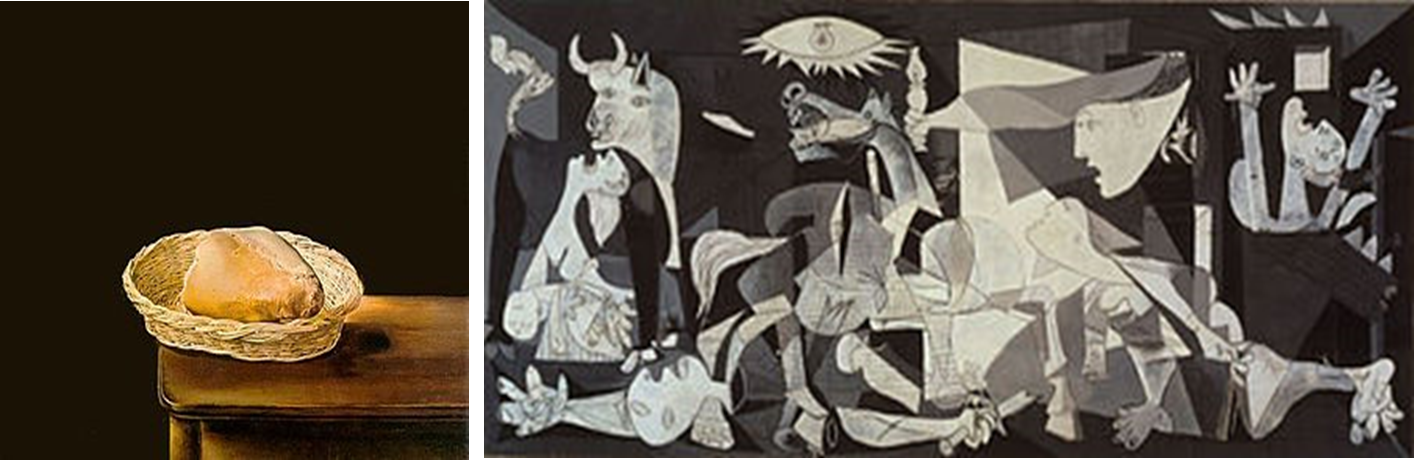
Greek deal will be done: Bread rather than Guernica

June 22, 2015

I was listening to Swedish, UK and German radio this morning and one could be forgiven for being utterly depressed. But surprisingly, the blackness went over the top. It was too much. The picture being painted by all the pundits and commentators seemed a little surreal. The picture left in my mind is of  Salvador Dali’s “Basket of Bread” rather than Picasso’s “Guernica”.

bread rather than destruction

bread rather than destruction

So instead, I am feeling remarkably upbeat. Maybe I am just an optimist and would rather see bread than destruction. But I am sufficiently “moved” that I shall make a forecast for the next few weeks.

Tsipras will make statements which seem like that he will do something about curtailing pensions. These will be worded sufficiently loosely such that the Eurozone Finance Ministers can accept the assurances and still have their posteriors covered. Tsipras will have sufficient face-saving text so that he can argue domestically that pensions will not actually be cut when the turnaround occurs and that the turnaround is just around the next corner (or maybe the one after that).

The ECB will make further emergency arrangements so that the current run on Greek banks will not be unmanageable. (By some accounts Greek banks have seen some €20 billion withdrawn).

The payment due to the IMF will be paid.

A short-term (6 month?) deal will be done and the whole problem of a non-homogeneous and splintered Eurozone will be patched up for the short term

Which is good for the short term but which, in the long term and if the Eurozone does not become homogeneous, will give a very big bang when it implodes.

There is a little more brinkmanship to go through until the Greek payment actually falls due at then end of the month.  But I expect a real jump in European markets – and followed by the Asian markets – when Greece makes the payment due and a “deal” is announced. Probably by the end of June.

Maybe it is time to pick up some equity bargains.