Archive for the ‘Behaviour’ Category

Challenge to Bollywood union’s ban on women for make-up

August 15, 2014

It is nothing new that the modus operandi of a trade union is founded on discriminating against non-members. But a Bollywood trade union – the Cine Costume, Make-up Artists and Hair Dressers Association – has for the last 55 years forbidden women from being make-up artists or hair-dressers. But they are now being challenged in court and the Indian Supreme Court is expected to hand down its decision on August 26th.

The union’s defense – that allowing women into the profession would lead to all men losing their jobs – is particularly stupid. I expect the union will lose – as it should.

As an aside, the contemptuous attitude to women demonstrated by newly urbanised Indian youth is – I think – at least partially a consequence of the portrayal of women in Bollywood movies.

The National: Charu Khurana, 32, a make-up artist who trained at the Cinema Makeup School in Los Angeles in 2008 and returned to India with dreams of working in Bollywood. But Khurana found herself being confined to doing bridal make-up, fashion shows and commercials in New Delhi and unable to find work in Mumbai because the Cine Costume, Make-up Artists and Hair Dressers Association turned down her application in 2009.

“They rejected me, saying only men could work as make-up artists. It’s my basic human right to work in any field I wish. They can’t exclude women. I, too, have children and a family to support,” says Khurana.

Indignation prompted her to contact the New Delhi lawyer Jyotika Kalra, who took up the case and also asked the National Commission for Women – the state organisation that protects women’s rights – for support.

Kalra says she did not know whether to laugh or cry at the explanation she received from the Association.

“They wrote saying that the rule was intended to protect a man’s livelihood because, if women were allowed to do make-up, no actor would ever choose a man to do it. What kind of logic is that?” asks Kalra.

IKEA shopping bags provide “efficient” storage for 500 year old skeletons

August 10, 2014

It would be just as easy to consecrate an IKEA shopping bag as a shrine or a piece of turf – so I don’t see anything sacrilegious or anything to be much indignant about. This story from The Local:

The Kläckeberga church is using Ikea bags to store the remains of around 80 people who were once buried under the floorboards. The macabre collection, which is almost overflowing from a set of large blue Ikea bags, was found by local woman Kicki Karlén. 
“There were around 80 skeletons,” she told The Local.
Woman finds Ikea bags stuffed with 80 skeletons

Ikea bags stuffed with 80 skeletons – photo The Local

“I was on the team called in to dig out the bones five years ago,” archaeologist Ludvig Papmehl-Dufay told The Local.  
“Our mission was to document and rebury the bones, which may be as much as 500 years old. But the reburial was delayed and I have no idea why. The plan was to rebury them as soon as possible, but that’s up to the church. The county board said they couldn’t leave church ground, and it became complicated.”  
He explained that the bones were likely reburied in a secondary deposition many years ago in what he called a “bone house”. The collection is mostly skulls and longer bones, he added.  
While Papmehl-Dufay denied storing the bones in the Ikea bags himself, he admitted that it sounded like an efficient storage technique.   
“It’s not standard practice, definitely not for archaeologists, but the Ikea bags aren’t actually that bad. They’d be great for stopping the moulding process. But it can’t be that good to have them in the basement for so long.”
But what will future archaeologists and anthropologists make of the bags (which may well survive) when they are rediscovered in a few hundred years time. Possibly of the existence of an IKEA cult (which would not be so far from the truth)? With strange burial rituals?  or perhaps that the Swedish church was a department within IKEA?

Roll on midnight – or why the Doomsday Clock is an abdication to cowardice

August 10, 2014

August 6th is Hiroshima Day and it is now 69 years since the Enola Gay dropped its bomb and the nuclear weapons age began. In 2010, there were about 227,00 hibakusha (被爆者) still alive. In 1945, Hiroshima and Nagasaki met their Doom. But such is the resilience of man that, today, less than 4 generations later, both are thriving cities. Hiroshima has a population today of 1.2 million compared to the 340,000 before the bomb. For Hiroshima and Nagasaki their Doomsday Clocks reached midnight and moved on – into yet another day.

The Doomsday Clock was “invented” in 1947 and, of course is purely symbolic. It is “set” by a group of alarmists to represent the time left before a human induced catastrophe (nuclear war, global warming, genetic modification, disease …) strikes at the “symbolic” hour of midnight. But this symbolism is flawed, rather stupid and just plain wrong. They use midnight as a symbol of the end of things whereas – certainly for me and, I suspect, for most people – midnight is just the start of another day. And when that day ends there will be yet another one to come. When it was first set in 1947 the alarmists of the time reckoned that humanity was 7 minutes away from their “midnight”.  In 1953 the clock was set to 2 minutes to midnight. The time to catastrophe has gone up and down over the years and reached 17 minutes in 1991 when the Berlin Wall fell and optimism ran high – even among the professional pessimists. Currently pessimism has taken over again and we stand just 5 minutes from catastrophe.

Doomsday Clock - Wikipedia

Doomsday Clock – Wikipedia

The Doomsday Clock is nothing more than a subjective – and less than qualitative –  assessment of the state of the world by a group of alarmist pessimists.

Naom Chomsky has a new article in The Unz Review – “How many minutes to midnight”. I’m afraid I do not have the same high opinion of Chomsky – even on language which is his own field – that others seem to have . But on the concept of the Doomsday Clock and the time left for impending disaster, his article is little more than well written drivel. He looks down on most of humanity – apart from himself of course – with a great deal of contempt when he writes

…. August 6, 1945, the first day of the countdown to what may be the inglorious end of this strange species, which attained the intelligence to discover the effective means to destroy itself, but — so the evidence suggests — not the moral and intellectual capacity to control its worst instincts.

Chomsky’s article is not particularly insightful but it serves as an example of the cowardice that alarmists exhibit. Cowardice is the subjugation of actions to fear whereas courage is the subjugation of fears to actions for a purpose. Alarmism and the Doomsday Clock pander to fear. Catastrophe theories never – ever – come to pass. But raising false alarms gets headlines, gets funding and usually provides lucrative opportunities for some. Fending off Doomsday rather than working to some objective becomes the priority of the hour. Political action is diverted to avoidance rather than to achieve goals.

Roll on midnight – and the start of another day!

Breeding for intelligence?

August 8, 2014

I take intelligence to be a capability – a potential. For every human it is – by my definition – genetic. Knowledge, not intelligence, is what is acquired. No matter how we define it, intelligence is a composite consequence of many genes. Epigenetics suggests that some of these genes may be switched on or not depending upon nurture but the existence of the relevant genes must surely be inherited (nature). The supremely idiotic goings-on in Iraq and Syria and Gaza and Africa and in all the instances of barbarism and mayhem around the world are all consequent to a lack of intelligence. They only convince me that human intelligence is not on the increase and- clearly – is not a trait that is being selected for.

But it should be.

Though intelligence does seem to be positively correlated with survival to reproduction age, it seems that it leads to a lower reproduction rate which more than negates the effects of the increased survival. Assuming that IQ is at least a partial measure of intelligence, fertility rate seems to reduce with increasing intelligence. If the lower reproductive rate is actually a consequence of the higher intelligence, then the human race – without intervention – is doomed to remaining where it is on the scale of intelligence and its proportion of idiots. The paradox is that there is nobody who does not want to be more intelligent – but it does not seem to be an evolutionary trait.

IQ and fertility: A cross-national study

Many studies have found a small to moderate negative correlation between IQ and fertility rates. However, these studies have been limited to the United States and some European countries. The present study was a between-nation study using national IQ scores and national fertility rates. There were strong negative correlations found between national IQ and three national indicators of fertility.

“Evolution” is actually just the result of the those who failed to reproduce. So while intelligence may be a survival trait it does not seem to result in increasing reproduction and is therefore not an evolutionary trait.

Demographically then the human race – without human intervention – is condemned to a  “dumbing down”.

Is human intelligence declining?

If “intelligence” is an inherited characteristic – as it seems at least partially to be –  then it is only a matter of simple arithmetic that unless the “more intelligent” reproduce at a higher rate than those of “less intelligence” then the “average intelligence” of the population will inevitably decrease.

There is little doubt that there is a connection between intelligence and brain size. But brain size alone is not a measure of intelligence. Intelligence was probably selected for (and therefore an evolutionary trait) during the period when the size of the human brain was increasing. Possibly at some point the collateral genetic cost of increasing intelligence led to a leveling off. There could well have been trade-offs during the period when – simultaneously – food supply was more secure, human brain size was increasing, intelligence increased, language was evolving and social interaction was increasing. Quite possibly there is an optimum combination of these (and possibly other) traits for any given set of prevailing environmental conditions.

Brain size does not seem to have increased for anatomically modern humans (AMH) and that means for around 100,000 years – perhaps 200,000. But during this time the physical differences between the various “races” of humans have evolved. Possibly these physical changes have occurred fastest during the last 20,000 years since the end of the last glacial period. But even coping with this massive change of environmental surroundings has not led to the further development of brain size and – apparently – intelligence. There is some suggestion that intelligence peaked with the hunter-gatherers. Intelligence has not been a decisive factor for survival and subsequent reproduction. Perhaps human intelligence cannot increase unless the conditions first exist which lead to an increase of brain size? Or perhaps brain size increases only as a consequence of intelligence being selected for?

The question is whether we should now explicitly be trying to increase the intelligence of humankind?

We are now within a paradigm where “natural selection” by the prevailing environment has been decoupled from survival and subsequent reproduction. Natural selection is apparently obsolete and of no great value for the further development of humankind.  Social factors rather than the surrounding environment control fertility. The welfare state has seen to it that physical disabilities after birth generally do not act as a de-selector. “Artificial selection” does not yet dominate but is of increasing importance in determining who survives to subsequently reproduce. Abortion (25 -30% of all conceptions) de-selects for some serious, detectable, physical disabilities but is also often for the social convenience of the mother.  Surrogacy and IVF are driven by social needs and are providing the possibility of selecting for specific characteristics – though the “selection” is still largely hit-and-miss. I am not sure that IQ is necessarily the best measure of intelligence, but it seems ridiculous that where we do use “artificial selection”, intelligence is not also a criterion for selection.

Humans have learned to overcome the limitations of the surrounding “natural” environment. We cannot predict – let alone control – earthquakes and volcanoes, but we do build houses which make the vagaries of most weather irrelevant. We breed other species to suit our needs. We overturn the natural order of things by protecting the weak and healing the sick and caring for the old.  Modern living is fundamentally “unnatural” in that it is dominated by human intervention to mitigate “natural” effects. The many deficiencies we still have – poverty and gratuitous violence and famine and rape and genocide and intolerance and religious insanities – can all be put down to insufficiency of intelligence.

There is nothing wrong with eugenics. It is the methods by which it is applied which can be ethical or unethical.It is inevitable that we try and achieve a growth of intelligence. And perhaps it has already started – in China.

iO9: Chinese parents will be able to engage in what’s called preimplantation genetic diagnosis (PGD) in order to select the most “intelligent” babies. It’s not genetic engineering — instead, doctors look at the DNA of several zygotes and choose the most promising one for implantation. Put this reproductive technology in the hands of enough parents, and the next generation of Chinese citizens could start to exhibit rates of intelligence five to 15 IQ points higher than what’s typically seen today.

China passed its so-called “Eugenics Law” in 1994, what it formally calls the “Maternal and Infant Health Care Law”:

This law regulates support for maternal and child health and also requires physicians to recommend a postponement of marriage if either member of a couple has an infectious, contagious disease or an active mental disorder. If one member of a couple has a serious hereditary disease, the couple may only marry if they agree to use longterm contraception or to undergo sterilization. If prenatal tests reveal that a fetus has a serious hereditary disease or serious deformity, the physician must advise the pregnant woman to have an abortion, and the law states that the pregnant woman “should” follow this recommendation.

The introduction of novel biotechnologies could allow the communist government to take its eugenic-like policies to the next level (though it’s not clear at this time if China will insist that PGD be enforced in this way). But rather than just screen for a “serious deformity,” the Chinese may eventually designate any kind of “deleterious” trait — like low IQ — as something that can and should be eliminated from the gene pool (with “low” IQ being a potentially normative and scalable characteristic).

Put that together with the Chinese Genetic Program:

Vice: At BGI Shenzhen, scientists have collected DNA samples from 2,000 of the world’s smartest people and are sequencing their entire genomes in an attempt to identify the alleles which determine human intelligence. Apparently they’re not far from finding them, and when they do, embryo screening will allow parents to pick their brightest zygote and potentially bump up every generation’s intelligence by five to 15 IQ points. 

Related: On birth rates, abortions and “eugenics by default”

The injustices of equality

August 3, 2014

We cannot both have individuality and equality.

And it would be a sorry day if humankind consisted just of clones and we had no differences. Without difference, equality is undefined and quality is meaningless and judgement is unnecessary. Discernment would not exist, there would be no “good” and no “bad”, and discrimination would cease to be.  Merely denying difference leads to injustice. Much of the legislation about “Rights” focuses on denying difference – as if that would make difference go away. Our very concepts of what is good or what is just depend upon being able to distinguish differences – in all the various differences that go to making individuals unique. Differences of capability, in behaviour, in performance, of competence, in appearance and – not least – in intelligence.

But it should not be beyond the wit of man to strive for justice – rather than a meaningless equality. Liberté, Égalité, Fraternité  is inherently unjust and should instead have been Liberté, Justice, Fraternité. 

We applaud discernment and judgement but condemn discrimination. We use reverse discrimination to try and correct discrimination. We use “affirmative action” and quotas of various kinds to favour some groups – defined by their difference – to right their “wrongs” by wronging still others. Some gender equality legislation tries to deny that gender difference exists. The Swedish government has just proposed that the term “race” should be removed from all legislation. As if that would make differences disappear.

Given individuality, equality is often incompatible with justice. They are not synonyms and one does not imply the other. It is not for nothing that the phrase “just and equitable” uses both words and having both together assumes that a compromise will be necessary to get a measure of both.

It is a “classic” issue that every society has to take a call on and related to the conflict interface between “what is desired” and “what is deserved”. Should the individuals in a society be granted (as “rights”) what they desire/need or should they only be rewarded for what they deserve/earn? (Desire in this context must be equated  with “need” and anything “deserved” then must have been “earned”.) What an individual “desires” he terms as “needs”, and what he believes that he “deserves” is what he thinks he has “earned”. The surrounding society he operates in may have quite a different view of what he should desire (his needs) or what he has earned (deserves).

Simplistically this is socialism versus capitalism. “Socialism” can be described simply as being the wealth of a society being appropriated and accumulated into a common pool and then distributed “according to the individual’s needs/desires”.  “Capitalism” can be described as a system where each individual generates wealth or is remunerated according to what he has earned/deserved and individuals – rather than their appropriated wealth – are accumulated to make up that society. In these terms, a socialist society assumes ownership of all wealth and then takes a call on how much individualism it will suppress or permit, whereas a capitalist society assumes that ownership of wealth lies with the creators of the wealth who must then determine how much individualism they are prepared to give up for the “common good”.

In practice every society or organisation has a mix – often illogical and irrational – of the balance between “the needs of society” and the “rights of the individual”. Every society or organisation exhibits a mix of rewards for performance (earned) and allowances for needs (desires). This is a classic ideological problem that all trade unions face today. Once upon a time they advocated – for example – that a father of six should be paid more than a father of two because his needs/desires were greater. To even accept payment for “piecework” or any remuneration for “performance” was once seen as being heresy. Most large corporations today are essentially capitalist but generally implement remuneration on a mix of need and performance factors. Housing allowances, child allowances, education allowances are all examples of payments for perceived needs. Performance bonuses or allowances for extra qualifications or “danger money” have to be earned.

Inevitably socialistic societies tend towards an oppression of minorities by the “majority of wealth consumers” while capitalistic societies lean towards an oppression of the majority by the “minority of wealth creators”. This is the fundamental divide between the Right and the Left; to what extent should individuals and societies be subservient to or dominate the other? It is also the fundamental reason why there must usually be a conflict between “equality” and “justice”.

In this context, socialism maps to equality while capitalism maps to justice.

The desired versus deserved schism cannot be separated from how “equality” is viewed and consequently on defining what discrimination consists of. There is no equality of humans at birth. To be all born equal we would have to be clones and genetically identical which we are not. We are born to parents not of our choice, to our random positions on the predominantly bi-nodal gender scale. Our genetic traits (nature) and our subsequent experiences (nurture) determine our different capabilities and our different behaviours. Since it is these differences in our capabilities, our behaviour and our performance which make us individuals, what, then, should be “equalised” by subsequent unequal treatment?

In the name of “Equal Rights” we try to correct existing injustices. We use “Equal Opportunites” to mean removing the handicaps of unequal nurture for some individuals but in so doing we add handicaps for others. We don’t handicap athletes at the start of an Olympic 100 m race to ensure that all participants finish equal. For “gender equality” two women are paid the same amount at Wimbledon for 3 sets of tennis as two men for five but we accept that it would be an unequal match for the men to play against the women. Striving for equality, Wimbledon has achieved equality of pay for unequal performance. All societies tax their members unequally (and what does equal taxation mean anyway?) Creating or having wealth is taxed more heavily – perhaps justly – than wealth consumption. We punish (hopefully) justly – but unequally – for the same bad behaviour by different individuals.  We reserve places in educational institutions for those considered disadvantaged and thereby deny those same places for the deserving. A just health care system must provide unequal care with more care for those less healthy.

Given individuality, equality and justice will often be in conflict. To be just requires a recognition of differences and to then treat unequally to make suitable compensation for the difference. In theory “equality” should be an objective measure but as soon as it becomes the equality of something, it is just as subjective as notions of what is just.

Far better we strive for justice for individuals rather than for some diffuse and meaningless “equality for all”.

Eugenics by surrogacy – Australian style

August 1, 2014

It was an Australian couple in this case but of course there are many who use surrogacy in Thailand and other poor countries to carry out procedures they cannot in their own countries. In nearly all cases of surrogacy the mother is required to abort if a serious medical problem is detected.

In the Sydney Morning Herald:

Gammy, a six-month-old baby abandoned by his Australian parents, could die because his impoverished Thai surrogate mother cannot pay for medical treatment for his congenital heart condition.

The child will never know his twin sister, who was born healthy with him in a Bangkok hospital and has been taken away by their parents, who are living anonymously in Australia.

The story of how 21-year-old Pattharamon Janbua was cheated by a surrogacy agent in Bangkok and left to try to save the life of her critically unwell baby has emerged as Thai authorities move to crack down on IVF clinics, …… 

Ms Pattharamon says three months after a doctor injected the Australian woman’s fertilised egg into her uterus, she discovered she was having twins. The agent promised her an additional $1673 to have the second baby.

The couple asked the Thai mother to abort the Downs syndrome twin which she was not prepared to do.

Four months into the pregnancy, doctors doing routine checks discovered one of the babies had Down syndrome. They told the Australian parents, who said they did not want to take the boy, according to a source familiar with the case.  

“They told me to have an abortion but I didn’t agree because I am afraid of sin,” Ms Pattharamon says, referring to her Buddhist beliefs. 

This couple probably should be barred from being parents but their genes are being carried forward.

How many surrogate conceptions are aborted is not known but they happen –  it is thought – mainly because a medical defect in the fetus has been detected.  However, it is known that many surrogate clinics do select for the sex of the child and babies of the undesired gender are also aborted. Many of the Thai surrogacies for Australians are for same-sex couples. I don’t believe that any child – if given and capable of an informed choice – would prefer to do without a father or a mother.

Currently around 25-30% of all “normal “human conceptions are aborted. But most of these are abortions for convenience rather than for defects in the fetus. If being a reluctant mother has a genetic component then every abortion is also a genetic deselection of reluctant mothers.

Related: On birth rates, abortions and “eugenics by default”

Obscenity takes many forms

July 31, 2014

When war and destruction becomes a spectator sport. All that’s missing is a hot dog stand.

This picture  by Andrew Burton/Getty Images was published in the New York Times

Israelis gathered on a hilltop outside the town of Sderot on Monday to watch the bombardment of Gaza. Andrew Burton/Getty Images via NYT

Israelis gathered on a hilltop outside the town of Sderot on Monday to watch the bombardment of Gaza. Andrew Burton/Getty Images via NYT

Similar scenes, of Israeli spectators gathered on the high ground above Gaza to view the destruction below, were documented in a Times of London article and a video report from Denmark’s TV2 during Operation Cast Lead in 2009.

Between debilitation and satiation: The behavioural space

July 28, 2014

This is the second part of series of posts describing what I call the Engagement Theory of Motivation and which I have found useful during my working career.

The first part was posted on 23rd July 2014: Manipulation, motivation and behaviour

=========================

2: Between debilitation and satiation: The behavioural space

The space within which rational behavior can be expected and elicited is constrained by the debilitations of intolerable deficiencies on the one hand and needs which are satiated and incapable of providing further satisfaction on the other.

Eliciting desired behaviour lies at the core of all human social interaction. I take “manipulation” and therefore motivation merely to be tools for eliciting behaviour from our fellows. As tools they are neutral and neither good nor bad.

Since Maslov (1954) first came up with his hierarchy of needs there have been many theories and hypotheses of motivation proposed. I find his hierarchy is fundamentally sound. His approach is still the simplest, most practically applicable approach. It remains I think the most useful – if qualitative – way of addressing motivation and behaviour in the work place.

Hierarchy a la Maslow

Hierarchy a la Maslow

Fig 1. Maslov’s hierarchy of needs

I take Maslow’s lower-order needs (physiological and safety needs) to be mainly – but not exclusively – physical and his higher-order needs (social, esteem and self-actualisation desires) to be mainly – but not exclusively – cognitive.

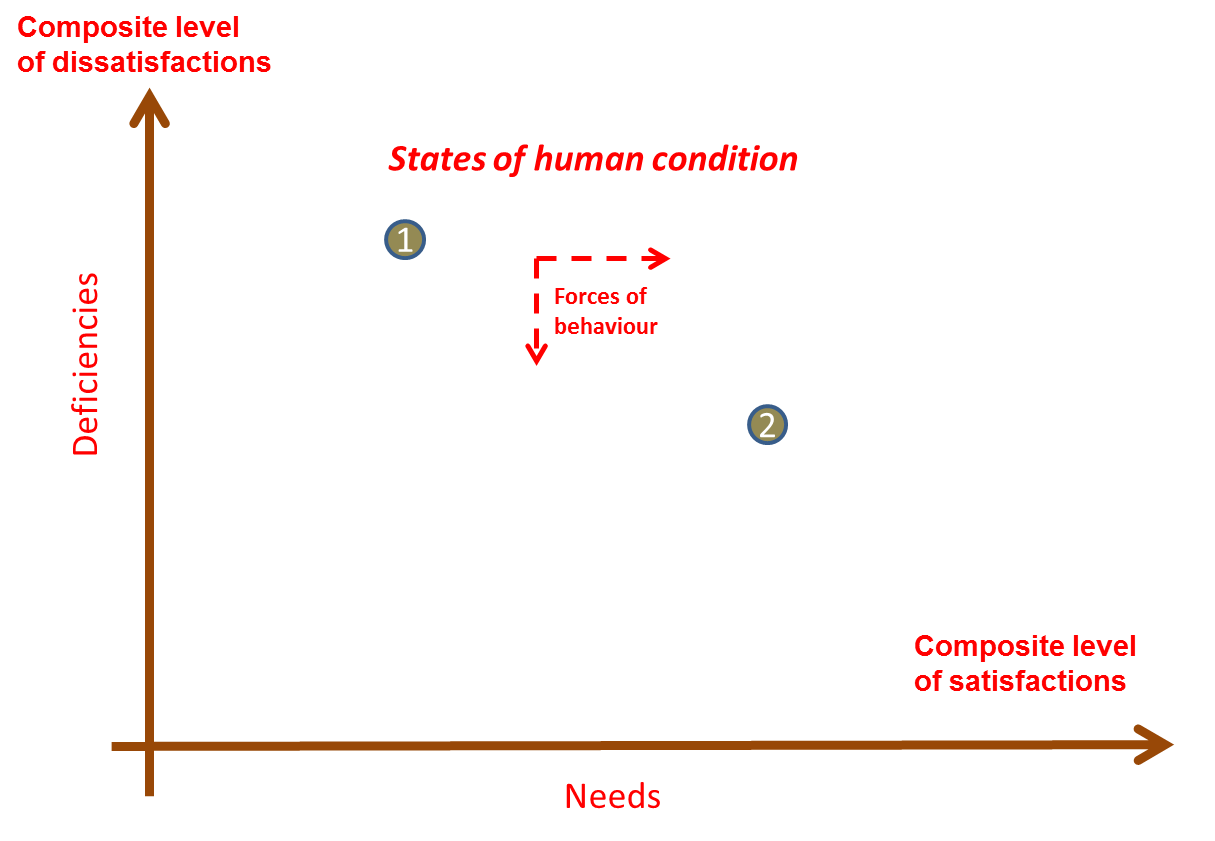
The space for eliciting rational human behaviour lies in the planes of his satisfactions and dissatisfactions. I postulate that all conscious, rational human behaviour is aimed at decreasing  internally perceived deficiencies giving dissatisfactions or increasing internally perceived desires (needs) giving satisfactions. I take these planes to be that on which the “state of human condition”, at any given time, can be plotted as a representation of the individual’s satisfactions and dissatisfactions at a particular time. The axis of time is not explicit but it is implied since only one “state of human condition” exists at any given time. For an individual to go from state 1 to state 2 on the behavioural therefore implies – and requires – the passage of time.

(more…)

A theory of motivation (as a subset of manipulation): Part 1

July 23, 2014

This is the first part of series of posts describing what I call The Engagement Theory of Motivation and which I have found useful during my working career.

1: Manipulation, motivation and behaviour

In common usage, “manipulation” has a negative connotation but “motivation” is generally regarded as being something positive. A “manipulated” person is considered a dummy, or someone being exploited. A ” manipulator” is considered “bad” even if not always “evil”. A “motivated” person  is usually seen as being diligent and performing to the best of his ability. To be “motivated” is usually considered a “good” thing – but not always. A “motivated” witness or a “motivated” observer is biased and therefore “bad”! To “manipulate” someone has a connotation of being unethical whereas to “motivate” someone is usually seen  as something to be admired.

This usage reflects the mixing up of what elicits human behaviour on the one hand, with value judgements about the objectives or purpose of causing such behaviour on the other. I try to keep these separate. The means of eliciting behaviour is merely a tool.

Manipulating the behaviour of others is central to being human. Most social interaction involves the influencing of the behaviour of others. Requesting, debating, arguing, persuading, coercing, threatening, ordering, begging, praying, rewarding, punishing are all methods we employ to elicit desired behaviour from others. I take all such influencing of behaviour to be “manipulation”. When I “request” a cup of coffee at a cafe in return for a “reward”, I successfully “manipulate” the behaviour of the server. An order in the army is to “manipulate” the actions of others. Politicians “manipulate” their voters – or try to. The cry of a baby “manipulates” the behaviour of its mother. We manipulate our children, our friends, our colleagues and our enemies. All man made laws manipulate. Manipulation is the very essence of social interaction.

Manipulation, as I use it here, is the eliciting of human behaviour. It is a tool of social interaction and is neither good nor bad.  It is only the objectives and purposes of manipulation which can be subject to value judgements about goodness or badness.

I take “motivation” – and particularly “motivation in the work place” – then to be just a particular subset of manipulation to elicit desired human behaviour. By empirical observation, I note that when a person is “motivated” he is not

  • more competent, or
  • more knowledgeable, or
  • more intelligent, or
  • more skillful, or
  • stronger or taller or smarter,

but he is

  • More effective
  • More focused
  • More cooperative
  • More “driven”
  • More dynamic
  • More result-oriented
  • More diligent …….

Thus I take the level of motivation to be a measure of the level of engagement of an individual in the actions he is performing (his behaviour). The more motivated he is the more “effective” his performance is, within the constraints set by his abilities. An unmotivated or demotivated person performs the actions in hand well below the limit of his capabilities. Motivation does not affect capability but it does affect performance.

Human behaviour and what causes it is part of the seemingly infinite universe of psychology in all its myriad forms (social psychology, cognitive psychology………). I can only approach behaviour and its causes in an empirical and pragmatic way.

My basic assumption in developing my “Engagement” theory of motivation invokes an analogy from the physical world. It is entirely qualitative and only very small parts are subject to quantification.

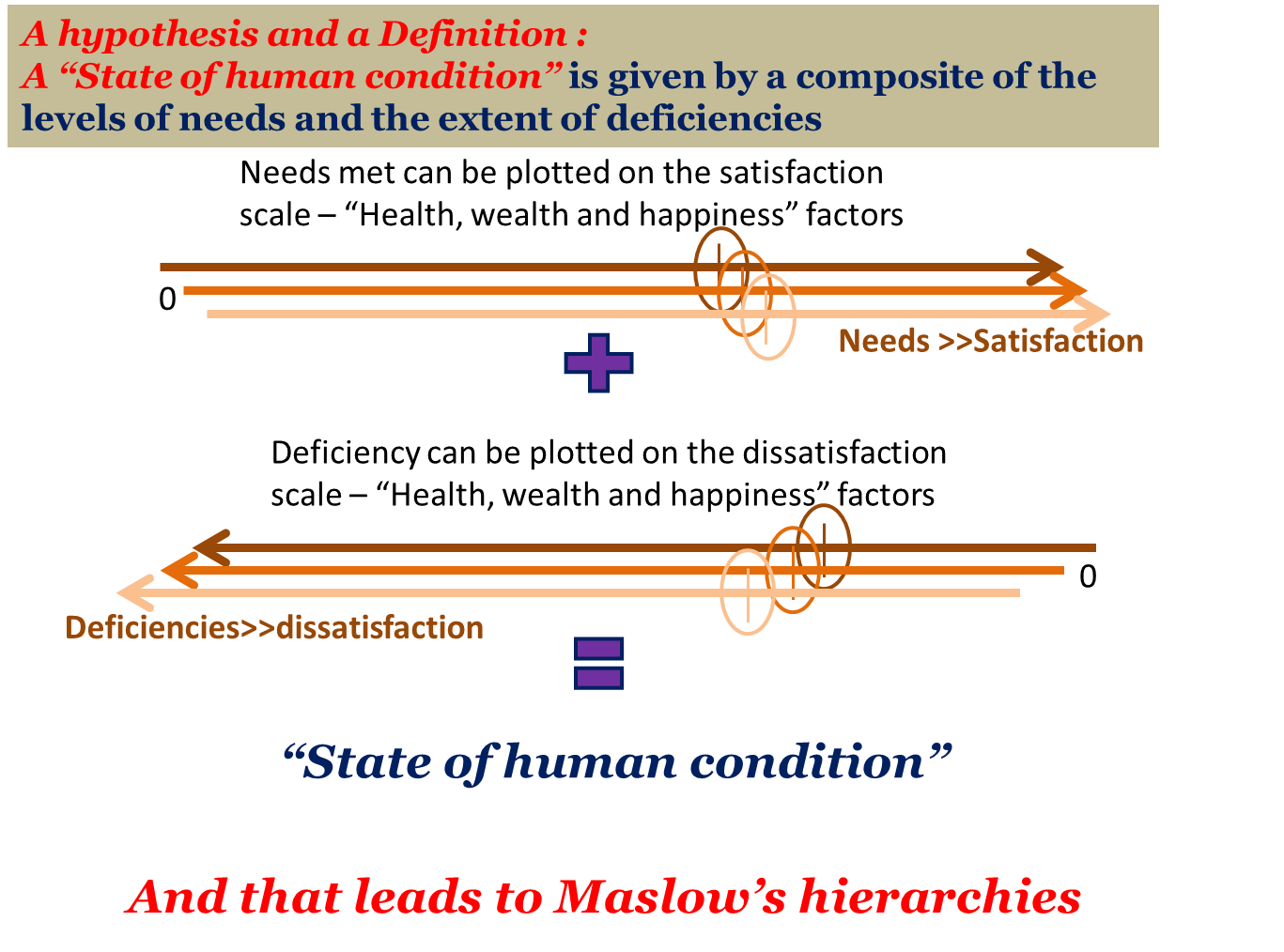
I assume that all human actions (which we call behaviour) are analagous to motion in physics. Further, I take a change to be only in response to a “force of behaviour”. The challenge lies in describing and defining this force. Building on Maslow (Motivation and Personality – 1954) I assume that any human, at any given time, exhibits a “state of human condition” which is a composite of

  1. the levels to which his various needs are satisfied, and
  2. the levels of his various dissatisfactions from deficiencies that are not met

I take “satisfaction of needs” and “dissatisfactions due to deficiencies” as two separate scales, neither of which can be negative and which are not diametrically opposed. Of course there are many needs and many deficiencies and there is a level of satisfaction or dissatisfaction with each of them,

state of human condition

state of human condition

It should be noted that there is a scale for each need and for each deficiency and that the scale itself is a composite of “health, wealth and happiness factors”. Nevertheless it should be possible by suitable weighting to combine all the levels of satisfaction of all the various needs into a single “level of satisfaction of needs”, and to combine all the various dissatisfactions due to deficiencies into a single “level of dissatisfaction due to deficiencies”. This then allows the positioning, at any given time, of an individual’s “state of human condition”.

state of human condition -2

state of human condition -2

For every deficiency – again following Maslow – there is a tolerable level of dissatisfaction. If this level is exceeded then rational behaviour is no longer possible and an individual can and will only act to reduce the dissatisfaction to the exclusion of everything else. It is the tolerable level of dissatisfactions which defines the behavioural space where manipulation and motivation can be brought into play to influence behaviour.

Next – 2: The Behavioural Space

The very model of a modern individual

July 21, 2014

I can never find a political label that fits me or a label that I would like to be fitted to.

(some edits on 24th July to try and improve the scanning)

(With apologies and thanks to Gilbert and Sullivan)

I am the very model of a modern individual,

I am well informed on matters social and political, 

I know the his-tory of Man and of theories philosophical,

Of apes and Denisovans and matters anthropological.

I’m very well acquainted, too, with matters mathematical,

I understand the flow of heat in a manner thermodynamical.

About politics and sociology, I’m up-to-date with all the news,

On any subject under the sun, I have opinions and decided views.


Of science led by politics, I tend to be suspicious,

My views on global warming verge nigh on being scandalous.

On matters social, economical and all that is political,

I am the very model of a modern individual.


I know our myths and legends from time ages immemorial,

I can tell the tales of Duryodana, of Beowulf and Galadriel.

I can quote from the songs of Omar Khayyam and from the sonnets of the Bard,

Verses from the Bible, the Koran or from the Vedas do not come so very hard.

I am familiar with the post-modernists and privy to all the schisms,

Between environmentalism, and feminism and even conservationism.

I could hum you an air from Bach or Mozart or even a Shankar raga, 

And even sing along with you the many hits of Abba.

I am quite familiar with the works of Marx and Paine and Friedman,

I can And debate with you the ins and outs pros and cons of abortion or execution

In short, in matters social and political,

I am the very model of a modern individual.


I don’t know what is meant by “God” and by ridiculous “Religions”,

As if w‘re e are still stuck in the dark depths of the Spanish Inquisition.

I have little time for Islamic jihad or rampant Zionism,

I only have contempt for Christians killing Christians.

I find I’m simultaneously, conservative and socialist,

And when I’m not a fascist, I can even be a communist.

Nationalism and patriotism seem to me quite artificial,

Since Nation States are merely accidents geographical.

As a conglomeration of matters contradictory,

There is no better modern individual than me.


I don’t know what I don’t know, or even all there is to know,

But I will know all that I can know, before it’s time for me to go.

In short, in matters social and political,

I am the very model of a modern individual.