Archive for the ‘China’ Category
January 5, 2013

from Xinhua
“The ice conditions in the Bohai Sea and the Yellow Sea this January may be more serious than that in the past years” reports Xinhua. Zheng Dong, chief meteorologist at the Yantai Marine Environment Monitoring Center under the state oceanic administrationsaid that the area under ice in Laizhou Bay was 291 square km this week.
Temperatures in China have plunged to their lowest in almost three decades, cold enough to freeze coastal waters and trap 1,000 ships in ice, official media said at the weekend.
The Shizuishan segment of the Yellow River is frozen due to persisiting cold weather in northwest China’s Ningxia Hui Autonomous Region, Jan. 5, 2012. Two segments of the Yellow River in Ningxia region have been frozen up due to low temperature.
I would have thought it was just winter even if such conditions have not been seen for 3 decades. But – for political and religious correctness – it is no doubt all due to global warming and carbon dioxide!!
Tags:China, ships trapped, winter
Posted in China, Weather, Winter | Comments Off on Over 1000 ships trapped by ice in China
June 15, 2012
Three Chinese astronauts, Liu Yang, Jing Haipeng and Liu Wang will launch at 1237 GMT on Saturday in a Shenzhou 9 spacecraft to dock with the orbiting Tiangong 1 space “station” (module) now orbiting 322 kilometers above the Earth.
(Updated with new image below).

Liu Yang, China’s first female astronaut, at the Jiuquan Satellite Launch Centre in Gansu province on Friday. Photo AP
China Daily: The impending launch of the manned Shenzhou IX spacecraft will be the first time that China’s astronauts will stay in space for more than 10 days, said Cui Jijun, chief commander of the country’s first space docking mission’s launch site system, on Wednesday. The previous record is five days, set by the Shenzhou VI spacecraft in 2005.
The mission will also complete the country’s first manned space docking to master thenecessary technology for assembling a space station, see China’s first female astronaut in space and have astronauts entering a space lab module for the first time, he added.
It is also the first time for the Jiuquan Satellite Launch Center, located in a desert, to conduct a mission in the summer. The past nine launches of China’s manned space program were held in the spring, autumn and winter, but not summer. The three manned spacecraft all blasted off in autumn.
Xinhua: China succeeded in the automatic docking between Shenzhou-8 spacecraft and Tiangong-1 lab module last year. A manual docking between Shenzhou-9 and Tiangong-1 will be attempted this time. ……. a female astronaut will be included in a space mission for the first time in China’s space program, the selection, training, medical monitoring and security, and flight crew equipment for female astronauts will also be tested.

Tiangong-1 Heavenly-Palace Chinese-space-station
Tags:China, Jing Haipeng, Liu Wang, Liu Yang, Shenzhou program, Space rendezvous, Tiangong-1
Posted in China, Science, Space | 3 Comments »
April 8, 2012
Common sense and simple economics are beginning to reassert themselves as the the fundamental weaknesses in the fashionable – but subsidised – expansion of solar and wind power plants are revealed. The expensive, intermittent and unpredictable generation that derives from solar and wind power plants can – at best – be used to augment an existing system. They are actually useful as an auxiliary heat and power source as small decentralised units. But in a large power grid they are more of a nuisance than an asset and can only increase the cost to the consumer.
China has now published a policy document changing direction towards nuclear and hydro power and an accelerated development of shale gas use. Solar and wind power are downgraded.
Electric Light & Power
China will accelerate the use of new-energy sources such as nuclear energy and put an end to blind expansion in industries such as solar energy and wind power in 2012, Chinese Premier Wen Jiabao says in a government report published on March 5.
(more…)
Tags:China, Energy, Energy development, Hydro Power, Nuclear power, Shale gas, Solar power, wind power
Posted in China, Energy, Nuclear Power, Renewable Energy | Comments Off on China downgrades solar and wind power – pushes for nuclear, hydro and shale gas
March 15, 2012
It was high time and even though they have tried before, the new measures just announced by the Chinese Education Ministry will hopefully begin to curb the widespread plagiarism, data manipulation and even data fakery that allegedly goes on.
India needs to institutionalise something similar. The Society of Scientific Values in India is an independent body and tries valiantly to act as a watch-dog but it has no teeth and no official standing. Of course in India the danger with creating institutions under a Ministry – and therefore under a Minister – is that the institution will very quickly become politicised. And Indian politicians are perhaps not the best choice when it comes to monitoring and establishing ethical standards. Nevertheless a start has to be made and the Ministry of Science and Technology in India is the natural home of an institution to promote ethical standards in scientific research and at institutes of higher education. The key will be to provide the backing of the Ministry to give it sufficient weight but to maintain its independence from party political influences. Giving such an institution semi-judicial status is one way but could be very heavy handed.
China Daily reports:
China’s Ministry of Education on Wednesday issued new rules to supervise universities’ scientific research and academic activities in order to “effectively prevent and curb academic misconduct.”
(more…)
Tags:China, China Education Ministry, ethics, India, Scientific misconduct, Society for Scientific Values
Posted in Academic misconduct, China, Ethics, India, Science, scientific misconduct, Technology | Comments Off on Chinese Government tries to get to grips with science misconduct. When will India follow?
March 2, 2012
The Age of Gas is not just dawning but is well and truly underway with China revealing reserves sufficient for 200 years. At 25 trillion cubic meters (875 trillion cubic feet) of recoverable reserves these could be almost twice the recoverable reserves in the US.
As shale gas comes into play all over the globe there is going to be a run on large gas turbines for power generation. Gas turbine manufacturers (and the big 4 are GE, Siemens, Alstom and MHI) can expect a sellers market within 2 or 3 years as the economic recovery pressurises generation capacity.

from Wikipedia
The Telegraph:
China is planning an investment blitz to unlock its vast reserves of shale gas, convinced it can match the energy revolution under way in the US and meet a significant part of its fast-growing fuel needs.
(more…)
Tags:Age of Gas, China, dash for gas, gas glut, gas turbines, sellers market, Shale gas
Posted in China, Energy, Engineering, Gas | 2 Comments »
February 14, 2012
China has reserves of shale gas at least 50% greater than in the US and is the latest country hopping onto the fracking band-wagon. The Chinese are looking to acquire minority interests in technology companies owning fracking technology in the US and are pushing ahead with their plans for production of shale gas. It seems quite clear now that whenever the global economic recovery finally gets going, the availability of shale gas will be one of the contributing factors. I expect we shall see a boom in exploration for shale gas reserves, in increasing production of shale gas and a boom in gas-fired power generation. There may well be a boom in the sales of gas turbines for power generation within the next 2 -3 years.
“Peak” gas is nowhere in sight. And the fracking technology developments seem to have application even for the recovery of large amounts of gas from methane gas hydrates which are found under deep sea-beds (>500m deep) and even under thick layers of permafrost. While this may take another 10+ years to develop, it makes it even more unlikely that any “peak” gas scenario can develop.

Shale gas reserves: Reuters graphic
Forbes reports:
(more…)
Tags:"Peak" gas, China, fracking, Hydraulic fracturing, Natural gas, Shale gas
Posted in Business, China, Energy, Gas | 1 Comment »
November 7, 2011
Victor Roberto Muller has already tweeted that he is going back to the “drawing board” !!
But the pictures he draws are all illustrations for fairy tales.
Reuters:
General Motors Co said on Monday it had decided to sever its ties to Saab and its commitment to supply it with vehicle components and the 9-4X model because of the risks posed by the pending sale of the Swedish auto brand to Chinese owners.
“Although General Motors is open to the continued supply of powertrains and other components to Saab under appropriate terms and conditions, GM will not agree to the continuation of the existing technology licenses or the continued supply of 9-4X vehicles to Saab following the proposed change in ownership as it would not be in the best interests of GM shareholders,” GM spokesman Jim Cain said. ….
On Friday, GM had said that it would be difficult to support a sale of Saab if it hurt GM’s competitive position in Chinaand other key markets.
China’s Pang Da Automobile Trade Co and Zhejiang Youngman Lotus Automobile have struck a deal to buy Saab from its current Dutch owner, Swedish Automobile , in what amounts to a rescue plan for the Swedish auto brand formerly owned by GM.
But the deal had to be approved by GM, which still has preference shares in Saab and has supplied the Swedish auto brand with crucial components. …
The new deal which had been announced last week was for 100% ownership to pass to the Chinese. When asked if GM licences would be available if the plan went back to the Chinese buying just 53.9% of Saab – as originally envisaged – the GM spokesman refused to speculate.
Tags:China, General Motor, Pang Da Automobile Trade Co, SAAB, Victor Muller, Zhejiang Youngman Lotus Automobile
Posted in Automobiles, China, Sweden, US | Comments Off on No GM licence to a Chinese-owned SAAB
September 11, 2011
China’s lunar probe Chang’e 2 completed its mission orbiting the moon three months ago and has now reached Lagrange (liberation) Point L2.
It has now reached a point in space where neither the moon nor the earth’s gravity will affect the probe. This point is called L2. It’s the farthest a Chinese spacecraft has ever been.
Chang’e 2’s primary mission was to orbit the moon at only 100 kilometers from the surface, taking high resolution photos. After completing this, scientists decided that there was enough fuel to continue with the second part of the mission. But sending the probe from the moon was unprecedented. Similar missions has previously left directly from Earth, so keeping the satellite on course was a technological challenge.
Zhou Jianliang, Deputy Chief Designer, Measure & Control System of Chang’e 2, said, “The satellite faced various disruptions on its journey, which could have led it off course. We had planned four readjustments to keep it on track. But we only need(ed) to do it once since the first adjustment proved so accurate.”
China’s ambitious three-stage moon mission is steadily advancing. The next phase will be the launch of Chang’e-3 in 2013. The probe’s mission is to land on the moon together with a moon rover. In the third phase, the rover should land on the moon and return to Earth with lunar soil and stones for scientists to study. The Chang’e program was named after the legendary Chinese goddess who flew to the moon. With the progress in technology and experience from the Chang’e mission, sending a Chinese astronaut to the moon is now clearly feasible.
On Lagrange Points:
The Italian-French mathematician Joseph-Louis Lagrange discovered five special points in the vicinity of two orbiting masses where a third, smaller mass can orbit at a fixed distance from the larger masses. More precisely, the Lagrange Points mark positions where the gravitational pull of the two large masses precisely equals the centripetal force required to rotate with them. Those with a mathematical flair can follow this link to a derivation of Lagrange’s result (168K PDF file, 8 pages).
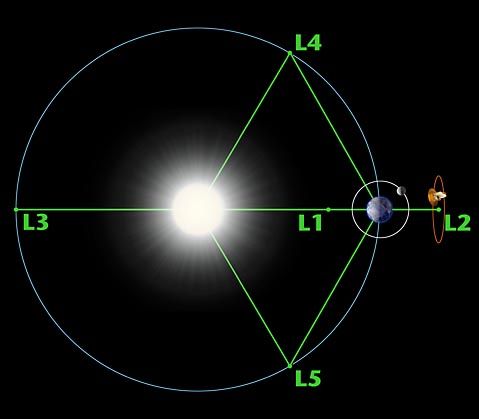
Of the five Lagrange points, three are unstable and two are stable. The unstable Lagrange points – labeled L1, L2 and L3 – lie along the line connecting the two large masses. The stable Lagrange points – labeled L4 and L5 – form the apex of two equilateral triangles that have the large masses at their vertices.

Lagrange Points of the Earth-Sun system (not drawn to scale!): NASA
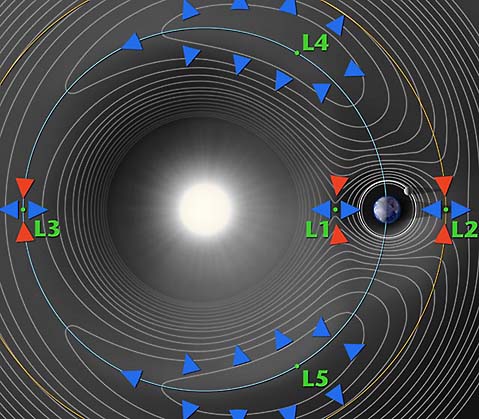
The easiest way to see how Lagrange made his discovery is to adopt a frame of reference that rotates with the system. The forces exerted on a body at rest in this frame can be derived from an effective potential in much the same way that wind speeds can be inferred from a weather map. The forces are strongest when the contours of the effective potential are closest together and weakest when the contours are far apart. In the contour plot below we see that L4 and L5 correspond to hilltops and L1, L2 and L3 correspond to saddles (i.e. points where the potential is curving up in one direction and down in the other).

A contour plot of the effective potential (not drawn to scale!): NASA
Tags:Chang'e 2, China, Exploration of the Moon, Joseph-Louis Lagrange, Lagrangian point, Lunar exploration, Moon
Posted in China, Lunar science, Science, Space | Comments Off on Chang’e 2 is now “liberated” from earth and lunar gravity
August 10, 2011

Image via Wikipedia
The Chinese economy is not immune to whatever craziness is going on around the world. They hold such a large amount of US treasury bonds that the gridlock and political irresponsibility in Washington is leading to some fundamental policy changes regarding their reserve holdings. The People’s Bank of China owns about $1.1 trillion of US Treasury bonds out of the $1.5-trillion treasury bonds or so of foreign treasuries that it holds amid China’s total reserves of about $3.2 trillion.
It is not therefore surprising then that China is among those most concerned by Standard & Poor’s recent downgrade of the United States’ AAA credit rating. It was sufficiently concerned to publicly chastise the US for its irresponsibility!
“The U.S. government has to come to terms with the painful fact that the good old days when it could just borrow its way out of messes of its own making are finally gone,” reported the Xinhua news agency.
Meanwhile
BEIJING, Aug. 10 (Xinhua) — China Wednesday reported faster than expected growth in exports, imports and trade surplus in July, but analysts said the picture would become worse in the coming months amid a faltering global economy.
The trade surplus rose sharply to a record high of 31.48 billion U.S. dollars in July from June’s 22.27 billion U.S. dollars and the 28.7 million U.S. dollars in the same period a year ago, the General Administration of Customs (GAC) said on its website.
July exports rose 20.4 percent year-on-year to reach 175.128 billion U.S. dollars, a record monthly high compared with 17.9 percent in June. Imports quickened from June’s 19.3 percent to 22.9 percent to 143.64 billion U.S. dollars.
The robust readings suggests both China’s competitiveness in exports and domestic demand are in relatively good shape, Bank of America-Merrill Lynch economist Lu Ting said in an email to clients.
Exports to the EU and Japan rose to 22.3 percent and 27.2 percent year-on-year in July from 11.4 percent and 20 percent in June.
And exports to the United States expanded 9.5 percent, down slightly from 9.8 percent in June, but down significantly from 13.3 percent in the second quarter and 21.4 percent in the first quarter, which indicated weakness in the U.S. economy has been weighing on its imports from China, according to Lu. ….
On Wednesday morning, yuan hit a record high of 6.4167 against the U.S. dollar.
US politicians in the Administration and those grand-standing in Congress will need to get their act in order if they are to avoid the day when the Chinese are no longer around to buy their debt. As it is, China is now engaged in diversifying its foreign reserves away from US dollars to other currencies and even other asset classes and is under severe internal pressure to accelerate this diversification.
Tags:China, Chinese reserves, United States, United States dollar, US credit rating downgrade, US debt, US Treasuries
Posted in China, Economy, International Trade | Comments Off on Chinese trade surplus at a record high as US downgrade threatens their holdings
March 28, 2011
Xinhua News:

March 25, 2011 MA600 aircraft in Luoyang City of central China's Henan Province. (Xinhua/Li Qiaoqiao)
One of China’s new generation of short-haul passenger aircraft, the MA600, was put into use Saturday at a civil aviation training base in southwest China’s Sichuan Province.
The “Modern Ark” 600 was delivered in December last year to the Civil Aviation Flight University of China (CAFUC) by its manufacturer, the Xi’an Aircraft International Corporation (XAIC), which is based in northwestern China’s Shaanxi Province.
CAFUC ordered two MA600 aircraft at the China International Aviation and Aerospace Exhibition, which was held in the city of Zhuhai in Guangdong Province in November 2010.
The MA600 is an upgraded version of the company’s MA60 passenger aircraft and can carry 50 to 60 passengers. The aircraft has been updated with a more comfortable cabin and other design improvements.
“The MA600 also features better performance in regards to safety and fuel efficiency,” said Wang Kaiyin, an official with the CAFUC. The turboprop aircraft has a range of 2,450 km.
Tags:Aircraft, China, short haul aircraft, Xian MA 600
Posted in Aviation, China | 2 Comments »




 The k2p blog