Archive for the ‘China’ Category

Manufacturing in India and China powers ahead and driven by domestic consumption

November 2, 2010

Reuters reports on the latest PMI (Purchasing Managers Index) numbers:


image: whatsinbiz.wordpress.com


Manufacturing growth in India and China powered ahead last month and U.S. industry also picked up steam, according to data on Monday that suggested the global economic recovery may be on firmer footing.

China’s official purchasing managers’ index (PMI) rose to a six-month high in October of 54.7 from 53.8 in September, easily beating market forecasts of 52.9.

The strength of China’s official PMI was especially striking because the index normally heads down in October, said Yu Song and Helen Qiao, economists at Goldman Sachs. “The fact that the PMI went up despite this seasonal bias suggests real activity growth was likely to have been exceedingly strong in October,” they said in a note. The survey showed manufacturers continued to run down stocks last month to meet rising domestic orders. “These readings bode well for a recovery of output in coming months,” Ting Lu at Bank of America Merrill Lynch told clients. A companion PMI produced by Markit for HSBC painted a similar picture, rising to 54.8 from 52.9 — one of the largest month-on-month rises in the history of the survey.

Manufacturing in India — Asia’s other emerging powerhouse — put in a performance every bit as strong as China’s. India’s manufacturing was supported by strong domestic consumption. The HSBC Markit PMI for India, Asia’s third-largest economy, rose to 57.2 in October from 55.1 in September.

Mirroring a report from Japan last Friday, South Korean manufacturing shrank for the second month in a row as the HSBC/Markit PMI fell to 46.75 in October — the lowest since February 2009 — from 48.8 in September.

An unexpected rise in Britain’s manufacturing index to 54.9 will increase doubts that the Bank of England will soon embark on more quantitative easing. It followed official data last week that showed the UK economy grew at a surprisingly strong rate of 0.8 percent in the third quarter from the second.

Equivalent surveys from Europe are due on Tuesday, but Britain’s PMI showed manufacturing growth picked up pace last month for the first time since March.

Flash October figures for Germany, released last month, also gave a strong reading although much of Europe remains mired in debt and poised to cut public spending to deal with it — a move that will crimp economic growth going forward.

It seems that the Chinese and Indian motors are being fuelled primarily by domestic consumption which continues to grow strongly. Perhaps this is not so surprising considering that the growth of the consuming “middle-class” in India and China is probably the fastest it has ever been. In India this growth is probably twice the growth of the total population (and there is some belief that population growth rates drop sharply for people as they enter the “consuming middle-class”).

Japanese manufacturing is being hampered by the strong Yen and Korean manufacturing is yet to pick up. In Europe, the weak Euro is driving German exports and UK manufacturing is showing very strong. The low Dollar value may be beginning to help US exports as well.

Trade war! Cerium oxide price has risen 665% since April

October 22, 2010
Phase diagram of cerium in english

Phase diagram cerium: Image via Wikipedia

Freely translated from Dagens Industri

Cerium oxide, which is used to finish semiconductors and obtained from the rare earth element cerium, has risen in price from $ 4.70 per kg on April 20 to 36 U.S. dollars a kilo on Tuesday, October 19. An increase of 665 percent.

The price rise is primarily due to China scaling down its export quotas. In recent years there has been a gradual reduction of 5-10 percent per year, but in July alone it was reduced by 40 percent.  The country accounts for almost 95 percent of world supply of rare earths and in some cases almost 100 percent.

The official explanation from China is that the  country’s own industrial needs must be met first. These account  for 60 percent of global demand. Producing earth metals is a dirty business and China also gives environmental reasons as an explanation for the lower export quotas.

But many, especially in the U.S., suspect that it is a low-key trade war.

“Gene pool of plants and animals still expanding”

October 20, 2010

Xinhua reports today from Wuhan:


Shennangojia in Hubei Province


Twenty-three unique new plant species have been found over the past five years in the mysterious Shennongjia Nature Reserve in central China’s Hubei Province, a researcher said Wednesday. “We are pretty much sure that the new species, which have not been discovered elsewhere in the world, are new members of the plant kingdom,” said Yang Jingyuan, head of the reserve’s research institute.

The new discoveries showed the “gene pool” of plants and animals was still expanding, said Yang. Researchers had identified 143 previously undocumented plant species in Shennongjia since 2006, excluding the 23 new varieties that are unique to the area, he added. Scientists had also discovered 16 kinds of snakes and 270 kinds of insects that were new to Hubei Province. The number of albino animals, including bears, snakes and magpies, found in the reserve have also baffled scientists.

The area is also believed to be home to the legendary Bigfoot-like ape man. The Hubei Wild Man Research Association said earlier this month that it was considering launching a high-profile search for the elusive creature, almost 30 years after the last organized expedition to seek the legendary beast in the early 1980s.


Shennangojia Nature Reserve : image http://english.cnhubei.com


Chinese Science Ministry vindicates academic fraud journalists

October 13, 2010
Chinese Academy of Sciences

Chinese Academy of Sciences: Image via Wikipedia

The case of the two crusading journalists in China who were brutally attacked after they had exposed academic fraud has been reported by Retraction Watch and the risks they take has been reported here.

In one case after a quick trial, a local court in Beijing convicted urologist Xiao Chuang-Guo on 10 October of assaulting two well-known advocates of academic integrity in China.
One victim of the attacks was Fang Shimin, freelance writer and self-appointed watchdog of research misconduct. Fang had questioned Xiao’s academic achievements, but this was not what prompted the attack, Xiao claimed. Xiao told the court that he had a decade-long personal conflict with Fang, mainly because Fang had insulted Xiao’s wife and teacher.
http://news.sciencemag.org/scienceinsider/2010/10/doctor-sentenced-in-beijing-for.html

But the Chinese Science Ministry has today issued a statement castigating Xiao.

China’s Ministry of Science and Technology has lambasted a doctor at the center of an academic fraud scandal who masterminded two violent attacks on his critics, and denied he was still on the payroll of a medical research project. The ministry issued a statement on its website late Tuesday, claiming Doctor Xiao Chuanguo had no respect for the law and disrupted social order.

It said Xiao should be condemned for his vicious misconduct and lack of integrity. Xiao, 55, head of the Urology Department of Wuhan Union Hospital, was sentenced Sunday to five and a half months in detention by the Shijingshan District People’s Court of Beijing. The court found Xiao hired four men to attack two writers who had accused him of academic fraud.

Xiao believed the accusation had led to his failing to become a member of the Chinese Academy of Sciences.

The victims of the violent attacks were Fang Zhouzi, a science writer with a reputation for exposing academic fraud, and Fang Xuanchang, an editor at the economic journal, Caijing.

The ministry denied claims that Xiao was still a chief scientist on a ministry-sponsored science project.

According to the statement, Xiao used to be the chief scientist researching neurological damage repair on the “973 Plan,” a key national science project. The statement said Xiao’s program ran from 2003 to 2008 and that Xiao was no longer responsible for any “973 plan” projects. It said “chief scientist” was not an honorary title.


Chang’e-2 enters final working orbit around the moon.

October 9, 2010

Chang’e-2 has now entered into its final 118 min orbit and formally starts its mission of mapping the moon and preparing the way for Chang’e-3.

http://news.xinhuanet.com/english2010/china/2010-10/09/c_13548648.htm

Chang’e-2, following instructions from the Beijing Aerospace Control Center (BACC), started the third braking at 11:17 a.m. and entered the 118-minute, round working orbit 15 minutes later, changing the satellite’s apolune from 1,825 km to about 100 km, the BACC said. The satellite will begin scientific exploration activities soon.

Chang’e-2 lifted off from the Xichang Satellite Launch Center, in southwest China’s Sichuan Province, on Oct. 1. The moon probe completed its first braking on Wednesday and the second on Friday.


Academic Cheating: China and India need to clean up their acts

October 9, 2010

The number of scientific research papers published in India stood at 22,215 in 2007, up from 11,067 a decade earlier.  Chinese academies published a similar number of papers in 1997 — 12,632 but that figure had leapt to 67,433 by 2007.  China in 2007 contributed8.6 percent of the world’s scientific papers while India produced 2.4 percent.


Plagiarism


Publish or perish is the prevailing paradigm in both countries and plagiarism, data manufacture and manipulation and just downright cheating are endemic to academia. (Plagiarism is rampant in the Indian movie industry and in book publishing as well so academia merely reflects the society at large).

Where cases of plagiarism come to light as with the recent high profile case of plagiarism in reports on GM crops or the cases of plagiarism at IIT-Kanpur, the whitewash committees soon swing into action. Even if sometimes suspended, it does not take long for the parties involved to regain their former positions. CYA prevails.

But the solution does not lie just with correcting institutional processes and better monitoring. A fundamental change in institutional and personal standards of ethics  is required. Academia will need to lead society and not just be sheep.

Just some of the recent cases of academic plagiarism in India and China are given below:

India

  1. Plagiarism: a scourge afflicting the Indian science
  2. Plagiarism plagues India’s genetically modified crops
  3. Biotechnology Advances retracts 3 papers from India for plagiarism
  4. Scientific plagiarism in India
  5. We must restore scientific integrity in Indian research
  6. In India, plagiarism is on the rise
  7. Call for Indian plagiarism watchdog
  8. Copycats from IIT-Kanpur?

China

  1. Do plagiarism, fraud, and retractions make it more difficult trust research from China?
  2. Rampant Fraud Threat to China’s Brisk Ascent.
  3. Scientists behaving badly; Recent events show China needs to clean up its scientific act.
  4. Academic corruption undermining higher education: Yau Shing-tung.
  5. CHINA: Universities fail to tackle plagiarism.
  6. In China, academic cheating is rampant; Some say practice harmful to nation.
  7. CHINA: Professor sacked for academic plagiarism
  8. Nearly half of China’s science workers think academic cheating is “common”.

Chang’e-2 enters penultimate lunar orbit

October 8, 2010

http://news.xinhuanet.com/english2010/sci/2010-10/08/c_13547437.htm

China’s second unmanned lunar probe, Chang’e-2, has successfully completed its second braking at perilune on Friday, which decelerated the satellite and allowed it to enter a 3.5-hour orbit, according to the Beijing Aerospace Control Center (BACC).

Chang’e-2, following instructions from the center, started the second braking at 10:45 a.m. and entered the 3.5-hour elliptical moon orbit 17 minutes later, said Ma Yongping, vice-director of the BACC.

The second braking was to decelerate the satellite to prepare it for the final braking and its entering the designed 118-minute working orbit, Ma said.

Previous posts on Chang’e-2

https://ktwop.wordpress.com/2010/10/08/change-2-starts-transmitting-data-from-lunar-orbit/

https://ktwop.wordpress.com/2010/10/06/change-2-enters-12-hour-lunar-orbit/

https://ktwop.wordpress.com/2010/10/03/change-2-mission-on-track/

https://ktwop.wordpress.com/2010/09/30/chinas-second-moon-probe-change-2-to-launch-this-weekend/

Chang’e-2 starts transmitting data from lunar orbit

October 8, 2010


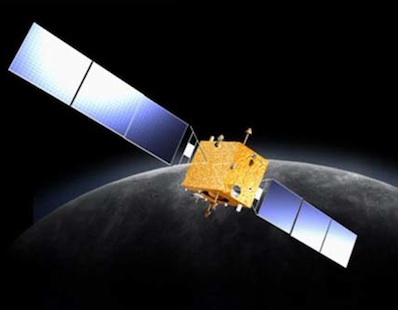
Chang'e-2 lunar probe: Credit: CNSA


Chang’e-2 remains on track and the scond orbit correction planned for Sunday may not be necessary.

From the Beijing Review:

All scientific exploration equipment has begun operation on China’s new lunar probe,Chang’e-2. The instruments that collect information about the space environment between the Earth and the Moon have sent back their first batch of data. The ground control center received the first readings from Chang’e-2 early Tuesday morning. The equipment on board detects a wide array of information such as gamma radiation levels.

The control center has confirmed that all instruments are working correctly.

The center announced that the second correction of Chang’e-2‘s orbit has been cancelled, as data proves the satellite is travelling strictly to plan following the first correction.

Experts said the satellite might change its orbit slightly due to the influence of the atmosphere and cosmic environment. Timely correction is therefore needed to prevent Chang’e-2 from deviating from its designed orbit.

The probe went through its first trajectory correction 17 hours after its successful launch. According to the original plan, the second correction would have been on Sunday. The control center is now watching closely for the timing of its next orbit correction. It’s the first time a Chinese lunar probe has directly entered an Earth-Moon transfer orbit without orbiting the Earth first.

Chang’e-2 satellite was launched just before 7 p.m. on October 1, inaugurating China’s second phase of a three-step moon mission, which will eventually culminate in a soft landing on the Moon.

From Spaceflight Now:

Chang’e 2 will map candidate landing sites for the next mission in China’s lunar program, which targets a robotic touchdown on the moon after launch in 2013. Another project in China’s long-term plans is a vehicle to return soil and rock from the moon back to Earth.

After its $134 million baseline mission at the moon is finished, Xinhua reports Chang’e 2 could enter an extended phase.

Officials are considering three scenarios for Chang’e 2’s overtime, including sending the spacecraft away from the moon and into deep space, giving Chinese engineers practice in operations further from Earth. The satellite’s propellant could also return Chang’e 2 to Earth orbit, according to Huang Jiangchuan, a chief designer quoted in Xinhua.

Chang’e 2 could also continue circling the moon, relaying more science data before attempting a landing or impact on the surface, officials said.

Chang’e 1 was deliberately crashed into the moon at the end of its mission in March 2009.


Chang’e-2 enters 12 hour lunar orbit

October 6, 2010

Chang’e-2 enters 12 hour lunar orbit

China’s second unmanned lunar probe  Chang’e-2, completed its first braking Wednesday, which decelerated the spacecraft and successfully allowed it to enter a 12-hour orbit, according to the Beijing Aerospace Control Center (BACC). Chang’e-2, following instructions from the center, started the first braking at 11:06 a.m. and entered the 12-hour elliptical moon orbit 32 minutes later. It was the first braking for Chang’e-2. The space- probe needs to brake another two times before it can enter the designed 118-minute working orbit. The braking “laid a solid foundation” for Chang’e-2 to carry out scientific explorations in its final orbit, BACC said in a press release.

Compared with Chang’e-1, it is more challenging for Chang’e-2 to brake as it must do so at a closer distance to the moon and at a higher speed. A Long-March-3C carrier rocket carried Chang’e-2 into space blasting off from the Xichang Satellite Launch Center, in southwest China’s Sichuan Province, at about 7 p.m. Friday.

To acquire more detailed moon data, Chang’e-2 will enter a lower lunar orbit about 100 km above the surface, compared with the 200-km altitude of Chang’e-1, according to the control center. Before its first braking, the lunar probe had traveled nearly 350,000 km.

Screen shows the virtual animation of the first braking of Chang'e II lunar probe in Beijing Aerospace Control Center in Beijing, capital of China, Oct. 6, 2010. China's second unmanned lunar probe, Chang'e II, completed its first braking Wednesday, which decelerated the satellite and successfully made it enter a 12-hour orbit, according to the Beijing Aerospace Control Center. (Xinhua/Tian Zhaoyun) (xzj)

Cheng'e - 2 enters 12 hour lunar borbit

Two satellites into orbit

In other news today a Long March 4B rocket carrying two satellites of the “Shijian VI-04” group lifted off from the launch pad in Taiyuan, capital of north China’s Shanxi Province, Oct. 6, 2010. The satellites which have entered their space orbits will carry out probes on space environment and radiation and conduct space science experiments, according to the Taiyuan Satellite Launch Center.

Three Gorges Dam to reach full water level this month

October 4, 2010

The Three Gorges Dam is a hydroelectric dam that spans the Yangtze River by the town ofSandouping, located in the Yiling District of Yichang, in Hubei province, China.

Map of the location of the Three Gorges Dam, Sandouping, Yichang, Hubei Province, China and major cities along the Yangtze River

Three Gorges Dam location: Wikipedia image

The dam body was completed in 2006. Except for a ship lift, the originally planned components of theproject were completed on October 30, 2008, when the 26th generator in the shore plant began commercial operation. Each generator has a capacity of 700 MW. Six additional generators in the underground power plant are not expected to become fully operational until 2011. Coupling the dam’s 32 main generators with 2 smaller generators (50 MW each) to power the plant itself, the total electric generating capacity of the dam will eventually reach 22,500 MW.

Xinhua reports  from Yichang, Hubei that the water level at the Three Gorges Dam, the world’s largest water control project, reached 164.59 meters on Sunday, only 10 meters short of its full capacity of 175-meters. The dam in central China started to hold back water this September by discharging less to the lower reaches of the Yangtze River, the country’s longest river.

When the water level is at its maximum of 175 metres over sea level (110 metres above the river level downstream), the dam reservoir is about 660 kilometres  in length and 1.12 kilometres  in width on average, and contains 39.3 km3 of water. The total surface area of the reservoir is 1,045 km². The reservoir flooded a total area of 632 km² of land, compared to the 1,350 km² of reservoir created by the Itaipu Dam on the border of Brazil and Paraguay (which has a  generating capacity of 14,000 MW).

File:Yangtze longitudinal profile upstream.JPG

Yangtze longitudinal profile: Wikipedia image

Reaching the 175-meter water level would enable the Three Gorges Dam to fulfill its functions of flood control and generating electricity to the fullest extent, symbolizing the total success of the massive water project. This is the reservoir’s third attempt to reach full capacity since 2008. However, water levels stopped at 172.8 meters in 2008 and 171.43 meters in 2009 due to droughts on the lower reaches.

However, this time officials believe the dam will reach full capacity by the end of October.

Changed Landscape of the Three Gorges Dam region. (NASA/Goddard Space Flight Center Scientific Visualization Studio).