Archive for the ‘Defense’ Category

$35 billion US tanker decision imminent: Boeing and Airbus prepare to protest a loss

February 24, 2011

The much awaited winner of the order for 179 tanker aircraft for the US Air Force worth about $35 billion will be announced after markets close this evening (Thursday 24th February) reports Reuters (via the NYT):

KC-767-200ER/300ER is a credible replacement for the KC-135R: image ausairpower.net

The decision, expected after U.S. financial markets close, marks another pivotal point in the Air Force’s nearly decade-long struggle to begin replacing its 50-year-old KC-135 Stratotankers, which refuel fighter planes and other aircraft in mid-flight to extend the range of military operations.

But analysts say there is no guarantee an epic industry battle will end there. The losing bidder is likely to file a protest that could delay — or overturn — the contract.

The competition to supply 179 air-to-air tankers has sparked sporadic transatlantic tensions and clashes in Congress among lawmakers eager to bring jobs to their states. …. Now, the Pentagon is close to giving its decision on the third attempt to replace aging Eisenhower-era tanker planes and senior defense officials say the choice between Boeing and EADS could come on Thursday.

A330 MRTT tanker (EADS)

A330 MRTT tanker (EADS)

Both Boeing and EADS, through its North American subsidiary, are offering specially adapted versions of existing twin-engined wide-body passenger jets: the Boeing 767 and the Airbus A330.

Analysts widely expect the losing side to file a protest against the decision with the Government Accountability Office, the arm of Congress which rules on federal contract disputes.

The Air Force has been trying since 2001 to begin replacing its Boeing-built KC-135 tankers.

An initial $23.5 billion plan to lease and then buy 100 modified Boeing 767s as tankers, fell apart in 2004. …. EADS, partnered with Northrop Grumman Corp, won a 179-plane deal in February 2008, only to have it canceled after government auditors upheld parts of a protest by Boeing.

Northrop subsequently pulled out, leaving the European aerospace and defense company to bid alone.


German military looking to drop-outs and foreigners as cannon fodder?

February 16, 2011

This seems to indicate a perverse view of military recruitment. With the end of conscription the German armed forces are short of people.  But targeting school drop-outs and foreigners for lower-ranking military positions seems like an attempt to recruit cannon-fodder.

The Local Germany reports:

German military officials are considering pursuing high school dropouts to fill the Bundeswehr’s ranks following the end to conscription.

Photo: DPA

The Bundeswehr is hoping to make military service more attractive to less educated and unskilled Germans as it transitions to a fully professional force, daily Financial Times Deutschland reported.

“In light of the demographic developments as well as the ongoing structural adjustments to the Bundeswehr, young people with below-average education and school dropouts will now be approached for recruiting,” the document acquired by the paper reads. This “opening of new potential for gaining personnel” will be necessary to maintain the necessary troop numbers, it says, calling the plan an “Attractiveness Programme.”

These recruits would be targeted to fill mainly lower-ranking military positions, the paper said.

The latest detail in military reform plans by the Defence Ministry came after this weekend’s news that foreigners living in Germany could be allowed to join the Bundeswehr. But a Defence Ministry spokesperson told the Financial Times Deutschland on Tuesday that only EU citizens and those from a few other countries would be among those considered for enlistment.

Indian MMRCA decision in two weeks – Eurofighter Typhoon still leads

February 13, 2011

A decision on the winner of the $10 billion Indian MMRCA deal for 126 fighters could be announced in two weeks and the contract signed by September. But in the normal way of these things I expect that a number of the losing contractors will object to whoever is chosen and some of the objections may well be in Court. There is no large Government contract placed in India without allegations of biased and “fixed” evaluations by the losers. But eventually the number of decisions overturned by such objections is very few. Whoever is called for negotiations when the winner is announced is 95% certain of being awarded the contract.

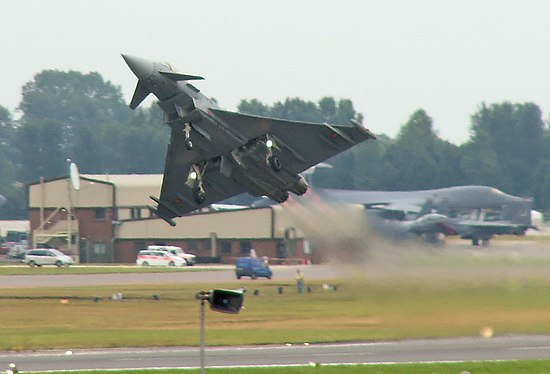
Eurofighter take-off: image india-defence.com

The word on the street is that the 4-nation European consortium’s Eurofighter Typhoon still leads after the commercial and strategic evaluation having already won the technical evaluation . But all the offset proposals put forward by the contractors may not have been fully evaluated yet. It would seem that technical considerations for one ( Lockheed Martin’s F-16IN Super Viper) and strategic considerations for the other ( Boeing’s F/A-18 Super Hornet) may disallow the choice of the US fighters. The Saab JAS 39 Gripen is probably running second.

But there may yet be a surprise.

Business Standard reports:

Electrifying aerospace vendors at Aero India 2011 in Bangalore, Indian Air Force chief, Air Chief Marshall PV Naik, announced today that New Delhi would decide within two weeks about which medium multi-role combat aircraft (MMRCA) it would buy, and actually sign the US $10 billion contract by September.
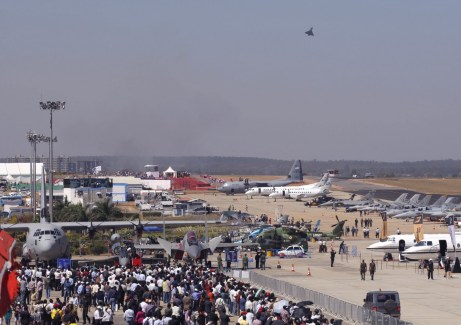
A panoramic view of Aero India 2011: image Broadsword (4.bp.blogspot.com)

“The CNC (Cost Negotiation Committee) is likely to start in a week or two. Taking that as the datum and giving [the CNC] another 6-8 months, the contract is likely to be signed in September”, declared Naik.
The CNC is a group of officials that negotiates, between the Ministry of Defence and the winning vendor, a final price for the sale.
Naik’s boss, defence minister AK Antony, had stated at Aero India 2011 yesterday that the globally-watched contract would be finalised by the end of the next financial year 2011-2012, i.e. by March 2012. By setting the deadline six months earlier, Naik appears to have put the MoD under pressure.
Asked for a clarification by Business Standard, Naik’s officiating deputy, Air Marshall RK Sharma, confirmed his chief’s announcement. Sharma clarified that the winning vendor would be issued an invitation within two weeks to appear for cost negotiations, while the CNC would actually meet within two months. An invitation to a vendor to appear in a CNC is tantamount to announcing the winner of a contract.
“The DAC (the MoD’s apex Defence Acquisition Council) will formalise the winner soon; we will then invite that company for negotiations”, said Sharma.
Six fighters are competing for the IAF contract: Boeing’s F/A-18 Super Hornet; Lockheed Martin’s F-16IN Super Viper; the MiG Corporation’s MiG-35; Saab’s Gripen NG; Dassault’s Rafale; and a four-nation European consortium’s Eurofighter. Executives from these companies say they are baffled by Naik’s announcement. Asked in late-2010 to rework their offset bids, and with no date yet given for resubmission, the MoD does not have a key element needed to decide a winner.
“Is the MoD going to decide the contract winner without examining the offset bids?” asks a bemused executive, from one of the competing aircraft manufacturers.
……….

The air chief also voiced his apprehension that the contract could be delayed by “dissatisfied vendors (who) put a spoke in the wheel”, using allegations of wrongdoing to trigger long-running probes by investigation agencies.
Yesterday, a defensive Antony had announced that political considerations would play no role in deciding the winner. That seemed to suggest that the Cabinet Committee on Security (CCS), which will be required to approval the contract after the CNC negotiates a final price, would merely rubber-stamp the IAF/MoD decision.
Other than the impending contract for 126 medium fighters to boost the IAF’s dwindling numbers, the IAF chief also announced the impending conclusion, “within this financial year”, of the contract to upgrade the air force’s 20-year-old fleet of 52 Mirage-2000 medium fighters. This upgrade, which has been the subject of bitter negotiations between the IAF and French contractor, Thales, will give the Mirage-2000 another 20 years of service life by fitting on a new radar and a modern cockpit with state-of-the-art avionics and electronic warfare equipment.
While Thales had initially demanded US $52 million per aircraft, the deal has been concluded, say IAF sources to Business Standard, at US 39 million per aircraft.
Related:
https://ktwop.wordpress.com/2010/11/07/eurofighter-typhoon-leads-after-technical-evaluation-but-still-not-the-favourite-for-indian-m-mrca-contract/
https://ktwop.wordpress.com/2011/01/04/no-surprise-secret-technical-evaluation-in-indian-mmrca-deal-found-on-the-street/

Aero India 2011 kicks off tomorrow: MMRCA and technology transfer are the issues of the day

February 8, 2011

The 5 day Aero India 2011 airshow kicks off tomorrow in Bangalore and is expected to attract over 600 equipment vendors from over 60 countries. It also brings to a head the discussions within India as to how to stimulate the indigenous aviation industry and whether offset requirements in defence procurement are effective. There is a school of thought that technology transfer should be used and that offset requirements do not contribute to developing the industry. In the background is the competition for the $10 billion, 126 MMRCA aircraft contract that must be decided in March / April.

DNA reports:

In the premier Indian defence journal, Maj Gen (Retd) Mrinal Suman — who retired from the Indian Army in 2003 and currently heads the defence technical assessment and advisory service of Confederation of Indian Industry (CII) — prescribes that India, at present, urgently needs FDI in the defence and military aviation sector which is technology-centric with inherent flexibility. He has suggested that FDI could be 26% for low-tech products, while it could be 51%-74% for matured systems, and 75%-100% for cutting edge technologies.

Maj Gen Suman has decried the drastic fall in defence exports from ordnance factories from Rs41.07 crore in 2008-09 to a mere Rs12.28 crore in 2009-10, and has called it “a reflection of the nature of quality items being produced indigenously”. He has called for significantly increasing FDI and private sector’s participation in defence production and manufacture instead of just restricting to doors and frames of aircraft bodies. Suman also blasted India’s offset policy which envisages Indian companies to manufacture components worth 30% of any deal bagged by a foreign company as a seller to India. He termed it a “flawed policy” as it was not contributing to upgrading the indigenous technological base. He instead suggested that the current offset policy be amended to make transfer of technology the preferred mode.

While this is expected to take centre-stage at Aero India 2011, the intensifying contest for winning India’s $10 billion contract to procure 126 medium-weight multi-role combat aircraft (MMRCAs) will undoubtedly be the second most important issue in focus.

Not surprisingly, this is the first time ever that all six contenders for the contract are participating at an Aero India show — Boeing’s F/A-18 Super Hornet, Lockheed Martin’s F-16 Super Viper (both from USA), MiG Corporation’s MiG-35 (Russian), Dassault’s Rafale (French), EADS’s Eurofighter Typhoon (European Union’s) and SAAB’s Grippen (Swedish).

The contest between these six, this time round, will be there for all to see with these aircraft displaying their skills and manoeuvrability to win the hearts of the Indian Air Force and ministry of defence experts who are expected to place a finger on one of them for procurement.

The IAF is procuring the 126 MMRCAs to bolster its depleting squadron strength. The IAF squadron strength is at present below the sanctioned strength — just 34 squadrons as against the sanctioned strength of thirty-nine-and-a-half.

There is a formidable Russian presence at the air show.

Russia will exhibit over 80 types of weaponry and will be represented by 35 companies at the upcoming Aero India 2011 air show, state-run arms exporter Rosoboronexport said in a statement.
Russia will be represented by 35 companies, including MiG , Sukhoi, Almaz-Antei and Engineering Design Bureau.
Russia will traditionally promote MiG-35 and Su-35 fighter jets, the Yak-130 combat trainer, two versions of Il-76MD transport plane (with different engines), the Il-78MK aerial tanker and MiG-29K and MiG-29KUB naval fighters.
The Be-200 amphibious aircraft will most likely be one of the top attractions of the Russian exhibit as its popularity with foreign customers steadily grows. The plane could be used in a wide variety of roles, from maritime reconnaissance and rescue to firefighting.
Rosoboronexport and Russian helicopters will show the Mi-28NE attack helicopter, the light multirole Ka-226T and the heavy transport Mi-26. All three helicopters are currently taking part in separate Indian helicopter tenders.
The visitors will also be able to receive information about the Mi-35M combat transport helicopter, the Kamov Ka-31 radar surveillance helicopter and the Ansat and Kamov Ka-32A11BS multi-role helicopters.
The air defence part of the Russian exhibit will be represented by the Tor-M2E, the S-300VM, the Buk-M2E and the Tunguska-M1 systems.

Relatedhttps://ktwop.wordpress.com/2010/11/07/eurofighter-typhoon-leads-after-technical-evaluation-but-still-not-the-favourite-for-indian-m-mrca-contract/

German freighter sinks Indian Navy frigate

February 4, 2011

From thelocal.de:

Cargo Ship Nordlake IMO 9057173 by MSC Michi

Cargo Ship Nordlake 22,450 tons

A German cargo ship has slammed into an Indian frigate in the port of Mumbai, causing the military vessel to catch fire and eventually sink.

The ocean liner Nordlake, based in Hamburg and managed by the Klaus E. Oldendorff shipping company, crashed into the Indian navy vessel Vindhyagiri in a narrow navigation channel at the entrance to the port of Mumbai on Sunday, Indian broadcaster NDTV reported.

The nearly 400 people on board the Vindhyagiri – including the ship’s crew and their visiting families, who were celebrating Navy Day – were successfully evacuated before a massive fire broke out on the vessel some 12 hours later.

A preliminary investigation found that the Nordlake was exiting the harbour as theVindhyagiri was navigating its way in. The Nordlake swerved to avoid another ship and subsequently struck the Vindhyagiri.

INS Vindhyagiri 2682 tons

The Indian navy called the sinking of the Vindhyagiri India’s greatest peacetime casualty, noting that a frigate has never been sunk by a civilian vessel. Built in 1981, the Vindhyagiri suffered extensive damage, but the navy said the ship could possibly be repaired and eventually brought back into service.

The nearly 180-metre-long Nordlake, which flies a Cypriot flag, did not sustain any serious damage. The freighter supports an international crew, and no Germans were on board at the time of the crash.

“We are happy that, to our current understanding, the accident has caused neither environmental harm nor any human casualties,” Peter Rybarczyk, chief executive of the Klaus E. Oldendorff shipping company, told Hamburg broadcaster NDR.

The Director General of Shipping in Mumbai has ordered an inquiry into the collision, NDTV reported, while the navy has also filed a complaint that argues the ship from Cyprus did not follow standard operating procedure.

The Nordlake has a deadweight of 22,450 tons and almost ten times greater than the standard weight of INS Vindhyachal at 2682 tons.

Photo: DPA

Mumbai harbour after collision: photo DPA


Development of stealth fighter aircraft moves East

January 10, 2011

Both China and India are developing 5th Generation stealth fighters; China on its own and India as part of a joint development programme together with Russia.

From http://china-defense.blogspot.com/2010/12/latest-batch-of-j-20-photos.html

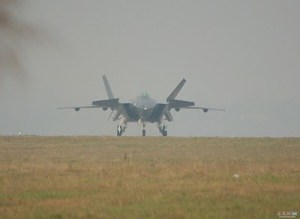
Chinese Chengdu J20 - 5th generation stealth fighter: image http://china-defense.blogspot.com

Rumours from China’s Chengdu Aerospace Corporation (CAC) and the adjoining Aircraft Plant No 132 suggest that a flight of a Chinese-developed fifth-generation fighter prototype would take place by the end of the year. Reportedly, two airframes (numbered 2001 and 2002) have been assembled at the 132 plant.

In August 2008 it was reported that 611 Institute was selected to be the main contractor for the development of the fifth-generation stealthy J-20, and that 601 Institute was the sub-contractor. It was rumored that 611 Institute has started to issue manufacturing drawings for constructing the first prototype, which is expected to fly by 2012, even though the full configuration one won’t fly until a few years later. The latest rumor suggested that a full-scale mock-up had been built at CAC.

From http://www.globalsecurity.org/military/world/china/j-xx.htm

File:Pak fa.jpg

Sukhoi PAK FA T50: image wikipedia

Russia and India are jointly developing the Sukhoi PAK FA / T-50 , which first flew in January 2010. In June 2001, India was offered ‘joint development and production’ of this new 5th generation fighter by Russia. Russia had been trying to sell this concept both to China and India for some time. It seems probable that China declined to participate in this project given a belief that Russia stood to gain more from Chinese participation than did China. That is, it would seem that China had determined that it could produce a superior product without Russian help. With the first flight of the Russian stealth fighter in 2010, an arguably superior Chinese steath fighter might be expected to take to the skies not too long thereafter.

Chinese combat aviation has made remarkable strides in recent years, moving from a collection of obsolete aircraft that would have provided a target-rich environment to potential adversaries. Today China flies hundreds of first rate aircraft, and even flies more Sukhoi Flankers [the aircraft the American F-22 was designed to counter] than does Russia. The Chinese stealth fighter has arrived right on schedule. Chinese military technology is generally rated about two decades behind that of the United States. while the advent of a Chinese counterpart to the F-22 fighter might be disconcerting, the first flight of the prototype American F-22 stealth fighter came on September 29, 1990.

From the Hindustan Times:
New Delhi, December 21, 2010: India and Russia on Tuesday finalised a contract for the biggest defence programme in the country’s history — a $30-billion (Rs 1,35,000-crore) project involving the joint production of 200-250 fifth generation fighter aircraft (FGFA). The aircraft, being called the perspective multi-role fighter (PMF), will exploit the basic design of the Russian Sukhoi T-50 PAK-FA prototype, with modifications thrown in to meet the Indian Air Force’s “more stringent specifications”. The 30-tonne aircraft will be a swing-role fighter with stealth features for increased survivability, advanced avionics, smart weapons, top-end mission computers and 360-degree situational awareness. What will put the co-produced fighter in a different league is its ability to supercruise, i.e. sustain supersonic speeds in combat configuration without kicking in fuel-guzzling afterburners. Currently, the US Air Force’s F-22 Raptor is the only fighter in the world that can supercruise.
The contract for the joint design and development of the FGFA was signed between Hindustan Aeronautics Limited and two Russian firms, Sukhoi Design Bureau and Rosoboronexport. The fighter will be jointly marketed to international air forces. The first prototype flew its maiden sortie in January 2010 and has conducted more than 40 flights. The IAF hopes to induct it by 2018.
A joint statement issued by the ministry of external affairs said Prime Minister Manmohan Singh and Russian President Dmitry Medvedev agreed that the December 2009 pact covering bilateral military cooperation during the next decade would lead to a more substantive engagement cutting across joint research and development, manufacturing and marketing activities.
In the meantime DNA reports:
 

HAL Tejas at Aero India 2009

HAL Tejas: Image via Wikipedia

India today joined a select group of nations manufacturing warplanes with the home-grown Light Combat Aircraft ‘Tejas’ moving a step closer to its induction into the Indian Air Force after getting its Initial Operational Clearance (IOC) here. 

27 years after the project was initiated, defence minister AK Antony handed over the IOC certificate to Air Chief Marshal PV Naik at the HAL airport in Bangalore.

“This is only the semi-finals”, Antony said, adding the LCA would enhance national security and build the country’s own fighter aircraft capabilities.

The aircraft, with an investment of over Rs 14,500 crore ($3.2 billion), has been developed by DRDO’s Aeronautical Development Agency after battling technology denial regimes and sanctions for nearly three decades. “After crossing a number of challenges and accomplishing a significant series of milestones including weapon delivery, in over 1500 sorties, the country is poised for a major turning point with the declaration of the IOC,” Antony said.

The IAF has plans to induct a total of around 200 planes of which orders for the initial 40 have already been placed by the IAF.

The aircraft, which costs between Rs 180 to 200  crore ($45 million)  per piece, is presently powered by American GE-F 404 engine and the advanced GE-414 engines have been chosen for powering the LCA Mk II aircraft, which are likely to be developed by 2014.


No surprise: “Secret” technical evaluation in Indian MMRCA deal found on the street

January 4, 2011

The Times of India reports on the bizarre story of a confidential file found on the street:

Even as the race for the “mother of all defence deals” enters the last lap, two IAS (Indian Administrative Service) officers of the defence ministry are now under the scanner for the mysterious way in which a “secret” file connected to the $10.4 billion project to acquire 126 new fighters went missing and was then found by a roadside.

There is an intense battle currently in progress to win the $10 billion deal for 126 combat aircraft (MMRCA – medium multi-role combat aircraft) where the final decision is expected to be taken by March. As I have posted earlier, the technical and flight evaluations on the 6 contenders were conducted by the Indian Air Force and their highly confidential and secret report was submitted to the Ministry of Defence  by early November 2010. Many rumours circulated at the time and the word on the street was that the Eurofighter Typhoon had won the technical evaluation. However this evaluation is merely one (but important) stage in the decision making process. The strategic and financial evaluations are under way and political lobbying is building up.  Some of this lobbying is at the highest levels of government and no doubt the recent visits to India by Obama and Medvedev and Sarkozy were utilised fully.

For all the contenders the technical evaluation is what determines what is left to be done to win the contract. The details in the technical evaluation report are most important for a contender to know how to compensate for any perceived failings. I am quite sure that every contender has managed by now to obtain a copy of the technical evaluation report. (To obtain copies of confidential reports from Indian bureaucrats is not in the realm of the impossible. In my experience obtaining reports and confidential documents from clerks in government service is much more effective than any Freedom of Information application and are not subject to any redactions.) I am equally sure that all the six aircraft manufacturers would have by now developed their sales strategies and lobbying plans based on the their weaknesses as recorded in the report. But what may have been missed by some is that unofficial dissemination of the “confidential” report is an expected event. It may even have been a deliberate leakage of the report as part of the Government of India’s buying strategy.

The six are:

  1. Dassault, Rafale, France
  2. Eurofighter, Typhoon, UK, Italy, Germany and Spain
  3. Lockheed Martin, F-16IN Super Viper, US
  4. Boeing, F/A-18E/F Super Hornet, US
  5. Saab, JAS 39 Gripen, Sweden
  6. Mikoyan, MiG-35, Russia

Even though there are only 6 contenders, the number of lobbyists, sub-contractors and foreign embassy officials involved would have led to at least 100 copies of the report having been “sold” by various bureaucrats with access to the file. So I do not find it very surprising that one of the many “unsold” copies was abandoned somewhere. The value of such reports goes down sharply with time. It must have been at its most expensive immediately after it was submitted to government and before the many visits by various heads of state to Delhi. Again from my past experience of such things I would expect that the report probably had an initial “price” of around Rs 10 lakhs (about $20,000) but now some 2 months later, can probably be purchased for less than 1 lakh ($2,000).

Nobody is probably very bothered by this episode since the leakage of the report to the contenders is part of the game and already taken into consideration by the Government. In fact leakage of “perceived weaknesses” to a supplier is one of the best buying strategies to extract improvements in the supplier’s offer. The most senior bureaucrats in the Ministry of Defence are probably congratulating themselves for having managed to disseminate so many copies of the report before this particular slip-up.

But for now all the right noises will be made for public consumption. As the ToI reports:

Ordering an inquiry into the episode, defence minister A K Antony on Monday said he was “very clear that every officer has to be very careful at every stage” while dealing with the huge MMRCA (medium multi-role combat aircraft) project. “We have viewed the incident seriously…the inquiry is in progress,” he said. It was last week that the “secret” file, which was earlier submitted to the MoD by IAF, went missing and was then found later in the day near Khelgaon Marg in South Delhi.

MoD was tight-lipped about the incident but sources said the file was apparently lost by the bureaucrats, one an additional secretary-rank officer and the other a director, while being taken to the Bharat Electronics Limited guest-house on Khelgaon Marg. The file was found by a security guard who then got in touch with the authorities concerned.

Obama in India: Day2: Networking aplenty but no new contracts announced today

November 7, 2010

Plenty of activity and a full schedule for President and Mrs Obama in Mumbai and Delhi today. There were no new announcements of any agreements or any business deals but no doubt these will be saved up for the final, ritual press conference.

Fielding questions from students on issues ranging from Pakistan to jehad, establishing an e-connect with farmers and breaking into an impromptu jig, US President Barack Obama got into the groove in more ways than one as he ended the first leg of his India visit here before heading for New Delhi Sunday afternoon. Obama took on a host of sharp questions from eager students at the St Xavier’s College this morning in Mumbai.

Obama met hundreds of American and Indian business leaders yesterday at the USIBC event. “India is the United States’ 12th largest trading partner. It could be number one or two if the conditions for trade between these two giant economies continue to improve,” said The McGraw-Hill Companies Chairman and CEO Harold Terry McGraw III, who is also the Chairman of the US-India Business Council (USIBC). Along with the USIBC Chairman, the meeting was attended by GE CEO Jeff Immelt, PepsiCo CEO Indra Nooyi, Honeywell Chairman David Cote, Reliance Industries Ltd Chairman Mukesh Ambani and Bharti Enterprises Vice Chairman Rajan Bharti Mittal.

Having mixed serious business with interactions with schoolchildren and a town hall-style meeting at St Xavier’s College, U.S. President Barack Obama and First Lady Michelle Obama began the second leg of their Indian trip in New Delhi.

President Obama has now arrived in Delhi where he was met at the airport by the Prime Minister.


Humayun's Tomb, Delhi: tripadvisor.com


It was as close to the slum-dog moment as the Obamas could get in their India tour. The US President Barack Obama and First Lady Michelle Obama met with 16 children of labourers at  Humayun’s tomb in New Delhi today. The children, aged between five and seven, do not go to a regular school because they are too poor. They receive informal education due to the voluntary efforts of Mr K.K. Mohammad, the Superintendent of the Archaeological Survey of India who has taken upon himself to get some basic literacy tools to these kids. At Humayun’s tomb, the children attired in uniforms of checked shirt and shorts spoke in Hindi to the U.S. President and the First Lady. They had small slate tablets in their hands and scribbled with white chalk on those tablets were the words “Welcome to India, Obamajee”. The President spoke to one eight-year-old Vishal, whose father Ram Das is a restoration worker at the Humayun’s tomb.

On the eve of their formal talks, Prime Minister Manmohan Singh and US President Barack Obama had a meeting in New Delhi on Sunday during which the two leaders are understood to have taken stock of bilateral ties and ways to push these to higher levels of strategic partnership.  Singh and Obama had a one-on-one meeting for about 25 minutes before the private dinner hosted by the Prime Minister for the visiting leader and his wife Michelle at his 7, Race Course Road residence.

Eurofighter Typhoon leads after technical evaluation but still not the favourite for Indian M-MRCA contract

November 7, 2010

The Telegraph today carries the story that the Eurofighter Typhoon came out best in the technical and flight evaluation just completed for the Indian M-MRCA contract for 126 fighters worth about 11 billion $. However the Telegraph’s conclusion that

The European-made Typhoon fighter is winning the fight for the $11.5bn (£7.1bn) contract to supply 126 fighters to the Indian Air Force in a deal worth $5 billion and 2,000 new jobs to Britain.

is a little premature.

In a recent interview Air Chief Marshal Pradeep Naik Chief of Air Staff said

The IAF has completed the Field Evaluation Trials on all six M-MRCA aircraft and has submitted its Staff  Evaluation Report to MoD for further processing.The likely time frame for completion of various activities before the contract is signed is about 6-8 months. So, we expect the contract to be signed by March 2011.

Now begin the strategic evaluations and these include a number of different levels of nested strategies. In addition to the IAF’s own views of what is required in its goals of becoming a Strategic rather than a Tactical Air Force and the mix of aircraft required for that, come the strategic requirements of the Armed Forces as a whole including the views of the Army and Navy not only for tactical support needs but also including the Navy’s carrier based fighter requirements. The Ministry of Defence and the Ministry of Finance are obviously involved together with the Prime Ministers Office (PMO) in the highest level of strategic evaluation of the National Interests. The initial costs, life-cycle costs and operating costs are all separate parameters in the final evaluation. Then the impacts of future jobs, technology transfer, development of indigenous capabilities and National political aspirations come into play here.

The reason I believe that the Telegraph story is a little too optimistic about the EurofighterTyphoon’s chances is that the “Medium” representing the first “M” of M-MRCA (Medium Multi Role Combat Aircraft) is a critical factor. In the “Heavy” class India has the Russian Su-30MKI, which is under series production at HAL in Nasik, India. The Heavy class will probably represent about 60% of India’s combat aircraft for some time to come. The need for a “Medium” fighter comes about because most of India’s MIG 21s are obsolete and “life-expired” and the IAF only has some 50 Mirage 2000s which are a decade old. The indigenous Light Combat Aircraft which was to have replaced the MIG 21s is a long way behind schedule and has not yet resolved all its technical issues. It is the need for around 15 -20% of the IAF’s combat aircraft being in the “Medium” class which generates the 126 fighters required in the current contract. The winner of this contract is likely to then sell another 80 -100 aircraft in a second phase.

The Eurofighter Typhoon and the French Rafale at around 24,000 kg maximum weight are close to the level that would be classed as “Heavy”. The aircraft coming closest to meeting the Indian definition of “Medium” are Lockheed Martin’s F-16 IN Super Viper and the Swedish Saab Gripen IN and they have both been configured specifically for the IAF.


JAS Gripen

JAS Gripen Image via Wikipedia


Political considerations cannot be ignored and this gives the F-16 an edge even though there can be a perception issue since the F-16 is the mainstay of the Pakistani Air Force and the IAF must be seen to be getting something superior to that supplied to the Pakistan Air Force. The Swedish fighter may actually be closest to Indian requirements but bears the political burden of the Bofors affaire and the perception issues in India that domestic Swedish politics may suddenly intrude into a long term supply arrangement which must last for some 30 years.

The Eurofighter cannot be dismissed but my top three at this stage would be:

  1. Lockheed Martin F-16 IN Super Viper
  2. Saab Gripen IN, and
  3. Eurofighter Typhoon.

But there are many angles to be looked at and there is a very long way to go before the contract is awarded in March 2011.

Indra Dhanush 2010 concludes but UK hopes of selling Harriers is dashed

November 3, 2010

By all accounts both the IAF and the RAF are very satisfied with the joint exercise Indra Dhanush 2010 which has just concluded. But UK hopes of selling the Harrier seem to have stalled. The Financial Times reports that

Britain has hit an early obstacle in its bid to sell its fleet of Harrier jump jets after India, the most promising potential buyer, described the aircraft as “iffy” and obsolete.

Air Chief Marshall PV Naik, the head of the Indian Air Force, said on Tuesday he would be looking to acquire modern aircraft of fourth-generation capabilities or better. “The Harrier doesn’t fit into that category,” the Air Chief Marshall said. His dismissive remarks over the “iffy” Harrier came soon after Air Chief Marshal Sir Stephen Dalton, the chief of the UK air staff, acknowledged the possibility of a sale while paying a visit to India to boost military co-operation and exports.

The distinct lack of interest shown in the Harrier, which was decommissioned in the defence review primarily on grounds of cost, will be a blow to ministers who are seeking to generate some much-needed revenue from the disposal.

Air Chief Mashall Naik’s words will particularly sting because the Ministry of Defence has spent more than £500m upgrading the Harrier avionics over the last five years and the jets could potentially remain in service until the mid 2020s.

Sify News reports the conclusion of the exercise:

The joint air force drill between India and United Kingdom (UK) held under the banner of ‘Indradhanush’-III at Air Force Station Kalaikunda in West Bengal’s West Midnapore District concluded on Tuesday. The Royal Air Force of UK participated with modern Typhoon Eurofighters, the E-3D Sentry, and VC-10 mid air re-fueller, while the Indian Air Force (IAF) fielded the SU-30 MKIs, Mirage 2000s, Mig 27s and its AWACS for the first time in a joint Air Exercise.


Eurofighter Typhoon

Eurofighter Typhoon: Image by Destinys Agent via Flickr


Pilots of the Royal Air Force said that the purpose of this exercise was to enhance understanding between the Royal Air Force and the Indian Air Force. “The whole purpose of the exercise of the ‘Indradhanush’ has been to enhance understanding between the Royal Air Force and the Indian Air Force and whosoever increase…competence as an Air Force and it’s been on air front a very, very successful exercise,” said Guy Lockwood, a pilot of the Royal Air Force of United Kingdom.

“We have learned good things from them. They follow the NATO procedures, we follow our own. When we fought together we realised they have got some good things, they realised that we have also got some good tactics, we fought together, so it was a good experience,” said Susil Kumar, a pilot of the IAF.

During the initial two-days of the exercise on October 18 and 19, elaborate briefings on standard operating procedures, rules of exercise and familiarisation of the local flying area was carried out.

The exercise ‘Indradhanush’ began on October 21 and continued for 12-days.


Day 3 at Kalaikunda: image http://chhindits.blogspot.com