Archive for the ‘Demographics’ Category

The freedom not to breed is the coming demographic challenge

December 26, 2014

Alarmism has its downsides. It is always cowardly since it requires actions (and inactions) to be subservient to fear. The actions proposed by Alarmists are very often coercive in the name of the “common good”. But the Alarmists are nearly always wrong.

For over 40 years we have been brain-washed by the Malthusian alarmism of catastrophic population growth, catastrophic resource consumption (peak oil, peak gas, peak food), catastrophic loss of biodiversity and catastrophic environmental change. The population alarmism was expounded in 1968 in Hardin’s “Tragedy of the Commons”. Garrett Hardin was one of the leading lights of the population doom-sayers. His paper became a classic but is a classic example of the arrogance of the Alarmist, overwhelmed by the fear of doom and looking down at the “Commons” from on high. It was the conclusion of the Hardins of this world that “coercion” was both necessary and acceptable to control breeding which led to the coercive sterilisation programmes and the one-child policy.

Freedom To Breed Is Intolerable. To couple the concept of freedom to breed with the belief that everyone born has an equal right to the commons is to lock the world into a tragic course of action.

Unfortunately this is just the course of action that is being pursued by the United Nations. In late 1967, some 30 nations agreed to the following :

The Universal Declaration of Human Rights describes the family as the natural and fundamental unit of society. It follows that any choice and decision with regard to the size of the family must irrevocably rest with the family itself, and cannot be made by anyone else.

It is painful to have to deny categorically the validity of this right; denying it, one feels as uncomfortable as a resident of Salem, Massachusetts, who denied the reality of witches in the 17th century. ……. If we love the truth we must openly deny the validity of the Universal Declaration of Human Rights, even though it is promoted by the United Nations. …….. 

The only way we can preserve and nurture other and more precious freedoms is by relinquishing the freedom to breed, and that very soon. “Freedom is the recognition of necessity”–and it is the role of education to reveal to all the necessity of abandoning the freedom to breed. Only so, can we put an end to this aspect of the tragedy of the commons.

As van Dalen and Henkens put it

…… the Malthusian assertion that the earth’s capacity to support mankind is outpaced by population growth. The main proponent of this view was Hardin (1968), who explained this idea more fully in his classic article,
“Tragedy of the Commons.” ……. it is the central thesis behind Al Gore’s documentary An Inconvenient Truth. Hardin related the tragedy directly to the problem of overpopulation, and his conclusion was therefore quite unequivocal: “Freedom to breed will bring ruin to us all” 

There are numerous political pressure groups in the international arena trying to establish zero or negative population growth in order to prevent a “tragedy of the commons.”

Al Gore like Hardin before him is another example of an arrogant Alarmist.

We are now less than one hundred years away from a general population decline across all countries of the world. It is already a reality in many countries. Development and economic growth and the emancipation of women has achieved far more than forced sterilisation programmes. The Chinese one-child policy has only anticipated by a few years what development would have achieved anyway.

Japan’s population will be down to less than 90 million in 2060 compared to the 128 million today. The replacement fertility rate is 2.1 births/woman in industrialised countries and about 2.3 -2.4 in countries with higher mortality rates. Already (2014) more than half the world’s population has fertility rates below the replacement level. Europe as a whole has a fertility rate of less than 1.6. So has China. Japan is at 1.4 and Singapore is down at 0.8. More than half the states of India are at below the replacement rates and half are just above but declining fast. Countries which have significant immigration from developing countries initially see a boost to their fertility rates but that tends to be short-lived as immigrants are assimilated and also exhibit the rates applying to the country’s level of development. In parts of Asia, Africa and Latin America where fertility rates are higher than the replacement rate, they are declining fast.

Hardin got it quite wrong. As with all Alarmist memes, he was more than just a little condescending of the “Commons” but his worst mistake was allowing his fear to exclude common sense. The freedom to breed is no guarantee that any breeding – let alone uncontrolled breeding – will occur. In fact, it is the freedom not to breed which could make humanity extinct.

Many countries are now seeing population declines in rural areas which are significant enough to affect local tax revenues and cause the deterioration of infrastructure and social services. All over Europe, rural areas see growing needs for health and social services for the elderly and declining demands for children’s services. Skilled craftsmen leave because the client-base is declining. The public sector in rural areas is tending towards being both underfunded due to the loss of tax revenues and over-staffed (and mis-matched) for the declining and ageing population. It is not that planners are not aware of the challenges.

The reality is that fertility is reducing (and subsequently population is peaking), not for lack of resources but because of new technologies and the shift of attitudes that they have brought about. The factors well correlated with a decline of fertility are fairly well established, even if the mechanisms by which these factors affect attitude are not certain. Some of the clearest factors – where many are interlinked – are:

  1. the availability of contraception,
  2. the emancipation of women,
  3. women being an integral part of the labour market,
  4. economic development (GDP)
  5. the decline of infant mortality,
  6. the decline of mortality rates and the increase of longevity
  7. the availability of TV
  8. the availability of safe abortion procedures

Some of the changes of attitude which can also be observed are of couples marrying later (or not marrying), of women having children later and a social acceptance of being childless. It is the spread of the ability and of the freedom not to breed which dominates fertility rate decline.

While we can observe the decline of fertility rates all across the world, we have no clear notion of how fertility rates can be increased. Many countries have tried but few – if any – have succeeded in increasing fertility rates. Russia has tried many times and failed.

In 1944, as Russians were being ground up in the war against Germany, Josef Stalin created the “Motherhood Medal” for women who bore six children. …….. In 1955, Nikita Khrushchev surveyed the nascent Western overpopulation mania and declared it a “cannibalistic theory” invented by “bourgeois ideology.” ……….

None of it worked, then or now. The Soviet Union’s fertility rate—that’s the average number of children a woman bears during her lifetime—declined throughout the ’50s, ’60s, and ’70s. The only brief period of increase came during the late 1980s. And then it resumed decline.

Putin’s initiatives haven’t fared any better. The Russian government declared demographic victory in 2012 because there was an increase in the crude number of births. “The demographic programs enacted in the past decade are, thank God, working,” Putin said. But most demographers believe this is a statistical ghost—the slight spike in fertility rates during the late ’80s created a relatively fat cohort of women now in their prime childbearing years. So while the number of births has increased thanks to the size of this cohort, Russia’s total fertility rate has remained very low. The CIA World FactBook puts it at 1.61.

Singapore, Spain, Japan and South Korea have all instituted programmes to increase fertility rates but – at best – they have had limited and only temporary success.

Where fertility is increasing, it is often a result of delayed childbearing caused by a long-term shift in childbearing patterns or by marriages delayed by an unfavorable economy. In Sweden, the peak age group of childbearing for women is now 30 to 34, up from 25 to 29 in 2001. In Russia, childbearing below age 25 dropped sharply after 1990 so that women ages 25 to 29 are just as likely to have a birth as those ages 20 to 24. A similar pattern has emerged in Ukraine. …… 

Many governments have moved to address the problem of low fertility and extreme societal aging. In Russia, couples can receive about $9,000, a huge sum, for a second or subsequent child. Child payments are lower in Ukraine, but are still significant. Singapore has introduced beneficial tax packages and lengthened government-subsidized maternity leave from 12 to 16 weeks. Spain introduced a 2,500 Euro payment for each birth. Other countries debate ways to encourage childbearing, without reaching a consensus. In Japan, there has been much discussion in government and the media on steps that might be taken but little has actually been done. The very slight rise in births from 2007 to 2008, heralded in the press, was almost entirely due to births to non-Japanese resident in the country.

Iran has shifted from promoting birth control to promoting more children. Ayatollah Khamenei has implemented a 14 point plan to avoid a population implosion but the fertility rate is still stubbornly declining.

Iran has seen its fertility rate reduce from close to 7 children per woman in 1960 to around an implosion level of 1.8 per woman  at the current time. …. Through the 1980’s Iran ran a free contraception program and the birth rate plummeted. So much so that Iran is facing a coming crisis of population implosion. The Ayatollah Khamenei has taken notice and issued a 14 point plan to increase the fertility rate.

The fertility increase programmes around the world generally offer various forms of financial incentives – by way of grants or tax breaks or subsidies – for additional children, but the declining trends have not been arrested.

By 2100 the world population will be between 10 and 11 billion and a fertility rate of -perhaps – about 1.9. To remain at such a level is unsustainable of course, but the real question is what are the behavioural forces which could increase fertility rate. Certainly financial incentives will help but their effect seems weak. An Alarmist of the 22nd century would no doubt suggest coercive and compulsory artificial insemination and ban abortions for convenience. But parents resentful of children they are forced to have seems counter-productive. Better no child than an unwanted child. The social engineering needed to ensure that sufficient breeding takes place – but not too much – will be the challenge of the 21st century.

Maybe it will happen naturally. No doubt children will be given higher value when they are in short supply. But I suspect that behavioural change, leading to the desire to have more children, will only come when there is both an elevation of status and of the financial condition of the mother. I can imagine a time where the social accolades and real benefits for having children are more than sufficient to outweigh the perceived disadvantages. But a woman’s career is also linked to fertility rate and there is an obvious trade-off between caring for a number of children and a woman’s working career. An increase of fertility may be necessarily connected to a reduction of time spent on the labour market. Abortions for convenience may come to be impacted more by social acceptance and social pressures than by any religious or moral considerations. Having children may afford social prestige.

The countries of the former Soviet Union maintain the highest rate of abortions in the world. In 2001, 1.31 million children were born in Russia, while 2.11 million abortions were performed – 62% of all conceptions. Currently about 25% of all conceptions worldwide are aborted. In Japan, the overall abortion rate dropped from 26% to 22% of all conceptions between 1975 and 1995 but these rates are thought to be under-reported. These numbers are not insignificant since a  dangerously low fertility rate of 1.6 – for example – would increase to 2.1 without the 25% abortion of all conceptions. It is conceivable that abortions will come to be permitted only for serious health issues for the mother or for the foetus.

But the bottom line is that every freedom has a corresponding duty. And so does the freedom to breed. There has to be a perceived duty to breed but not to breed indiscriminately.
Decline of Indian fertility rates is accelerating but some worrying demographics

December 23, 2014

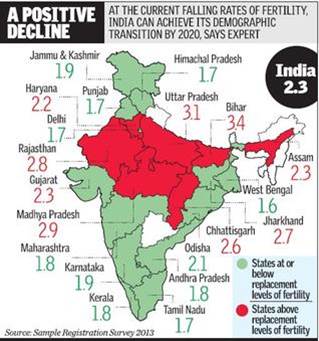
Just over a year ago the average fertility rate in India was 2.5 (where the replenishment level is 2.1) and over half the country was at levels below 2.1. With corresponding declines in infant mortality the projections were for population to reach a peak between 2040 and 2050 and to decline slowly thereafter. But new data for 2013 from the Registrar General shows that fertility is declining faster than expected. The average is already down to 2.3. By 2020 the country as a whole will have an average fertility rate below the 2.1 needed for maintaining a constant population (the replenishment rate). However, infant mortality rate has declined slower than expected. India’s population will therefore likely peak closer to 2040 than 2050.

The HinduThe 2013 data for the Sample Registration Survey (SRS), conducted by the Registrar General of India, the country’s official source of birth and death data, was released on Monday.

India Fertility 2013 - graphic The Hindu

India Fertility 2013 – graphic The Hindu

The SRS shows that the Total Fertility Rate – the average number of children that will be born to a woman during her lifetime – in eight States has fallen below two children per woman, new official data shows.

Just nine States – all of them in the north and east, except for Gujarat – haven’t yet reached replacements levels of 2.1, below which populations begin to decline. West Bengal now has India’s lowest fertility, with the southern States, Jammu & Kashmir, Punjab and Himachal Pradesh. Among backward States, Odisha too has reduced its fertility to 2.1.

“At 2.3, India is now just 0.2 points away from reaching replacement levels. Fertility is declining rapidly, including among the poor and illiterate. At these rates, India will achieve its demographic transition and reach replacement levels as early as 2020 or 2022,” Dr. P. Arokiasamy, a demographer and Professor at the International Institute for Population Sciences (IIPS), Mumbai, explained to The Hindu.

Some of the demographics are worrying.

  1. The ratio of women to men is low (average 909 women per 1000 men). Haryana, Rajasthan, Punjab and Uttar Pradesh have women /men ratios of less than 900 per 1000. I suspect that it is these states which have the lowest levels of emancipation of women and tend to have the highest fertility rates as well. It is clearly the level of development in the state – and not least the emancipation of women – which impacts the fertility rate.
  2. The shortage of women in urban areas (Delhi – 887/ 1000), is probably also due to the general shift of young males seeking employment from rural to urban areas. I wonder if this is also one of the contributing causes for the higher incidence of rape and sexual harassment in places like Delhi.
  3. Countrywide, the mortality rates for infants and children upto 5 years old is higher for girls than for boys.
  4. Abortion rates for female foetuses are also higher than for male foetuses.

An unrepresentative Swedish parliament

October 3, 2014

There is a 90% under-representation of the over-65s in the Swedish parliament.

The older I get the more I seem to encounter “age discrimination”. I have the perception that wisdom, knowledge and experience – but not wealth – are given a diminishing value by society. But it is not just perception. The numbers don’t lie. But the numbers also suggest that the elderly themselves contribute to this perception by giving less value to their own hard-earned qualities.

The new Swedish Parliament has just convened and a new socialist/green government (a minority government) is being formed. The media touted that this was the youngest ever Swedish Parliament and possibly one of the youngest in the world – as if it was a good thing. Perhaps it is – though I doubt it. I found the election debates degenerated often into childish squabbles. Wisdom, knowledge and experience were conspicuous by their absence from many of the candidates.

Riksdag 2014

Riksdag 2014

The Numbers (from SCB and the Election Commission):

  1. The total population of Sweden is currently (31st July 2014) 9.7 million and 19.2% (1.9 million) are over 65 years old. By 2060 the population is expected to be 11.6 million with 25.3% (2.9 million) over 65 years old.
  2. Of the 7.33 million eligible to vote, 25.6% (1.87 million) were over 65.
  3. Of the 5,901 candidates, only 13.5% were over 65 (a 53% representation).
  4. Of the major parties only the Folk Party and the Centre Party had a representation of the over-65’s among their candidates which was higher than 75%.
  5. Of the 349 elected to parliament only 2.6% were over 65 (a 10% representation)
  6. Women (86% representation) are slightly underrepresented.
  7. Under 30’s ( 56% representation) are underrepresented.
  8. Over 65s are grossly underrepresented (10% representation)

“Age discrimination” is endemic in Sweden. To be labelled a “pensioner” in Sweden has the “kiss of death” about it. This is no doubt partly due to the elderly’s perception of themselves and their disinclination to be strident. Under-representation cannot be solved by quotas since quotas are fundamentally unjust and discriminatory in nature.. The skewed representation can only be addressed by greater participation of the over-65s through the entire chain.

But a 10% representation in Parliament is untenable. Perhaps the over-65s need to take to the streets.

NO TAXATION WITHOUT REPRESENTATION!!


In one generation, the minorities of the US will be the majority of the country

October 1, 2014

The quotation is from Colin Powell on Meet the Press last year making the point that the Republican Party is running the risk of alienating the “new majority” while trying to ensure the support of the fringes of the “new minority”. Of course this new found majority (African Americans, Hispanic Americans, and Asian Americans ) is a conglomeration of different ethnic groups and the “new minority” is still – by far – the largest distinct ethnic group.

ChangeLabInfo.com

01/13/2013
Colin Powell (former Secretary of State, G.W. Bush Administration): The country is changing demographically.
And if the Republican Party doesn’t change along with that demographic, we’re going to be in trouble. And so, when we see that in one more generation, the minorities of America; African Americans, Hispanic Americans, and Asian Americans will be the majority of the country, you can’t go around saying that we don’t want to have a solid immigration policy.

The Asian Americans are the fastest growing group though it does seem a little odd to lump Chinese, Filipinos, Indians, Vietnamese, Korean and other Asians as being a single “ethnic group”.

  • Asians comprised just over 6 percent of the total U.S. population in 2011, having grown by 46 percent between 2000 and 2010. This rate of growth makes Asian Americans the fastest growing group by race in the United States. 
  • Since 2011, the United States Census Bureau reports that the Asian American population grew by approximately 2.9 percent (530,000) exceeding 18.9 million in 2012.
  • Approximately 68% of Asian Americans old enough to vote are U.S. citizens. 
  • More than 60 percent of this growth in the Asian American population was due to immigration.
  • Approximately 10 percent of undocumented immigrants (almost 1.2 million people) in the United States were born in five Asian countries: China, the Philippines, India, Korea, and Vietnam.

There is a great deal of diversity among Asian Americans:

(While) Asian Americans as an aggregate have relatively high median family incomes, it is important to note that Asian American per capita income is actually lower than that of whites. Asian America also includes 43 diverse ethnic groups speaking over 100 distinct language dialects. Among these groups, the Hmong, Vietnamese, Cambodian, and Chinese exceed the national average of adults without high school diplomas, and are not among the Asian American ethnic groups whose representation among those enrolled in American colleges and universities exceeds their share of the population

Pew has analysed the 2010 census data.

Population

HiB visas

Identity


Education

Income

As Jeb Bush observed

…I mean, if you look at Asian Americans, for example, in general, they have higher income than the median of our country, more intact families, more entrepreneurship, higher levels of education. And they supported President Obama 75-24; higher margins than with Hispanics…

Though a large section of Asian Americans based on their family values and entrepreneurship would be expected to be Republicans, they are overwhelmingly Democratic supporters (75%). It seems that this is primarily based on a single issue – immigration. There is a real sense of insecurity engendered by the rhetoric of prominent Republicans on immigration. Interestingly they are also the group where individuals are least likely to describe themselves as religious and where marriage outside the ethnic group is most acceptable (50% would have no objection to marrying outside the community). Of current Asian American marriages (2008 – 2010), 29% were to non-Asians and 6% to other Asian ethnic groups. But 40% say that all or most of their friends are from their own country of origin. Among some ethnic groups (Vietnamese, Chinese, Hmong, Korean, Bangladeshi) 50- 60% don’t speak English very well whereas in other (presumably more integrated) groups (Japanese, Indian, Malaysian) this number is around 20 – 25%.

The US is, by a long way, the most multi-ethnic country in the world. But what is also apparent is that integration with the accompanying development of a new inclusive culture is the key rather than the preserving of multiple cultures of origin. This is the problem, I think, in much of Europe. Multi-culturism has been made a God, but multi-culturism is inherently a preserving of the past. Integration with the development of a new, over-riding, multi-ethnic culture is the only way forward. And integration requires language. The one single step that could contribute most to the integration of different ethnic groups in Europe, I think, would be to ensure that all immigrants (regardless of age) become proficient in the local language (and to allow the language of the country of origin to find its own level).

The changing colours of the world’s population

July 26, 2014

I like playing with numbers and – more often than not – the numbers do tell the tale.

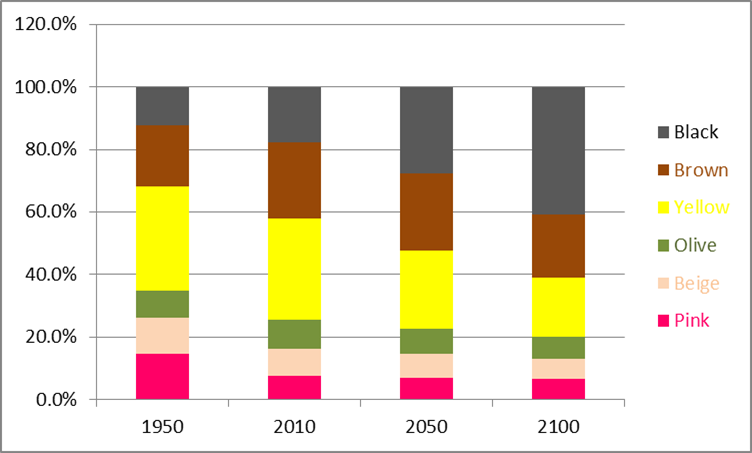
The human species comes in a variety of colours and this skin colour is a genetic trait. (They are different races whether we wish to admit to it or not but they are all part of the same species). I choose to classify the world’s population as six colours.

  • Pink (euphemistically called white – but I note that “pink supremacy” does not have quite the ring of “white supremacy”)
  • Beige
  • Olive
  • Yellow
  • Brown, and
  • Black

I use the data from the medium scenario of the  UN’s 2012 World Population Prospects and assign all countries a colour in 1950. In reality of course there is a mix of colours in most countries with the US possibly presenting the most significant “melting pot”. In any country, the changes to the colour mix comes primarily from immigration and only to a very minor extent from the genetic mixing of the colours. I arbitrarily assign colours and percentages to countries and regions as follows (1950 as the reference point):

  1. Pink – Northern Europe, Western Europe, Australia/New Zealand, N America 80%
  2. Beige – Central and Western Asia and Eastern Europe
  3. Olive – Southern Europe, Central America 80%, South America 70%
  4. Yellow – East Asia, SE Asia and Polynesia (excluding Australia/New Zealand), South America 10%
  5. Brown – Southern Asia
  6. Black – Africa, N America 20%, Caribbean, Central America 20%, South America 20%

Of course this is just playing with the numbers. Of course there are mixtures of races in all countries. I could as well have included SE Asia in the brown as the yellow. My purpose is to picture the primary colours of the world population as they change and not to distinguish every hue.

But demographic numbers are cold and inexorable and inevitable.

Fertility rates do not change that quickly and intentional changes are not that easy to achieve. The effects of the Chinese one-child policy will really kick-in only in the next 50 years as Chinese population declines. Between 2050 and 2100, China will face the aging challenge faced by Japan already today and which will be increasingly faced by Europe  in the next 30-50 years. Indian population will peak around 2050 and will then decline as the reductions of fertility now taking place work their way through. Africa will only just be reaching peak population by 2100.

By 2100 world population will have stabilised at around 10.5 billion and may be slightly on the decline.

The changes to the colours of the world’s population are already fixed for the next 100 years.

Changing colours of the world population table

Changing colours of the world population table

Changing colours of the world population

Changing colours of the world population

This is just a picture of what humanity will look like in 2100.

The last 50 years has seen a sharp decline in the pink races and an increase in the brown and yellow races. The next 50 years will see the yellow races beginning to decline and the brown and  black races increasing sharply. For the 50 years to 2100, the browns will stabilise and only the black races will still be increasing. By 2100 a relatively stable mix of races may be in place.

If fertility rates develop as expected then the mix of races in 2100 is likely to persist for some considerable time thereafter. This picture is silent as far as immigration is concerned and is also silent as to the extent to which races are mixing. It is my perception that the US and Australia are much more open to the mixing of races whereas Western Europe, Japan and China are not. Eastern Europe is still stuck in a 1950’s world-view of humanity and its races. The challenges of aging faced by Japan now and later to be met by Europe and China will likely use immigration as one of the main solutions. But it will probably take at least 3 or 4 generations before the genetic mixing of races is accepted in these countries.

Paradoxically it is the “politically correct” version of multiculturalism prevalent in much of Western Europe which actually preserves races in their silos and prevents mixing. They have missed the fact that just trying to preserve cultures of the past does not help in creating the culture of the future. But they cannot live in the past forever.

There will be greater movement of peoples around the world. People will move from countries with low GDP. They will move to countries with high GDP’s but where the aging problem is acute and where the proportion of productive population must be increased to cope. Movement of people in large numbers will cause many problems for the immigrants themselves and for the areas of aging population they move to. But for the next 100 years this shift of peoples northwards will – and has to – increase.

John Derbyshire: Consider the numbers. The three countries contributing the most to the Children’s Crusade coming in across our southern border—Guatemala, El Salvador, and Honduras—are home to 29 million people. If the entire populations of those three countries decamped to the USA our population would increase only nine percent.

Many more than three countries are contributing to the human flood into Europe across the Mediterranean and through Turkey. The five most commonly mentioned in news reports and the Eurostat databases are Syria, Eritrea, Somalia, Afghanistan, and Sudan–homelands for a total of 106 million people. If they all moved into the 28-nation European Union, the EU population, currently 506 million, would increase by 21 percent. …..

…… Thus, while both the USA and the EU live figuratively in the shadow of dams with vast numbers of wretched people in dysfunctional nations backed up behind them, the EU’s dam is far wider and higher than ours, the shadow correspondingly deeper.

The wealth gap is greater over there, too. GDPs per capita for Guatemala, El Salvador, and Honduras are 10, 14, and 9 percent of the US figure. Compare Syria, Eritrea, Somalia, Afghanistan, and Sudan at 15, 3, 2, 3, and 8 percent of the EU average—and that Syria figure is from 2011, before the civil war.

Africa as a whole, even with oil-rich Nigeria and Angola and still-functioning South Africa, is far poorer than Latin America.


Related: Will Americans and Europeans ever become identifiable races.


Population Implosion? Even US fertility rates are at lower than replacement level

June 8, 2014

In Iran the Ayatollah Khamenei has announced his 14 point plan (or directive) to try and revive the fertlity rate which is at a potentially catastrophic low. In the US, Hispanic fertility rates have – in recent times – held the fertility rate up just above the replacement level of 2.1. In China the one-child policy has been withdrawn as population has reached its peak and will now decline significantly. In country after country, fertility rates are lower than the replenishment rate. In half the states in India the rate is already below 2.1. By 2050 the total Indian population will start to decline. Generally improvement in living standards with more attention to women’s rights are accompanied by a sharp decline in fertility rates. Now however, the recession is being blamed for the decline in the US.

Till 2100 the main demographic challenge is increasingly going to be the long term decline in fertility and the increasing proportion of the “aged” relative to the working population.

US TFR - Washington Examiner

US TFR – Washington Examiner

Washington Examiner:

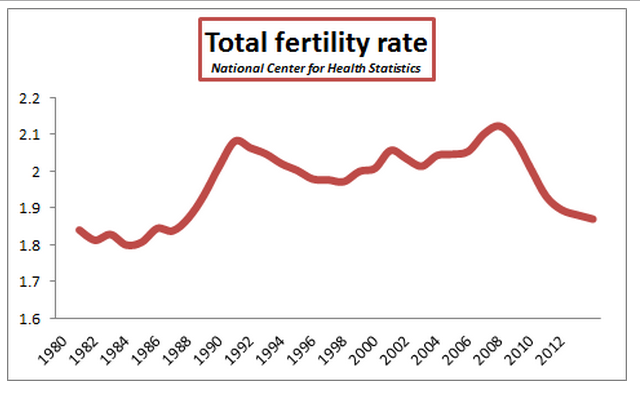
U.S. fertility is not recovering from the financial crisis — and demographers aren’t sure why. The fertility rate fell to a record low 62.9 births per 1,000 women aged 15-44 in 2013, according to the National Center for Health Statistics.

The total number of births, at 3.96 million, inched up by a mere 4,000 from 2012, the first increase since the financial crisis. But the total fertility rate, or TFR, the average number of children a woman would have during her child-bearing years, fell to just 1.86, the lowest rate in 27 years. TFR is considered the best metric of fertility. A TFR of 2.1 represents a stable population, with children replacing parents as they die off.

Demographers expected the fertility rate to fall during recession, as financially strapped families put off childbearing. But what has surprised some demographers is both the depth of the decline and the fact that fertility has continued to drop even over the course of the country’s five years of slow but steady recovery. The rate has fallen steadily each year since 2007, when it stood at 2.1 …….. 

One foreseen factor behind the dropoff in childbearing is the rapid decline in Hispanic-American fertility.

 For several decades, high Hispanic childbearing has been driving U.S. population growth. White fertility has been under the 2.1 replacement rate for decades, and ranged from 1.7 to 1.9 in the 2000s. The TFR for black Americans first fell below 2.1 in the early 2000s. 

But the number of children per Hispanic-American woman has plummeted from just under three in 1990 and 2.7 as recently as 2008 to 2.19 in 2012, just above the replacement rate.

That decline has been mirrored in other Hispanic countries. Mexico’s TFR has fallen precipitously, from 6.7 in 1970 to 2.2 in 2012, according to the World Bank. A similar decline has taken place in El Salvador, and to a lesser extent Honduras and Guatemala, all three prominent countries of origin for American Hispanics. ….


Ayatollah Khamenei’s 14 point plan to avoid a population implosion

May 31, 2014

It is becoming increasingly obvious that population implosions in many countries  – not population explosion – is what faces humans by 2100.

Iran has seen its fertility rate reduce from close to 7 children per woman in 1960 to around an implosion level of 1.8 per woman  at the current time. For a stable population the replenishment rate required is 2.1 children per woman. Through the 1980’s Iran ran a free contraception program and the birth rate plummeted. So much so that Iran is facing a coming crisis of population implosion.

The Ayatollah Khamenei has taken notice and issued a 14 point plan to increase the fertility rate.

Reuters: In his 14-point decree, Ayatollah Ali Khamenei said increasing Iran’s 76 million-strong population would “strengthen national identity” and counter “undesirable aspects of Western lifestyles”.

“Given the importance of population size in sovereign might and economic progress … firm, quick and efficient steps must be taken to offset the steep fall in birth rate of recent years,” he wrote in the edict published on his website.

Khamenei’s order – which must be applied by all three branches of government – in effect replaces the “Fewer Kids, Better Life” motto adopted in the late 1980s when contraception was made widely available.

The 14 points are (AlMonitor):

  1.  Fertlity rate to be increased above replacement level
  2. Barriers to marriage are to be eliminated, the allowable age for girls to marry will be lowered and young couples will get state support for housing
  3. Improved medical facilities during pregnancy and medical treatment for male and female infertility will be made available and health insurance will cover childbirth.
  4. Public education will emphasise the importance of the family
  5. Islamic-Iranian values and lifestyle will be promoted and undesirable influences from abroad will be discouraged
  6. A healthy lifestyle is to be encouraged and addiction to drugs and pollution will be attacked
  7. Care for the elderly shall be improved
  8. Public education shall equip students with relevant and marketable skills
  9. An equitable distribution of dwelling space must be achieved across the population
  10. Actions shall be taken to retain the rural poulation in their villages and near the borders
  11. Immigration into and out from Iran shall be actively managed
  12. The Iranian diaspora outside of Iran must be encouraged to invest in Iran and for the country to make use of their skills and abilities
  13. A national identity must be strengthened and propagated to encompass especially those living in the border regions and even those outside the country
  14. The population policy is to be closely monitored

The slogan of “Fewer Kids, Better Life” has now changed to “More children, a Happier Life”

Iran - Israel total fertility rate Google public data

Iran – Israel total fertility rate Google public data

It certainly has not escaped notice in Iran that Israel has a steady fertility rate of about 3 children per woman.

Whether this will halt the trend is not certain.

Iran will not be alone in encouraging higher fertility rates. For some countries the population implosion is already approaching and a matter of great concern.

BusinessWeekJapan is expected to see its population contract by one-fourth to 95.2 million by 2050 … making it the fastest-shrinking country in the world. Former Eastern Bloc nations Ukraine and Georgia came in second and third …. 

……. “Europe, Korea, and Japan have gone into panic mode,” says Carl Haub, a senior demographer at the Population Reference Bureau. A declining population impacts a country’s economic growth, labor market, pensions, taxation, health care, and housing, according to the U.N. Globally by 2050, the number of older persons in the world will exceed the number of young for the first time in history, according to the U.N. The imbalance will create havoc in the pension systems and make it difficult to support retired and elderly persons, Haub says.

Related:

Without immigration OECD populations will be in decline and in crisis

The inexorable numbers – 10:10:10:100 is inevitable around 2100

China relaxes highly successful one-child policy

ktwop posts on demographics

Another meaningless Earth hour to ignore today

March 29, 2014

For the same reasons as last year, and all previous years, I shall not be turning down the heat or switching off any lights today.

Earth hour is a morally bankrupt, self-indulgent, “feel-good” gesture. It is a “cheap” and mean action. It does a disservice to humanity. It diverts attention from the real issues of development that face the world’s poor. And the availability of electric power is fundamentally necessary to this development.

Switching off power during Earth hour manifests a self-righteous and a morally bankrupt arrogance. I shall not though respond in kind by the equally arrogant gesture of  turning on all the lights in my house.

The numbers tell the tale:

The world per capita consumption of energy(in tons of oil equivalent – toe)  is about 1.85 toe in 2013 and varying from about 7 toe in the US to 0.2 in the least developed parts of the world. In Europe it is about 3.5 toe with India at about 0.5 toe and China at 0.6 toe.

World population will increase from 7 billion now and stabilise at about 10 billion by 2100. Assuming that most of the world can reach an average level of development commensurate with a total per capita energy consumption of around 3 toe, then total energy production (all sources) has to increase by a factor of 2.3 between now and 2100. There is no shortage of energy availability. Shale gas has removed even the perceived – but false – threat of that. Peak oil and peak gas have disappeared over the horizon. If the developing world is to develop, then this energy has to be consumed and will be produced.

Global warming is a mirage and Earth hour is meaningless.

Eugenics by default: Abortion is of greater significance now than infant mortality ever was

March 6, 2014

We determine the demographic future – almost unthinkingly – by the patterns of child-bearing and child-rearing that we practise today. Population and its composition for the next 100 years or so has already been determined. The Chinese population has started declining and will continue to do so till at least 2100. The Indian population will reach its peak around 2050 and will then decline. The “aging” of populations and the increase of longevity has also been fixed. Demographic “robustness” is critically dependent on maintaining the ratio of the “working” population to the “supported” population (the young and the old). The US is maintaining its demographic sustainability by means of immigration in the face of declining fertility rates. Some countries in Europe are doing the same. Many do not since maintaining  some form of “racial purity” is an undercurrent in many societies and fuels the resistance to immigration – even with dangerous declines in fertility rates. Japan is facing an aging crisis as immigration is resisted. The numbers are inexorable.

Fitness to survive after birth is no longer of significance in the survival stakes. All around the world societies see to it that those with disabilities – once born – are protected. The further evolution of humans will now increasingly be the result of

  1. artificial selection for particular genetic traits, and
  2. the deselection of individuals who have been conceived but are not allowed to be born or to survive and reproduce.

It is my contention that we are in fact – directly and indirectly –  exercising an increasing amount of genetic control in the selection and deselection of our offspring. So much so that we already have “eugenics by default” being applied to a significant degree in the children being born today.

The numbers tell the tale.

One of the key measures of the advances of medical science has been the drastic reduction of infant mortality rates (defined here as deaths after birth but before the age of one year). In the 16th and 17th century this was about 30% of all births (an estimate based on a dearth of data). Since 1950 this rate has dropped from about 15% of all births to around 4% today. The variation is still very high with the current rate being as high as 12% in Afghanistan and 11% in Niger but less than 0.2% in Monaco. By 2050, as development in Africa proceeds, this global rate is expected to have dropped to about 2% (20 per 1000 live births).

It is more difficult to define miscarriages. After fertilisation of an egg it seems that perhaps 50 – 70% fail to attach themselves to the uterus wall and these would not even be considered – or even show up – as a pregnancy. I take such “miscarriages” to be failures of conception. Taking attachment to the uterine wall and the establishment of a fetal heartbeat as being a successful conception, around 10% still result in a miscarriage today.

In 2012 about 135 million babies were born (7 billion population and crude birth rate of 19.15 per 1000 of total population). Worldwide induced abortions numbered about 45 million (estimate). One third of all successful conceptions were not allowed to reach birth.

Economist:  It fell precipitously in the 1990s, but recently the rate has not budged, barely dipping from 29 abortions per 1,000 women (aged 15 to 44) in 2003 to 28 abortions per 1,000 women in 2008. Eastern Europe has the highest abortion rate in the world, at 43 per 1,000. The geography of abortions has also shifted. In 2008, 86% of abortions were in the developing world, up from 78% in 1995.

(Note! the number per 1000 women of child bearing age is different to the number per 1000 live births).

The current status then is:

  • Of 1000 successful conceptions (fetal heartbeat established)
  • less than 20 are by IVF
  • 100 are miscarried before birth
  • 330 are aborted before birth
  • 570 live births result
  • 22 do not survive beyond one year
  • 548 survive beyond 12 months
  • 3 do not survive beyond 5 years
  • About 540 – 545 live to child bearing age

Four hundred years ago miscarriage rates (after successful conception) were probably around 20% of live births and infant mortality rates were about 30%, such that only 50% of all successful conceptions led to children surviving up to their first birthdays.

The picture today is not so different. About 55% of all successful conceptions lead to children surviving beyond one year.

Without moralising about abortion – which I am not qualified to do – as far as the numbers are concerned, infant mortality of 400 years ago has effectively been replaced by abortion today. Deselection which took place in the first year after birth has been shifted to the period after conception but before birth. From a genetic perspective and since there is an element of “selection” in every abortion, abortions today are of greater evolutionary and demographic significance than infant mortality ever was.

Older Dads have sicker children

February 27, 2014

There is – it seems – an optimal child bearing age for fathers as well as mothers. Older fathers may be richer and more able to support a child but there is an increased risk to the health of their children.

A study by Indiana University, in the US, and Sweden’s Karolinska Institute is the largest and one of the best designed studies on the issue and suggests that mutated sperm with older fathers are the cause.

Seems very plausible.

Brian M. D’Onofrio, Martin E. Rickert, Emma Frans, Ralf Kuja-Halkola, Catarina Almqvist, Arvid Sjölander, Henrik Larsson and Paul Lichtenstein Paternal Age at Childbearing and Offspring Psychiatric and Academic Morbidity, JAMA Psychiatry, doi:10.1001/jamapsychiatry.2013.4525

BBC reports: 

A wide range of disorders and problems in school-age children have been linked to delayed fatherhood in a major study involving millions of people.

Increased rates of autism, attention deficit hyperactivity disorder (ADHD), bipolar disorder, schizophrenia, suicide attempts and substance abuse problems were all reported. …….

…. The researchers looked at 2.6 million people and at the difference between siblings born to the same father as it accounts for differences in upbringing between families.

Comparing children of a 45-year-old dad to those of a 24-year-old father it indicated:

  • autism was more than three times as likely
  • a 13-fold increased risk of ADHD
  • double the risk of a psychotic disorder
  • 25 times more likely to have bipolar disorder
  • 2.5 times more likely to have suicidal behaviour or problems with drugs
  • lower scores at school

There was no starting point after which the risk started to increase, rather any increase in age had an associated increase in risk.

….. One of the researchers, Dr Brian D’Onofrio, said he was shocked by the findings, which suggested a higher risk than previously estimated. He told the BBC: “The implications of the study is that delaying childbearing is also associated with increased risk for psychiatric and academic problems in the offspring. The study adds to a growing body of research, that suggests families, doctors, and society as a whole must consider both the pros and cons of delaying childbearing.”

The social trend for both parents to have children later in life thus seems to have repercussions for the children. Though the risk may be small it could be said that this a social trend which weakens the health and reduces the well-being of succeeding generations. The demographic effect is that the incidence of psychoses will increase. While having children later may allow a maximisation of the economic contributions of the parents to society, it could also lead to increased medical costs for the affected children in the following generations. Genetic screening and abortion could of course mitigate some of the long term consequences for the evolution of humans.

It could be that we are moving towards greater promiscuity during the “best” child-bearing years but without the production of children due to the availability of contraception. Child bearing itself is then postponed to a more economically suitable time of life for the parents, but a less than optimal time for the health of the children so conceived. Apart from genetic screening of foetuses and abortion of some there does not seem to be a “natural” self-correcting mechanism for this social trend.