Archive for the ‘Economy’ Category

Trade war! Cerium oxide price has risen 665% since April

October 22, 2010
Phase diagram of cerium in english

Phase diagram cerium: Image via Wikipedia

Freely translated from Dagens Industri

Cerium oxide, which is used to finish semiconductors and obtained from the rare earth element cerium, has risen in price from $ 4.70 per kg on April 20 to 36 U.S. dollars a kilo on Tuesday, October 19. An increase of 665 percent.

The price rise is primarily due to China scaling down its export quotas. In recent years there has been a gradual reduction of 5-10 percent per year, but in July alone it was reduced by 40 percent.  The country accounts for almost 95 percent of world supply of rare earths and in some cases almost 100 percent.

The official explanation from China is that the  country’s own industrial needs must be met first. These account  for 60 percent of global demand. Producing earth metals is a dirty business and China also gives environmental reasons as an explanation for the lower export quotas.

But many, especially in the U.S., suspect that it is a low-key trade war.

German economic motor is still running strong

October 15, 2010

The weaknesses in various Eurozone countries are depressing the value of the Euro but this is contributing to the continued strong exports from Germany. The GDP growth forecast for 2010 has been revised upwards to 3.5%. A second recession in the US and global reduction of stimulus programmes through 2011 could depress exports but the hope is that lower unemployment and wage increases would favour the strengthening domestic consumption to be able to compensate.


Exports helped  the German economy rebound quickly

Exports helped the German economy rebound quickly


Deutsche Welle: German economy on course for strongest growth in decades

Five leading think tanks have predicted that the German economy will grow by 3.5 percent in 2010, up from a more modest prediction of 1.5 percent earlier this year. Unemployment is expected to drop below three million. In their twice-yearly report, Germany’s five leading economic think tanks also included ….. a sharp increase in exports in the first half of the year (which has) fuelled the rebound from the deepest recession since World War II.

“The upturn is stable,” said Kai Carstensen from the Munich-based Ifo institute, one of the think tanks involved in the report. “In Germany, it looks good. The risks are above all overseas.” In Germany, Berlin plans to bring the country’s finances back into shape by cutting back on government spending. The move could lead to the deficit falling below three percent of gross domestic product, the ceiling set out for Euopean Union countries that use the euro currency.

And Der Spiegel points out that

the DAX, Germany’s stock exchange index, topped 6,400 on Wednesday, reaching a level not seen since just days before the collapse of the US investment bank Lehman Brothers.

The report also indicated that climbing tax revenues will result in a 2011 budget deficit of just 2.7 percent, below the 3.0 percent maximum allowed by European Union rules. German wages are forecast to rise by up to 2.8 percent in 2011. The economic experts who authored the report anticipate that domestic consumption will continue to be strong next year as a result.

The report, which is used by the German government to develop its own economic forecasts, was not without warnings. A renewed recession in the US remains possible, the report warns, as does a massive correction in the overheated Chinese real estate market.

Currency war of words continues – time to be in Yuan?

October 13, 2010

For the layman currency investor these are dangerous times. Countries are intervening in currency markets to hold the value of their currencies down as a way of helping their own exports. The currency market is not that “free”. The only certainty for the long term is that the Chinese Yuan is undervalued. Even Gold where the price may keep rising in Dollars may not keep pace – in the long term – with the Yuan. The Korean Won is also undervalued  but whether this will hold in the long term is uncertain. In the Eurozone the Euro will not rise till the lowish values now can get the economies of Spain and Ireland and Greece and Portugal moving again. But the current values can help the export engines in Germany and the UK  to keep going.

The G20 finance ministers will meet in South Korea from October 22 and its leaders are to gather in Seoul next month to try to reach a consensus on the global currency system to prevent competitive devaluation from damaging growth. A weekend International Monetary Fund meeting failed to defuse tensions reports Reuters.

“As chair of the G20, South Korea’s role will be seriously questioned,” Japanese Finance Minister Yoshihiko Noda told a parliamentary panel when asked about South Korea’s currency intervention and its place in G20. Japan intervened in the currency market last month for the first time in more than six years to try to stem a rise in the yen that is putting a fragile economic recovery at risk. Noda declined to say whether Japan would step in again as the Japanese currency hovers near a 15-year high against the dollar. He drew a distinction, however, between Japan’s intervention, which appears so far to have been a one-off move, and more frequent intervention by South Korea and China. “In South Korea, intervention happens regularly, and in China, the pace of yuan reform has been slow.

“Our message is that we have confirmed at the Group of Seven that emerging market countries with current account surpluses should allow their currencies to be more flexible.”

Analysts say Tokyo is worried about Japanese exporters’ waning competitiveness against South Korean rivals, given that the yen has risen about 13 percent against the dollar so far this year, while the won has gained only about 4 percent.

Hopes for a G20 currency consensus look slim. “It’ll be impossible for the G20 to reach a consensus on currencies. Many emerging economies feel that they are being forced to intervene because of a weak dollar,” said Etsuko Yamashita, chief economist at Sumitomo Mitsui Banking Corp.

Japanese Prime Minister Naoto Kan urged Seoul and Beijing to act responsibly but acknowledged Tokyo’s delicate position. “I want South Korea and China to take responsible actions within common rules, though how to say this is difficult because Japan has also intervened,” he told the same parliamentary panel.

Japan sold 2.1 trillion yen ($25.65 billion) last month in its first currency intervention in more than six years to curtail the yen’s strength against the dollar. South Korea has intervened to the tune of about $13 billion since late September to try to cap the won’s rise, but analysts said its intervention had been more aggressive in relative terms.

A mix of prudence and optimism: Swedish GDP forecast up to 4.8%

October 12, 2010

The Swedish moderate/centre/ right coalition government presents its autumn budget proposal today. The previously expected growth of 4.5% has been revised upwards to 4.8%. But a strong level of prudence is still included with GDP assumed to be 3.7% next year instead of 4.0%. Though the coalition government is only just in a minority the budget is expected to pass in parliament. The main focus is on unemployment and job creation with the objective to reduce unemployment from the current 8.4% to 8.0% next year.

Sweden sticks out in Europe with its relatively high export-led growth.

Free translation from SvT:

http://svt.se/2.22620/1.2188350/regeringen_andrar_prognos

Unemployment as a share of the workforce aged 15-74 years will be 8.4 % this year and fall to 8.0% next year. Unemployment will continue to fall gradually to 6.0% in 2014.
Consumer price index is expected to grow by 1.2 % this year and by 1.5 % next
year. “The government’s main goal is to bring Sweden back to full employment. We will therefore continue to work to strengthen employment and reduce exclusion, “said Finance Minister Anders Borg (M) according to a press release.
“But Sweden is still at a low activity level with high unemployment. And there are still risks that the development could be worse than expected. It is therefore important that we ensure that public finances are in surplus and that we prevent unemployment from remaining stuck at a high level. We must make use of the coming years of high growth to include those who have had difficulty to enter the labour market” said Finance Minister Anders Borg.

With a “good” monsoon in the bag Indian GDP should exceed 11%

October 11, 2010

The 4 month monsoon season in India ended on 30th September and total rainfall was 2% over the long term average, about 25% higher than last year and about 5% above the long range forecast made in the spring.


Total rainfall 2010 Monsoon: IMD


Expectations that a good monsoon could lead to double digit growth are stronger with the IMF now predicting a 9.7% growth rate for the calendar year 2010.

“India’s macroeconomic performance has been vigorous, with industrial production at a two-year high. Leading indicators — the production manufacturing index and measures of business and consumer confidence — continue to point up,” the IMF said.

“Growth is projected at 9.7 per cent in 2010 and 8.4 per cent in 2011, led increasingly by domestic demand. Robust corporate profits and favorable external financing will encourage investment,” it said.

“Recent activity (10 per cent year-over year growth in real GDP at market prices in the second quarter) was driven largely by investment and the contribution from net exports is projected to turn negative in 2011 as the strength in investment further boosts imports,” the IMF said.

But in spite of the IMF’s caveat on net exports turning down, I think the trickle-down effects of a good monsoon may have been under-estimated. Agricultural growth which was low should pick up and domestic demand will ensure the industrial growth continues. For the Fiscal Year 2010/11 (till 31st March 2011) I fully expect that the GDP will grow by just over 11%.

The establishing La Niña probably helped the monsoon somewhat.

A “moderate to strong” La Niña, which appeared in July, was now well estabished according to the WMO, and forecasts showed “rather a strengthening of this La Niña episode for the next four to six months.” La Niña is characterised by unusually cool ocean temperatures in the eastern equatorial Pacific and has been associated with strong rainfall in Asia and Australia, bitter cold snaps in North America, as well as drought in South America.


The quiet nuclear renaissance is already under way

October 10, 2010


The map shows the commercial nuclear power pla...

Commercial and planned nuclear plants around the world: Wikipedia


In spite of political posturing of many kinds,  nuclear power capacity worldwide is steadily increasing  with 58 reactors under construction in 15 countries. Most reactors on order or planned are in Asia, though there are plans for new units in 65 countries. In many countries which already have nuclear plants in operation significant capacity addition is being created by plant upgrading.

Quietly, the nuclear renaissance is already under way and the lead is in Asia.

The 2nd International Conference on Asian Nuclear Prospects 2010 (ANUP 2010) gets under way tomorrow at Mahabalipuram near Chennai, India.

Speaking on the occasion, chairman, Indian Atomic Energy Commission, and secretary department of atomic energy Srikumar Banerjee said that the major issue facing the sector was waste management.  R.K. Sinha, vice president, Indian Nuclear Society and director, Bhabha Atomic Research Centre, said around six new countries are interested to have atomic power plant and many of them will have one by 2030.

Of the 58 nuclear reactors currently under construction world-wide, 35 are in Asia (23 in China, 6 in Korea, 4 in India and 2 in Japan).

The Deputy Director General of the International Atomic Energy Agency (IAEA) Y.A. Sokolov said that current nuclear expansion remains centred in Asia. Of the twelve constructions started in 2009, ten were in Asia.

In addition to the new plants under construction, numerous power reactors in USA, Belgium, Sweden and Germany, for example, have had their generating capacity increased. In Switzerland, the capacity of its five reactors has been increased by 12.3%. In the USA, the Nuclear Regulatory Commission has approved 126 uprates totalling some 5600 MWe since 1977, a few of them “extended uprates” of up to 20%. Spain has had a program to add 810 MWe (11%) to its nuclear capacity through upgrading its nine reactors by up to 13%.  Some 519 MWe of the increase is already in place.  For instance, the Almarez nuclear plant is being boosted by more than 5% at a cost of US$ 50 million. Finland boosted the capacity of the original Olkiluoto plant by 29% to 1700 MWe. This plant started with two 660 MWe Swedish BWRs commissioned in 1978 and 1980. It is now licensed to operate to 2018. The Loviisa plant, with two VVER-440 (PWR) reactors, has been uprated by 90 MWe (10%). Sweden is uprating Forsmark plant by 13% (410 MWe) over 2008-10 at a cost of EUR 225 million, and Oskarshamn-3 by 21% to 1450 MWe at a cost of EUR 180 million.

Commissioner William C. Ostendorff, United States Nuclear Regulatory Commission gave the Keynote Address at  the Emerging Issues Policy Forum, Powering the Future 2010 Conference on 4th October in Florida. During his speech he said:

Despite the global financial crisis over the last two years, there still appears to be great interest in nuclear power worldwide. In September, the International Atomic Energy Agency (IAEA) released its annual nuclear power projections. In these projections, the IAEA estimates that up to 10.4% of global electricity will come from nuclear reactors by the year 2030. This estimate is higher than last year’s estimate, which was up to 9% from nuclear power by 2030. The IAEA also made projections out to the year 2050, which estimated a maximum share of 11.9% from nuclear reactors.

Since the 2008 timeframe, the number of countries interested in the introduction of nuclear power has risen from 43 to about 65. Most of these countries are in Asia and Africa. At the same time, the number of countries planning to phase out their reactors has dropped. For example, you may have read that the German government decided last month to extend the life spans of its nuclear plants while alternative energy sources are developed.

I want to touch on one more subject before I close. I believe that it is important for the public to have trust and confidence in a strong regulator. A recent report from the Organization for Economic Co-operation and Development (OECD) Nuclear Energy Agency (NEA) compared nuclear accident risks with those from other energy sources. What caught my attention was the impressive safety record of the nuclear industry compared to other energy sectors.

China steps in to support Greece (and the EU)

October 3, 2010
Wen Jiabao (温家宝), Chinese Premier

Image via Wikipedia

China is now too big a player to take lightly and I see the Euro strengthening.

Dagens Industri:

(My translation)

On Saturday China entered into an EU- country’s economy by promising strong financial support to crisis-hit Greece. “When Greece has problems, China is prepared to offer all the help it can” said the Chinese Prime Minister Wen Jiabao at a press conference in Athens together with his Greek counterpart, Giorgos Papandreou sfter they had held bilateral discussions.

China, according to Wen Jiabao, will help finance the purchase of
Chinese ships to the Greek shipping industry by creating  a
Fund worth five billion U.S. dollars (about 34 billion SEK). “China is willing to join together with the EU – as a passenger in the same boat – to strengthen cooperation to meet the financial crisis, said the Chinese Prime Minister. Crisis-hit Greece also had the promise of Chinese investment, including for the port of Piraeus and for import of Greek
goods. The Chinese also promised purchases of Greek government bonds.
“Greece has been effective in its handling of the debt crisis”, continued Wen Jiabao, who spoke through an interpreter at a press conference.

He also stressed that the EU and the IMF aid package to Greece had
yielded positive results and that he sees the Greek economy recovering in line with the global economy. Papandreou, for his part said that China’s plans to support Greece is an expression of confidence in Greece.

Wen Jiabao will speak to the Greek Parliament on Sunday before moving on to Brussels to attend a meeting between EU and Asian leaders. Then he goes on to Germany, Italy and Turkey.

Stuttgart’s white elephant

September 23, 2010

Hamada Marine "Bridge to Nowhere"

Japan is famous for its bridges to nowhere and highways without traffic but Germany is not immune from this extravagant form of supporting the construction industry and their powerful lobbies.

Der Spiegel runs a scathing attack on the white elephant that is “Stuttgart 21” and Deutsche Bahn‘s CEO Rüdiger Grube:

A multibillion railway development project is going ahead in Stuttgart, despite the fact that it offers hardly any benefits for the rail network and the money would be better spent elsewhere. Experts have been warning against the plans for years, but they were ignored.

Current estimates put the costs of building the subterranean railway station in Stuttgart, the capital of the southwestern German state of Baden-Württemberg, at €4.1 billion ($5.38 billion). An associated high-speed rail line to Ulm, a city lying about 90 kilometers (56 miles) southeast of Stuttgart, is slated to cost another €3 billion.

But what, you might ask, is the payoff for Deutsche Bahn, the federal government or the EU of implementing Stuttgart 21 and building the new line to Ulm? Deutsche Bahn CEO Rüdiger Grube offers one answer: The building project, he explains, will “eliminate the biggest bottleneck on the high-speed route from Paris to Bratislava.”

It would seem that Grube still doesn’t have his facts straight. It might help if he actually took the train from Paris to Bratislava. The roughly 13-hour trip would probably be enough to convince him that this so-called express corridor actually isn’t so express and that boring tunnels through the karst formations of the Swabian Alps mountain range for the Stuttgart-Ulm line is not about to make the connection significantly more attractive.

See map Paris to Bratislava

As Düsseldorf-based engineer Sven Andersen puts it, “Stuttgart 21 does nothing for long-distance travel.” Unlike Grube, Andersen has spent his entire career working in the railway industry, most recently as an expert on operational issues, and is considered one of the top experts on Germany’s railway system.
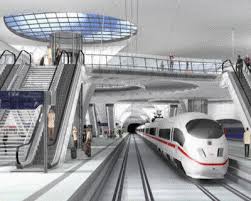
New Stuttgart station

As Andersen sees it, Stuttgart 21 and the related plan to built the Stuttgart-Ulm high-speed railway line are “a transportation-policy disaster.” Likewise, he adds, the project seems to be based on a complete misunderstanding of Stuttgart’s role in the German and European railway network. “Stuttgart is a destination,” he says. “It’s not a place people travel through to get someplace else. Converting the station into a through station won’t be an improvement on any significant route.” Indeed, all you have to do is look at a map to realize that Stuttgart is not a central location. All fast connections between key economic zones pass through other cities. For example, the Frankfurt-Zurich route runs far west of Stuttgart through Karlsruhe and Basel, while the Frankfurt-Munich route makes a wide arch through Würzburg and Nuremberg, far north and east of Stuttgart.

Full article:

http://www.spiegel.de/international/germany/0,1518,717575,00.html

US Recession officially over – but what about the second dip

September 20, 2010

http://economix.blogs.nytimes.com/2010/09/20/the-recession-has-officially-ended/?hp

The recession officially ended in June 2009, according to the Business Cycle Dating Committee of the National Bureau of Economic Research, the official arbiter of such dates.

As many economists had expected, this official end date makes the most recent downturn the longest since World War II. This recent recession, having begun in December 2007, lasted 18 months. Until now the longest postwar recessions were those of 1973-5 and 1981-2, which each lasted 16 months. Recession and expansion dates are based on various economic indicators, including gross domestic product, income, employment, industrial production and wholesale-retail sales. The Business Cycle Dating Committee typically waits to declare that the economy has turned until well after the fact, when it has a longer track record of economic data to confirm a new trend.

But the double-dip remains a distinct possibility even if the OECD believes the US may just escape it.

A graph of the Early 1980s recession in the Un...

Triple-dip in the 1980's

The United States will experience a slow, jobless recovery from its deepest and longest downturn since the 1930s but will avoid a double-dip recession, the Organisation for Economic Co-operation and Development said today. In its annual health check of the world’s biggest economy, the Paris-based OECD said that it expected activity to expand by 2.6% in both 2010 and 2011 without having a marked impact on the country’s near double-digit jobless rate.

But the optimism is speculative and not shared by everybody. Some believe that jobs growth is not happening at a speed sufficient to avoid the double-dip.

The U.S. economy has a “significant likelihood” of entering a double-dip recession if the government doesn’t step in to help the unemployed, economist Robert Shiller told MarketWatch News Break in August. The Yale University professor and author of the best-selling book “Irrational Exuberance” pinned the probability of a double-dip recession at more than a 50-50. Shiller pointed to the nation’s stubbornly-high unemployment as a root cause of lingering economic woes. And with the Federal Reserve running out of bullets to fight a second recession, he urged Congress to join the battle and focus on putting people back to work.

Gold fever

September 15, 2010
Mojave Nugget, a gold nugget weighing 156 ounc...

Image via Wikipedia

The price of gold hit a record high on Tuesday, with analysts giving a number of reasons for its rise.

Gold generates no income. It costs to store and secure and insure. Yet the flight to gold continues. Gold only beats inflation. It fares poorly when compared to real estate or shares when compared on the basis of real inflation adjusted returns. Gold scores the highest in terms of liquidity, compared to all other investments. Gold can be converted to cash at any time. All gold investments have the same tax concern. Gold, being a commodity, is taxed as ordinary income even if  profit comes from buying a gold ETF. Between the costs of storage, premiums paid and taxes, returns from an investment in physical gold can be eroded quickly unless compensated by the gold price.

Gold price can be very volatile. Over the past three years, gold has seen an increase of 84% in value but has seen gains and losses of over 12% within the same quarter.

Indian households are estimated to hold over 16,000 tons of gold primarily as jewellery.

The BBC reports:

The price of gold hit a record high on Tuesday, with analysts giving a number of reasons for its rise. Both the price of the actual metal and the price for buying it at a future date rose more than 2% to $1,274.75 an ounce. It was the biggest one-day gain for the commodity in four months.

One of the factors spurring investors is gold’s traditional role as a so-called “safe-haven” investment at times of economic uncertainty. On the physical market, demand for both bullion and jewellery has risen ahead of the seasonal Indian wedding period and the Hindu religious festivals that begin in September.

Another driver is more technical – gold is priced in dollars, and any fall in the dollar makes it cheaper to buyers using other currencies. The dollar has fallen across a range of currencies, driven down by a range of factors. Its most remarked upon slide has been against the Japanese yen. It is trading at a 15-year low against that currency. The price of gold has risen 16% so far this year. The World Gold Council’s last report on the gold market predicted that continuing strong demand from jewellery buyers in the two fast-developing markets of India and China, would help keep the price high.

http://goldprice.org/charts/history/gold_all_data_o_usd.png

10 year gold price per ounce