Archive for the ‘Education’ Category

Another case of misconduct at a private Indian college: Plagiarism at Nagpur College of Engineering

October 1, 2011

(link updated)

K. S. Jayaraman of Nature India reports on a blatant case of plagiarism at the G. H. Raisoni College of Engineering in Nagpur. Not only did a doctoral student, Parag Puranik, copy material from an American scientist but the Director of the institute, Preeti Bajaj, added her name as a co-author but she denies any knowledge of the admitted plagiarism nor does she take any responsibility.

Director Dr. Preeti Bajaj

Unfortunately the habit of senior academic staff merely adding their names onto papers written by their juniors seems to be quite prevalent. And – as in this case – where they provide no guidance, exercise no quality asssurance and probably do not even read what has been written by their students but are quite happy to add another publication to their list, they exhibit the worst kind of parasitic behaviour.

In yet another case of misconduct, scientists of a large PhD-granting research university in India have confessed having plagiarised a paper from an American scientist. The institute G. H. Raisoni College of Engineering in Nagpur, Maharashtra has named one of its doctoral students Parag Puranik for copying material from a paper by Lior Shamir, assistant professor of computer science, at the Lawrence Technological University in Southfield, Michigan. The co-authors of the paper, which include the director of the institute, say they had no knowledge of this blatant copying.

American computer scientist Shamir was shocked to notice that an important paper he published in 2006 was recycled and copied not once but thrice by a group of researchers at the Nagpur institute. “I became aware of it recently after I received an anonymous e-mail,” Shamir told Nature India.

(more…)

Bruno Frey and his habitual self-plagiarising by the “cloning” of papers

September 16, 2011

Handelsblatt, Germany’s business daily has been investigating Bruno Frey and his habitual self-plagiarising for some months now. Bruno Frey is an economics professor at the University of Zurich and has been making a habit of publishing the same paper in multiple journals. He is also apparently a potential candidate for a Nobel prize!! Frey apparently carried out a fairly trivial analysis of the people who survived the Titanic sinking but then went and got it published – with very minor variations – in 5 different journals. That such mundane and repetitive material would be published in fairly heavyweight journals does not say much for their review processes.

Olaf Storbeck is an author and Economics editor with Handelsblatt and is responsible for the weekly economics section. He has been leading the charge and he writes in Economics Intelligence:

One of the most senior economists of the German speaking world faces serious questions about his scientific modus operandi. Bruno Frey and his research team are accused of self-plagiarism. Additionally, they at least showed an amazing degree of sloppiness with regard to literature research. Five older publications from different authors on exactly the same research question are missing from the references.

This blog (among others, especially Andrew Gelman’s as well as “Economic Logic” and the EJMR forum) has played a role in making the whole thing public. On Wednesday, 6 July the University of Zurich has started a formal investigation against Frey, based on the “suspicion of unethical scientific conduct”.

Bruno Frey (University of Zurich), Benno Torgler (Queensland University of Technology) and Torgler’s Ph.D. student David Savage simultaneously published a series of papers dealing with the sinking of the Titanic, but neither cross-reference their own work nor  cite a number of older papers by other researcher addressing exactly the same topic.

The articles by Frey, Torgler and Savage appeared in the “Journal of Economic Behaviour and Organization”“PNAS”“Rationality and Society” and the“Journal of Economic Perspectives” in 2010 and 2011. They used individual-level passenger data showing the age, gender, ticket class and nationality of 2207 people sailing on the Titanic and employed an econometrical analysis on the determinants of survival. For several months the authors have been criticised because they simultaneously published nearly identical papers in four different journals without mentioning their other work on the same topic to the editors.

the article continues>>>>

Professor Debra Weber-Wulff comments on Bruno Frey on her blog:

The “Journal of Economic Perspectives” (JEP) has formally censured him, the “Journal of Economic Behaviour and Organization” (JEBO) has blacklisted the authors and will not accept any further papers from them. Frey and Torgler have said that Savage is not at fault and have tendered excuses at 3 of the 4 journals [German language detail: The article says that they “excused themselves”, I always thought you had to ask the other party to excuse you –dww]. Apparently, Frey had not gotten around to writing to the “Proceedings of the National Academy of Sciences” (PNAS) before the Handelsblatt started its investigations. 

The whole issue seems to have started with the blog Economic Logic and an entry entitled On the ethics of research cloning. The author of the blog had a good look at the CVs of the senior authors and finds evidence both of slicing results very thin in order to get much publication mileage out of them, as well as republishing the same results multiple times. In the comments a number of other clones showed up, and a  FreyPlagWiki (the currently popular German way to collect evidence on scientific misconduct and plagiarism) was set up. 

Interesting things have popped up, such as Frey exempting his doctoral students from coursework now required by the University in Zürich, or his being dropped from an editorial board without explanation.

Olaf Storbeck has found further examples of Frey’s multiple publications which he documents in this  Google Table  describing the “cloning” of 5 publications. But Storbeck’s article contains some disturbing reports of the behaviour of Journal Editors – in particular Jürgen Backhaus Professor of Finance and Fiscal Sociology at the Political Sciences Faculty of the University of Erfurt and Editor-in-chief of Springer’s European Journal of Law and Economics (EJLE).

Bruno Frey: More cases of self-plagiarism unveiled …. However, when I talked to Jürgen Backhaus on Sunday, the editor-in-chief was strongly backing Bruno Frey. Backhaus argued that Frey is known for his new and unconventional ideas. According to Backhaus, it was necessary to repeat them again and again to get them through to a reluctant audience. Backhaus told me:

“It is well known in the profession that Bruno Frey works like this.”

He said that it was an honour to be able to publish an article by Frey:

“He is an internationally renown academic who is a candidate for the Nobel prize.”

According to Backhaus, publishing an article by Frey enhances the attention for other articles in the journal. I asked him how he would explain to a PhD student that the official submission guidelines of the journals apparently are not applicable to Frey. His answer was:

“Bruno Frey is a trademark. The PhD student still has to build one.”

I was really stunned by these remarks. I emailed those quotes (in German) to Backhaus prior to publication. He confirmed that I quote him correctly. (Translations from German into English were done by me, however.) …… If the EJLE wants to retain any credibility and if Springer takes the COPE guidelines seriously, they won’t have any choice but to officially retract both articles. Additionally, I don’t see how Frey can stay on the editorial board of a journal which submission guidelines he repeatedly has clearly violated.


Misuse of peer review by UK Research Councils leads to mediocrity

September 14, 2011

The 7 UK Research Councils are publicly-funded agencies responsible for the funding of most research in the UK. They have often been criticised for being much too “establishment” driven such that any line of research considered heretical is strangled of any funding. Donald W. Braben is honorary professor in the department of earth sciences, University College London and known for his support for academic freedom and “blue-skies” research. In an article in The Times Higher Education Supplement,  he comes down hard against the research councils and their use of “peer review”. He argues that they inherently discourage  any “pioneering” research and drive towards mediocrity.

Until about 1970, academic researchers were usually given modest funds to use as they pleased. This apparent profligacy led to a prodigious harvest of unpredicted discoveries and huge stimulants to economic growth. ……. 

It is said that peer review is like democracy: it’s not the best but it’s the best we know. But science is not democratic. One doubtful scientist can be right while 100 convinced colleagues can be wrong. Indeed, the physicist Richard Feynman once defined science as “the belief in the ignorance of experts”. Specifically, peer review of grant applications, or peer “preview”, is inimical to radically new ideas. Today, however, the all-powerful peer-preview bureaucracy is the determinant of excellence. It is taboo even to criticise it. So the natural inclination to oppose major challenges to the status quo has become institutionalised. For radical research, one can argue that “the best we know” has become the worst. 

“Independent expert peer review” is contradictory. One submits a proposal and the councils ask experts to assess it. But these experts are likely to include proposers’ closest competitors, even if they are selected internationally, because science is global – and real pioneers have no peers, of course. How then can the councils ensure that reviews are independent? To make matters worse, these experts can pass judgement anonymously: applicants don’t know who put the boot in.

I suggest that the misuse of peer review is at the heart of the research councils’ problems. Before about 1970, they largely restricted its use to the assessment of applications for large grants or expensive equipment. Scientific leaders protected the seed corn, ensuring that young scientists could launch radical challenges if they were sufficiently inspired, dedicated and determined. Today, the experts whose ignorance they would challenge might also influence their chances of funding. ………

….. The research councils are taking UK research down pathways to mediocrity and using peer review as justification. We – the academic community – must stop them, or accept the dire consequences.

Read the whole article

Arab – Iranian feuding continues at Utah University’s Middle East Center

September 11, 2011

H/T to reader Ron.

The mud-slinging and back stabbing at the University of Utah’s Middle East Center is less than edifying and continues unabated. Charges and counter-charges include plagiarism, cronyism, sexual harassment, insubordination and even contributing to a student’s suicide. It begins to seem like a B-grade movie with bad actors and a melodramatic script. An Arab- Iranian feud – with under-currents of Shia-Sunni rivalry – being played out in Utah!! And the roots of the feuding go back some 1500 years to the very rapid Arab conquest of Persia in 644 AD. Ever since there has been a feeling of Persian “shame” at not resisting the takeover very strongly and is the root cause of the Persian disdain for Arab culture and influence which continues today. Just to complicate the picture there is much back-biting and intrigue within the Arabists themselves.

The Salt Lake Tribune now reports that officials at University of California, Los Angeles said on Thursday that

..they can find no record of awarding a degree beyond a master’s to Ibrahim Karawan, who led the Middle East Center until 2008, when he was succeeded by Bahman Bakhtiari. 

That would seem to support allegations by Bakhtiari, recently terminated for plagiarism, that Karawan does not hold a doctorate and never was qualified to be a professor, sign off graduate students’ work and seek federal grants. In a lawsuit filed Sept. 2, Bakhtiari alleges a colleague concealed Karawan’s “academic fraud” for at least two decades and orchestrated Bakhtiari’s firing by inciting graduate students to drum up evidence of plagiarism and then publicize what they found.

Bakhtiari is now using the confusion over Karawan’s academic status in his legal fight with former colleagues whom he blames for his expulsion from his tenured faculty appointment. Bakhtiari, whose name also appears in print as “Baktiari,” claims he is guilty of little more than sloppiness with attribution, while alleging Karawan perpetrated a fraud on the university, its students and the federal government, which awarded grants to the MEC on the basis of Karawan’s doctorate.

“The University’s failure to take any action against a proclaimed professor who did not hold the mandatory credentials and, for nearly 25 years, signed his name to graduate degrees and solicitations for public monies through the United States Department of Education as one holding those credentials in violation not only of university policy but also federal law, while conversely seeking the academic death penalty for me based on minimal allegations, is discriminatory at best,” Bakhtiari wrote in an Aug. 17 e-mail to the Tribune.

Bakhtiari’s suit targets history professor Peter Sluglett, who was the center’s director from 1994 until 2000, when Karawan took the reins, as well as several “John Does.” Sluglett, who left this week for a year in Singapore, had a leadership position on the center’s executive committee and worked closely with Karawan over the years. Administrators’ abrupt dismissal of Sluglett and another scholar from the center is what precipitated Karawan’s resignation as director in 2008, setting the stage for Bakhtiari’s hiring from the University of Maine. Sluglett later was reinstated at the center and resumed a central role in its management.

The principal cast of villains consist of Bakhtiari (of Iranian origin – fired as Director), Karawan (an Arab, a former Director and currently acting Director) and Sluglett ( an Arabist, former Director and now in Singapore for a year).

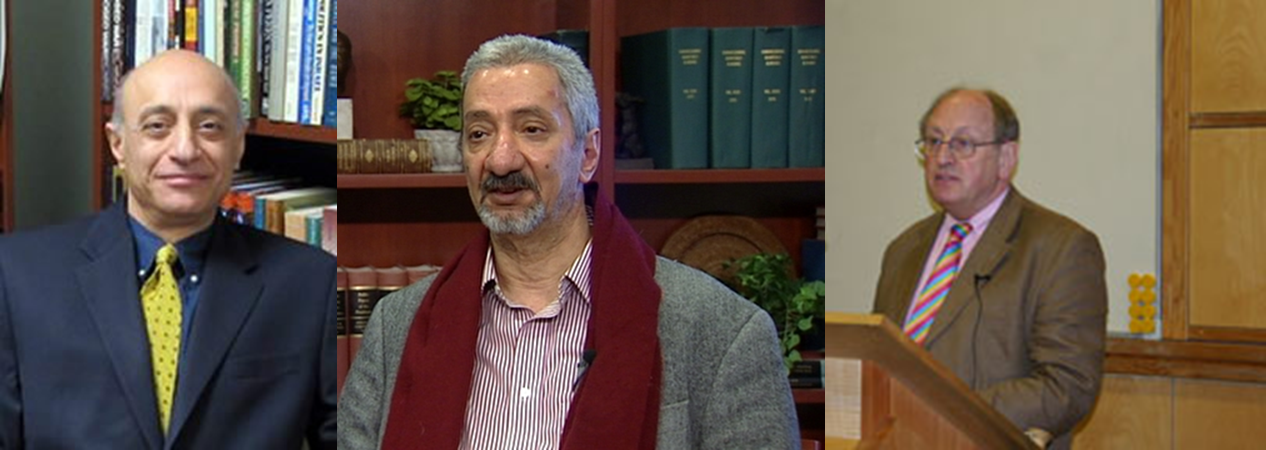
Cast of villains at the Mid-East Center: Bakhtiari-Kerawan-Sluglett

There is a large supporting cast of actors of students and faculty consisting among others of university interim President, Lorris Betz,  and humanities dean Robert Newman.

But this appears to be a movie where the entire cast are bad-guys and there is no hero in sight!

A hotbed of intrigue: Bahman Bakhtiari sues Peter Sluglett after being fired from Utah University’s ME Center

September 8, 2011

Two months ago Bahman Bakhtiari was fired from the University of Utah’s Middle East Center for a pattern of plagiarism. Now he has filed  a suit last Friday in 3rd District Court against Peter Sluglett, the center’s senior-most faculty member and a former Director of the Center himself.

Deseret News:  Bakhtiari alleges that two senior faculty leaders at the center conspired to eliminate him after personality conflicts. He also alleges in the lawsuit that a senior faculty member, who was a former center director, lied about having a Ph.D. from UCLA and that faculty conspired to cover it up.

Bakhtiari served as center director from July 2009 to June 2011. He was brought in from the outside by the Dean of the College of Humanities to replace an existing faculty member. The suit states that from the onset, Bakhtiari was disliked by senior center faculty and that the political science department, which oversees the center, refused to support his tenure. The suit states that the dean of humanities ended up granting him tenure through the department of languages and literature.

Last June, a U. faculty committee investigated complaints of alleged plagiarism against Bakhtiari. In a unanimous vote, the committee found that Bakhtiari committed “a pattern of plagiarism that is harmful to the university’s academic integrity.” …

Although the committee stopped short of termination and revocation of tenure, University of Utah Interim President A. Lorris Betz overrode the decision and terminated Bakhtiari on June 30. ….

Bakhtiari alleges in his suit that center faculty actively dug through his career history to find justification to get rid of him. According to U. documents, evidence of plagiarism was found in six scholarly publications, including Bakhtiari’s 1984 Ph.D. dissertation, an online newsletter and an op-ed piece published in The Salt Lake Tribune. The suit states Bakhtiari is seeking damages for interference with economic relations, invasion of privacy, breach of contract and defamation.

Both Peter Sluglett and the Middle East Center are no strangers to internecine dispute, intrigue and academic “dirty tricks”. Sluglett gets mixed reports as a teacher.

Sluglett is also apparently  a self-anointed expert in recent Iraq history:

February 03, 2006  

Sluglett gets SluggedI noted with some pleasure that Wafaa’ Al-Natheema knocked Peter Sluglett down a peg or two. She posts the full email exchange on her blog. Professor Peter Sluglett considers himself an expert on modern Iraqi history with good reason – he has studies the subject for 30 years. Along with his late wife, Marion Farouk Sluglett, they wrote one of the important books on modern Iraqi history called “Iraq since 1958”. However, he uses that position to stifle any debate on Iraqi history. He considers himself the expert and nobody has the right to contradict him. The problem is that in many cases he is wrong.

The Middle East Center itself is no stranger to controversy where Sluglett was Director before Ibrahim Karawan – who resigned and was then succeeded by Bahman Bakhtiari.

April 4, 2008 

Karawan Resigns over Middle East Center Dismissals  

Ibrahim Karawan, director of the Middle East Center, announced his resignation yesterday before a lecture at the Hinckley Institute of Politics. Karawan said he is resigning because two of his colleagues were forced out of the center by Dean Robert Newman of the College of Humanities. “They were basically moved out of the center, not according to what they wanted, and moved to other departments,” Karawan said.

He questioned whether the action was justified and what the impact will be on the governing structure of the center and its ability to receive funding from the U.S. Department of Education. … Peter Sluglett, a professor of Middle Eastern history, and Harris Lenowitz, a professor in Hebrew, both received letters from Newman informing them that they could continue teaching but would no longer be able to hold leadership positions in the center. Sluglett and Lenowitz both have joint appointments in the center and their departments — history and languages and literature, respectively — and both teach cross-listed courses. ….

On March 13, Lenowitz said he received a letter from Newman that read: “It has come to my attention that you have contributed consistently toward creating an atmosphere in the Middle East Center that lacks collegiality and can no longer be tolerated.” Sluglett said he also received this letter, but he doesn’t think other faculty members have any problems with his behavior…….

Leaving aside the legal positions and claims and counter-claims which will run their course, the Middle East Center and its faculty strike me as being a bunch of  rather petty, uncivilised, amoral and childish group of academics. Petty intrigue, academic dishonesty and scientific misconduct seems to come quite naturally to them.

Playing their games of intrigue appears far more important to them than academic rigour or integrity. Whether they should be getting any funding at all from the US Department of Education ought to be a question being asked.

Sangiliyandi Gurunathan on his way to another private University in South India

September 5, 2011

Kalasalingam University recently took strong action against a Professor and 6 PhD students for scientific misconduct which included data manipulation and plagiarism. Dr. G Sangliyandi, Senior Professor and Head, Department of Biotechnology, and Dean, International Relations, Kalasalingam University was directed to resign from the University. The 6 PhD students involved had their registrations cancelled.

His name has been removed from the Department of Biotechnology page at the university website but still appeared on the International Relations page last week.

It seems that Dr. Gurunathan has been offered (and is said to have accepted) a position at another private University in Southern India – also at a Department of Bio-technology but it has not been possible to confirm this. 

One reader comments that all the six students involved are still continuing at Kalasalingam University

All the 6 research scholars, whose Ph.D registration has been cancelled are still doing (continuing) their research work in the department itself on the support of Prof. Dr. K. Sundar.

If this is true then it seems that Sangiliyandi Gurunathan is being assigned all the blame for the wrong-doings at his lab and not primarily the students he had initially blamed. Presumably the students have new PhD registrations and stern warnings about maintaining good conduct and about the ethics of plagiarism and image manipulation!

Are Universities cracking down on academic and scientific misconduct?

September 3, 2011

It may just be a passing gust of a cleansing wind but I do have a perception that universities are becoming much more responsive to allegations of academic dishonesty and scientific misconduct.

Investigations of misconduct at academic institutions have long been notorious for the amount of time they take (usually many years) and for always protecting “the establishment”. But I think I detect a change.

Investigations are speeding up and sanctions against those found guilty are beginning to be more than symbolic slaps on the wrist. The frequency of enforced resignations and dismissals seem to be increasing. I perceive a trend and I hypothesise that it is partly in response to the on-line scrutiny and negative publicity which comes from the blogosphere. 

Close on the heels of the recent Ahluwalia resignation /dismissal come these two cases:

1. Academic impropriety with Professor Julius Nyang’oro considered to have improperly helped athletes to cheat at the University of North Carolina. He is tied to two athletes who were kicked off the football team. In one case he did not detect or ignored blatant plagiarism and in the other he allowed a freshman to take a senior graduate level course and awarded him a suspiciously high grade. Nyang’oro apparently rarely gave low grades in his classes:

College athletes and accommodating professors

UNC professor resigns amid football investigation

UNC’s Afro-American studies head resigns amid questions of football …

2. A well known cardiac researcher Zhiguo Wang has been dismissed from the Montreal Heart Institute for scientific misconduct following retraction of two papers in the Journal of the Biological Chemistry just a month ago.  Wang also has an appointment at the University of Montreal, and is senior research scholar of the Fonds de Recherche en Sante de Quebec, a ChangJiang scholar professor, and a LongJiang scholar professor of China. The dismissal comes less than a month after the publication of the retraction notices.

Authors retract two JBC papers on how heart rhythms go awry; Montreal Heart Institute looking into why

Montreal heart studies ‘withdrawn’ – Zhiguo Wang’s arrhythmia research being investigated after retractions 

Montreal hospital dismisses cardiac researcher over misconduct allegations

There have been a number of other cases recently in Germany as well where the speed of the investigations by the academic institutions have been unprecedented (zu Guttenberg and Bulfone-Paus as examples).

Perhaps it’s all just in my mind – or even wishful thinking – but I have the distinct impression that a cleansing wind is beginning to blow. The world wide web may already be having an impact on combating academic dishonesty and scientific misconduct by forcing institutions to be more responsive. There is much on-line which is still malicious or untrue or just plain rubbish. But the amount of “solid” comment has achieved a  “critical mass”. The blogosphere can no longer be merely ignored it seems.

University of Peshawar Vice Chancellor defends himself

August 30, 2011

The Vice-Chancellor of the University of Peshawar,  Dr Azmat Hayat Khan was found guilty of plagiarism by a three-member committee of the Higher Education Commission that was constituted to probe the matter. The Higher Education Commission had submitted its report to the Governor of Khyber-Pakhtunkhwa who is also the Chancellor of the university.

The Vice Chancellor has now put forward his story publicly and explained the plagiarism claims are not justified:

The News

Speaking out for the first time since he was accused of plagiarism, Vice-Chancellor of the University of Peshawar Prof Dr Azmat Hayat Khan Sunday rejected the allegations against him as baseless. A pressure group in the university is politicising the issue for its personal gains, he told The News in an exclusive interview.

… He said that the case was in the court and he could not comment much about it. However, I have challenged the jurisdiction of the Higher Education Commission. The letter of the HEC was written on malafide intention to the Khyber Pakhunkhwa governor in May 2011, he argued….

The Vice-Chancellor said that he had done his PhD in 1990 on the Durand Line and his thesis were challenged after 21 years, which was self-explanatory of the malafide intent behind the issue. He said that the Indian Office Library was the primary source of files for him. If you see my book you will come to know that I have quoted the original sources of information which is the same that Mst Kulwant Kaur has done. I mean both the authors have quoted original sources with different citations, he argued. In my book on several occasions I have mentioned in the footnotes that for further details see Kulwant Kaur’s book, Pak Afghan Relations. Now if I wanted to steal somebody’s work, I would not have referred to his or her book, he added.

Regarding the letters of a faculty member of the university to various quarters accusing him of giving life threats to him and his family members, Dr Azmat Hayat said he was an academician and believed in the sanctity of pen and book. ìAlso, I belong to a well-reputed family of Peshawar. People know me and my family very well. I cannot even think about such mean practices, he stated.

Read whole interview


“Top 11 examples” of US academic dishonesty

August 28, 2011

This an arbitrary listing / ranking of examples of academic dishonesty at US colleges and secondary schools put together by Online Colleges. I am sure there are many other candidates for the list but I have no doubt that it is only by exposing such cases that change can occur. The internet provides an unprecedented medium for the exposure of cases which would otherwise be swept under carpets and never get any attention. The cases of plagiarism being revealed in Germany is a case in point.

The downside of the internet is, of course, that mere allegations may be taken as being confirmed fact and that it also allows personal feuds and partisan opinions to be presented without much rigorous scrutiny.

11 Most Egregious Examples of Academic Dishonesty 

Academic dishonesty is a serious concern on college campuses and secondary schools around the U.S., as it seriously undermines the entire purpose of education. Not only does it reflect poorly on students, but the institutions to which they are enrolled as well. While cheating and lying in the classroom is nothing new, in recent years the lengths to which many college kids (and their teachers) are willing to go has shocked and surprised many. This often leads to a call for stricter penalties levied on those violating academic honor codes.

No matter where you stand on cheating or how you feel it should be combated in a school setting, there is no doubt that these cases we’ve collected here are some of the most outrageous examples in recent history. We’d like to hope these eventually mark a turning point in student behavior, but as education becomes even more competitive and expensive, cheating isn’t likely to stop anytime soon.

When plagiarism is not plagiarism: University of Peshawar allows 19% plagiarism to protect plagiarising Vice Chancellor

August 26, 2011

When plagiarism is not plagiarism

The Vice-Chancellor of the University of Peshawar,  Dr Azmat Hayat Khan was found guilty of plagiarism by a three-member committee of the Higher Education Commission that was constituted to probe the matter. The Higher Education Commission had submitted its report to the Governor of Khyber-Pakhtunkhwa who is also the Chancellor of the university.

For apparently political reasons, no action has so far been taken against the Vice Chancellor. Instead the University went on the attack. First they attacked the complainant, Mohammad Zubair, an assistant professor at the UoP Law College. They  suspended him and have now dismissed him and are going through a paper exercise to strip him of his law degree. Now they have attacked the Higher Education Commission for finding their beloved Vice Chancellor guilty. The defence of the Vice Chancellor is ingenious. First they have objected to the procedures followed by the Commission in not interrogating the Vice Chancellor. Since they felt this argument was probably a little weak they then redefined plagiarism so that the Vice Chancellor’s plagiarism was no longer plagiarism!!

The University has effectively created a Cheaters Charter. It has reinvented and redefined a plagiarism “threshold” of allowable copying as being 19% for scholarly articles and 25% for theses. And since – they claim – the Vice Chancellor only cheated to the extent of copying 18% of his book from others – what he did was not plagiarism!!

From being a case of the Vice Chancellor’s plagiarism this has now escalated to become a case of blatant corruption at the highest levels of the University and not excluding the Chancellor – who is of course merely taking a political position as the Governor of Khyber-Pakhtunkhwa.

The ethical standards of the University of Peshawar are beginning to stink.

Pakistan Today reports:

The University of Peshawar issued a clarification on a news item pertaining to plagiarism stating certain elements from a political group were involved. …. 

The HEC thus already had jumped to conclusions without inquiring into the matter which shows a partial approach and mala fide intentions. This in fact was the only inquiry in history in which the author under investigation was not called before the committee. The plagiarism policy of HEC point number eight section“E“ clearly reads that the author under investigation must be provided opportunity to justify the originality of their concepts. …..

The HEC Plagiarism policy states plagiarism cases be dealt by respective universities and the threshold is setup by the concerned University in light of the Quality Assurance guidelines of HEC. The percentage of allowed threshold decided by meeting of the Advance Studies and Research Board of University of Peshawar in light of HEC Quality Assurance guidelines, in its meeting held on 25/11/2009 was 19% allowed matching (threshold) for published research articles and 25% for thesis.
The plagiarism allegations against the Vice Chancellor were looked in HEC recommended software and the result was shown to be 18%. This is the same software which is being used all over the country and by HEC. The same document was checked manually and the matching percentage of Kulwant Kaur Book “Pak Afghan relations” to that of Dr Azmat Hayat Khan book was 17%.  …….

The press release stated the case was in court and an unbiased decision would be issued because the author would get a chance to explain his point of view and the facts of the matter. It said the University of Peshawar considered the HEC’s recommendation of a penalty and the press conference organized by them as contempt of court (against PHC decision) and will take the case to legal corners. It claims that the victimizing campaign is spear-headed by Zubair Mehsud. The press release denied Zubair was being targeted, as claimed by a newsreport, for raising his voice against the VC.
The press release said ex-Law College faculty member Zubair had been terminated for engaging in political activities against the VC’s directives and the used of defamatory language when issued show cause notice to explain his position on the matter.

But the demands on the Governor to replace the tainted Vice Chancellor are continuing to grow.