Archive for the ‘Energy’ Category

Global proven oil reserves have never been as high as now

June 19, 2013

So much for peak oil!

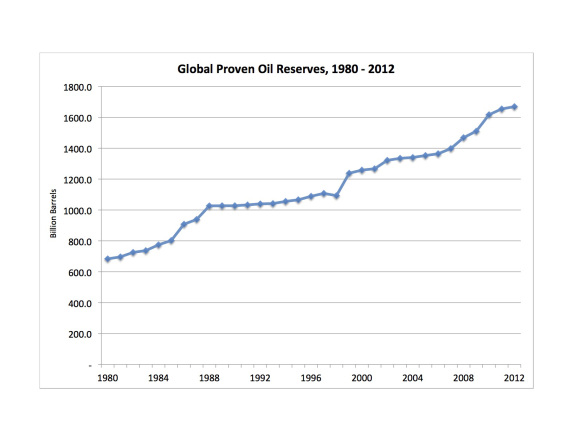
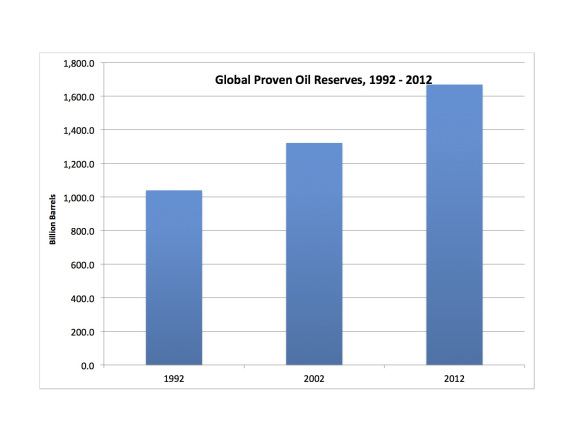
Proven oil reserves have increased by 144% since 1980 and 60% since 1992!

BP’s Statistical Review of World Energy 2013 is now out.

These two images are from Power Line’s Steven Hayward

Like the end of the whole peak oil hypothesis.  The first figure below displays the 60 percent growth in proven global oil reserves over the last 20 years.  This is not just the result of recent technological advances such as directional drilling and fracking: the second figure takes BP’s data back to 1980, which shows a steady increase in reserves throughout the period amounting to a 144 percent increase.  (That kink in the line in the late 1990s corresponds to the collapse in oil prices down to about $10 a barrel at the time.  Simple lesson: price matters.)  

global oil reserves 1992 - 2012 graphic hayward power line

global oil reserves 1992 – 2012 graphic hayward power line

Global oil reserves  1980 -2012 graphic hayward power line

Global oil reserves 1980 -2012 graphic hayward power line

When this interglacial ends ….

June 7, 2013

This interglacial will end.

It may take another 100 years or 5,000 or it may already have ended. From whenever the end is reckoned  it could take about 4,000 years for full glacial conditions to set in.

interglacials

This interglacial will end

The ice sheets will advance again. New land will be exposed as sea levels fall – up to 120m.

The land mass of the world with the reduced sea levels might look like this (http://www.ngdc.noaa.gov/mgg/topo/globega2.html:

world map ice age image National Geophysical Data Center at NOAA

world map ice age image National Geophysical Data Center at NOAA

Geography will change. Islands will expand. Some seas will disappear as water gets locked up in the expanding ice sheets.  Greenland will expand. Siberia will connect to North America again. The United Kingdom will once again rejoin the continent. Indonesia and Australia will be extremely close. Japan will no longer be islands. The Baltic Sea will not exist. The Persian Gulf will disappear. Across the world coastlines will be “pushed out”. Ancient coastal city sites – long submerged – will reappear. The ice sheets will expand and will drastically reduce populations above 55 °N. The global population would have stabilised and may even fall. Populations will migrate. Nation states will  see their boundaries changing – physically not just by war. No doubt there will be new human conflicts as populations shift – though the shifts will be over hundreds of years and quite gradual in our terms. Average global temperatures will be about 2 – 4°C colder than today.

But this time the ice sheets will not stop humans from utilising the resources under some of the ice sheets. As during the last glacial period, human innovation and engineering will flourish and reach new heights as the challenges are met. New science and new technologies will appear. Art will take new forms. A new wave of exploration will occur – this time into space. And through all of this our energy needs will increase.

Time line of prehistoric inventions (pdf)

But it is the availability of abundant energy which will be the deciding factor, which allows growth to continue and which allows the continued  improvement of the human condition. And this energy will primarily be fossil energy and nuclear energy.  It will be nuclear energy for large central plants (> 1000 MW), fossil energy (coal, and gas) for medium sized plants (100 – 1000 MW)  and gas for municipal and domestic applications. Transportation will – largely as now – be electric or oil-based though the proportion of electric (charged from “cheap” nuclear power) vehicles will increase. Solar and wind and wave and tidal power will have their little place but will – as now – be of small impact.

It is fossil and nuclear power which will allow humanity to meet these new challenges. They will be a necessity for humans to flourish. Carbon dioxide emissions – as now – will be irrelevant. It is in the development of small nuclear, energy storage and more efficient gas- winning and utilisation that we should be concentrating.

Three decades of needless “green” energy has cost some 15 million jobs in Europe

June 2, 2013

It has been a pointless waste. Just to pander to the superstition that controlling carbon dioxide emissions can control global temperature.

Temperatures have been flat since 1997 while human emissions of carbon dioxide have risen around 30%. Carbon dioxide concentrations in the atmosphere have also increased but have had little impact on global temperature – if any at all.

graphic Bert Rutan via WUWT

graphic Bert Rutan via WUWT

graphic source: WUWT

The last three decades have seen the vilification of carbon dioxide and the combustion of fossil fuels but it has been a pointless and expensive exercise. The profligate subsidies in favour of renewable energy and the shameless taxation of fossil fuel use and the consequent increase of energy prices have made their contributions to the economic slowdown and loss of jobs – particularly in Europe. The cowardly adoption of political correctness and of “green” energy is proving expensive – and has been quite needless.

Today electricity prices in Europe are at least 50% higher and perhaps twice as high as they need to be. The curbing of fossil fuel use and the hysteria about nuclear power together with the renewable profligacy are responsible for that. The cost of electricity is a fundamental parameter in our economies which feeds its way into every aspect of economic activity. It is the availability of affordable electricity which has been the driver of growth for over 100 years. A simple estimate of the growth that has been prevented by having unnecessarily high electricity prices gives the cost as being about 15 million jobs within the European Union.

Gerald Warner writes in The Scotsman: (my emphasis)

…. As the bottom falls out of the man-made climate change industry, those who were among its most bullish investors at the height of the scam are now covering their positions in a bear market.

Great damage was done to this much-hyped imposture by Climategate (“Hide the decline!”), by the discredited “hockey stick”, by the farce over “melting” Himalayan glaciers and the “decrease” in the polar bear population from 5,000 in 1970 to 25,000 today. Yet what has chiefly discredited the climate change superstition is the basic, inescapable fact that there has been no global warming since 1997.

The official face-saving response is that this is a “pause” in an otherwise menacing trend – a pause of a decade and a half. The warmist fanatics will freeze to death in their solar bunkers before they will admit defeat; but the more worldly wise, especially scientists anxious to preserve a vestige of academic credibility, are now striving to effect a withdrawal in good order.

Even the Intergovernmental Panel on Climate Change began to ratchet down its more extravagant predictions as early as 2007. In 2010 the Royal Society reviewed its stance on the Anthropogenic Global Warming theory and assumed a more neutral position. Since then, it has been like the retreat from Moscow: last month Oxford scientists, albeit in Delphic language, moderated forecasts of climate disaster. …..

….. The global warming hysteria began in the 1880s but was discredited when its prediction that CO2 would increase the mean global temperature by more than 1C by 1940 was not borne out. What gave it fresh life over the past two decades was the realisation by governments that it could provide a pretext for taxing citizens to unprecedented levels and by private entrepreneurs that government subsidies could supply a dripping roast. Of all the damage that politicians have inflicted on the public, the “green” scam has been among the most extreme.

The Renewables Obligation, introduced in Scotland in 2002, was scheduled to end in 2027, by which time UK energy customers will have been robbed of £32 billion. It has now been extended to 2037 for new projects. By 2011 Ofgem confirmed that 10 per cent of every electricity bill went towards “renewables”. Proliferating wind turbines are blighting the landscape despite being a wholly inefficient source of energy. Turbines operate at just 24 per cent of capacity – for more than a third of the time at only 10 per cent – and conventional power stations have to remain in service as backup: two energy systems pointlessly working in tandem. ……

…… South of the Border a modicum of sanity has entered government thinking since UK energy minister John Hayes’ “Enough is enough” remarks. In England and Wales turbines are falling out of favour. 

Not so in Scotland. ……. 

Local objections to wind farms are routinely overruled by central government (that would be the listening, accountable Scottish Nationalist government). At the end of last year only ten out of Scotland’s 32 local authorities admitted to knowing how many wind turbines were sited in their areas.

They could cover every inch of Scottish soil with Martian whirligigs and the lights will still go out, due to the SNP’s refusal to replace Hunterston B, due to close in 2016, and Torness, closing in 2023. All this to satisfy a superstition: if all mankind stopped producing CO2 (try selling that idea in China and India), 96.5 per cent would remain. The climate Anabaptists will never recant, but their mad creed is doomed all the same.

Wind turbines and solar energy have their place in the energy mix we should use.  But not at the expense of fossil fuel and nuclear use.
Reality bites as EU politicians slowly back away from costly energy policy

May 7, 2013

Reuters reports that EU politicians are to meet at a summit to reassess energy policy in the post-fracking world  (and  – but this is not to be admitted under pain of being shunned – a post-global-warming reality). I just note that politicians will be the most adept at changing direction aand taking credit for moving away from global warming orthodoxy. Many scientists will find their own exit strategies but many will find it difficult to find the rationale to move away from what has become their religion and their livelihood. The least adept at embracing the new reality will the “climate bureaucrats” whose comfortable existence depends upon the global warming religion continuing in force. And all those who have milked the EU subsidy regime for all its worth will not be pleased but they will just move on to the next scam.

(Reuters) EU heads of state and government will seek ways to limit the impact of energy costs on European competitiveness at a summit this month, a draft document seen by Reuters showed.

European industry says it is disadvantaged because of the price it pays for energy compared with the United States, where the shale gas revolution has drastically lowered costs.

The document ahead of the May 22 EU summit, which has energy and taxation on the agenda, calls for examination of the impact of energy prices and costs and action to limit the effects.

One option is developing the European Union’s own shale gas resources, although this is not mentioned directly. Instead, the draft refers to safe and sustainable development of “indigenous sources of energy”.

Europe’s very different geography and land ownership would make it hard for the European Union to rival the United States in shale gas, but the executive European Commission is working on a framework to guide prospectors.

The leaders are expected to urge the Commission to analyze energy prices and costs in member states “with a particular focus on the EU’s competitiveness” against global rivals.

The draft also points to massive investment costs in boosting power generation and networks as likely to drive up energy prices.

Arguments over energy costs have featured prominently in political debate ahead of German elections and played a part in blocking a Commission proposal to boost carbon prices on the EU market.

The Emissions Trading Scheme (ETS), where carbon prices have sunk to record lows, is not on the draft agenda, but it could be debated on the sidelines of the summit, EU sources have said.

Efforts to repair that market are also a focus of attention for the European Parliament.

Composition of exhaust gases from humans and from fossil fuels

April 13, 2013

It occurred to me when carrying out some combustion calculations that what humans breathe out is pretty close to the flue gas from a gas-fired, gas turbine combined cycle plant.

In a gas turbine combustion chamber, fuel is burned typically at an excess air level of about 200% (the amount of oxygen available in the combustion air compared to that which is needed for complete oxidation of the fuel). This means that about one third of the oxygen available is used and converted to carbon dioxide and water while about 2/3ds just passes through (i.e of the 21% oxygen in air, about 6-7% is “consumed” and about 14 -15% passes through unused). In coal-fired plants the excess air levels are usually only about 25% which leads to about 15 -16% of the incoming 21% oxygen being consumed with about 5% passing through. The amount of oxygen actually consumed depends on the fuel composition and the oxygen demands of the elements which are oxidised during the combustion process. Carbon, hydrogen and sulphur (giving CO2, H2O and SO2) are the main oxygen consumers. All the other constituents of air pass through – heated up of course – but otherwise unchanged. Minute quantities of the fuel- nitrogen and the nitrogen in the incoming air can – depending upon the combustion temperature – be “fixed” to create the nitrogen oxides – nitrous oxide (N2O) and nitrogen dioxide (N2O). The higher the combustion temperature the greater the “fixing”. Too low a combustion temperature – for example with very wet fuels and bio-mass – can give “incomplete combustion” with some carbon monoxide (CO) and even some dioxins and hydrocarbons with a particularly poor combustion process. Internal combustion petrol engines essentially run at stoichiometric conditions (zero excess air) and there is no oxygen in the exhaust. However combustion is never quite complete and around 1% carbon monoxide is usually present (which is why suicide by exhaust fumes becomes possible). Diesel engines on the other hand have 10% oxygen in the exhaust when idling and this reduces to 1 or 2% when fully loaded.

All fuels essentially contain carbon and hydrogen as the main energy releasing elements when oxidised. Most industrial combustion processes happen fast and speed of combustion – which is desirable for complete combustion – has to be tempered by the need to keep temperatures at levels which can be handled by the materials used. The human use of the same elements of carbon and hydrogen for the release of energy however is by a relatively slow oxidation processes. Not all the water produced leaves the human body with our expelled breath since some part of it leaves in liquid form with urine. But from the composition of the waste gas we breathe out it seems that the carbon/hydrogen ratios in our food intake cannot be so very different to the natural gas burned in gas turbines (and not very surprising considering that plant-life is the ultimate source of both).

exhaust gas compositions


Since human exhaust gases emit the same concentration of carbon dioxide as gas turbine, combined cycle power plant perhaps we should penalise every human as well?


Durham University finds that fracking is not very significant in causing tremors

April 10, 2013

The fears of earthquakes and water contamination are being wildly exaggerated by all those who would prevent the hydraulic fracturing (fracking) of the vast deposits of gas shale available around the world. But research at the University of Durham puts the threat of micro-seismsity into perspective.

BBC reports:

New research suggests that fracking is not a significant cause of earthquakes that can be felt on the surface. UK scientists looked at quakes caused by human activity ranging from mining to oil drilling; only three could be attributed to hydraulic fracturing.

Most fracking events released the same amount of energy as jumping off a ladder, the Durham-based team said. They argue that the integrity of well bores drilled for fracking is of much greater concern.

The research is published in the Journal of Marine and Petroleum Geology.

 …. Fracking, as it is called, utilises a mixture of water, sand and chemicals pumped underground at high pressure to crack open sedimentary rocks and release the fuels within. But opponents of fracking have long been concerned that the process could induce earthquakes such as the one that occurred near a shale gas operation in Lancashire in 2011.

Now researchers from Durham University’s Energy Institute say that the pumping of fracking liquid does indeed have the potential to reactivate dormant fault lines. But they say that compared to many other human activities such as mining or filling reservoirs with water, fracking is not a significant source of tremors that can be felt on the surface.

“We’ve looked at 198 published examples of induced seismicity since 1929,” Prof Richard Davies from Durham told BBC News. “Hydraulic fracturing is not really in the premier league for causing felt seismicity. Fundamentally it is is never going to be as important as mining or filling dams which involve far greater volumes of fluid.” The researchers detailed just three incidences of earthquakes created by fracking – one each in the US, the UK and Canada. The biggest at Horn River Basin in Canada in 2011 had a magnitude of 3.8.

“Most fracking related events release a negligible amount of energy roughly equivalent to, or even less than someone jumping off a ladder onto the floor,” said Prof Davies. ….. 


Argentina joins the shale gas bandwagon

April 8, 2013

The shale gas bandwagon is now truly rolling and countries all across the globe are scrambling to catch up. The wide-spread reserves mean that, more than any other energy source, shale gas has the potential of making concerns about energy security and reliance on foreign sources a thing of the past. South America also has its share of gas bearing shale. Argentina and Brazil have substantial shale deposits which the EIA estimates could give 774 and 226 trillion cubic feet of gas respectively. Even Chile and Bolivia have substantial deposits. The Argentinian deposits are only smaller than those in the US and China.

Shale Gas deposits South America SOURCE: USGS

Shale Gas deposits South America SOURCE: USGS

In April last year Argentina nationalised the YPF unit of Spanish Grupo Repsol which in turn had been acquired by Repsol on privatisation of YPF in 1999. There is a dispute ongoing between Repsol and the Argentinian government regarding the compensation for the nationalisation. One of the reasons for the nationalisation was a perceived reluctance from Repsol to invest in Argentina. While Repsol acquired YPF in 1999 for $15 billion, the nationalised assets of YPF are now valued at only around $9 billion.

OilPrice: Argentina shale gas reserves exceed its 13.4 trillion cubic feet (tcf) conventional proven gas reserves. The largest shale play is the Neuquen basin with more than 250 TCF. YPF discovered 4.5 TCF of shale gas in the Loma de la Lata Field of Neuquen in December 2010. Gas transportation and field services infrastructure are already in place making it attractive for further development. There are also additional Argentine shale deposit reserves in Chubut and Santa Cruz provinces near the Golfo San Jorge in the Atlantic southeast part of the country.  The U.S. Energy Information Administration (EIA) says Argentina’s technically recoverable shale gas reserves are the third largest in the world after the United States and China at 774 trillion cubic feet (Tcf) with more than half of that in the Neuquén Basin on the western side of the country. ….

To exploit its shale potential Argentina needs the active participation and assistance from large international oil field services companies and deep pocket investors. … Argentina’s shale resource potential is large enough to attract the biggest companies. But in the rapidly changing world of global shale development there are many places where investors can participate in the growth of shales without the risk Argentina presents. 

In any event Argentina is looking to make YPF a flagship for the country in the Oil & Gas space (with Petrobras across the border as an example to follow). And YPF will need both fracking technology and investment if they are to make something of their vast gas shale reserves in the Neuquén basin. There are a number of potential suitors from the US and even from China who may be prepared to take on the perceived country risks of Argentina, but Dow Chemical seems to be the first:

Chemical & Engineering NewsWith eyes on what could be the first shale gas project in Argentina, Dow Chemical has signed a memorandum of understanding with the Argentinian oil company YPF to develop a gas-rich area of the country.

The memorandum envisages YPF ceding Dow a 50% stake in a shale formation in Neuquén province. Dow and YPF also would explore expanding petrochemical capacity in the country on the basis of additional raw material supply. The firms are still negotiating the terms of the deal.

In the U.S., abundant shale-based feedstocks are leading to a renaissance in the petrochemical industry. According to the U.S. Energy Information Administration and consulting firm Advanced Resources International, Argentina has 774 trillion cu ft of recoverable shale gas reserves, the third-largest amount after the U.S. and China. But energy companies are so far only drilling exploratory wells in Argentina.

Dow already operates an ethylene cracker and polyethylene plants in Bahia Blanca, Argentina. In 2001, the company completed $720 million in expansion projects at the site.

And Dow is involved in chemical feedstocks in the country. In Bahia Blanca, it has a 28% interest in Compañía Mega, a natural gas liquids fractionation joint venture with YPF and Brazil’s Petrobras. The venture takes in natural gas liquids from Neuquén and supplies the ethane to Dow to feed its ethylene cracker.

The U.S. firm has been keen to expand its polyethylene business in the region but has been stymied by feedstock supply. Dow recently delayed a plant in Brazil that would get its ethylene from sugarcane-derived ethanol.

Reality Check – Climate does not much care for Acts of Parliament

March 24, 2013

Two interesting articles today and perhaps they presage the return of some sanity to the ludicrous, Canute-like attempts to try and control climate. The first is in Die Welt (which is usually a most politically correct adherent of global warming dogma) about the nonsense that the Greens have wrought in German policy (by Sebastian Lüning and Fritz Vahrenholt reported by P. Gosselin). The second is a leader in the Telegraph calling for the repeal of the Climate Change Act in the UK.

NoTricksZone: Germany’s Energiewende [energy transition over to renewables] is being watched closely in foreign countries. Already bets are being made on whether the expensive experiment is going to work. Meanwhile increasing numbers of international experts are expressing serious doubts. In the March 20th print edition of German national daily Die Welt, Daniel Wetzel reports on a survey by the World Energy Council in an article titled “The Energiewende is an international flop”. An online version of the report is now available and bears the watered down title: “Other countries disdaining the Energiewende”:

Worldwide doubt about the success of the German Energiewende is growing. International experts are sure that the German economy is weakening. This is the finding of a survey from the World Energy Council. […] A rapid short-term shutdown of nuclear power plants along with unlimited subsidies for renewable energies: In Germany this has been viewed as the silver bullet for energy policy since the Fukushima accident. However in Europe and globally, there’s hardly a nation that views the German ‘Energiewende”’ as worth copying. These are the findings of the German section of the World Energy Council in 23 member countries, made exclusively available to Die Welt. […] The rising doubt is possibly related to the unexpectedly rapidly rising electricity prices in Germany, which are having a dissuasive effect. Stotz believes: ‘Obviously one has to be able to afford an energy transition.’ (Read more at Welt Online).

In a commentary appearing at Die Welt titled, “Germany, the odd one out”, Daniel Wetzel pleads for more prudence, and rejects climate alarmism as the most important argument for an Energiewende:

Also the necessity to rapidly end the use of fossil fuels no longer appears as urgent as it was just a few years ago. Indeed, in the meantime, fear of climate change appears to have evaporated worldwide. Global warming has been taking a break for over 10 years, and politicians in many countries appear as if they would rather await a good explanation for this phenomenon before again making the fight against climate change a high priority. Quite apart from this: one other large industrial country has just succeeded in reducing its per capita CO2 emissions to levels of the early 1960s. The best in the class when it comes to climate politics is the USA. Thanks to fracking technology in natural gas drilling, they have been able to switch off dirty coal power plants.”

“The Tory part of the Coalition is beginning to recognise some painful truths, but it is time for the Coalition to tear up its energy policy before the lights go out” says The Telegraph:

……  Because of a misguided faith in green energy, we have left ourselves far too dependent on foreign gas supplies, largely provided by Russian and Middle Eastern producers. Only 45 per cent of our gas consumption comes from domestic sources. All it takes is a spell of bad weather, and the closure of a gas pipeline from Belgium, to leave us dangerously exposed, and to send gas prices soaring. Talk of rationing may be exaggerated, but our energy policy is failing to deal with Britain’s fundamental incapacity to produce our own power.

…… It is time for the Coalition to tear up its energy policy before the lights really do go out. The first priority must be to repeal the Climate Change Act of 2008, with its brutal, punishing targets: ………  But green technology – in its current incarnation, anyway – is just too inefficient and expensive to meet our energy needs. In some of the worst weather for more than 30 years, green power still only provides a tiny fraction of our energy needs. Solar power is of limited use in our cold, dark, northern climate. And wind power isn’t much better – cold weather doesn’t necessarily mean windy weather. 

…….. He will know that American gas prices have plummeted, thanks to the US embracing the shale gas revolution. ………. Our energy problems have been deepened by the greener-than-green Liberal Democrats, with their seeming stranglehold on the Cabinet post of Energy Secretary. ………….

There is some good news, however. As we report today, government sources have said that wind power subsidies are to be cut again. This is a move in the right direction and we very much welcome it. It is to be hoped that there will be more such announcements, and concrete actions, from a government that has neglected a fundamental duty – to keep the lights on, energy affordable and our houses warm.

Fire Ice (methane hydrate) success in Japan gets India all excited

March 17, 2013

I get the impression that not only the oil and gas industry but also countries with limited energy resources have not been this energised about prospects for energy independence for a long time ( and perhaps not since the discovery of North Sea Gas). First came Shale gas and then Shale oil and now Fire Ice is catching the imagination. The sheer abundance of methane hydrates around the globe and the thought that much of this gas could soon be economically extractable is almost intoxicating for those involved.

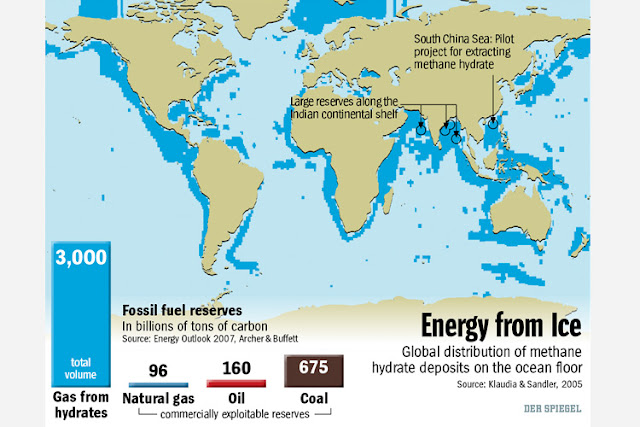
“The worldwide amounts of carbon bound in gas hydrates is conservatively estimated to total twice the amount of carbon to be found in all known fossil fuels on Earth”.

I posted recently about the successful flow test for extracting gas from deep sea methane hydrate conducted in Japan. Of course commercialisation of this technology is still many years away (though Japan hopes this could be as early as 2016). Deposits of methane hydrate are known to be extensive and generally exist either under permafrost or under the sea. The deep sea deposits were laid down under conditions of high pressure (deep sea conditions). India is known to have substantial deposits and this is now getting some people very excited:

Types of methane hydrates deposits

Economic Times:

Estimates of global reserves are sketchy, but range from 2,800 trillion to 8 billion trillion cu.metres of natural gas. This is several times higher than global reserves of 440 trillion cu. metres of conventional gas. However, only a small fraction of hydrate reserves will be exploitable.

Methane hydrate is a mixture of natural gas and water that becomes a solid in cold, high-pressure conditions in deep sea-beds (where the temperature falls to 2 degrees centigrade). It is also found in onshore deposits in the permafrost of northern Canada and Russia. Heating the deposits or lowering the pressure (the technique used by JOGMEC) will release gas from the solid. One litre of solid hydrate releases around 165 litres of gas.

India has long been known to have massive deposits of methane hydrate. These are tentatively estimated at 1,890 trillion cu.m. An Indo-US scientific joint venture in 2006 explored four areas: the Kerala-Konkan basin, the Krishna-Godavari basin, the Mahanadi basin and the seas off the Andaman Islands. The deposits in the Krishna Godavari basin turned out to be among the richest and biggest in the world. The Andamans yielded the thickest-ever deposits 600 metres below the seabed in volcanic ash sediments. Hydrates were also found in the Mahanadi basin.

Formidable economic and environmental challenges lie ahead. Nobody has yet found an economic way of extracting gas from hydrates. Industry guesstimates suggest the initial cost may be about $30/ mmBTU, double the spot rate in Asia and nine times higher than the US domestic price. JOGMEC is optimistic that the cost can be cut with new technology and scale economies.

The Indian National Gas Hydrate Program (NGHP) Expedition was conducted together with the US Geological Service

The World’s Largest Potential Energy Resource
Released: 2/7/2008 9:21:21 AM

An international team led by the U.S. Geological Survey (USGS) and the Directorate General of Hydrocarbons, which is under the government of India’s Ministry of Petroleum and Natural Gas, conducted the expedition.

Highlights include:

  • gas hydrate was discovered in numerous complex geologic settings, and an unprecedented number of gas hydrate cores and scientific data were collected;
  • one of the richest marine gas hydrate accumulations ever discovered was delineated and sampled in the Krishna-Godavari Basin;
  • one of the thickest and deepest gas hydrate occurrences yet known was discovered offshore of the Andaman Islands and revealed gas hydrate-bearing volcanic ash layers as deep as 600 meters below the seafloor;
  • and for the first time, a fully developed gas hydrate system was established in the Mahanadi Basin of the Bay of Bengal.

“NGHP Expedition 01 marks a monumental step forward in the realization of gas hydrates becoming a viable energy source,” said USGS Director Mark Myers. “This partnership combines the expertise of two organizations dedicated to understanding gas hydrates, and research results provide new and exciting information about this important potential energy resource.”

Directorate General of Hydrocarbons Director General and NGHP Program Coordinator V. K. Sibal said, “The global gas hydrate resources are estimated to be huge. Although the exploration and exploitation of gas hydrates pose significant challenges, the opportunities are unlimited. The combined wisdom of the scientific community from across the world could provide the answers and solutions to many of these challenges. The Indian gas hydrate program has been fortunate in having the benefits of a truly global collaboration in the form of the first gas hydrate expedition in Indian waters. The results of the studies are not only encouraging, but also very exciting. I believe that the time to realize gas hydrate as a critical energy resource has come.”

Methane hydrate deposits around the world: Graphic Der Spiegel


Japanese test confirms successsful extraction of gas from deep-sea methane hydrate

March 13, 2013

Methane hydrates represent the largest source of hydrocarbons in the earth’s crust.

“The worldwide amounts of carbon bound in gas hydrates is conservatively estimated to total twice the amount of carbon to be found in all known fossil fuels on Earth”.

JOGMEC has put out a press release:

Japan Oil, Gas and Metals National Corporation which has been conducting preparation works for the first offshore production test off the coasts of Atsumi and Shima peninsulas, started a flow test applying the depressurization method and confirmed production of methane gas estimated from methane hydrate layers on March 12, 2013.
JOGMEC will start analyzing data while it continues the flow test.

Methane hydrate receives attention as one of the unconventional gas resources in the future.
During the period from FY2001 to FY2008, which is Phase 1 of the “Japan’s Methane Hydrate R&D Program”, seismic surveys and exploitation drillings were conducted at the eastern Nankai trough, off the coast from Shizuoka-pref. to Wakayama-pref., as the model area, where a considerable amount of methane hydrate deposits is confirmed.
In Phase 2 of the Program starting from FY2009, aiming to develop a technology to extract natural gas through dissociation of methane hydrate, this is the first offshore test ever conducted. The first offshore production test is planned over a span of two years. In February and March last year, the preparatory works including drilling a production well and two monitoring wells were conducted. From June to July, the pressured core samples were acquired from methane hydrate layers. In this operation, a flow test through dissociation of methane hydrate is conducted after the preparatory works including drilling and installing equipments for the flow test.

Deposits of methane hydrates have been reported in marine sediments in the Nankai Trough off the Pacific coast of central Japan, where the water depth is more than 500 meters. Some estimates indicate that the reserves of methane hydrate correspond to a 100-year supply of natural gas for Japan, making it an important potential source of energy. The Japan National Oil Corporation (JNOC) began research work on methane hydrates in 1995, and JOGMEC has overseen the project since the JNOC’s restructuring. An international joint research team including Japan has obtained successful results in experimental production of methane gas by injecting hot water into a borehole in the Mackenzie Delta in the arctic region of Canada.

With shale gas and shale oil adding to the known reserves of oil and gas and now with the potential exploitation of deep-sea methane hydrates, “peak-oil” and “peak-gas” would seem to have been postponed by a millenium.