Archive for the ‘Energy’ Category
November 17, 2011
Most subsidies for the introduction of uneconomic technologies are in an effort to make them commercially viable. But after 30+ years in the power generation industry I have yet to see a case where this has happened. Instead, subsidies have nearly always been counter-productive. In virtually every case I have seen, subsidies have always been used first to maintain margins rather than to reduce costs. If costs are not reduced then the “indirect” costs for every taxpayer which a subsidy represents eventually end up becoming direct costs for the consumer when the subsidies end.
This is happening to an increasing extent with solar and wind power as subsidies are reduced or withdrawn in the current financial crisis. The costs have then to be borne directly by the consumers and it is not surprising that virtually all countries which have introduced wind power to any extent have seen electricity prices to the consumer increase.
Now it is the turn of the Dutch government to reduce subsidies and pass on the costs directly to consumers.
Reuters reports:
Dutch fall out of love with windmills
(more…)
Tags:Electricity generation, Netherlands, off-shore wind power, Subsidy, wind power
Posted in Business, Energy, Environment, Renewable Energy | Comments Off on Now Holland cannot afford to subsidise off-shore wind power
November 15, 2011
There are some simple and rather obvious matters that the “green” lobbies prefer to ignore.
- In spite of twenty years of subsidies wind power is still not commercially viable without subsidy. Solar thermal power plants enjoy feed in tariffs some 3 times higher than the cost of conventional fossil power generation. Wherever renewables have been used to any extent, electricity prices for the consumer have increased.
- Intermittent sources of power (which cease when the wind does not blow, or blows too hard or when the sun does not shine at night or when clouds appear) are – by definition – unreliable. They do not add to the reliable, base-load, generating capacity that any electricity grid requires and must be backed up. In Scotland for example – as Professor Colin McInnes points out – wind power capacity now exceeds nuclear capacity but only produces about one-third of the energy.
- Electricity is energy in motion and cannot be stored as electricity. For any electrical grid, at any instant, generation must, perforce, equal demand – and pumped storage schemes are merely devices to try and ensure such balance. Since the outages of wind and solar power are unpredictable (though it is generally predictable that solar power will not be available at night), and cannot be relied on to meet load demand fluctuations, “balancing power” (usually from gas turbines) must be arranged for whenever wind or solar capacity is added.
- In addition to the direct subsidies, whenever wind or solar power is available at times when there is low load, the subsidised regime forces the turning-down of other capacity – to the detriment of that capacity – and adds to the total cost of the grid.
Now – finally – some of the real numbers are beginning to be acknowledged but not, of course, by the green lobbies. KPMG has produced a new report
“Thinking about the Affordable” and
Power Engineering International reports that:
Tags:Business, Energy, grid balancing, KPMG, rnewable power, Scotland, wind power
Posted in Business, Energy, Environment, Renewable Energy | 3 Comments »
November 8, 2011
The Russian gas pipeline bypassing all transit countries to Germany by being routed under the Baltic Sea goes live today.
RT: After 13 years of planning and two years of construction, the Nord Stream pipeline will deliver its first supplies of Russian gas to an estimated 26 million homes in the EU on Tuesday.
(more…)
Tags:Baltic Sea, Dmitry Medvedev, European Union, Gazprom, Germany, Nord Stream, Russia, Vladimir Putin
Posted in Business, Energy, Gas, Germany, Russia | Comments Off on Nord Stream gas goes on-line today
September 23, 2011
Juliet Davenport, founder and CEO of something carrying the subjective and emotive name “Good” Energy writes in the New Scientist blog today bemoaning the fact that climate sceptics are winning the argument by the use of emotion rather than science!!
Scientists – she believes – are not doing enough to help her cause. But she might carry a little more credibility if she attempted to use science rather than dogma and consensus. And of course if she did not have a vested interest in extorting subsidies from taxpayers. Clearly Al Gore has failed her in being “charismatic and campaigning”- but then he is no scientist and perhaps he does not count.
A charismatic campaigning voice from the scientific community would make a huge difference in helping to combat the small but vocal minority of sceptics who tend to resort to emotion rather than science to make their arguments. ……..
…. I can’t help but think it would be better to see all government departments arguing more loudly about the long term benefits of tackling climate change and the transition to a low carbon economy. To do that convincingly, however, they need to have information at their fingertips. Scientists have a huge role to play here, debating and responding to claims made through the media and simplifying messages for the public. They need to make the case that a low-carbon economy is not only necessary for tackling climate change, but also that it is technologically possible.
If we are going to act in time on climate change, it is vital that we keep up the pressure on the government to form a policy framework that we can then deliver.
The coming gas glut and the availability of shale gas – now even in the UK – must be giving her nightmares. Without climate change alarmism and the demonisation of carbon dioxide, the cost of wind and solar power would make them non-starters.
But the tide is turning.
Tags:carbon dioxide, climate change, environment, global warming, Juliet Davenport, Low-carbon economy, New Scientist, wind power
Posted in Alarmism, Climate, Energy, Renewable Energy | 1 Comment »
September 22, 2011
“Peak-gas” moves further into the future as recoverable reserves of shale-gas are found in more countries. The coming gas glut is getting ever more real. Now the UK – which was thought to have little shale gas – has found reserves of about 5,700 billion cubic metres of shale gas in Lancashire. Poland -which was thought to be the richest in shale gas resources in Europe has recoverable reserves of about 5,400 billion cubic metres. Till now the British Geological Survey had thought the country possessed only about 150 billion cubic metres.
The map of the world’s shale gas reserves is changing rapidly as exploration for this previously ignored resource intensifies. The gas glut is going to provide relatively cheap options for the use of gas based electricity generation into the foreseeable future. In fact the increase in the cost of electricity which has been driven by the use of renewables and misplaced penalties for fossil fuel could finally be reversed. Needless to say the “environmental” industry – instead of welcoming the finding of new resources – is in a state of denial – and looking for every possible objection to the use of shale gas. The use of intermittent wind and solar power – apart from being so expensive when deployed – always needs back-up capacity and gas fired power generation is the only real option. The gas glut comes just in time for the recovery of the world economy which is now badly needed.
Wall Street Journal: An area in northwest England may contain 200 trillion cubic feet of shale gas, putting it in the same league as some of the vast shale-gas plays that have transformed the U.S. energy industry. The figure for the area near Blackpool, released Wednesday by Cuadrilla Resources, a small oil-and-gas company with operations in England’s Bowland Shale, highlights the U.K.’s emerging position as a new frontier for unconventional gas exploration. But it inflamed environmental groups who say the technology used to extract shale gas is environmentally damaging.
The discovery of such vast resources—200 trillion cubic feet would be enough to meet U.K. gas demand for 64 years—comes at a time when the U.K.’s conventional gas fields are in steep decline and as it is becoming increasingly dependent on imports such as liquefied natural gas from Qatar and piped gas from Norway.
The response from the World Wildlife Fund was predictably alarmist.
In response to Cuadrilla’s announcement, the environmental group WWF called Wednesday for a moratorium on shale-gas production in the U.K. and said the country should be more focused on investing in renewables than increasing its reliance on fossil fuels. “The government should at the very least halt shale gas exploration in Britain until more research can be undertaken on both the climate-change impacts and contamination risks associated with shale gas,” said Jenny Banks, WWF-UK’s energy- and climate-change policy officer.
Tags:"Peak" gas, gas glut, Lancashire, Shale gas, WWF Alarmism
Posted in Energy, Gas, UK | 2 Comments »
September 21, 2011
In August I wrote:
Sometime soon the world’s population will exceed 7 billion. No one knows exactly when. According to the UN Population Reference Bureau, this will happen on 31st October in India or in China. The world’s 6 billionth living person was “suppposedly” born just 11 years ago in Bosnia, and world population is expected to reach 9 billion by 2050. …
But I am no Malthusian and have a strong belief that the catastrophe theories are fundamentally misguided. Peak gas will never happen. Peak oil is a long way away and will be mitigated by new ways of creating oil substitutes as oil price increases. All the dismal forecasts of food production not being able to cope with population have not transpired. …..
Today Matt Ridley, author of The Rational Optimist, has an excellent piece on his blog which is also published in the Ottawa Citizen:
…… Clearly it is possible at least for a while to escape the fate forecast by Robert Malthus, the pessimistic mathematical cleric, in 1798. We’ve been proving Malthus wrong for more than 200 years. And now the population explosion is fading. Fertility rates are falling all over the world: in Bangladesh down from 6.8 children per woman in 1955 to 2.7 today; China – 5.6 to 1.7; Iran – 7 to 1.7; Nigeria – 6.5 to 5.2; Brazil 6.1 to 1.8; Yemen – 8.3 to 5.1.
The rate of growth of world population has halved since the 1960s; the absolute number added to the population each year has been falling for more than 20 years. According to the United Nations, population will probably cease growing altogether by 2070. This miraculous collapse of fertility has not been caused by Malthusian misery, or coercion (except in China), but by the very opposite: enrichment, urbanization, female emancipation, education and above all the defeat of child mortality – which means that women start to plan families rather than continue breeding. ……
Already huge swaths of the world are being released from farming and reforested. New England is now 80 per cent woodland, where it was once 70 per cent farm land. Italy and England have more woodland than for many centuries. Moose, coyotes, beavers and bears are back in places where they have not been for centuries. France has a wolf problem; Scotland a deer problem. It is the poor countries, not the affluent ones, that are losing forest. Haiti, with its near total dependence on renewable power (wood), is 98-percent deforested and counting.
Read the entire article.
Tags:doomsday postponed, Matt Ridley, Population growth, Population Reference Bureau, Thomas Robert Malthus, World population
Posted in Alarmism, Demographics, Energy, Food, Science | 1 Comment »
September 19, 2011
An estimate of the world’s recoverable shale gas reserves in 32 countries is as at least as much again as the world’s proven natural gas reserves as of 2010. This does not include large parts of Africa and Russia, the Middle East and SE Asia. It does not include known resources within the 32 countries but which have not yet been assessed. Fears of any kind of “peak” gas scenario being attained are rapidly disappearing into the future.

US EIA: The initial estimate of technically recoverable shale gas resources in the 32 countries examined is 5,760 trillion cubic feet. Adding the U.S. estimate of the shale gas technically recoverable resources of 862 trillion cubic feet results in a total shale resource base estimate of 6,622 trillion cubic feet for the United States and the other 32 countries assessed. To put this shale gas resource estimate in some perspective, world proven reserves of natural gas as of January 1, 2010 are about 6,609 trillion cubic feet, and world technically recoverable gas resources are roughly 16,000 trillion cubic feet, largely excluding shale gas. Thus, adding the identified shale gas resources to other gas resources increases total world technically recoverable gas resources by over 40 percent to 22,600 trillion cubic feet.
Outside of the US the recovery of shale gas is being planned in many countries. In Europe the rush to recover and use shale gas is being led by Poland which has been dependant upon its own coal and on Russian gas. The shale is not very deep down and is mainly in thinly populated areas. And now the recovery has started and commercial production should start within 10 – 20 months.

Shale gas is abundant in Poland: map via Wikipedia
Wall Street Journal: Shale gas is burning in Poland after gas firm PGNiG SA torched a flare on one of its rigs. Poland wants to become one of the major players in the European gas market within the next two decades, with the state-controlled natural gas firm starting commercial production in 2014.
PGNiG has begun technical production of natural gas from its shale gas concession in Lubocino, a village in northern Poland, and plans successive drilling as the company hopes to tap the country’s potentially vast unconventional hydrocarbon reserves.
Outside the U.S., Poland is the first country where companies are making a serious effort to develop shale gas, which Polish Prime Minister Donald Tusk has called the country’s “great chance,” as it could reduce Poland’s dependence on Russia for gas, create tens of thousands of jobs and fill state coffers.
PGNiG now plans to drill horizontally and conduct further fracturing procedures on this concession, which may be completed in 10-20 months and will enable commercial extraction. …….
Prime Minister Tusk Sunday said he was “moderately optimistic” commercial shale gas production would begin in 2014, which would by 2035 free it from its overreliance on Russia’s OAO Gazprom for natural gas supplies and allow it to be a major player in Europe’s gas.
“After years of dependence on our large neighbor, today we can say that my generation will see the day when we will be independent in the area of natural gas and we will be setting terms,” Mr. Tusk said. Poland’s domestically produced shale gas should be competitively priced compared to gas imported from Russia, a government official said earlier. Exploration in Poland won’t pose a danger to the environment, he added.
China and India have not yet even fully mapped all the shale gas reserves they have but plans for commercial gas production from the reserves already known to exist are being prepared. With the slow-down expected in building nuclear plant the gas “glut” comes just in time for the gas based power production that will be needed when the economic recovery is established. Moreover all intermittent, subsidised renewable energy (solar and wind) need capacity back-up and the only viable option is gas based power plants.
Tags:"Peak" gas, Energy Information Administration, gas glut, Poland, Shale gas, shale gas reserves
Posted in Energy, Gas, Geosciences, Technology | 2 Comments »
August 26, 2011
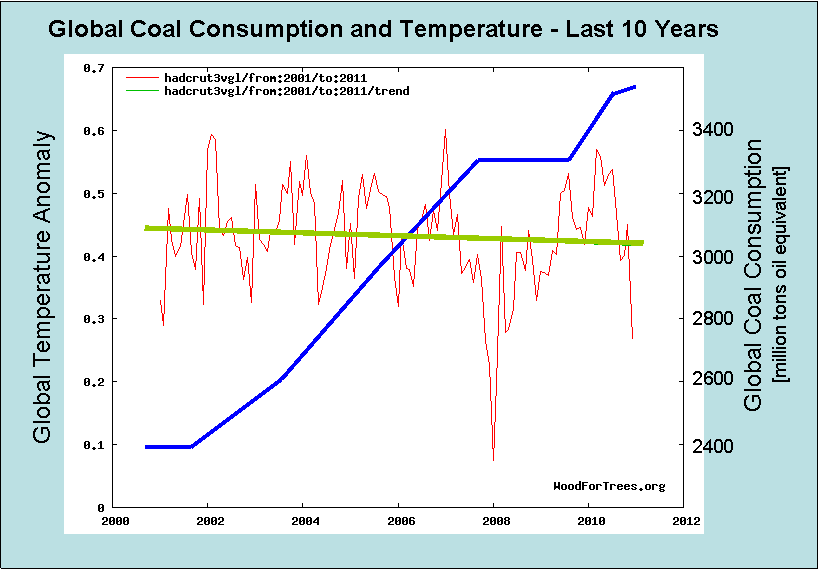
There is a clear disconnect between global coal consumption (and therefore carbon dioxide emissions) and global temperatures.
Of course we must take into account that these are only real data over the last 10 years and are not generated by computer models and have not been validated by the IPCC!!
Quote of the week at WUWT 22nd May 2011
“People underestimate the power of models. Observational evidence is not very useful,” adding, “Our approach is not entirely empirical.” John Mitchell, principal research scientist at the UK Met Office
P Gosselin at NoTricksZone has the “heretical” story:
Global Coal Consumption Jumps Almost 50% – Yet Global Temps Drop!
A recently released BP report here shows that global coal consumption has risen over the last 10 years by almost 50%. So wouldn’t you think that all those millions of tons of emitted CO2 (food for plants) as a result would drive the global temperatures up? Have temperatures risen along with all that extra coal burning?
No they haven’t. In fact they’ve dropped slightly over the same period. So go figure!
In the above chart the blue line shows global coal consumption, data taken here, Review of World Energy. According to the report, India and China alone are responsible for 90% of the world’s coal consumption increase, while renewable energy in the 2 countries plays nary a role. According to BP figures, global CO2 emissions rose 5.8% in the year 2010. ……..
Read source report
Tags:carbon dioxide emissions, climate, Coal, coal consumption, coal consumption disconnected from global temperature, Energy, Fossil fuel, global temperature, IPCC, John Mitchell
Posted in Alarmism, Climate, Energy | Comments Off on Coal consumption increases almost 50% in 10 years and has no impact on global temperature
August 24, 2011
Man-made carbon-dioxide emissions are of little significance in the global concentration of carbon dioxide in the atmosphere and the effect of carbon dioxide concentration on global climate is of even less significance. In fact it is much more likely that CO2 concentrations in the atmosphere follow global temperature rather than the other way around.
Nevertheless there are perceptions of fossil fuel fired power plants being terribly polluting and of being the dominant source of man-made emissions while hydro-power plants are perceived as being totally non-polluting. These perceptions are mainly based on pre-determined political positions and not necessarily on measurements or reality.
A new study from Brazil looking at the impact of hydro power plants and the Balbina dam has been published in the Journal of Geophysical Research. One caveat of course with many such studies is that it is not based on measurements but on some measurement followed by hypotheses built into computer models. Nothing wrong with that of course but the weakness with many model results – as with climate models – is that the results can neither be verified or dis-proved by measurements.
Kemenes, A., B. R. Forsberg, and J. M. Melack (2011), CO2 emissions from a tropical hydroelectric reservoir (Balbina, Brazil), J. Geophys. Res., 116, G03004, doi:10.1029/2010JG001465
Swedish Radio P1:
Electricity from hydropower can lead to several times the emissions of greenhouse gas emissions than produced from fossil fuels. At least from hydro-electric dams in the rain forest areas, according to a new study from Brazil.
The Balbina dam, which was built fifteen years ago, is located north of Amazonas state capital Manaus. When the rain forest area here was flooded large amounts of organic material ended up at the bottom of the pond. Rotting vegetation then caused large emissions of carbon dioxide and methane. According to this study this corresponded to three tonnes of carbon dioxide per megawatt-hour of energy produced, which is almost ten times that of a coal-fired power plants, and just over half of the emissions from burning fossil fuels in the city of São Paulo.
A recently published study of 85 hydroelectric dams in the world shows that emissions vary between different ponds, depending on size, age and what kind of soil is soaked. How big emissions Swedish hydroelectric dams produce has not yet been studied, but estimates indicate that they are significantly lower than from those in tropical areas in Brazil says Professor Philip Fernside of Instituto Nacional de Pesquisas da Amazônia (INPA) in Manaus. “It is true that dams in tropical areas such as the Amazon produces more than ponds in temperate climate, but there are emissions in these areas also” says Philip Fernside.
A pdf version of the paper is here.
Tags:carbon dioxide, emissions from hydro plant, fossil fuel power plant, Hydro power plant, Journal of Geophysical Research
Posted in Brazil, Energy, Environment | 1 Comment »
August 16, 2011
The amounts of money sloshing around in the EU in carbon trading scams is mind-boggling and puts even drug money into the shade. The EU emissions trading scheme has been one of the major drivers of corruption in the last few years. The latest scam to come to trial is in Germany where just the tax evasion amounts to €5 billion ($7 billion). The total value of the carbon trades involved in this particular fraud probably exceed €50 billion. The frauds revealed so far are just a tiny fraction of all the succesful frauds that have been perpetrated – and all with the undoubted help (and connivance) of EU politicians.
It would not be surprising if the total cost of the EU emissions trading schemes (assuming a conservative 80:20 principle) exceeded €250 billion. Eventually, the cost of all these carbon trades will have to be borne by EU taxpayers and electricity consumers.
Reuters reports:
A 5 billion euro tax fraud returned to haunt European Union’s emissions trading scheme on Monday as six individuals faced tax evasion charges at a trial which starts in Frankfurt. The case will haul the market’s multiple scandals back into the spotlight but is unlikely to implicate investment banks following a similar case against small firms in Britain.
In an activity which peaked in May 2009, traders bought carbon emissions permits in one country and sold them in another, charging for and then keeping the value-added tax (VAT) which they should have handed to tax authorities.
- The total value of the fraud was at least 5 billion euros ($7.1 bln) in lost tax receipts, according to Europol
- Charges have been brought against individuals at small firms. Europol said the fraud was linked to criminal networks operating outside the EU including the Middle East
- The biggest swoop, initiated by Germany in early 2010, saw more than 2,500 officers involved across European and other countries
- In Germany, prosecutors said in March that in addition to the six individuals charged, a further 170 suspects including seven Deutsche Bank employees were still under investigation and could be charged later
- In Britain, the first trial of seven suspects risked delay as the investigation unearthed new evidence
- It was easier to open an account on the carbon market registry than to open a bank account, allowing less reputable characters to participate.
- As a new market, tax authorities in EU member states were slower to spot the fraud opportunity
- The fraud was carried out on an unregulated spot market. Participants in such markets do not have to register with financial authorities, unlike in futures markets
- As well as making it easier for fraudsters to gain entry, unregulated markets do not force strict know-your-client (KYC) rules on law-abiding participants meaning criminals escaped detection more easily
- Officials at Paris-based Bluenext have not denied that their spot exchange was used by tax evaders but have maintained that they acted to stop the practice
- French tax authorities are demanding 355 million euros ($505 million) from Bluenext, owned by NYSE Euronext, in unpaid VAT related to trades that occurred on the exchange
- The EU’s head of tax, Algirdas Semeta, and of climate change, Connie Hedegaard, in June sent letters to EU states urging them to apply reverse tax charges which would remove the opportunity to buy EUAs VAT-free and then pocket the tax
- The carbon market has suffered scandals besides VAT fraud, including a phishing attack, the circulation of used emissions permits and cyber theft of EUAs
- The market has seen near-record low prices in recent weeks as the threat of a new downturn widens a glut in permits
Tags:Bluenext, carbon trading scams, Emissions trading, EU corruption, European Union, global warming
Posted in Alarmism, Business, Climate, Corruption, Energy, Ethics, European Union | Comments Off on One EU Carbon trading scam comes to trial: €5 billion just in lost taxes



 The k2p blog