Archive for the ‘Engineering’ Category
May 6, 2011
Shale gas is abundant and now beginning to undercut the price of other sources of natural gas. It is already cheaper than LNG transported around the world which requires both terminals for liquefaction and receiving stations for evaporation. Gas-fired power plants are relatively cheap and quick to build. In simple-cycle operation gas turbine based power plant provide the economic method of choice for emergency power and peak power. In combined cycle operation they provide the highest efficiency of all types of fossil fired electricity generation (around 60%). The ratio of gas price to coal price determines whether this can be cheaper than coal fired power generation.

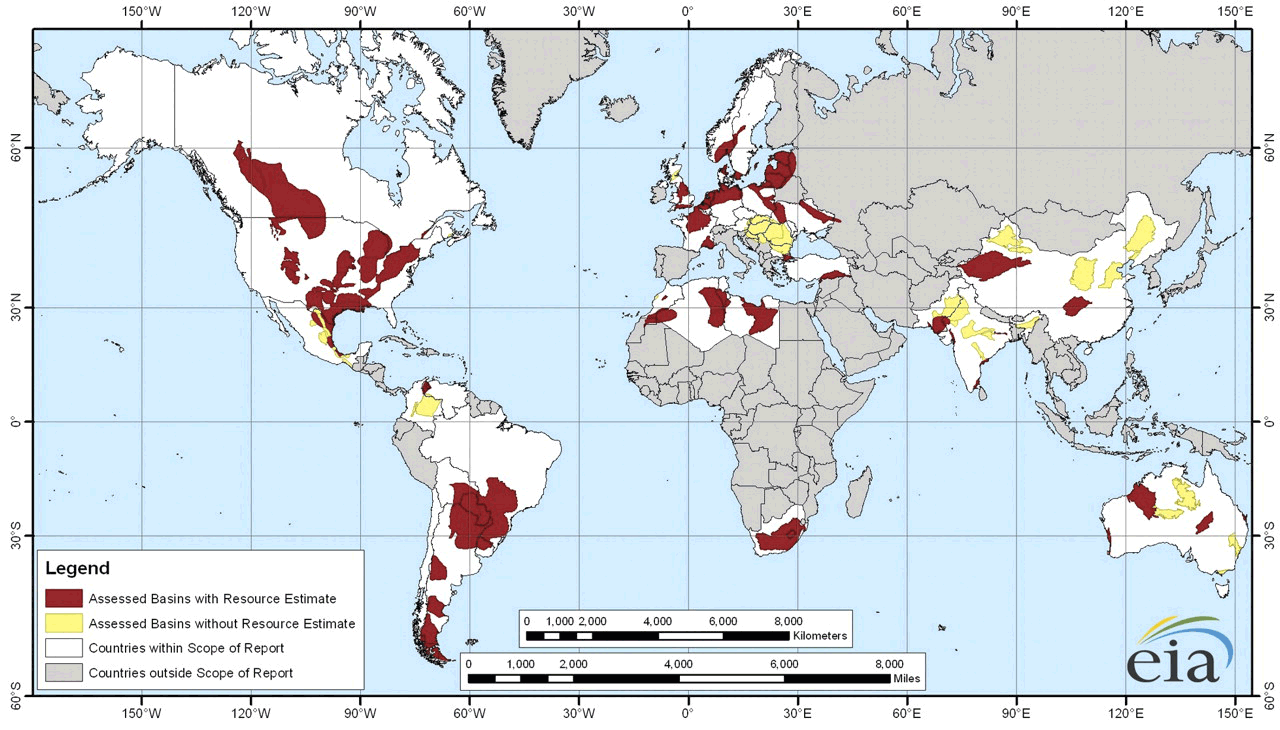
Shale gas is abundant: map via Wikipedia
Total oil, gas and coal resources in the Earth’s crust are estimated at more than 570,000 exajoules. The world will use about 450 exajoules (billion billion joules) of fossil fuel energy this year.
Exajoule
The exajoule (EJ) is equal to 1018 joules. The 2011 Tōhoku earthquake and tsunami in Japan had 1.41 EJ of energy according to its 9.0 on the Richter magnitude scale. Energy in the United States used per year is roughly 94 EJ.
Matt Ridley:
Quantity is not really the point; price is. Most fossil fuels are impossibly hard to extract at a reasonable price. More than half the reserves consist of methane clathrates hydrated gas found mostly on the seabed near the margins of the continents in vast quantities. Nobody knows how to turn them into fuel except at huge cost, although the Japanese are on the case. So the question is not whether we run out of fossil fuels but whether we run out of cheap fossil fuels.
With oil, the answer may be “yes”. A huge amount of oil is still untapped, but most of it is under deep water or in oil sands and is costly to extract. But with gas, the answer is “no”. Most free methane is found in impermeable rocks such as shale, not in permeable “traps” whence it is easiest to extract. Shale gas was thought to be as inaccessible as clathrates, and when it began to be exploited in the 1990s it looked as if it would still come in at the top of the price range. Now technological improvements have brought the price down so far that it undercuts conventional gas.
The “shale-gas shock” will have far-reaching consequences. It will make gas prices lower and less volatile relative to oil than ever before.
This will cause gas to take market share from coal, nuclear and renewables in electricity generation, and from oil in transport. London buses should follow Washington and Delhi in switching to gas both to save money and to produce less smog.
Shale gas is good news for America and China (which probably has even more of it than America), consumers (cheap fuel means higher standards of living) and farmers (fertiliser is made from gas). It is bad news for Russia and Iran (which hoped to corner the gas market in coming decades), for coal (until now the cheapest fuel for electricity) and for the nuclear and wind industries. The last two had expected to be rescued from dependence on subsidies by rising fossil fuel prices. They may now not be.
The losers are formidable enemies, so there is a movement, whose fans range from Gazprom to Greenpeace, to strangle the shale-gas industry at birth, by claiming that drilling for it contaminates water with carcinogenic and even radioactive chemicals. This turns out to be true only in the sense that coffee is carcinogenic, bananas radioactive and dihydrogen monoxide (water) a chemical.
The use of gas for power generation is perfectly sustainable into the foreseeable future. As the hysteria and alarmism around carbon dioxide causing global warming is debunked and begins to fade away the fashionable and unsustainable focus on bio-gas will also die away. The price of electricity production from gas will be the benchmark for judging whether wind and solar power make any sense. Without artificially imposed penalties on carbon or carbon taxes on fossil fuel, bio-gas can never be more than a marginal fuel of little significance. For bio-gas to have any significance catchment areas become so large that food production is adversely affected. The cost of production is relatively high. Without a carbon dioxide scare and the resulting subsidies, wind and solar power are still not able to compete against any form of fossil fuel power generation or hydro power or nuclear power.
But the success of technologies for the extraction of shale gas ensures availability of significant quantities for a long time to come. These quantities are so large that there is no “peak” in sight and all the alarmist “peak” gas scenarios are rendered meaningless.

Moving peaks: Peak gas will never come
Related: Europe told of potential shale gas bonanza
Tags:"Peak" gas, Electricity production, Energy, Shale gas
Posted in Energy, Engineering, Gas, Technology | 3 Comments »
March 14, 2011
The size of the quake and tsunami and death and suffering is enormous. It was an event that comes once in a millenium.
The danger and risk is not over.
Fukushima Dai-ichi nuclear plant is still in a critical situation.
But the Great Hanshin earthquake in 1995 and the destruction in Kobe where “earthquake proofing” was limited because there had not been a sizable quake in the region for some 400 years, and some 6,000 people died after a 7.4 magnitude quake, puts this 9.0 magnitude quake into perspective. The Sendai quake was 8,000 times stronger than the Kobe quake and the massive tsunami was a feature not present in Kobe. In some areas the tsunami came rushing in just minutes after the quake. It is thought that the failure of the 13 emergency diesel generators at Fukushima Dai-ichi were caused by the arrival of the tsunami wave rather than by the quake and that the failure of coolant pumping has led to all the subsequent problems.
It has been good engineering, well developed and strict building standards and a tsunami warning system which has prevented the death toll from being counted in hundreds of thousands or even millions. The events in Fukushima Dai-ichi following this massive quake and tsunami must also be put into perspective against the Three Mile Island and Tjernobyl incidents where there were no natural disasters to be coped with. The majority of the casualties and the damage seems to have been due to the tsunami rather than directly due to the earthquake itself.
Engineering and technology will keep advancing and will never be perfect but I am quite sure that good engineering has saved a very great many.
Tags:Good Engineering, Great Hanshin earthquake, Great Sendai earthquake, Tsunami
Posted in Engineering, Japan, Natural Disasters | Comments Off on The Great Sendai Quake: Millions were saved by good engineering
February 26, 2011
From AFP via PhysOrg

Robovie PC (right) beats his brother Robovie PC-Lite by one second
Robovie-PC, a toy-sized humanoid, won the world’s first full-length marathon for two-legged robots by a whisker Saturday, beating its closest rival by a single second after more than two days of racing.
Five bipedal machines began the non-stop 42.2-kilometre (26.2-mile) contest on a 100-metre indoor track in the western Japanese city of Osaka Thursday morning after doing knee bends or raising their hands to greet spectators.
One of the competitors retired after finishing only the first lap, but the others continued running day and night, getting up by themselves every time they fell to the floor or got into collisions with rivals.
Robovie-PC, 40 centimetres (16 inches) tall and weighing 2.4 kilograms (5.3 pounds), stormed into first place with only a few laps to go after Robovie-PC Lite, which had established a comfortable lead and appeared to have secured an easy victory, suddenly locked up.
Robovie-PC Lite managed to return to the track and fiercely chased the leader, but after 422 laps Robovie-PC crossed the line in 54 hours 57 minutes 50 seconds, organisers said, one second ahead of its rival.
Their average speed was 0.77 kilometres per hour.
After the dramatic finish the two robots — both made by Vstone Co., a robot technology firm based in the industrial city which also organised the “Robo Mara Full” race — waved their arms and bowed, to wild applause from the crowd.
According to the event’s regulations, competitors were allowed to change batteries and the servomotors which control the robots’ speed and other functions.
The other two robots still running had yet to complete the race Saturday evening.
Tags:Osaka, Robot marathon, robotics, Robovie-PC, Vstone
Posted in Engineering, Japan, Technology | Comments Off on Robovie-PC wins robot marathon by one second
February 24, 2011
The world’s first full-length marathon for two-legged robots kicked off in Japan on Thursday, with the toy-sized humanoids were due to run 42.195 kilometres (26 miles) over four days.
http://www.physorg.com/news/2011-02-robot-marathon.html
Five robots are competing. Results will be reported in 4 days.

A humanoid robot named "Robovie-PC" (R) leads in a race against other robots during the world's first full-length marathon for two-legged robots, in Osaka. image:physorg.com
Tags:Osaka, Robot, Robot marathon, robotics, Robovie-PC
Posted in Engineering, Japan, Technology | Comments Off on Robot Marathon underway
February 17, 2011
Qantas half-year profits have already been hit to the tune of $55 million by the failure of the Rolls Royce Trent 900 and the subsequent grounding of their A380 aircraft in November last year. They also stated that there would be a charge of $ 25 million for the second half-year which gives a total cost to Qantas – for this financial year – of at least $ 80 million.
BBC News:
Qantas Airways said its first half net profits had risen four-fold, but it added that last year’s explosion in one of its Rolls-Royce engines had wiped off $55m (£34.4m). The breakdown led to the grounding of its A380 aircraft last year.
The Australian airline predicted 2011 full year profits would be much higher than last year. But it warned that these would be held back by high fuel prices and the recent floods in Queensland.
Qantas said there would be another $25m charge in the second-half results from the A380 problems.
Rolls Royce has already announced a hit on profits for direct costs of £56 million (about $89 million) for the engine explosion and related events for the year till December 2010. No doubt the losses suffered by Qantas will be part of their compensation claim against the engine maker.
With compensation claims due also from Airbus (EADS), Singapore Airlines and Lufthansa and with the additional costs spilling over into 2011, the total cost of the engine mishap will likely exceed my estimate of $300 million.
Estimated costs for Rolls Royce:
- Direct costs $130 million
- Indirect (servicing) costs thru 2011 – $50 million
- Qantas claim – $70 million
- Airbus claims – $50 million
- Singapore Airline claims – $25 million
- Lufthansa claims – $10 million
What impact the loss of potential sales could have is anybody’s guess – but it would be interesting to see if Pratt & Whitney shows a better than expected order intake.
Tags:Airbus, EADS, Lufthansa, Pratt & Whitney, Qantas, Rolls-Royce Trent 900, Singapore Airline, Trent 900 failure
Posted in Australia, Aviation, Engineering, Technology, Travel | Comments Off on Rolls Royce engine failure will eat up $80 million of Qantas profits
February 10, 2011
BBC reports:
Manufacturing giant Rolls-Royce has said the mid-air failure of one of its Trent 900 engines on a Qantas superjumbo had led to costs of £56m. The explosion in the engine forced an emergency landing of the A380 in November last year. The one-off cost contributed to annual pre-tax profits dropping 76% to £702m in 2010 from £2.96bn. Foreign exchange costs and interest rate and fuel hedging contracts also contributed to the profit fall.
But the Derby-based company said that underlying pre-tax profits – which strip out one-off costs – were up by 4% to £955m in 2010 and were a better indication of its performance.
Rolls Royce say that the may face further “modest costs” but this seems to be far too optimistic considering that all the engine servicing costs have yet to show up and all the various compensation claims from Qantas, Airbus, Lufthansa, and Singapore Airline will take some time to work their way through. Once all the claims are presented there is an even chance that some will need arbitration before settlement which will take some time.
Jorn Madslien also writes:
Investors will be scrutinising Rolls-Royce’s financial figures to try to find out how the recent engine failure that led to the grounding of six Qantas Airbus A380 aircraft affected the company. ……..
….. The long-term effects of the engine failure, for instance a potential fall in new orders over the months and years ahead, cannot be measured at this stage. Consequently, the final impact on the company’s bottom line is not yet known.
It does not seem as if Rolls Royce have made any provision for further costs which is a little worrying and I stay with my estimate of around $300 million as the total hit that Rolls will have to swallow for the Trent 900 for the A380 in addition to any impact on engine sales.
Judging from the delays the development cost of the Trent 1000 for the Dreamliner is also likely to be significantly more than budgeted or expected.
It will be at least 2012 before the full financial impact is known though some residual impacts will continue for many years.

The wrecked engine after QF32 landed in Singapore in Nov. 2010:Photo: AFP
Tags:Airbus, Airbus A380, Qantas, Rolls Royce, Rolls-Royce Trent, Trent 900 costs
Posted in Aviation, Business, Engineering, Technology | 3 Comments »
February 9, 2011
The London Design Museum is putting on a special display to celebrate 50 years of the Jaguar E-type from its launch at the Geneva Motor Show in 1961. In the late 1960’s as an apprentice in England, the E-type represented the stuff of our dreams. But back then when my weekly wage as an engineering apprentice was £3- 10s per week, the £2,000 price tag was as unattainable as a date with Sophia Loren!
In the 1970’s when I could aspire to more, I actually considered the Triumph GT6 – also known as the “poor-man’s E-type” – but instead I settled for a much more sedate Renault -12. And by the time I could consider its price tag the E-type was no longer in production and my tastes had a decided preference for the comfort of a Mercedes.
The Design Museum celebrates 50 years of the iconic Jaguar E-Type with a display in the Design Museum Tank.

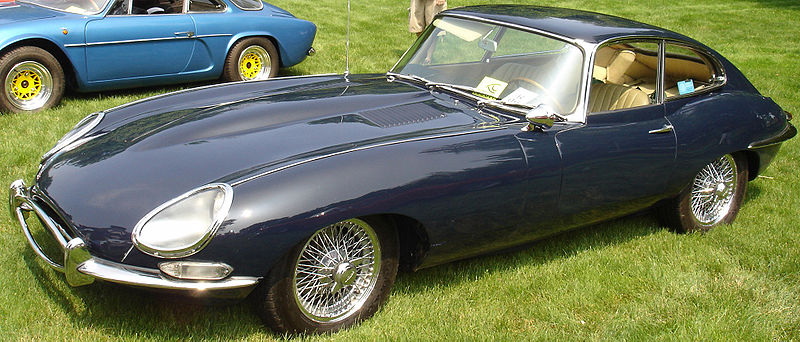
Jaguar E-Type series 1, 1961
Originally launched at the Geneva Motor Show in 1961, the E-Type’s caused an instant sensation. With a 3.8 litre XK engine, a top speed of 150 miles per hour and a price of £2000, the E-Type was an accessible dream and signalled the new era of modernity of the 1960s. Between 1961 and 1974 over 70,000 E-Types were produced.
The bullet-like design of the E-Type was the result of the mathematical and engineering talent of Malcolm Sayer and the E-type was the first large-scale production road car to be developed from the study of aerodynamics. The founder of Jaguar, Sir William Lyons combined his flare for style and luxury with his business and marketing skills to ensure the E-Type became the car of celebrities from George Harrison of the Beatles to footballer George Best
The E-Type on display was manufactured in 1961 and has been provided by Classic Motors Cars Limited.
On its release Enzo Ferrari called it “The most beautiful car ever made”.

Jaguar e-Type series one: image Wikipedia
The E-type was 4.4 m long with a 3.8 litre engine while the GT6 had a length of 3.7 m and a 2 litre engine. Technically and in looks the Triumph GT6 never came close to the E-type, but it looked fast. On the few occasions when I drove a friend’s GT6, my main memory is that it had a decided “tail-wag” when cornering.

1973 Triumph GT6: image Wikipedia
Bot nowadays my tastes are much more sedate and the Jaguar E-type remains the dream it always was. So I shall make do with my Mercedes E-class.

Mercedes E-class 2010: image via Flickr
Tags:50 years E-type, Geneva Motor Show, Jaguar E-type, Mercedes-Benz E-Class, Triumph GT6
Posted in Automobiles, Design, Engineering, Technology | Comments Off on The E-type turns 50
January 30, 2011
Ria Novosti today:

MOSCOW, January 30 (RIA Novosti) 18:45 30/01/2011
The Russian icebreakers Krasin and Admiral Makarov have rescued the ice-trapped mother fishery ship Sodruzhestvo ending the month-long operation in the Sea of Okhotsk.
“The operation to rescue the Sodruzhestvo mother ship out of ice trap has been completed,” Russia’s Ministry of Transport said in a statement on Sunday.
The icebreakers resumed towing the vessel, stuck in the Sea of Okhotsk, toward clear waters on Wednesday. The rescue operation was earlier suspended due to poor weather conditions.
The Sodruzhestvo, Bereg Nadezhdy ship and the Professor Kizevetter research vessel, carrying altogether over 400 people, got stuck in two-meter-thick ice in the Sea of Okhotsk on December 31. Two other ships, the Mys Yelizavety and the Anton Gurin, became trapped a few days later.
The Admiral Makarov released the Professor Kizevetter and the Mys Yelizavety vessels from the ice trap, while the Anton Gurin managed to cope on its own. The Bereg Nadezhdy was successfully towed to clear water on January 24.
Tags:Icebreaker Admiral Makarov, Icebreaker Krasin, Russia, Sea of Okhotsk
Posted in Engineering, Environment, Russia, Technology, Weather | Comments Off on Okhotsk rescue over and icebreakers end operations
January 28, 2011
The Space Shuttle Challenger’s maiden flight was on 4th April, 1983, and it completed nine missions before breaking apart 73 seconds after the launch of its tenth mission, STS-51-L on 28th January, 1986.
A sombre anniversary today.
A special ceremony is taking place at the Kennedy Space Center’s visitor complex this morning. Members of the NASA family and the public will gather to honor those who died aboard space shuttle Challenger.
Twenty-five years ago the STS-51L crew boarded Challenger for a six-day flight. It was just after liftoff when things went wrong. Challenger was in the air for 73 seconds before the orbiter exploded. …. According to investigators’ findings, the cause of the explosion was an O-ring that failed in one of the solid rocket boosters. Cold weather was cited as a contributing factor.

The breakup of the space shuttle Challenger: 28th January 1986: Wikipedia

Challenger crew; El Onizuka,Christa McAuliffe, Greg Jarvis, Judy Resnik, Mike Smith, Dick Scobee, Ron McNair: image christa.org
Today is also 4 days short of 8 years since the space shuttle Columbia was destroyed during rentry.
Space Shuttle Columbia (NASA Orbiter Vehicle Designation: OV-102) was the first spaceworthy Space Shuttle inNASA’s orbital fleet. First launched on the STS-1 mission, the first of the Space Shuttle program, it completed 27 missions before being destroyed during re-entry on February 1, 2003 near the end of its 28th, STS-107. All seven crew members were killed.
The investigation found that 82 seconds after launch a large piece of foam insulating material from the external tank broke free and struck the leading edge of the shuttle’s left wing, damaging the protective carbon heat shielding panels. This damage allowed super-heated gases to enter the wing structure during re-entry into the Earth’s atmosphere and caused the destruction of the Columbia.

Columbia was commanded by Rick Husband and piloted by William McCool. The mission specialists were Michael Anderson, Kalpana Chawla, David Brown, Laurel Clark; and the payload specialist was Israeli astronaut Ilan Ramon: image NASA
Currently the 3 operational orbiters are the
Space Shuttles Discovery, Atlantis and Endeavour.
Tags:Challenger accident aniversary, Space Shuttle, Space Shuttle Challenger, Space Shuttle Columbia
Posted in Engineering, Science, Space, Technology, US | Comments Off on 25 years since Challenger exploded; almost 8 years since Columbia was destroyed
January 26, 2011
The Rolls Royce Engine Syndrome (RES) strikes again.
This time – one very thirsty engine
Flight QF2 carrying 352 passengers was about 30 minutes into its flight from Bangkok International Airport when one of its engines began “consuming fuel more quickly than normal” a Qantas spokesman said.
It was forced to return to Bangkok where it landed safely about 7pm local time (11pm AEST). Affected passengers are expected to spend a second night in temporary accommodation with Qantas scrambling to send a replacement engine from Sydney for the troubled Boeing 747 today.
“As far as possible we will try and get passengers who need to return to Sydney urgently on other flights but that will be dependent on availability on other airlines,” the spokesman said.
“It was not actually an engine failure, (the pilots) did not shut the engine down they just reduced the thrust.” However one passenger on the flight says the engine “blew”.
The spokesman said there were no other replacement Qantas aircraft available in Bangkok.
Read more: http://www.news.com.au/travel/news/another-engine-problem-for-qantas/story-e6frfq80-1225994833407#ixzz1C7bLqCgl
Tags:Boeing 747, Qantas, QF2, RB 211, Rolls Royce, Rolls Royce Engines
Posted in Aviation, Business, Engineering, Technology | Comments Off on Once again: Qantas + RR engine + B747 = return to base






 The k2p blog