Archive for the ‘Engineering’ Category

Trade war! Cerium oxide price has risen 665% since April

October 22, 2010
Phase diagram of cerium in english

Phase diagram cerium: Image via Wikipedia

Freely translated from Dagens Industri

Cerium oxide, which is used to finish semiconductors and obtained from the rare earth element cerium, has risen in price from $ 4.70 per kg on April 20 to 36 U.S. dollars a kilo on Tuesday, October 19. An increase of 665 percent.

The price rise is primarily due to China scaling down its export quotas. In recent years there has been a gradual reduction of 5-10 percent per year, but in July alone it was reduced by 40 percent.  The country accounts for almost 95 percent of world supply of rare earths and in some cases almost 100 percent.

The official explanation from China is that the  country’s own industrial needs must be met first. These account  for 60 percent of global demand. Producing earth metals is a dirty business and China also gives environmental reasons as an explanation for the lower export quotas.

But many, especially in the U.S., suspect that it is a low-key trade war.

Resource depletion is imaginary

October 19, 2010


Limits of growth

Doomsaying: Image by net_efekt via Flickr


“Humanity’s demands on natural resources are sky-rocketing to 50 per cent more than the earth can sustain”

trumpets the WWF.

Similar headlines have been common-place for the last 40 years. “The Limits to Growth” in 1972 was not the first time such dire predictions were made. They only carried on from where Malthus left off with his  An Essay on the Principle of Population in 1798. And before Malthus there were plenty of alarmists and doom merchants  at least as far back as mankind has lived in complex societies where opportunists could exploit people by fears of catastrophes and impending doom.

Unfortunately, today’s so-called conservationists have descended to the level of doom “merchants”. Either they are propagating fears of humanity running out of food or oil or coal or metals or water or rare earths or they are screaming about the Earth running out of biological species or of polar ice or sustainability.

But I am not convinced.

Actually, mankind destroys nothing. At the elemental level we neither create or destroy anything (except in the use of nuclear energy where some elemental transformation takes place and where some little mass is converted to energy). All the metals we use or the fuels we use are merely transformed from one compound to another and occasionally some molecules are reduced to their elemental form. The Earth as a system loses only heat (and if the global warming maniacs are to be believed we are not even losing that). The mass of the earth changes only by the accretion of meteors and the leakage of atmosphere and this change is of no material significance.

All the elements that were available remain available. The forms of compounds that we currently use and which have been created slowly by slow natural processes may well be used up. But so what? Mankind has always used what is available and when natural rubber was not enough we made synthetic rubber. We usually take what is available and transform it into the form we want. We take metal oxides, reduce them to the elemental metals and then recombine them into the qualities of steel or alloys we need. We take oil and convert it into plastics. We take plant material and make paper. We take other plant material and make oils. We take sand and make glass. We take limestone and make cement or concrete. We are a carbon-based life form. We use carbon in all its forms as diamonds and all organic materials and now as graphene for nano-materials. We take oil and make food. Nearly all the drugs we use are synthesised.

Even if we restrict ourselves to the known form of the resources we use, we cannot forget that 70% of the Earth’s surface is covered by water. We have not even begun to see what can be found there. Even the off-shore oil and gas we extract hardly scratches the (submerged) surface. We are crowding out some particular species but keep finding new ones. The number of mammals (but not necessarily species) in existence is increasing rather than reducing. The diversity of life in the sea is hardly touched.

The overwhelmingly pessimistic view of mankind and its future which drives the current-day conservationists to their creed of “stop everything” goes nowhere. “Stop the World, I wan’t to get off” is not something for me. A strategy for humanity – like any other strategy – cannot be based on “what not to do”.

I suppose it is the difference between an optimist and the doom sayers. I see no energy crisis – only some technological challenges to be met. I see no food crisis – only some tasks to be carried out, and these tasks do not need any technological breakthroughs. The Earth and the Sun will take care of climate as they see fit and our task is to adapt to whatever changes may come and not to waste our time in any futile attempt to try and control it. We could stop using all energy today and the Earth and the Sun will still cause climate change to happen and mankind is not even a bit player in that music.

I remain an optimist and I believe in the human ability to develop technology. As educational standards improve, human population will probably increase till about 2050, then reduce slightly from about 10 billion people and then stabilise at a very slow rate of growth. This development will be dynamically coupled to our rate of technological development which will continue but where we cannot predict the rate of breakthroughs appearing. A breakthrough in transportation methods (and since the invention of the modern internal combustion engine for transport in 1862, this is now overdue) or a breakthrough in food synthesising technology or finding new sources of energy (and I do not mean wind or solar) will have an obvious effect on quality of life and on rate of population growth.

A true environmentalist must be first concerned with the quality of life for humankind. The “environment” devoid of humans is no environment at all. I wish the so-called conservationists (who are not in my opinion true environmentalists) would stop telling me what not to do.

There is no resource crunch. There may come shortages of resources in the form we are used to but I have supreme confidence in our ability to develop the required technologies to keep improving on our quality of life – and to keep evolving.

Now UK joins the nuclear renaissance with 8 plants approved

October 18, 2010

The quiet nuclear renaissance continues with the UK now announcing its plans.

http://www.telegraph.co.uk/earth/energy/8070810/Eight-new-nuclear-power-stations-despite-safety-and-clean-up-concerns.html

Chris Huhne, the UK Energy Secretary, has given the go-ahead for eight new nuclear power stations in Britain despite concerns about safety and the clean-up costs.

The new nuclear power stations will be built near existing sites in in Bradwell in Essex, Hartlepool, Heysham in Lancashire, Hinkley Point in Somerset, Oldbury in South Gloucestershire, Sellafield in Cumbria, Sizewell in Suffolk and Wylfa in Anglesey.

Three sites in Dungeness in Kent and Braystones and Kirksanton in Cumbria were ruled out due to concerns over the impact on wildlife and the Lake District National Park. The new stations will not start generating power until 2018 so the Government also plans to allow existing nuclear stations to extend their life.

Nuclear Engineering International reports that


AREVA EPR


The government also signed a regulatory justification for the AP1000 and EPR reactor designs. Following 2004 regulations, it is required to justify that new reactors are worth the potential radiological risk. Following three consultations have taken place—one on the regulatory review, and one on each design—the government decided not to launch a further public consultation on the matter.

The AP1000 is a Westinghouse designed  1154 MWe PWR nuclear power plant. The EPR reactor is an advanced Pressurized Water Reactor (PWR) offered by AREVA and which is being built in Finland, France and China.


Westinghouse AP1000: Westinghouse


Virgin Galactic’s VSS Enterprise makes its solo flight

October 11, 2010


Drop test (Virgin Galactic)

The Enterprise spaceship is released from underneath the Eve carrier plane


Virgin Galactic conducted the first piloted gliding flight of its commercial suborbital spaceship, the VSS Enterprise, today, releasing the winged rocket plane from the WhiteKnightTwo mothership at an altitude of 45,000 feet above the Mojave Desert.

With Scaled Composites pilot Pete Siebold and copilot Mike Alsbury at the controls, the futuristic twin-tail spacecraft glided to a touchdown at the Mojave Air and Space Port 11 minutes after its release from WhiteKnightTwo, also known as Eve. The craft was not equipped with a rocket motor for the glide test.

“The VSS Enterprise was a real joy to fly, especially when one considers the fact that the vehicle has been designed not only to be a Mach 3.5 spaceship capable of going into space but also one of the world’s highest altitude gliders,” Siebold said in a Virgin Galactic press release.

Branson said he expects rocket-powered test flights to begin next year, followed by test flights into space “hopefully by the end of next year.”

Read more: http://news.cnet.com/8301-19514_3-20019149-239.html#ixzz121kUYP79

Read more: http://www.bbc.co.uk/news/science-environment-11511604

Three Gorges Dam to reach full water level this month

October 4, 2010

The Three Gorges Dam is a hydroelectric dam that spans the Yangtze River by the town ofSandouping, located in the Yiling District of Yichang, in Hubei province, China.

Map of the location of the Three Gorges Dam, Sandouping, Yichang, Hubei Province, China and major cities along the Yangtze River

Three Gorges Dam location: Wikipedia image

The dam body was completed in 2006. Except for a ship lift, the originally planned components of theproject were completed on October 30, 2008, when the 26th generator in the shore plant began commercial operation. Each generator has a capacity of 700 MW. Six additional generators in the underground power plant are not expected to become fully operational until 2011. Coupling the dam’s 32 main generators with 2 smaller generators (50 MW each) to power the plant itself, the total electric generating capacity of the dam will eventually reach 22,500 MW.

Xinhua reports  from Yichang, Hubei that the water level at the Three Gorges Dam, the world’s largest water control project, reached 164.59 meters on Sunday, only 10 meters short of its full capacity of 175-meters. The dam in central China started to hold back water this September by discharging less to the lower reaches of the Yangtze River, the country’s longest river.

When the water level is at its maximum of 175 metres over sea level (110 metres above the river level downstream), the dam reservoir is about 660 kilometres  in length and 1.12 kilometres  in width on average, and contains 39.3 km3 of water. The total surface area of the reservoir is 1,045 km². The reservoir flooded a total area of 632 km² of land, compared to the 1,350 km² of reservoir created by the Itaipu Dam on the border of Brazil and Paraguay (which has a  generating capacity of 14,000 MW).

File:Yangtze longitudinal profile upstream.JPG

Yangtze longitudinal profile: Wikipedia image

Reaching the 175-meter water level would enable the Three Gorges Dam to fulfill its functions of flood control and generating electricity to the fullest extent, symbolizing the total success of the massive water project. This is the reservoir’s third attempt to reach full capacity since 2008. However, water levels stopped at 172.8 meters in 2008 and 171.43 meters in 2009 due to droughts on the lower reaches.

However, this time officials believe the dam will reach full capacity by the end of October.

Changed Landscape of the Three Gorges Dam region. (NASA/Goddard Space Flight Center Scientific Visualization Studio).

Airbus engineering to grow in India

October 3, 2010
Airbus A320 (9M-AFA) der Air Asia

Airbus A 320: Wikipedia

The Telegraph:

Airbus expects India to need around 1,000 new planes over the next 20 years, compared with 3,000 in China. Air traffic has expanded by 16pc in India this year.

Airbus, which has 68 per cent Indian market share, as measured by orders, believes it can build on its current success by selling more aircraft. The European plane maker is also building relationships on the ground. It has 25 partners in India, eight of them top-tier suppliers. Airbus is also leaning more and more on Indian engineers.

The company will decide this week whether to go ahead with its next development programme, a new engine for the single-aisle A320 plane that generates much of Airbus’s profit. “Airbus has never made a secret that our engineering resources are stretched thin,” Mr Enders said during a two-day visit to Airbus’s Indian operations in Bangalore last week. “We’re taking this decision very seriously because we cannot afford that other programmes, especially the 350, should suffer.”

At its base in Bangalore, Airbus has 160 engineers working on the A350 and A380 programmes in conjunction with staff in France, Germany and Britain. The company plans to have 200 staff at the engineering centre by the end of the year and 400 by 2013. India produces around 350,000 engineering graduates a year, about 25pc of which Airbus describes as “employable”. “I don’t think 400 is going to be the final number, there is a huge pool of talent we can tap into,” said Mr Enders. “In terms of the work we sub-contract, there’s a lot more to come.”

In the past, most of the work done for Airbus by external suppliers has been making parts of the airframe, and while some manufacturing work is now being done in India, it is the engineering and technology base that is more attractive, Mr Enders said. “IT, simulations, technical publication – all these are things which India is particularly good at,” he said.

It makes sense and is inevitable that more will shift to India and China – where the market is.

Rain and lack of wind hit UK renewable generation

October 1, 2010

The Guardian reports that

The UK has suffered a second fall in renewable energy production this year, raising concern about the more than £1bn support the industry receives each year from taxpayers.

Wind turbine accident

Lower than expected wind speeds and rainfall led to a 12% fall in renewable electricity generated between April and June, compared to the same period in 2009. This setback follows a smaller but still notable decline between January and March, again compared to last year.

The DECC admits that “The intermittent nature of wind means that we do need alternative back-up generation, for when wind speeds drop” but should have added that alternative capacity is also necessary when it blows too hard and when it is too cold and when the foundations are cracking and …

Seasonal power generation can contribute marginally to energy needs but cannot provide base-load power generation.

Wind is not always as benign as it is made out. The “Summary of Wind Turbine Accident Data to 31 December 2008” reports 41 worker fatalities.

China’s second moon probe Chang’e-2 to launch this weekend

September 30, 2010

From Space.com:

On Thursday, workers will begin fueling the Long March rocket that will blast the unmanned Chang’e-2 probe into space from Xichang Satellite Launch Center in Sichuan province, Xinhua reported. Launch will occur “at an appropriate time” between Friday — China’s National Day, when the country marks 61 years of Communist rule — and Sunday (Oct. 3).


Chang'e-2 lunar probe


Chang’e-2 is the second step in China’s three-phase Chang’e moon exploration program, which is named after China’s mythical moon goddess. Chang’e-2 will test out technology and collect data on possible landing sites for the Chang’e-3 spacecraft, which is scheduled to land on the moon in 2013. According to the state news agency, Chang’e-2 should arrive at lunar orbit about five days after launch. It will eventually swoop down to an orbit just nine miles (15 km) above the lunar surface to take high-resolution pictures of landing areas for Chang’e-3. After snapping the photos, Chang’e-2 will retreat to an altitude of about 62 miles (100 km) to conduct a study of the lunar surface and dirt.

The Chang’e-1 probe  launched in October 2007 and conducted a 16-month moon observation mission, after which it crash-landed on the lunar surface by design, in March 2009.


The launch of Long March 3B Rocket, Xichang Sa...

Image via Wikipedia:Long March 3B Rocket launch


Michibiki navigation satellite in position over Japan

September 30, 2010

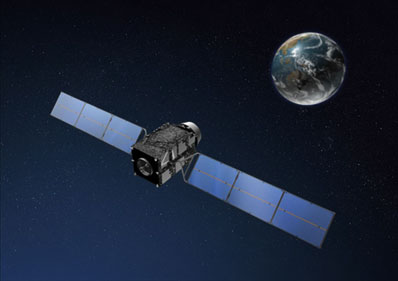
Japan’s first navigation satellite has arrived on station more than 20,000 miles over Asia to improve positioning coverage in mountainous terrain and urban centers.

Artist's concept of the Michibiki satellite. Credit: JAXA

MICHIBIKI injected into the quasi-zenith orbit with its center longitude of about 135 degrees.

The First Quasi-Zenith Satellite MICHIBIKI, which was launched by the H-IIA Launch Vehicle No. 18 on Sept. 11 (JST,) has been maneuvered to shift its orbit from the drift orbit to the quasi-zenith orbit starting on the 21st. The satellite is now confirmed to be inserted into the quasi-zenith orbit over Japan with its center longitude of about 135 degrees through the final orbit control performed at 6:28 a.m. on Sept. 27. The MICHIBIKI was launched from the Tanegashima Space Center at 8:17 p.m. on September 11, 2010 (JST.)

Yoshinobu Launch Complex

Yoshinobu Launch Complex at the Tanegashima Space Center: JAXA

JAXA’s press release is here:

http://www.jaxa.jp/press/2010/09/20100927_michibiki_e.html

Rolls Royce Trent 1000 fix is in place

September 28, 2010

RR Trent 1000 cutaway

On August 2nd a  production standard ‘Package A’ Rolls-Royce Trent 1000 engine suffered an engine failure while on the test stand at the company’s Derby, UK facility. The ‘Package A’ engines do not incorporate upgrades planned for the ‘Package B’ engines, which will bring the specific fuel consumption target within 1% of planned spec. The failure – which has been described as an “uncontained failure” – of the Trent 1000 engine, which powers the Dreamliner, resulted in “limited debris being released into the test facility,”
At the time a Rolls-Royce spokesman rejected speculation that the unavailability of the engine that Boeing required was related to the incident earlier this month at one of its test facilities in Derby, England, saying the events were “unrelated,” though he declined to elaborate.

Aviation Week: Rolls-Royce says it is already testing an upgrade to the Trent 1000 engine to mitigate a component problem that caused a failure of one of the turbofans this month. The engine maker suffered a Trent 1000 engine failure this month on a test stand in Derby, England, with the powerplant in a sea-level testbed configuration at high power. The engine suffered an intermediate pressure turbine-related failure because of what is being called an “inappropriate operating regime.”

Rolls officials note that ground and flight trials have not been affected, nor is the miscue expected to affect the larger 787 schedule. Rolls supplies the Trent 1000 to Boeing 787 lead customer All Nippon Airways.

Although some elements of what transpired are understood, a Rolls-Royce official notes that “we are now investigating in detail and have made good progress in understanding the issue.” The company was aware of the issue, so later model Trent 1000 builds already have a fix in place, which is now also being installed on engines built to the earlier standard.

The grapevine as to what transpired on August 2nd points to an oil fire in the high pressure compressor drum leading to a failure of the intermediate pressure (IP) shaft. One industry source says once the IP shaft failed, the mounted IP turbine disk moved rearward, causing its blades to impact the low pressure (LP) turbine inlet guide vanes. The result was the separation of the IP turbine disk, which subsequently spun out of the casing and into the test stand.  The same source adds that the “non-adherence to test procedures” was the root cause of the failure, saying that the “stand crew ran more cold starts in close succession than allowed without purging of fuel and oil that accumulate within the engine in places these fluids are not supposed to be.”

Bloomberg reports today that Boeing delayed the 787’s first delivery last month for the sixth time, saying Rolls-Royce wasn’t going to be able to supply an engine needed to finish flight testing. A $17 million Trent 1000 blew up during testing on Aug. 2, forcing Rolls-Royce to close the plant for repairs to the Derby, England, site used to test engines for the 787 and the Airbus SAS A350.

Dreamliner with RR Trent 1000 engines

Boeing Co. said Rolls-Royce Group Plc has a remedy for the August blowout of a jet engine for the 787 Dreamliner aircraft and the two companies will discuss it in meetings in Seattle this week.

A Rolls-Royce team will brief Boeing on a plan that supports the latest target for delivering the delayed Dreamliner at the beginning of next year, Boeing Commercial Airplanes President Jim Albaugh said. Boeing parked one of its five Dreamliner test jets earlier this month to replace one of its two Rolls-Royce Trent 1000 engines that had experienced a power surge before takeoff. Albaugh said a fix is already in place to address the issue, which Boeing has said was unrelated to the engine blowout.