Archive for the ‘Environment’ Category

Mount Merapi winds down and Indonesia plans ending of Emergency period

November 19, 2010

The Indonesian news agency ANTARA reports that:

The government is to end the emergency response period for the Mount Merapi eruption disaster on November 24, a cabinet member said.

“We will maintain the emergency response period until November 24. Whether the period will be extended or not will depend on the situation,” Social Welfare Minister Salim Segaf Al-Jufri said.
Speaking to newsmen on when visiting Magelang district on Thursday, he said Mt Merapi evacuees could return home after the volcano`s “beware” status had been lowered.

After the end of the emergency response period, the National Disaster Management Agency (BNPB) would begin implementing the reconstruction and rehabilitation programs for Mt Merapi victims, he said. “Houses that have been damaged or destroyed will be rebuilt and people who have lost cattle will be financially compensated. The funds to pay for people`s dead cows would be taken from the state and regional government budgets”, he said.
Salim Segaf Al-Jufri further said his ministry had at its disposal Rp397 billion in funds to help disaster victims. Eighty percent of the amount was to meet the victims` physical needs and the rest for operational expenses. But there also was more than Rp3 trillion in stand-by funds to respond to the needs of reconstruction and rehabilitation, he added.
Mount Merapi had erupted repeatedly in the past two or three weeks but its most fatal eruptions occurred on October 26 and November 5. As a result of the eruptions, at least 259 people had perished and many others sustained burns and became displaced.
Topographischer Atlas zur Reise durch Java: Magdeburg, Verlag E. Baensch 1845
via wikipedia.de.
Merapi from the South
File:Merapi-Suedseite.jpg

UN cholera and protests against UN reach Port-au-Prince

November 19, 2010
Map of Haiti

Haiti: image via Wikipedia

With its official population of 1 million and its estimated population of perhaps 3.5 million with many in refugee camps, Port-au-Prince is particularly susceptible to a cholera epidemic. The hope of containing the outbreak of UN cholera and preventing it from getting established in the capital are fading as more cases appear. Yesterday the protests against the UN also spread to the capital. So far 3 protesters and over 1100 cholera victims have been killed, directly or indirectly, by the UN. The number of infected is officially said to be over 18,000 but in reality may be as many as 100,000.

The BBC reports:

Protests linked to the outbreak of cholera in Haiti have spread to parts of the capital, Port-au-Prince.

Police fired tear gas as demonstrators set up barricades and threw rocks at United Nations vehicles. On Monday, clashes between residents and UN troops in the north had left two people dead. Some Haitians blame UN peacekeepers from Nepal for bringing cholera to the country – a claim denied by the UN. Sporadic gunfire could be heard on Thursday as protesters took to the streets of Port-au-Prince, which was devastated by a massive earthquake in January.

In its latest update, the Atlanta-based Centers for Disease Control (CDC) said the course of the disease was “difficult to predict” as it was the first cholera outbreak in Haiti for more than a century.  “The Haitian population has no pre-existing immunity to cholera, and environmental conditions in Haiti are favourable for its continued spread,” it said. The CDC said about 1.3m Haitians remained in camps following the earthquake and the camps’ “ability to provide centrally treated drinking water, adequate sanitation, handwashing facilities, and health care varies”. Just 17% of Haitians had access to adequate sanitation before the quake, the CDC said, adding that the situation had considerably worsened since then. US health experts say Haiti is vulnerable to further outbreaks.

It is thought that the cholera originated from septic tanks at a base for UN peacekeepers from Nepal. While the UN denies this and undercounts the number of cases in a totally misguided public relations exercise, the Swedish sources (Ambassador Claes Hammar and Svenska Dagbladet) are adamant about the UN being the source. Over 80% of people who carry the bacteria show no symptoms and since cholera is endemic in Nepal it is very likely that the troops from Nepal exhibited no symptoms but it is apparent that the UN did not test them to ensure that they were not carriers.

Elections in Haiti are due on November 28th and the UN’s communications “experts” seem to be incompetent. Spinning the truth to under-play the extent of the disease and and to deny responsibility is a fundamental PR mistake.

Case of UN cholera reaches Florida from Haiti while UN “spins” information

November 18, 2010

UPDATE from Operational Biosurveillance:

Current official stats are more than 18,382 cases and 1,110 fatalities.  This includes more than 1,800 cases in Port au Prince with over 30 fatalities.

  • Conservative estimates therefore suggest 75,000 cases of cholera in Haiti to-date, the majority of which were subclinical.
  • In some areas of Haiti, we have confirmation that in-patient statistics are under-reported by as much as 400%. In many areas of Haiti, we are documenting outbreaks that are not being accounted for in the official statistics.  We therefore estimate the upper bound of estimated case counts to be 250,000.
  • We are now pursuing answers to the question of uptake by indigenous zooplankton and spread along oceanic currents that pass west of the Gonave Gulf, which is where the Artibonite River discharges, north and west along the northern Cuban coastline and north to the waters east of Florida.
  • Tomorrow is Vertieres Day, where we may see some degree of population mixing, particularly in the north.  It is unclear at this time to what degree the recent violence will affect observance of the holiday.  Holidays are opportunities to spread disease further as populations intermingle.

As noted by HEAS one week ago and yesterday officially acknowledged, cholera is in the  Dominican Republic.  We expect to see medical clinic inundations inside DR in the near future.

As expected, Florida has reported a case of cholera in a returned traveler.  There will be more cases in the United States; we believe it likely more cases are inside the US unreported.  Implications for the United States are neglible.

The cholera introduced into Haiti by the UN has spread not only into the Dominican Republic but also to Florida through a traveller from Haiti. Diplomats have confirmed that the disease has come with UN troops from Nepal where the disease is endemic. It is unlikely to spread in the US since the propagation of cholera is through water or food that is contaminated by the bacterium Vibrio cholerae.  For an epidemic, the source is often the feces of infected people. The New York Times reports:

The first known case of cholera in the United States linked to the outbreak in Haiti was confirmed Wednesday by health officials who said a southwest Florida woman contracted the disease while visiting family in a region at the heart of Haiti’s epidemic.

The Florida Department of Health was investigating several suspected cases of the disease elsewhere in the state. They were not believed to be connected to the verified patient, who sought treatment this month at a hospital emergency room in Collier County. The woman spent five days in hospital after developing diarrhea and dehydration, classic symptoms of cholera, following her return from Haiti, where she had spent time in the Artibonite region. She is expected to recover fully.

“We are lucky in the state of Florida, and the U.S. generally, to have a very sound infrastructure for our food, water and sewage,” said Rob Hayes, spokesman for the Florida Department of Health. “With that in place, and with our aggressive public health practices, we are not concerned about this being a significant public health threat.”

The situation is more dangerous in the Dominican Republic where conditions are more conducive to the spread of the disease. In Haiti official reports give over 1100 deaths and over 18,000 infected.

There are reports that the actual number of cases may be being grossly under-reported.

On November 14, Operational Biosurveillance said it confirmed statistics of up to 400% undercounting.

“We now have nearly 60k cases shedding pathogen into the environment. We believe the true statistic to be closer to more than 100k based on the degree of under-reporting. It is extremely difficult to estimate the true scale of this epidemic now. (It’s) grossly uncontrolled, uncontained, (and) has exceeded public health capacity to investigate and assess every site reported and every sample received.”

It seems that political considerations are now leading to all information being subject to political “spin”.

  1. For reasons of not upsetting the Nepalese Government and to defuse the local anger, the UN officially denies that the cholera originated with the troops from that country.
  2. With elections due in Haiti in just two weeks all information about the cause of the outbreak and the extent of the spread is being down-played to avoid further exploitation by some politicians and further riots.

Haiti – till now – had been free of cholera for over a hundred years. No doubt the priority now must be to treat those infected and contain the spread of the disease. But UN processes are clearly wanting and the sooner they come out of “denial” and address their own methods and processes the better.

UN cholera spreads from Haiti to Dominican Republic

November 17, 2010
Map of Haiti

Haiti: image via Wikipedia

After diplomats confirmed yesterday that the cholera outbreak in Haiti had been brought in by UN personnel from Nepal, cases have also been detected in the neighbouring Dominican Republic.

While the UN is still denying that its troops from Nepal have introduced the disease, it seems that they are carrying out some mis-judged PR exercise in the face of the following:

  1. the cholera strain found in Haiti is that which is endemic in Nepal,
  2. the UN military camp has had cases,
  3. Haiti has not seen cases of cholera for over 100 years until this outbreak, and
  4. the disease has broken out even in areas which were not affected by the earthquake on 12th January.

It would be quite wrong to blame the poor Nepalese soldiers who face endemic cholera at home but it is certainly an indictment of UN systems and processes that over 1000 have died in Haiti which has not seen cholera for over 100 years.

The BBC reports:

The Dominican Republic has detected its first case of cholera, following the outbreak of the disease in neighbouring Haiti last month.

The patient is a Haitian migrant who had recently returned from his homeland, the health minister said.

The Dominican authorities had stepped up border controls and health checks to try to stop cholera from spreading from Haiti. More than 1,000 Haitians have died of the disease.

Dominican health minister Bautista Rojas said the patient, a 32-year-old Haitian construction worker, was being treated in isolation in the eastern town of Higuey.

Like Haiti, the Dominican Republic had not had a confirmed case of cholera in more than a century until this year.

In Haiti, the government says 1,034 people have died and the disease is still spreading rapidly. The epidemic has provoked fear and anger in Haiti. The country was already struggling to recover from a devastating earthquake in January which killed about 230,000 people in and around the capital Port-au-Prince and shattered its already poor infrastructure. On Monday two people died during violent protests against UN peacekeepers, whom some Haitians accuse of bringing cholera into Haiti. At least one of the men was shot dead by the UN troops.

The UN has said there is no evidence to support allegations that cholera was brought into Haiti by peacekeepers from Nepal, where the disease in endemic.

So much for biodiversity!

November 16, 2010
Procambarus clarkii taken near a lake in Giron...

Red Swamp Crayfish: Image via Wikipedia

Spain is preparing to rid its shores of foreign species of plants and animals that are considered a danger to the ecosystem says The Telegraph.

Successful species which threaten weaker species but which are considered “foreign” are to be eliminated by human intervention – and all in the name of biodiversity!

An exhaustive list of non-native species has been targeted for control or eradication by Spain’s Environment Ministry to protect the country’s own flora and fauna.

The inventory of 168 “alien invaders” that were introduced accidentally or deliberately to the Iberian Peninsula and are now not welcome includes the American mink and raccoon, which found their way from commercial fur farms into Spain’s countryside where their population has boomed.

Other species have been introduced intentionally but are deemed a threat to native varieties. The Zebra Mussel and Red Swamp Crayfish have both been identified as causing serious harm to indigenous species and habitats and with causing “a negative impact on agricultural production”.

The Ruddy Duck, introduced to Europe as an ornamental species, is one of the worst culprits because of its aggressive courting behaviour and willingness to interbreed with endangered, native duck species.

Besides the impact on biodiversity and agriculture some species can also cause problems for human health.

The Asian Tiger mosquito originally native to areas of south-east Asia has in the last couple of decades invaded many countries because of increasing international travel and transport of goods. The insect is a vector for Chikungunya fever which can cause severe illness in humans. Invasive plants species, such as the Galenia pubescens and Water hyacinth are choking the sand dunes of southern Spain and clogging water courses.

But not all foreign species are considered a threat. The draft proposal includes a measure that will exempt from extermination those species considered beneficial to the environment. The Barbary Sheep, native to North Africa and introduced to a national park in Murcia, will be offered protection. Certain fish species, notably carp, pike and bass, will be restocked in the rivers Ebro and Tagus.

Cholera in Haiti introduced by UN Nepalese troops confirms Swedish Ambassador

November 16, 2010
A man, apparently turning on a water pipe, is ...

"Turning on the cholera": Image via Wikipedia

It would seem that the cholera tap in Haiti was “turned” on by UN troops.

Translated freely from Svenska Dagbladet:

Violent riots have erupted in Haiti after rumors of the cholera infection
having originated from the Nepalese UN staff – something which the UN denied. But now, the Swedish Ambassador Claes Hammar has confirmed that the rumor is true. ” I’ve had it confirmed by a diplomatic source that the cholera comes from Nepa ” he told Svenska Dagbladet.

Since the earthquake on 12 January, cholera has taken hold in the extreme poor living conditions in Haiti. The epidemic broke out in October and since then more than 900 people have died and 15 000 are believed to be infected.

Violent riots broke out yesterday in the cities of Cap Haitien, Hinche and Milot, when hundreds of people attacked the UN mission, MINUSTAH. The riots began after a rumor that previously infected Nepalese UN personnel took cholera to the island. The UN has always denied the rumors.

But now Claes Hammar, Sweden’s ambassador to the country has confirmed for Svenska Dagbladet that the information is correct. Two weeks ago he visited Haiti. “Yes, unfortunately it is so. It has been shown that the cholera is from Nepal. This is obviously a strain of the disease that is prevalent in Nepal and now it seems that to have ended up in Haiti. I have received the information from a diplomatic source. It is 100 percent accurate. We have taken samples and traced the infection to Nepal”.

Meanwhile, the U.S. Centers for Disease Control and Prevention, found that the cholera epidemic in Haiti came from South Asia, but it had not identified any specific country. Cholera has never previously been detected in Haiti.

The cholera began to spread in areas that were not affected by the earthquake and only after the Nepalese forces arrived. The UN has also accepted that health problems exist at the UN base, but says that the soldiers are not behind the cholera outbreak.

“It is of course very sad that this has happened. But one should not forget the disease spreads because of poor hygiene. The UN is making great efforts to combat the outbreak “, said Claes Hammar.

The violence that erupted yesterday in Haiti occurred just two weeks before presidential and parliamentary elections due on November 28. Svenska Dagbladet can also reveal that, according to an internal UN report it is the notorious rebel leader Guy Philippe, wanted by U.S. authorities for drug smuggling, who is behind the riots.  He is thought to have started the riots across Haiti by sending out many text messages in which he asked the locals to attack the UN force. The UN headquarters in Cap Haitien was attacked by hundreds of people who threw stones and bottles.

The violence escalated later in the day, when several police stations were attacked and burned down. A hospital in the town of Milot was attacked by hundreds of people protesting that the hospital was accepting cholera patients. At the same time the Nepalese UN troops were subjected to stone throwing by a large crowd in the town of Hinche. The soldiers responded with tear gas. Local people also opened fire on UN troops in Cap Haitien who were forced to shoot back in self defense, according to a statement from the UN.
Two Haitians have died and dozens were injured in the disturbances. Seven of the United Nations force were injured.

Paraguay suspends Natural History Museum’s “genocide” expedition

November 16, 2010
Very approximate location of the Gran Chaco (U...

Gran Chaco area: Image via Wikipedia

I posted a few days ago about the dangers of the Natural History Museum’s planned 60 – 100 strong “expedition” to the forests of Paraguay.

Today comes news that on Monday Paraguay suspended a British scientific expedition into the remote Chaco woodlands after indigenous rights groups raised concerns over the welfare of protected tribes in the region.

Sponsored by Britain’s Natural History Museum, the 45-member British-Paraguayan expedition planned to conduct a month-long survey of animal and plant life in the sprawling savanna 800 kilometers (500 miles) north of Asuncion, the ministry said in a statement.

The decision to suspend it followed “last minute” concerns raised by indigenous rights groups including Iniciativa Amotocodie, and recommendations by the Washington-based Inter-American Human Rights Commission, the environment ministry said.

“The massive presence of about 60 researchers in the land inhabited by the Ayoreo tribal groups in the remote, northern reaches of Chaco… poses significant risks to their lives and territory,” Amotocodie said in a statement.

The rights groups argued that since the tribes have had very little contact with the outside world they are at risk of contracting diseases that in some cases could prove fatal.

It would have been far better if the Natural History Museum had itself suspended the expedition and had taken the initiative to carry out the consultations which it is now forced to conduct.

Seattle pi:

Paraguay denied authorization Monday for a British-led scientific expedition to catalog plants and animals in the country’s remote northern corner, saying there isn’t enough time to consult with relatives of nomadic Indians who try to remain isolated as they pass through the area.

The non-governmental Amotocoide Initiative, an advocacy group for native Ayoreo Indians who live in the dry forests of northern Paraguay, had warned that scientists might carry European diseases to the Indians, leave trash or otherwise suffer violent encounters.

Isabel Basualdo, director of the biodiversity office of Paraguay’s environmental ministry, said in a statement that the decision follows the recommendation of the Interamerican Human Rights Commission that public hearings and all other legal requirements are complied with before such a visit.

Richard Lane, the British Natural History museum’s director of science, said the expedition had been suspended while consultations take place. “We believe that this expedition to scientifically record the richness and diversity of the animals and plants in this remote region is extremely important for the future management of this fragile habitat,” Lane said in a statement.

But some anthropologists who advocate for the Ayoreos say no outsiders should enter these dry forests, where small bands of people are still trying to live in isolation from the modern world. Irene Gauto, who represents the private environmental group Guyra Paraguay, told The Associated Press that the environment ministry “sent a letter to the British museum arguing that, for now, it’s better to delay the visit of the scientists because there hasn’t been time enough to hold public hearings with the relatives of the forest-dwelling Ayoreos,” one of 20 surviving indigenous groups living in Paraguay.

The trip was to begin Saturday to the Chovoreca and Cabrera-Timane hills near Paraguay’s border with Bolivia and Brazil, about 500 miles (800 kilometers) northeast of the capital. The scientists planned to catalog species on a private cattle ranch within a Paraguayan nature reserve. The ranch’s owners approved the trip and said indigenous people didn’t live there, Gauto said.

The government appeared ready to approve the trip. But the situation changed after a leader of the Totobiegosode subgroup of Ayoreos, Chiri Etacori, said about two dozen nomadic Ayoreos wander through the area.

Merapi Evacuees Ignore Volcano Threat to Go Home

November 15, 2010

Jakarta Globe:

Thousands of Indonesian families returned to their villages Monday even as scientists warned Mount Merapi volcano remained a severe threat and more bodies were found buried in the ash. Carrying their belongings on motorcycles and pickup trucks, more than 30,000 people had left emergency shelters after the government reduced a 20-kilometre (12-mile) exclusion zone by as much as half in certain districts. Most of the returnees were from Boyolali, Klaten and Magelang districts where the danger zone had been reduced.

Mount Merapi, a sacred landmark in Javanese tradition whose name translates as “Mountain of Fire”, had killed 259 people as of Monday’s count. Disaster Management Agency spokesman Sutopo Purwo Nugroho said 367,548 people were still living in shelters on Monday, about 30,000 fewer than on Sunday.

Merapi spewed clouds of gas and ash as high as four kilometres Sunday but volcanologist Subandrio said this was “small compared to the 14 kilometres in previous days”.

“It’s safe for people to go home as long as they stay outside the danger zone,” he added. The government maintained the 20-kilometre danger zone for Sleman district, on the southern slopes of the mountain, as “there’s still a probability of heat clouds going in that direction”, he said.

In another report The Jakarta Globe says that evacuees leaving the camps have been asked to sign waivers before returning home:

About 600 evacuees left two shelters in Boyolali on Friday to return to their homes in the Selo and Cepogo subdistricts. Volunteers at the shelters tried to persuade them to stay, but the evacuees were insistent. Those who wanted to leave were eventually made to sign a statement saying that they were leaving the shelters voluntarily.

“We will still monitor them and give them food aid because food is still scarce at the mountain slopes,” a volunteer told Metro TV. Another shelter located in Tlogo village, Prambanan subdistrict, Klaten, was almost empty. Most of the 1,200 evacuees had returned to their homes, arguing that their cattle and fields were deserted.

Mount Merapi in 1920

File:COLLECTIE TROPENMUSEUM Rijstvelden bij de vulkanen Merapi en Merbaboe op Java. TMnr 60007940.jpg

Mt. Merapi ca. 1920: Thilly Weissenborn (Fotograaf/photographer). Lux Fotostudio (Fotostudio).wikimedia commons

Water levels in the Murray-Darling basin are highest since 2001

November 14, 2010
Second version of a Murray catchment map

Murray Darling Basin: image via Wikipedia

After 10 years of drought, heavy rainfall has left the Murray-Darling Basin now so full of water that controlled spillages are having to be made to prevent levels becoming too high. The Sydney Morning Herald:

AFTER years of drought, there are dams and reservoirs across the Murray-Darling Basin where controlled spilling is taking place to keep levels within specified limits. The amount of water stored in the basin is close to 19,000 gigalitres, the highest level since November 2001. The Bureau of Meteorology water storage website, which monitors more than 25,000 gigalitres of storage, reports that basin storages are now more than 74 per cent full, compared to 29 per cent a year earlier.

Several reservoirs have reached capacity, including the Menindee Lakes, Burrendong Dam and Blowering Reservoir in NSW, and the Hume Dam on the NSW-Victoria border near Albury. A year ago the Hume Dam was at 39 per cent and the Blowering Reservoir at 36 per cent.

A spokeswoman for the Murray-Darling Basin Authority confirmed it had been forced to spill water from the Hume Dam and Lake Menindee to prevent the storages rising above specified levels. More rain is forecast for the Murray-Darling Basin tomorrow and on Monday, but the bureau’s deputy director for water, Robert Vertessy, said it was ”50/50” whether storages would break through the 75 per cent mark because a lot of the rain was expected to fall in areas that have no further capacity.

”What is spectacular is how much it has gone up in the last year,” Dr Vertessey said. In the long term it was very unlikely that basin storages would ever reach 100 per cent because rainfall patterns varied across the basin and some dams, such as the Dartmouth in north-eastern Victoria, had enormous capacity compared to the drainage area they serviced, Dr Vertessey said.

Replenished water storages mean that many farmers are now receiving their full general allocation of water. Trading of temporary water allocations has ground to a halt in many areas and the price of water in one exchange has fallen to $45 per megalitre, down from $200 a year ago and a peak of about $1200 in late 2007.

Meanwhile the Guide prepared by The Murray-Darling Basin Authority came under fire because the computer models used to prepare the Guide did not (or could not) account for some 20% of the water flows in the basin. The Guide has proposed drastic cuts in irrigation flows and this not at all popular with farmers. The Australian reports:

KEY assumptions about water flows in the Murray-Darling Basin guide are under challenge from newly released figures. It emerged that 20 per cent of basin water flows were not included in scientific models. The models were used to recommend cuts of up to 37 per cent in irrigators’ water entitlements.

In technical volumes published with the guide, the Murray-Darling Basin Authority said the complexity of hydrologic modelling made it difficult to consider a large range of scenarios on sustainable diversion limits in a timely way. Hydrologic models have been developed for all major rivers in the basin in conjunction with the states and the CSIRO. “Overall, about 80 per cent of current surface water use under current diversion limits in the basin is explicitly represented in the hydrologic modelling framework,” the guide says.

The National Farmers Federation seized on the concession, saying it would challenge key assumptions in the guide. NFF chief executive Ben Fargher said he would challenge how the plan had identified environmental assets for protection and the modelling for environmental water requirements. “They are saying because of the complexity of all the hydrological models it has been difficult for them to do the modelling, and so they’ve used analytical tools,” he said. “We are not confident in that. In our view it is not robust, not good enough and we are going to challenge it.” NSW Irrigators Council chief executive Andrew Gregson said the guide’s modelling “has holes in it” and the authority needed to be 100 per cent certain, given the enormous ramifications for the communities along the river.

Last night the authority defended the guide and Wentworth Group of Concerned Scientists chief executive Peter Cosier described the science behind it as “some of the best in the world”. The authority said the 20 per cent of water flows not represented in hydrologic models would not affect recommendations about water allocations or environmental flows.

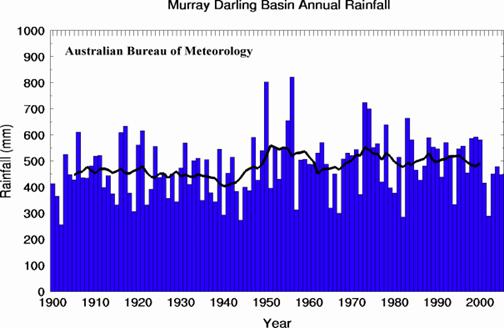
The 10 years of drought have often been attributed to climate change but rainfall records over the last 100 years  suggest that the variation of rainfall and of the subsequent water levels are nothing unusual. Online opinion has this to say:

The Australian Bureau of Meteorology has information on rainfall right back to 1900. The rainfall record for the Murray Darling Basin (see chart below) shows there have been periods of as low rainfall in the past. The 11-year rolling average, the trend line shown in chart, indicates there has been no general increase or decrease in rainfall over the last 100 years. Carbon dioxide levels have increased by about 30 per cent over this same period.

Indeed the rainfall record for the Murray Darling Basin would suggest it is drawing a long bow to blame the current drought on climate change.

Murray Darling Basin Annual Rainfall

Merapi eruptions slowing down but still deadly

November 13, 2010

Mount Merapi volcano continued spewing hot gas ash but not as violently as before. But the death toll continues to climb as people succumb to their injuries.

Mount Merapi spews volcanic material as seen from Argomulyo, Indonesia, Friday, Nov. 12, 2010.(AP Photo/Achmad Ibrahim)

The Jakarta Globe now puts the toll at 240 lives:

Indonesia’s Mount Merapi volcano has killed 240 people since it began erupting late last month, with more than 390,000 people in makeshift camps, an official said. That figure continues to rise as people with severe burns die from their wounds and officials count those who have died from respiratory problems, heart attacks and other illnesses related to the blasts.

In addition, search operations continue for bodies buried under a thick layer of ash that shrouds whole villages. On Friday, soldiers pulled eight more bodies from around one hard-hit village, said Waluyo Rahardjo, who works for the search and rescue agency.

The Associated Press reports:

Ash has continuously shot out of the crater since it roared to life Oct. 26, occasionally canceling international flights into and out of Jakarta, hundreds of miles (kilometers) to the volcano’s west. After the output slowed overnight, an advisory from the Volcanic Ash Advisory Center in Darwin, Australia, showed the ash patch was well clear of the capital. The airport in Yogyakarta, at the foot of the mountain, however, remained closed.

Officials warned residents that less ash does not mean the volcano is finished.

“The activity of Merapi is still high, but the intensity of eruptions is reducing now. But people still should be careful. Merapi is still on high alert,” said Surano, a state volcanologist who uses only one name.

While officials struggle to persuade hundreds of thousands of people who live on the volcano’s fertile slopes not to return to their homes, a new kind of evacuee has been seen in recent days. Villagers checking on their homes and crops have seen Javan leopards — who live in a national park near the crater — heading down the mountain.

The cats likely feel the continuing tremors, said Tri Prasetyo, who runs the park, and are seeking safer ground. It’s also possible that prey is scarce in areas scorched by searing gases.

Aceng , a Java leopard, released back into the wild. Credit IAR

The Javan leopard — a subspecies of the cat only found on the island of Java — is critically endangered, with no more than 250 left in the wild. Some put the total population as low as 50.

Joko Tirtono, the manager of a zoo in Yogyakarta, said zoo keepers are now searching villages where the leopards have been spotted and laying traps in which they hope to capture the cats alive.