Archive for the ‘Ethics’ Category

Multiple investigations of multiple allegations of image manipulation at University of New South Wales

October 22, 2013

A supposedly game changing skin cancer drug, a number of retractions of papers, drug trials suspended, allegations of image manipulation, allegations of misconduct from other noted scientists and at least 3 different investigations by his Univesrity, surround Professor Levon Khachigian of the School of Medical Sciences at the University of New South Wales.

At least 6 papers are involved (of which 4 have already been retracted). The University is facing criticism for the pace of their investigations and there are some suggestions that commercial interests may be involved.

ABC News reports:

Research overseen by an eminent scientist at the University of New South Wales is again under investigation following concerns about alleged research misconduct.

The latest allegations centre on a scientific paper into the genetics of heart disease co-authored by Professor Levon Khachigian.

A research team overseen by Professor Khachigian has received many grants from bodies such as the National Health and Medical Research Council, including an $8.3 million grant for 2014 looking at cardiovascular disease research.

The research in question was published in the journal PLOS One in July 2012.

It focused on how muscle cells change into plaque – a key cause of heart attacks.

A scientist complained to the university, saying he believed one of the images appeared to have been manipulated. A letter sent to the university’s vice chancellor of research says “in figure 5, one of the panels has been duplicated, rotated 180 degrees and then used to represent cells treated with a different compound.”

“If anomalies are found, it will be necessary to (conduct interviews) individually to determine who was responsible and whether they were deliberate or accidental,” it says.

The university has conducted an initial investigation and the ABC understands it believes there is a prima facie case of research misconduct.

Professor Khachigian was in the news earlier this year about image manipulation and the suspension of the skin cancer drug DZ13.

ABC News (August 2013):

Clinical trials of an experimental cancer drug have been suspended after serious questions have been raised about the accuracy of some of the scientific data behind it.

The ABC has learnt that the University of New South Wales (UNSW) is investigating a number of allegations concerning the science and data underpinning the DZ13 compound.

DZ13 was developed by an Australian team of researchers led by Professor Levon Khachigian and heralded as a super drug in the fight against skin cancer.

Two investigations conducted at the UNSW into allegations against Professor Khachigian and his team found that there was no evidence of research misconduct.

But the current investigation was prompted by further concerns raised separately by an eminent Australian scientist and one of the former researchers on DZ13.

Both are concerned that images in a paper on DZ13, published in the Journal of Biological Chemistry in 2010, may not be genuine. ……

….. Professor David Vaux is an internationally acclaimed cell scientist at Melbourne’s Walter and Eliza Hall Institute and lectures worldwide on research ethics.

“I think that anybody who has concerns of scientific misconduct, there’s an ethical responsibility for them to raise those concerns with either the designated person to receive allegations of misconduct or with the journal editors or with the authors of the paper,” he said.

In late 2009, he came across images in three papers from Professor Khachigian’s lab relating to genetic research in the Journal of Biological Chemistry that he was concerned were inappropriately duplicated. 

He wrote twice to the journal about his concerns that the images were not genuine.

In July 2010, the three papers were retracted by the authors, who said that the presentation of the images was a genuine error.

In February this year, Professor Vaux came across another paper in the Journal of Biological Chemistry that he said raised similar concerns of image duplication. This paper was focusing on DZ13.

Professor Vaux says this time there was more urgency, as the paper gave support to DZ13, which was about to be administered to patients in clinical trials.

He wrote to the vice-president and deputy vice-chancellor (research) at the University of New South Wales, Professor Les Field, asking for him to carry out an investigation.

I wish to alert you to concerns I have over a possible case of research misconduct at the UNSW. In the paper attached I have annotated the images that I am concerned about…

They appear to contain duplications and/or alterations of images in such a way that the same data is used to represent two different conditions.

Professor Vaux also contacted the National Health and Medical Research Council in June.

I believe it would be important to act quickly, as patients may currently be receiving the agent described in the publication, DZ13, as part of a clinical trial.

If the results in this paper are not genuine, the Human Research Ethics Committee that approved the trial might have been misled, and the patients receiving the drug might not have been able to give properly informed consent.

Corruption is in the genes of the EU

October 20, 2013

In the developing world venality is often a matter of survival. In Europe venal behaviour is a matter of choice. The EU bureaucracy in Brussels has corruption in its genes and tax-payer’s money running through its veins. It is remarkable that so many ostensibly democratic countries (at least in name) have so easily surrendered their powers to a bloated and corrupt group in Brussels.

It is not Best in Class that applies. The Least Common Factor applies in Europe. Brussels is as corrupt and as wasteful and as inefficient as the worst country in Europe. In this case the corruption and the condoning of corruption in Brussels is as bad as in Greece. And corruption in Greece was not a small contributor to their financial problems.

Der Spiegel writes:

Anti-corruption officials in Brussels have failed to investigate reports of squandered EU funds at a training institute in Greece, a German paper reported Friday. Well-connected teachers were allegedly paid up to €610 per hour for up to 225 work hours per month.

The European Anti-Fraud Office (OLAF) has reportedly ignored repeated tip-offs about squandered European Union funds in Greece, according to an article in the Friday edition of the Süddeutsche Zeitung. The German daily reports that a Greek civil servant uncovered multiple cases of nepotism and vastly inflated salaries while inspecting the finances of a vocational training institute. Officials in Brussels have apparently not acted on any of the whistleblower’s suspicions, which he communicated in several letters, the paper added.

According to the newspaper report, Giorgos Boutos, a government finance official in Athens, began auditing the books of the Organization for Vocation Education and Training (OEEK) in 2006. The institute receives and distributes EU funds earmarked for vocational training in Greece. Boutros repeatedly stumbled upon irregularities and documented the cases in numerous letters to OLAF.

…. The case involves at least €6 million ($8.2 million). It’s not an excessive sum of money, but it is well documented. Boutos was able to substantiate the irregularities in his letters to the EU with contracts, hotel bills and bank statements. He reportedly found that 75 percent of the misappropriated money had come from the EU.

The details provided by the Süddeutsche Zeitung are sure to raise eyebrows. Some of the instructors are said to have been paid for up to 225 hours per month, even during periods when they were abroad. Hourly wages for teachers were reportedly as high as €610. The alleged corruption was compounded by apparent instances of nepotism: The son of a cabinet member taught a course on silver-plating watches, the wife of a Socialist politician led classes on both dentistry and geography, and relatives of the institute’s leader held jobs there.

….. It wasn’t until seven months — and several more inquiries — later that Boutos received fresh news about the case. Still, that letter merely stated that OLAF was in the process of “a comprehensive reorganization,” and asked him to be patient. 

Meanwhile, Boutos told the newspaper, many similar cases of misspent EU funds now fall under the statute of limitations because the EU took too long to address them. Exactly €516,000 of misappropriated EU funds have been repaid. But Boutros stressed that the EU could demand that all such funds be paid back — that is, if it really wanted to.

Boutos also questioned whether investigations had been delayed because some suspected fraud cases involved relatives of government and party officials — or whether Brussels even cared at all about such instances.

Bora’s gardening leave ends in resignation from Scientific American

October 19, 2013

Following the noise and the revelation that his sexual harassment was not just an isolated incident, Bora Zivkovic’s position was no longer tenable. The resignation from Scientific American was almost inevitable but editor-in-chief Mariette DiChristina cannot escape some reprimand. Both she and the magazine need to make some kind of public statement and acknowledgement that their support for their own DN Lee was wanting. The Press release about Bora’s resignation contains nothing about her initial censorship “Following recent events, Bora Zivkovic has offered his resignation from Scientific American, and Scientific American has decided to accept that resignation”.

IndyWeek:

Scientific American has an anti-harassment policy. We offer live and online anti-harassment training to those who manage employees. We’ve recently begun providing such training to individuals who work with freelancers and contractors as well. We take allegations, such as those that have appeared online this week, very seriously. When Monica Byrne contacted Scientific American a year ago, we investigated her report, offered the Company’s apologies and Ms. Byrne acknowledged in her blog that she was satisfied with our response. We were unaware of any additional allegations until this week.

Zivkovic, who lives near Pittsboro, has admitted to engaging in inappropriate and unwanted sexual advances toward Byrne. However, he claimed it was an isolated incident. In the last week, at least a half-dozen women have come forward with similar accounts of interactions with him.

One more scientist of Indian origin found to have faked data in the US

October 18, 2013

Nitin Aggarwal – a researcher in cardiology – apparently falsified and invented data. Once again a scientist of Indian origin caught faking data. Perhaps it’s the peer pressure – but it does make for depressing reading.

This is scientific fraud and  – once again – I wonder why scientists and scientific bodies should not be held liable and accountable for their “product” which is whatever they publish.

Maybe it is time to sell my shares in BMS.

Retraction Watch reports:

Nitin Aggarwal, formerly of the Medical College of Wisconsin, faked data in his PhD thesis, grant applications to the NIH and American Heart Association, and in two papers, according to new findings by the Office of Research Integrity.

(The case would have apparently first been published in the Federal Register on October 2, except for the government shutdown.)

Here were their findings:

…the Respondent engaged in research misconduct by falsifying and/or fabricating PHS-supported data in six (6) figures that were included in the following two (2) publications, one (1) grant application to the American Heart Association (AHA), one (1) grant application to NIH, and the Respondent’s Ph.D. thesis:

  • Aggarwal, N.T., Principal Investigator (P.I.), National Scientist Development grant application to the American Heart Association No. 11SDG7650072, “Sulfonylurea rReceptor-2 splice variant and mitochondrial mechanisms for cardioprotection and arrhythmia” (hereafter the “AHA grant application”).
  • K99 HL113518-01, “Mitochondrial ATP-sensitive K-channels and pharmacological approaches for cardioprotection,” Aggarwal, Nitin, Ph.D., P.I.
  • Aggarwal, N.T. “Endothelial 15-lipoxygenase regulates vasorelaxation and blood pressure in rabbits in normal and pathological condictions.” A Dissertation Submitted to the Faculty of the Graduate School of Biomedical Science of the Medical College of Wisconsin in Partial Fulfillment of the Requirements for the Degree of Doctor of Philosophy, Milwaukee, Wisconsin, 2008 (hereafter the “thesis”).

…………

Aggarwal won a $1,000 award for his dissertation in 2009. According to his LinkedIn profile and a recent speaker announcement, he’s now working at Bristol Myers-Squibb. We’ve tried to reach BMS for comment, along with the Medical College of Wisconsin, and will update with anything we learn.

Update, 6 p.m. Eastern, 10/17/13: The Medical College of Wisconsin tells us they have no comment on the ORI’s findings.

Modern eugenics in all but name: Sex selection by abortion is legal in the UK

October 7, 2013

Eugenics is here even if nobody wants to acknowledge it for fear of being equated with the Nazis. Artificial selection and deselection rather than natural selection will eventually come to dominate the future evolution of humans. In India the abortion of female foetuses is sometimes an extension of female infanticide caused by the fear of the cost of female children and by the social status accorded by a male child. Sex selection by deselecting foetuses of unwanted genders is not just a feature of the developing world. Even in the UK, sex selection by abortion is legal.

The Telegraph:

Doctors have been informed that they can carry out sex-selective abortions in certain circumstances, the Director of Public Prosecutions has disclosed.

The British Medical Association (BMA) updated its guidance in the wake of an investigation by the Telegraph to advise doctors that “there may be circumstances, in which termination of pregnancy on grounds of fetal sex would be lawful”.

The disclosure is expected to spark fury among dozens of MPs who have criticised the medical establishment for seeking to redefine abortion laws.

Keir Starmer, the Director of Public Prosecutions, today publishes a detailed memorandum explaining the controversial decision by the Crown Prosecution Service not to prosecute two doctors who agreed to arrange illegal abortions based on the sex of an unborn baby.

Mr Starmer warns that current guidance for doctors needs to be urgently updated amid widespread concern over practices in clinics which do not appear to fall foul of the letter of the law.

The two doctors at the centre of the controversy were exposed by the Telegraph after being secretly filmed offering to abort baby girls, even though this is widely thought to be illegal.

The CPS decided it would not be in “the public interest” to prosecute the two doctors.

It has today emerged that in guidance published after The Daily Telegraph carried out the investigation, the BMA issued guidance for doctors.

It stated: “It is normally unethical to terminate a pregnancy on the grounds of fetal sex alone.”

However, it then continues: “The pregnant woman’s views about the effect of the sex of the fetus on her situation and on her existing children should nevertheless be carefully considered.”

“In some circumstances doctors may come to the conclusion that the effects are so severe as to provide legal and ethical justification for a termination,” concludes the guidance.

Letter from DPP

“…… The law does not, in terms, expressly prohibit gender-specific abortions; rather it prohibits any abortion carried out without two medical practitioners having formed a view, in good faith, that the health risks of continuing with a pregnancy outweigh those of termination. …..

….. The discretion afforded to doctors under the current law in assessing the risk to the mental or physical health of a patient is wide and, having consulted an experienced consultant in Obstetrics and Gynaecology, it appears that there is no generally accepted approach among the medical profession.”

University of Queensland asks for a paper to be retracted and returns a grant!

September 3, 2013

An unusual event in the academic world. Commendable and exemplary – I think.

The University of Queensland (not to be confused with the Queensland University of Technology – QUT – which has also recently been in the news) has taken the unusual step of asking a major journal to retract a paper published by a former staff member and has returned a grant from an NGO thought to have been awarded on the basis of the discredited paper.

The University Press Release ;

The University of Queensland (UQ) is investigating events that have led to the retraction of a paper published in an academic journal. 

As a result of its investigation to date, UQ has asked the journal that published the paper to retract it on the grounds that: “no primary data can be located, and no evidence has been found that the study described in the article was conducted.” 

A former UQ staff member from the Centre for Neurogenic Communication Disorders Research was corresponding author on the paper. 

Published online in October 2011 in the European Journal of Neurology, the paper was titledTreatment of articulatory dysfunction in Parkinson’s disease using repetitive transcranial magnetic stimulation

The journal has agreed to the retraction. 

The paper in question seems to be this one:

B. E. Murdoch(1), M. L. Ng(2) and C. H. S. Barwood(1), Treatment of articulatory dysfunction in Parkinson’s disease using repetitive transcranial magnetic stimulation,  European Journal of Neurology, 19: 340–347. doi: 10.1111/j.1468-1331.2011.03524.x

The paper has been cited 8 times.

Author Information

  1. Centre for Neurogenic Communication Disorders Research, School of Health and Rehabilitation Sciences, The University of Queensland, St. Lucia, Qld, Australia
  2. Speech Science Laboratory, Division of Speech and Hearing Sciences, The University of Hong Kong, Hong Kong, China

*B. E. Murdoch, School of Health and Rehabilitation Sciences, The University of Queensland, St. Lucia, Qld 4072, Australia

ABC News reports:

The University of Queensland says a Parkinson’s disease study published by a former staff member may not have actually been carried out.

The university released a statement today saying that “no primary data can be located, and no evidence has been found that the study described in the article was conducted.”

UQ has asked the academic journal that published the research to retract the article, and the journal has agreed. The university said Professor Bruce Murdoch, a former staff member from the university’s Centre for Neurogenic Communication Disorders Research, was one of the authors of the article.

… The investigation is continuing and the Crime and Misconduct Commission has been informed, the statement said.

UQ has also returned a $20,000 grant from “a non-government organisation” because it fears the money was allocated on the basis of information in the article.

It said there was no National Health and Medical Research Council (NHMRC) funding for the paper.

“By having the paper retracted, the university enables the global scientific community to learn that the research reported in the paper has no place in the body of scientific knowledge and so cannot be used as a basis for further research,” the statement said.

No acknowledgement or apology for plagiarism from Rawnsley

September 1, 2013

A few weeks ago the Observer’s political correspondent Andrew Rawnsley was apparently caught plagiarising an article in the Economist by Jeremy Cliffe:

The revelations about Rawnsley came 2 weeks ago from Guido Fawkes on his blog (run by Paul Staines and is probably the most read right-of-centre political blog in the UK):

Rawnsley’s column went missing for a few weeks but I see that he has returned today. His absence could have been vacation or a spot of “gardening leave” as a slap on the wrist for his “cut and paste” activities. But I can find no reference or acknowledgement or apology for his apparently quite blatant plagiarism.

The article today is a rather topical piece about Cameron and his lost vote in the House of Commons. This only happened 3 days ago so the article is probably mostly his own work. He expounds on the thesis that Cameron’s loss was his own and not a loss for the country!

But the basis for his thesis is odd and seems to be fundamentally unsound.

Why on earth would a political commentator in the “democracy” that is the UK  think that a vote taken in a duly elected Parliament could ever be a loss for the country? Unless he believes that Parliament’s normal role is just to rubber stamp all decisions made by the sitting Government.

Observer’s political correspondent caught plagiarising

August 14, 2013

Picture of Andrew Rawnsley

Andrew Nicholas James Rawnsley (born 5 January 1962, Leeds), according to his Guardian profileis the Observer’s award-winning chief political commentator. He is also a critically acclaimed broadcaster and author.

But – and in the best tradition of Johann Hari’s  techniques and ethics – he is not above lifting a few paragraphs of text from others when it suits his purpose.

The revelations about Rawnsley came 2 weeks ago from Guido Fawkes on his blog (run by Paul Staines and is probably the most read right-of-centre political blog in the UK):

Catching up with Andrew Rawnsley’s “award winning” column yesterday, Guido could not help think he had read the same points being made, with all the same examples and the same anecdotes, somewhere before. Rawnsley tackles the great North/South divide debate with a remarkable similarity to Jeremy Cliffe, the Economist’s UK politics correspondent, who wrote extensively on the issue in April. Cliffe’s two pieces are online here and here.

Guido first smelt a rat at the mention of Alastair Campbell, who Rawnsley writes “secured his two, even more whopping landslides in 1997 and 2001 by winning for Labour in places that had been previously thought unreachable. On the night of his first victory, he thought his staff were pulling his leg when they reported that Labour had won St Albans.”Something Economist readers would know from April, minus the insider anecdote.

“Alastair Campbell, Mr Blair’s spin doctor, recalls the party’s astonishment at the results: “seats were falling that we would never have imagined standing a hope in hell of winning.” The greatest swing was in the south-east and eastern regions, where Labour won 44 constituencies, including such leafy, middle-class suburbs as St Albans (now comfortably Tory once more).”

A coincidence, surely? So Guido started compare the rest of Rawnsley’s column to the Economist pieces, and it does not look good. See if you can spot the differences here:

Economist:

“Of the 158 seats that make up the three northern English regions, only 43 are Conservative […] Of the 197 MPs representing the English south beyond the capital, just ten are now Labour. The Tories hold only two seats in the north-east and one in Scotland.”

Rawnsley:

“Of the 158 seats in the three northern English regions, only 43 have a Conservative MP. The Tories hold just two seats in the north-east and have only one MP in the whole of Scotland. […] Under a line drawn from the Wash to the Bristol Channel, there are 197 seats outside London. Just 10 of those seats are represented by a Labour MP.”

Lifting statistics from the Economist is one thing, but what about whole chunks of analysis?

Economist:

“well-off people in the north are more likely to vote Labour than the poor are in the south […] northerners from the highest social class are more likely to vote Labour than are southerners from the lowest social class.”

Rawnsley:

“Well-heeled parts of the north are these days much more likely to vote Labour than their counterparts in the south. […] Affluent northerners (the As and Bs of pollsters’ jargon) are more likely to vote Labour than poorer southerners (the Ds and the Es).” 

The Guide Fawkes post contains many more examples of the filching of text/ideas

Somebody else filled in for Rawnsley last week and Guido reports that he is still away and may be replaced for next week’s column as well.

Perhaps he is on extended gardening leave!

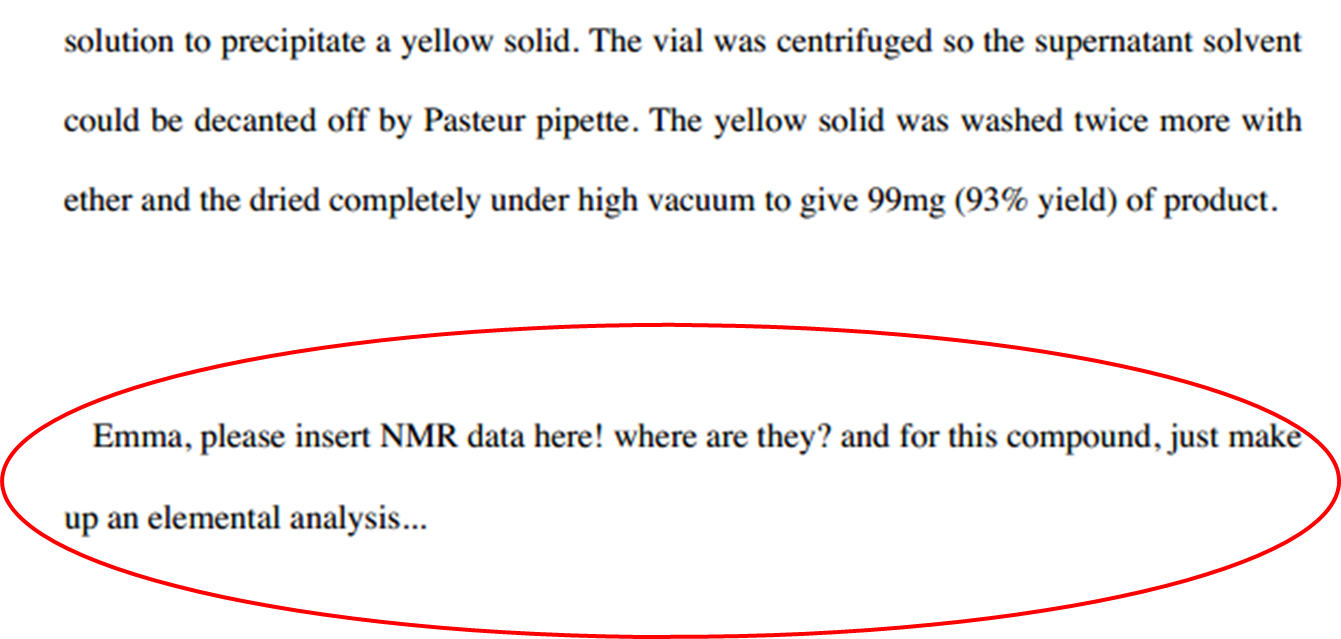
“Just make up an elemental analysis…..”

August 8, 2013

ChemBark has the details of this case where sloppy writing and/or editing shows up some not so ethical behaviour:

Just make up the data..

Just make up the data ……

This instruction apparently from the senior author to the first author was found inadvertently left in the Supplemental Information for this paper – which has been archived here in case it disappears: SI Emma E Drinkel et al.

What is particularly noteworthy is the casual nature of the instruction to “just make up the data…”. It would almost appear that faking data is a routine and regular procedure. Less shocking but a telling commentary on the review process is that such a statement made it all the way to publication.

Emma E. Drinkel, Linglin Wu, Anthony Linden and Reto Dorta, Synthesis, Structure and Catalytic Studies of Palladium and Platinum Bissulfoxide Complexes, Organometallics, Article ASAP, DOI: 10.1021/om4000067

The affiliations of the authors is given as  the University of Zurich, but the senior author, Professor Reto Dorta now seems to be at the University of Western Australia while Emma Drinkel is in Brazil at the Universidade Federal de Santa Catarina.

ChemBark:

A recently published ASAP article in the journal Organometallics is sure to raise some eyebrows in the chemical community. While the paper itself is a straightforward study of palladium and platinum bis-sulfoxide complexes, page 12 of the corresponding Supporting Information file contains what appears to be an editorial note that was inadvertently left in the published document:

Emma, please insert NMR data here! where are they? and for this compound, just make up an elemental analysis…

This statement goes beyond a simple embarrassing failure to properly edit the manuscript, as it appears the first author is being instructed to fabricate data. Elemental analyses would be very easy to fabricate, and long-time readers of this blog will recall how fake elemental analyses were pivotal to Bengu Sezen’s campaign of fraud in the work she published from 2002 to 2005 out of Dalibor Sames’ lab at Columbia.

The compound labeled 14 (an acac complex) in the main paper does not appear to correspond to compound 14 in the SI. In fact, the bridged-dichloride compound appears to be listed an as unlabeled intermediate in Scheme 5, which should raise more eyebrows. Did the authors unlist the compound in order to avoid having to provide robust characterization for it? ….

Related:

 Insert data here … Did researcher instruct co-author to make up results for chemistry paper?

When Authors Forget to Fake an Elemental Analysis

For charities, charity begins at home

August 7, 2013

There are very few charities and NGO’s that command my unquestioning admiration. There are many where the stated objectives are something I would like to support. But in most cases their objectives do not withstand too much scrutiny. And whenever I try to do some background checks I end up finding that a political agenda lies behind the apparently worthy objective. Distortion of data to suit a political “cause” is all too common. In some cases they have merely become advocacy groups where their ends justify their means. Greenpeace, Friends of the Earth and the World Wildlife Fund – for many of their projects – have embraced coercion and are no longer trustworthy. Even the main stream organisations like the Red Cross in Sweden or Save the Children – for example – have had their share of scandals and cases of embezzlement of funds.

I am always amazed at how little of what is contributed by the general public ends up being disbursed on the ground. There are people with “sticky fingers” at every step of the “charity money trail”.

This in the Guardian only goes to support my view that many of the so-called charities have become organisations where the primary goal is to take care of their own. Once upon a time a charity-worker was one who commanded some admiration for his care for those in need.. No longer. For charities and many NGO’s, top executives – and staff in general – get salaries at such high levels that it can no longer be assumed that altruism plays any part.

Even with charities it seems that Greed – not Altruism – is the name of the game.

Leading charities have defended the income of their chief executives after research revealed that the number receiving six-figure salaries at Britain’s 14 biggest foreign aid charities has risen by nearly 60%, from 19 to 30, over the past three years.

The number of staff on salaries of more than £60,000 at charities – which form the 50-year-old Disasters Emergency Committee (DEC) and co-ordinate disaster relief during global emergencies – increased by 16%, to 192, between 2010 and 2012, the Daily Telegraph reported. Eleven of the executives were paid more than the prime minister’s salary of £142,500 a year in 2013, while some senior staff at some charities had pay rises despite falling revenues and donations.

William Shawcross, the chairman of the Charity Commission, said trustees of the charities should assess pay to judge if it is appropriate. “It is not for the commission to tell charities how much they should pay their executives. That is a matter for their trustees,” he told the newspaper. “However, in these difficult times, when many charities are experiencing shortfalls, trustees should consider whether very high salaries are really appropriate, and fair to both the donors and the taxpayers who fund charities. Disproportionate salaries risk bringing organisations and the wider charitable world into disrepute.”

…. The top earners whose pay increased included Sir Nicholas Young, the chief executive of the British Red Cross, who has received a 12% pay rise to £184,000 since 2010, despite a 1% fall in donations and a 3% fall in revenues.

Justin Forsyth, the chief executive of Save the Children, received £163,000 last year, while Anabel Hoult, its chief operating officer, was paid £168,653. Revenue at the charity has fallen by 3% since 2010, although donations are significantly up. A Save the Children spokesman said the charity paid competitive wages benchmarked against two external salary surveys. “We want to save more children’s lives. We can’t – and shouldn’t – compete with salaries in the private sector, but we need to pay enough to ensure we get the best people to help our work to stop children dying needless deaths.”

The salary of Chris Bain, the director of the Catholic aid charity Cafod, increased by 9% between 2010 and 2012, from £80,000 to £87,000. Over the same period donations and revenue rose 16% and 24% respectively. A Cafod spokesman said its director’s pay “remains much lower than any of his counterparts in the biggest non-governmental organisations, and has only risen in recent years in line with the increase for other Cafod members of staff”.

Richard Miller, the director at ActionAid, saw his pay rise by 8% to nearly £89,000 a year, while revenues and donations fell by 11%. Janet Convery, ActionAid’s director of communications, said: “Richard Miller’s salary is well below the market rate for a chief executive of a major development charity.”

The top paid executive at Christian Aid was Loretta Minghella, a former chief executive of the Financial Services Compensation Scheme, who was paid £126,072 this year, up from £119,123 in 2011. A Christian Aid spokesman said the charity had a “strict policy that requires us to set salaries at or below the median of other church-based and/or international development agencies”.