Archive for the ‘Europe’ Category

Greece just moved from a “developed” to a “developing” nation

July 1, 2015

It has never happened before – certainly not since the 2nd World War –  that a developed economy defaults on payments to creditors and slides back to be a developing nation. But now Greece joins Argentina, the Ivory Coast, the Dominican Republic, Russia, Ukraine and Ecuador, among other developing countries, as countries which have defaulted on loan repayments to international creditors.

Greece has however defaulted many times before; in 1826, 1843, 1860, 1893, 1932 and now in 2015.

Reuters:

The International Monetary Fund on Tuesday confirmed Greece had not made its 1.5 billion euro ($1.7 billion) loan repayment to the Fund, making it the first advanced economy to ever be in arrears to the Fund.

The missed payment, the largest in the Fund’s history, is equivalent to a default, in that both imply a breach of Athens’ obligations. IMF spokesman Gerry Rice said Greece can now only receive further IMF funding once the arrears are cleared.

The Greek default is not only an indictment of the past profligacy and mismanagement in Greece but also of the EU’s (and the Eurozone’s) recklessly expansionist policies.

It is time, I think, for Greece to return to the Drachma. And then an orderly Grexit – as orderly as may be possible. The Euro is too far ahead of its time. As of now it is a failed experiment and the Eurozone needs to shrink sharply, if not to be entirely dismantled.

If the Deutschmark is not to return then at least a N.Euro and a S.Euro are called for?

A Grexit is the best option as the government hides behind a new referendum

June 28, 2015

It seems to me that modern democracies – and especially those with coalitions produced by proportional representation – produce “followers” rather than leaders. And when “followers” pretend to lead they end up taking the easy, CYA, path through referenda. The Scottish referendum and the upcoming UK referendum on EU membership are illustrations of where supposed “leaders” pass the buck onto a diffuse and unaccountable electorate. The “wrong” choice can always be justified as being “the will of the majority”. All across Europe, countries have “followers” in leadership positions, who inevitably fail to lead. I take vision and the ability to carry people towards that vision as being the hallmarks of leadership. Rather than vision, it is the next election which governs. “Leaders” merely follow the current whims of the crowd and don’t even make the attempt to “carry” the crowd an any difficult path.

But I think the current Greek government’s call for a referendum to vote on the lenders’ conditions for further loans to Greece, while carrying out negotiations with those lenders is an abject abdication of leadership. Suppose, as is most likely, the conditions are rejected. The government may well return to the negotiating table in the hope that this may have strengthened its hand. Though exactly how is difficult to see. It is really only an attempt to mobilise a “sympathy” factor. It is equivalent to sitting in front of the bank manager, without any collateral and without any plans to stop spending on unnecessary things while pointing at a crying child and begging for a sympathy loan.

If the government recommends a rejection and this is confirmed by the referendum,  it would be the start of a Grexit. The government may carry forward a “begging” from the lenders but it will only be postponing the inevitable. If the people accept the lenders’ terms, the government ought to resign but will not since they can always point to the referendum for their abandonment of their “principles”. But it will also make it impossible for anyone to negotiate with the Greek government, since no “decision” by them will carry any credibility without being backed up by a referendum.

I expect we will see a run on the banks on Monday – if the banks are open. I also expect that the government will scrape up the relatively modest €1.6 billion needed for the repayment due on Tuesday. Then the result of the referendum  on Sunday the 5th will be the card in the hole to continue negotiations.

But I hope a default takes place and that the Greeks reject the lenders’ conditions and a Grexit does occur. Then a debt restructuring can take place. Writing off debt without first going bankrupt is not healthy. In the long run it will be better for Greece to return to the drachma. It will also be better for both the EU and the Eurozone. Both need to shrink. In corporate terms I would say that EU Inc. has expanded too far, much too fast. Some divestment is desperately needed. It would be better for the EU to focus on the common market and free labour movement provisions and to allow political union to happen whenever, and only when, it is ripe – or maybe not to happen at all. Trying to force the political union is counter-productive. The European parliament can be dismantled completely without losing anything. The Brussels bureaucracy could, and should, be drastically trimmed to be an accounting agency and nothing else. The common currency is of little value with the disparity in economic disciplines across the Eurozone. Dealing with multiple currencies but where each currency is representative of its underlying economy is not as difficult as having the fundamental mis-match we now have between the “average” value of the Euro and the strength of each of the underlying economies.

Greece needs to get out of the Euro strait-jacket it is in while remaining within the European trade zone.

EU judges don’t have the discernment necessary to tell Sky from Skype

May 6, 2015

Any 5-year old today can tell you what Skype is. In a country where Sky operates the child will also tell you the channel number on cable.

But EU judges – by their own admission –  have not the discernment necessary to be able to tell the difference.  They seem terribly confused  but they try to blame the confusion on the “general public”. But I am afraid I find them (the EU judges) either blatantly partisan or unashamedly unintelligent.

BBC: Video chat software Skype’s name is so similar to the broadcaster Sky’s that the public is likely to be confused between the two, an EU court has ruled.

The judgement prevents Microsoft from registering a trademark for Skype’s name and bubble-design logo. The US company intends to appeal against the decision.

Judges at the General Court of the European Union said: “Conceptually, the figurative element conveys no concept, except perhaps that of a cloud.”

“[That] would further increase the likelihood of the element ‘Sky’ being recognised within the word element ‘Skype’, for clouds are to be found ‘in the sky’ and thus may readily be associated with the word ‘sky’.”

I don’t think that EU judges really lack the intelligence to tell the difference. But they do bend to what is considered to be politically correct in a bigoted EU world. And in that world, EU judges do not easily rule against an EU corporation if pitted against a US (or any non-European) corporation.

After all Skype is now owned by a US corporation

Skype was later acquired by Microsoft in May 2011 for $8.5 billion. Microsoft’s Skype division headquarters are in Luxembourg, but most of the development team and 44% of the overall employees of the division are still situated in Tallinn and Tartu, Estonia.

But Sky is European and the EU judges know what is politically correct.

Sky plc is a British-based pan-European satellite broadcasting, on-demand Internet streaming media, broadband and telephone services company headquartered in London, with operations in the United Kingdom, Ireland, Germany,Austria and Italy. Sky is Europe’s biggest and leading media company and the largest pay-TV broadcaster in Europe, with over 20 million subscribers.

I am afraid that for the EU General Court and its judges, whatever is “politically correct” comes first and any pretense to fairness or being equitable comes a distant second.

Germany needs 500,000+ immigrants every year till 2050

March 27, 2015

A new study has just been published by the Bertelsmann Stiftung:

Zuwanderungsbedarf aus Drittstaaten in Deutschland bis 2050

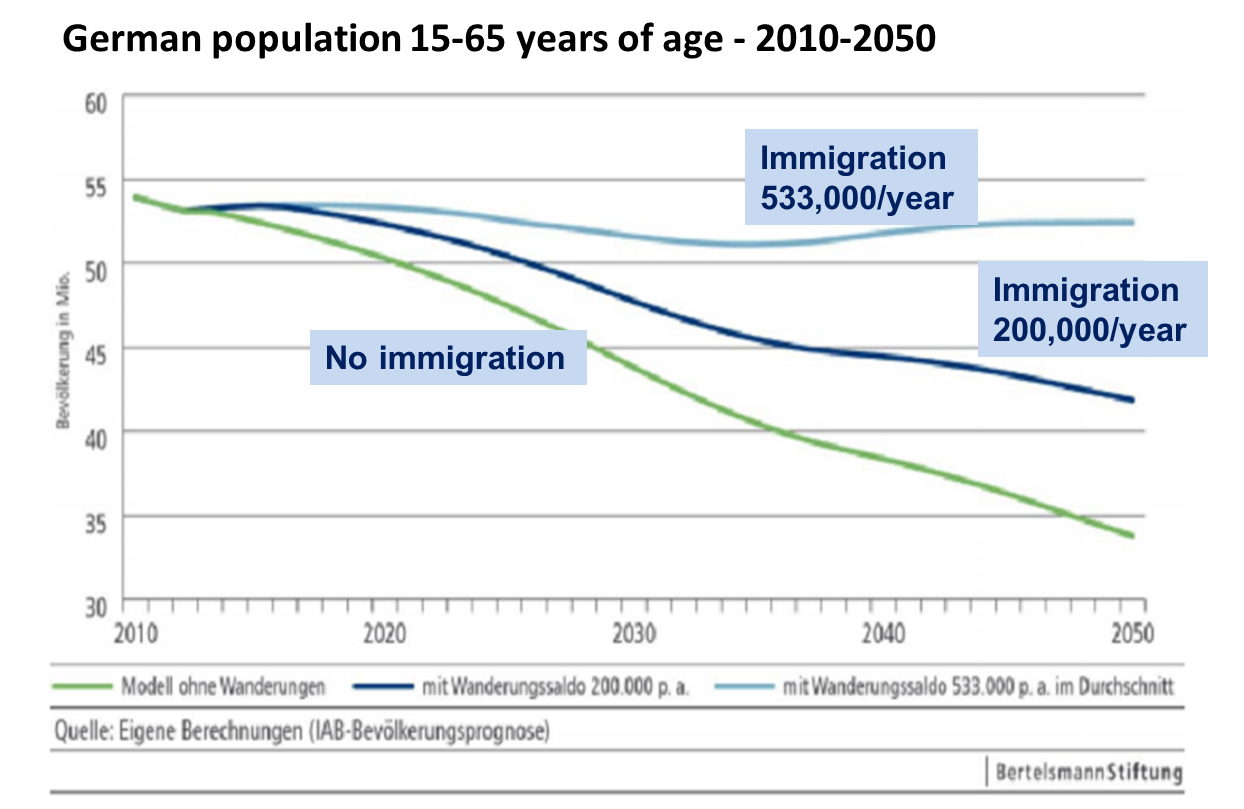
Press Release: Without immigrants, the potential labor force would sink from approximately 45 million today to less than 29 million by 2050 – a decline of 36 percent. This gap cannot be closed without immigration. Even if women were to be employed at the same rate as men, and the retirement age was increased to 70 in 2035, the number of potential workers in the country would rise by only about 4.4 million.

In 2013, a total of 429,000 more people came to Germany than left the country. Last year, the net total was 470,000, the Federal Statistical Office reports. According to the study, net immigration at this level would be sufficient for at least the next 10 years to keep the country’s potential labor force at a constant level. From that time onward, however, the need for immigrants will grow, because the baby-boomer generation will be entering retirement. One out of two of today’s skilled workers with professional training will have left the working world by 2030. …

….. the current high levels of immigration from EU countries (2013: around 300,000) will soon decline significantly, as demographic change is shrinking populations across the European Union, and because incentives to emigrate in crisis-stricken countries will decline with economic recovery. The experts forecast an annual average of just 70,000 immigrants or fewer from EU counties by 2050. For this reason, efforts to attract skilled workers from non-EU countries should be intensified. …

German working population  development

German working population development – Bertelsmann Stiftung

This is not a picture that is unique to Germany in Europe. Moreover just keeping the working population constant does not allow for the additional numbers who are ageing and whose “pensions” whether from the Sate of from private sources must be supported by a corresponding growth in the resource funds.

All politicians are well aware of the demographic inevitabilities in Europe. But they have not yet managed to convince all their constituencies that “old Europe” has to renew and reinvent itself. A “new Europe” cannot hark back to the days of the Crusades. Few, if any, politicians in today’s Europe and on the right of the divide, have had the courage to point out that immigration from outside the EU is necessary and that these immigrants must be speedily integrated. Few of the politicians on the left of the divide have either had the courage to point out that a multiethnic society still requires a single over-riding culture (set of values) which may then have as many subordinate cultures as desired. Few have had the courage to point out that “multiculturalism” does not allow a single society to be sustained. If these politicians truly want to take care of their children’s children they will have to come to terms with the reality of the cold hand of demographics. The only alternative to immigration – but hardly viable – is a Europe-wide “baby production” policy which would have to discourage abortions and maximise incentives for having children. Fertility clinics and multiple births could always be heavily subsidised.

But I can’t help feeling that EU immigration policy cannot be just based on “asylum seekers”. Any such policy must be built on demographic realities and must be based on needed skills (and on the provision of training in the needed skills) and not just on “asylum seekers” and the random set of skills that that represents.

EU 2009 Ageing Report:

…. low birth rates, rising life expectancy and continuing inflow of migrants can be expected to result in an almost unchanged, but much older, total EU population by 2060, meaning that the EU would move from having four working-age people (aged 15-64) for every person aged over 65 to a ratio of only two to one. The largest decrease is expected to occur during the period 2015-35 when the baby-boom cohorts will be entering retirement. …….

The fiscal impact of ageing is therefore projected to be substantial in almost all Member States, becoming apparent already over the course of the next decade. Overall, on the basis of current policies, age-related public expenditure is projected to increase on average by about 4¾ percentage points of GDP by 2060 in the EU and by more than 5 percentage points in the euro area – especially through pension, healthcare and long-term care spending.

Who is Charlie?

January 13, 2015

JE SUIS CHARLIE

Omslaget på tidningen Charlie Hebdos nya nummer, Charlie Hebdo och tidningen Liberations redaktioner. Foto: TT/AP och Charlie Hebdo.

The cover of the new issue of Charlie Hebdo, Charlie Hebdo and the newspaper Liberation editors. Photo: TT / AP and Charlie Hebdo (via Swedish Radio)

 PEGIDA ALSO CLAIMS TO BE CHARLIE 

A protestor holds a poster showing German Chancellor Angela Merkel wearing a head scarf in front of the Reichtstags building with a crescent on top and the writing "Mrs Merkel here is the people" during a rally of the group Patriotic Europeans against the Islamization of the West, or PEGIDA, in Dresden, Germany, Monday, Jan. 12, 2015.

A record 25,000 attended the Pegida demonstration in Dresden on 12th January 2015 BBC/AP

 BUT, HE IS NOT CHARLIE

Right-wing Polish MEP Janusz Korwin-Mikke

Right-wing Polish MEP Janusz Korwin-Mikke at the European Parliament 12th January 2015 BBC/Reuters

Nigel Farage the UKIP leader, who is a clown in many ways and on many issues, does have a point regarding integration (not immigration). It is not mass immigration – as he believes – but the blind worship of a soppy, separatist, “multi-culturism” which has removed the incentive and need for immigrants to integrate. The grooming rings of Pakistani immigrants and the attempted take-over of Birmingham schools have certainly been enabled – perhaps only partly – by the cowardly worship of “multi-culturism”. Like it or not, Europe is and will continue to be multiethnic. That requires the separate cultures to be subordinated to a single over-riding culture, which in turn has to be something new which evolves from the various new inputs. Immigration inevitably gives multi-ethnicity but it is the blind worship of multi-culturism which hinders integration. No doubt prejudice and racism also hinder integration but even here, the separatist nature of multi-culturism entrenches racism.

I love the fact that in the UK, chicken tikka massala has gone mainstream and I can get it at M&S and at the pub. But I am equally glad that the pub remains a pub and has not been converted into a dhaba. When I want channa – bhatura my favourite dhaba is in Handsworth, but thankfully that dhaba will never be a pub. There is a place for the dhaba to exist, but it is the pub serving the chicken tikka massala which is integration in motion.

(I shall leave my ranting about all organised religions for another time and another post).

It is not immigration but integration which is the real issue.

BBC: Mr Farage, leader of the anti-EU UK Independence Party, said mass immigration had “made it frankly impossible for many new communities to integrate”.

“We do have, I’m afraid, I’m sad to say, a fifth column that is living within our own countries, that is utterly opposed to our values,” he said.

He is quite correct that in Europe, the supporters of radical Islam are self-confessed fifth-columnists (defined as any group of people organised to undermine a larger group).

Juncker’s Christmas present for Europe: used goods in an imaginary wrapping

November 27, 2014

Jean-Claude Juncker announced – with great fanfare – a Christmas present for Europe yesterday. It was a €315 billion investment plan which would generate 1.3 million new jobs.  Sleight of hand is what he is good at as he has proved during his time as Prime Minister of Luxembourg. Do one thing and call it something else. Provide and attract users for clever schemes for tax evasion but call it tax avoidance.

Yesterday’s announcements don’t surprise. They don’t provide any credit for Juncker, the European Commission or the European Parliament. They do confirm for me that the “old” dream of a new European hegemony – mainly shared by French and German and some Italian politicians – is crippling the EU.  Trying to recreate the past with another Holy Roman Empire or a Fourth Reich will only lead to a spurt for separatism and further internal conflicts.

Right now European companies are awash with money which is not being invested. It is not being invested because the political environment does not provide any confidence that a return can be earned. Angela Merkel is seen as being forced to accept wasteful spending because of her grand coalition with the socialists. German energy policy is in a shambles and Germans pay the highest electricity prices in Europe. Even reductions in oil price don’t get passed on to the consumer because the Energiewende has locked the country into an era of high prices to support the unsupportable shift to renewables. The German economy has been stagnating since the coalition assumed office. Francois Hollande is desperately trying to spend more money that France does not have. Northern Italy is being held down by spending in southern parts. In Sweden a new Red/Green minority coalition depends upon support from the far left (a euphemism for old communists) and is busy stopping infrastructure development projects to keep the Greens happy and planning a splurge of public spending to keep the far left happy.

And then comes Juncker with his claim that Europe would have an early Christmas. The European Fund for Strategic Investment (EFSI) is the brainchild of the EU Commissioners and will keep them happy and the bureaucracy growing in a time of “austerity”. And the idiot EU parliament approved it.

Juncker's EFSI

Juncker’s EFSI

The fund is supposed to stimulate infrastructure projects (road, rail, energy, IT, …) but it needs new legislation in each country and will cause a competition between the countries to get their share of the new EU pig-trough. But his €315 billion turns out not to be €315 billion. It is just €21 billion. Oh, and by the way, even this is not real. It is not any new money but just an arithmetic subterfuge. It is just reallocated from other  areas of the EU budget. And if the massive leveraging to get private investment to produce the rest of the €294 billion does not materialise – as it won’t – then the European taxpayer has to pick up the tab. Those few investors who come in will be protected – by taxpayers money – and will lead to further exploitation of EU money by the few. As wih most such grand EU spending schemes new scams will be developed. A few developers and the EU bureaucrats will enrich themselves. And the EU taxpayers will pay – and continue to pay.

Juncker sees himself as Santa Claus. But as Pope Francis said a couple of days ago, Europe is becoming “haggard”. Not that the Roman Catholic Church has much to crow about but with Juncker at the helm it could become an expensive Christmas for Europe. He faces a no-confidence motion today but I don’t hold out any great hopes that he will be rejected by a compliant and self-serving European Parliament.

The EU has become just another cult.

Novorossiya: Putin calculates that Obama will bark and show his teeth but will not bite

August 31, 2014

Putin did not cause the descent of Ukraine into anarchy. That was the EU and the US respectively trying to expand the boundaries of Europe and NATO. The EU sold the “benefits” of joining Europe very hard and raised expectations in the country which no President could live up to. In the process they supported the opposition to the elected (but disliked) President of Ukraine, Viktor Yanukovych. That included substantial support for Ukraine’s neo-Nazi, nationalist Right Sector. The EU bureaucrats in Brussels were elated at the potential for expanding the EU. Catherine Ashton and John Kerry were so full of themselves and their “success” in spreading democracy that they miscalculated the consequences. Yanukovych was toppled in February 2014 and the EU and the US celebrated. But the Right Sector lost no time in “pushing” and pressurising the Russian speakers especially in Eastern Ukraine. The push-back started and Crimea “voted” to join Russia. Russia ratified the decision and effected the transition on the ground. The EU and the US responded with sanctions. A missile fired by Russian separatists – perhaps aimed at a Ukraine military aircraft flying in the shadow of a commercial jet – brought down Malaysian flight 17. Sanctions were extended. The EU made noises. Obama demonstrated his risk aversion when even the atrocities by ISIS did not lead to any action by the US beyond a few drone attacks.

And so Putin has probably made his calculation that while Obama is by no means toothless, he will bark and show his teeth and foam at the mouth, but he will not bite. NATO will not start a war in Europe except as the tail of a belligerent US. The EU has 28 members and 28 strategies and no real leadership.

The US and EU have now established that regime-change of a government they disapprove of is a legitimate justification for the use of force. Vladimir Putin and Russia and China have taken notice. And the regime-change started by the US and the EU in February 2014 will probably be brought to some kind of conclusion (for the time being) as Putin establishes Novorossiya.

Novorossiya - graphic Washington Post

Novorossiya – graphic Washington Post

Whatever is left of Ukraine will be land-locked and Putin will again have control of the Black Sea.

“Euthanasia is both profitable and cost effective”

July 28, 2014

I think an individual should be able to choose, and be assisted, to die peacefully and painlessly – provided he is of sound mind and is suffering from a terminal and painful illness.

But I am afraid that part of the building momentum for euthanasia in Europe is cost driven and not driven by a concern for the individual. Countries with aging populations and with well developed public health programs are facing increasing costs for the care of the elderly. In Sweden and the UK for example this care is often “out-sourced” or privatised. Many of these establishments are owned by risk capital companies – which is a little strange – but not fundamentally wrong. But the “quality” requirements they are required to meet are set by the public institutions doing the out-sourcing. Inevitably these “quality” requirements are specified in such a way that the out-sourcing succeeds and contracts are let. To ensure this the requirements always allow the service provider sufficient room to make a profit. There is a clear incentive for the service provider to “increase the throughput” and reduce the cost per person they are tasked to care for. That – in turn – is leading to a deterioration in the care provided especially to the aged who are no longer competent or able to complain about the service received. It is clearly cheaper to allow a general reduction of service, and to only do more than the minimum if and when a complaint from a relative is received. Of course, relatives have only limited opportunities to notice any deterioration of service. The “out-sourcing” itself is driven by cost. There have been many “scandals” (such as this one) associated with the “quality” of service in “privatised” homes for the aged. But it is not by accident that the State and the municipalities and health authorities have pushed these scandals into the “privatised” sphere rather than to be found wanting themselves. Part of the reason for out-sourcing these services has clearly been to also out-source the scandals waiting to come as care of the elderly inexorably deteriorates. The more the care of the aged deteriorates the more attractive a voluntary euthanasia scheme becomes – for all parties involved.

I have a clear perception that in Sweden the quality of public medical and palliative care for the elderly is already driven by cost considerations. It is illegal in Sweden but age discrimination is endemic. We hear about procedures and expensive treatments being denied to the elderly for many ostensible reasons, but in reality because the patients are – in the judgement of the care-providers – just too old and too big a drain on costs. For public medical and palliative care, a form of unwritten age-discrimination is already in place. The aged patient has little recourse except to opt for private treatment and then euthanasia may be a much more cost effective solution..

The euthanasia debate is picking up steam in Europe but my fear is that though much of it is carried out under the guise of concern for an individual’s right to die, much of the debate is actually being driven by public health cost considerations. Many of the statements by politicians seem to me to be trial balloons or electoral posturing – but they have an underlying smell of preparing for curbing the costs of caring for the increasing number of the elderly.

It may be very cynical but I note that a healthy growth rate in voluntary euthanasia among the aged has many public and social and economic benefits. The cost of health care for the aged is both capped and reduced. The demographic of the ratio of elderly to working population is improved. Medical resources are freed for the more valuable, younger patients. And the aged patient gets what he or she wants.

A true win-win!

BioEdge: 

Euthanasia might be needed for poor people who cannot access palliative care, the new Lithuanian Health Minister has suggested. Rimantė Šalaševičiūtė was sworn earlier this month, but already she has made waves by backing an open discussion of the legalisation of euthanasia.

Without making any specific proposals, she told local media that Lithuania was not a welfare state with palliative care available for all and that euthanasia might be an option for people who did not want to torment relatives with the spectacle of their suffering.  

The minister has also raised the idea of euthanasia for children. She noted that this option had been approved for Belgian children after a long public debate. It was an option which might be appropriate in Lithuania as well after public debate.

Ms Šalaševičiūtė will face an uphill battle in her campaign to introduce Lithuanians to euthanasia. Many doctors and the Catholic Church oppose it. Dr Andrius Narbekovas, who is both a priest and a doctor, and a member of the Health Ministry’s bioethics commission, told the media:

“The Ministry of Health should protect health and life, instead of looking for ways to take life away. It goes without saying that it is … profitable and cost effective … But a democratic society should very clearly understand that we have to take care of the sick, not kill them.”

Lithuania merely reflects the debate all over Europe which is probably most advanced in Belgium where even involuntary euthanasia (is that not murder?) has been proposed.

Politicians and many aged sufferers could find this irresistible: “Euthanasia is both profitable and cost effective”.

Two of my friends have utilised the services of Dignitas. So, for whatever reasons it may come, I do hope that voluntary euthanasia is available to me when my time comes.
UK is not necessary for the Fourth Reich of the United States of Europe

June 28, 2014

My somewhat jaundiced and cynical view of what Juncker’s selection as President of the European Commission and Cameron’s defeat means. Cameron failed in his attempt to block the appointment of Juncker, but the EU failed in achieving a consensus.

In fact the French and the Germans have made it clear that the UK is not necessary in their definition of a European consensus.

The ultimate aim of the European Project is the creation of a United States of Europe where Brussels maps to Washington. This will require each member state to finally give up any semblance of sovereignty to the bureaucracy in Brussels and to the European parliament. A United States of Europe will favour the population-rich central part of Europe. That Germany and France endorse this goal is all too clear because they believe it will effectively be the start of the Fourth Reich of a Holy Franco-German Empire. The southern Europe states go along because they see greater economic benefit for themselves in being vassals and being supported by their masters in the richer north. The far northern states of Europe are small and just do not have the population and market size for their own home markets to be self-sufficient or to allow them much growth. They need the large markets of central and southern Europe to fuel their own growth. So they go along with the Project and dig their little heels in where they can.

The UK is the odd man out. While the UK has some clout due to its population, the Project is well aware that the UK – as it is – values its own sovereignty so high that its continued membership is entirely inconsistent with the aim of creating a United States of Europe. Better for a UK – if it stays united – to leave the EU than that it subverts the whole concept by remaining a member. The French and Germans would love to see the Balkanisation of the UK and an independent Scotland (perhaps followed by an independent Northern Ireland and an independent Wales). That would allow the fractured bits of the UK to stay within the EU but without the strength to jeopardise the Project. For an independent Scotland or Wales, ceding all power to Brussels rather than to London would not be all that bad. Moreover the markets of the fractured UK countries would then remain available to the EU but each of the new countries would have to accept the inevitability of the Fourth Reich.

It should be fairly obvious that while I would like the EU to remain as a free trade and free movement of labour area, any political union must come in a natural way and cannot be forced as Brussels and the Franco-German alliance are trying to do. If true economic union is achieved then political union across country boundaries becomes almost inevitable and a non-issue. Economic pressures have to be addressed first. Opening the political valve across an economic boundary is best done when pressures have equalised.

And yet the member states of the EU have already ceded many of their powers to the bloated Brussels bureaucrats. And inevitably their practices reduce to the lowest common behaviour. Rather than promoting best practices the EU enshrines the worst common practices. The EU parliament is about the most undemocratic institution there is where the members are not accountable to their constituencies, follow party guidelines and ultimately represent only themselves.

Just imagine the Canadians or the Mexicans having to follow bureaucratic diktats from Washington.

Shifting maps of Europe over 200 years from 1815 – 2014

June 23, 2014

On 28th June it will be 100 years since the assassination in Sarajevo of Franz Ferdinand, heir to throne of the Austro-Hungarian Empire  and the onset of World War 1. The maps of Europe changed drastically before and after the War from 1914 to 1920 and this is a an excellent yet simple presentation of the changes.

Before and after WW1

Before and after WW1

Before and after WW1

But it is worth noting that squabbling in Europe was going on long before WW1 and still continues today with the Balkans having recently redrawn their maps. And maps will continue changing, as in the Crimea and now perhaps also with Scotland breaking away from the United Kingdom.

But it is not so long ago that the map of Europe looked completely different. After Napoleon’s defeat at Waterloo in 1815 the Congress of Vienna redrew the map of Europe.

 map by thelessonlocker

europe after vienna 1815

europe after vienna 1815

And now, 200 years later the map of Europe is still changing. This map by Omniatlas is up to date as of March 2014.

Omniatlas map of Europe 2014

Omniatlas map of Europe 2014

What will the next 100 years bring?