Archive for the ‘Evolution’ Category

Neanderthals died out because they could see better than humans

March 13, 2013

Hot on the heels of the theory that Neanderthals died out because they couldn’t adapt from hunting big game to hunting rabbits comes this new theory that they died out because they developed bigger eyes than humans’ in the cold dark Northern latitudes!  The theory goes like this:

Their large eyes led to too much of their brain capacity being used for processing visual information and since more of their brain capacity was also needed to handle the motion of their larger, heavier bodies, this  resulted in less brain capacity being available for cognitive reasoning. They therefore had less brain to deal with other functions like social networking” and had “fewer friends to help them out in times of need”Obviously they then remained culturally trapped in the Stone Age and could not develop written language or Facebook or Agriculture as competing humans eventually did. Apart from a few intrepid and promiscuous Neanderthals who managed to participate in contributing their genes to the human gene pool, all the rest died out.

A novel theory but a little far-fetched!

Eiluned Pearce

This is the theory of  Eiluned Pearce a DPhil student at Oxford and is published in  a paper published today in the Proceedings of the Royal Society B (but where it is beyond a pay wall). A press release has been issued by the University of Oxford.

The only data are measurements of eye sockets in 13 Neanderthal skulls compared to those in 32 human skulls from the same time. All the rest is just conjecture – and then further conjecture based on the original speculation.  It would seem to be a little light on data and a little heavy on conjecture. It is still an interesting conjecture nevertheless.

… Looking at data from 27,000–75,000-year-old fossils, mostly from Europe and the Near East, they compared the skulls of 32 anatomically modern humans and 13 Neanderthals to examine brain size and organisation. In a subset of these fossils, they found that Neanderthals had significantly larger eye sockets, and therefore eyes, than modern humans. 

The researchers calculated the standard size of fossil brains for body mass and visual processing requirements. Once the differences in body and visual system size are taken into account, the researchers were able to compare how much of the brain was left over for other cognitive functions.

Previous research by the Oxford scientists shows that modern humans living at higher latitudes evolved bigger vision areas in the brain to cope with the low light levels. This latest study builds on that research, suggesting that Neanderthals probably had larger eyes than contemporary humans because they evolved in Europe, whereas contemporary humans had only recently emerged from lower latitude Africa.

‘Since Neanderthals evolved at higher latitudes and also have bigger bodies than modern humans, more of the Neanderthal brain would have been dedicated to vision and body control, leaving less brain to deal with other functions like social networking,’ explains lead author Eiluned Pearce from the  Institute of Cognitive and Evolutionary Anthropology at the University of Oxford.

‘Smaller social groups might have made Neanderthals less able to cope with the difficulties of their harsh Eurasian environments because they would have had fewer friends to help them out in times of need. Overall, differences in brain organisation and social cognition may go a long way towards explaining why Neanderthals went extinct whereas modern humans survived.’

‘The large brains of Neanderthals have been a source of debate from the time of the first fossil discoveries of this group, but getting any real idea of the “quality” of their brains has been very problematic,’ says Professor Chris Stringer, Research Leader in Human Origins at the Natural History Museum and co-author on the paper. ‘Hence discussion has centred on their material culture and supposed way of life as indirect signs of the level of complexity of their brains in comparison with ours.

‘Our study provides a more direct approach by estimating how much of their brain was allocated to cognitive functions, including the regulation of social group size; a smaller size for the latter would have had implications for their level of social complexity and their ability to create, conserve and build on innovations.’

Professor Robin Dunbar observes: ‘Having less brain available to manage the social world has profound implications for the Neanderthals’ ability to maintain extended trading networks, and are likely also to have resulted in less well developed material culture – which, between them, may have left them more exposed than modern humans when facing the ecological challenges of the Ice Ages.’

The relationship between absolute brain size and higher cognitive abilities has long been controversial, and this new study could explain why Neanderthal culture appears less developed than that of early modern humans, for example in relation to symbolism, ornamentation and art.

The Smithsonian blog writes:

One of the easiest differences to quantify, they found, was the size of the visual cortex—the part of the brain responsible for interpreting visual information. In primates, the volume of this area is roughly proportional to the size of the animal’s eyes, so by measuring the Neanderthals’ eye sockets, they could get a decent approximation of their the visual cortex as well. The Neanderthals, it turns out, had much larger eyes than ancient humans. The researchers speculate that this could be because they evolved exclusively in Europe, which is of higher latitude (and thus has poorer light conditions) than Africa, where H. sapiens evolved.

Along with eyes, Neanderthals had significantly larger bodies than humans, with wider shoulders, thicker bones and a more robust build overall. To account for this difference, the researchers drew upon previous research into the estimated body masses of the skeletons found with these skulls and of other Neanderthals. In primates, the amount of brain capacity devoted to body control is also proportionate to body size, so the scientists were able to calculate roughly how much of the Neanderthals’ brains were assigned to this task.

After correcting for these differences, the research team found that the amount of brain volume left over for other tasks—in other words, the mental capacity not devoted to seeing the world or moving the body—was significantly smaller for Neanderthals than for ancient H. sapiens. Although the average raw brain volumes of the two groups studied were practically identical (1473.84 cubic centimeters for humans versus 1473.46 for Neanderthals), the average “corrected” Neanderthal brain volume was just 1133.98 cubic centimeters, compared to 1332.41 for the humans.

This divergence in mental capacity for higher cognition and social networking, the researcher argue, could have led to the wildly different fates of H. sapiens and Neanderthals. “Having less brain available to manage the social world has profound implications for the Neanderthals’ ability to maintain extended trading networks,” Robin Dunbar, one of the co-authors, said in a press statement. “[They] are likely also to have resulted in less well developed material culture—which, between them, may have left them more exposed than modern humans when facing the ecological challenges of the Ice Ages.”

New insights into differences in brain organization between Neanderthals and anatomically modern humans by Eiluned Pearce, Chris Stringer and R. I. M. Dunbar

Published online March 13, 2013 doi:10.1098/rspb.2013.0168 Proc. R. Soc. B 7 May 2013 vol. 280 no. 1758 20130168 

Related articles

Rabbits (or a lack thereof) killed off the Neanderthals!

March 4, 2013

A new paper in the Journal of Human Evolution claims that the diet of the Neanderthals contained far fewer rabbits than that of Modern Humans. The paper then suggests that this was because Neanderthals could not shift from hunting large prey to hunting small animals. The data may well be valid but the interpretations of the data and the conclusions drawn are so lacking in common sense that the entire paper may well qualify as “idiot science”.

Rabbits and hominin survival in Iberia

by John E. Fa, John R. Stewart, Lluís Lloveras and J. Mario Vargas

Abstract

High dependence on the hunting and consumption of large mammals by some hominins may have limited their survival once their preferred quarry became scarce or disappeared. Adaptation to smaller residual prey would have been essential after the many large-bodied species decreased in numbers. We focus on the use of a superabundant species, the rabbit, to demonstrate the importance of this taxon in Iberia as fundamental to predators. We show that the use of the rabbit over time has increased, and that there could have been differential consumption by Neanderthals and Anatomically Modern Humans (AMH). Analysis of bone remains from excavations throughout Iberia show that this lagomorph was a crucial part of the diet of AMH but was relatively unutilised during the Mousterian, when Neanderthals were present. We first present changes in mammalian biomass and mean body mass of mammals over 50,000 years, to illustrate the dramatic loss of large mammalian fauna and to show how the rabbit may have contributed a consistently high proportion of the available game biomass throughout that period. Unlike the Italian Peninsula and other parts of Europe, in Iberia the rabbit has provided a food resource of great importance for predators including hominins. We suggest that hunters that could shift focus to rabbits and other smaller residual fauna, once larger-bodied species decreased in numbers, would have been able to persist. From the evidence presented here, we postulate that Neanderthals may have been less capable of prey-shifting and hence use the high-biomass prey resource provided by the rabbit, to the extent AMH did.

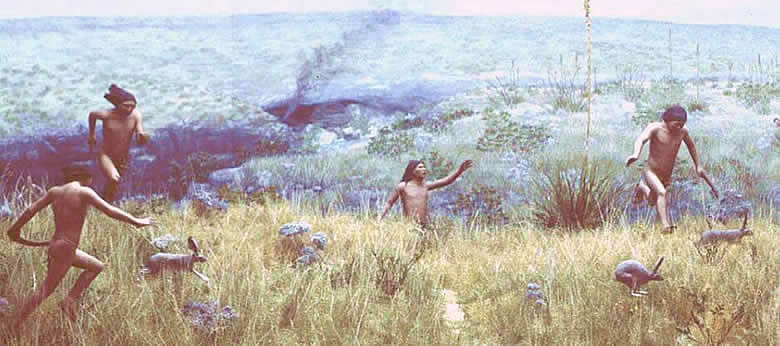
painting of prehistoric hunters

Prehistoric hunters prepare to unleash their throwing sticks at a group of jack rabbits on the run. Painting by Nola Davis, courtesy Texas Parks and Wildlife Department.

That Anatomically Modern Humans ate more rabbits than Neanderthals may well be true but to then leap to the amazing conclusion that Neanderthals were incapable of hunting small prey and then to the even more dubious suggestion that this may have something to do with the demise of Neanderthals as a species takes legitimate speculation into the fantasy worlds of the Land of Painted Caves. We could just as well assume that eating rabbits led to a virulent disease which AMH were immune to but which led to the eradication of the Neanderthal species (except of course for the offspring of those who had mated with AMH) !!

Fighting against species extinction is to deny evolution

February 27, 2013

I was reading an article today about the threat of extinction for leather-backed turtles and once again I started wondering as to why extinction of a species or a language or of an isolated tribe arouses moral outrage or is an emotional matter for so many people. I don’t want these turtles to become extinct just as I don’t want tigers or polar bears or pandas to become extinct. But this is purely an emotional reaction because each of these animals is attractive – to my human eye – in its own right. Outside of TV documentaries, zoos and safari parks I have never seen any of them. I don’t have the same reaction when I read that guinea worms or disease-carrying species of mosquitoes are being eradicated. “Good riddance” is then the predominating feeling that I have. Yet whether a mammal or a bacterium becomes extinct the genetic loss is about the same. That dinosaurs became extinct millions of years ago or even that humans killed off the dodo or the thylacine or the Javan tiger in more recent times arouses some feelings of regret but not any moral outrage or much emotional response from me. The article about the turtles – like most other articles about the extinction of species  – is permeated with the politically correct assumption that extinction would be a “bad thing”. But I never see properly addressed the question as to why the extinction of a species is a “bad thing”.

This is essentially a value-judgement and is taken for granted and yet – in the rational plane – I can only conclude that there is nothing “unnatural” about this. In fact it is this emotional desire that species considered “attractive” should not become extinct when their time is due that is irrational. Normal or natural evolution is always a result of change. It is the result of species responding to change where the individuals of a species most suited to the changed circumstances continue and reproduce. Where the variety existing within a species is insufficient to provide any individuals who can survive and reproduce in the changed environment, the species dies out. It is said that about 90% of all species that have ever lived have become extinct. If they had not there would be no room for the 10% that exist today. Just as homo sapiens would never have evolved without the environmental changes which led to the extinction of the dinosaurs, most of the species alive today would not have succeeded their extinct ancestors if conditions had not led to their extinction. Where a species cannot compete with another – in whatever the prevailing circumstances – it dies out. It makes room for the more successful species.

Siberian Tiger Français : Tigre de sibérie Ita...

Siberian Tiger Français : (Photo credit: Wikipedia)

So what then is the objection to – say – tigers becoming extinct which is not just an emotional reaction to the disappearance of a magnificent but anachronistic creature?  The bio-diversity argument is not very convincing and is of little relevance. To artificially keep an unsuccessful species alive in a specially protected environment has no genetic value. It increases the mis-match between the existing environment and the genetic profile needed to survive in that environment. In fact the biodiversity argument is only relevant for “life” in general and never for any particular species or group of species.  It can serve to maintain a very wide range of genetic material in the event of a catastrophe such that some form of life has a chance of continuing. But given a particular environment biodiversity in itself is of little value.

Returning to the tiger as an example, the variety of individuals within the tiger population does not provide any which have the characteristics necessary for adapting to the reality of co-existing with humans in some form of urban living. Foxes, on the other hand, are evolving within our lifetimes. In a few more fox generations, urban foxes will out-compete their “wild” cousins who may well become extinct. But urban foxes will thrive. Many bird species and insects are throwing up the individuals to succeed in the shadow of the success of the human species. Bacteria and no doubt viruses are also throwing up their survivors. Some bacteria are changing faster than we would like. The polar bears who visit Churchill every year are evolving. Those who know how to forage in human communities have a distinct advantage over their less intelligent brethren. And of those who visit Churchill it is the ones who avoid attacking humans which have the best chance of surviving. (Polar bears are of course thriving and are in no danger of extinction – but that is another story). Langur and rhesus monkey troops in Delhi are in the process of becoming urbanised and “evolving” to succeed in their human-filled environment. These species are not domesticated. They are still wild but they are evolving – by selection – into new species suited to their new environment.

All those species which succeed into the future will be those which continue to “evolve” and have the characteristics necessary to thrive within the world as it is being shaped and changed by the most successful species that ever lived (though we cannot be sure how far some particular species of dinosaur may have advanced). Putting a tiger into a zoo or a “protected” environment actually only preserves the tiger in an “unsuccessful” form in an artificial environment. Does this really count as “saving the species”? We might be of more use to the future of the tiger species if we intentionally bred them to find a new space in a changed world  – perhaps as urban tigers which can co-exist with man.

If a polar bear were to hunt and kill a seal – even if it was the last individual of a seal species – it could be a matter of some regret but it would not generate any moral outrage. And then if the polar bears did not themselves adapt to find alternative food sources – then they too would fail to survive. The loss of a species can always be a matter of some regret but so is the death of any individual. Both are equally inevitable but the regret is mitigated by what comes after.

The thought occurs to me that while there is no doubt that human activity is altering the environment for many species, it is of little benefit to try and deny evolution. Species protection must consist of helping “threatened species”  to evolve and not in standing-still in some artificial environment.

Perhaps the answer is – for example – to breed and train a new species of Siberian tiger to manage vast reindeer herds where they could also be allowed to hunt and devour a few!

Junkies versus Non-junkies: Junk genes are not junk — or maybe they are

February 24, 2013

Myopic “scientists” bitching about each other is always interesting. Scientific theories have their own evolutionary life as some wither and die and some – gradually – become accepted and “proven”.  But it is the behaviour of the protagonists of rival theories which is entirely human. Rivalry, back-biting and childish insults in the world of evolutionary biology between junk-gene supporters and junk-gene debunkers are now getting entertaining.

Animation of the structure of a section of DNA...

from wikipedia

In September last year the ENCODE Project made a major splash when they published some 30 papers in front-line journals showing that most of the human genome dismissed earlier as as “junk genes”  did in fact show biological activity and probably had some as yet unknown function. They reported that they had transcribed some 76% of “junk” DNA and that more than 50% of all genes could be accessible to proteins which can control genetic behaviour and they concluded that over 80% of human DNA serves some purpose.

The term “non-coding” DNA, then popularised as”junk” genes, was coined in 1972. This idea  gradually gained favour and by 2003 the human genome was supposed to consist of some  26,000 protein-coding genes within a large amount of non-coding DNA where the non-coding or “junk” DNA represented some 98% of the whole genome. The results of the ENCODE project turned this idea on its head. The junk gene supporters were not amused. It has taken them a little while to circle the wagons and formulate a response to the flood of papers published in September. And the response resorts to unusually harsh language for scientific discourse. It would seem that the “junk” gene protagonists have been prodded in their vitals and feel their life-work and their livelihoods being threatened!

Junkies versus Non-junkies! The battle-lines have been drawn. They have now published an open-access diatribe: On the immortality of television sets: “function” in the human genome according to the evolution-free gospel of ENCODE

The Guardian: “Everything that Encode claims is wrong. Their statistics are horrible, for a start,” the lead author of the paper, Professor Dan Graur, of Houston University, Texas, told the Observer. “This is not the work of scientists. This is the work of a group of badly trained technicians.”

Scientists are being called technicians — no less!

The junkies write:

From an evolutionary viewpoint, a function can be assigned to a DNA sequence if and only if it is possible to destroy it. All functional entities in the universe can be rendered nonfunctional by the ravages of time, entropy, mutation, and what have you. Unless a genomic functionality is actively protected by selection, it will accumulate deleterious mutations and will cease to be functional. The absurd alternative, which unfortunately was adopted by ENCODE, is to assume that no deleterious mutations can ever occur in the regions they have deemed to be functional. Such an assumption is akin to claiming that a television set left on and unattended will still be in working condition after a million years because no natural events, such as rust, erosion, static electricity, and earthquakes can affect it. The convoluted rationale for the decision to discard evolutionary conservation and constraint as the arbiters of functionality put forward by a lead ENCODE author (Stamatoyannopoulos 2012) is groundless and self-serving.

Would the Junkies  – I wonder – allow 98% of their DNA – or that of their children – to be excised if it could be?

The first 200 year old human has already been born

December 27, 2012

The journalist Henrik Lennart has a new book out  in Swedish – “Åldrandets gåta” (The Mystery of Aging), where he interviews the worlds leading researchers and demographers about aging. Our descendants will have to learn to have many careers within their lifetimes.

Science has long envisaged a limit to how long a person can live – around 120 years. But now research is catching up with our fantasies. Henrik Lennart interviews the world’s leading researchers specializing in aging. They all come to the same conclusion: We, and especially our children, will live far longer than is common today.

Why? Improved standards of living come into play but also our lifestyles. Advice from the experts can differ: eat fewer calories, stand up when you are working, fast or cut down on meat and sugar. These choices certainly affect the aging of cells, and when researchers finally find the genes that control lifespan and have learned how to control them, the question will become:

How old would we like to be?

Aftonbladet reports:

Some researchers believe that the first human who will live to be 200 years old is already living.

“According to our calculation, half of the children born in Sweden in 2012 will live to be 104 years old”, says demographer James Vaupel.  Life expectancy has increased steadily over the past hundred years. ….. Today, the average life expectancy in Sweden is 83 years for women and 79 for men.

In a new book “The Mystery of Aging” journalist Henrik Lennart has  interviewed demographers and scientists who believe that statisticians world-wide have systematically underestimated the rate of increase of life expectancy and that this has been going on for a very long time.

Statisticians have not fully considered the influence of welfare reforms, better living conditions and more efficient healthcare. To get a more accurate picture one of the world’s best-known demographers James Vaupel, along with a group of prestigious scientists have made new calculations where they have added a factor to reflect the impact of as yet unknown developments – not dramatic but which can be expected in the future.

Their calculations show that half of all the children born in Sweden this year will live to be 104 years old. “In the future, we could live to be ten times older. Why not? It will take time to get there but it is certainly not impossible. In my opinion it is quite likely that there is a rather small child already born somewhere who will live to be more than 200 years old”, says James Vaupel who is interviewed in “The Mystery of Aging.”

Svenska Dagbladet adds:

James Vaupel and Cambridge researcher Jim Oeppen have previously shown that the curve of women’s life expectancy in the Western world has increased at an even and steady pace of three months per year for 160 years. Swedish statistics extend further back than in most other countries, and this increase has been by an average of 2.5 months per year since 1751.

Previously, scientists believed that there was a ceiling for the average life expectancy of  a little over 80 years. Today this ceiling has shifted up at least a decade, and continues to rise.

“We no longer know if there is any ceiling and where it lies if it does exist”, says James Vaupel.

At this rate everybody will be living to around 200 years by 2500.

A catfish which hunts pigeons on land!

December 6, 2012

A freshwater fish as a predator and with a bird as its prey!!

The European catfish was introduced into the river Tarn in in France only in 1983. This is behaviour which has developed in just about 30 years. So the genetic pre-disposition of the catfish for this kind of hunting must have already been in place. Perhaps this is further evidence that the genetic portfolio of an individual determines the range of behaviours that are possible but which particular traits actually develop or come into play are determined by the surrounding environment.

Ed Yong reports:

In Southwestern France, a group of fish have learned how to kill birds. As the River Tarn winds through the city of Albi, it contains a small gravel island where pigeons gather to clean and bathe. And patrolling the island are European catfish—1 to 1.5 metres long, and the largest freshwater fish on the continent. These particular catfish have taken to lunging out of the water, grabbing a pigeon, and then wriggling back into the water to swallow their prey. In the process, they temporarily strand themselves on land for a few seconds.

Other aquatic hunters strand themselves in a similar way, including bottlenose dolphins from South Carolinawhich drive small fish onto beaches, and Argentinian killer whales, which swim onto beaches to snag resting sealions. The behaviour of the Tarn catfishes is so similar that Julien Cucherousset from Paul Sabatier University in Toulouse describes them as “freshwater killer whales”. …..

….. The European catfish is an alien, introduced into the Tarn in 1983, and currently flourishing there. Is it possible that these invaders have eaten too many local fish and are forced to seek sustenance elsewhere? Does this explain why it seems to be the smaller catfish that go after pigeons? Or is it that the smaller individuals are less likely to be permanently stranded on shore, or expend less energy in wiggling back into the water? Why, essentially, is a bird in the mouth worth being a fish out of water?

Reference: Cucherousset, Bouletreau, Azemar, Compin, Guillaume & Santoul. 2012. ‘‘Freshwater Killer Whales’’: Beaching Behavior of an Alien Fish to Hunt Land Birds. PLOS ONEhttp://dx.doi.org/10.1371/journal.pone.0050840

European Gypsies (Roma) descended from the ancestors of NW Indian Adivasis

November 30, 2012

While the Indian origin of the European Roma populations is linguistically and genetically well-established, accurate identification of their South Asian source has remained a matter of debate. A new open access paper PLoS ONE 7(11): e48477. doi:10.1371/journal.pone.0048477 now pinpoints the ancestry of today’s Roma to the ancestors of the Adivasi (“original people)  tribes of North West India.

The Phylogeography of Y-Chromosome Haplogroup H1a1a-M82 Reveals the Likely Indian Origin of the European Romani Populations, Niraj Rai et al.

I note , in passing, that the discrimination and “oppression” of the current Roma populations across all of Europe is not so unlike the discrimination and “oppression” being suffered by their distant cousins who are the current Adivasis in India.

Out of India Migration Rai et al

(more…)

Modern English derives from Scandinavian rather than from Old English

November 28, 2012

Linguists at the University of Oslo – Jan Terje Faarlund and  Joseph Emonds – believe they can prove that English is in reality a language  belonging to the Northern Germanic language group which includes Norwegian, Danish, Swedish, Icelandic and Faroese rather than deriving from Old English where Old English, in turn, was derived from the West Germanic language group brought into Britain by the Angles from Northern Germany and Saxons from Southern Jylland  in the fifth century.

I found learning Swedish from English a lot easier than learning German from English. The number of words similar to English in the other two languages are not so different. So I have always assumed that my ease of learning was due to the similarities of grammar and syntax between Swedish and English.  All the more understandable with this connection between English and old Scandinavian.

New linguistic research has concluded that residents of the British Isles didn’t just borrow words and expressions from Norwegian and Danish Vikings and their descendants. Rather, claim two professors now working in Oslo, the English language is in fact Scandinavian.

Jan Terje Faarlund, a professor of linguistics at the University of Oslo (UiO), told research magazine Apollon that new studies show English “as we know it today” to be a “direct descendant of the language Scandinavians used” after settling on the British Isles during and after the Viking Age. 

(more…)

Humans may have started selective breeding 50-60,000 years ago

November 25, 2012

Humans probably started selective breeding – artificial selection – with the domestication of the dog. Dogs diverged from wolves about 100,000 years ago. The earliest skeletal association of wolves with humans is also from about 100,000 years ago. The earliest evidence of an ancestral dog  is from about 32,000 years ago.

It is not implausible that the first exercise of artificial selection is connected with the domestication of the dog and happened 50- 60,000 years ago.

Ancient dog domestication was the start of artificial selection by humans

“Selection” lies in the begetting and evolution is just a result

November 19, 2012

Recently I posted about two  papers by Gerald Crabtree who suggested that perhaps human intelligence peaked as hunter-gatherers, and

“that we are losing our intellectual and emotional capabilities because the intricate web of genes endowing us with our brain power is particularly susceptible to mutations and that these mutations are not being selected against in our modern society”.

Apparently it is not politically correct to suggest that humanity might be on a “degenerative” evolutionary path for intelligence and Crabtree’s speculations have been the subject of indignant criticism:

Why Gerald Crabtree’s speculations about declining human intelligence are wrong: ….  But like Sanford, Crabtree fails to analyse the problem correctly. In particular, neither show any understanding of quantitative genetics (this is the area of genetics that deals with lots of genes acting on a trait). But unlike young earth creationist Sanford, Crabtree doesn’t even bother to present any data to indicate that an intellectual decline has actually happened.

Discussions and arguments about “intelligence and race” or the “future evolution of intelligence”  or “what intelligence is” or whether “intelligence is selected by natural selection” are fascinating but – in evolutionary terms – are largely irrelevant. Evolution is not a force of change. It is the consequences of a response to change, a result – a report-card of what has happened before.

What counts for evolution – both for what has happened before and for what will happen in the future –  is which inheritable traits lead to the most begetting. It is in the begetting of offspring that all “selection” lies. This applies both with natural and with artificial selection. All other traits which happen to be present in the individual organisms being reproduced and which are inheritable are only carried along with the ride.

(more…)