Archive for the ‘Germany’ Category

Googleberg affaire: Loss of reputation could hit Bayreuth students

February 22, 2011

University of Bayreuth’s President Rüdiger Bormann sees “zu Googleberg’s” letter to the University requesting that his doctorate be withdrawn as an admission of guilt says Welt Online. Whether the plagiarist could retain his academic title or not, was not his decision, but solely the responsibility of the Examination Board. “The request to withdraw his doctorate, does not relieve the Commission from making an assessment of the incident.”

In addition to the thousands of jokes now circulating about Guttenberg, the University of Bayreuth is also getting its share of criticism and ridicule. “The University with a special mailbox where inadvertently or unfairly acquired doctorates can be resubmitted anonymously. “

Bayreuth’s commission of self-regulation for science currently consists of Professors Stephan Rixen, Nuri Aksel, Wiebke Putz-Osterloh and Paul Rösch. “Cases like this have never happened”. Never during his term of office has the examination committee had to meet, protested President Bormann. Bormann was only appointed in 2009 but the Dean of the Faculty of Law and Economics, Markus Möstl also asserted “In Bayreuth university circles, no one can recall the denial of a doctoral degree”.

However, Borman admits that in the Law School theses have not always been checked for plagiarism. Computer programs to detect plagiarism would be used only for “suspicious” cases.

But there are many students at the University who are irritated and depressed. They are now questioning how such a set piece of work could have been awarded a “Summa cum laude” stamp.  Students were concerned about the reputation of their degrees, accuses the student chairman Benjamin Horn. They fear, that as Bayreuth students they will be disadvantaged in their search for jobs.

And the University is obviously very sensitive to being accused of giving undue favours. They declared that the management had immediately checked and that the University had not received any donations from the Guttenberg family.

The University cannot escape some ridicule and loss of reputation. But as with all such cases where the actual award is less rigorous than the process to be proposed for an award of a degree, his supervisor for his doctorate bears a large part of the blame and cannot be immune to criticism.

“zu Googleberg”: PhD retracted at the request of the plagiarist

February 22, 2011

zu Googleberg on 18th February 2011:  “I will temporarily – I repeat temporarily – give up my doctoral title.”

22nd February 2011:

The University of Bayreuth says he has now asked them to retract his doctorate in law, according to German TV. Mr Guttenberg admitted that he had made “serious mistakes”. At an election rally near Frankfurt on Monday, the charismatic defence minister said the mistakes were not intentional but he conceded that they “do not meet the ethical code of science”. ….

Chancellor Angela Merkel insisted on Monday that she is standing by her defence minister, who is seen as something of a rising star in her conservative coalition.

“I appointed Guttenberg as minister of defence,” she told reporters. “I did not appoint him as an academic assistant or doctor. What is important to me is his work as minister of defence and he carries out these duties perfectly.”

He has a nice smile and he is apparently popular but the Defence Minister of the Republic of Germany, Mr. zu Googleberg is nothing but a liar and a cheat and a fraud. And Angela Merkel will at some point realise that keeping him on brings her own ethics and integrity into question.

But maybe it is just a continuation of the long line of German politicians with deficient ethics and little integrity.

“We hang the petty thieves and appoint the great ones to public office”.
Aesop (~550 BC)


A man of no shame! Guttenberg reproduced work by a parliamentary researcher in his thesis

February 20, 2011

Update!

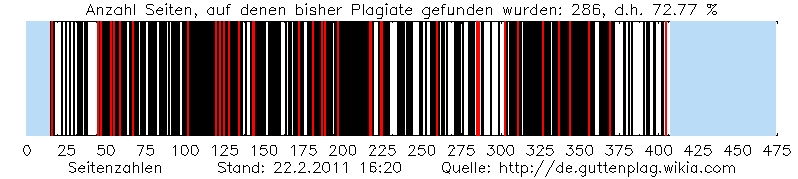
The GuttenPlag Wiki is expanding . Over 68% of the pages in his thesis contain plagiarised material.

http://de.guttenplag.wikia.com/wiki/GuttenPlag_Wiki

Plagiat graphic.jpg

Pages where plagiarism were found (black). The Table of Contents (pages 1-14) and Annexes, page 408 (blue) were not included in calculating the percentages. Pages with imitations of various sources are shown in red. Plagiat graphic.jpg

Professor DEBORA WEBER-WULFF writes

I’m wondering if KTzG thought that this crazy quilt is how we do science. Or if he is perhaps suffering from an advanced version of cryptomnesia. Wikipedia quotes Macrae, C.N., Bodenhasen, G. V. & Calvini, G. (1999). Contexts of cryptomnesia: May the source be with you. Social Cognition, 17, 273–297:

Cryptomnesia is more likely to occur when the ability to properly monitor sources is impaired. For example, people are more likely to falsely claim ideas as their own when they were under high cognitive load at the time they first considered the idea.

Sounds fitting. The saga continues.
 

Perhaps the rumour that zu Guttenberg (aka “zu Googleberg”) actually used ghost writers for his thesis is more than just rumour.

Baron zu Googleberg image: emperorswithoutclothes.com

Der Spiegel reveals:

In May 2004, when Guttenberg was a member of parliament for the conservative Christian Social Union party, Ulrich Tammler, a civil servant in the department with two PhDs of his own, wrote an analysis for Guttenberg headlined “The Question of the Link to Faith in the US Constitution and Supreme Court Rulings on the Separation of the Church and State.”

Tammler completed the 10-page document on May 13, 2004 and passed it on to Guttenberg’s parliamentary office under the reference number WF III – 100/04, according to an article due to be published in SPIEGEL on Monday.Even though members of Bundestag, or lower house of parliament, are only supposed to use of the department for work relating to their parliamentary mandate, Guttenberg included almost the entire article in his dissertation, with only minor word changes.

Tammler himself isn’t cited in any of Guttenberg’s footnotes. Only the parliamentary research department itself is mentioned, a footnote 83. The 60 staff of the department are meant to help lawmakers fulfil their duties as members of parliament. The department’s guidelines state: “The German Bundestag reserves all rights to the work of the Research Department. Publication and distribution require the approval of the departmental management.”

A man of no shame!

Gockel-guttenberg.jpg

Gockel-guttenberg.jpg

And the question becomes whether his thesis contains anything original at all.

On Friday Angela Merkel was still giving her Defence Minister her public support but it is going to be difficult for her to continue with this line. Associating with him is now a burden that few will be able to bear. The Süddeutsche Zeitung reported that the defense minister had plagiarised at least 19 authors. According to the Berliner Zeitung he also copied the work of first-year students at the Free University of Berlin.

Plagiarism and the morphing of a Minister

February 18, 2011

Misconduct in the scientific world takes months if not years to be investigated and sanctions – if any – are light. But for those riding high in the poltical world the consequences can be swift. It seems unlikely that Googleberg can continue as the German Defence Minister for very long.

Just 4 days ago he was

Baron Dr. Karl-Theodor Maria Nikolaus Johann Jacob Philipp Franz Joseph Sylvester Freiherr von und zu Guttenberg, Defence Minister of the Federal Republic of Germany.

Baron Dr. Karl-Theodor Maria Nikolaus Johann Jakob Philipp Franz Joseph Sylvester Freiherr von und zu Guttenberg (focus.de)

Then his plagiarism was revealed by the Süddeutsche Zeitung earlier this week, and his copying of some 24 passages for his PhD thesis has grown to be the copying of at least 78 passages. Even the first two paragraphs of his introduction appear to have been copied from a 1997 article in the center-right dailyFrankfurter Allgemeine Zeitung.

Der Spiegel dubbed him Merkel’s Minister of Scandals.

Deutsche Welle decided that Googleberg was more appropriate than Guttenberg. Two criminal complaints have now been filed against him, claiming infringement of copyrights and lying in the sworn statement that accompanied the thesis. Others are claiming that he can’t be guilty of plagiarism – it must have been the fault of his ghost writer!

In a desperate damage control exercise after being read the riot act by Angela Merkel, Googleberg said on Friday that he would temporarily renounce his doctorate and relinquish his “doctor” title amid allegations that he plagiarized significant sections of his dissertation.

And now Der Spiegel has baptised him Merkel’s Copycat minister.

In the space of just 3 days,

Herr. Dr. Karl Theodor Maria Nikolaus Johann Jacob Philipp Franz Joseph Sylvester Freiherr von und zu Guttenberg, Defence Minister of the Federal Republic of Germany

has morphed to

Herr Theodor Googleberg, Merkel’s copycat minister.

But at least Googleberg has upheld the reputation of German politicians in the misconduct stakes and managed to reduce the lead that was being being taken by Bunga Bunga Berlusconi in Italy and by the “free loading” ministers of the French Republic.

Guttenberg (aka “Googleberg”) at a loss for words over plagiarism charges says Deutsche Welle

February 18, 2011

Update 2!

Breaking –

BBC reports that zu Googleberg has temporarily renounced his PhD.

That’s easily done but guilt cannot be as easily renounced!!

Update on my previous post:

Karl-Theodor zu Guttenberg (aka “zu Googleberg”) is in hot water. Without the ability to “cut and paste” he is apparently at a loss for words! Clearly Google is the corrupting influence.

The German MSM are having a field day.

Deutsche Welle: Guttenberg is back from Afghanistan and

Chancellor Merkel called Defense Minister Karl-Theodor zu Guttenberg to her office in Berlin to explain severe allegations of plagiarism in his doctoral thesis. Opposition politicians, meanwhile, want Guttenberg to go.

After returning from Afghanistan on a short visit with German troops, Defense Minister Karl-Theodor zu Guttenberg had to let down excited guests at a campaign fundraiser in Saxony-Anhalt on Thursday because he was “unavailable and engaged in Berlin.”

Public broadcaster ZDF reported that the popular politician had been called in by Chancellor Angela Merkel for a question-and-answer session regarding allegations that he plagiarized complete – and numerous – passages of his doctoral dissertation.

“Karl-Theodor zu Guttenberg did not credit me as the author of excerpts that came from an article I once wrote,” Barbara Zehnpfennig, a professor at Passau University, told news channel N24. “This breaks all academic rules.”

Zehnpfennig is not the only source not “properly cited” in Guttenberg’s text; several German law professors have accused him of blatant plagiarism, citing up to 70 dubious passages.

Newsmagazine Spiegel said Guttenberg even passed off US Embassy material as his own text – translated directly into German – in a string of allegations that has prompted German media to turn the posh Franconian surname “zu Guttenberg” into a far less noble “zu Googleberg.” …….

…… The university has given the minister 14 days to issue a written explanation of the allegations.

Der Spiegel’s headline calls him the Minister of Scandals

Plagiarism Scandal Threatens ‘Merkel’s Minister of Scandals’


Guttenberg plagiarism: Germans fixated with academic titles

February 18, 2011
c. 2011: Axel Völcker, DerWedding.de

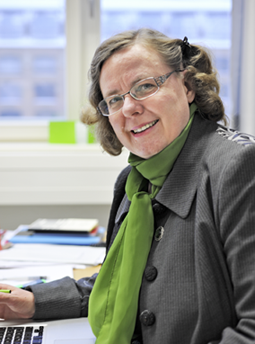
Prof. Dr. Debora Weber-Wulff

The Guttenberg plagiarism saga continues while he has gone off to Afghanistan for a surprise visit – probably because it is less dangerous there right now.

Prof. Dr. Debora Weber-Wulff is Professor for Media and Computing at the HTW Berlin. She was involved in the BMBF flagship project “Virtuelle Fachhochschule” developing eLearning materials and carries out Internet- and eLearning-related projects. She also works on detecting plagiarism and has a plagiarism blog.

Following the apparently blatant plagiarism carried out by Germany’s Defence Minister for his PhD thesis, she was interviewed by TheLocal.de which includes the folllowing:

What is your assessment of the Guttenberg situation?

What the rest of the thesis is like, and which chapter the alleged plagiarism is in – that’s another question. There are communities here who say it’s OK to plagiarize a little in your methodology section, but not in others. I think this is completely bizarre. Germans have a way of talking the problem down.The excerpts that the Süddeutsche Zeitung has online are scary, because they are one-to-one copies. And that’s not OK.

What is the real issue then?
This has to do with the German tendency to love titles, they are title-fixated, and people in politics love to have a doctor title so they seem wiser. But it should be about science, for scientists to prove that they can work by themselves – it’s the first proof that they can do research on their own.

Would you say there is a culture of plagiarising and cheating among German students?
I wouldn’t go that far. There’s a download culture. Young people download their music, videos, and why not download their thesis, because they just see it as busy work – something that stands between them and the degree they think they want or need so they can make lots of money and don’t have to work any longer.

She also writes on her blog:

Guttenberg, the conservative German defense minister from Bavaria, has left the country and gone to Afghanistan. They say this was planned, but right now, he’s probably safer there than in the streets of Berlin. The opposition is gleefully taking potshots at him (metaphorically, you understand).

His supporters accuse the scientist who discovered the plagiarism of being part of a commie plot to undermine the country, if I understand their tone of voice correctly.
No one believes that a professor might sit down one evening at the computer, in the midst of writing a review of a doctoral thesis that had been around for a while, but had a very prominent author, currently under fire for other things. The professor, Andreas Fischer-Lescano of the University of Bremen, poured himself a glass of Argentine red wine, looked over the thesis and put three words into Google: “säkularer laizistischer multireligiöser” (secular lay multireligious – the thesis includes a chapter on putting references to a god in a constitution).
And he got a hit. From an article in the Neue Züricher Zeitung by Klara Obermüller, written a few years before his thesis was published. Oops. He poured another glass and tried some other terms, and some more. Fischer-Lescano wrote a scathing review, and includes as an appendix 24 word-for-word passages that are not quoted and not referenced. The review will be published the end of the month in Kritische Justiz, 44(1), pp. 112-119.
A number of journalists have spoken with me today to question this way of working. How do I look for plagiarists? “Well,” I said, “pretty much the same. Except that I prefer Austrian wine.”

As a sociological phenomenon, the rise of the “cut-and-paste” culture together with the German love of academic titles is a worthy subject for study. But what does not seem to be in doubt is that Guttenberg is just another politician who is just another fraud. And a misuse of position – whether to get an academic degree or to amass huge sums of money – is still corruption.

Why voters continue to vote for frauds is an even more interesting subject for study.


German Defence Minister accused of plagiarism in his PhD thesis

February 16, 2011
Picture of Karl-Theodor Freiherr von und zu Gu...

Image via Wikipedia

The Financial Times Deutschland carries this story today:

Defence Minister Karl-Theodor zu Guttenberg (CSU) has to defend himself against accusations that he had cheated on his doctoral thesis. According to the “Sueddeutsche Zeitung” (Wednesday) there are some passages in Guttenberg’s thesis which match literally formulations by other authors, and which have not been acknowledged.
The thesis is in several places “a brazen plagiarism” and “deception”, the paper quoted the Bremen law professor Andreas Fischer-Lescano, who had discovered the duplications during a routine examination. Fischer-Lescano teaches at the University of Bremen Public Law, European and international law.
…….
Guttenberg submitted his doctoral work in 2006 at the Law Faculty in Bayreuth. In 2007, he was then awarded the highest degree – summa cum laude doctorate in law (PhD).

The thesis is now under investigation by the Ombudsman for scientific self-regulation of the University of Bayreuth.

But this is an investigation concerning a serving Minister. I can predict with the greatest of confidence that the establishment will close ranks and that the investigation will come to the conclusions that:

  • no scientific misconduct is involved,
  • the lack of references were merely an oversight and an honest mistake, and
  • the degree award is not tainted in any way and
  • no further action is required except the insertion of an addendum acknowledging the plagiarised authors

Related:

Guttenberg’s slick image slips away

German Defense Minister Agrees to Inquiry Into Military Incidents


German military looking to drop-outs and foreigners as cannon fodder?

February 16, 2011

This seems to indicate a perverse view of military recruitment. With the end of conscription the German armed forces are short of people.  But targeting school drop-outs and foreigners for lower-ranking military positions seems like an attempt to recruit cannon-fodder.

The Local Germany reports:

German military officials are considering pursuing high school dropouts to fill the Bundeswehr’s ranks following the end to conscription.

Photo: DPA

The Bundeswehr is hoping to make military service more attractive to less educated and unskilled Germans as it transitions to a fully professional force, daily Financial Times Deutschland reported.

“In light of the demographic developments as well as the ongoing structural adjustments to the Bundeswehr, young people with below-average education and school dropouts will now be approached for recruiting,” the document acquired by the paper reads. This “opening of new potential for gaining personnel” will be necessary to maintain the necessary troop numbers, it says, calling the plan an “Attractiveness Programme.”

These recruits would be targeted to fill mainly lower-ranking military positions, the paper said.

The latest detail in military reform plans by the Defence Ministry came after this weekend’s news that foreigners living in Germany could be allowed to join the Bundeswehr. But a Defence Ministry spokesperson told the Financial Times Deutschland on Tuesday that only EU citizens and those from a few other countries would be among those considered for enlistment.

German freighter sinks Indian Navy frigate

February 4, 2011

From thelocal.de:

Cargo Ship Nordlake IMO 9057173 by MSC Michi

Cargo Ship Nordlake 22,450 tons

A German cargo ship has slammed into an Indian frigate in the port of Mumbai, causing the military vessel to catch fire and eventually sink.

The ocean liner Nordlake, based in Hamburg and managed by the Klaus E. Oldendorff shipping company, crashed into the Indian navy vessel Vindhyagiri in a narrow navigation channel at the entrance to the port of Mumbai on Sunday, Indian broadcaster NDTV reported.

The nearly 400 people on board the Vindhyagiri – including the ship’s crew and their visiting families, who were celebrating Navy Day – were successfully evacuated before a massive fire broke out on the vessel some 12 hours later.

A preliminary investigation found that the Nordlake was exiting the harbour as theVindhyagiri was navigating its way in. The Nordlake swerved to avoid another ship and subsequently struck the Vindhyagiri.

INS Vindhyagiri 2682 tons

The Indian navy called the sinking of the Vindhyagiri India’s greatest peacetime casualty, noting that a frigate has never been sunk by a civilian vessel. Built in 1981, the Vindhyagiri suffered extensive damage, but the navy said the ship could possibly be repaired and eventually brought back into service.

The nearly 180-metre-long Nordlake, which flies a Cypriot flag, did not sustain any serious damage. The freighter supports an international crew, and no Germans were on board at the time of the crash.

“We are happy that, to our current understanding, the accident has caused neither environmental harm nor any human casualties,” Peter Rybarczyk, chief executive of the Klaus E. Oldendorff shipping company, told Hamburg broadcaster NDR.

The Director General of Shipping in Mumbai has ordered an inquiry into the collision, NDTV reported, while the navy has also filed a complaint that argues the ship from Cyprus did not follow standard operating procedure.

The Nordlake has a deadweight of 22,450 tons and almost ten times greater than the standard weight of INS Vindhyachal at 2682 tons.

Photo: DPA

Mumbai harbour after collision: photo DPA


The strange and murky case of Silvia Bulfone-Paus: 12 retractions so far …..

January 25, 2011

Twelve papers where Sylvia Bulfone-Paus was the senior author have been retracted.

Silvia Bulfone-Paus: image retraction watch

That itself is sufficiently unusual and remarkable. But the story seems to go back a long way. Retraction Watch has been following the story.

In September 2010 Nature carried the story of a formal investigation which had started in July 2010 of scientific misconduct being carried out at the Research Center Borstel in Germany (Forschungszentrum Borstel, Leibniz Gemeinschaft, Deutsche Forschungsgemeinschaft, Medizinischen Fakultäten der Universitäten Lübeck und Kiel). The story however was not about the investigation but about a destabilising influence:

But events around such an investigation in Germany have taken a troubling and damaging turn from such good practice in the past few months. An unknown agitator using the presumed pseudonym Marco Berns is engaged in an e-mail and Internet offensive against two biomedical researchers whom he accuses of scientific fraud.

Berns’s libellous messages are targeted at dermatologist Ralf Paus and immunologist Silvia Bulfone-Paus, a married couple who both hold joint positions at the University of Manchester, UK, and the University of Lübeck, Germany.

The trial-by-Internet is disturbing a formal investigation, organized by the Research Center Borstel in Germany and begun in July, into some of the pair’s publications.

“Marco Berns” and his accomplice (or alter ego?) “Martin Frost” were posting articles on the internet since at least the end of 2009 and had also been subjected to “cease and desist” demands from lawyers representing the Research Centre. Some of these articles questioned Sylvia Bulfone-Pause’s use of academic titles among other wrong doings.

It does seem that the formal investigation started in July 2010 partly – if not wholly – because of the allegations which had been made by Berns and Frost in 2009. Formally the reason for the investigation was that Bulfone-Pause herself had reported some manipulation of data in papers published about research carried out under her supervision but how and when such manipulation had been discovered is not very clear.

In any case the investigation was completed and the results were published by the Research Centre on 2nd December 2010.

The Commission concludes that scientific misconduct (has ocurred) within the laboratory group “Immunobiology” for years. In 6 out of 8 of the analyzed publications in which, the two former research assistants, Dr. E. Bulanova and Dr. V. Budagian, recorded as first authors, manipulation of images found that the manipulation of the reproduction of scientific results. Data corruption within the meaning of “independent inventors” of results are not available. Given the primary responsibility of the first authors in data collection and data presentation in a scientific publication, these two first authors of these publications (bear the) main responsibility for scientific misconduct.

The blame was put squarely on Drs. Bulanova and Budagian – both Russian – and as their supervisor, Bulfone-Paus received a firm slap on the wrist:

The 6  publications complained of (were) produced under the senior authorship of Prof. Dr. Bulfone-Paus………  The Commission considers that this a lack of supervision which must be expected from the senior author / group leader, even if the first author of the offending publications are experienced scientists. The senior author / research group leader, therefore, carries a key responsibility for the scientific wrongdoings within their work group.

Nature reported:

An external investigation, launched in July and chaired by Werner Seeger, a biomedical researcher at the University of Giessen, Germany, found that two former postdocs with the centre’s immunology group were guilty of using pictures of protein blots from unrelated experiments to support their findings on signalling in cells involved in allergic reactions such as asthma. The pair’s supervisor, Silvia Bulfone-Paus, who chairs the centre’s immunology and cell biology department, bears “substantial responsibility” for the manipulations, the committee found, but added that they found no evidence of data fabrication.

The three Directors of the Research Centre are Prof. Dr. Dr. S. Bulfone-Paus, Prof. Dr. U. Schaible and Prof. Dr. P. Zabe. And the elusive Martin Frost continued his writings implying that the Russian scientists could actually just be scapegoats for the more senior authors involved and that some of their wrongdoing could be traced back to 1999!!

Now the six retractions have grown to be 12 papers so far.

This story is not over yet……..