Archive for the ‘India’ Category

Indian monsoon starts early and vigorously

June 17, 2013

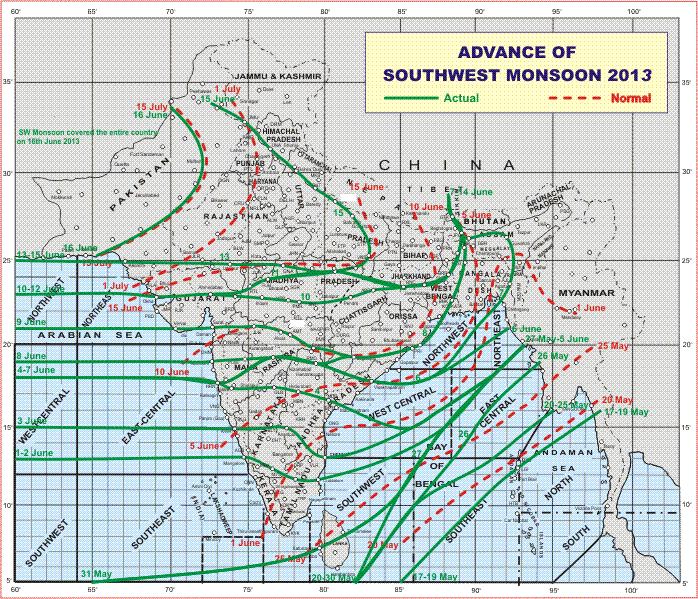
An almost spectacular start to the Indian monsoon and Delhi has received heavy rains almost two weeks earlier than expected. Two weeks of the official 4 month monsoon period (about 15%) are over and the welcome rains have covered the entire country around one month ahead of schedule. Over 30% of the total expected rainfall for a “normal” monsoon has already been received. So much so that the new airport in Delhi was flooded yesterday, not so much because of problems at the airport but because the drainage in the surrounding areas could not cope with the flow draining out of the airport and caused a back-flow!

Temperatures have dropped to a “pleasant” 31°C and it augurs well for my trip to Delhi in a couple of weeks.

Expectations for a “good” monsoon and a subsequently high level of agricultural growth are high.

ToI:The monsoon hit Delhi and its neighbourhood on Sunday, two weeks before time — and in a record sweep, swiftly covered all of northwest India. 

Besides reaching the capital well before the initially predicted date of June 29, a record occurrence unfolded in a span of 24 hours with the rain bearing system reaching the ends ofnorthwest India a full month before the usual July 15 date. The progress of rains to cover all of India as rapidly as happened over Saturday and Sunday last occurred in 1961. 

Delhi recorded 6.1 mm rain till 8.30 am and 45 mm in the next 12 hours. Palam recorded a day’s highest rainfall in the city in two years with 117.8 mm between 8.30 am and 5.30 pm. The showers have been so plentiful that Delhi will see the Yamuna cross the warning level and maybe even touch the danger mark by June 18. 

The city’s maximum temperature sharply fell to 31.5 degrees Celsius, eight degrees below normal while the minimum was 23.7 degrees.

From IMD:

monsoon 16 June 2013

monsoon 16 June 2013

Indian monsoon on schedule

June 10, 2013

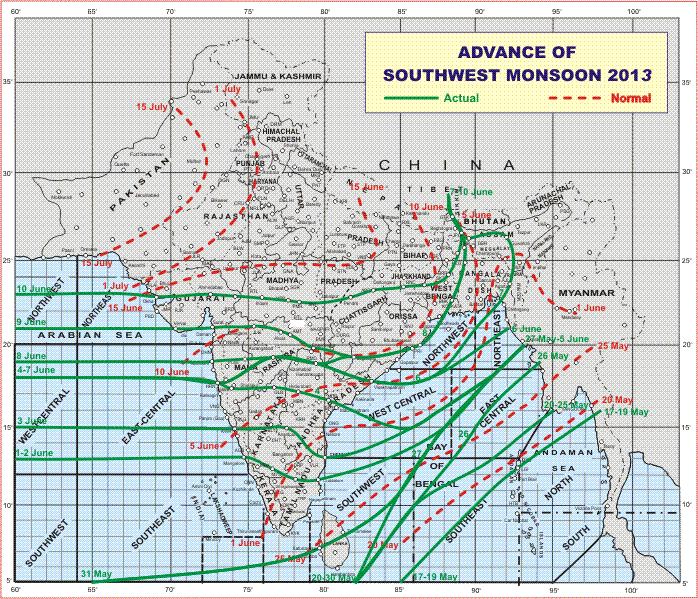
The Indian monsoon season has just started and officially runs from June to September. It seems to be on schedule and perhaps a little early in the west and a few days late in the east. Mumbai is seeing heavy rains a few days early.  Last year the monsoon was somewhat delayed and not too regular though it was “average” taken over the entire 4 months. With industrial growth still somewhat in the doldrums a boost to agricultural output will be very welcome.

( from IMD).

Monsoon progress 10th June 2013

Monsoon progress 10th June 2013

There are no signs of the catastrophe scenarios that climate models take delight in forecasting about the effects of global warming on the Indian monsoon.

India’s plummeting birth rates illustrate the coming population decline

May 9, 2013

Fertility rates are dropping sharply across the world and simple arithmetic tells us that by 2100 world population will be steady or declining slightly. In fact, rather than facing a population explosion and food shortages we will be facing the demographic challenges of a stable or declining population together with an increase in longevity. A new flexibility in the patterns of working will be needed as the populations in work reduce in proportion to those beyond retirement age. Retirement age itself will have to increase.

Yet it seems to me that the utterly alarmist, Malthusian, catastrophe scenarios for world population put forward in the 1970’s and 80’s by the Club of Rome, Ehrlich and other doom-mongers still prevail as “conventional wisdom” – even though it has long been established that their basic assumptions were plain wrong. For some reason environmentalists are the most ardent deniers of what the arithmetic says. They are the first to proclaim the dangers of population explosions yet are extremely loth to abandon catastrophe scenarios they have espoused when they are shown to be exaggerated or false.

I was therefore glad to see the subject getting attention in GeoCurrents where Martin W Lewis addresses and presents the sharply falling fertility rates around the world and in the various States in India. His maps are particularly well put together. The average fertlity rate in India is now down to 2.5 but many of the States fall well below the “replacement rate” of 2.2. The variation of fertility rates is impacted by the “usual suspects”; GDP, female literacy, proportion of urban dwellers, life expectancy, the Human Development Index (HDI) and the availability of electricity. But as Lewis shows there is also a striking correlation between fertility and TV ownership (seems plausible) and between fertility rates and the exposure of women to the media (also very plausible).

India’s Plummeting Birthrate: A Television-Induced Transformation?

…. It can be deceptive, however, to view India as an undivided whole. As shown on the map posted here, fertility figures for half of India are actually below replacement level. Were it not for the Hindi-speaking heartland, India would already be looking at population stabilization and even decline. All the states of southern India post TFR figures below 1.9. A number of states in the far north and the northeast boast similarly low fertility levels, including West Bengal, noted for its swarming metropolis of Calcutta (Kolkata).

(from GeoCurrents)

India’s geographical birthrate disparities, coupled with the country’s admirable ability to collect socio-economic data, allow us to carefully examine ideas about fertility decline. The remainder of this post will do so through cartography, comparing the Indian fertility-rate map with maps of other social and economic indicators. ……. 

……

Some scholars have argued that recent fertility decreases in India and elsewhere in the Third World are more specifically linked to one technological innovation: television. The TV hypothesis is well-known in the field, discussed, for example, in the LiveScience article on the African population explosion mentioned above. In regard to India, Robert Jensen and Emily Oster argue persuasively that television works this magic mostly by enhancing the social position of women. As they state in their abstract:

This paper explores the effect of the introduction of cable television on women’s status in rural India. Using a three-year, individual-level panel dataset, we find that the introduction of cable television is associated with significant decreases in the reported acceptability of domestic violence towards women and son preference, as well as increases in women’s autonomy and decreases in fertility. We also find suggestive evidence that exposure to cable increases school enrollment for younger children, perhaps through increased participation of women in household decision-making. We argue that the results are not driven by pre-existing differential trends.

As it turns out, the map of television ownership in India does bear a particularly close resemblance to the fertility map. Two anomalously low-fertility states with low levels of female education, Andhra Pradesh and Jammu and Kashmir, score relatively high on TV penetration, as does West Bengal, which lags on several other important socio-economic indicators. The correlation is far from perfect: Mizoram ranks higher on the TV chart than its fertility figures would indicate, whereas Odisha and Assam rank lower. Odisha and Assam turn out to be a bit less exceptional in a related but broader and more gender-focused metric, that of “female exposure to media.” These figures, which include a television component, seem to provide the best overall correlation with the spatial patterns of Indian fertility.

(from GeoCurrents)

Indian surrogate mother dies after delivery of child for a Norwegian couple

April 2, 2013

UPDATE – from the Norwegian press

The surrogate mother bore twins but one of them died after birth.

The Norwegian Embassy in India confirmed that preparations were underway for the other child to be taken to Norway.

The surrogate mother was apparently paid 31,000 Norwegian Kronor (about $6,000) (corrected below)

================================

This report in the Svenska Dagbladet today is disturbing not because there is anything inherently wrong with surrogacy but because it smacks of exploitation – of wealth being used to pass on the risks of childbirth to a “poor” surrogate mother. There are some very gray ethics involved in a “rich” Norwegian couple exploiting the poverty of a “poor” surrogate mother who dies – especially in doing something not permitted in Norway. No doubt the surrogate was paid the “going rate” for surrogacy (about $6,000). But I doubt the surrogate had made any real assessment of the risk of losing her life or that the “contract” had a clause to cover for the death of the surrogate.

Svenska DagbladetAn Indian woman who was the surrogate for a Norwegian couple died shortly after birth. The woman, who was married and had children of  her own developed Hepatitis E during the pregnancy. 

“Pregnancy and childbirth is unpredictable for us all. Unforseen things can happen and the surrogate contract and the parties should take this into account”, says anthropologist Kristin Engh Førde.

Surrogates are not allowed in Norway and Norwegians make use of egg donation abroad.

The article does not report on the condition of the baby nor on the condition of the surrogate’s own children.

I hope the Norwegian couple get their child — but what is their responsibility for those other children?

I am not sure if the quote from anthropologist Kristin Engh Førde is meant to imply – and I hope it does not – that it is the responsibility of every surrogate mother to accept the risk of dying and contract accordingly.

Would the surrogate have died if she had been giving birth at a Norwegian hospital? Would her Hepatitis E have been treated in time?

Mortality rates are generally low, for hepatitis E is a “self-limiting” disease. …  However, during the duration of the infection (usually several weeks), the disease severely impairs a person’s ability to work, care for family members, and obtain food. Hepatitis E occasionally develops into an acute, severe liver disease, and is fatal in about 2% of all cases. Clinically, it is comparable to hepatitis A, but in pregnant women the disease is more often severe and is associated with a clinical syndrome called fulminant hepatic failure. Pregnant women, especially those in the third trimester, suffer an elevated mortality rate from the disease of around 20%.

Fire Ice (methane hydrate) success in Japan gets India all excited

March 17, 2013

I get the impression that not only the oil and gas industry but also countries with limited energy resources have not been this energised about prospects for energy independence for a long time ( and perhaps not since the discovery of North Sea Gas). First came Shale gas and then Shale oil and now Fire Ice is catching the imagination. The sheer abundance of methane hydrates around the globe and the thought that much of this gas could soon be economically extractable is almost intoxicating for those involved.

“The worldwide amounts of carbon bound in gas hydrates is conservatively estimated to total twice the amount of carbon to be found in all known fossil fuels on Earth”.

I posted recently about the successful flow test for extracting gas from deep sea methane hydrate conducted in Japan. Of course commercialisation of this technology is still many years away (though Japan hopes this could be as early as 2016). Deposits of methane hydrate are known to be extensive and generally exist either under permafrost or under the sea. The deep sea deposits were laid down under conditions of high pressure (deep sea conditions). India is known to have substantial deposits and this is now getting some people very excited:

Types of methane hydrates deposits

Economic Times:

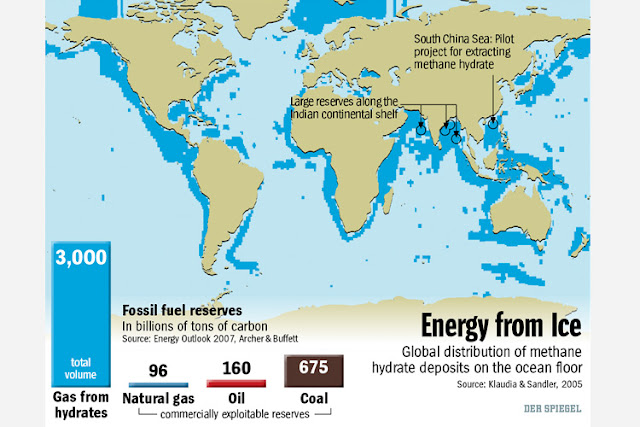
Estimates of global reserves are sketchy, but range from 2,800 trillion to 8 billion trillion cu.metres of natural gas. This is several times higher than global reserves of 440 trillion cu. metres of conventional gas. However, only a small fraction of hydrate reserves will be exploitable.

Methane hydrate is a mixture of natural gas and water that becomes a solid in cold, high-pressure conditions in deep sea-beds (where the temperature falls to 2 degrees centigrade). It is also found in onshore deposits in the permafrost of northern Canada and Russia. Heating the deposits or lowering the pressure (the technique used by JOGMEC) will release gas from the solid. One litre of solid hydrate releases around 165 litres of gas.

India has long been known to have massive deposits of methane hydrate. These are tentatively estimated at 1,890 trillion cu.m. An Indo-US scientific joint venture in 2006 explored four areas: the Kerala-Konkan basin, the Krishna-Godavari basin, the Mahanadi basin and the seas off the Andaman Islands. The deposits in the Krishna Godavari basin turned out to be among the richest and biggest in the world. The Andamans yielded the thickest-ever deposits 600 metres below the seabed in volcanic ash sediments. Hydrates were also found in the Mahanadi basin.

Formidable economic and environmental challenges lie ahead. Nobody has yet found an economic way of extracting gas from hydrates. Industry guesstimates suggest the initial cost may be about $30/ mmBTU, double the spot rate in Asia and nine times higher than the US domestic price. JOGMEC is optimistic that the cost can be cut with new technology and scale economies.

The Indian National Gas Hydrate Program (NGHP) Expedition was conducted together with the US Geological Service

The World’s Largest Potential Energy Resource
Released: 2/7/2008 9:21:21 AM

An international team led by the U.S. Geological Survey (USGS) and the Directorate General of Hydrocarbons, which is under the government of India’s Ministry of Petroleum and Natural Gas, conducted the expedition.

Highlights include:

  • gas hydrate was discovered in numerous complex geologic settings, and an unprecedented number of gas hydrate cores and scientific data were collected;
  • one of the richest marine gas hydrate accumulations ever discovered was delineated and sampled in the Krishna-Godavari Basin;
  • one of the thickest and deepest gas hydrate occurrences yet known was discovered offshore of the Andaman Islands and revealed gas hydrate-bearing volcanic ash layers as deep as 600 meters below the seafloor;
  • and for the first time, a fully developed gas hydrate system was established in the Mahanadi Basin of the Bay of Bengal.

“NGHP Expedition 01 marks a monumental step forward in the realization of gas hydrates becoming a viable energy source,” said USGS Director Mark Myers. “This partnership combines the expertise of two organizations dedicated to understanding gas hydrates, and research results provide new and exciting information about this important potential energy resource.”

Directorate General of Hydrocarbons Director General and NGHP Program Coordinator V. K. Sibal said, “The global gas hydrate resources are estimated to be huge. Although the exploration and exploitation of gas hydrates pose significant challenges, the opportunities are unlimited. The combined wisdom of the scientific community from across the world could provide the answers and solutions to many of these challenges. The Indian gas hydrate program has been fortunate in having the benefits of a truly global collaboration in the form of the first gas hydrate expedition in Indian waters. The results of the studies are not only encouraging, but also very exciting. I believe that the time to realize gas hydrate as a critical energy resource has come.”

Methane hydrate deposits around the world: Graphic Der Spiegel


Jaguar Land Rover poised to “make in India, export to the emerging world”

March 2, 2013

Jaguar Land Rover sells around 250,000 Land Rovers and about 55,000 Jaguars worldwide.  In 2011/12 this generated about £13.5 billion sales with a profit of £1.5 billion.  They will spend around £2 billion in the 2013 financial year on new products including a new £350 million engine plant in the West Midlands.

JLR’s Strategy (Sustainability Report), JLR Strategy, states:

In 2011 we expanded assembly operations into India, one of our key markets, and announced plans for our first manufacturing facility abroad in another key market, China, through a joint venture with Chery Automobile Company Ltd. We predict Jaguar Land Rover sales will more than double in volume by 2020, largely due to increasing demand in emerging markets.

Now Reuters reports that the emerging market strategy is progressing fast and that JLR is poised to move from just assembly to the complete manufacture of some brands in India. They join the growing number of players who now see India as a sort of export hub to emerging markets.

Jaguar Land Rover (JLR) is investigating the potential of manufacturing cars in India, company sources said, as the British luxury carmaker looks to build on its growth in emerging markets with the help of Indian parent Tata Motors.

JLR, which has ridden a wave of surging demand in China and other emerging markets to post record profits over the past year, is “actively exploring the possibility” of building cars from scratch in India, said one company source.

“The idea is being looked into, with the (Jaguar) XF and (Land Rover) Freelander the obvious candidates,” said another source with knowledge of the matter.

The British brands, which already assemble two models in India using parts and engines shipped from factories in the UK, will also begin assembling its popular Range Rover Evoque in the country soon, the first source said without providing details.

Building cars in India, which has developed into an emerging market export hub for many global carmakers, would allow JLR to skirt high import taxes on luxury cars, which the country’s finance minister proposed raising to 100 percent from 75 percent in his budget speech last week.

… JLR will exhibit a new 9-speed automatic Evoque and an electric-powered version of its Land Rover Defender at the Geneva Motor Show next week.

Bought by Tata for $2.3 billion from Ford in 2008, JLR has defied those skeptical of its future under Indian ownership to roar back into profit over the past three years as the main growth driver for its now-struggling parent.

Continued growth in emerging markets such as India and China, which accounted for 22.3 percent of its sales in the December quarter, is key for JLR as it embarks on an expensive overhaul of its production and product clout. The carmaker is investing $1.7 billion with local partner Chery Automobile Co in a factory in China.

JLR lags rivals BMW AG, Volkswagen AG’s Audi and Daimler AG’s Mercedes-Benz in assembling cars in India, where the luxury market is expected to swell by around six times by 2020 to 300,000 cars a year, according to business consultancy Frost & Sullivan. ….

…. Earlier this year JLR started the assembly of the 2.2-litre diesel version of the Jaguar XF saloon at a plant in Pune, west India, tucked away in a corner of a sprawling production site where Tata builds its heavy duty trucks and hatchbacks.

Screwed together using engines and components shipped from JLR’s Castle Bromwich plant in Birmingham, central England, the company has also been assembling its Land Rover Freelander 2 in Pune since May 2011.

The XF and the Freelander 2 are JLR’s best-selling models in India, where it sold 2,288 cars in the year to March 2012, up 157 percent from the previous year. ….. 

“Bribes are necessary” – Berlusconi; but he does hit a nerve.

February 18, 2013

Bunga-bunga Berlusconi is at it again!

But he is describing a reality which applies not only in 3rd world and developing countries but also in the EU and Japan and the rest of the “developed” world.

This time he was reacting to a string of corruption cases in Italy culminating in the arrest of the Finmeccanica CEO Giuseppe Orsi for involvement in bribes allegedly paid to Indian government officials to secure a helicopter contract. This follows ENI’s CEO Paolo Scaroni being investigated for alleged bribes paid by its Saipem subsidiary to win contracts in Algeria.

From the FT:

Former prime minister Silvio Berlusconi has defended the need for bribery in winning contracts for Italy’s multinationals, as politicians campaigning in general elections have been forced to respond to a welter of corruption scandals revolving around the nexus of politics and business.

“Bribes are a phenomenon that exists and it’s useless to deny the existence of these necessary situations when you are negotiating with third world countries and regimes,” Mr Berlusconi, leader of a centre-right coalition and seeking his fourth stint in office, said on Thursday.

“These are not crimes,” said Mr Berlusconi, describing payments as “commissions”. He also defended state-controlled energy group Eni, whose chief executive Paolo Scaroni is under investigation for alleged bribes paid by its Saipem subsidiary to win contracts in Algeria. Mr Scaroni denies the allegations.

Corruption generally takes two forms:

  1. According to rule: Where a bribe is paid for preferential treatment  in an otherwise lawful process (i.e. to be preferred over a competitor, to have an application approved “out of turn”  or generally for the facilitation of a lawful process in favour of the briber)
  2. Against the rule: Where a consideration is provided to obtain some service that the receiver is not legally authorised to provide (i.e. to a judge for a favourable judgement or to a policeman to not do his bounden duty or to a Professor to pass a failing student).

For both the cases above of Finmeccanica and ENI, the corruption alleged is primarily of the “According to Rule” type. In the first Finmeccanica’s subsidiary Augusta-Westland apparently payed bribes totalling some €51 million to first have specifications altered so that they could bid and then paid bribes for preferential evaluation during technical trials where the trials themselves were tailored to suit their product. The value of the helicopter contract is about €480 million. In the ENI case, CEO Scaroni apparently arranged to pay some €197 million through a Hong Kong company who then paid bribes to Algerian officials to win Sonatrach and other Algerian contracts for their Saipem subsidiary. The contract values add up to some €8.5 billion.

In the Finmeccanica case the “bribes” make up some 10.6% of the contract value whereas for the ENI case the alleged bribes amount to some 2.4% of the contract value. This difference is itself interesting. Profit margins in energy contracts (oil and gas pipelines or equipment or power plants and power equipment)  are generally significantly lower than in defence contracts. Certainly in the power industry – from my own experience – “consultancy” and “agent” contracts – always ostensibly for the supply of specific services – were considered to be at an “acceptable” and justifiable level if they amounted to less than than about 3% of the contract value in a contract with a profit margin of something less than 10% and typically around 7 – 8%. This suggests to me that the helicopter contract probably has a true profit margin of around 25% with a visible margin of around 15% after paying the “commissions” and “software consultancy contracts” of around 10%.

This is bad enough but there is a particular kind of case where I am a little less certain of what the correct and ethical course of action is. I have seen many cases where the “bribe” is effectively structured as a kind of ” private tax” applying to whoever the winner is. A sort of level playing field as regards bribes.

It is made clear to all bidders that the bidder with the lowest visible evaluated price will win. But it is also made clear – privately – to all bidders that there is a minimum “commission” payment  – usually expressed as a percentage – which will apply. The bidder who makes the best (highest) private bid above this minimum also receives the largest amount of “support” during the evaluation procedure  to be able to declare his bid L1 (lowest evaluated price). The highest bribe-bidder does not necessarily win if his product/bid are not quite good enough to also achieve the lowest evaluated price.

The real question for a CEO then becomes:
“Should I decline to bid and jeopardise jobs – and profits – at my own factories, or join the prevailing game and pay the lowest possible bribe I can?”

And by the way – it is not only 3rd world and developing countries where this dilemma appears. And anybody who thinks this does not happen every day in the EU is living in a fantasy. Not least in the area of public procurement.

“Not peer-reviewed” but it seems to work – A new green revolution underway in Bihar

February 17, 2013

The System of Rice Intensification was discovered almost by accident in 1983-84 in Madagascar by the French Jesuit Father Henri de Laulanié. It is a system of managing crops and is not based on fertilisers or insecticides or new gene modifications. As such it does not give rise to a huge number of supposedly “peer-reviewed” publications. Politically correct “scientists” are not keen to accept the benefits of SRI since it is not a   “science”.

Father de Laulanié died in 1995 but SRI has spread globally largely due to the efforts of Norman Uphoff and the International Institute for Food, Agriculture and Development at Cornell University, Ithaca, New York.

SRI field

SRI field wikipedia

Father Laulanié’s unpublished paper from 1992 is here: Laulanie SRI unpublished

This System of Rice Intensification was discovered almost by accident in 1983-84. Due to a lack of time for letting rice seedlings grow for 30 days before being transplanted, students in a farm school at Antsirabe (1,500 meters a.s.l.) were obliged to use their very small nursery twice within a month. ….. Such was the beginning of the System of Rice Intensification.

But now some 3 decades after it was discovered SRI seems to be having a quite dramatic effect in the State of Bihar in India and rice yields have risen by a factor of 2 – 4. So much so that it is being called India’s secod “green revolution”. For Bihar and Chattisgarh – which have long had to put up with being labelled India’s least developed States – SRI is part of a new vigorous and  unexpected growth.

India Today: Bihar’s resurgence begins at the grassroots level. For many years, villages in Bihar saw their youths migrating to other states in large numbers in search of livelihood. It was left to the minuscule minority of do-gooders to stay back and contribute their mite towards a silent agricultural revolution in the state. 

Leading the pack of achievers are five young and doughty farmers from Darveshpura village from Nalanda district who recently created a new world record in paddy cultivation. Sumant Kumar had a bumper yield of 224 quintal per hectare which was enough to eclipse the world record set by a Chinese farm scientist Yuan Longping. Four of his friends from the same village – Krishna Kumar, Nitish Kumar, Ramanand Singh and Sanjay Kumar – also had extraordinary produce.

The achievements in Bihar and Chattishgarh are begining to attract international attention much to the chagrin of the International Rice Research Institute which does not like to acknowledge any advance which does not originate with them. Low tech solutions just aren’t sexy enough to attract funding especially when no large corporation will make any extra profit on new, expensive, high-tech products.
The Guardian: Sumant Kumar was overjoyed when he harvested his rice last year. There had been good rains in his village of Darveshpura in north-east India and he knew he could improve on the four or five tonnes per hectare that he usually managed. …. This was not six or even 10 or 20 tonnes. Kumar, a shy young farmer in Nalanda district of India’s poorest state Bihar, had – using only farmyard manure and without any herbicides – grown an astonishing 22.4 tonnes of rice on one hectare of land. This was a world record and with rice the staple food of more than half the world’s population of seven billion, big news. 
…… It beat not just the 19.4 tonnes achieved by the “father of rice”, the Chinese agricultural scientist Yuan Longping, but the World Bank-funded scientists at the International Rice Research Institute in the Philippines, and anything achieved by the biggest European and American seed and GM companies. ….
……. That might have been the end of the story had Sumant’s friend Nitish not smashed the world record for growing potatoes six months later. Shortly after Ravindra Kumar, a small farmer from a nearby Bihari village, broke the Indian record for growing wheat. ….
…. What happened in Darveshpura has divided scientists and is exciting governments and development experts. Tests on the soil show it is particularly rich in silicon but the reason for the “super yields” is entirely down to a method of growing crops called System of Root Intensification (SRI). It has dramatically increased yields with wheat, potatoes, sugar cane, yams, tomatoes, garlic, aubergine and many other crops and is being hailed as one of the most significant developments of the past 50 years for the world’s 500 million small-scale farmers and the two billion people who depend on them. ……  While the “green revolution” that averted Indian famine in the 1970s relied on improved crop varieties, expensive pesticides and chemical fertilisers, SRI appears to offer a long-term, sustainable future for no extra cost. ….
…… In its early days, SRI was dismissed or vilified by donors and scientists but in the past few years it has gained credibility…..
Low -tech crop management does not lead to a splurge of publications, corporate funding or scientific career advancement. It does not offer the chance for developing new high-tech plants or fertilisers or insecticides. In modern “science”- it would seem – being “peer-reviewed” is more important than being real!
…. The state will invest $50m in SRI next year but western governments and foundations are holding back, preferring to invest in hi-tech research. The agronomist Anil Verma does not understand why: “The farmers know SRI works, but help is needed to train them. We know it works differently in different soils but the principles are solid,” he says. “The biggest problem we have is that people want to do it but we do not have enough trainers.“If any scientist or a company came up with a technology that almost guaranteed a 50% increase in yields at no extra cost they would get a Nobel prize. But when young Biharian farmers do that they get nothing. I only want to see the poor farmers have enough to eat.”

The System of Rice Intensification (SRI)

was developed as a methodology aimed at increasing the yield of rice produced in irrigated farming without relying on purchased inputs. Its main elements were assembled in 1983 by the French Jesuit Father Henri de Laulanié in Madagascar after 20 years of observation and experimentation.[1] However, systematic evaluation and then dissemination of the system did not occur until some 10-20 years later. The productivity and merits of SRI have been debated between supporters and critics of the system since 2004, but the controversy has waned in recent years.

SRI concepts and practices have continued to evolve as they are being adapted to rain-fed (unirrigated) conditions and with transplanting being superseded sometimes by direct-seeding. Regarding the management of rice plants, the basic practices of SRI according to SRI-Rice at Cornell University are:

  • Rice plant seedlings should be transplanted very young (usually just 8-12 days old) with just two small leaves
  • Seedlings should be transplanted carefully and quickly to inflict minimum trauma on the roots
  • Seedlings should be transplanted singly, with only one per hill instead of 3-4 together to minimize root competition
  • Seedlings should be widely spaced to encourage greater root and canopy growth
  • Seedlings should be transplanted in a square grid pattern (25×25 cm, or wider in good quality soil)
30 million pilgrims seek salvation at the Maha Kumbh Mela today

February 10, 2013

This years Kumbh Mela – which is a “Maha” Kumbh being a one in 144 year event – started on 14th January and will continue  for 55 days. So far there have been 3 fires of significance in the various tent cities that have sprung up to cater for the 100 million visitors expected and some 20 people have been injured. Remarkably, considering the sheer volume of people, there have not been many other serious incidents or any fatalities attributable to the crowds.

(Update! 11th February

It is reported that 36 people – mainly women and children – died in a crush at the railway station on Sunday)

The Kumbh Mela web site tries to explain the fervor (but I don’t share the fervor and am not much the wiser):

The highlight for most pilgrims during a Kumbhmela festival is the observance of a holy bath at the sangam. A holy bath in either of a sacred river has purifying effects, but where the three rivers meet, the purification is said to increase one hundred times. It is further believed that when one takes a sacred bathe at the sangam during the Kumbhmela the potency of the holy water increased one thousand times. For this reason Indians believes that the Kumbhmela is the most auspicious place in the universe to take a holy bath. Armed with this faith pilgrims attend the Kumbhmela and bathe in the Ganges in a mood of solemn reverence.

Today is Mauni Amavasya  and is apparently a particularly auspicious day for these rituals. The Times of India also tries to explain the significance of the day – but their language is rather cryptic:

Astrologers believe that it’s a rare position when Sun and Moon enter and the zodiac sign of Capricorn, because of the transit, on this day. This day is also celebrated as the birthday of Manu Rishi. While Capricorn sign has the yoga of Sun and Moon which increases the significance of this Amawasya, taking a holy dip in Sangam will be giving virtues to an individual, on this day.

kalpavasi

A Kalpavasi

In Hindu mythology Mauna (silence) comes from Muni an ascetic who practised total silence in an effort to achieve a state of oneness with the self. It is therefore supposed to be a day of calmness, of silence and for the stilling of restless minds. It ought to be a day of meditation and contemplation and pilgrims are not supposed to talk to each other. Mauni Amavasya occurs annually on the 15th day of the dark fortnight of Magh (January-February) when both the Sun and the Moon are in Capricorn. It has a special relationship with the Kumbh Mela at Allahabad, being one of its major bathing days. This is reinforced in the annual Magha Mela of the Kalpavasis which views bathing on this day as extremely rewarding.

But I expect there may be some frayed tempers today when 30 million try to wash their sins away.

In any event some 30 million visitors are expected today and some 18,000 security personnel have been deployed. The Parliament House attacker Afzal Guru was executed yesterday in Delhi’s Tihar jail and there are some fears of a reaction

Indian “curry” dates back to 4,500 years ago

January 30, 2013

Curries have come a long way from the proto-curry of the Indus Valley civilization and I am sure our tastes have also evolved. And chillies probably came much later and only in the 16th century.

But I can attest to the fact that curry withdrawal syndrome is a real thing and hits hard if I go more than 3 or 4 days without a fix.

Slate:

The Mystery of Curry

By |Posted Tuesday, Jan. 29, 2013,

Indian chicken jalfrezi curry.

Indian chicken jalfrezi. Photograph by Joe Gough/iStockphoto/Thinkstock.

What is curry? Today, the word describes a bewildering number of spicy vegetable and meat stews from places as far-flung as the Indian subcontinent, the South Pacific, and the Caribbean Islands. There is little agreement about what actually constitutes a curry. And, until recently, how and when curry first appeared was a culinary mystery as well.

The term likely derives from kari, the word for sauce in Tamil, a South-Indian language. Perplexed by that region’s wide variety of savory dishes, 17th-century British traders lumped them all under the term curry.  A curry, as the Brits defined it, might be a mélange of onion, ginger, turmeric, garlic, pepper, chilies, coriander, cumin, and other spices cooked with shellfish, meat, or vegetables.

Those curries, like the curries we know today, were the byproduct of more than a millennium of trade between the Indian subcontinent and other parts of Asia, which provided new ingredients to spice up traditional Indian stews. After the year 1000, Muslims brought their own cooking traditions from the west, including heavy use of meat, while Indian traders carried home new and exotic spices like cloves from Southeast Asia. And when the Portuguese built up their trading centers on the west coast of India in the 16th century, they threw chilies from the New World into the pot. (Your spicy vindaloo may sound like Hindi, but actually the word derives from the Portuguese terms for its original central ingredients: wine and garlic.) 

But the original curry predates Europeans’ presence in India by about 4,000 years. Villagers living at the height of the Indus civilization used three key curry ingredients—ginger, garlic, and turmeric—in their cooking. This proto-curry, in fact, was eaten long before Arab, Chinese, Indian, and European traders plied the oceans in the past thousand years.

….. The Indus society began to flourish around the same time that the ancient Egyptians built their pyramids and Mesopotamians constructed the first great cities in today’s Iraq. Though less well known than its more famous cousins to the West, the Indus civilization boasted a half-dozen large and carefully planned urban centers with sophisticated water and sewage systems unmatched until Roman times. During its peak, between 2500 B.C. and 1800 B.C., the Indus dominated a land area larger than either ancient Egypt or Mesopotamia, covering much of today’s Pakistan and most of western India, as far west as the Iranian coast, as far north as Afghanistan, and as far east as the suburbs of New Delhi. But unlike the hieroglyphic and cuneiform writing of the Egyptian and Mesopotamian scribes, the strange symbols left behind by their Indus counterparts has not yet been deciphered by today’s scholars. Deciphering their food traditions has, until recently, been equally challenging.

Archaeologists have long known how to spot some ancient leftovers. The biggest breakthrough came in the 1960s, when excavators began to drop soil from their sites—particularly from places where food likely was prepared—onto mesh screens. The scientists then washed the earth away with water, leaving behind little bits of stone, animal bones, and tiny seeds of wheat, barley, millets, and beans. This flotation method allowed scientists to piece together a rough picture of an ancient diet. “But spices are absent in macro-botanical record,” says archaeologist Arunima Kashyap at Washington State University Vancouver, who, along with Steve Weber, made the recent proto-curry discovery.*

Working with other Indian and American archaeologists, the two applied new methods for pinpointing the elusive remains of spices that don’t show up in flotation tanks. Instead of analyzing dirt from Indus kitchens, they collected cooking pots from the ancient town of Farmana, a modest settlement that prospered in the late third millennium B.C. (Today, it’s a two-hour drive west of Delhi.) They also obtained human teeth from the nearby cemetery from the same era. …… 

…… Examining the human teeth and the residue from the cooking pots, Kashyap spotted the telltale signs of turmeric and ginger, two key ingredients, even today, of a typical curry. This marked the first time researchers had found unmistakable traces of the spices in the Indus civilization. Wanting to be sure, she and Weber took to their kitchens in Vancouver, Washington. “We got traditional recipes, cooked dishes, then examined the residues to see how the structures broke down,” Weber recalls. The results matched what they had unearthed in the field. “Then we knew we had the oldest record of ginger and turmeric.” Dated to between 2500 and 2200 B.C., the finds are the first time either spice has been identified in the Indus. They also found a carbonized clove of garlic, a plant that was used in this era by cooks from Egypt to China.

They found additional supporting evidence of ginger and turmeric use on ancient cow teeth unearthed in Harappa, one of the largest Indus cities, located in Pakistan west of the border with India. Why would cattle be eating curry-style dishes? Weber notes that in the region today, people often place leftovers outside their homes for wandering cows to munch on. There are numerous ancient Indus images of cattle on terra-cotta seals, suggesting that during Indus times, people may have regarded cows as sacred, as Hindus do today. The Harappan ruins also contain evidence of domesticated chickens, which were likely cooked in those tandoori-style ovens and eaten. …….