Archive for the ‘India’ Category

Arman Jaffer – a successor to Tendulkar?

December 23, 2010

From the Mumbai Mirror:

Arman Jaffer: image Mumbai Mirror

Arman Jaffer etched his name in the record books by scoring an incredible 498 runs against IES Raje Shivaji in the Giles Shield. The youngster, who plays for Rizvi Springfield, helped his team reach 800 for eight in the process but yesterday was all about him as he became the holder of the highest individual score in Mumbai schools cricket. The ease with which the 13-year-old batted revealed an instinct that cannot be coached. Perhaps the fact that he is former India opener Wasim Jaffer’s nephew has started to show. The Rizvi batsman broke his teammate Sarfaraz Khan’s record of 439 runs which was recorded in last year’s Harris Shield.


Sachin Tendulkar started his phenomenal Test career at the age of 16, so Arman has another 3 years to emulate his hero and get into the Indian Test team.

High corruption at the Commonwealth games spawns tales of conspiracies

December 22, 2010

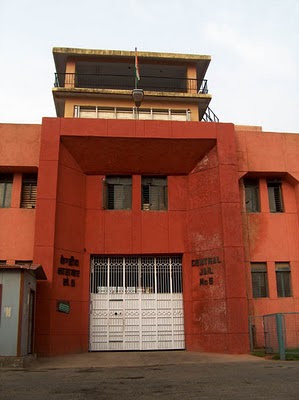
Today came the startling news that two inmates serving life sentences at Delhi’s notorious Tihar jail claim that the jail authorities gave them weapons to kill 2 of the 3 members of the Commonwealth Games Organising Committee currently being held at the jail on corruption charges.

Tihar Jail

The Hindustan Times reports:

Two inmates serving life sentences at Tihar Jail have claimed that the prison authorities gave them weapons to murder two former senior officials of the Commonwealth Games (CWG) lodged in the prison with them. In an application to chief metropolitan magistrate (CMM) Vinod Yadav, Amit and Nishant who are facing trial in a murder case, have said, “The jail authorities inside jail number 4 and ward number 11 approached us with weapons on December 20, 2010, and asked us to murder the two Commonwealth Games officials lodged in the jail with us.”  On personally meeting the judge, the inmates identified the officials as TS Darbari and Sanjay Mahendroo, who are lodged in Tihar following corruption charges.

Their application stated, “The jail officials threatened us with dire consequences if we do not comply with their orders. We are also receiving threats to our life inside the jail premises.” Amit’s mother Munni Devi has also filed an application in the magistrate’s court claiming her son and Pawan were being threatened inside the jail.

The application also claimed that a Delhi police official, who had come to the prison on Monday, recovered the knife from their cell. But they have not identified the officer before the magistrate. “The country-made pistol that was given to us was displaced by the jail authorities. We seek the court’s help to protect us from this ongoing exploitation at Tihar,” the application read.

Following this, the judge has directed the station house officer of the Hari Nagar police station to file a report in the incident and investigate the claims of the Tihar inmates.

Sunil Gupta, PRO of Tihar Jail, told Hindustan Times, “These are hardcore criminals lodged in high security jail. No weapon was recovered from the jail premises and their application is a farce. There was no conspiracy.”

Speculation now is that:

  1. The lifers made up the story merely to create a distraction from their own murder trial, or
  2. Other officials in fear of new confessions have placed a contract on the lives of the officials being held, or
  3. Politicians who fear being implicated in the mesh of corruption surrounding the games have placed the contract, or
  4. the officials under arrest have themselves arranged for the “confession” to develop a sympathy factor before they come to trial.

Tihar Jail is itself notorious for the mal-treatment of many prisoners and for the comfortable living conditions for inmates with money and clout. So the allegation that Tihar jail officials were involved in something like this is not – in itself- so incredible!!

There will be many more twists and turns in this corruption scandal.

Capitation fees: The stench of corruption in the Indian body academic

December 10, 2010
Varkala in Kerala. India.

Image via Wikipedia

This past week I have been travelling in the southern Indian states of Tamil Nadu and Karnataka.

The growth is palpable and vibrant. But it is chaotic and uncontrolled – and probably uncontrollable, The best that can be hoped for is that movement is in the general direction desired but it is futile to to try and exercise any micro-control. The speed is such that there is no time for consolidation, for reflection, for developing values or standards or for any feedback. Feed forward is the only thing that can keep up.

But in every field of operation – whether construction or government or industry or financial institutions or academia – the stench of corruption is contained under a thin veneer of apparent sophistication. The overpowering fundamental value which gets free reign is greed.

What has become apparent to me is that in spite of many good intentions by government, the shortage of supply in the face of an ever-increasing demand for education has allowed the unfettered growth of  private colleges and universities. But the demand is only used as a vehicle for satisfying greed not for satisfying educational needs.

All degrees and especially post graduate degrees in medicine, engineering and IT related subjects from private colleges in India are granted solely for the payment of a capitation fee.

http://en.wikipedia.org/wiki/Capitation_fee

Capitation fee refers to the unlawful collection of payment by educational bodies in exchange for a seat in the institution. It is also known as donations. This practice is popular in private colleges and universities in India, especially those that grant baccalaureate degrees in Engineering, IT and the sciences. This is an example of institutionalized corruption prevalent in India.The practice goes mostly unnoticed because the board/owners of these institutions hold political/financial powers and also the parents who pay the donations are more than happy to do so.

The Concise Oxford Dictionary defines capitation as follows:

The payment of a fee or a grant to a doctor, school, etc., the amount being determined by the number of patients, pupils etc. Origin (denoting the counting of heads)

The Kerala Self Financing Professional Colleges (Prohibition of Capitation Fees and Procedure for Admission and Fixation of Fees) Act 2004 defines capitation fees as follows.

“capitation fees” means any amount by whatever name called, whether in cash or in kind paid or collected or received directly or indirectly in addition to the fees determined under section 4.

The Supreme Court Judgement in 1993 in the Unni Krishnan Case declared that charging capitation fees was illegal.

But capitation fees are now the only way of  getting a seat in a private college. It guarantees a degree will be awarded. Academic staff  have no say in the selection of students. That selection is reserved for the owners and they usually auction the seats to the highest bidder. Capitation fees are unrecorded, undeclared and paid in cash. Academic standards are irrelevant.

This is not to say that competent engineers and doctors do not exist. But a degree from a private college is an empty thing. It only proves that a capitation fee was paid and is totally silent regarding the capability or competence of the person receiving a degree.

Sarkozy pushes nuclear, arms deals on India visit

December 5, 2010
The Indian Air Force has the second largest fl...

IAF Mirage 2000H: Image via Wikipedia

Domainb.com reports on the French President’s 4 day visit to India soon after the visits by President Obama and the Russian Prime Minister. The Chinese Premier is due next.

Close on the heels of India’s environment ministry clearing the last hurdle for French nuclear company Areva to supply six third-generation pressurised water reactors for a project worth Rs95,000 crore ($22 billion), French president Nicolas Sarkozy today kicked off a four-day visit to the country, pitching for new nuclear energy and arms contracts.

However, villagers in Jaitapur in Maharashtra, where the plant will come up, today staged a protest. Reports said at least 10,000 people turned up at the site to oppose the project.

Sarkozy, heading a large delegation of 7 ministers as also 60 business leaders, including the heads of aircraft-makers Dassault Aviation and EADS and Areva, to lobby for multibillion-dollar contracts for fighter jets and nuclear equipments, also stressed India’s increased stature in world affairs.

Although Indian officials said no defence deals will be signed during Sarkozy’s visit, French aircraft maker Dassault is hoping to secure a $1.2-billion contract to upgrade 56 Mirage-2000 aircraft that India bought from France in the 80s.

Dassault and EADS are vying with US and Swedish rivals for an Indian Air Force purchase order for 126 warplanes, for an estimated $11 billion.

“We all know how critical it is for India to ensure its energy security,” Sarkozy said in a speech at the Indian Space Research Organisation at India’s technology hub Bangalore.

“Root canal” performed successfully on elephant

November 26, 2010

Dentists in India have successfully carried out a “root canal” procedure on a 27 year old elephant which had been suffering from tusk-ache for 5 years.

From AFP:

A three-member team of dentists helped by a veterinary surgeon carried out the two-and-a-half-hour operation on the male pachyderm which developed a cavity in one of its tusks, they said. The operation took place in early November after the owner of the pet elephant brought the animal for an examination of the infection that had damaged the tusk. “We decided to use the traditional root canal process as a remedy,” dentist Sunil Kumar told AFP in state capital Thiruvananthapuram.

The elephant had a six centimetre cavity in its tusk: photo AFP

The Hindu reports:

In a procedure claimed to be the first of its kind in the world, an elephant in Kerala has successfully undergone a conservative dental treatment to repair his cracked tusk. Twenty-seven-year-old Devidasan, the tusker from Thrissur, had been living with a crack on its tusk for the past five years which was causing him discomfort.

The elephant’s owner and Dr. V. Sunil Kumar, Forest Veterinary officer, approached Dr. C. V. Pradeep, Conservative dentist and Endodontist of Kannur, to see if the crack could be treated and beauty of the tusk restored. Dr. Pradeep, former principal of Pariyaram Dental College, and currently professor and head of the Department, PSM Dental College, Thrissur, first extensively studied the structure of the tusk and found that that the elephant tusk and human teeth had similar structure. He chose a method of treatment based on the histology of the tusk. Dr. Pradeep told PTI that the 50 cm long and 4 cm deep crack was filled using micro and macromechanical bonding using light cure composite resin. The resin was bonded to the elephant dentin by using nano-filled bonding agent. The dentin was cleaned, microblasted and etched. Bonding agent was applied layer by layer and light cured two weeks ago.

The animal was not tranquilised during the treatment which took two and half hours and it was fully cooperative throughout the procedure, Dr. Pradeep said.

Lot of water and dirt was accumulating in the tusk and if the crack was not treated, it would lead to the death of the pulp and result in pus formation which could endanger the animal’s life, he said. The elephant could not be taken for temple festivals as the crack on the tusk was not pleasing to the eye. The treatment was a challenge and this was the first time in the world that a ‘conservative approach’ was followed and no part of the tusk was removed, he said.

Finding the equipment to treat the pachyderm was an elephantine task. “We had to modify and customise some of the equipment”, he said adding some of the equipment had to be made specially for the procedure. About 47 tubes of composite resin was used to fill the crack, he said. The cause of the crack in the tusk is unknown. However the owner of the elephant was conscious of the consequences of the widening crack and hence had requested for the treatment. The animal has now recovered and has already started going for temple festivals.

Dr. Pradeep was assisted by Dr. Jayaprasad Kodoth, Prof. of Periodontics, Kanhangad and Dr. George Jacob, of PSM Dental College, Thrissur.


Belated action on scientific misconduct in India

November 18, 2010

The Calcutta Telegraph carries the sordid story of scientific fraud, establishment denial, paper retractions and finally establishment acceptance of the misconduct.

The Gopal Kundu controversy

A controversy erupted in National Centre for Cell Science (NCCS), Pune in 2006 when an anonymous mail alleged that the authors (H. Rangaswami and Colleagues from the group of Dr. Gopal Kundu) may have misrepresented data in a paper published in Journal of Biological Chemistry. The allegation was that they had rehashed the same set of data which they had published earlier. An internal committee of the NCCS advised the authors to take back their paper, however an independent committee led by G. Padmanabhan, a former director of Indian Institute of Science, Bangalore, concluded that there was no manipulation in the data. This led to some heated debate between Indian Scientists with several viewpoints being presented. On 23 February 2007, the Journal of Biological Chemistry withdrew the paper amid allegations of data manipulation. The authors still maintain that the two papers used different set of data though similar experiments.

However the panel set up was not as independent as claimed. Its members were chosen by the Government and – as often when things get politicised in India – they returned a “politically correct” white-wash. But now as The Telegraph reports:

An apex association of Indian scientists today debarred for three years a senior biologist who had been accused of plagiarism by international scientific journals three years ago but was exonerated by a government panel of top scientists.

The unprecedented action by the Bangalore-based Indian Academy of Sciences, after an internal investigation by its ethics committee, appears to vindicate claims by some scientists that the government-appointed panel had tried to shield the accused.

At its annual meeting in Goa today, the academy endorsed the decision by its ethics committee (which was accepted by the academy’s council in July) and barred Gopal Kundu from participating in the academy’s activities for three years, beginning August 2010.

Nor can Kundu, a research scientist at Pune’s National Centre for Cell Science (NCCS), propose any candidates for fellowship of the academy during this period.

The prestigious US-based Journal of Biological Chemistry(JBC) had in February 2007 withdrawn a research paper by Kundu, accusing him of reusing images he had published in an earlier paper.

Another journal, Glycoconjugates Journal, too, had withdrawn a paper by Kundu because it had substantial similarities with a paper he had himself published previously in the JBC.

Better late than never but what is more important is the relatively low value given to ethics by the scientific establishment. Ethics, misconduct and scientific rigour can always be trumped by political correctness. Rahul Siddharthan writes in his excellent post:

An internal investigation at Kundu’s institution found him guilty of misrepresenting data, but a subsequent investigation by an external committee of six eminent scientists exonerated him completely, declaring themselves entirely satisfied that the images, though visually similar, were “indeed different.” I subsequently made my own analysis and published it in Current Science, who followed it with a response from G Padmanaban, the head of the committee that exonerated Kundu.

………

To me, this case is not really about Kundu. It is about our complete lack of appreciation of scientific ethics, and our tendency to “close ranks” when trouble arrives. To succumb to this tendency even after an international journal has conducted its own investigation and made its own decision, and to justify it with a paltry two-page report, merely makes us a laughing-stock.

So it is a good thing that the Academy has, belatedly, tried to correct this.

Coal India looking to acquire mines in US, Australia and Indonesia

November 13, 2010

Reuters

State-run Coal India (COAL.BO) is in talks to buy mines from U.S.-based Peabody Energy and Massey Energy , according to a media report citing the company’s chairman. “They expressed interest in offering certain mines to us and we are looking at that,” Partha Bhattacharyya said in a report by the Associated Press carried in the Economic Times newspaper on Saturday. “The discussions are continuing,” the report quoting him as saying. He declined to provide further details.

The Economic Times:

Coal India has budgeted $1.2 billion to buy assets in the US, Indonesia and Australia during the year ending March as it battles a widening gap between domestic coal supply and demand. The company, which last month raised $3.4 billion in the nation’s biggest-ever initial public offering, has near-monopoly control of India’s coal market. Indian companies are increasingly turning to the US to secure vital commodities to fuel the nation’s breakneck growth.

This year, Reliance Industries — India’s most valuable company by market value — bought stakes in three US shale gas companies for a combined $3.4 billion, the largest Indian investment in the US ever made. In 2007, India’s Essar Group acquired Minnesota Steel and is investing over $1 billion to build two plants and run its iron ore mine near Nashwauk, in northern Minnesota. This March, the company spent $600 million to acquire US-based Trinity Coal with mines in Kentucky, West Virginia.

St Louis, Missouri-based Peabody Energy says it is the world’s largest private sector coal company, with 9 billion tonnes of reserves. Richmond, Virginia-based Massey Energy says it is the largest coal producer in the Central Appalachian region, which accounted for 20% of United States coal production in 2007.

Obama concludes India visit – leaves for Indonesia

November 9, 2010

The Hindu:

U.S. President Barack Obama on Tuesday left here for Indonesia after his three-day visit to India, during which he announced support for New Delhi’s bid for a permanent seat in the UN Security Council and asked Pakistan to bring perpetrators of 26/11 attacks to justice.

Barack Obama with wife

President and Mrs. Obama leaving India

Mr. Obama and his wife Michelle were given a warm send-off by Minister-in-Waiting Salman Khursheed, Foreign Secretary Nirupama Rao and other officials. U.S. Ambassador to India Timothy J Roemer was also present.

The Air Force One carrying the US First Couple took off from the Delhi Airport at 8.54 AM.

BBC:

The Indian media has hailed US President Barack Obama’s trip to India, saying it had helped forge an “enduring partnership” between the two countries. It lauded Mr Obama for backing India’s ambition for permanent membership of the UN Security Council.

In an address to India’s parliament at the end of a three-day visit on Monday, Mr Obama backed India’s bid to gain a permanent seat on the UN Security council and lavished praised on the country. He also said safe havens for militants in Pakistan were “unacceptable”.

The Hindu said that Mr Obama’s support for a permanent UN Security Council seat for India “represents a significant evolution of American policy towards both India and the world body”.

“Even if he has essentially handed the Indians a cheque that cannot be easily cashed, the US President’s words will strengthen India’s hand as it seeks to press for reform in the UN,” the newspaper said.

Obama in India: Day 3: Supports India as permanent member of UNSC, criticises India for being too soft on Burma

November 8, 2010

Sify NewsLauding India’s growing role in global bodies, US President Barack Obama Monday said the US welcomed India as it prepared for a permanent seat in the UN Security Council. ‘We welcome India as it prepares to take a seat at the United Nations Security Council,’ said Obama in an address to members of the two houses of parliament. “That is why I can say today-in the years ahead, I look forward to a reformed UN Security Council that includes India as a permanent member,’ he said to loud applause from over 780 MPs.


Houses of Parliament, Delhi: image indiareport.com


Hindustan Times: ‘Bahut dhanyavad’. This is how US president Barack Obama thanked people of India for the warm welcome and hospitality he and American First Lady Michelle Obama received during their India visit. The ‘thank you’ in Hindi during his 35-minute address at the Central Hall of Parliament was received by thunderous applause by the law makers which included Prime Minister Manmohan Singh, UPA Chairperson Sonia Gandhi and top BJP leader LK Advani.

“At every stop, we have been welcomed with the hospitality for which Indians have always been known.  So to you and the people of India, on behalf of me, Michelle and the American people, please accept our deepest thanks. Bahut dhanyavad,” he said. The American President wound up his speech by saying ‘Jai Hind’ which was also received by the MPs with cheers.

AFP: US President Barack Obama criticised India on Monday for failing to condemn rights abuses in Myanmar, saying democracies with global aspirations could not ignore “gross violations” in other countries. “When peaceful democratic movements are suppressed, as they have been in Burma (Myanmar), then the democracies of the world cannot remain silent,” Obama said in an address to the Indian parliament. “Faced with such gross violations of human rights, it is the responsibility of the international community, especially leaders like the United States and India, to condemn it,” he said. “If I can be frank, in international fora, India has often shied away from these issues,” he added.

Earlier in his speech, Obama had, to sustained applause, given his backing to India’s push for a permanent seat on the United Nations Security Council.

Times of IndiaThe United States and India on Monday signed six agreements besides a plethora of business deals inked separately during US President Barack Obama’s trip to India.

  1. India-US agreement to set up a joint Clean Energy Research and Development Centre. It will be backed by 50 million dollars by both sides over five years and work to complete joint research in solar, biofuels and energy efficiency.
  2. Memorandum of Understanding (MOU) for a Global Centre for Nuclear Energy Partnership. US will cooperate in India’s plans for a nuclear centre, to promote nuclear security and address threats of nuclear terrorism.
  3. MOU to establish an India-US Energy Cooperation Programme. It will mobilise private sector expertise and resources to address clean energy-related issues in India and the US.
  4. Agreement on technical cooperation to study India’s annual monsoon rains. Cooperation on weather forecasting for India’s crucial annual monsoon.
  5. MOU between India and the US on shale gas resources which will see US technology used to assess shale gas resources in India.
  6. MOU on establishing and operating a Global Disease Detection Centre in India, which will set up a laboratory in New Delhi designed to prevent the spread of infectious diseases.

Hindustan TimesIndia and the United States will set up a $10 billion infrastructure debt fund to help develop India’s physical and social infrastructure, Commerce and Industry Minister Anand Sharma said on Monday. “The Governments of India and the United States have agreed in principle to set up the fund on the recommendation of the India-US CEO Forum,” Sharma told reporters on the sidelines of a conference organised by the Confederation of Indian Industry and the US-India Business Council in New Delhi. Sharma said India planned to invest $1 trillion in the infrastructure sector in the next five years and a substantial part of the investment would come from the private sector and overseas investment.

Obama in India: Day2: Networking aplenty but no new contracts announced today

November 7, 2010

Plenty of activity and a full schedule for President and Mrs Obama in Mumbai and Delhi today. There were no new announcements of any agreements or any business deals but no doubt these will be saved up for the final, ritual press conference.

Fielding questions from students on issues ranging from Pakistan to jehad, establishing an e-connect with farmers and breaking into an impromptu jig, US President Barack Obama got into the groove in more ways than one as he ended the first leg of his India visit here before heading for New Delhi Sunday afternoon. Obama took on a host of sharp questions from eager students at the St Xavier’s College this morning in Mumbai.

Obama met hundreds of American and Indian business leaders yesterday at the USIBC event. “India is the United States’ 12th largest trading partner. It could be number one or two if the conditions for trade between these two giant economies continue to improve,” said The McGraw-Hill Companies Chairman and CEO Harold Terry McGraw III, who is also the Chairman of the US-India Business Council (USIBC). Along with the USIBC Chairman, the meeting was attended by GE CEO Jeff Immelt, PepsiCo CEO Indra Nooyi, Honeywell Chairman David Cote, Reliance Industries Ltd Chairman Mukesh Ambani and Bharti Enterprises Vice Chairman Rajan Bharti Mittal.

Having mixed serious business with interactions with schoolchildren and a town hall-style meeting at St Xavier’s College, U.S. President Barack Obama and First Lady Michelle Obama began the second leg of their Indian trip in New Delhi.

President Obama has now arrived in Delhi where he was met at the airport by the Prime Minister.


Humayun's Tomb, Delhi: tripadvisor.com


It was as close to the slum-dog moment as the Obamas could get in their India tour. The US President Barack Obama and First Lady Michelle Obama met with 16 children of labourers at  Humayun’s tomb in New Delhi today. The children, aged between five and seven, do not go to a regular school because they are too poor. They receive informal education due to the voluntary efforts of Mr K.K. Mohammad, the Superintendent of the Archaeological Survey of India who has taken upon himself to get some basic literacy tools to these kids. At Humayun’s tomb, the children attired in uniforms of checked shirt and shorts spoke in Hindi to the U.S. President and the First Lady. They had small slate tablets in their hands and scribbled with white chalk on those tablets were the words “Welcome to India, Obamajee”. The President spoke to one eight-year-old Vishal, whose father Ram Das is a restoration worker at the Humayun’s tomb.

On the eve of their formal talks, Prime Minister Manmohan Singh and US President Barack Obama had a meeting in New Delhi on Sunday during which the two leaders are understood to have taken stock of bilateral ties and ways to push these to higher levels of strategic partnership.  Singh and Obama had a one-on-one meeting for about 25 minutes before the private dinner hosted by the Prime Minister for the visiting leader and his wife Michelle at his 7, Race Course Road residence.