Archive for the ‘India’ Category

Statistician wins India Science Prize

October 19, 2010

Prime Minister Manmohan Singh on Tuesday inaugurated the 21st general meeting of the Academy of Sciences for the Developing World (TWAS) at the Hyderabad International Convention Centre here.

Dr.  Singh presented the India Science prize, on behalf of the Indian National Science Academy, to  C. Radhakrishna Rao. The prize carried a reward of Rs. 25 lakh (550,000$) in cash and a 200 gram gold medal.


Calyampudi Radhakrishna Rao: image connect.in.com


C R Rao (born September 10, 1920) is an Indian statistician. He is currently Professor Emeritus at Penn State University and Research Professor at the University at Buffalo.  The American Statistical Association has described him as “a living legend whose work has influenced not just statistics, but has had far reaching implications for fields as varied as economics, genetics, anthropology, geology, national planning, demography, biometry, and medicine.” Among his best-known discoveries are the Cramér-Rao bound and the Rao-Blackwell theorem both related to the quality of estimators. Other areas he worked in include multivariate analysis, estimation and differential geometry. His other contributions include the Fisher-Rao Theorem, Rao distance, and orthogonal arrays.

CR Rao uses these lines from Robert Frost’s “Pertinax” to begin his book Statistics and truth: putting chance to work

Let chaos storm!

Let cloud shapes swarm!

I wait for form.


Indian MMRCA deal seems to be going to the US

October 17, 2010

I posted a few days ago about the joint RAF / IAF  exercises and its connection to the Indian need to acquire some 126 combat aircraft.

The $10.4 billion project to acquire 126 medium multi-role combat aircraft (MMRCA) for the Indian Air Force is in the final stages of the selection process. Apart from the Eurofighter, the other five contenders in the hotly-contested race for the lucrative MMRCA project are the F/A-18 `Super Hornet’ and F-16 `Falcon’ (both US), Gripen (Swedish), Rafale (French) and MiG-35 (Russian).


F/A-18E/F Super Hornet  (Neg#: Super Hornet )

F/A-18E/F Super Hornet: Boeing


While all the technical evaluations will no doubt be done by air-force  and MoD personnel, ultimately this is a political decision and the geo-political need to balance the growing Chinese might and to keep Pakistan in check will be paramount. The clear favourites in this game will be the US or the Russian aircraft. Domestically for the US government, an Indian order for either of the American fighters would be worth 27,000 jobs in the US. The commercial delegation accompanying Obama will be looking for a number of orders for nuclear power plant equipment to be finalised.


F-16 Figfhting Falcon: Lockheed-Martin


Considering

  • the timing of President Obama’s visit to India next month,
  • the visit of President Medvedev in December,
  • the political lobbying strength of the US,
  • the current concern in India about Chinese games in Kashmir and Arunachal Pradesh,
  • the technical rather than political lobbying of Europe for the Eurofighter,
  • the absence of any political advantage with the Swedish Gripen,
  • the international weakness of Sarkozy in being able to support the French Rafale

the choice, I think comes down to Boeing’s F/A Super Hornet or Lockheed Martin’s F-16 Falcon. The strength of the MIG-35 lies in its continuity with the MIG’s that the IAF already has and the familiarity of HAL in Bangalore with the MIG. But, I think the US will be seen as much more politically useful in the balance-of-power game and India would not like that the Russian aircraft enjoy a monopoly position. Europe will be fobbed off with the British Hawk trainers.

But the play between the US and Russia is complex:

In return for Washington removing strategic hurdles (withdrawing entities like the Defence Research and Development Organisation from the US Entities List; easing the curbs on US high-tech exports to India), India could open up some of its lucrative markets to American companies.

The big-ticket transactions are the ones involving the defence market. India is expected to sign a deal with Boeing to buy 10 C-17 transport aircraft for about $3.5 billion during the Obama visit.

The Americans are hoping that the Indian government will also opt for what The Financial Times described as the world’s biggest military hardware deal and buy 100 multi-combat aircraft worth $11.8 billion from US defence manufacturers.

Agreement on the latter aircraft will be more complicated since India is also negotiating with the Russians to jointly build a Fifth Generation Fighter Aircraft, which is expected to be the finest of its kind when operational. The Russians will also sell 150 Sukhoi-30 MKI fighters, the best of its kind, to the Indian Air Force.

India expects to conclude the agreement for the FGFA with the Russians when President Dmitri Medvedev visits New Delhi in December, a visit which will probably match the Obama excursion in its strategic significance, if not in its symbolism.

But Obama cannot return from India “empty-handed” and my “guess” would be that the Boeing F-18 Super Hornet will be the winner but that the “price” will include some other advanced US equipment as well. And perhaps the Russians will  supply some 200 Sukhoi-30 MKI but maybe not the MIG 35.

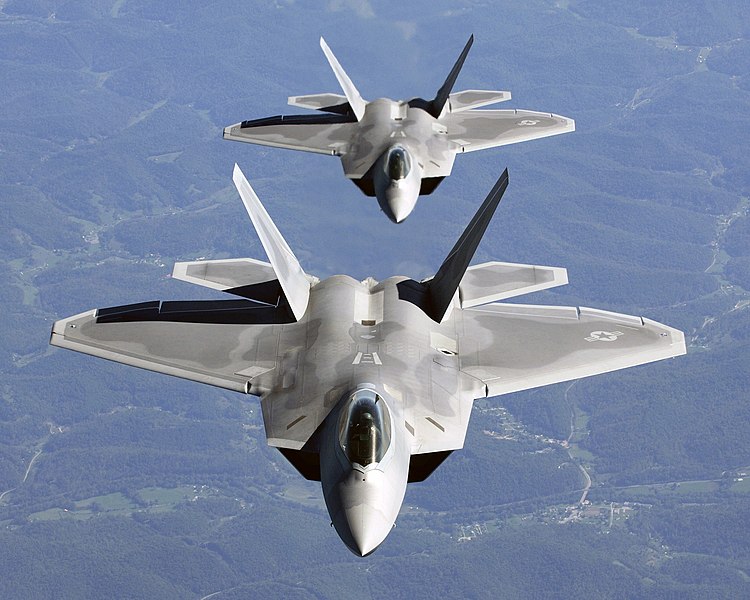
But none of  of these is as advanced as the F-22A Raptor from Lockheed-Martin. But that is not on the table – yet.


File:Two F-22A Raptor in column flight.jpg

Two F-22A Raptor in column flight: Lockheed Martin


Commonwealth Games: The inquest begins

October 17, 2010

The “last minute syndrome” is a unique and peculiar asset in India

The Games were supposed to cost under Rs 2,000 Crores (about 450 Million$).

The actual cost is likely to be around Rs. 30,000 Crores (about 6.7 Billion $).

About 500 Million $ has probably been paid for fictitious work, over-invoiced and overpaid to contractors, skimmed off or pocketed by individuals connected to the Organising Committee headed by Kalmadi. Some individual fortunes have been made and squirrelled away into Swiss and Channel Island and Caribbean bank accounts.

CWG Delhi Closing ceremony: image bharatchronicle.com


The investigations have begun. Some scapegoats will have to be found. Shrill voices are questioning whether it was worth it or not. There is no shortage of suggestions about how all the money could have been better spent.

For example Vir Singhvi writes in the Hindustan Times:

We could have overhauled healthcare in our cities. We could have built thousands of new schools. We could have overhauled the chaotic traffic system. We could have spent that money on recruiting more policemen and giving them the facilities they need. We could have built hundreds of new courts and recruited more judges to reduce the backlog in our judicial system.

But I have a somewhat different take.

None of the predicted or feared catastrophe’s occurred. There were no terrorist attacks. There was no epidemic of dengue fever. The facilities at the Games village largely functioned well.  The logistics were chaotic to begin with but also largely functioned satisfactorily. As the performance of India’s athletes started bringing in the medals at the Games, the crowds which were initially absent started showing up. The opening ceremony was well carried out but the logistics on the opening day were chaotic and stressful for many athletes. But this was transformed by the time of the spectacular closing ceremony in front of a packed house.

In transforming an apparently hopeless situation into a qualified success by means of India’s patented “last minute syndrome” some heroes appeared. Sheila Dikshit the Chief Minister of Delhi and Dr Manmohan Singh, the Prime Minister can I think be credited with the success of the final mobilisation of effort. Politicians who were busy distancing themselves from the Games the week before it started were clamouring to be seen at the closing ceremony. The Delhi Police must take a bow not only for the security aspects but also for the handling of traffic. The organisers (and even the newly activated Committee who were now under the whip) and all the officials and “volunteers” and even the Delhi population pulled out all the stops. Many private contractors with their contract labour carried out a minor miracle on the last few days.

And this brings me to my point. One of the key issues in India is not – in the first instance – the availability of funding. The Indian weakness is in implementation, in using the money available well. Whatever the Games cost, the money was forthcoming when needed. About 10% was probably wasted. But because of the attention and pride (or more accurately the potential loss of face), a fiasco was averted. The “last minute syndrome” was activated. Implementation, and rather effective implementation, took place.

Even if there had been no Games and even if all the money had been poured into health care or traffic improvements or overhaul of the judicial system it would have achieved virtually nothing. Without attention and without visible deadlines to create a potential loss of face and -therefore – without a means of activating the “last minute syndrome” the money would have been frittered away.

It would be much more constructive if, instead of moaning about what could have been, every project being implemented in India could figure out a way of creating the real deadlines which could activate the “last minute syndrome”.

Commonwealth Games- Australians dominate the medals but athletes leave Delhi on a sour note

October 15, 2010

The Australian team totally dominated the Games with their haul of 177 medals including 74 Golds. But some of their athletes seem to have been involved in vandalising the Games village. Just high jinks perhaps.

Rank Country Gold Silver Bronze Total
1. Australia 74 55 48 177
2. India 38 27 36 101
3. England 37 59 46 142
4. Canada 26 17 32 75
5. South Africa 12 11 10 33

Zee News reports that

Some Australian athletes destroyed electrical fittings and furniture in their tower in the Games Village on Tuesday and Wednesday.
According to a newspaper report, the athletes shouted slogans against Indian ace batsman Sachin Tendulkar, who was named ‘Man of the match’ and ensured India’s victory in the Bangalore match, and tossed a washing machine down from the eighth floor of their tower.
According to newspaper sources in Delhi police, this hooliganism by Australian athletes started on Tuesday when Tendulkar scored a double century to force Australia out of the match. Irked by this match-winning performance, they first damaged electrical fittings and fixtures in their block. The report also says that Delhi Police, which received a complaint about this vandalism, has downplayed the incidents to prevent them from growing into a diplomatic embarrassment for Australia.
Meanwhile, confirming these vandalism reports, Australia’s Commonwealth Games boss Perry Crosswhite on Friday denied involvement of any Australian athlete in the incident at the Games Village.

The Sydney Morning Herald reports:

An Australian athlete was sent home from the Commonwealth Games for bad behaviour this week and a washing machine was dropped from a balcony in Australia’s section of the athlete’s village after the closing celebrations.

No one was injured by the washing machine but Perry Crosswhite, Australia Commonwealth Games association chief executive, said he was disappointed by the incident on Thursday night.

“We don’t know who did that,” Crosswhite told journalists today. “Delhi police came around and they’ve done a report and an investigation and we’ll hear about that.”

But by all accounts it was a spectacular closing ceremony and a qualified success. It was a long way away from being the fiasco that had been feared.


Tata Group gives 50 Million $ to Harvard Business School

October 14, 2010
This is a portrait of Mr.Ratan Naval Tata made...

Ratan Tata: Image via Wikipedia

Times of India

BOSTON: America’s prestigious Harvard Business School has received a whopping USD 50 million from Ratan Tata-led Tata Group, the largest gift from an international donor in the institution’s 102-year history.

The USD 50 million gift comes just days after Anand Mahindra, vice-chairman and managing director of Mahindra and Mahindra, gave USD 10 million dollar as gift to the Humanities Centre at Harvard.

Ratan Tata, Chairman of the Tata conglomerate, attended the school’s Advanced Management Programme–one of three comprehensive leadership programmes offered by HBS Executive Education–in 1975.

He received the school’s highest honour, the Alumni Achievement Award, in 1995.

The gift will fund a new academic and residential building on the HBS campus here for participants in the school’s broad portfolio of executive education programmes.

The school hopes to break ground for the building, which will be named Tata Hall, next spring.

Commonwealth Games: A stirring closing under way and a metaphor for investment in India

October 14, 2010


Delhi 2010 logo


The Closing Ceremony for the 2010 Delhi Commonwealth Games is underway. The final verdict will come in the weeks and months ahead but after the incredibly chaotic, tainted and incompetent beginning the fact that it appears now as a qualified success is a tribute to those who finally mobilised themselves and further evidence of the “last-minute fix syndrome” that India suffers from.

Delhi virtually shut down on Thursday 2 hours ahead of the Commonwealth Games closing ceremony, with government offices, banks and major markets closed for the day. The Jawaharlal Nehru stadium, the venue for the event, is swarming with thousands of security personnel.

Around 60,000 spectators are expected to attend the event, that will start at 7 pm and end 10.30 pm. Around 7,500 security personnel have been deployed at the JN stadium. “A multi-layered security arrangement is in place for the closing ceremony, similar to the opening event,” Rajan Bhagat, spokesperson Delhi Police, told reporters.

Spectators will be put through manual and mechanical security checks at four points at the stadium, while Indian Air Force choppers will survey the skies. The stadium has 19 entry points where card readers, door frame metal detectors and X-Ray baggage machines have been installed. Mobile quick reaction teams have also been deployed on the outer perimeter of the stadium.

High-tech security equipment, including devices to check CBNR (chemical, biological, nuclear and radiological) assaults have been put in place. Delhi Police Commissioner YS Dadwal reviewed the security arrangements at a meeting with senior officials.

Delhi Police has also deployed snipers, commandos on Light Armoured Troops Carrier (LATC) and specially trained men from paramilitary personnel along with Delhi Police personnel at the Games venues. Unmanned Aerial Vehicles are also in place to scan the ground.

There are 3 hours to go before the ceremony draws to a close and fingers remain crossed.

ABC Online says that after a chaotic start, Games organisers have given themselves a pat on the back for delivering a functional, if somewhat bumpy, ride to the finish line. “The athletes and the competitions have gone very well,” Commonwealth Games Federation president Michael Fennell said today. Australia finished the Games well atop the medal tally with 74 gold, 55 silver and 48 bronze. India narrowly pipped England for second spot, winning 38 golds to 37.

The Economic Times sees the Games as a metaphor for investment in India. Chaotic, difficult to enter, bumpy journeys but immensely rewarding at the end.

For many Indians who only two weeks ago labelled the event the “Shame Games”, it was an unprecedented success, with the country’s best-ever gold medal tally. “The Games has turned out to be better than worst feared,” said V. Ravichandar, head of Feedback consulting in Bangalore, which advises multinationals. “The Games were really a metaphor for investment in India. It’s not a smooth ride but things work out in the end.

After sparse crowds ruined the atmosphere in the first week of the two-week event, crowds soon swelled, with the medal results providing a respite for Prime Minister Manmohan Singh and his ruling Congress party, which before the Games had been under pressure to save India from international embarrassment.

The wider and much publicised chaos of the preparations highlighted the gap between India and China when it comes to infrastructure. When organisers called on luxury hotel chains to clean up the athletes’ village, it underscored the fact that the private sector motor that drives India had been left out of a Games run by a state immersed in red tape, cronyism and graft. Thus, the Games failed to be the coming-out party the 2008 Beijing Summer Olympics was for China. For foreigners, delegations threatening to quit with filthy rooms, dog faeces and dengue-carrying mosquitoes in the Games Village were the overarching memory.

It was a sign of the health of India’s business that the blue-chip Sensex stock index hit a near-three year high during the Games. India has attracted a record $21.4 billion in foreign funds into stocks this year — one-third of that since September. State-run Coal India is poised to launch a $3.5 billion IPO, the country’s largest that is expected to see heavy investor demand. It underscores how private industry in India is booming, thanks to tens of millions of Indians aspiring to the middle class.

“In a sense, India stands out internationally,” said Amit Tandon, managing director of Fitch rating agency in India. “It may be difficult to come in, but once you are in you make money.” That may signal more complacency ahead from India’s leaders, increasingly focused on state elections next year rather than long-term economic reforms. “I do hope at the end of the Games, someone in Congress or the prime minister will sit down and take stock of the situation,” said Tandon.

With a “good” monsoon in the bag Indian GDP should exceed 11%

October 11, 2010

The 4 month monsoon season in India ended on 30th September and total rainfall was 2% over the long term average, about 25% higher than last year and about 5% above the long range forecast made in the spring.


Total rainfall 2010 Monsoon: IMD


Expectations that a good monsoon could lead to double digit growth are stronger with the IMF now predicting a 9.7% growth rate for the calendar year 2010.

“India’s macroeconomic performance has been vigorous, with industrial production at a two-year high. Leading indicators — the production manufacturing index and measures of business and consumer confidence — continue to point up,” the IMF said.

“Growth is projected at 9.7 per cent in 2010 and 8.4 per cent in 2011, led increasingly by domestic demand. Robust corporate profits and favorable external financing will encourage investment,” it said.

“Recent activity (10 per cent year-over year growth in real GDP at market prices in the second quarter) was driven largely by investment and the contribution from net exports is projected to turn negative in 2011 as the strength in investment further boosts imports,” the IMF said.

But in spite of the IMF’s caveat on net exports turning down, I think the trickle-down effects of a good monsoon may have been under-estimated. Agricultural growth which was low should pick up and domestic demand will ensure the industrial growth continues. For the Fiscal Year 2010/11 (till 31st March 2011) I fully expect that the GDP will grow by just over 11%.

The establishing La Niña probably helped the monsoon somewhat.

A “moderate to strong” La Niña, which appeared in July, was now well estabished according to the WMO, and forecasts showed “rather a strengthening of this La Niña episode for the next four to six months.” La Niña is characterised by unusually cool ocean temperatures in the eastern equatorial Pacific and has been associated with strong rainfall in Asia and Australia, bitter cold snaps in North America, as well as drought in South America.


Indra Dhanush 2010: Sukhoi vs Eurofighter and 10 B$ at stake

October 11, 2010


F3, Eurofighter, SU-30MKI


In 2006, and for the first time in over forty years the Royal Air Force and the Indian Air Force carried out exercises at bases in northern India, with Tornado F3s, E3-D AWACS and a VC10 making up the bulk of the RAF air presence. The bi-lateral Exercise INDRA DHANUSH (which means rainbow in Hindi), was held at IAF Gwalior and IAF Agra.The IAF platforms included the Sukhoi-30 MKIs, Mirage 2000, MiG-21 ‘Bison’ and MiG-27 aircraft.


Indra Dhanush 2007


Exercise Indra Danush moved to RAF Waddington in July 2007. On one side was Britain’s Eurofighter Typhoon, whose advanced aerodynamics and intuitive controls and avionics have led to it being rated as the second-best air superiority aircraft in the world. Its supporting cast included 1980s era Tornado F3 air defense variants, and upgraded GR9 Harriers from the Royal Navy. On the other side was India’s SU-30MKI, the most evolved variant of Sukhoi’s outstanding Flanker family, with aerodynamics that allow unique maneuvers, and full thrust vectoring besides.The Eurofighter is smaller, and is generally agreed to have more “shaping” than the SU-30 to reduce its radar profile (though neither aircraft is in the same class as the F-22A Raptor or even the less-stealthy F-35 Lightning II).

(See http://jetwashaviationphotos.com/wwwjetwashaviationphotosindradhanush.aspx)

Now the Indian Air Force and the Royal Air Force “meetat Exercise Indra Dhanush 2010 from October 20th  at Kalaikunda, West Bengal. The exercise will be held in an AWACS (airborne warning and control systems) environment, with air defence being a major thrust area. Both the Indian and British forces are also expected to use their mid-air refuelling aircraft, like the IL-78 and VC-10 tankers, during the combat manoeuvres.

The exercise comes at a time when the $10.4 billion project to acquire 126 medium multi-role combat aircraft (MMRCA) for the IAF is in the final stages of the selection process. Apart from the Eurofighter, the other five contenders in the hotly-contested race for the lucrative MMRCA project are the F/A-18 `Super Hornet’ and F-16 `Falcon’ (both US), Gripen (Swedish), Rafale (French) and MiG-35 (Russian).

A major Indo-UK defence deal has been the `Hawk’ AJT (advanced jet trainer) project. India is going in for another 57 Hawks as a “follow-on” order to the ongoing Rs 8,000 crore (about 1.75 B $) AJT project, finalised in March 2004 with BAE Systems, under which the IAF is already getting 66 Hawks.

The Royal Air force is going to field its Eurofighter Typhoon aircraft, AWACS (E-3D) and Air to Air refuellers (VC-10). The IAF will field SU-30 MKI, Mirage 2000’s, Mig 27’s and Airborne Early Warning and Control Systems(AWACS) Aircraft.

Survey and review of integrity at Indian Research Institutions

October 10, 2010

Cases of plagiarism and other scientific misconduct is thought to be increasing in India. The rapid growth in the country in recent years has been mirrored by a growth in the number of research institutions, science publications and number of published papers. The pursuit of advancement of institutional reputations in newly established Universities and the development of personal careers has led to an increased pressure to publish. Scientific funding has not kept pace with the growth of institutions and numbers of people involved in research and this has led to increased competition in the seeking of limited funds. Quality assurance and oversight processes have not kept pace and in many young institutions may even be totally absent. There is little emphasis given to training for scientists or administrators regarding scientific rigour or ethics or integrity.

Indian graduates and scientists are generally highly regarded. There is an increasing focus from outside the country for establishing research and engineering centres in India and for commissioning research at Indian Research Institutions. But there is growing concern about standards and the proper selection and use of Indian scientists and Indian Research Institutions. A need has been expressed for an independent review of the level of integrity at various Institutions.

This need has only been emphasised by the recent high profile cases of plagiarism regarding GM crops where the Minister rejected a report by the 6 top Indian science academies including the Indian National Science Academy and the apparent, wide-spread plagiarism which has, for example, led to the retraction of 3 papers in the Journal Biotechnology Advances.

A survey and review to assess and rank Integrity at Indian Research Institutions has therefore been privately commissioned. The study is to be completed by 1st May 2011 and the first phase of information gathering is expected to continue through February 2011.

Institutions to be included in the survey will be requested individually to make a formal submission.

Institutions or individuals wishing to participate by making unsolicited submissions are invited to do so as detailed in the separate page established here.


Academic Cheating: China and India need to clean up their acts

October 9, 2010

The number of scientific research papers published in India stood at 22,215 in 2007, up from 11,067 a decade earlier.  Chinese academies published a similar number of papers in 1997 — 12,632 but that figure had leapt to 67,433 by 2007.  China in 2007 contributed8.6 percent of the world’s scientific papers while India produced 2.4 percent.


Plagiarism


Publish or perish is the prevailing paradigm in both countries and plagiarism, data manufacture and manipulation and just downright cheating are endemic to academia. (Plagiarism is rampant in the Indian movie industry and in book publishing as well so academia merely reflects the society at large).

Where cases of plagiarism come to light as with the recent high profile case of plagiarism in reports on GM crops or the cases of plagiarism at IIT-Kanpur, the whitewash committees soon swing into action. Even if sometimes suspended, it does not take long for the parties involved to regain their former positions. CYA prevails.

But the solution does not lie just with correcting institutional processes and better monitoring. A fundamental change in institutional and personal standards of ethics  is required. Academia will need to lead society and not just be sheep.

Just some of the recent cases of academic plagiarism in India and China are given below:

India

  1. Plagiarism: a scourge afflicting the Indian science
  2. Plagiarism plagues India’s genetically modified crops
  3. Biotechnology Advances retracts 3 papers from India for plagiarism
  4. Scientific plagiarism in India
  5. We must restore scientific integrity in Indian research
  6. In India, plagiarism is on the rise
  7. Call for Indian plagiarism watchdog
  8. Copycats from IIT-Kanpur?

China

  1. Do plagiarism, fraud, and retractions make it more difficult trust research from China?
  2. Rampant Fraud Threat to China’s Brisk Ascent.
  3. Scientists behaving badly; Recent events show China needs to clean up its scientific act.
  4. Academic corruption undermining higher education: Yau Shing-tung.
  5. CHINA: Universities fail to tackle plagiarism.
  6. In China, academic cheating is rampant; Some say practice harmful to nation.
  7. CHINA: Professor sacked for academic plagiarism
  8. Nearly half of China’s science workers think academic cheating is “common”.