Archive for the ‘India’ Category

Domesticating tigers to ensure their survival

March 1, 2015

Tigers cannot survive without human intervention. They are just not capable of handling the shrinking of their traditional habitats and the changing environment. They are not evolving fast enough. Traditional – and misguided – conservation is all about trying to maintain some limited habitats in which they can survive without change. That is a misguided policy just because it tries to freeze the tiger into a genetic dead-end in an artificially maintained habitat. The tiger reserves are then little more than large zoos.

If tigers are to survive they must change within themselves. They need to adapt genetically. They have to adapt and move on. To change is to be alive. Not to change is to die. And a species which will not change “deserves” to go extinct. Traditional “conservation” is temporary and unsustainable. Conservation is stagnation.

I have long felt that real conservation must consist of helping threatened species to adapt genetically, not just freeze them into an artificial, temporary and unsustainable habitat. Of course changing a species genetically means that the unchanged species disappears. But that’s life.

Genetic adaptation – not stagnating conservation – is the way to help threatened species

So this apparently bizarre suggestion by a State Minister in Madhya Pradesh is not as crazy as it may first sound. A true, sustainable survival of tigers requires that they adapt such that they can continue living among humans without threatening humans. And that may well be a form of “humanisation” if not of “domestication”.

Deccan HeraldIn a bizarre suggestion, a senior Madhya Pradesh minister has sought a law that allows people to domesticate or keep as pets big cats like lions and tigers for their conservation.

Animal Husbandry, Horticulture and Food Processing Minister Kusum Mehdele, in a proposal sent to the state’s forest department, has cited legal provisions in some African and South-East Asian countries like Thailand which have helped bring about an increase in the population of the big cats.

Noting that there are various projects in the country for conservation of tigers, the minister, however, said that although crores of rupees have been spent on these projects, there has been no surprising increase in tiger numbers.

In Thailand and some other nations, there is a legal recognition to people for keeping tigers and lions as pets, she said, adding the number of such animals is increasing in a surprising way in these countries.

If such a possibility can be thought over, then necessary action should be undertaken and guidelines passed on, she said in the proposal sent to state Forest Minister Gaurishankar Shejwar in September last year.

The suggestion has, of course, been ridiculed by the traditional “conservationists” who are all into trying to keep the tiger and its world unchanged – frozen in an artificial environment which is unsustainable.

Indian claims of the recovery of tiger numbers may be overestimated:

Data released in January suggested India was home to 30 per cent more tigers than four years ago, with numbers rising from 1,706 in 2010 to 2,226 in 2014. Now conservation experts from the University of Oxford, the Indian Statistical Institute and the Wildlife Conservation Society have cast doubt on the assertion, suggesting the statistics were the result of a flawed method commonly used in censuses of tigers and other rare wildlife.

Indian government plays down swine flu epidemic which has killed 833 so far

February 24, 2015

Over 14,000 people have been affected so far and the death toll till yesterday had reached 833. The swine flu epidemic in India is spread across the northern states – mainly – though deaths have also been reported in Telengana. But health officials both at state level and in the central government are resisting any discussion and insist that all is under control.

There are reviews and review committees galore and the bureaucratic process is in full swing. State and central government health departments are assiduously collecting data. But state assemblies will not allow debate. There is no shortage of medicines. Health departments “are on the job” but the number of states affected and the number of deaths are rising.

It is not so much being in denial as trying to sweep “unpleasantness” under some bureaucratic carpet. The public private partnership in health care is broken. It is the partnership of an underfunded and hopelessly inadequate public service and a rampant and avaricious private sector. Private hospitals are turning away “public” patients – who they are normally obliged to accept – on the grounds of lacking isolation wards. Private labs are charging exorbitant rates for tests. Tamiflu is being hoarded for the use of paying patients.

DNAEvery time a disease outbreak is reported, the government swings into action. High level review meetings are held in the health ministry and the cabinet secretariat, guidelines are issued for states, health minister visits hospitals and makes reassuring statements that  there is ‘no shortage of drugs and vaccines’. On the ground, however, government hospitals are crowded with patients complaining about lack of proper care, confusion prevails on diagnostic tests and medicines, and generally there is an atmosphere of panic among the general public. This is pretty much the picture whenever a disease outbreak occurs in India or there is a threat of a pandemic touching Indian shores. We have had a series of them in the past decade – Severe Acute Respiratory Syndrome (SARS), Avian influenza (bird flu), swine flu, Ebola and so on. The current outbreak of Influenza A (H1N1) — popularly called swine flu because it originally got transmitted to humans from swine — is no different. The last major outbreak of this flu in India was in 2009 when Influenza A (H1N1) was declared a pandemic by the World Health Organisation. ….. 

…. The private sector today provides nearly 80 per cent of outpatient care and about 60 per cent of inpatient care. However, when outbreaks like swine flu or SARS occur private sector draws into a shell. Patients are denied admission on the pretext of private hospitals not having isolation wards or the fear of losing medical tourists. Pathological labs start charging exorbitant fees for conducting diagnostic tests, as has been happening in the case of the current outbreak. Chemists begin hoarding or black marketing essential drugs like oseltamivir (trade name Tamiflu), working in tandem with private doctors and hospitals.

Noted while visiting Delhi

February 6, 2015
  1. Returning through Munich, the airport security staff reminded me of automated robots. They once again demonstrated that their jobs required them to suppress the one key behavioural factor which makes them human. They were not rude by any means, but they were required to provide pre-determined responses to given stimuli. They had no freedom to deviate from their trained responses and were required – under all circumstances – not to think for themselves. Of course, this is not the only job which requires humans to refrain from exercising their minds. But it begs the question – Are we still human if /when we suppress the differentiating ability to think?
  2. During my week in Delhi I noticed no signs of the new “Clean India” campaign supposedly underway. The piles of rubble and the 95% syndrome were all too clearly visible. Even in the areas visited by Barack Obama (he left Delhi on the day I arrived), the “clean-up” was as superficial as it usually is. The winter gloom and choking dust in the air were essentially unchanged.
  3. There is a new “gender game” which is catching on among middle-class, spoilt, educated girls in India. The game consists of accusing some middle-aged male – preferably in a crowded place – of having groped her and filming the accusation and the response on a smart phone. Of course the film is uploaded on You Tube along with any hulabaloo created. The winners are those who cause the greatest outrage and get the greatest number of hits. I note that poor and oppressed girls who have the greatest reason to complain about real harassment are not players. I note also that many of the players are not particularly attractive and speculate that it is a new way of seeking and getting attention. It is part of the global wave of narcissism promoted by the social media and selfies.
  4. The winter weather in Delhi is entirely unaffected by any global warming. Even the Urban Heat Island effect provides no respite for those who live on the street.
  5. Driverless cars should be tested in Delhi. If they can survive here they can survive anywhere! The protocol to be programmed in for the use of the horn could be particularly challenging.
  6. Obama’s visit was – for most Delhiites – a non-event. A small diversion and a small inconvenience providing some photo-ops for some politicians. It was largely forgotten within 2 days. (It is my theory that the inherent racism in most Indians leads to the negatives for Obama as half-black being greater than his positives for being American).
  7. Street stalls in Delhi were selling a “standard meal” for Rs 20 – 30 (30 – 50 US cents). This consists of a thali containing a portion of rice, 4 – 5 chappatis, two vegetable dishes, a portion of dal, one papad and a portion of yogurt or raita. The number of chappatis on offer was the competitive factor being used by two adjacent stalls. The same meal at a subsidised factory canteen costs about Rs 70 and around Rs 250 at a clean dhaba with plastic chairs. And at the Bukhara restaurant a the ITC Maurya Hotel (where Obama stayed and where we had our last dinner in Delhi), something similar would set you back Rs 3,000 – $50.
  8. The ubiquitous TV news channels – which are very Delhi-centric – were drooling over the State elections due tomorrow. They were never of any quality but they seem to have deteriorated even further. The news anchors and journalists running the “reality news shows” who I had some respect for once upon a time, have completely prostituted themselves to the perceived ratings. I am afraid that journalistic integrity is something that Arnab Goswami, Rajdeep Sardesai, Barkha Dutt and Shekhar Gupta   – among many others – have long since abandoned.

I returned to a snow blanketed landscape and spent over an hour breaking and scraping frozen snow off my car before I could move. It was round 10ºC at night in Delhi, but it felt colder than the -6ºC I have returned to.


Obama (or his advisors) are too scared to visit the Taj Mahal?

January 24, 2015

Unlike during Bill Clinton’s visit to Agra and the Taj Mahal in 1997, when Agra was turned into a ghost town, this time the Indian government has declined to have the entire city vacated of people and animals just so that Barack and Michelle Obama can visit. It would seem that the security team of the “most powerful person in the world” relies so heavily on only allowing Obama to move into empty spaces that his visit to the Taj Mahal, planned for Tuesday 27th January, has been reportedly cancelled! The US President is not up to making a visit that is made by around 12,000 visitors every day (on average), by around 4 million every year and by up to 300,000 during a long holiday weekend.

It occurs to me that every new security measure introduced – whether for the “ordinary man” or for Barack Obama – is a victory for the terrorists. The bottom line is that if Barack Obama does not visit the Taj Mahal on Tuesday it will be because he (and/or his advisors) were too scared to do so. You could say that they have been well and truly “terrorised”Airport security is primarily driven by the lobby for the manufacturers of security and scanning equipment. They have enjoyed a bonanza since 9/11. It is fairly obvious that the supposed benefits for passengers (which can never be demonstrated) are dwarfed by the benefits to the manufacturers.

The Hindu:

U.S. President Barack Obama is believed to have cancelled the Agra leg of his India visit. The President, who will be the chief guest at the Republic Day celebrations, was scheduled to visit the Taj Mahal with his wife, Michelle, on January 27.

Official confirmation of the cancellation of the Agra leg of his tour is still awaited. “It’s possible that he might leave India earlier,” a government source said, adding that no reason had been given for the cancellation of the Agra visit.

Obama’s security team and the Indian government have been at odds over his 3 day visit.

FirstPostAs the date of the United States President Barack Obama’s India visit nears, disagreement between the security agencies of US and India is getting sharper. ..

…… a number of special requests made by the US secret service to the Indian security agencies and the Indian government have been turned down. Sources in the Ministry of Home Affairs and the Ministry of External Affairs in India confirmed that some of the demands made by the secret service are rather unrealistic.

Here are five areas that the US agencies are disappointed with the Indian security arrangements:

  1. Extended outdoor time

The American president has never been on an outdoor event for more than 45 minutes. However, the Republic Day celebrations in Delhi last for almost two hours. The secret service had requested Indian agencies to either cut short the event or ensure that Obama will not be attending the event for more than 45 minutes.

But the Indian government has refused to oblige, according to a source in the Home ministry. To make things worse between the agencies, the number of tableaux participating in the parade could be increased from 20 to 25. It means that the event may end up extending the function further, beyond the usual two hours. This has not gone down well with the US Secret Service, but the Indian government too is not willing to budge.

  1. No Fly zone over NDMC area

The US security agencies had earlier asked the Indian government to clear airspace over Delhi on January 25 and 26, according to sources in the MHA. In this case too Indian agencies refused to oblige. Following this, it was decided that commercial planes will be kept clear of the airspace over the New Delhi Municipal Corporation area during the event.

However, the US Secret Service had more recently asked the government for a five-kilometre radius no-fly zone (both commercial and the Indian Air Force) imposed around Rajpath during the event. That has also been turned down by the government as it is tradition for the Indian Air Force to do a flypast on Republic Day.

  1. Airspace security over Yamuna Expressway

The Americans are also unhappy about the fact that while the airspace over the 165-kilometre long Yamuna Expressway to Agra, has not been declared a no-fly zone for commercial aircraft while the US President’s convoy is travelling on it. We have restricted the highway from public use for as long as the US President’s convoy is travelling through it. They have two F-35 raptors doing surveillance of the sky and will be flying on top of the President’s convoy. In addition to that, there are a number of security measures taken to ensure that any threat is detected beforehand. I don’t see why they should be upset,” an official at the Ministry of Home Affairs said.

  1. Indian anti-terrorist squad unsatisfactory

Sources also revealed that the US secret service officials said that the Indian commandoes gave unsatisfactory results in the aptitude test on security along with surprise checks conducted by the agency. As a result, the Central Intelligence Agency is bringing their Concealed Anti-Terrorists (CAT) squads to the national capital.

  1. Agra visit

Former US President Bill Clinton called Agra a ‘ghost town’ after his visit to the city on March 20, 2000. But that’s because city was cleared of people for his security. The US Secret Service wanted the same measure extended to President Obama, but the Indian agencies have denied that request as well.

Obama, during his earlier trip had reportedly skipped visiting the Taj due to the fact that the city did not pass the security scanner. “This time around we had issued directions for security arrangements to the state government way in advance,” a senior administrative official at the Ministry of External Affairs said. “But, we want to avoid clearing the city completely. It is an inconvenience for the general public and we wish to maintain an ‘organic’ look of the city rather than it feeling like a deserted town,” he added.

Pseudo-science and religious loonies: Modi needs to purge the riff-raff he attracts

January 7, 2015

Narendra Modi’s new BJP government in India has been a breath of fresh air after the stagnant, smelly and stale environment in which the previous Congress government had got itself stuck in. It is still early days yet but Narendra Modi will need to get to grips with his idiot fringe before they leach away all his gains. The loony, religious Hindu right feel empowered and and are making fools of themselves. The sad part is that they elevate bigotry and prejudice and religious violence as being justified for their “holy cause”.

The idiot fringe consists  – among others – of supposedly pious people (men and women) who claim that “goodness” is implicit in being a “Hindu”. They bask in the reflected glory of the supposedly great days of Rama but their grasp of history is a little less than zero and is mostly imagined. Their use of pseudoscience and their interpretation of ancient scriptures sounds like those who manage to read every current event into the soothsayings of Nostradamus. They threaten to make Modi’s government a laughing stock. Before too long Modi will need to purge the BJP of the lunatic fringe.

They usually make up history whenever – and wherever – they lack knowledge. They have started a campaign of reconverting people they claim were converted to Islam or Christianity in the first place. They are not averse to using violence in their self-defined “just causes”.  They include idiots who are Members of Parliament calling for every good Hindu woman to have 5 children each! The same MP called Gandhi’s assassin a “patriot”. They also tend to be the same people who inculcate the culture of feudal fiefdoms and accord themselves and their followers the right of “droit du seigneur”. The so-called “god-men” are perhaps the worst sexual predators around.  They not only allow but they sanctify the rape culture that is endemic in all of urban India.

They also include those who would claim that ancient Hindu culture was responsible for all the major inventions and discoveries of the last 2,000 years. This has led to a wave of pseudo-science which is perceived by the loony right as being “politically correct” and fashionable under the new government. Unfortunately many academics are too cowed down by their own perceptions of career and government patronage to resist the nonsense. Even the Indian Science Congress currently going on feels that it must give space to the the pseudo-scientists and the charlatans. Allowing pseudo-science is academic misconduct which is just as bad as faking data.

One entire session of the current program (Indian Science Congress 2015 program) is devoted to “Ancient Sciences through Sanskrit”.

Pseudo-science at the Indian Science Congress 2015

Pseudo-science at the Indian Science Congress 2015

The nonsense claims range from the origin of hominids being in India to Vedic nanoscience and elephant urine as fuel for powered flight.

Indian Express: The paper on aviation is part of a symposium on “ancient Indian sciences through Sanskrit”, and will be presented by Captain Anand Bodas, retired principal of a pilot training centre, and Ameya Jadhav, lecturer at Mumbai’s Swami Vivekanand International School and Junior College. ……. The abstract of the Bodas-Jadhav paper says: “Aviation technology in ancient India is not a tale of mythology, but it is a total historical document giving technical details and specifications. Ancient Sanskrit literature is full of descriptions of flying machines, Vimanas. “From the many documents found, it is evident that the scientist-sages Agastya and Bharadwaja had developed the lore of aircraft construction. Aeronautics or Vaimaanikashastra is a part of Yantra Sarvasva of Bharadwaja. This is also known as Brihadvimaana Shastra. Vaimaanikashastra deals with aeronautics, including the design of aircraft, the way they can be used for transportation and other applications, in detail.” According to the abstract, the knowledge of aeronautics is described in Sanskrit in 100 sections, eight chapters, 500 principles and 3000 slokas. “Great sage Bharadwaja explained the construction of aircraft and way to fly it in air, on land, on water and use the same aircraft like a submarine,” the abstract says.

“He also described the construction of war planes and fighter aircraft. This paper will deal with manufacturing an alloy for making aeroplanes, the specialised dress material being virus proof, waterproof and shock proof for the pilots. This was given by Bhardwaja sage in Brihatvimanshashtra. He had mentioned 97 reference books for aviation.”

According to the abstract, the paper will provide a short account of the special diet for aviators, and on “emergency food” for times when regular “fooding facility was not available or possible”, as recommended in the Aharadhikaran. “Bharadwaja has considered the climatic changes in the atmospheric levels while considering the dressing of the pilot. He has mentioned 25 types of viruses in the atmosphere which attack the human skin, bones and the body… In Vastradhikaran, he has given the reason for special clothing and the process of making fabric. After studying all above points, which are mentioned in Brihatvimanshashtra, we came to know that ancient Indian sciences and specially aviation technology was so advanced. The most interesting thing about the Indian science of aeronautics and Bharadwaja’s research was that they were successfully tested in actual practice by an Indian over hundred years ago. In 21st century, we should study and spread the achievements of our sages,” says the abstract.

Basking in a past and imagined glory!

Decline of Indian fertility rates is accelerating but some worrying demographics

December 23, 2014

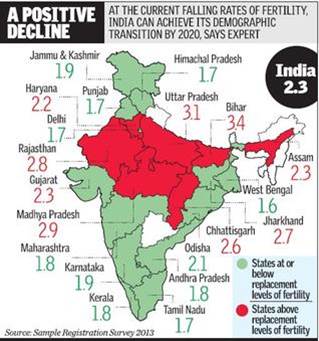
Just over a year ago the average fertility rate in India was 2.5 (where the replenishment level is 2.1) and over half the country was at levels below 2.1. With corresponding declines in infant mortality the projections were for population to reach a peak between 2040 and 2050 and to decline slowly thereafter. But new data for 2013 from the Registrar General shows that fertility is declining faster than expected. The average is already down to 2.3. By 2020 the country as a whole will have an average fertility rate below the 2.1 needed for maintaining a constant population (the replenishment rate). However, infant mortality rate has declined slower than expected. India’s population will therefore likely peak closer to 2040 than 2050.

The HinduThe 2013 data for the Sample Registration Survey (SRS), conducted by the Registrar General of India, the country’s official source of birth and death data, was released on Monday.

India Fertility 2013 - graphic The Hindu

India Fertility 2013 – graphic The Hindu

The SRS shows that the Total Fertility Rate – the average number of children that will be born to a woman during her lifetime – in eight States has fallen below two children per woman, new official data shows.

Just nine States – all of them in the north and east, except for Gujarat – haven’t yet reached replacements levels of 2.1, below which populations begin to decline. West Bengal now has India’s lowest fertility, with the southern States, Jammu & Kashmir, Punjab and Himachal Pradesh. Among backward States, Odisha too has reduced its fertility to 2.1.

“At 2.3, India is now just 0.2 points away from reaching replacement levels. Fertility is declining rapidly, including among the poor and illiterate. At these rates, India will achieve its demographic transition and reach replacement levels as early as 2020 or 2022,” Dr. P. Arokiasamy, a demographer and Professor at the International Institute for Population Sciences (IIPS), Mumbai, explained to The Hindu.

Some of the demographics are worrying.

  1. The ratio of women to men is low (average 909 women per 1000 men). Haryana, Rajasthan, Punjab and Uttar Pradesh have women /men ratios of less than 900 per 1000. I suspect that it is these states which have the lowest levels of emancipation of women and tend to have the highest fertility rates as well. It is clearly the level of development in the state – and not least the emancipation of women – which impacts the fertility rate.
  2. The shortage of women in urban areas (Delhi – 887/ 1000), is probably also due to the general shift of young males seeking employment from rural to urban areas. I wonder if this is also one of the contributing causes for the higher incidence of rape and sexual harassment in places like Delhi.
  3. Countrywide, the mortality rates for infants and children upto 5 years old is higher for girls than for boys.
  4. Abortion rates for female foetuses are also higher than for male foetuses.

Oil price decline is the antibiotic for India’s inflation infection

December 15, 2014

The effects of the dramatic fall in oil prices since June is now beginning to work its way through into cost and inflation statistics. In India, where oil imports are a major burden on both costs and foreign exchange, the impact seems to be killing the persistent inflation virus. The latest government figures for November 2014 have just been released:

The annual rate of inflation, based on monthly WPI, declined to 0.0% (provisionally) for the month of November, 2014 (over November,2013) as compared to 1.77% (provisional) for the previous month and 7.52% during the corresponding month of the previous year. Build up inflation rate in the financial year so far was 0.67% compared to a build up rate of 6.70% in the corresponding period of the previous year.

The most significant contributor has been the cost of fuel:

The index for this major group declined by 5.4  percent to  199.3 (provisional) from 210.7 (provisional) for the previous month due to lower price of furnace oil (13%), high speed diesel oil (10%), aviation turbine fuel (8%), petrol (5%) and kerosene (3%).

WPI inflation has now dropped for 6 consecutive months. Retail inflation is also declining and reached a record low of 4.38% in November. The target was to get it down to 6% by January 2016 and the oil price decline has allowed this target to be met a year in advance. And this in spite of the government raising some of the taxes on fuel to protect their revenues. With industrial growth also down to 4.2% in October the calls for a cut in Reserve Bank rates are increasing.

India is one of the few countries still fighting inflation. Currently growth is running in the 5.4-5.9% range. The Reserve Bank of India is not cutting rates just yet. It will probably wait until the figures for January and February 2015 are out. But the drop in oil prices has provided welcome relief for Indian consumers – even if the inflation virus has not been eradicated.

ISRO to test ascent of GSLV-III launch vehicle and recovery of human-capable capsule in Christmas week

December 2, 2014

India’s ISRO is developing the GSLV-III launch vehicle to be able to lift payloads of 4,500 – 5,000 kgs directly into a Geosynchronous Transfer Orbit (GTO). The Indian national space agency intends to study the ascent phase of the rocket as well as the recovery of a human capsule, after it lands in the sea with a test flight during Christmas week. Such a lift capacity would allow larger communication satellites to be put into orbit or – for example – a Mars lander to be lifted or even a human-capable capsule. It would also then be able to enter the commercial satellite launch market. Later this week the Indian satellite GSAT-16 is to lift on an Ariane-5 rocket on December 5th, 2014 at 02:08 hrs (IST) from French Guiana.

GSLV-III would be comparable to the two Ariane Space heavy-lift launch vehicles

  1. The Ariane-5  with a payload capacity of 10 metric tons delivered to GTO,  or up to 20 metric tons in LEO, and
  2. The Soyuz with a payload capacity of 3,150 kg. delivered to GTO, or 4,900 kg. into SSO

ISRO: GSLV-Mk III is designed to be a three stage vehicle, with 42.4 m tall with a lift off weight of 630 tonnes. First stage comprises two identical S200 Large Solid Booster (LSB) with 200 tonne solid propellant, that are strapped on to the second stage, the L110 re-startable liquid stage. The third stage is the C25 LOX/LH2 cryo stage. The large payload fairing measures 5 m in diameter and can accommodate a payload volume of 100 cu m. Realisation of GSLV Mk-III will help ISRO to put heavier satellites into orbit.

image actmaniac.com

India is also continuing with the development of a 2-man space capsule though any manned space flight is not yet budgeted for and could – at the earliest – take place during the national 5-year plan for 2017-2022.

“Those Indian women in their flying machines…”

November 24, 2014
Baroness de Laroche

SEMAINE D’AVIATION DE TOURAINE (30 avril – 5 mai 1910) Madame DE LAROCHE, Collection of Dave Lam, (via earlyaviators.com)

Those magnificent ladies in their flying machines,
they go up tiddly up up,
they go down tiddly down down. (with apologies)

There are almost more than 3 times as many commercially active, women pilots in India compared to the global average.

The Wright brothers first flew a powered flight in December 1903. They had much support – and financing – from their sister Katharine Wright and she first joined them in exhibition flights in 1909.

But it was a young French actress, Elise Raymonde Deroche (who called herself the Baroness Raymonde de Laroche), perhaps inspired by Katharine, who was the first woman to fly solo in 1909 and the first to be awarded a pilot’s licence in 1910. Though some others flew solo flights earlier, the first American woman to gain a pilot’s licence was Harriett Quimby in 1911.

Amy Johnson of England was the first woman to fly solo from Croydon, London to Darwin in Australia in her Gypsy Moth in 1930. Amelia Earhart of the US was then the first woman to fly solo across the Atlantic in 1932.

Women were involved in military flying already from WW 1.

In World War I, Helene Dutrieu of France and Princess Eugenie Shakhovskaya of Russia both served as reconnaissance pilots.

The first military woman to fly combat missions did so in Turkey in 1937. Sabiha Gokcen participated in the Thrace and Aegean exercises, and in the same year joined the “Dersim Operation.” During the Seyh Riza Rebellion, she facilitated the land operation by bombing Dersim and its surroundings.

In the Soviet Union in World War II, women flew combat missions in three predominately female regiments. The 588th Air Regiment (later the 46th Taman Guards Bomber Regiment) flew night bomber missions in the PO2 biplane. The 587th Bomber Regiment (later the 125th M. M. Raskova Borisov Guards Bomber Regiment) flew bombing missions in the PE2 airplane. The 586th Fighter Regiment flew air defense missions in the YAK-1 aircraft.

Fighter pilot Lily Litvak of the 586th regiment shot down 12 German aircraft and shared the credit for two others. Regiment mate Katya Budanova shot down even more aircraft but the exact number is unknown. They were both killed in action in 1943.

Originally a navigator and a Gold Star Hero of the Soviet Union, Marina Raskova used her influence to propose and gain approval for the formation of the female regiments. She was the first commander of the 587th Bomber Regiment, and she was killed ferrying her aircraft to the front lines. Galina Brok-Beltsova, one of the navigators in Raskova’s regiment, attended our conference last year and we anticipate having her attend this year’s conference.

Rose Clement served as a Navigator in the US Navy during World War II. These women navigators were the first US military women to be aircrew, to wear wings, and to receive flight pay (half their base pay). They were generally assigned as navigator instructors, in pairs at various bases around the country, after satisfactory completion of celestial navigation training.

In Britain in November 1939, Pauline Gower proposed and was granted permission to form the Women’s Section of the Air Transport Auxiliary (ATA), which would ferry aircraft from the DeHaviland factory to RAF training bases. She was the first woman to be allowed into, let alone fly, a Royal Air Force plane.

Though women have been involved in flying from the very early days of flight, they only constitute about 6% of all licensed pilots and only about 3% of active airline pilots according to The International Society of Women Airline Pilots. But for some reason over 11% of commercial pilots on Indian airlines are now women (and over 14% among the newly qualified pilots).

sarla-thakral

Sarla Thakral image iwpa

The first Indian woman to gain a licence was Sarla Thakral in 1936. Prem Mathur was the first woman to gain a commercial licence in 1947 and she flew on domestic airlines but was only allowed as co-pilot. It was only in 1956 that Indian Airlines had Durba Bannerjee as its first woman pilot. The Indian Women Pilots Association was formed in 1967. And by 1985, Saudamini Deshmukh had led the first all-woman flight crew on a domestic commercial flight. In 2008, Sonica Chhabra became the first Indian woman to qualify as a Pilot Examiner.

But the Indian Air Force lags far behind. It was only in 1994 – 80 years after WW1 started – that 3 women were first inducted – reluctantly – as pilots into the Air Force. The first missions ever flown in a combat zone by a woman pilot was during the Kargil conflict in 1999. They are still not permitted as pilots of Indian combat jets though the first combat mission ever flown by a woman was back in 1937. The staid bureaucrats of the Ministry of Defence and the still old fashioned leadership of the Air Force are apparently very disturbed by the very idea of women wielding power. The current Air Chief Marshall Arup Raha recently displayed his rather fossilised thinking. He apparently classes pregnancy as a “health problem”!

TOI, March 13th, 2014.

IAF chief Air Chief Marshal Arup Raha, answering questions in Kanpur on Tuesday, said the capabilities of women “air warriors” in his force was never in doubt but biological and natural constraints precluded them from flying fighters.

“As far as flying fighter planes is concerned, it’s a very challenging job. Women are by nature not physically suited for flying fighters for long hours, especially when they are pregnant or have other health problems,” said ACM Raha, as per news reports.

Defence minister A K Antony, in turn, told Parliament just last month that two studies – by the integrated defence staff HQ in 2006 and a high-level tri-Service committee in 2011 – had both rejected induction of women in combat duties. A serving major-general said, “As a society, we are not ready for our women in combat roles. What if they are taken PoWs?”

Indian commercial airlines clearly don’t have the same fears of women as the Indian Air Force. In the world of commercial airlines, Indian women are progressing much faster than their colleagues abroad.  Why this should be is not very clear though it has been suggested that the availability of family support may make it easier for Indian women to cope with time away from home.

TOI 24th November, 2014.

Almost 600 of the 5,050 pilots in Indian airlines are women, according to the Directorate General of Civil Aviation (DGCA). At 11.6%, this is way above the 3% global average estimated by the International Society of Women Airline Pilots.

India is also seeing a steady rise in women pilots annually. The last five years saw 4,267 commercial pilots’ licences being issued, of which 628 or 14.7% went to women. 

A direct outcome of this trend is that Indian carriers are employing more women pilots. The Jet Group, for instance, had 152 women pilots in October 2011; today it has 194 — the highest in India. “There has been steady growth of about 10% year on year in the number of women pilots joining the airline,” says a Jet official referring to Jet Airways and JetLite. The official adds that 30.5% of their 13,674 employees are women.

At IndiGo, 11% of pilots are women. “That number is definitely growing. Of the pilots that joined from April 2014, 16.5% are women,” says an IndiGo official. Overall, 43% of the airline’s 8,200-strong workforce is women. SpiceJet and GoAir also reported that the number of women pilots is on the rise. The merged Air India-Indian Airlines has the second largest number of women pilots at 171, and often has an all-women crew operating its longest non-stop flights to the US.

Species that developed while India moved from Gondwana to Asia

November 21, 2014

About 200 million years ago the land mass that is now the India plate was part of Gondwanaland. When this plate broke off from Gondwana around 135 million years ago it included what is now Madagascar but then left Madagascar behind as it began – by tectonic standards – a headlong rush north-eastwards around 90 million years ago. Till the collision of this plate with Asia around 10 million years ago brought about the formation of the Himalayas. For around 80 million years then the Indian land mass was an isolated island “rushing” north-east at between 16-20 cm/year!

From Gondwanaland to modern times image berkeley.edu

Indian plate tectonics (after Wikipedia)

(after wikipedia)


This period was also extraordinarily rich in the evolutionary history of the mammals. It was the time when snakes and ants first appeared. There was a mass extinction event about 66 million years ago. The dinosaurs disappeared and became birds. Birds proliferated and so did large flightless birds. The diversity of mammals exploded, perhaps just because of the space left by the disappearance of the large, unsuccessful dinosaurs. The first pigs and deer developed. The grasses arrived. Carnivorous mammals appeared as their prey increased. The first primates made an entrance. But whatever was evolving on the Indian land-mass was evolving largely in isolation from that taking place in the areas that were to become Africa and Eurasia. But there are tantalising indications that on its journey the Indian land-mass may have been connected for short periods by a land bridge to the Horn of Africa or to what is now Arabia.

A new paper reports on fossils from the edges of an open cast coal mine north east of Mumbai in Western India.

Kenneth D. Rose, Luke T. Holbrook, Rajendra S. Rana, Kishor Kumar, Katrina E. Jones, Heather E. Ahrens, Pieter Missiaen, Ashok Sahni, Thierry Smith. Early Eocene fossils suggest that the mammalian order Perissodactyla originated in India. Nature Communications, 2014; 5: 5570 DOI: 10.1038/ncomms6570

The results suggest that an ancient relative of horses and rhinos lived 54.5 million years ago in what is now India. The findings shed light on the evolution of this group of animals. Several groups of mammals that appear at the beginning of the Eocene, including primates and odd- and even-toed ungulates, might have evolved in India while it was isolated.

John Hopkins Press ReleaseWorking at the edge of a coal mine in India, a team of Johns Hopkins researchers and colleagues have filled in a major gap in science’s understanding of the evolution of a group of animals that includes horses and rhinos. That group likely originated on the subcontinent when it was still an island headed swiftly for collision with Asia, the researchers report Nov. 20 in the online journal Nature Communications.

Modern horses, rhinos and tapirs belong to a biological group, or order, called Perissodactyla. Also known as “odd-toed ungulates,” animals in the order have, as their name implies, an uneven number of toes on their hind feet and a distinctive digestive system. Though paleontologists had found remains of Perissodactyla from as far back as the beginnings of the Eocene epoch, about 56 million years ago, their earlier evolution remained a mystery, says Ken Rose, Ph.D., a professor of functional anatomy and evolution at the Johns Hopkins University School of Medicine.

An artist’s depiction of Cambaytherium thewissi via Science Daily Credit: Elaine Kasmer

The mine yielded what Rose says was a treasure trove of teeth and bones for the researchers to comb through back in their home laboratories. Of these, more than 200 fossils turned out to belong to an animal dubbed Cambaytherium thewissi, about which little had been known. The researchers dated the fossils to about 54.5 million years old, making them slightly younger than the oldest known Perissodactyla remains, but, Rose says, it provides a window into what a common ancestor of all Perissodactyla would have looked like. “Many of Cambaytherium’s features, like the teeth, the number of sacral vertebrae, and the bones of the hands and feet, are intermediate between Perissodactyla and more primitive animals,” Rose says. “This is the closest thing we’ve found to a common ancestor of the Perissodactyla order.”

Cambaytherium and other finds from the Gujarat coal mine also provide tantalizing clues about India’s separation from Madagascar, lonely migration, and eventual collision with the continent of Asia as the Earth’s plates shifted, Rose says. In 1990, two researchers, David Krause and Mary Maas of Stony Brook University, published a paper suggesting that several groups of mammals that appear at the beginning of the Eocene, including primates and odd- and even-toed ungulates, might have evolved in India while it was isolated. Cambaytherium is the first concrete evidence to support that idea, Rose says. But, he adds, “It’s not a simple story.”

“Around Cambaytherium’s time, we think India was an island, but it also had primates and a rodent similar to those living in Europe at the time,” he says. “One possible explanation is that India passed close by the Arabian Peninsula or the Horn of Africa, and there was a land bridge that allowed the animals to migrate. But Cambaytherium is unique and suggests that India was indeed isolated for a while.”