Archive for the ‘Japan’ Category

Divabot – debut for the all singing, all dancing robot

November 8, 2010

(PhysOrg.com) — A singing, dancing humanoid recently joined a live group of dancers to perform.

Developed by the country’s biggest public research organization, Japan’s National Institute of Advanced Industrial Science and Technology (AIST), the new variant of HRP-4, the female robot HRP-4C deemed “Divabot,” has a realistic face, movable features and even mimics human-sounding breaths.

Diva-bot’s intricate software creates complicated movements such as jumping, dancing and even balancing. Using a mouse, those with zero robotic expertise are meant to find Diva-bot easily operable, which may or may not be a good thing considering how complex the robot is.Comparable to the software commonly used in CG character animation, Diva-bot’s positioning can be controlled by clicking on the different parts and dragging them to the desired position, creating a sequence of key poses that the software generates, making the robot move.

http://pinktentacle.com/2009/03/video-hrp-4c-fashion-model-robot/



The HRP-4C, a walking, talking humanoid fashion model fembot developed by Japan’s National Institute of Advanced Industrial Science and Technology (AIST), is ready for the runway.

Video here.

With 30 motors in her body, the 158-centimeter (62-in) tall, 43-kilogram (95-lb) HRP-4C can walk around and strike a range of poses.

The black-haired robot also has 8 motors in her face, allowing her to wow the crowds with expressions of simple emotions like anger and surprise.
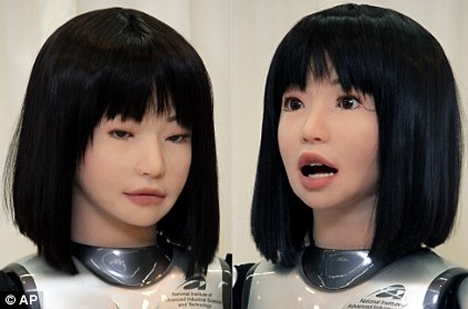


HRP-4C fashion model robot --

Anger // Surprise: HRP-4C


Nuclear renaissance: Vietnam gets nuclear reactors from Russia and Japan, Japan gets access to rare earths

November 1, 2010

Now Vietnam is going nuclear with its first 2 plants coming from Russia and the next 2 from Japan. Unexploited rare earth deposits in Vietnam are receiving a great deal of attention from countries hit by the Chinese monopoly on rare earth supplies.

Chosun Ilbo reports

Russian President Dmitry Medvedev and his Vietnamese counterpart Nguyen Minh Triet have called for increased trade and investment between their two countries. The two leaders met Sunday in Hanoi to seal a nuclear plant construction agreement and other bilateral deals. Under the $5 billion agreement, Russia will build Vietnam’s first nuclear power plant. Construction is expected to start in 2014.

Asahi Shimbun reports on a deal where Japan  gets access to the rare earth resources in Vietnam in exchange for two 1000 MW nuclear reactors worth 14.4 billion $ to the Japanese nuclear construction industry.

The nuclear reactor construction agreement, worth an estimated 1 trillion yen ($14.4 billion), gives the green light for Japanese companies to build nuclear facilities in an emerging nation’s fledgling nuclear industry for the first time.

The two reactors will be built in the southeastern province of Ninh Thuan and are scheduled to start operations in 2021. They will have a combined output of 2 gigawatts. Vietnam plans to build 14 nuclear reactors by 2030. Construction deals for four reactors in Ninh Thuan province have so far been agreed upon, including the two to be awarded to Japan. Russia won the rights to build two reactors in December last year.

Japan, which has been trying to use infrastructure exports as a springboard for its flagging economy, began bidding for the nuclear reactor project earlier this year. In August, a delegation of Japanese business leaders led by Japan’s industry minister visited Vietnam to lobby officials. They offered financial assistance and training for Vietnamese people.

Visiting Prime Minister Naoto Kan and Vietnamese Premier Nguyen Tan Dung also agreed on joint development of deposits in Vietnam of rare earth elements, part of a Japanese drive to reduce its reliance on China for supplies of the vital raw materials, which have been obstructed following a diplomatic dispute with Beijing.

A joint team of Japanese and Vietnamese businesses is currently applying for rare earth mining rights. The Japan Oil, Gas and Metals National Corp. discovered rare earth veins in the northern Lai Chau province about 10 years ago. Toyota Tsusho Corp., Sojitz Corp., and an arm of a Vietnamese public corporation have been preparing plans for joint development.

The underground reserves are believed to be capable of yielding 3,000 tons of rare earths a year, about 10 percent of Japan’s current annual requirement.

The Japanese government has offered to provide expertise and training in surveying, excavation, and processing the rare earth metals to Vietnam. Japan is also likely to dip into official development assistance to help the country build infrastructure such as roads and water supply near the mines. In a separate project, Sumitomo Corp. is looking into mining rare earths in Yen Bai province in the north of Vietnam.

Hayabusa particles could be extraterrestrial

October 10, 2010

I posted earlier on the return of the ion engine powered Hayabusa.

Hayabusa started its journey in 2003 and met up with the asteroid Itokawa in 2005. The plan was to fire small metal projectiles at the asteroid to generate small pea size samples of the asteroid. This plan failed when the projectile firing device failed to function. After a long journey the spacecraft returned to Earth in June this year.

The sample capsule released by the Hayabusa asteroid probe. (Mainichi)

The sample capsule released by the Hayabusa asteroid probe. (Mainichi)


Though the inner capsule had no mm sized particles as hoped, some dust was found in the sealed container. Until recently, many of the fine particles found in the capsule had been believed to be aluminum powder or dust that had slipped into the capsule on Earth during manufacturing or Hayabusa’s launch reports the Mainichi Daily News.

However, the research team collected some 100 particles that are smaller than 0.001 millimeters in size from the inner cylinder of the capsule, called the “sample catcher,” and concluded some of them may be cosmic materials. The particles, which are invisible to the human eye, were collected by remote control using a special Teflon spatula — about 6 millimeters long and 3 millimeters wide — and examined with an electron microscope. Japan Aerospace Exploration Agency (JAXA) plans to further analyze the samples by splitting each particle and examining their crystal structure at Spring 8, a large-scale synchrotron radiation facility in Hyogo Prefecture, starting next month to determine where they are from. The procedure may also provide new information on the birth of the solar system.

“We cannot yet tell (whether the particles are from Itokawa) from their external features, but we have found many particles and there is a chance (that they are extraterrestrial),” said Munetaka Ueno, a researcher at JAXA’s Institute of Space and Astronautical Science.

Today Mainichi reports that:

Rocky particles (circled) are seen on the tip of a spatula used to scrape materials off of the sample capsule. (Photo courtesy of JAXA).

Rocky particles (circled) are seen on the tip of a spatula used to scrape materials off of the sample capsule. (Photo courtesy of JAXA).

The particles in a sample capsule released by the Hayabusa asteroid probe on its return to Earth were largely rocky materials, researchers have announced. At a lecture of the Japanese Society for Planetary Sciences in Nagoya on Oct. 8, a team of researchers released electron micrographs of the particles that were retrieved from the capsule, reporting that most of them were rocky.

According to the research team, including experts from the Japan Aerospace Exploration Agency (JAXA), they have detected at least 100 particles from the capsule, with most of them measuring less than 0.001 millimeters in size.

Since the rocky particles are diverse in composition, researchers will further inspect them at SPring-8, a large synchrotron radiation facility in Sayo, Hyogo Prefecture, to determine if they are terrestrial or from the asteroid Itokawa.

Michibiki navigation satellite in position over Japan

September 30, 2010

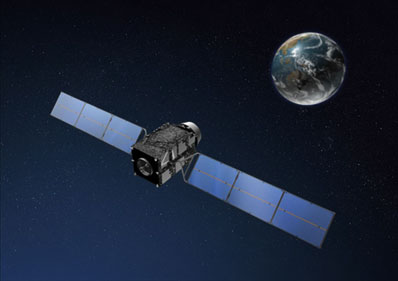
Japan’s first navigation satellite has arrived on station more than 20,000 miles over Asia to improve positioning coverage in mountainous terrain and urban centers.

Artist's concept of the Michibiki satellite. Credit: JAXA

MICHIBIKI injected into the quasi-zenith orbit with its center longitude of about 135 degrees.

The First Quasi-Zenith Satellite MICHIBIKI, which was launched by the H-IIA Launch Vehicle No. 18 on Sept. 11 (JST,) has been maneuvered to shift its orbit from the drift orbit to the quasi-zenith orbit starting on the 21st. The satellite is now confirmed to be inserted into the quasi-zenith orbit over Japan with its center longitude of about 135 degrees through the final orbit control performed at 6:28 a.m. on Sept. 27. The MICHIBIKI was launched from the Tanegashima Space Center at 8:17 p.m. on September 11, 2010 (JST.)

Yoshinobu Launch Complex

Yoshinobu Launch Complex at the Tanegashima Space Center: JAXA

JAXA’s press release is here:

http://www.jaxa.jp/press/2010/09/20100927_michibiki_e.html

Hayabusa returns — Ion engine spacecraft back after 7 years

August 4, 2010

The Japanese asteroid exploration spacecraft Hayabusa returned miraculously on 13th June from a seven-year, trouble-filled journey  powered by ion engines.

Hayabusa’s main engine failed due to fuel leaks, but the probe was able to complete its odyssey by relying on ion engines developed by  NEC. The Japanese firm’s unique method of using microwaves can extend the lifespan of an ion engine to more than twice that of conventional engines. Hayabusa’s successful return “has boosted the credibility of ion engines,” an NEC official said.

image: http://www.jpl.nasa.gov/missions/missiondetails.cfm?mission=Hayabusa

Japan is planning for the launch of the “Hayabusa-2” asteroid probe sometime between July 2014 and 2015.

(more…)