The now, of course, can not, has not, does not and will not ever exist.
Then can refer to the past or the future but never to the now – which does not exist.

The now, of course, can not, has not, does not and will not ever exist.
Then can refer to the past or the future but never to the now – which does not exist.
The wisdom of yesteryear is not necessarily wisdom today.

Most people know around 20,000 – 35,000 words (in any language). Extremely gifted people – very rarely – may approach a vocabulary of 60,000 words. Even multi-lingual people seem to have a total vocabulary not exceeding the limits of mono-lingual people. Twenty years ago when I lived in Japan, my English conversations included many words which I no longer have in my active memory. Similarly Chinese, Hindi, Tamil and German words that I once used regularly as part of my social conversations in English, are no longer in my active memory.
But why does each of us know so few words of all the words that are available?
It cannot be memory capacity in the brain that sets the limit. My hypothesis is that just like there seems to be a cognitive limit to the number of significant social connections a person can maintain (the Dunbar number – averaging around 150 with a minimum of around 50 and a maximum of perhaps 250), there is a cognitive limit (the Wordsmith Number) to the size of the active vocabulary that a person can maintain. (I note that the number of Facebook friends or Twitter followers do not represent significant social relationships).
The more you read the bigger your vocabulary. The more you write the more likely you are to have a larger vocabulary. The more diverse your social connections the larger vocabulary you need and have. But yet, each of us knows only a fraction of the active words available in any language. The active words in a language form only a fraction of the total words in that language. And the total words in a language are a tiny fraction of all the words that could be formed by an alphabet a and a set of rules.
In any language, the rules of grammar together with about 2,000 base words would be sufficient to get by. In any language a degree of proficiency would have been achieved with a vocabulary of around 10,000 base words. Over 20,000 words would be considered a high level of fluency.
The number of words needed to enable most communication needs is thus not so large. Equally, knowing words that are not used is pointless. Words that others don’t know is of no great use either. Yet, we have all at some time complained of “not having the words to express our feelings”. We are often “lost for words”. Our eyes can distinguish shades of colour for which there are no specific words. But we use adjectives and combine words to express emotions or shades of colour rather than invent specific words for just that shade or that emotion.
In any alphabet where the length of a word is not restricted, there are an infinite variety of ways of creating combinations of letters to be words. In practice most languages have working vocabularies of a few hundred thousands and even if all possible variations and forms, past and present, are counted, the vocabulary may be around one million words. The Oxford English Dictionary has around 177,000 words as being in current usage and another 50,000 as obsolete. Similarly German has around 150,000 words as being in current use and Swedish has around 125,000. However current usage is not the whole story. Current usage is only a part of the total number of words available in a language where the total number depends on the age of the language. It is said that Japanese has around 100,000 active words in a total vocabulary of around 500,000. The OED estimates the total number of words in English to be around 750,000. Other estimates put the total English vocabulary at just over one million words.
According to the Global Language Monitor’s (GLM) “English Language WordClock,” there are 1,005,366 words in the English language. …… The Google/Harvard Study of the Current Number of Words in the English Language also arrived at a similar number — 1,022,000 (a difference of .o121%) ……… The Oxford English Dictionaries (OED) comes up with an estimate of 750,000, when counting only distinct senses and excluding variants.
The number of words that any person knows in a language is also not so easily determined. I would generalise to say that all modern languages have each around 100 – 200 thousand active words with a total vocabulary depending upon the age of the language and ranging from 300,000 to about 1 million. But, in most extant languages today, any single individual generally has a personal vocabulary which is only around 10 – 20% of the active words (or 2 – 5% of the total number of words) available in that language. An exceptionally gifted person might come up to around 30% of active words (or less than 10% of the total number of words). Depending on how words are defined Shakespeare is thought to have had command over about 8% of all the English words of that time but only used about 4% in an all his writings. In modern times James Joyce is thought to have had an extraordinarily large personal vocabulary and perhaps it was even a little more than 10% of the total number of English words. Ulysses alone – by one count – contains a larger vocabulary than all of Shakespeare’s works.
According to lexicographer and Shakespeare scholar David Crystal, the entire English vocabulary in the Elizabethan period consisted of about 150,000 words. ……… Crystal believes that Shakespeare had a vocabulary of about 20,000 words (13.5% of the known lexicon). Compare that to the size of the vocabulary of the average modern person (high school-level education) that is 30,000 to 40,000 words (about 6% of the 600,000 words defined in the Oxford English Dictionary). Other lexicographers estimate that Shakespeare’s vocabulary ranged from 18,000 to 25,000 words.
….. In their 1976 study, “Estimating the Number of Unseen Species: How Many Words Did Shakespeare Know,” statisticians Bradley Efron (Stanford University) and Ronald Thisted (University of Chicago) used word-frequency analyses to predict more accurately Shakespeare’s actual vocabulary, including the words he used in his writing (active or manifest vocabulary) and the words he knew but didn’t use in his writing (passive or latent vocabulary). Efron and Thisted turned to the Harvard Concordance and the 31,654 different words from a grand total of 884,647 words, including repetitions. …….. Thus to calculate Shakespeare’s total working vocabulary, we add 31,534 different words found in his writings to the 35,000 words he probably knew, to arrive at an estimate of 66,534 words.
Taking only current words in English as an example (< 200,000) , most individuals considered fluent would have between 25,000 – 40,000 words in their personal vocabularies. (There may be the extremely rare person with a personal vocabulary approaching 60,000 words, though that is doubtful. But there is surely nobody with a personal vocabulary greater than that). Even for those who are multilingual, the sum of the words they command in all languages seems to be limited to be no different to those who are monolingual.
the rate and pace of development of the bilinguals’ lexical knowledge were similar to those of monolingual children. In addition, the total vocabulary count of these children (taking into account both languages) was not different to that of the monolinguals, but their single language vocabularies were somewhat smaller. So we have known for some time that bilingual children do have as many words as their monolingual counterparts when both languages are taken into account but maybe not so when one examines only one language.

Why this apparent limit to the number of words one can know?
My hypothesis is that there is a stable level – the Wordsmith Number – which the brain establishes. It is a cognitive limit to the size of the active vocabulary that a person can maintain. It is established by the manner in which the brain learns, stores and retrieves active and passive words. It is a dynamic level and varies as our activities change (reading, writing, speaking, diversity of social relationships ..). Words that are not active are shunted out of active memory. In very rare circumstances is a Wordsmith Number of greater than about 30,000 established.
Donald Rumsfeld was often the butt of cheap jokes after this quote. In reality, Rumsfeld was absolutely spot on and close to philosophic.

Starting from where Rumsfeld left off we come to the distinction between the knowable and the unknowable
These are things we don’t know that we don’t know. There are knowable unknowns. That is to say, there are things that we could know but we don’t know which we don’t know. But there are also unknowable unknowns. There are things we cannot know that we don’t know that we can never know.
a la Rumsfeld
I am coming to the conclusion that the sum of all human cognition lacks some of the dimensions of the universe. It may be increasing with time, but human cognition is limited. The expanding universe may be infinite or it may be boundless. For human cognition to grasp the universe is then like trying to measure an infinite length with a ruler of finite length, or of trying to measure some unknown parameter with a ruler marked in inches. Those measurements will never reach a conclusion.

Logic is inherent in the universe. It is not a creation of man and is not dependent on observation or what kind of brain perceives the universe.
The laws of logic are taken to be unchanging over space and time. Logic now, is as logic was, and as logic will always be. Logic here, is as logic is there and everywhere.
Language, however, is invented. All languages (including mathematics or chemical notation or Boolean algebra or …..) must have a structure which is compliant with the logic of the universe it is used to describe. We perceive a logic in the universe and express it through the inbuilt logic of our language(s). We use the one to describe the other and they are both the same.
How not?

It is one of the worst feelings one can experience. To have reality intrude rudely on illusions one has cherished.
And the worst of the worst is when it is another person who is the disillusionment. When somebody turns out to be not quite what they seem to be.

The domination of English as a world language probably begins only about 200 years ago and 1820 is as good a starting time as any.
Language influence, I would suggest, follows economic influence. The predominance of English today is merely a consequence of growth and spread of the English speaking economies. And the role of the US has been decisive in the last 150 years. The Latin of 2,000 years ago which had gained dominance in Europe died during the dark ages, evolved into Italian at home and was replaced by a plethora of local dialects in the rest of Europe. Latin was possibly the first ever which could be considered a “world language”. As a language of international communication it was probably preceded by Greek and Egyptian before that. Perhaps Arabic came close to being an international language during the Middle Ages. As European countries colonised the Americas and parts of Asia, they took their local languages with them. But the key for English was that North America adopted English rather than Spanish (or French or German). The US does not formally have an official language but English is the de facto national language. (According to legend German came close to being adopted in Pennsylvania in 1794).
There is no official language at the U.S. federal level. However, 32 states of the United States … have adopted legislation granting official status to English. Out of 50 states, 30 have established English as the only official language, while Hawaii recognizes both English and Hawaiian as official and Alaska has made some 20 Native languages official, along with English.
…… American schools, public as well as private, require English classes at every grade level, even in bilingual or dual-language learning. Semesters of English composition are required in virtually all U.S. colleges and universities to satisfy associate’s and bachelor’s degree requirements. – Wikipedia
Harald Haarmann writes in his Mosaic of Languages:
Europe has far exceeded all other continents regarding the export of languages. There is no other continent from which so many languages have been spread around the world, taking root elsewhere in the world and giving rise to global language communities. Most world languages, i.e. languages with global communicative functions, are European in origin and belong to the Indo-European family of languages. The result of this language export from the 15th century onward is a vast increase in the numbers of speakers. Today, the majority of speakers of languages such as English, Spanish, Portuguese and French live in regions outside of Europe. The proportion of speakers in Europe compared to those in other continents varies considerably between the individual languages:

German and Russian are Europe-centred, with the vast majority of speakers of these languages living in Europe. Languages such as Portuguese, English and Spanish, on the other hand, have far more speakers overseas, and the speakers in the countries of origin constitute a minority of the total number of speakers.
The spread of language cannot be divorced from economic well-being. Angus Maddison’s important work on historical GDP’s is insightful and fascinating. In his Millenial Perspective of the World Economy he begins:
Over the past millennium, world population rose 22–fold. Per capita income increased 13–fold, world GDP nearly 300–fold. This contrasts sharply with the preceding millennium, when world population grew by only a sixth, and there was no advance in per capita income. From the year 1000 to 1820 the advance in per capita income was a slow crawl — the world average rose about 50 per cent. Most of the growth went to accommodate a fourfold increase in population. Since 1820, world development has been much more dynamic. Per capita income rose more than eightfold, population more than fivefold. Per capita income growth is not the only indicator of welfare. Over the long run, there has been a dramatic increase in life expectation. In the year 1000, the average infant could expect to live about 24 years. A third would die in the first year of life, hunger and epidemic disease would ravage the survivors. There was an almost imperceptible rise up to 1820, mainly in Western Europe. Most of the improvement has occurred since then. Now the average infant can expect to survive 66 years. The growth process was uneven in space as well as time. The rise in life expectation and income has been most rapid in Western Europe, North America, Australasia and Japan. By 1820, this group had forged ahead to an income level twice that in the rest of the world. By 1998, the gap was 7:1. Between the United States (the present world leader) and Africa (the poorest region) the gap is now 20:1. This gap is still widening. Divergence is dominant but not inexorable. In the past half century, resurgent Asian countries have demonstrated that an important degree of catch–up is feasible. Nevertheless world economic growth has slowed substantially since 1973, and the Asian advance has been offset by stagnation or retrogression elsewhere.
What he writes about population and income applies as well to language
Advances in population and income over the past millennium have been sustained by three interactive processes:
a) Conquest or settlement of relatively empty areas which had fertile land, new biological resources, or a potential to accommodate transfers of population, crops and livestock;
b) international trade and capital movements;
c) technological and institutional innovation.
I would suggest that the spread of English during the colonial expansion (say 1650 – 1850), immediately followed by the economic dominance of the English-speaking US (1870 – present), led to English happening to be the dominant language at just the right time during the explosion of Maddison’s period of technological and institutional innovation. It is being adopted as the language of science and engineering and innovation which has given English the decisive penetration it now has.

World GDP by country 1 – 2008AD (Maddison)
The US became the country with the largest GDP in about 1872. By 1918 (after World War 1) the US economy exceeded that of the UK, France and Germany combined. By 1942 the US economy was larger than that of all of Western Europe. China and India are rising though their per capita GDP is diluted by their large populations.

GDP rising
Within 10 – 20 years the Chinese economy will be significantly larger than that of the United States.

GDP 2030 projection
The question is whether another language will replace English, in time, to reflect the economic realities of the age. I suspect it will not happen for another 200 years – if ever. The position of English as the language of innovation and science and now as the language of the internet presents an inertial barrier that even Mandarin Chinese may not be able to overcome. Hindi and Tamil are the only Indian languages that could even be remotely considered, but either becoming a dominating language is in the realm of fantasy. It is the same type of inertial barrier which will also keep English predominant in Europe, even after BREXIT. In fact, English may have an added strength in a Europe without the UK, as a non-French, non-German, “neutral” language. There are those who name Spanish or Arabic as potential world languages but I find the case for them replacing English less than convincing. The adoption of Spanish would require that the economies of South and Central America (without Brazil but including Mexico) become dominant in the global economy and that is a very remote possibility. German and Russian are too Euro-centric to be considered. The case for French rests entirely – and implausibly – on the economic dominance of France and French-speaking Africa.
Unless the world shifts from the economic growth model that has served us for over 8,000 years (at least) – and I cannot imagine what that paradigm shift could be – I cannot see any language replacing an English (which will of course mutate and change and evolve) as the dominant world language for at least a few hundred years.
Language is ultimately a matter of usage for the purpose of communication. Grammar is never “right” or “wrong” but it can be “correct usage” or “incorrect usage” or “effective” or “ineffective”. New forms of usage always override existing “rules”. The point of language is communication and if that is achieved – to the communicator’s satisfaction – then whatever manner language is used – whether following current usage or not – is a successful use of language.
Chapter 4: Essence of a Manager
Communication: Hearing what isn’t said
Where a communication is intended, the responsibility for what has been understood lies always with the communicator, not with the receiver. It is why the statement “He did not understand what I meant!” actually reflects poorly on the speaker. The intending communicator cannot escape from the consequences of what has been finally understood by the receiver.
A European in Japan cannot blame the Japanese for not understanding his English. A grandfather cannot blame his grandchild for not understanding his archaic usage of language. The onus lies with the person intending to communicate. It is the communicator who has the freedom – even the prerogative – to comply with or deviate from conventional usage, or to even invent words. The only test is whether the intended communication was achieved.
Language changes and, in itself, the change should not be a matter of regret. If the change helps to achieve better communication then it can only be a good thing. However not all change does help. It is not also just the generational effect. Usage does change with each generation and generally it improves communication within the new generation. (The abbreviations used on Twitter or Snapchat being a case in point). But not always. Sometimes the generational change is to bring in an increase in sloppiness and a loss of precision in the communication. But the responsibility always lies with the communicator. So when misunderstandings arise between people or across generations, the fault always lies with the communicator.
All this because someone used the word “matching” to describe 4 people in a photograph. (The four were dressed similarly in various shades of blue). I couldn’t quite see what the “matching” referred to and in explanation I was offered “complimentary”. Remarkably, it was actually the misuse of “complimentary”, instead of (I think) “complementary” (which itself would have been a misuse), which did succeed in getting me to understand what the “matching” referred to. A case of two wrongs making a right.
A “compliment” may well be flattering but rarely ever “matches” the “complement” which completes. And not to forget that when it comes to colours, the objective of complementary colours is to finally achieve white or black.

If someone takes offense at an intended insult then that is a case of a successful communication. But, an intended insult delivered by swearing in an incomprehensible language fails miserably as a communication.
After Brexit, English will have no legal status in the EU. But without English, the EU language wars will surely begin. It would be a horrible loss of face for the EU if they continued to use English after Brexit. Maybe the UK could claim a royalty if they did.
Each member state of the EU nominates and registers a primary language. Only the UK has registered English as a primary language. Ireland has registered Gaelic and even Malta chose Maltese.
The European Union has 24 official and working languages. They are:
Bulgarian French Maltese Croatian German Polish Czech Greek Portuguese Danish Hungarian Romanian Dutch Irish Slovak English Italian Slovenian Estonian Latvian Spanish Finnish Lithuanian Swedish The first official language policy of what was then the European Community identified Dutch, French, German, and Italian as the official working languages of the EU.
Since then, as more countries have become part of the EU, the number of official and working languages has increased. However, there are fewer official languages than Member States, as some share common languages.
On the other hand, some regional languages, such as Catalan and Welsh, have gained a status as co-official languages of the European Union. The official use of such languages can be authorised on the basis of an administrative arrangement concluded between the Council and the requesting Member State.
Part of the ridiculous bureaucracy in Brussels is a permanent staff of 1,750 linguists, 600 support staff, 600 full-time interpreters, and a further 3,000 freelance interpreters.
French MEP’s are already calling for the removal of English after Brexit. Before the UK joined the EU (1st January 1973) the EU had Dutch French, German and Italian. Spain only joined in 1986. For English to remain a “working language” would require agreement by all member states. French dominated until Sweden, Finland and Austria tilted the balance in the 1990s. With the Eastern European members now established the resistance to French and German will be all the more obvious.
English is the most spoken second language in the EU and even in France, Germany, Spain and Italy. The dominance of English as a second language in Scandinavia and in the low countries is accompanied by a very high level of fluency in English. Without English as a unifying factor, the existing cracks and splits in the EU will not only be all the more visible, they will be positively encouraged.
map by https://jakubmarian.com/map-of-the-most-spoken-foreign-languages-of-the-eu-by-country/

map by Jakubmarian.com
The Royal Society has a new paper
, Comparative phylogenetic analyses uncover the ancient roots of Indo-European folktales, .
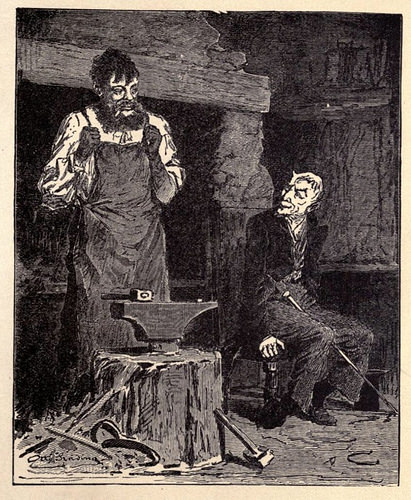
The Smith and the Devil – Russian folk tale or something much older?
The BBC reports:
In the 19th Century, authors the Brothers Grimm believed many of the fairy tales they popularised were rooted in a shared cultural history dating back to the birth of the Indo-European language family.
Later thinkers challenged that view, saying some stories were much younger and had been passed into oral tradition having first been written down by writers from the 16th and 17th Centuries.
Durham University anthropologist Dr Jamie Tehrani, who worked with folklorist Sara Graca Da Silva, from the New University of Lisbon, said: “We can come firmly down on the side of Wilhelm Grimm. Some of these stories go back much further than the earliest literary record and indeed further back than Classical mythology – some versions of these stories appear in Latin and Greek texts – but our findings suggest they are much older than that.” ……
…..
It also used a tree of Indo-European languages to trace the descent of shared tales to see how far they could be demonstrated to go back in time.
Dr Tehrani said Jack And The Beanstalk was rooted in a group of stories classified as The Boy Who Stole Ogre’s Treasure, and could be traced back to when Eastern and Western Indo-European languages split more than 5,000 years ago.
Analysis showed Beauty And The Beast and Rumpelstiltskin to be about 4,000 years old. And a folk tale called The Smith And The Devil, about a blacksmith selling his soul in a pact with the Devil in order to gain supernatural abilities, was estimated to go back 6,000 years to the bronze age. Dr Tehrani said: “We find it pretty remarkable these stories have survived without being written. They have been told since before even English, French and Italian existed. “They were probably told in an extinct Indo-European language.”
Tale telling around a camp-fire must have been one of the major contributors for the evolution of language. But what is a little surprising is that the oral tradition can be so persistent, and for so long. That suggests that orally transmitted tales from ancient cultures should probably be given much more weight. The origin of many concepts, which are often dated to the beginning of written records, are probably much older than thought.
Abstract
Ancient population expansions and dispersals often leave enduring signatures in the cultural traditions of their descendants, as well as in their genes and languages. The international folktale record has long been regarded as a rich context in which to explore these legacies. To date, investigations in this area have been complicated by a lack of historical data and the impact of more recent waves of diffusion. In this study, we introduce new methods for tackling these problems by applying comparative phylogenetic methods and autologistic modelling to analyse the relationships between folktales, population histories and geographical distances in Indo-European-speaking societies. We find strong correlations between the distributions of a number of folktales and phylogenetic, but not spatial, associations among populations that are consistent with vertical processes of cultural inheritance. Moreover, we show that these oral traditions probably originated long before the emergence of the literary record, and find evidence that one tale (‘The Smith and the Devil’) can be traced back to the Bronze Age. On a broader level, the kinds of stories told in ancestral societies can provide important insights into their culture, furnishing new perspectives on linguistic, genetic and archaeological reconstructions of human prehistory.

 The k2p blog