Archive for the ‘Media’ Category

Science journalism by press release -“New ligament found in the knee” – Yes back in 1879!

November 10, 2013

Last week every Science section in every major newspaper reported the discovery of a new ligament in the knee! Every science site carried the astonishing news in breathless tones of wonder! I almost wrote about it since my son had had his knee ligament reconstructed a few years ago after a volleyball accident. But I couldn’t get access to one of the references and I didn’t – thank goodness!

To put it mildly the “newness” of the discovery was all a load of bulls**t.

The body part in question had been discovered in 1879! A new paper had been written about this ligament and published on 1st August. But their University had only issued a press release last week. And not one of the very many science “journalists” looked beyond the press release and had bothered to read the very first line of the paper abstract which stated “In 1879, the French surgeon Segond described the existence of a ‘pearly, resistant, fibrous band’ at the anterolateral aspect of the human knee…” . Instead they went to town with their headlines as this simple Google search shows (About 29,200,000 results in 0.32 seconds) 

Science journalism by infectious press release!

Paul Raeburn’s take-down is as comprehensive as needed and is reproduced here:

 It was startling news, but an easy story to write: Scientists have discovered a new body part! Amazing, isn’t it, that something could have eluded us since the time of Hippocrates?

Well, it would be amazing, except for one little detail, a detail so trivial I’m embarrassed to bring it up: It isn’t true.

But, hey, it’s an unusually warm Thursday in New York, I’m feeling good about life, so let’s give the journalists who bungled this story a break.

Why? Because in order to discover that the story wasn’t true, they would have had to dig down all the way to the very first line of the study’s abstract, which says, “In 1879, the French surgeon Segond described the existence of a ‘pearly, resistant, fibrous band’ at the anterolateral aspect of the human knee…”

That’s the body part in question, as journalists who even glanced at the abstract would have known. The darn thing was discovered 134 years ago.

USA Today‘s story, headlined, “New body part discovered,” reports that the new study confirmed the existence of the thing, called the anterolateral ligament, or ALL. The story then says that in Segond had “speculated” about the ligament, when the abstract clearly says that he “described” it. (Please excuse the annoying overuse of italics, but it’s hard to write normally when you’re grinding your teeth.)

Gizmodo‘s story: “It may sound impossible but scientists have discovered a new body part.”

Vanity Fair: “Newly Discovered Body Part Means New Sections of WebMD to Memorize!” Funny, right?

TIME: “Your Knee Bone’s Connected to Your…What? Scientists Discover New Body Part.” This story has the virtue of consistency. Unlike some of the others, it’s wrong all the way through. Congrats, people! Segond, TIME writes, “theorized” that the knee might have another ligament.

FoxNews.com: “Surgeons Discover New Ligament in Human Knee.” The story reports that the study’s authors “looked into a theory made by a French surgeon in 1879, which claimed that an unknown ligament existed on the anterior of the human knee.” Well, what was it–a theory, or a claim? Prospectors can theorize about the location of gold deposits, but that falls far short of staking a claim.

MsnNow.com: “Doctors find totally new, undiscovered part of the human body.” MsnNow also reports that the Anatomical Society found this discovery “very refreshing.”

I’ll spare you any further examples, but here’s the catch: This study was published online on Aug 1, 2013. Why the sudden pickup now?

Apparently because the University of Leuven in Belgium, where the study’s authors work, put out a press release this week. The release sadly lacks TIME’s sparkling consistency. Its headline reports that surgeons described the ligament, which is–gasp!–correct. (The release still wrongly calls it a “new” ligament, as Ed Yong pointed out to me.) But the release’s author can’t help but go further in the text. The French surgeon “postulated” the existence of the ligament, it says. Wrong again; he described it.

That release was picked up by ScienceDaily, a press-release aggregator that masquerades as a news site, and which mangled the news further. “New ligament discovered in the human knee,” the headline reports. “Two knee surgeons at University Hospitals Leuven have discovered a previously unknown ligament in the human knee…” the story begins. ScienceDaily parrots the release’s “postulated.” And just for fun, ScienceDaily describes the new study as something “that could signal a breakthrough” in treatment of ACL injuries in the knee.

Only a single ray of hope penetrated my day, which had started out hopeful and turned so depressingly dark. The website io9 (“We come from the future”) got it right. “No,” its headline read, “science has not discovered a new body part.” The stories, it writes with admirable clarity, are “all crap.” It even links to the original French paper, where, if you’re so inclined, you can read about des ligaments dans le genou.

Moi, I’m heading to yoga; I don’t know how else to unclench my jaw.

-Paul Raeburn
A quick fix for plagiarism

November 8, 2013

It doesn’t seem right. In fact it sounds like an abdication of responsibilities and like covering up a crime if and when the crime is discovered.

But it also sounds a simple fix. A stroke of genius – somewhat crooked but very clever. Just eliminate the plagiarism by punctuation!

If accused of plagiarism, just put the impugned text within quotation marks!

Retraction Watch has the story:

PNAS has a curious correction in a recent issue. A group from Toronto and Mount Sinai in New York, it seems, had been rather too liberal in their use of text from a previously published paper by another researcher — what we might call plagiarism, in a less charitable mood.

To paraphrase Beyoncé: If you like it, better put some quotation marks around it. But we’re pretty sure she meant before, not after, the fact.

The article, “Structural basis for substrate specificity and catalysis of human histone acetyltransferase 1,” had appeared in May 2012, in other words, some 17 months ago. It has been cited twice, according to Thomson Scientific’s Web of Knowledge.

……..

Parthun is Mark Parthun, a professor at Ohio State University. It was he who brought the misused text to PNAS’s attention. He tells us:

I read this paper with great interest because my lab also studies the Hat1 enzyme.  While reading this, a number of the passages in the Introduction and Discussion sections started to sound very familiar.  These passages were familiar because they were plagiarized from a review article I had published earlier (Parthun, M.R. Oncogene 26:5319–5328, 2007).  I also found some sentences that were plagiarized from another manuscript from another lab (Campos, et al, NSMB 2010).  I brought this plagiarism to the attention of the editors at PNAS and suggested that this manuscript be retracted.  After more than a year, PNAS published a correction (http://www.pnas.org/content/110/45/18339.full).  This correction lists all of the passages that were plagiarized and simply says that they should have had quotation marks around them.  This seems like a woefully inadequate response.  PNAS has essentially made plagiarism irrelevant because if you are caught, all you have to do is retroactively say that you should have used quotations.  Is this a common practice with journals.  I hope not because I think this represents a serious step in the erosion of scientific ethics.

….

We asked Daniel Salisbury, a PNAS editor, why the journal opted to correct rather than retract the paper. This was his reply:

In light of recent concerns from the author of the plagiarized text, we are following up with the PNAS authors’ institution.

Parthun, who said he received a similar message, was not impressed:

My problem with his response [is] that they are simply passing the buck.  I would have thought that PNAS had the ultimate responsibility for the manuscripts that it publishes.  I don’t understand why they need Mount Sinai to tell them when something is improper.

To which we say, we agree.

We’ve emailed Plotnikov for comment and will update this post if we hear from him. Meanwhile, although we think there might be room in science publishing for correcting improperly attributed text, an instance of multiple examples of frank plagiarism such as this probably isn’t the test case.

Has Facebook reinstated beheading videos for the NSA or just for revenue – or for both?

October 23, 2013

That Facebook allows NSA access to all its material has become clear from the Snowden leaks.

In addition to phone records and email logs, the National Security Agency uses Facebook and other social media profiles to create maps of social connections — including those of American citizens.

That beheading and other videos with gratuitous violence are often uploaded on  Facebook is apparent (and whichever way Facebook twists and turns it is equally apparent that they must stand as the publishers – if not the authors – of such material). That much of the uploaded material is faked is also apparent (especially from areas of conflict). It is the gratuitous violence which attracts the voyeuristic surfers like a crowd gathering at the scene of a bloody incident. The sight of vultures gathering at the carcass of a kill attract even more scavengers of all kinds. It is the gatherings of the crowds which increases the revenue generating traffic for Facebook.

The more bloodstains on the road the larger the crowd of ghouls who gather. But among the ghouls are also perpetrators returning to the scene of their crimes where the “incident” was not just an accident. And that interests the NSA.

Why then has Facebook removed its ban on such material? There are very few voices supporting the move.

Who gains? Why the NSA and Facebook. The NSA needs material to mine in its search for the “bad” guys. And people who behead others or fake such pictures or are inspired by such material are of special interest. And Facebook wants the revenues.

ArsTechnicaFacebook said that overall, it received between 9,000 and 10,000 requests from authorities in the second half of 2012, pertaining to between 18,000 and 19,000 individual Facebook accounts. …. By the end of July 2013, we learned directly from an FISC judge that no corporation ever served with a “business record” court order under the Patriot Act has ever challenged one. This is despite the fact that the law provides them a means to do so.

Judging by what Facebook does – and not by what it says – also suggests that they are a lot closer to the NSA than they would like their users to know.

Beforeitsnews: About a year after Facebook reportedly joined PRISM, Max Kelly, the social network’s chief security officer left for a job at the National Security Agency, either a curious career move or one that makes complete sense. The Chief Security Officer at a tech company is primarily concerned with keeping its information inside the company. Now working for an agency that tries to gather as much information as it can, Kelly’s new job is sort of a complete reversal.

And it does not matter where in the world you are. If you are on Facebook your information is in a security agency’s database somewhere. It may not have been flagged as being of special interest but it’s there. If not at the NSA then surely at GCHQ or with the Germans or with the Russian agencies. Even if meta-data is only kept for some limited period of time – once your existence has been registered it can never be deregistered. And if the initial data was “flagged” for any reason then that individual will forever be under surveillance.

Science is losing its ability to self-correct

October 20, 2013

With the explosion in the number of researchers, the increasing rush to publication and the corresponding explosion in traditional and on-line journals as avenues of publication, The Economist carries an interesting article making the point that the assumption that science is self-correcting is under extreme pressure. “There is no cost to getting things wrong,” says Brian Nosek, a psychologist at the University of Virginia who has taken an interest in his discipline’s persistent errors. “The cost is not getting them published.”

The field of psychology and especially social psychology has been much in the news with the dangers of “priming”.

“I SEE a train wreck looming,” warned Daniel Kahneman, an eminent psychologist, in an open letter last year. The premonition concerned research on a phenomenon known as “priming”. Priming studies suggest that decisions can be influenced by apparently irrelevant actions or events that took place just before the cusp of choice. They have been a boom area in psychology over the past decade, and some of their insights have already made it out of the lab and into the toolkits of policy wonks keen on “nudging” the populace.

Dr Kahneman and a growing number of his colleagues fear that a lot of this priming research is poorly founded. Over the past few years various researchers have made systematic attempts to replicate some of the more widely cited priming experiments. Many of these replications have failed. In April, for instance, a paper in PLoS ONE, a journal, reported that nine separate experiments had not managed to reproduce the results of a famous study from 1998 purporting to show that thinking about a professor before taking an intelligence test leads to a higher score than imagining a football hooligan.

It is not just “soft” fields which have problems. It is apparent that in medicine a large number of published results cannot be replicated

… irreproducibility is much more widespread. A few years ago scientists at Amgen, an American drug company, tried to replicate 53 studies that they considered landmarks in the basic science of cancer, often co-operating closely with the original researchers to ensure that their experimental technique matched the one used first time round. According to a piece they wrote last year in Nature, a leading scientific journal, they were able to reproduce the original results in just six. Months earlier Florian Prinz and his colleagues at Bayer HealthCare, a German pharmaceutical giant, reported in Nature Reviews Drug Discovery, a sister journal, that they had successfully reproduced the published results in just a quarter of 67 seminal studies.

The governments of the OECD, a club of mostly rich countries, spent $59 billion on biomedical research in 2012, nearly double the figure in 2000. One of the justifications for this is that basic-science results provided by governments form the basis for private drug-development work. If companies cannot rely on academic research, that reasoning breaks down. When an official at America’s National Institutes of Health (NIH) reckons, despairingly, that researchers would find it hard to reproduce at least three-quarters of all published biomedical findings, the public part of the process seems to have failed.

It is not just that research results cannot be replicated. So much of what is published is just plain wrong and the belief that science is self-correcting is itself under pressure

Academic scientists readily acknowledge that they often get things wrong. But they also hold fast to the idea that these errors get corrected over time as other scientists try to take the work further. Evidence that many more dodgy results are published than are subsequently corrected or withdrawn calls that much-vaunted capacity for self-correction into question. There are errors in a lot more of the scientific papers being published, written about and acted on than anyone would normally suppose, or like to think. …… Statistical mistakes are widespread. The peer reviewers who evaluate papers before journals commit to publishing them are much worse at spotting mistakes than they or others appreciate. Professional pressure, competition and ambition push scientists to publish more quickly than would be wise. A career structure which lays great stress on publishing copious papers exacerbates all these problems. “There is no cost to getting things wrong,” says Brian Nosek, a psychologist at the University of Virginia who has taken an interest in his discipline’s persistent errors. “The cost is not getting them published.” 

…… In 2005 John Ioannidis, an epidemiologist from Stanford University, caused a stir with a paper showing why, as a matter of statistical logic, the idea that only one such paper in 20 gives a false-positive result was hugely optimistic. Instead, he argued, “most published research findings are probably false.” 

The tendency to only publish positive results leads also to statistics being skewed to allow results to be shown as being poitive

The negative results are much more trustworthy; …….. But researchers and the journals in which they publish are not very interested in negative results. They prefer to accentuate the positive, and thus the error-prone. Negative results account for just 10-30% of published scientific literature, depending on the discipline. This bias may be growing. A study of 4,600 papers from across the sciences conducted by Daniele Fanelli of the University of Edinburgh found that the proportion of negative results dropped from 30% to 14% between 1990 and 2007. Lesley Yellowlees, president of Britain’s Royal Society of Chemistry, has published more than 100 papers. She remembers only one that reported a negative result.

…. Other data-heavy disciplines face similar challenges. Models which can be “tuned” in many different ways give researchers more scope to perceive a pattern where none exists. According to some estimates, three-quarters of published scientific papers in the field of machine learning are bunk because of this “overfitting”

The idea of peer-review being some kind of a quality check of the results being published is grossly optimistic

The idea that there are a lot of uncorrected flaws in published studies may seem hard to square with the fact that almost all of them will have been through peer-review. This sort of scrutiny by disinterested experts—acting out of a sense of professional obligation, rather than for pay—is often said to make the scientific literature particularly reliable. In practice it is poor at detecting many types of error.

John Bohannon, a biologist at Harvard, recently submitted a pseudonymous paper on the effects of a chemical derived from lichen on cancer cells to 304 journals describing themselves as using peer review. An unusual move; but it was an unusual paper, concocted wholesale and stuffed with clangers in study design, analysis and interpretation of results. Receiving this dog’s dinner from a fictitious researcher at a made up university, 157 of the journals accepted it for publication. ….

……. As well as not spotting things they ought to spot, there is a lot that peer reviewers do not even try to check. They do not typically re-analyse the data presented from scratch, contenting themselves with a sense that the authors’ analysis is properly conceived. And they cannot be expected to spot deliberate falsifications if they are carried out with a modicum of subtlety.

Fraud is very likely second to incompetence in generating erroneous results, though it is hard to tell for certain. 

And then there is the issue that all results from Big Science can never be replicated because the cost of the initial work is so high. Medical research or clinical trials are also extremely expensive. Journals have no great interest to publish replications (even when they are negative). And then, to compound the issue, those who provide funding are less likely to extend funding merely for replication or for negative results.

People who pay for science, though, do not seem seized by a desire for improvement in this area. Helga Nowotny, president of the European Research Council, says proposals for replication studies “in all likelihood would be turned down” because of the agency’s focus on pioneering work. James Ulvestad, who heads the division of astronomical sciences at America’s National Science Foundation, says the independent “merit panels” that make grant decisions “tend not to put research that seeks to reproduce previous results at or near the top of their priority lists”. Douglas Kell of Research Councils UK, which oversees Britain’s publicly funded research argues that current procedures do at least tackle the problem of bias towards positive results: “If you do the experiment and find nothing, the grant will nonetheless be judged more highly if you publish.” 

Trouble at the lab 

The rubbish will only decline when there is a cost to publishing shoddy work which outweighs the gains of adding to a researcher’s list of publications. At some point researchers will need to be held liable and accountable for their products (their publications). Not just for fraud or misconduct but even for negligence or gross negligence when they do not carry out their work using the best available practices of the field. These are standards that some (but not all) professionals are held to and there should be no academic researcher who is not also subject to such a standard. If peer-review is to recover some of its lost credibility then anonymous reviews must disappear and reviewers must be much more explicit about what they have checked and what they have not.

Scientific American sends Bora on “leave”

October 18, 2013

One thing is clear after this last weeks’ convulsions at Scientific American. Breaking the silence can have an effect in the face of wrongdoing but it requires a society prepared to listen.  In the face of wrongdoing, silence is not always golden, silence is acquiesence, silence condones. But breaking the silence does not always end well for whistle-blowers  and breaking the silence requires taking some risk. Edward Snowden can testify to that.

The fall-out at Scientific American continues and Bora Zivkovic has been sent on gardening leave. But the behaviour of Scientific American editor-in-chief Mariette DiChristina for her initial knee-jerk censorship and then her attempts to explain away her initial untruth has yet to be fully addressed. The Editor’s Note accompanying the reinstatement of the censored blog post does not carry much credibility and – in my opinion – seeks to establish a blatant untruth as real. There is no apology to the blogger for the censorship, no expression of regret.

Editor’s note (10/14/13): This post was originally published on Friday, October 11, 2013, at 16:58, and taken down within the hour. As fully detailed here, we could not quickly verify the facts of the blog post and consequently for legal reasons we had to remove it. Email to the editor referenced in this post to elicit his comments has gone unanswered. Biology Online would not disclose his identity or give out additional contact information and other efforts to identify him to solicit a response have been unsuccessful. Biology Online has confirmed the exchange. This post is therefore being republished as of October 14th at 4:46pm.

Whether Zivkovic was sent on leave or asked to go on leave is moot.

NASW:

Bora Zivkovic, who has admitted to sexual harassment and resigned from the board of ScienceOnline, has now taken a break from his duties as blog editor at Scientific American, according to Philip Yam, Scientific American’s news editor.

In an email this morning, Yam confirmed the news that was making its way around Twitter–that Zivkovic was taking a break from his duties at his request. Alice Henchley, a spokesperson for Scientific American, said in an email, “Bora Zivkovic is on personal leave at the moment.”

Bora! Bora! Bora! Could this be SciAm’s Pearl Harbour?

October 17, 2013

This is a sorry tale. And Scientific American and their Blogs Editor, Bora Zivkovic are covered in the proverbial effluent. Scientific American’s editor-in-chief Mariette DiChristina has not covered herself with very much glory. Biology Online has tarnished what little reputation it had.

It all started as an unpleasant little incident when DN Lee, a scientist and a blogger at Scientific American, was called a “whore” by an “editor” at biology-online because she declined (very politely) to contribute free material for that site. She took exception to being called such names and blogged about it at her SciAm blog. The idiot who had referred to her in such terms was dismissed.

Then Scientific American made a fool of itself.  It removed her blog post. (All the rest follows only as a consequence of that one action).

Scientist and science communicator @DNLee5 declined an offer to blog for free from biology-online.org and got called a ‘whore’.  @DNLee5 posted a thoughtful response on herScientific American‘s blog The Urban Scientist.  A short time later, her response vanished

Scientific American editor-in-chief Mariette DiChristina also made herself out to be very economical with the truth. First she explained that the post was inappropriate and then – when the noise mounted –  said it had been removed for legal reasons. After the fire storm the post was reinstated.

But that was not all. Monica Byrne recounted her story. This Happened by Monica Byrne. The apparently well respected (in some circles) Bora Zivkovic, Blogs Editor for Scientific American, was a regular wolf in sheep’s clothing. His reputation in the blogosphere as being very helpful to women bloggers now seems to have been built on a hidden agenda. (Zivkovic is known as being hypocritical in other circles).

Priya Shetty was astonished at the silence on the blogosphere and was scathing in her article. Silence she argued was condoning the behaviour (as it was).

Bora apologised  – but not before the critical comments had escalated to a level which made it impossible to stay silent. This was when DN Lee’s post was reinstated by Scientific American.  And then further details emerged that this was not just some isolated incident but appeared to be a pattern in Bora’s behaviour.

(UPDATE!  And yet another “But he didn’t just make a mistake, apologize, atone and change his behavior. He harassed, and kept harassing”)

Andrew Maynard performed some ethical calisthenics and suggested that Bora had done so much good that he didn’t deserve to be named and shamed. He deserved “compassion”! He only managed to come out as an apologist for Bora — but his ethical standards came up rather short (in my opinion). The use of positions of power (actual or implied) for sexual harassment cannot be excused – I think – in any circumstances. Greg Laden is another blogger who tries to appear objective but comes out as an apologist for his friend Bora. (I recall that he tried in a very similar style to excuse the disgraced Marc Hauser – also apparently a friend). So I think Greg Laden’s excuses for the wrongdoings of establishment figures are to be discounted.

But the bottom line is that it took much too long for SciAm to show any kind of support – if it could even be called support – for DN Lee. The grudging reinstatement of her post hardly redresses the balance. The many friends of Bora are either silent or are drafting carefully worded apologia in his support. SciAm is now contorting itself to ensure that Bora’s position at SciAm is not jeopardised. I don’t see how SciAm can avoid a public rebuke for Bora.

Shades of Pearl Harbour! Bora! Bora! Bora! will be etched in SciAm’s psyche for some time to come.

(For those who can’t remember the movie Tora! Tora! Tora!  is the Japanese code-word used to indicate that complete surprise had been achieved at Pearl Harbour)

Marc Hauser publishes on “Evil”

September 27, 2013

Following in the footsteps of other fraudsters (Diedrik Stapel for one), Marc Hauser has published a new book on “Evil”. Since he left Harvard he has been involved with “brain training  (brain-washing?) of children at risk.

I suppose that a transgressor cannot be said to have no practical experience of morality though to say that he is particularly qualified to write about “Evil” is perhaps pushing it a bit. What constitutes “Evil” is of course rather subjective. Just as with Stapel there is no shortage of his advocates and apologists now rushing to praise his book. Just as with Stapel the New York Times (Nicholas Wade) appears to be providing some free promotion. Good Luck to him though I shall not be acquiring a copy.

Boston.com: 

Marc Hauser, the former Harvard University psychology professor who was found by federal officials to have fabricated and manipulated data, is publishing a book on the nature of evil, “Evilicious: Desire + Denial = Cruelty.”

The former professor, who has worked with at-risk youth on Cape Cod since leaving Harvard, announced on Twitter his book would be available October 15. On his blog, he said that the book will be available through Kindle Select, as an audio book, or as a print-on-demand book. ….

At the blog Retraction Watch, two who blurbed the book—Nicholas Wade, a New York Times science reporter and science writer Michael Shermer—said that they believe in second chances.

The Guardian employs disgraced Chris Huhne in an alliance of mutual discredit

September 9, 2013

I just heard an interview with disgraced former UK Minister and philanderer, Chris Huhne on the BBC.

Apparently The Guardian likes his position of attacking the Murdoch Press for his arrest but he did stop short of blaming them for his transgressions. He is going to have a weekly column in The Guardian  – which seems to be an alliance of mutual discredit.

I am probably hoping in vain that he will not be writing about energy or the environment – both areas where his ignorance, incompetence and transgressions dwarf his marital infidelities.

But on second thoughts perhaps this is not such a bad thing. He should be pretty good at damaging his espoused causes.

Citation stacking rife in Brazil

September 3, 2013

The impact factor of an academic journal is a measure of the average number of citations for articles in the journal. In the academic world it is always better to have your papers published by a “high impact” journal. For editors and publishing houses, impact factor is directly related to revenues earned. Over the years the methods of increasing the number of citations (not self citations, by articles in other journals and preferably from a different publishing house) and the impact factors of journals have become increasingly sophisticated.

Citation stacking has been the method that has developed where editors of journals – sometimes even from quite different publishing houses – have colluded to see to it that articles in their journals cited articles in the others. This has been going on for some time and a year ago THE reported that Thomson Reuters had suspended 26 journals for citation stacking.

“Anomalous citation patterns” is a euphemism for excessive citation of other articles published in the same journal. It is generally assumed to be a ruse to boost a journal’s impact factor, which is a measure of the average number of citations garnered by articles in the journal over the previous two years.

Impact factors are often used, controversially, as a proxy for journal quality and, even more contentiously, for the quality of individual papers published in the journal and even of the people who write them.

When Thomson Reuters discovers that anomalous citation has had a significant effect on a journal’s impact factor, it bans the journal for two years from its annual Journal Citation Reports (JCR), which publishes up-to-date impact factors.

In Brazil the Ministry of Education is obsessed by impact factor. In consequence publishing in high impact factor journals has become a matter of survival in academia.  Journals have been caught in a vicious cycle where nobody wants to publish in their pages because their impact factor is too low and their impact factor falls further because they have insufficient citations.

“By 2009, editors of eight Brazilian journals decided to take measures into their own hands”. 

Ciencia Brasil has been pointing out dubious cases in Brazilian journals for some time. The Brazilian scam has now reached the pages of Nature as Thomson Reuters suspends some Brazilian journals from its rankings for ‘citation stacking:

Brazilian citation scheme outed

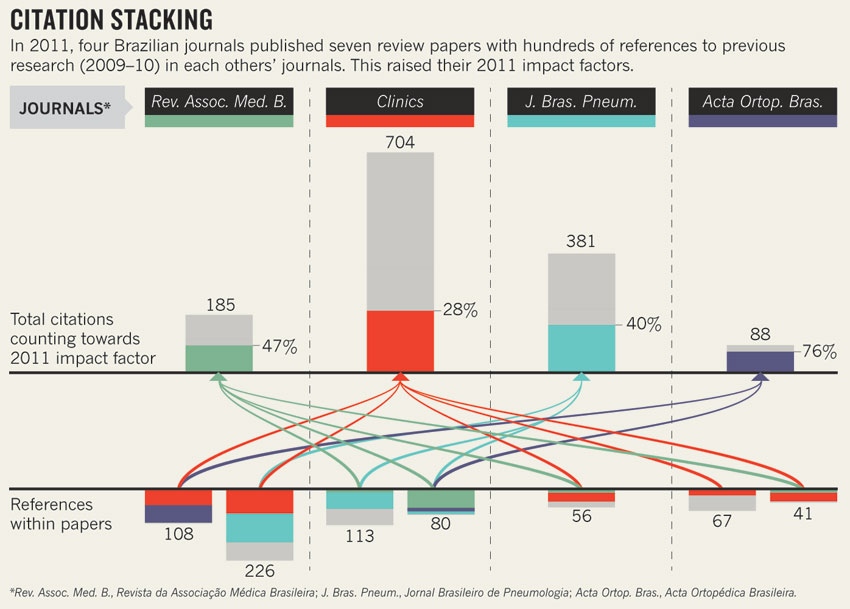
Mauricio Rocha-e-Silva thought that he had spotted an easy way to raise the profiles of Brazilian journals. From 2009, he and several other editors published articles containing hundreds of references to papers in each others’ journals — in order, he says, to elevate the journals’ impact factors.

Because each article avoided citing papers published by its own journal, the agreement flew under the radar of analyses that spot extremes in self-citation — until 19 June, when the pattern was discovered. Thomson Reuters, the firm that calculates and publishes the impact factor, revealed that it had designed a program to spot concentrated bursts of citations from one journal to another, a practice that it has dubbed ‘citation stacking’. Four Brazilian journals were among 14 to have their impact factors suspended for a year for such stacking. And in July, Rocha-e-Silva was fired from his position as editor of one of them, the journal Clinics, based in São Paulo.

…. Editors have tried before to artificially boost impact factors, usually by encouraging the citation of a journal’s own papers. Each year, Thomson Reuters detects and cracks down on excessive self-citation. This year alone, it red-flagged 23 more journals for the wearily familiar practice. But the revelation that journals have gained excessively from citations elsewhere suggests that some editors may be searching for less detectable ways to boost their journals’ profiles. In some cases, authors may be responsible for stacking, perhaps trying to boost citations of their own papers.

The journals flagged by the new algorithm extend beyond Brazil — but only in that case has an explanation for the results emerged. Rocha-e-Silva says the agreement grew out of frustration with his country’s fixation on impact factor. In Brazil, an agency in the education ministry, called CAPES, evaluates graduate programmes in part by the impact factors of the journals in which students publish research. As emerging Brazilian journals are in the lowest ranks, few graduates want to publish in them. This vicious cycle, in his view, prevents local journals improving.

Abel Packer, who coordinates Brazil’s system of free government-sponsored journals, known as SciELO, says that the citation-stacking venture was “unfortunate and unacceptable”. But he adds that many editors have long been similarly critical of the CAPES policy because it encourages local researchers to publish in high-impact journals, increasing the temptation for editors to artificially boost their own impact factors, he says.

Nature 500, 510–511 (29 August 2013) 

Read the articledoi:10.1038/500510a

No acknowledgement or apology for plagiarism from Rawnsley

September 1, 2013

A few weeks ago the Observer’s political correspondent Andrew Rawnsley was apparently caught plagiarising an article in the Economist by Jeremy Cliffe:

The revelations about Rawnsley came 2 weeks ago from Guido Fawkes on his blog (run by Paul Staines and is probably the most read right-of-centre political blog in the UK):

Rawnsley’s column went missing for a few weeks but I see that he has returned today. His absence could have been vacation or a spot of “gardening leave” as a slap on the wrist for his “cut and paste” activities. But I can find no reference or acknowledgement or apology for his apparently quite blatant plagiarism.

The article today is a rather topical piece about Cameron and his lost vote in the House of Commons. This only happened 3 days ago so the article is probably mostly his own work. He expounds on the thesis that Cameron’s loss was his own and not a loss for the country!

But the basis for his thesis is odd and seems to be fundamentally unsound.

Why on earth would a political commentator in the “democracy” that is the UK  think that a vote taken in a duly elected Parliament could ever be a loss for the country? Unless he believes that Parliament’s normal role is just to rubber stamp all decisions made by the sitting Government.