Archive for the ‘Middle East’ Category

Where Iraq goes today, Afghanistan will go tomorrow

June 14, 2014

History will come to see the Bush-Blair invasion of Iraq as an Axis of Evil.

The developments in Iraq are clearly showing the way for what is going to happen in Afghanistan. Barack Obama’s risk aversion and his desperation to disentangle the US from the quagmire that Bush led them into, is increasingly looking like an abdication. If the Bush-Blair objectives for the sexed-up invasion of Iraq were

  • to redefine the country,
  • to help create a new Kurdistan,
  • to permit Sunni extremists to establish an own state – Sunnistan,
  • permit an Iran backed Shia state to be Iran’s buffer against the Sunni and
  • to get hundreds of thousands of people killed (including many thousands of US and allied troops,
  • to create a precedent and a vision for Afghanistan and Saudi Arabia

then the entire adventure has been a spectacular success with the final phases being completed by Barack Obama. If the purpose was to combat modern terrorism then it has been an abject failure. In fact Bush and Blair and Obama have done more to increase terrorism than any rabid Mullah could have.

The Ralph Peters imagined map of a better Middle East in his book Never Quit the Fightof 2006 is looking increasingly prescient and real.

Turkey better get used to the idea loosing a chunk of Eastern Turkey to an integrated Kurdistan. Iran will be reshaped and Pakistan will have to accept a new state of a Free Baluchistan in the west. The Kingdom of Saudi Arabia will splinter into many pieces.

Ralph-Peters-Remapped-Middle-East

Ralph-Peters-Remapped-Middle-East

As Ralph Peters wrote in his Blood Borders article for the Armed Forces Journal:

A just alignment in the region would leave Iraq’s three Sunni-majority provinces as a truncated state that might eventually choose to unify with a Syria that loses its littoral to a Mediterranean-oriented Greater Lebanon: Phoenecia reborn. The Shia south of old Iraq would form the basis of an Arab Shia State rimming much of the Persian Gulf. Jordan would retain its current territory, with some southward expansion at Saudi expense. For its part, the unnatural state of Saudi Arabia would suffer as great a dismantling as Pakistan.

A root cause of the broad stagnation in the Muslim world is the Saudi royal family’s treatment of Mecca and Medina as their fiefdom. With Islam’s holiest shrines under the police-state control of one of the world’s most bigoted and oppressive regimes — a regime that commands vast, unearned oil wealth — the Saudis have been able to project their Wahhabi vision of a disciplinarian, intolerant faith far beyond their borders. The rise of the Saudis to wealth and, consequently, influence has been the worst thing to happen to the Muslim world as a whole since the time of the Prophet, and the worst thing to happen to Arabs since the Ottoman (if not the Mongol) conquest. ……

…….. True justice — which we might not like — would also give Saudi Arabia’s coastal oil fields to the Shia Arabs who populate that subregion, while a southeastern quadrant would go to Yemen. Confined to a rump Saudi Homelands Independent Territory around Riyadh, the House of Saud would be capable of far less mischief toward Islam and the world.

Iran, a state with madcap boundaries, would lose a great deal of territory to Unified Azerbaijan, Free Kurdistan, the Arab Shia State and Free Baluchistan, but would gain the provinces around Herat in today’s Afghanistan — a region with a historical and linguistic affinity for Persia. Iran would, in effect, become an ethnic Persian state again, with the most difficult question being whether or not it should keep the port of Bandar Abbas or surrender it to the Arab Shia State.

What Afghanistan would lose to Persia in the west, it would gain in the east, as Pakistan’s Northwest Frontier tribes would be reunited with their Afghan brethren (the point of this exercise is not to draw maps as we would like them but as local populations would prefer them). Pakistan, another unnatural state, would also lose its Baluch territory to Free Baluchistan. The remaining “natural” Pakistan would lie entirely east of the Indus, except for a westward spur near Karachi.

The abdication of Barack Obama ensures that all the lives lost in Iraq will have been in vain. And that Afghanistan will go the way of Iraq.The Middle East is going to keep the world on tenterhooks for the next 50 years at least.

France does Israel’s bidding and “spoils” nuclear deal with Iran

November 10, 2013

The French – Israeli nuclear cooperation goes back a long way to 1956. That Israel’s “secret” Nuclear Weapon’s programme has long been assisted and enabled by the French is also one of those open secrets that is never officially acknowledged.

HaaretzMay 9, 2007

Israel and France once made a secret deal to produce a nuclear bomb together, according to a new biography of Vice Premier Shimon Peres. The deal was later cancelled, but the disclosure in the book by historian Michael Bar-Zohar sheds new light on the depth of France’s involvement in Israel’s nuclear program.

Bar-Zohar told Reuters his information came from recently released documents from Israeli and French government archives relating to the key role Peres, now 83, played in launching Israel’s nuclear project more than half a century ago. The book divulges new details of how Peres served as a behind-the-scenes architect of Israel’s military might, securing weapons secretly and buying an atomic reactor from France. …

Experts believe Israel has used the Dimona reactor it built with French help in the 1960s to produce as many as 200 nuclear warheads. Israel neither confirms nor denies it has atomic weapons, saying only it will not be the first country to introduce them to the Middle East. …..

The most significant, experts say, is a secret agreement Peres signed in 1957 with then French Prime Minister Maurice Bourges-Maunoury in Paris, several months after the deal for the reactor was concluded. “It stated in so many words that the two nations would cooperate in research and production of nuclear weapons,” the book says.

France ultimately scrapped that agreement several years later under the weight of enormous United States diplomatic pressure for it to cease its nuclear cooperation with Israel.

The so-called formal scrapping of the deal has long been recognised as a public relations gesture which has little to do with actual cooperation on the ground. Now Israel probably has something in excess of 100 and maybe up to 200 nuclear warheads.

Federation of American ScientistsIn the fall of 1956, France agreed to provide Israel with an 18 MWt research reactor. However, the onset of the Suez Crisis a few weeks later changed the situation dramatically. Following Egypt’s closure of the Suez Canal in July, France and Britain had agreed with Israel that the latter should provoke a war with Egypt to provide the European nations with the pretext to send in their troops as peacekeepers to occupy and reopen the canal zone. In the wake of the Suez Crisis, the Soviet Union made a thinly veiled threat against the three nations. This episode not only enhanced the Israeli view that an independent nuclear capability was needed to prevent reliance on potentially unreliable allies, but also led to a sense of debt among French leaders that they had failed to fulfill commitments made to a partner. French premier Guy Mollet is even quoted as saying privately that France “owed” the bomb to Israel.

On 3 October 1957, France and Israel signed a revised agreement calling for France to build a 24 MWt reactor (although the cooling systems and waste facilities were designed to handle three times that power) and, in protocols that were not committed to paper, a chemical reprocessing plant. This complex was constructed in secret, and outside the IAEA inspection regime, by French and Israeli technicians at Dimona, in the Negev desert under the leadership of Col. Manes Pratt of the IDF Ordinance Corps.

That Israel is not happy that Iran may reach a deal with the West and get sanctions lifted and be able to continue with the bulk of their nuclear program is only to be expected. That Israel would turn to France to be the spoiler in the discussions with Iran is also not surprising. And it is patently obvious that France is doing Israel’s bidding and is being intransigient at the Geneva discussions.

But how long can or will France be ready to continue in their “spoiler” role? Francois Hollande has enough troubles of his own not to also wish to be seen as Netanyahu’s poodle.

Perhaps a year?

The GuardianSunday 10 November 2013

Three gruelling days of high-level and high-stakes diplomacy came to an end in Geneva with no agreement on Iran’s nuclear programme, after France blocked a stopgap deal aimed at defusing tensions and buying more time for negotiations. …

The Iranian foreign minister, Mohammad Javad Zarif, also sought to play down the disagreements that had surfaced with France, and the divisions between the six-nation group, known as the P5+1. ….

….. other diplomats at the talks were furious with the role of the French foreign minister, Laurent Fabius, whom they accused of breaking ranks by revealing details of the negotiations as soon as he arrived in Geneva on Saturday morning, and then breaking protocol again by declaring the results to the press before Ashton and Zarif had arrived at the final press conference.

But there is also a purely commercial aspect to the French “spoiling”. The animosity between Saudi Arabia and Iran is not to be underestimated and the the French desire for being Saudi’s preferred supplier is almost without limit. Upsetting Iran gains them brownie points with Saudi. They are on much safer ground here since Saudi does not have the capability of running its own nuclear programme in any foreseeable future. Nuclear power plant in Saudi supplied by France would not pose any great threat to Israel.

But one day – when the balances are different –  Saudi  may well have enough money to buy a few warheads and I would not be surprised if France is then at the front of the pack of potential vendors.

Saudi GazetteOctober 03, 2013

French companies AREVA and EDF hosted a number of Saudi business and industry representatives at their Second Suppliers Day event held in Jeddah on Tuesday to take part in the framework of the sustainable energy program suggested by King Abdullah City for Atomic and Renewable Energy (KA-CARE) focused on nuclear and renewable energy sources. …. 

Speaking to the Saudi Gazette, the French Ambassador to the Kingdom said “the aim of this meeting is very clear, France has been the first country to sign government to government agreement on nuclear and energy because we do think that taking it into account the huge program the Saudi government wants to implement in the nuclear field and France has a lot to bring in terms of the best nuclear technology in the world.”

Besancenot added that Saudi Arabia is a strategic partner of France in the region and the bilateral relationship is of paramount importance in the economic field as “we are seeing that bilateral trade has doubled over the last five years.” He stressed that France is ready to be Saudi Arabia’s strategic partner in the field of nuclear and renewable energy. He also highlighted the competencies of France’s nuclear energy industry and its ability to support the Kingdom goal.

Assad’s gambit but is it Putin’s end-game being played out in Syria?

November 10, 2013

The Hindu carries an interesting editorial on Assad’s Gambit:

In extending his cooperation to the OPCW – which has until June 2014 to oversee the elimination of Syria’s chemical stockpile – President Bashar al-Assad has signalled his indispensability to a diplomatic settlement. Mr. Assad has underlined that not only is he in control but he is also willing to make tactical concessions. The odds are now stacked heavily against the Syrian rebels. After the United States shelved its plan to intervene militarily, opposition groups have had to reconcile themselves to the option of sharing power with Damascus. That al-Qaeda and other terror outfits have infiltrated the rebels’ ranks has also substantially diminished the support they initially received from the West. Not surprisingly, many of the rebel factions have expressed their reluctance to participate in the “Geneva 2” diplomatic conference scheduled for later this year. Mr. Assad, on the other hand, has made the Syrian government’s participation contingent on his being allowed to complete a full term in office.

Paradoxically it is the destruction of his chemical weapons which has made Assad an indispensable part of the solution. If it was one of the rebel groups (Al Qaida or a group supported by Turkey or by Iran or by Saudi Arabia or by the Kurds or by the Muslim Brotherhood) which actually did use the chemical weapons (Sarin gas) in September, then their ploy has misfired spectacularly. If it was Assad’s forces which released the gas (whether with or without his knowledge), it has certainly brought matters to a head and – also spectacularly –  shifted the course of this civil war. Syrian Opposition became “armed rebels” and are now equated with “terrorists”. From being about Assad’s repression and justified opposition the conflict is being transformed to Assad versus the terrorists.

Keeping score in the Great Syria Chess Game is not easy and when the chemical inspectors were called in I wrote

Vladimir Putin and Sergei Lavrov are winning. The diplomatic path is now their creation. Suddenly Russia is the peace-maker in the face of US war-mongering! Not only was the US strike on their ally delayed indefinitely, it is now Assad’s Syria – and not the various opposition groups – which is required to engage with the international community. Any opposition forces who seem to be coming in the way of inspecting or securing control of the chemical weapons can now be attacked by Assad with the full support of the international community. Russia can continue supplying Syria with conventional weapons. ….

Bashar al-Assad is winning. He does not really need chemical weapons which cannot effectively be used anyway. Any US strike on his forces is postponed indefinitely. With no prospect of any no-fly zone being declared his air-force could be decisive in the civil war. The supply of conventional weapons from Russia is assured. His claim that rebels and terrorists were responsible for the use of Sarin is backed up by Russia and the UN weapons inspectors have no option but to investigate this (and they are on their way back to Syria).

But I think the Hindu is wrong to think that it is merely the infiltration of rebel groups by Al Qaida which has damaged their support from the West. The point is that the rebel groups supported and supplied by so many surrounding countries are not a home-grown opposition but are essentially a collection of mercenary groups fighting proxy wars for many players. Saudi Arabia and Turkey in particular were and are heavily involved – and may even have been instrumental in starting the armed conflict. Now of course Iran and the Kurds and the Muslim Brotherhood are providing succour and support for their pet groups. Al Qaida has its fighters from all over the region (and from radicalised youth in the West) trying to attain eternal salvation through martyrdom. The EU and the US supply arms through third parties to a variety of the rebel groups – and it often seems they have no idea who the arms are going to. Russia supplies Assad. Israel no doubt stirs the pot whenever it can and using whichever faction is available to maintain the turmoil.

As Aron Lund writes in his report,Divided they Stand” An Overview of Syria’s Political Opposition Factions

The opposition landscape is so fragmented and disconnected, that there is little clarity even among activists themselves about what groups and coalitions are truly effective or enjoy popular support. ….

While it is unlikely that any of today’s political opposition groups will control the future Syria, they are likely to play a significant role in a future transition phase or reconciliation process. Regardless of who rules Syria in the future – the current regime, breakaway elite factions, a government installed with foreign backing, or armed rebels – they will need to connect with the political opposition to legitimize their own position.

Assad’s Gambit may be paying off but it is just a few moves within the Putin initiated defence. Whether the Putin defence also has an end-game in mind is as yet difficult to discern. It may just lead to a stalemate and a long drawn-out conflict. It may lead – in the best scenario – to a gradual political transition where Assad has an “honourable” discharge and exile waiting for him sometime late next year.

There are no longer any outright victories in sight in this multi-dimensional chess game where the rules keep changing. But if there is any overall direction to this end-game it is probably coming from Putin and Lavrov. Whether Obama and Kerry are playing the game, or are just bystanders providing infrastructure for the playing of the game remains to be seen. The EU is almost as divided as the Syrian opposition and are very good at mouthing platitudes. The dilemma that the US and the EU face is that support for secular forces in Syria is inevitably support for Assad. Support for any armed rebel group is also support for Islamist jihadists.

How the map of the Middle East could develop

October 5, 2013

Once upon a time maps were dawn primarily as symbolic and pictorial descriptions of physical geography. Then came the nation states and “Nations of the Mind” became nations on the ground. With their dark under-belly of nationalism and jingoism, maps have become – nearly always – political, religious or ideological maps superimposed on and tied to physical geography. Some day humans will outgrow the limitations of nation-states and nationalism. “Nations” tied to a geography will eventually become obsolete but it will not be in my lifetime.

The dynamics in the Middle East are particularly volatile and give rise to much speculation about how new nations could form and how the map of the region could develop. But much of the new formations – which are already ongoing – are not by design but by the realities on the ground. Many forces are engaged and much blood is being shed as the various parties try to impose their own designs.

A few years ago Ralph Peters imagined a “better Middle East” in  “Blood Borders: How a Better Middle East Would Look” and was heavily criticised for his provocative work.

The map was prepared by Lieutenant-Colonel Ralph Peters. It was published in the Armed Forces Journal in June 2006, Peters is a retired colonel of the U.S. National War Academy. (Map Copyright Lieutenant-Colonel Ralph Peters 2006). The map is included in Peters’ book Never Quit the Fight.

Ralph-Peters-Remapped-Middle-East

Ralph-Peters-Remapped-Middle-East

As Geo Currents remarked in 2010:

For all of Peters’s miscues, many of his core ideas are sound. His initial assertion – that misplaced boundaries often generate injustice and strife – is spot on. And he is right to point out that the foreign policy establishment refuses to acknowledge the violence engendered by geopolitical misalignment for fear of opening a Pandora’s Box of separatist demands. Because of that fear, any suggestions for alternative arrangements tend to be dismissed out of hand. Such a stance, Peters argues, is intellectually dishonest. New countries sometimes do appear on the map without ruffling the international order. Think of Montenegro, 2006. Such neophyte states must, however, come into being through the channels of global diplomacy if they want international recognition. Should they emerge on their own, their existence will be denied by the powers that be. In this way the system of international diplomacy that Peters mocks can indeed become a masquerade. Grant diplomatic recognition to Somaliland, the only effectively administered territory in the bedlam called Somalia? Impossibly destabilizing: surely anarchy would be loosed across the Horn of Africa!

The New York Times has just carried an article by Robin Wright returning to the same subject

Imagining a Remapped Middle East

Robin-Wrights-Remapped-Middle-East

Robin-Wrights-Remapped-Middle-East – NYT

THE map of the modern Middle East, a political and economic pivot in the international order, is in tatters. Syria’s ruinous war is the turning point. But the centrifugal forces of rival beliefs, tribes and ethnicities — empowered by unintended consequences of the Arab Spring — are also pulling apart a region defined by European colonial powers a century ago and defended by Arab autocrats ever since.

A different map would be a strategic game changer for just about everybody, potentially reconfiguring alliances, security challenges, trade and energy flows for much of the world, too.

Syria’s prime location and muscle make it the strategic center of the Middle East. But it is a complex country, rich in religious and ethnic variety, and therefore fragile. After independence, Syria reeled from more than a half-dozen coups between 1949 and 1970, when the Assad dynasty seized full control. Now, after 30 months of bloodletting, diversity has turned deadly, killing both people and country. Syria has crumbled into three identifiable regions, each with its own flag and security forces. A different future is taking shape: a narrow statelet along a corridor from the south through Damascus, Homs and Hama to the northern Mediterranean coast controlled by the Assads’ minority Alawite sect. In the north, a small Kurdistan, largely autonomous since mid-2012. The biggest chunk is the Sunni-dominated heartland.

…………

Saudi-Arabia-Remapped-by-Robin-Wright

Saudi-Arabia-Remapped-by-Robin-Wright

GeoCurrents reviews the NYT article:

Wright’s article, however, shows that her purpose is different from that of Peters. Whereas Peters sought to depict a more rationally constituted political map, Wright rather speculates about a map that might be developing on its own, regardless of her personal preferences, much less her country’s geo-strategic designs. In this regard, the map has much to recommend it. Libya, Syria, Yemen, and Iraq could well be in the process of disintegration, splitting into de facto states or state-like entities that might bear some resemblance to the territories depicted by Wright’s map. The likelihood of Iraq and Syria regaining stability as effective states within their internationally recognized boundaries seems remote, given the viciousness of the conflicts currently being waged. As things already stand, the non-country of Iraqi Kurdistan is almost as much of a state as Iraq itself, and arguable more of a nation. Whether Libya and Yemen can politically reintegrate is also an open matter. Mapping how the Middle East appears today, rather than how the international political community thinks it should be configured, is thus an essential task. Thinking about where such processes might lead is equally important. Wright’s thoughts on the subject are generally insightful, and her map has many pertinent and intriguing features. I commend the New York Times for publishing such a provocative piece. ……

…….. My serious misgivings concern Wright’s  treatment of Saudi Arabia. She realizes that she goes out on a limb here, noting that “The most fantastical ideas involve the Balkanization of Saudi Arabia…” Unlike the other countries that she remaps, Saudi Arabia is a relatively stable state, with no serious challenges to its territorial integrity. Imagining the division of this country thus does not involve speculating about the possible end-points of processes already in motion, as is the case in the other countries considered. It is not at all clear, moreover, why Wright has divided Saudi Arabia as she has, as her article is largely silent here. Presumably, her division is based on the idea that the non-Wahhabi peripheries of the country could detach themselves from the Wahhabi core, potentially resulting in the emergence of the new states of North Arabia, Eastern Arabia, South Arabia, and Western Arabia.

Fascinating stuff.

Keeping score in the great Syria chess game

September 24, 2013

It is not possible to say who won or who lost. The Great “Game” will take a long time to reach a conclusion. All that can be done is to see who’s winning and who’s losing.

David Cameron is losing and may have lost. He took a slap in the face from the House of Commons. If he had managed the vote in his favour, the US strike on Syria would have taken place almost immediately. Whether the strike would have achieved much will never be known but Obama would have “walked” his “talk”. Milliband seemed to be winning since he had defeated Cameron but it is becoming clear that he had played his trump far too soon and allowed Putin to make his play. And Milliband can be credited for letting down the US and the special relationship. Tony Blair lost. He showed up as a “rabid dog” revelling in going to war (to try and justify his bad judgements during the Iraq war). And nobody took him very seriously.

Barack Obama is losing. He has confirmed his reputation as a ditherer and that he is risk-averse to the point of being  seen as being ruled by his fears. He has effectively shifted the balance of power in going to war from the Presidency towards Congress. This power given up will be difficult to regain. Without the backing of the UK he was forced to look for ways to extricate himself from his “red line” box.

John Kerry was point-man for Obama and was – for a time – the potential scape-goat. But he has repositioned himself and may even take away some credit for the Russian play. His throw-away line about “no strike if Syria gave up their chemical weapons” is now being spun as an intentional statement.

Francois Hollande is losing. His support for Obama was not enough to allow the US to carry out a strike on Syria. The value of French support – compared to the UK support which was not forthcoming – was diminished. And then to make matters worse his Parliamentarians made it quite clear that they did not support his position even though they were not required to vote. Having supported a strike he was not quite adroit enough to claim any credit for the alternate diplomatic path that resulted. Getting Freedom Fries reverting to be French Fries was his only consolation.

Vladimir Putin and Sergei Lavrov are winning. The diplomatic path is now their creation. Suddenly Russia is the peace-maker in the face of US war-mongering! Not only was the US strike on their ally delayed indefinitely, it is now Assad’s Syria – and not the various opposition groups – which is required to engage with the international community. Any opposition forces who seem to be coming in the way of inspecting or securing control of the chemical weapons can now be attacked by Assad with the full support of the international community. Russia can continue supplying Syria with conventional weapons.

The Syrian Opposition groups (including Al Qaida) are losing the civil war. Assad can now get more weapons replacements than they can. Al Qaida need a weakened Assad to create a winning position and they need a prolonged civil war to achieve dominance among the opposition groups. Both objectives would have been assisted by a US strike.

Bashar al-Assad is winning. He does not really need chemical weapons which cannot effectively be used anyway. Any US strike on his forces is postponed indefinitely. With no prospect of any no-fly zone being declared his air-force could be decisive in the civil war. The supply of conventional weapons from Russia is assured. His claim that rebels and terrorists were responsible for the use of Sarin is backed up by Russia and the UN weapons inspectors have no option but to investigate this (and they are on their way back to Syria).

Iran is winning. President Hassan Rohani is on a roll. First Hizbollah – at Iran’s bidding – helped to keep the Syrian opposition groups at bay when they seemed to be gaining ground. Then he supported the Russian diplomatic initiative. That was followed by an interview  on NBC  and an op-ed in the Washington Post to assure the US and the world that Iran had no intention of developing WMD of any kind including nuclear weapons. Iran’s foreign minister, Mohammad Javad Zarif, sent Rosh Hashanah greetings to Jews worldwide via Twitter and caught the Israelis off-guard. Now Rohani is on his way to address the UN General Assembly. Willy-nilly they are now a part of the diplomatic path for Syria and cannot just be ignored. That engagement allows the Iranian charm offensive to proceed as well on other fronts.

Israel is both winning and losing. It was Israeli intelligence intercepts – not US  – which led to Obama’s threatened strike. A strike by the US was definitely preferred by the Israelis though their objective was to maximise turbulence for as long as possible in Syria.  To be able to get the US to threaten a strike as they wished based on selective intelligence was a coup. Not to have the strike consummated was a setback. If the Iran/Russia influence grows and Assad is more secure than before, then these are also setbacks.

Turkey is losing. The Islamic government was perhaps the strongest supporter of a strike on Assad. Their dislike of Assad is so strong that they would even have supported a strike by Israel. But Turkey’s subservience to and support for all groups Islamic ( Muslim Brotherhood in Egypt) is now becoming an embarrassment for Europe. Their application to join the EU is – I think – already lost.

The Great Game has a long way to run. It has been running for a thousand years and there are many more twists and turns to come. Many pieces will be lost and won by all the parties and there may never be a check-mate and a clear winner in this game. Having a clear winner always requires having a clear loser. Having a clear loser in the Middle East is not always a good thing.

And so a stalemate is probably the closest there is to a win-win.

Yemen a clear target in US drone sights

August 6, 2013

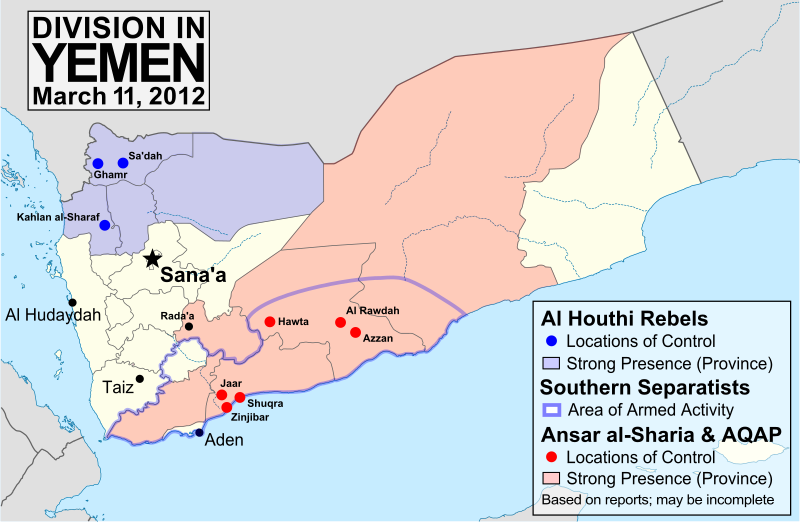
Perhaps it is all connected to the current global alert and threats of terrorist actions supposedly emanating from Yemen, but there certainly seems to be a major US operation ongoing in Yemen.

File:Yemen division 2012-3-11.svg

Yemen Divisions – wikipedia

UPDATE 2:

Drone strikes kill eight suspected militants in Yemen on Thursday 8th August

UPDATE!

Another 7 were killed in Yemen by US drone attacks on Wednesday, 7th August.

============================================

In the last 10 days since July 27th , there have been at least 4 drone attacks killing 17 people in Yemen.

  • July 27th: 6 killed in Abyan province
  • July 30th: 3 killed in drone attack on a car in Shabwa
  • August 1st: 4 killed in drone attack in Habramawt
  • 5th August: 4 killed on Tuesday when two unmanned aircraft fired four missiles at two vehicles in Wadi Abidah district. 

According to the Washington-based New America Foundation, the US killer drone attacks in Yemen almost tripled in 2012. 

The advantage with drone attacks is that they are impersonal, supposed to be clinically accurate, relatively cheap and put no personnel from the attacking side at risk. The downside is that they pre-empt any due process, are subject to the accuracy of very fallible intelligence gatherers and are inherently inhumane being “untouched by human hands”. And the civilians and children who frequently are killed on the ground get brushed under the carpet of “collateral damage”.

All those who have been killed recently in Yemen are said to have been affiliated with Al Qaeda.

But the dead cannot deny their alleged guilt and we will never know.

Arab – Iranian feuding continues at Utah University’s Middle East Center

September 11, 2011

H/T to reader Ron.

The mud-slinging and back stabbing at the University of Utah’s Middle East Center is less than edifying and continues unabated. Charges and counter-charges include plagiarism, cronyism, sexual harassment, insubordination and even contributing to a student’s suicide. It begins to seem like a B-grade movie with bad actors and a melodramatic script. An Arab- Iranian feud – with under-currents of Shia-Sunni rivalry – being played out in Utah!! And the roots of the feuding go back some 1500 years to the very rapid Arab conquest of Persia in 644 AD. Ever since there has been a feeling of Persian “shame” at not resisting the takeover very strongly and is the root cause of the Persian disdain for Arab culture and influence which continues today. Just to complicate the picture there is much back-biting and intrigue within the Arabists themselves.

The Salt Lake Tribune now reports that officials at University of California, Los Angeles said on Thursday that

..they can find no record of awarding a degree beyond a master’s to Ibrahim Karawan, who led the Middle East Center until 2008, when he was succeeded by Bahman Bakhtiari. 

That would seem to support allegations by Bakhtiari, recently terminated for plagiarism, that Karawan does not hold a doctorate and never was qualified to be a professor, sign off graduate students’ work and seek federal grants. In a lawsuit filed Sept. 2, Bakhtiari alleges a colleague concealed Karawan’s “academic fraud” for at least two decades and orchestrated Bakhtiari’s firing by inciting graduate students to drum up evidence of plagiarism and then publicize what they found.

Bakhtiari is now using the confusion over Karawan’s academic status in his legal fight with former colleagues whom he blames for his expulsion from his tenured faculty appointment. Bakhtiari, whose name also appears in print as “Baktiari,” claims he is guilty of little more than sloppiness with attribution, while alleging Karawan perpetrated a fraud on the university, its students and the federal government, which awarded grants to the MEC on the basis of Karawan’s doctorate.

“The University’s failure to take any action against a proclaimed professor who did not hold the mandatory credentials and, for nearly 25 years, signed his name to graduate degrees and solicitations for public monies through the United States Department of Education as one holding those credentials in violation not only of university policy but also federal law, while conversely seeking the academic death penalty for me based on minimal allegations, is discriminatory at best,” Bakhtiari wrote in an Aug. 17 e-mail to the Tribune.

Bakhtiari’s suit targets history professor Peter Sluglett, who was the center’s director from 1994 until 2000, when Karawan took the reins, as well as several “John Does.” Sluglett, who left this week for a year in Singapore, had a leadership position on the center’s executive committee and worked closely with Karawan over the years. Administrators’ abrupt dismissal of Sluglett and another scholar from the center is what precipitated Karawan’s resignation as director in 2008, setting the stage for Bakhtiari’s hiring from the University of Maine. Sluglett later was reinstated at the center and resumed a central role in its management.

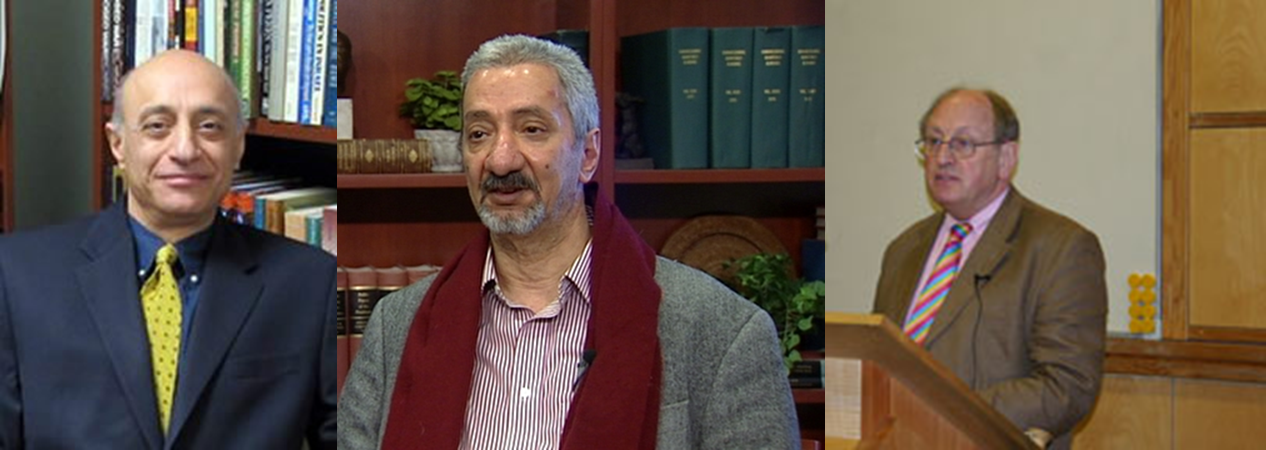
The principal cast of villains consist of Bakhtiari (of Iranian origin – fired as Director), Karawan (an Arab, a former Director and currently acting Director) and Sluglett ( an Arabist, former Director and now in Singapore for a year).

Cast of villains at the Mid-East Center: Bakhtiari-Kerawan-Sluglett

There is a large supporting cast of actors of students and faculty consisting among others of university interim President, Lorris Betz,  and humanities dean Robert Newman.

But this appears to be a movie where the entire cast are bad-guys and there is no hero in sight!

A hotbed of intrigue: Bahman Bakhtiari sues Peter Sluglett after being fired from Utah University’s ME Center

September 8, 2011

Two months ago Bahman Bakhtiari was fired from the University of Utah’s Middle East Center for a pattern of plagiarism. Now he has filed  a suit last Friday in 3rd District Court against Peter Sluglett, the center’s senior-most faculty member and a former Director of the Center himself.

Deseret News:  Bakhtiari alleges that two senior faculty leaders at the center conspired to eliminate him after personality conflicts. He also alleges in the lawsuit that a senior faculty member, who was a former center director, lied about having a Ph.D. from UCLA and that faculty conspired to cover it up.

Bakhtiari served as center director from July 2009 to June 2011. He was brought in from the outside by the Dean of the College of Humanities to replace an existing faculty member. The suit states that from the onset, Bakhtiari was disliked by senior center faculty and that the political science department, which oversees the center, refused to support his tenure. The suit states that the dean of humanities ended up granting him tenure through the department of languages and literature.

Last June, a U. faculty committee investigated complaints of alleged plagiarism against Bakhtiari. In a unanimous vote, the committee found that Bakhtiari committed “a pattern of plagiarism that is harmful to the university’s academic integrity.” …

Although the committee stopped short of termination and revocation of tenure, University of Utah Interim President A. Lorris Betz overrode the decision and terminated Bakhtiari on June 30. ….

Bakhtiari alleges in his suit that center faculty actively dug through his career history to find justification to get rid of him. According to U. documents, evidence of plagiarism was found in six scholarly publications, including Bakhtiari’s 1984 Ph.D. dissertation, an online newsletter and an op-ed piece published in The Salt Lake Tribune. The suit states Bakhtiari is seeking damages for interference with economic relations, invasion of privacy, breach of contract and defamation.

Both Peter Sluglett and the Middle East Center are no strangers to internecine dispute, intrigue and academic “dirty tricks”. Sluglett gets mixed reports as a teacher.

Sluglett is also apparently  a self-anointed expert in recent Iraq history:

February 03, 2006  

Sluglett gets SluggedI noted with some pleasure that Wafaa’ Al-Natheema knocked Peter Sluglett down a peg or two. She posts the full email exchange on her blog. Professor Peter Sluglett considers himself an expert on modern Iraqi history with good reason – he has studies the subject for 30 years. Along with his late wife, Marion Farouk Sluglett, they wrote one of the important books on modern Iraqi history called “Iraq since 1958”. However, he uses that position to stifle any debate on Iraqi history. He considers himself the expert and nobody has the right to contradict him. The problem is that in many cases he is wrong.

The Middle East Center itself is no stranger to controversy where Sluglett was Director before Ibrahim Karawan – who resigned and was then succeeded by Bahman Bakhtiari.

April 4, 2008 

Karawan Resigns over Middle East Center Dismissals  

Ibrahim Karawan, director of the Middle East Center, announced his resignation yesterday before a lecture at the Hinckley Institute of Politics. Karawan said he is resigning because two of his colleagues were forced out of the center by Dean Robert Newman of the College of Humanities. “They were basically moved out of the center, not according to what they wanted, and moved to other departments,” Karawan said.

He questioned whether the action was justified and what the impact will be on the governing structure of the center and its ability to receive funding from the U.S. Department of Education. … Peter Sluglett, a professor of Middle Eastern history, and Harris Lenowitz, a professor in Hebrew, both received letters from Newman informing them that they could continue teaching but would no longer be able to hold leadership positions in the center. Sluglett and Lenowitz both have joint appointments in the center and their departments — history and languages and literature, respectively — and both teach cross-listed courses. ….

On March 13, Lenowitz said he received a letter from Newman that read: “It has come to my attention that you have contributed consistently toward creating an atmosphere in the Middle East Center that lacks collegiality and can no longer be tolerated.” Sluglett said he also received this letter, but he doesn’t think other faculty members have any problems with his behavior…….

Leaving aside the legal positions and claims and counter-claims which will run their course, the Middle East Center and its faculty strike me as being a bunch of  rather petty, uncivilised, amoral and childish group of academics. Petty intrigue, academic dishonesty and scientific misconduct seems to come quite naturally to them.

Playing their games of intrigue appears far more important to them than academic rigour or integrity. Whether they should be getting any funding at all from the US Department of Education ought to be a question being asked.

Arab spring withering into autumn

June 23, 2011

The prospects and hopes and expectations of the Arab spring spreading throughout the Arab world are now becoming uncertain. In Tunisia and Egypt the military is firmly in control and whether a real shift of power to the people will now take place remains in doubt. There is still hope and the change itself is irreversible but how far the change will go remains to be seen. It will only be by attacking the high unemployment and endemic corruption that a measure of success can be achieved.

But the fires lit by the events in Tunisia and Libya are struggling to stay alight in Libya, Syria, Yemen and Bahrain. In Saudi Arabia the government has so far managed to douse even the smallest sparks that were flickering.

In Bahrain the King with the help of the Saudis is suppressing all opposition from the Shia majority:

The sentencing of 21 men to prison terms ranging from two years to life has sent waves of anger through the majority Shia community in Bahrain. Family members say they have already experienced weeks and months of anxiety about loved ones, to whom they have been given little access.

They say the men have been tortured, denied appropriate legal representation, and are now being sentenced harshly for crimes they did not commit in a bid to silence opposition calls for reform.

In Yemen:

Opposition figures blamed pro-government military officials for allowing more than 60 suspected members of al-Qaida to escape Wednesday from a Yemeni prison. The mass escape from the prison occurred Wednesday in the southern city of Mukalla.

Opposition leaders blamed senior military officials loyal to embattled Yemeni President Ali Abdullah Saleh for the prison break. They said it was an effort to get financial support from Washington and prop up the regime of the Yemeni president, the Yemen Post reports.

As the Hindu puts it:

Yemen, in many ways, is the most complicated situation. It is infested with the maximum external interference — Saudi Arabia, U.S., Iran, GCC and assorted countries. At one time, its long-serving President had accepted the principle of resigning and leaving, but since seems to have changed his mind. The injuries he suffered in an attack on his compound and consequent flight to Saudi Arabia have paradoxically given him time to consolidate his position and strengthen his support base in Yemen. The south wants to secede and parts of north want to merge with the big northern neighbour, but the latter is not interested, it seems. The Shia-Sunni act is also being played out there. Al-Qaeda was reported to have captured a town, Zinjibar, in the south, but it was suspected to be a diabolical move of the President who, thereby, calculated to win the sympathy of the Americans. The latter are exploiting the situation and relentlessly bombing suspected concentrations of the al-Qaeda, hoping to eliminate its leadership.

In Libya things are getting very messy and the NATO efforts sans the US is less than impressive:

Libya has turned out to be the cry of despair for those who have committed their armed personnel, scarce financial resources and, more importantly, prestige in the outcome of the situation there. The conflict has gone on for longer than anyone expected and is costing the western nations more than they would really care to spend. Having pushed through Resolution 1973 with the help of the Arab League, they had calculated a quick and low-cost operation. Like in Afghanistan, Nato cannot afford to pull out without being able to claim victory. Two or three factors have frustrated their plans — Muammar Qadhafi’s stubborn refusal to disappear from the scene, the absence of an identifiable and credible alternative leadership, and the continued loyalty of many African states to Mr. Qadhafi. Mr. Qadhafi is no doubt counting on the fatigue — financial and military — factor weakening public support for the Nato operation. Nato strikes killing civilians will further erode support and provide more propaganda ammunition to Mr. Qadhafi.

And in Syria an embattled Assad is balancing between cosmetic reforms and a ruthless and bloody repression of his opponents:

Tens of thousands of Syrians are demonstrating in support of the president a day after pro-democracy protesters rejected his speech. President Bashar Assad vowed reform in a speech Monday that was only his third public appearance since the revolt against his family’s 40-year-rule erupted in March.

But his vague overtures to a pro-democracy uprising fell flat with the opposition, and anti-government protesters took to the streets shouting “Liar!” and demanding his ouster. Thousands of people carrying Assad’s pictures took to the streets of Damascus on Tuesday, pledging allegiance to the president.

….  The opposition estimates more than 1,400 Syrians have been killed and 10,000 detained as Assad unleashed his military and security forces to crush the protest movement that erupted in March, inspired by the revolutions in Tunisia and Egypt, and that spread to region after region.

There is now a real possibility that the  fresh green  Arab Spring which promised so much just a few months ago may wither into an Arab Autumn and millions may have to withstand a dormant and repressive period before a new Spring finally arrives.

But this new season will surely come.

Paradigm shift: The beginning of the end of Jihadism

May 9, 2011

I have posted earlier that the death of Osama bin Laden represents a paradigm shift for US foreign policy where after a decade the “Get Osama” game is over. The question of evidence of Osama being dead is already obsolete. Doubts about the legality of  executing a self-appointed enemy in another country without the tacit approval of that country have also become irrelevant. The bottom-line is that it is the end of one chapter – if not the whole book – of the 9/11 tragedy. US Policy can finally begin to look beyond the nebulous “War on Terror”. The lack of definable boundaries for this “War” has actually led – in 10 years – to the loss of many of the civil liberties which had been won slowly in the previous 50+ years since the end of World War II. Perhaps some of these will be restored.

But the shift may be more fundamental and more widespread than just for US policy. The Spring revolutions in North Africa and the Middle East have  actually caused change on the ground and have been more effective than any ideology based on jihadism or terrorism. As this movement spreads to Libya, Yemen, Bahrain and perhaps even to Saudi Arabia, the value and even the capability of jihad being a vehicle for revolutionary change is losing ground.

The world has shifted away from Ben Ali, Mubarak, Osama bin Laden, Gaddafi, King Abdullah, Assad and their ilk.

Paradigm Shift

The violence of jihad is no longer being seen as a credible method of change against the authoritarian regimes of the Arab World. Other methods are clearly more effective. Jihad has few definable objectives left. 

Der Spiegel writes:

Osama bin Laden’s violent ideology may have once garnered support in the Arab world, but his death this week came at a time when the burgeoning pro-democracy movement in the Muslim world had rendered his ideas and his international terror network al-Qaida irrelevant.

… Many Muslims admired Osama bin Laden, and not secretly. A study by the Washington-based Pew Research Center conducted two years after the 9/11 attacks on New York and Washington found that 72 percent of Palestinians, almost 60 percent of Indonesians and Jordanians and almost half the Pakistani population considered bin Laden to be “trustworthy.”

Given such overwhelming support back then, it is amazing how little interest there is today in the former batal, or hero, in the Arab world. The news of the audacious Navy Seals raid electrified the West, but in North Africa and the Middle East it was merely one story among many. On Tuesday, the front page of Dubai’s Al-Bajan newspaper was dedicated to the 40th anniversary of the founding of the United Arab Emirates. In Cairo, the lead article in the Al-Wafd newspaper addressed worries about money flowing out of Egypt. The Arab News in the Saudi capital Jeddah reported that English would now be an obligatory subject at school from fourth grade onward. Only then did it mention and comment on the death of “the Sheikh,” as bin Laden was always respectfully and reverentially referred to.

Not much of that respect and reverence appears to remain, and both bin Laden’s reputation and the violent culture he symbolized have been on the decline in the Muslim world for years. Since 2003, researchers at Pew have asked the same question about bin Laden every year. While 72 percent of Palestinians backed him in 2003, that figure has now fallen to 34 percent. Jordanian support has dropped from 56 to 13 percent, while Pakistani backing for bin Laden has slumped from 46 to 18 percent. ….. But as dangerous as al-Qaida remains as a terrorist organization, its political ideology has become virtually irrelevant in the Middle East. The more attacks it has carried out since 9/11 — including on targets in the Muslim world — the harder it has been to justify that terrorism to ordinary Muslims. …

…. The upturn in fortunes in the Persian Gulf, the resulting opening of previously closed Arab economies and the simultaneous boom in the use of social media have threatened to sideline al-Qaida completely. A growing majority of mainly young Arabs are no longer primarily interested in fighting presumed American hegemony in the Middle East or pushing for the acceptance of a religion allegedly repressed by pro-Western regimes. Instead they want a share of the economic growth from which only their rulers’ clans have profited until now.

Pious jihadist philosophers simply have no answers to such aspirations. Religious arguments are as useless in countering anger at the unjust division of wealth as the sham reforms with which autocratic leaders in the region have tried, and in several instances, failed to cling to power. It is ironic, for example, that bin Laden’s killing comes only weeks after the toppling of Egyptian President Hosni Mubarak, who claimed until the bitter end that “hundreds of new bin Ladens” would make the world unsafe unless his advice was heeded. 

Other dictators and terrorist leaders will undoubtedly follow Mubarak and bin Laden into the annals of history. As the commanders of a sinking epoch both men managed to cause a lot of harm, but their philosophies are finished.