Archive for the ‘Oil’ Category
January 12, 2014
The shale boom (gas and oil) in the US has changed the energy landscape not only in the US but also in the export of cheap oil and now even coal from the US.

us petroleum production boom
But so far only the US has seen significant production of gas and oil from shale. In Europe the Green lobby is desperately trying to stop the advent of fracking even though their misguided policies have – so far – only led to an increased use of coal and an increased price of electricity to the consumer. But the UK, Poland and other countries have huge reserves of shale and the exploitation of these reserves is both necessary and inevitable. Russia, China, South America and India also have shale reserves which will – in time – be recovered. Russia is going slow with fracking because they have large amounts of natural gas to be sold first to recover the investment in their gas pipelines to Western Europe. China is forging steadily ahead and will soon produce shale gas in earnest. India has not even finished mapping its reserves. Both China and India have some technology transfer to be achieved. Japan is spending real development money to be able eventually to use under-sea methane hydrates since they have no shale.
Fox Business: Russia is estimated to have the largest shale oil reserves of 75 billion barrels, according to the Energy Information Administration. The U.S. is No. 2 with 58 billion barrels, followed at a distance by China, Argentina and Libya.
China is believed to have 1,115 trillion cubic feet of recoverable shale gas. The EIA estimates that Argentina has 802 trillion cubic feet, while the U.S. is fourth at 665 trillion. Algeria likely has the third-largest shale gas reserves.
While the U.S. energy industry has roared ahead, shale reserves overseas face several development hurdles such as a lack of drilling resources, land ownership issues and government regulations.
In Europe, the UK will probably lead the way – even though the “politically correct” opposition in Europe will continue to live in their dream worlds. The French oil majors – stopped in their own country by Francois Hollande – are moving in.
BBC: French oil and gas company Total is to invest in the UK’s shale gas industry, it is to be announced on Monday. Total will be the first of the so-called “oil majors” to invest in shale gas in the UK, the BBC has confirmed. The British Geological Survey estimates there may be 1,300 trillion cubic feet of shale gas present in the north of England.
…. Total is to spend tens of millions of pounds buying substantial stakes in firms with drilling licences in the north of England, where other large energy firms such as Centrica and Gaz de France have already invested.
It comes as the government is expected to introduce more incentives to encourage local authorities to allow drilling for shale gas …… Under the measures, local authorities would keep all income from business rates paid by companies drilling for shale gas, instead of giving it to the UK treasury.
In December, a report commissioned by the Department of Energy and Climate Change (DECC), said more than half of the UK could be suitable for fracking.
In his analysis, Joe Lynam writes:
That Total is now getting involved in the UK shale gas industry is not insignificant. The oil majors (BP, Shell, Total, Exxon, and Chevron) waited in the wings for five years in the US while smaller exploration companies drilled for shale gas.
When it became clear there were major commercial flows in America, then the majors piled in. Now it looks like the majors are getting interested in Britain at a very early stage – thanks in no small part to the confident reserve estimates from the British Geological Survey and the open arms of the UK government. The large energy players bring deep pockets and serious expertise with them and will be able to extract, sell and distribute any found gas quicker than smaller companies.
The advantage for the consumer could also be mouth watering – US energy costs are now a third of those in Europe. If Britain can extract 10% of the estimated reserves it could supply the entire country for almost 50 years.

UK Shale Regions
Related Posts.
Tags:Age of Gas, fracking, gas glut, Shale gas, shale oil, Total
Posted in Energy, Gas, Oil, Politics, UK | Comments Off on Total to enter fracking in the UK
July 5, 2013
It is seen as a “game changer” and the numbers are persuasive. It is certainly a step-change – and what a step!
Oil: Production data for April show how fracking has shattered not only the shale rock in formations like Texas’ Eagle Ford and Permian Basin but also the myths of “peak oil” and petroleum as an energy source of the past.

As Mark Perry notes on his Carpe Diem blog, Texas produced an average of 2.45 million barrels a day (bpd) of crude oil in April, according to the Energy Information Administration (EIA). That’s the highest average daily output for Texas in any month since April 1985 — 28 years ago.
In only 2-1/2 years, the Lone Star State has doubled its crude output, making it what Perry dubs Saudi Texas and reversing a 23-year decline that fueled speculation that the maximum rate of petroleum extraction has been, or will soon be, reached.
In only 2-1/2 years, the Lone Star State has doubled its crude output, making it what Perry dubs Saudi Texas and reversing a 23-year decline that fueled speculation that the maximum rate of petroleum extraction has been, or will soon be, reached.
As of February, the most recent month for which international oil production data are available, Texas would be the 12th largest oil producer in the world if it were a separate country, only slightly behind Kuwait and Venezuela. This is due to an oil boom that’s added the equivalent of the Bakken formation in North Dakota to the state’s output in just the past 16 months.
At the current pace of output gains, Texas’ production will likely surpass 3 million bpd by year-end, pulling it ahead of Venezuela, Kuwait, Mexico and Iraq to become the equivalent of the ninth largest oil-production “nation” in the world.
The Eagle Ford shale formation, a 400-mile-long, 50-mile-wide, crescent-shaped field in the south central part of the state, is still brimming with crude. Its production in March rose 77% from a year earlier to 529,900 bpd, the Texas Railroad Commission reported.
This of course has contributed to a job boom, just as in North Dakota. Over the 12 months ended in May, Texas payrolls swelled by 325,000 positions, equivalent to a 3% annual increase. Every business day over the past year, almost 1,500 new jobs were created in the Lone Star State.
A report by the University of Texas, San Antonio, showed that in 2011 alone Eagle Ford supported 38,000 full-time jobs, generated $10.8 billion in gross regional product and poured millions into state and local tax coffers.
Read More At Investor’s Business Daily: http://news.investors.com/ibd-editorials/070213-662299-texas-eagle-ford-shale-sparks-boom.htm#ixzz2Y9R2M2wr
Tags:Eagle Ford Formation, oil, Peak oil, Texas
Posted in Energy, Oil | Comments Off on The impact of fracking Eagle Ford shale in Texas
July 1, 2013
“Artificial” jobs created by subsidies and government inspired market distortions are never sustainable. As is being evidenced by the boom and bust of solar energy and wind turbines riding the wave of subsidies. But the advent of shale oil (and shale gas) is a game changer in many many ways. Fossil fuels are now no longer all “bad” (though some of this sentiment is leading to another inane “War on Coal”), and the fundamental truth that true sustainability – of necessity – requires being commercially sound and not just subsidised is taking hold again.
The US is at least 3 years ahead of Europe in exploiting shale gas and shale oil – even though the deposits in Europe are quite considerable. But Europe is still stuck in the self-righteous and self-delusional “green” policy regimes which have raised energy prices unnecessarily, helped to sustain economic stagnation and have prevented some 15 million jobs from being created. Without a paradigm shift in energy policies and a whole-hearted pursuit of shale gas and nuclear power, Europe’s return to sustainable growth is difficult to define.
Reuters:
Thanks to the U.S. shale energy boom, the once-quiet niche of U.S.-flagged oil tankers is in unprecedented flux.
A half-dozen vessels that typically carried gasoline to Florida are now rushing crude oil along the Texas coast. Major investment at the port of Corpus Christi, which now exports more than half of all Eagle Ford shale oil, suggests more to come even as new pipeline projects promise further market shifts.
The shale oil revolution, now in its third year, has already scrambled the inland U.S. crude market, forcing pipelines to reverse direction and fuelling a revival in railway oil trade. …..
(more…)
Tags:Florida, Gulf Coast of the United States, shale oil, Texas, United States
Posted in Energy, European Union, Gas, Oil, US | Comments Off on Shale Oil leading to real jobs and real investment in the US
June 19, 2013
So much for peak oil!
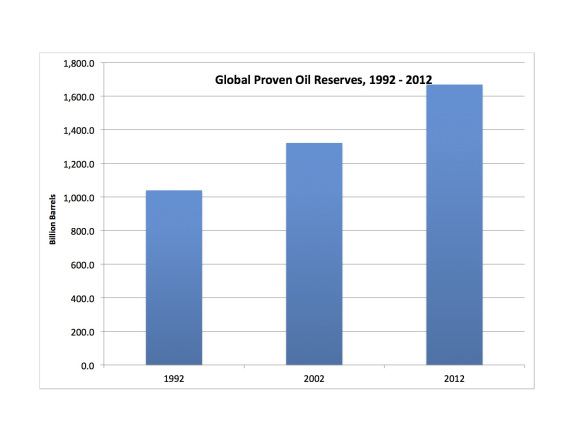
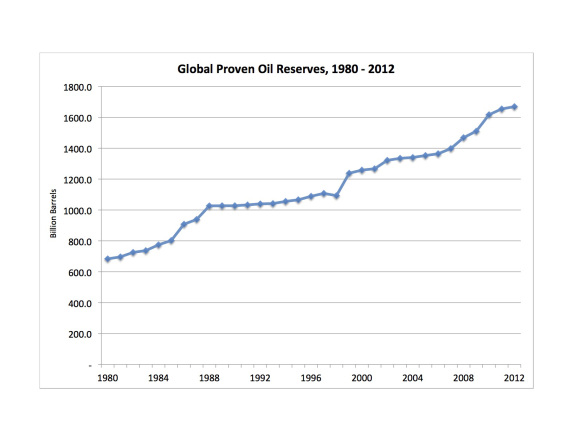
Proven oil reserves have increased by 144% since 1980 and 60% since 1992!
BP’s Statistical Review of World Energy 2013 is now out.
These two images are from Power Line’s Steven Hayward
Like the end of the whole peak oil hypothesis. The first figure below displays the 60 percent growth in proven global oil reserves over the last 20 years. This is not just the result of recent technological advances such as directional drilling and fracking: the second figure takes BP’s data back to 1980, which shows a steady increase in reserves throughout the period amounting to a 144 percent increase. (That kink in the line in the late 1990s corresponds to the collapse in oil prices down to about $10 a barrel at the time. Simple lesson: price matters.)
Tags:BP Statistical Review, Oil reserves, Peak oil
Posted in Energy, Oil | Comments Off on Global proven oil reserves have never been as high as now
April 13, 2013
It occurred to me when carrying out some combustion calculations that what humans breathe out is pretty close to the flue gas from a gas-fired, gas turbine combined cycle plant.
In a gas turbine combustion chamber, fuel is burned typically at an excess air level of about 200% (the amount of oxygen available in the combustion air compared to that which is needed for complete oxidation of the fuel). This means that about one third of the oxygen available is used and converted to carbon dioxide and water while about 2/3ds just passes through (i.e of the 21% oxygen in air, about 6-7% is “consumed” and about 14 -15% passes through unused). In coal-fired plants the excess air levels are usually only about 25% which leads to about 15 -16% of the incoming 21% oxygen being consumed with about 5% passing through. The amount of oxygen actually consumed depends on the fuel composition and the oxygen demands of the elements which are oxidised during the combustion process. Carbon, hydrogen and sulphur (giving CO2, H2O and SO2) are the main oxygen consumers. All the other constituents of air pass through – heated up of course – but otherwise unchanged. Minute quantities of the fuel- nitrogen and the nitrogen in the incoming air can – depending upon the combustion temperature – be “fixed” to create the nitrogen oxides – nitrous oxide (N2O) and nitrogen dioxide (N2O). The higher the combustion temperature the greater the “fixing”. Too low a combustion temperature – for example with very wet fuels and bio-mass – can give “incomplete combustion” with some carbon monoxide (CO) and even some dioxins and hydrocarbons with a particularly poor combustion process. Internal combustion petrol engines essentially run at stoichiometric conditions (zero excess air) and there is no oxygen in the exhaust. However combustion is never quite complete and around 1% carbon monoxide is usually present (which is why suicide by exhaust fumes becomes possible). Diesel engines on the other hand have 10% oxygen in the exhaust when idling and this reduces to 1 or 2% when fully loaded.
All fuels essentially contain carbon and hydrogen as the main energy releasing elements when oxidised. Most industrial combustion processes happen fast and speed of combustion – which is desirable for complete combustion – has to be tempered by the need to keep temperatures at levels which can be handled by the materials used. The human use of the same elements of carbon and hydrogen for the release of energy however is by a relatively slow oxidation processes. Not all the water produced leaves the human body with our expelled breath since some part of it leaves in liquid form with urine. But from the composition of the waste gas we breathe out it seems that the carbon/hydrogen ratios in our food intake cannot be so very different to the natural gas burned in gas turbines (and not very surprising considering that plant-life is the ultimate source of both).

Since human exhaust gases emit the same concentration of carbon dioxide as gas turbine, combined cycle power plant perhaps we should penalise every human as well?
Tags:Combustion, Energy, flue gas composition, fossil fuel power plant, Gas turbine, human respiration
Posted in Coal, Emissions, Energy, Gas, Humans, Oil | Comments Off on Composition of exhaust gases from humans and from fossil fuels
April 10, 2013
It was touted as the greatest environmental disaster of all time when Deepwater Horizon exploded in the Gulf of Mexico killing 11 and spilling vast quantities of crude oil. But two years later in April 2012 it was clear that the Gulf was recovering much faster than expected. It was soon clear that the effect of oil eating microbes had been grossly underestimated. And now 3 years after the accident an expert in bioremediation reported at the 245th National Meeting & Exposition of the American Chemical Society (ACS) that “the Gulf of Mexico may have a much greater natural ability to self-clean oil spills than previously believed”.
“It shows that we may not need the kinds of heroic measures proposed after the Deepwater Horizon spill, like adding nutrients to speed up the growth of bacteria that breakdown oil, or using genetically engineered bacteria. The Gulf has a broad base of natural bacteria, and they respond to the presence of oil by multiplying quite rapidly.”
From ACS: Terry C. Hazen, Ph.D., said that conclusion has emerged from research following the 2010 Deepwater Horizon disaster, which by some estimates spilled 4.9 million barrels (210 million gallons) of oil into the Gulf of Mexico. His research team used a powerful new approach for identifying microbes in the environment to discover previously unknown bacteria, naturally present in the Gulf water, that consume and break down crude oil.
“The Deepwater Horizon oil provided a new source of nutrients in the deepest waters,” explained Hazen, who is with the University of Tennessee in Knoxville. “With more food present in the water, there was a population explosion among those bacteria already adapted to using oil as a food source. It was surprising how fast they consumed the oil. In some locations, it took only one day for them to reduce a gallon of oil to a half gallon. In others, the half-life for a given quantity of spilled oil was 6 days. This data suggests that a great potential for intrinsic bioremediation of oil plumes exists in the deep sea and other environs in the Gulf of Mexico.”
Hazen spoke at a symposium, “Environmental Fate of Petroleum Oils and Dispersants in the Marine Environment,” that included other reports relating to the Deepwater Horizon spill. They were among 12,000 reports being presented at the ACS meeting, which continues through Thursday. Abstracts of the oil spill symposium appear at the end of this press release.
Oil-eating bacteria are natural inhabitants of the Gulf because of the constant supply of food. Scientists know that there are more than 600 different areas where oil oozes from rocks underlying the Gulf of Mexico. These oil seeps, much like underwater springs, release 560,000-1.4 million barrels of oil annually, according to the National Research Council.
Hazen’s team used a powerful new approach for identifying previously recognized kinds of oil-eating bacteria that contributed to the natural clean-up of the Deepwater Horizon spill. In the past, scientists identified microbes by putting samples of water into laboratory culture dishes, waiting for microbes to grow and then using a microscope to identify the microbes. The new approach, called “ecogenomics,” uses genetic and other analyses of the DNA, proteins and other footprints of bacteria to provide a more detailed picture of microbial life in the water.
“The bottom line from this research may be that the Gulf of Mexico is more resilient and better able to recover from oil spills than anyone thought,” Hazen said. “It shows that we may not need the kinds of heroic measures proposed after the Deepwater Horizon spill, like adding nutrients to speed up the growth of bacteria that breakdown oil, or using genetically engineered bacteria. The Gulf has a broad base of natural bacteria, and they respond to the presence of oil by multiplying quite rapidly.”
Tags:American Chemical Society, BP, Deepwater Horizon, Deepwater Horizon oil spill, Gulf of Mexico, microbes, oil eating microbes, oil spill, self-healing
Posted in Alarmism, Environment, Oil, US | 1 Comment »
March 17, 2013
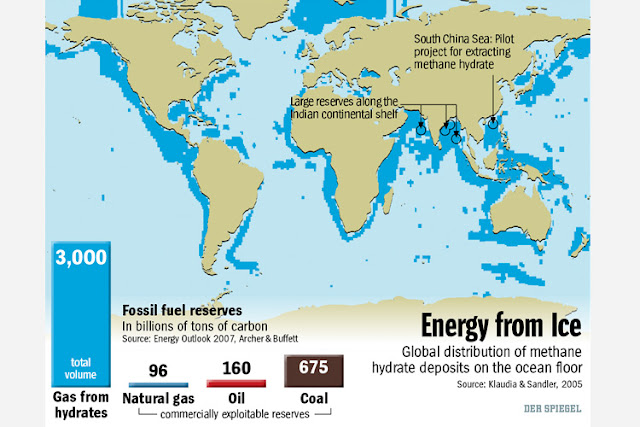
I get the impression that not only the oil and gas industry but also countries with limited energy resources have not been this energised about prospects for energy independence for a long time ( and perhaps not since the discovery of North Sea Gas). First came Shale gas and then Shale oil and now Fire Ice is catching the imagination. The sheer abundance of methane hydrates around the globe and the thought that much of this gas could soon be economically extractable is almost intoxicating for those involved.
“The worldwide amounts of carbon bound in gas hydrates is conservatively estimated to total twice the amount of carbon to be found in all known fossil fuels on Earth”.
I posted recently about the successful flow test for extracting gas from deep sea methane hydrate conducted in Japan. Of course commercialisation of this technology is still many years away (though Japan hopes this could be as early as 2016). Deposits of methane hydrate are known to be extensive and generally exist either under permafrost or under the sea. The deep sea deposits were laid down under conditions of high pressure (deep sea conditions). India is known to have substantial deposits and this is now getting some people very excited:

Types of methane hydrates deposits
Economic Times:
Estimates of global reserves are sketchy, but range from 2,800 trillion to 8 billion trillion cu.metres of natural gas. This is several times higher than global reserves of 440 trillion cu. metres of conventional gas. However, only a small fraction of hydrate reserves will be exploitable.
Methane hydrate is a mixture of natural gas and water that becomes a solid in cold, high-pressure conditions in deep sea-beds (where the temperature falls to 2 degrees centigrade). It is also found in onshore deposits in the permafrost of northern Canada and Russia. Heating the deposits or lowering the pressure (the technique used by JOGMEC) will release gas from the solid. One litre of solid hydrate releases around 165 litres of gas.
India has long been known to have massive deposits of methane hydrate. These are tentatively estimated at 1,890 trillion cu.m. An Indo-US scientific joint venture in 2006 explored four areas: the Kerala-Konkan basin, the Krishna-Godavari basin, the Mahanadi basin and the seas off the Andaman Islands. The deposits in the Krishna Godavari basin turned out to be among the richest and biggest in the world. The Andamans yielded the thickest-ever deposits 600 metres below the seabed in volcanic ash sediments. Hydrates were also found in the Mahanadi basin.
Formidable economic and environmental challenges lie ahead. Nobody has yet found an economic way of extracting gas from hydrates. Industry guesstimates suggest the initial cost may be about $30/ mmBTU, double the spot rate in Asia and nine times higher than the US domestic price. JOGMEC is optimistic that the cost can be cut with new technology and scale economies.
The Indian National Gas Hydrate Program (NGHP) Expedition was conducted together with the US Geological Service
The World’s Largest Potential Energy Resource
Released: 2/7/2008 9:21:21 AM
An international team led by the U.S. Geological Survey (USGS) and the Directorate General of Hydrocarbons, which is under the government of India’s Ministry of Petroleum and Natural Gas, conducted the expedition.
Highlights include:
- gas hydrate was discovered in numerous complex geologic settings, and an unprecedented number of gas hydrate cores and scientific data were collected;
- one of the richest marine gas hydrate accumulations ever discovered was delineated and sampled in the Krishna-Godavari Basin;
- one of the thickest and deepest gas hydrate occurrences yet known was discovered offshore of the Andaman Islands and revealed gas hydrate-bearing volcanic ash layers as deep as 600 meters below the seafloor;
- and for the first time, a fully developed gas hydrate system was established in the Mahanadi Basin of the Bay of Bengal.
“NGHP Expedition 01 marks a monumental step forward in the realization of gas hydrates becoming a viable energy source,” said USGS Director Mark Myers. “This partnership combines the expertise of two organizations dedicated to understanding gas hydrates, and research results provide new and exciting information about this important potential energy resource.”
Directorate General of Hydrocarbons Director General and NGHP Program Coordinator V. K. Sibal said, “The global gas hydrate resources are estimated to be huge. Although the exploration and exploitation of gas hydrates pose significant challenges, the opportunities are unlimited. The combined wisdom of the scientific community from across the world could provide the answers and solutions to many of these challenges. The Indian gas hydrate program has been fortunate in having the benefits of a truly global collaboration in the form of the first gas hydrate expedition in Indian waters. The results of the studies are not only encouraging, but also very exciting. I believe that the time to realize gas hydrate as a critical energy resource has come.”

Methane hydrate deposits around the world: Graphic Der Spiegel
Tags:Andaman Islands, Fire Ice, India, Japan, Japan Oil Gas and Metals National Corporation, Krishna-Godavari Basin, methane hydrate, Natural gas, Shale gas, shale oil, United States Geological Survey
Posted in Energy, Gas, India, Japan, Oil | Comments Off on Fire Ice (methane hydrate) success in Japan gets India all excited
March 13, 2013
Methane hydrates represent the largest source of hydrocarbons in the earth’s crust.
“The worldwide amounts of carbon bound in gas hydrates is conservatively estimated to total twice the amount of carbon to be found in all known fossil fuels on Earth”.
JOGMEC has put out a press release:
Japan Oil, Gas and Metals National Corporation which has been conducting preparation works for the first offshore production test off the coasts of Atsumi and Shima peninsulas, started a flow test applying the depressurization method and confirmed production of methane gas estimated from methane hydrate layers on March 12, 2013.
JOGMEC will start analyzing data while it continues the flow test.
Methane hydrate receives attention as one of the unconventional gas resources in the future.
During the period from FY2001 to FY2008, which is Phase 1 of the “Japan’s Methane Hydrate R&D Program”, seismic surveys and exploitation drillings were conducted at the eastern Nankai trough, off the coast from Shizuoka-pref. to Wakayama-pref., as the model area, where a considerable amount of methane hydrate deposits is confirmed.
In Phase 2 of the Program starting from FY2009, aiming to develop a technology to extract natural gas through dissociation of methane hydrate, this is the first offshore test ever conducted. The first offshore production test is planned over a span of two years. In February and March last year, the preparatory works including drilling a production well and two monitoring wells were conducted. From June to July, the pressured core samples were acquired from methane hydrate layers. In this operation, a flow test through dissociation of methane hydrate is conducted after the preparatory works including drilling and installing equipments for the flow test.
Deposits of methane hydrates have been reported in marine sediments in the Nankai Trough off the Pacific coast of central Japan, where the water depth is more than 500 meters. Some estimates indicate that the reserves of methane hydrate correspond to a 100-year supply of natural gas for Japan, making it an important potential source of energy. The Japan National Oil Corporation (JNOC) began research work on methane hydrates in 1995, and JOGMEC has overseen the project since the JNOC’s restructuring. An international joint research team including Japan has obtained successful results in experimental production of methane gas by injecting hot water into a borehole in the Mackenzie Delta in the arctic region of Canada.
With shale gas and shale oil adding to the known reserves of oil and gas and now with the potential exploitation of deep-sea methane hydrates, “peak-oil” and “peak-gas” would seem to have been postponed by a millenium.
Tags:"Peak" gas, Japan, JOGMEC, methane, Methane clathrate, methane hydrate, Nankai Trough
Posted in Energy, Engineering, Gas, Oil | 1 Comment »
December 19, 2012
The advent of shale gas (and shale oil) is having more profound effects than just on the production of energy or electric power. The development of “fracking” technology is providing an impetus for developments in the petrochemical industry which can be compared to the “golden years” which followed the introduction of catalytic cracking. Petrochemical processing costs are now lower in the US than in many other countries and there has been a sharp increase in projects for the “cracking” of ethane to make ethylene as a feedstock.
As put by the Financial Times: “The international chemicals industry is undergoing its most profound upheaval for 75 years, according to Kevin Swift of the American Chemistry Council. Not since the years before the second world war, when there was a flood of discoveries including nylon, synthetic rubber, PVC plastic and polystyrene, has there been technological change with such far-reaching consequences.”
The American Chemistry Council has just published its Year End 2012 Situation and Outlook and issued this press release.
HydrocarbonProcessing writes:
Favorable oil-to-gas price ratios driven by the production of natural gas from shale will drive a renewed US competitiveness that will boost exports and fuel greater domestic investment, economic growth and job creation within the business of chemistry.
(more…)
Tags:American Chemistry Council, catalytic cracking, fracking, petrochemicals, Shale, Shale gas
Posted in Chemistry, Energy, Gas, Oil | Comments Off on Shale gas boosts petrochemical developments as fracking proves as important as catalytic cracking
November 14, 2012
The reserves are massive but not yet technologically exploitable. I have little doubt that human ingenuity will prevail and before too long. It is just a matter of time and engineering before this oil starts flowing.
Malthusians must be gnashing their teeth as “Peak Oil” is pushed back – again – by a few hundred years!!
ABC News:
Drillers in Utah and Colorado are poking into a massive shale deposit trying to find a way to unlock oil reserves that are so vast they would swamp OPEC.
A recent report by the U.S. Government Accountability Office estimated that if half of the oil bound up in the rock of the Green River Formation could be recovered it would be “equal to the entire world’s proven oil reserves.”
Both the GAO and private industry estimate the amount of oil recoverable to be 3 trillion barrels.
“In the past 100 years — in all of human history — we have consumed 1 trillion barrels of oil. There are several times that much here,” said Roger Day, vice president for operations for American Shale Oil (AMSO).
The Green River drilling is beginning as shale mining is booming in the U.S. and a report by the International Energy Agency predicts that the U.S. will become the world’s largest oil producer by 2020. That flood of oil can have major implications for the U.S. economy as well as the country’s foreign policy which has been based on a growing scarcity of oil. …..
The cost of extracting the Green River oil at the moment would be higher than what it could be sold for. And there are significant environmental obstacles. ….. Nevertheless, the federal government has authorized six experimental drilling leases on federal land in an effort to find a way to tap into the riches of the Green River Formation. …….
Getting oil from Green River shale is a different proposition than getting gas and oil from other sites by using the controversial method of “fracking,” fracturing the underground rock with pressurized, chemical-infused water.
The hydrocarbons in Green River shale are more intimately bound up with the rock, so that fracking cannot release them. The shale has to be heated to 5,000 degrees Farenheit before it will give up its oil. ….
Tags:Green River Formation, Oil reserves, OPEC, Peak oil, shale oil, United States
Posted in Alarmism, Energy, Engineering, Oil, Technology, US | 2 Comments »




 The k2p blog