Archive for the ‘Philosophy’ Category

The magic which makes the speed of light what it is

December 8, 2017

Through the process of science we have discovered a great many “natural” constants that apply to our reality. These include  the speed of light in vacuum c, the gravitational constant G, Planck’s constant h, the electric constant ε0, and the elementary charge e. But why these constants are what they are – and not greater or smaller – still escapes us.

Physicists do not like to be contaminated by magic, but they do in fact invoke magic every time they use any of these so-called natural constants. That they are constant over time is itself an assumption without rhyme or reason as to why they should be so. That the passage of time is regular is itself a magical assumption. That a second now is of the same duration as a second 9 billion years ago or of the same duration as a second 10 billion years from now or at the other end of our universe are all just magical assumptions.

And so it is with the speed of light.

We have now fixed the speed of light in a vacuum at exactly 299,792.458 kilometres per second. Why this particular speed and not something else? Or, to put it another way, where does the speed of light come from?

……. Whether it was the ‘hand of God’ or some truly fundamental physical process that formed the constants, it is their apparent arbitrariness that drives physicists mad. Why these numbers? Couldn’t they have been different?  ……. leads us to the anthropic principle, the philosophical idea that what we observe in the Universe must be compatible with the fact that we humans are here to observe it. 

…… Why should the multiverse work like this, and not that? Perhaps it isn’t possible for the intellect to overcome a sense of the arbitrariness of things. We are close here to the old philosophical riddle, of why there is something rather than nothing. That’s a mystery into which perhaps no light can penetrate.

We don’t know why the speed of light is what it is. We don’t know what would have to be different in our universe for this speed to be different. We do not know if this value was always what it is now and will always be so. We don’t know if there are regions in our universe where it does not apply. It is what it is by magic.

I take the view that to the finite human mind some things are unknowable.

And as long as the unknowable exists in physics, physics must take recourse to magic. Giving magic a name or a label does not reduce its magicality.


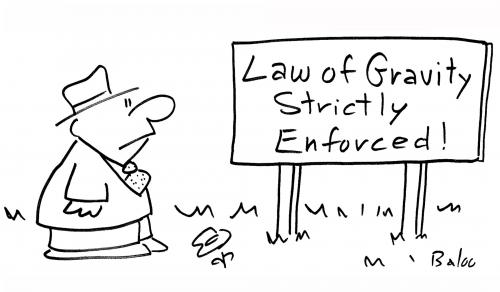
Laws are made to be broken

December 7, 2017

This is from a before-dinner talk I gave recently.

image – open parachute

Today I return to a little paradox which leads to quite subversive thoughts. 

A few weeks ago I had a conversation with a lawyer. Have you noticed that even small talk with a lawyer takes on the character of an inquisition? If only laws were simpler we would not need lawyers, I thought. In any event, it made me think of the nature of the quality of laws. How should we define a good law? And what would be a bad law? 

Now, after a long evening you all need to wake up and follow my reasoning. 

There are only two types of laws. We have either the natural laws of the universe or we have the myriad laws invented by humans. Even the so-called laws of the various gods have all been invented by humans. Note that the universe does not bother with proclaiming its laws. They just are. The universe does not even care if humans get the formulation wrong. No threat or punishment is required because it is impossible to violate these laws. Without any compulsion, it is guaranteed that everyone will comply with these perfect laws. 

So we can say that if everybody complies with a law it is an indication of a law of the highest quality. Perfect laws are those which – without any compulsion – are followed by everyone. As are the natural laws. Worthless laws are those not followed by anybody. Like the speed ​​limits on some motorways in Norrland, for example. But, a law that is followed by everybody, without compulsion, is not needed – is unnecessary, is redundant. 

All laws written by humans always fall between these limits of being useless on the one hand or unnecessary on the other. It may seem logical that a society makes a law so that everyone will comply. But that thinking is in error. If everyone does follow the law, it becomes a redundant law. Without laws there are no law breakers. It is not only that law breakers are created by human laws, human laws need law breakers. Laws are established in the first place to prevent some human behaviors which society judges to be undesirable. But if everyone follows a law then that law is unnecessary, and if no one follows that law it is worthless. One could well say that law breakers perform a fundamental and necessary service for society. They keep laws alive. Without law breakers, there would be no need for laws or legislators or lawyers. In a heaven without law breakers, and therefore, without any law makers or lawyers, there is no room for a legal system to exist. Without a system of justice, society collapses. 

The paradox for today is that if everyone followed all laws, the legal justice system would vanish and society would implode.

A society and its legal justice system depend – existentially – upon its law breakers.

I am forced to the inevitable but very subversive conclusion that human laws are all made – not to be followed – but to be broken.

Now it’s time for dinner.


Life exists as a succession of identities

November 18, 2017

Life is an abstract concept manifested as living things. The thread of life has no discernible beginning.

Life – to be life – must be manifested in an entity capable of reproduction. The elements displaying life either continue or come to an end. The thread is carried as a possibility by every sperm and every egg but the sperm and egg cannot themselves reproduce. Most of these possibilities come to an end before the two combine. If – and only if – a sperm and egg do combine, then life continues as, and within, a unique identity created by that combination. It is the creation of the identity – at conception – which continues life. About one in 300 billion sperm survives to combine with about one in 200 eggs to create an identity. It is a unique genetic identity. That identity, first as a fetus may end before birth. Or it may continue after birth as a child. It may grow to be an adult human and give rise to further sperm or eggs before itself coming to an end. When that identity qualifies to be considered a human entity and protected by society is a choice for the societies and the individuals concerned. Most societies start assigning the identity some rights and protections before birth but only after about 20 weeks of life as a fetus.

There is little doubt, however, that a unique genetic identity is created at conception, whether in a test tube or in a womb. At what stage of development that identity achieves consciousness and then self-awareness is not certain but almost certainly only after a rudimentary brain has formed. That would be some weeks after conception but probably some little time before birth. At what point that identity is to be afforded legal “rights” is then a matter for the surrounding society to determine.

Until the identity reaches birth – whether by natural or by artificial means – it has no options and no choices to exercise. Whether self-aware or not, its existence is in the gift and the power of others. It starts acquiring choices and freedoms of action only after birth, as allowed or constrained by its own development and the rules of the society it finds itself in.

Life then only exists as a succession of identities.

To trace the beginning of life would require going back from identity to identity to the specific cells some 3.7 billion years ago. A collection of sperm and eggs may contain the elements for life to continue but do not in themselves constitute life. The beginning of an identity is not the beginning of life. But the act of conception brings a unique identity into being and it is surely the beginning of a specific new life.

Life may be continuous as a concept but can only be realised and manifested as a succession of unique, discrete identities.


The chains of freedom

November 8, 2017

We speak glibly about free will, about the four human freedoms of speech, of religion, from want and from fear. For any entity, living or otherwise, we can define “freedom” as being the “unconstrained power to do”. With that definition, there are no freedoms anywhere because nothing is unconstrained. Nothing, in this universe, has freedom. An electron is not free to be wherever it wishes to be. Even a “free” electron,  untethered to any atom, can only move in compliance with the gravitational and magnetic fields it is subject to, and never faster than the speed of light. The universe itself is inextricably chained to the arrow of time.

At the most fundamental level, the chains of the “natural laws” thus imprison all matter and energy. All living things are then held by the further chains of their genes. Their physical form and attributes and behaviour must lie within the envelopes of possibility fixed by their genes. These chains ensure that a birch tree can never be an oak or a zebra a lion. From the time a seed is planted, it merely reacts to its environment and the changes to that environment. It chooses nothing. In fact, there are no choices to be made.

But humans have free will, it is said. Humans have choices available, it is said. They can choose how they will behave. But I am no longer sure if this is true. Certainly each one of the seven+ billion humans can imagine violating what we understand to be the “natural laws” but not a single one can actually do so. I can imagine myself running faster than Usain Bolt, but it never does, and never will, come to pass. All the chains connecting me to my past are unbreakable. All my possible future states of being are anchored to my current state by another unbreakable chain. All human actions are constrained by

  1. the starting conditions,
  2. what a mind can envisage,
  3. what is physically possible, and
  4. the forces driving the action

Free will, if it exists, is involved in imagining the action and in providing the driving forces for action. Causal Determinism of course allows of no free will. All future events are determined by past events and so on ad infinitum. Some forms of philosophical determinism allow some freedom of choice within a narrow envelope of possible behaviours, though others suggest that the choice of actual behaviour made is, in fact, also predetermined.

I think we need to distinguish between thought and action even if thinking itself is an action. The exercise of free will requires an action. But thinking itself is constrained. Thinking about violating the laws of nature is clearly an act which does not, itself, violate the laws of nature. Thinking about travelling backwards in time itself moves forward in time. Moreover, thinking has its own unbreakable chains. I cannot think, for example, in a language I do not know. What I cannot imagine I cannot even think about. What I cannot imagine is what, to my mind, is unknowable. What is knowable for any mind is a consequence of its capacity, its speed of learning and its knowledge base (experience). Even our possible thoughts then are limited and thus a constraint on our subsequent actions (if any).

image STAR

Every single human is in fact condemned to a life sentence on a prison planet called Earth from which there is no escape. We are in fact prisoners of

  1. what we understand to be the natural laws,
  2. our genes,
  3. the surrounding environment,
  4. our experience, and
  5. our current state

These chains are not susceptible to being broken. Each one of us is so enmeshed in constraining chains that we have few, if any, real freedoms of action.

I am about to make myself a cup of coffee. That was probably determined long before I was born. But I have the illusion that it is a choice I am making freely.


The Liar Paradox can be resolved by the unknowable

October 17, 2017

A paradox appears when reasonable assumptions together with apparently valid logic lead to a seeming contradiction. When that happens, then applying the same rules of logic lead to the further conclusion that either

  1. the assumptions were wrong or
  2. that the logic applied was not valid or
  3. that the seeming contradiction was not a contradiction.

Where a paradox lies in wrongly identifying a contradiction, it is just an error. If the paradox is due to an error of applying the rules of logic it is also just a mistake. However sometimes the paradox shows that the logic itself is flawed or inconsistent. That can lead to a fundamental revision of the assumptions or rules of the logic itself. Paradoxes have contributed to whole realm of the philosophy of knowledge (and of the unknowable). Many paradoxes can only be resolved if perfectly reasonable assumptions can be shown to be wrong. Many scientific advances can be traced back to the confrontation of the starting assumptions.

Confronting paradoxes has led to many advances in knowledge. Niels Bohr once wrote, “How wonderful that we have met with a paradox. Now we have some hope of making progress.” A paradox is just an invitation to think again. 

Classical Logic is digital. It allows no grey zone between true and false. What is not true is false and what is not false must be true. This requirement of logic is built into the fabric of language itself. Classical Logic does not allow a statement to be, true and false simultaneously, or neither false nor true. Yet this logic gives rise to the Liar Paradox in its many formulations. The paradox dates back to antiquity and in its simplest forms are the statements

“I am lying”, or

“This statement is false”

There are many proposed ways out of this paradox but they all require some change to the rules of Classical Logic. Some require a term “meaningless” being introduced which requires that a proposition may be neither true nor false. Others merely evade the paradox by claiming that the statement is not a proposition. Bertrand Russel took the radical step of excluding all self reference from the playing field.

Experts in the field of philosophical logic have never agreed on the way out of the trouble despite 2,300 years of attention. Here is the trouble—a sketch of the paradox, the argument that reveals the contradiction:

Let L be the Classical Liar Sentence. If L is true, then L is false. But we can also establish the converse, as follows. Assume L is false. Because the Liar Sentence is just the sentence “L is false,” the Liar Sentence is therefore true, so L is true. We have now shown that L is true if, and only if, it is false. Since L must be one or the other, it is both.

That contradictory result apparently throws us into the lion’s den of semantic incoherence. The incoherence is due to the fact that, according to the rules of classical logic, anything follows from a contradiction, even “1 + 1 = 3.” 

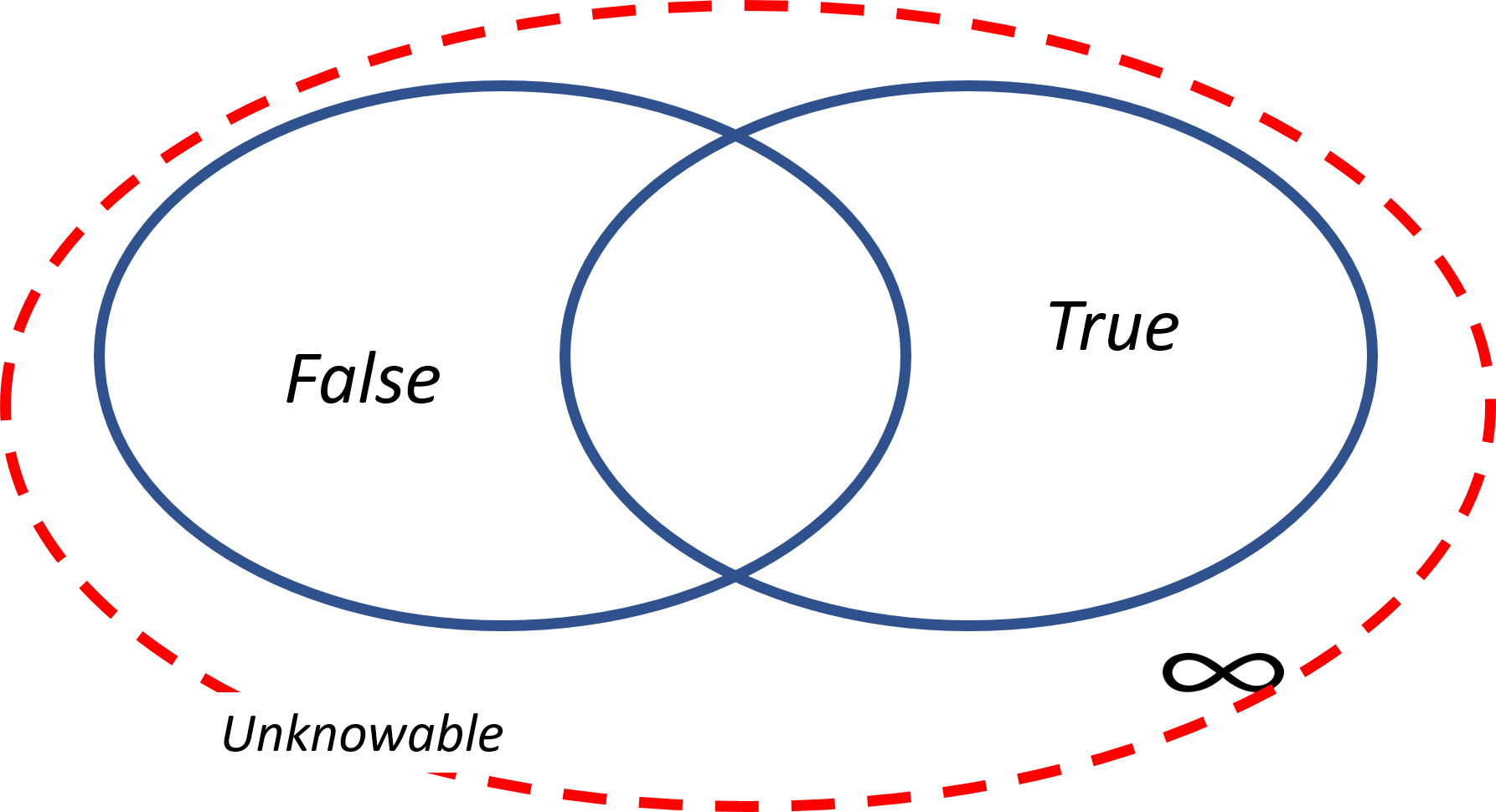
It seems to me that the paradox vanishes if we allow that what is not true is not necessarily false, and what is not false is not necessarily true. The fault lies in our self-determined assumption of the absence of a continuum between true and false. We can as well create a grey zone – some undefined state between and outside the realms of true and false – which would be an unknown state. Perhaps even an unknowable state. It is a strong indication – even if not a proof – that the unknowable exists and that logic needs to be fuzzy rather than digital.

The Liar Paradox is connected to the Fitch Paradox of Knowability

The paradox of knowability is a logical result suggesting that, necessarily, if all truths are knowable in principle then all truths are in fact known. The contrapositive of the result says, necessarily, if in fact there is an unknown truth, then there is a truth that couldn’t possibly be known.

More specifically, if p is a truth that is never known then it is unknowable that p is a truth that is never known. The proof has been used to argue against versions of anti-realism committed to the thesis that all truths are knowable. For clearly there are unknown truths; individually and collectively we are non-omniscient. So, by the main result, it is false that all truths are knowable. The result has also been used to draw more general lessons about the limits of human knowledge. 

Language is invented. Both words and the rules of grammar are invented – not discovered. We are forced to define words such as “infinite” and “endless” and “timeless” attempting to describe concepts which we cannot encompass with our finite brains and our limited physical senses. It is not possible to measure an endless line with a finite ruler.

The unknowable exists and it is therefore that we need the word “unknowable” .


Related:

Known, unknown and unknowable

The unknowable is neither true nor false

Gödel’s Incompleteness Theorems


The unknowable is neither true nor false

September 22, 2017

Some things are unknowable (Known, unknown and unknowable).

In epistemology (study of knowledge and justified belief), unknowable is to be distinguished from not known.

Fitch’s Paradox of Knowability (Stanford Encyclopedia of Philosophy)

The paradox of knowability is a logical result suggesting that, necessarily, if all truths are knowable in principle then all truths are in fact known. The contrapositive of the result says, necessarily, if in fact there is an unknown truth, then there is a truth that couldn’t possibly be known. More specifically, if p is a truth that is never known then it is unknowable that p is a truth that is never known.

Some believe that everything in the universe can be known through the process of science. Everything that is not known today will be known eventually. I do not quite agree. Some things are, I think, unfathomable, unthinkable – which one can not know. My reasoning is quite simple. The capacity of our brains is limited. That seems undisputed. It is because of our cognitive limitations, we have found it necessary in our invented languages to invent the concept of infinity – for things that are beyond observable. If brain capacity was unlimited there would be no need for the concept of infinity or for words such as “incomprehensible”. Even in mathematics, which, after all, is another language for describing the universe, we also have the concept of infinity. Infinitely large and infinitely small. We can find finite limits for some convergent infinite series, but we can never get to infinity by making finite operations on finite numbers. We cannot fill an infinite volume with a finite bucket or measure an infinitely long line with a finite ruler.

To my layman’s understanding, Cantor’s Continuum Hypothesis (which still cannot be proved), and Gödel’s Incompleteness Theorems (which prove that it cannot be proved in an axiom based mathematics), only confirms for me that:

  1. even our most fundamental axioms in philosophy and mathematics are assumed “true” but cannot be proven to be so, and
  2. there are areas of Kant’s “noumena” which are not capable of being known

It is not just that we do not know what we do not know. We cannot know anything of what is unknowable. In the universe of the knowable, the unknowable lies in the black holes of the current universe and in the time before time began.

I find Kant’s descriptions persuasive

Brittanica.com

Noumenon, (plural Noumena), in the philosophy of Immanuel Kant, the thing-in-itself (das Ding an sich) as opposed to what Kant called the phenomenon—the thing as it appears to an observer. Though the noumenal holds the contents of the intelligible world, Kant claimed that man’s speculative reason can only know phenomena and can never penetrate to the noumenon.

All human logic and all human reasoning are based on the assumption that what is not true is false, and what is not false must be true. But why is it that there cannot be a state where something is neither true nor false? Why not both false and true at the same time? In fact, it is the logic inherent in our own language that prohibits this state. It is a limitation of language which we cannot avoid. But language is not discovered, it is invented. That “what is not true must be false” is just an assumption – a very basic and deep assumption but still just an assumption.

Following Fitch

in fact there are unknown truths, therefore there must be truths that couldn’t possibly be known.

Therefore,

“Truth” and “that which is not true is false” are assumptions and are definitions inbuilt in our languages. Truth and Falsity are not necessarily mutually exclusive quantum states. They may instead form part of a continuum which is unknowable.  Maybe a truth-time continuum?

(image Forbes)


Time precedes existence

August 4, 2017
While Ilya Prigogine (Nobel prize in 1977 for nonequilibrium thermodynamics) claimed that time precedes existence, Einstein, Newton, and others held a symmetric view of time where time and existence occur simultaneously.
I am inclined to Prigogine’s view.
Causality, time, entropy, heat transfer, plastic deformation and spontaneous chemical reactions are all examples of irreversible processes.
I note that even in the statement “I think, therefore I am”, a “before” and an “after” is implied.
In fact, even the statement “I exist” implies that I exist “in time”.
Real time precedes the Big Bang.
Thereafter we have perceived time.
Time is causal.
It is not just past events which cause future events, past time causes future time.
Time precedes existence.

Known, unknown and unknowable

July 22, 2017

Donald Rumsfeld was often the butt of cheap jokes after this quote. In reality, Rumsfeld was absolutely spot on and close to philosophic.

Starting from where Rumsfeld left off we come to the distinction between the knowable and the unknowable

These are things we don’t know that we don’t know. There are knowable unknowns. That is to say, there are things that we could know but we don’t know which we don’t know. But there are also unknowable unknowns. There are things we cannot know that we don’t know that we can never know. 

a la Rumsfeld

I am coming to the conclusion that the sum of all human cognition lacks some of the dimensions of the universe. It may be increasing with time, but human cognition is limited. The expanding universe may be infinite or it may be boundless. For human cognition to grasp the universe is then like trying to measure an infinite length with a ruler of finite length, or of trying to measure some unknown parameter with a ruler marked in inches. Those measurements will never reach a conclusion.


The edge of the universe is to humans as the surface of the water is to fish

July 18, 2017

Things become weird and wonderful when physicists or cosmologists or astronomers talk about the “edge of the universe” or the “finitely bounded but infinite universe” or the “expanding universe” which does not expand into anything but creates space as it expands (the balloon analogy). I read that the Big Bang occurred 13.8 billion years ago but the size of the universe is said to be a diameter of (around) 93 billion light-years. Some photons, they say, have traveled 46-47 billion light-years since the Big Bang. Now how did they do that in just 13.8 billion years? The answer, say the physicist-philosophers, is that things aren’t moving away from each other so much as that the space between them is expanding. Really!

How can the universe be 93 billion light-years across if it is only 13.8 billion years old? Light hasn’t had enough time to travel that far…? Ultimately, understanding this facet of physics is the key to understanding what lies beyond the edge of the observable universe and whether we could ever get there. 

To break this down, according to special relativity, objects that are close together cannot move faster than the speed of light with respect to one another; however, there is no such law for objects that are extremely distant from one another when the space between them is, itself, expanding. In short, it’s not that objects are traveling faster than the speed of light, but that the space between objects is expanding, causing them to fly away from each other at amazing speeds.

Ultimately, this means that we could only reach the edge of the observable universe if we develop a method of transport that allows us to either 1) Travel faster than the speed of light (something which most physicists think is impossible) 2) Transcend spacetime (by using wormholes or warp drive, which most physicists also think is impossible).

The reality, I think, is that human cognition is limited. I reject the converse, that human cognition is unlimited, because, if it was, we would not have imponderable questions. Stephen Hawking has often said that “outside the universe” makes no sense, because if the universe came from nothing and brought everything into existence, then asking what lies beyond the universe is an invalid question. When physicists invoke dark energy and dark matter and, in the same breath, point out that they are unknown and undetectable, then it follows that human understanding is incomplete because of the limits to human cognition.

If human cognition is limited, whether at the level we have reached or ten times that level, our understanding of the universe around us is, and will be – and must be – also limited. We will always have a “conceptual edge” to the universe around us corresponding to our cognitive limits. Beyod this edge lies what is “unknowable”. The edge of the real universe lies at at the furthest reaches of our cognitive abilities.

As most fish (with exceptions for flying fish and lung fish) cannot conceive of the world beyond the surface of the water, so can humans not conceive a universe beyond the “conceptual edge” defined by their cognitive ability.

We can never observe what is beyond the “observable universe” because light will never get there. But it isn’t just light that doesn’t get there. Our minds don’t reach there either. There may be a multiverse out there – or maybe not. There may be just the ultimate void being converted into space-time as our universe eats into it. Or maybe there is The Restaurant at the End of the Universe awaiting the intrepid few who get there. Or maybe there is a Thing with a long white beard observing us to see if any human-fish manage to leap through the “edge of the universe”.


The Ship of Theseus paradox is no paradox

July 12, 2017

A dictionary definition would define identity as the characteristics uniquely determining what makes a thing, whether living or inanimate. Consider what is necessary and sufficient to define an identity.

Inanimate things can have identity. The Great Pyramid, or the Empire State building or even that particular, nondescript boulder just there, has an identity. That particular boulder, with that volume and that physical composition and which now is located in my garden in Sweden, may have been formed when it was ejected after a volcanic eruption on Gondwanaland some 500 million years ago. Or it may have been formed 100 years ago when rocks in this region were blasted to build a road. The key point here is that this particular thing had a beginning on the time line of the universe. This beginning, this begin-time, is inextricably tied to the identity of this boulder. This identifiable boulder may have lost some mass by erosion over the years or it may have (though much less likely) grown in mass by accretion. Its mass may have changed over time and its shape and volume may have changed. Even its composition may have changed somewhat as chemical reactions with the surrounding atmosphere slowly occurred. At any given time however, the thing having identity uniquely occupies a physical space.

The Ship of Theseus (see Theseus paradox) had an identity.

The ship of Theseus, also known as Theseus’s paradox, is a thought experiment that raises the question of whether an object that has had all of its components replaced remains fundamentally the same object. The paradox is most notably recorded by Plutarch in Life of Theseus from the late first century. Plutarch asked whether a ship that had been restored by replacing every single wooden part remained the same ship.

I now borrow the concept of a control surface from fluid dynamics

In an inertial frame of reference, a control volume is a volume fixed in space or moving with constant velocity, through which the fluid (gas, or liquid) flows. The surface enclosing the control volume is referred to as the control surface.

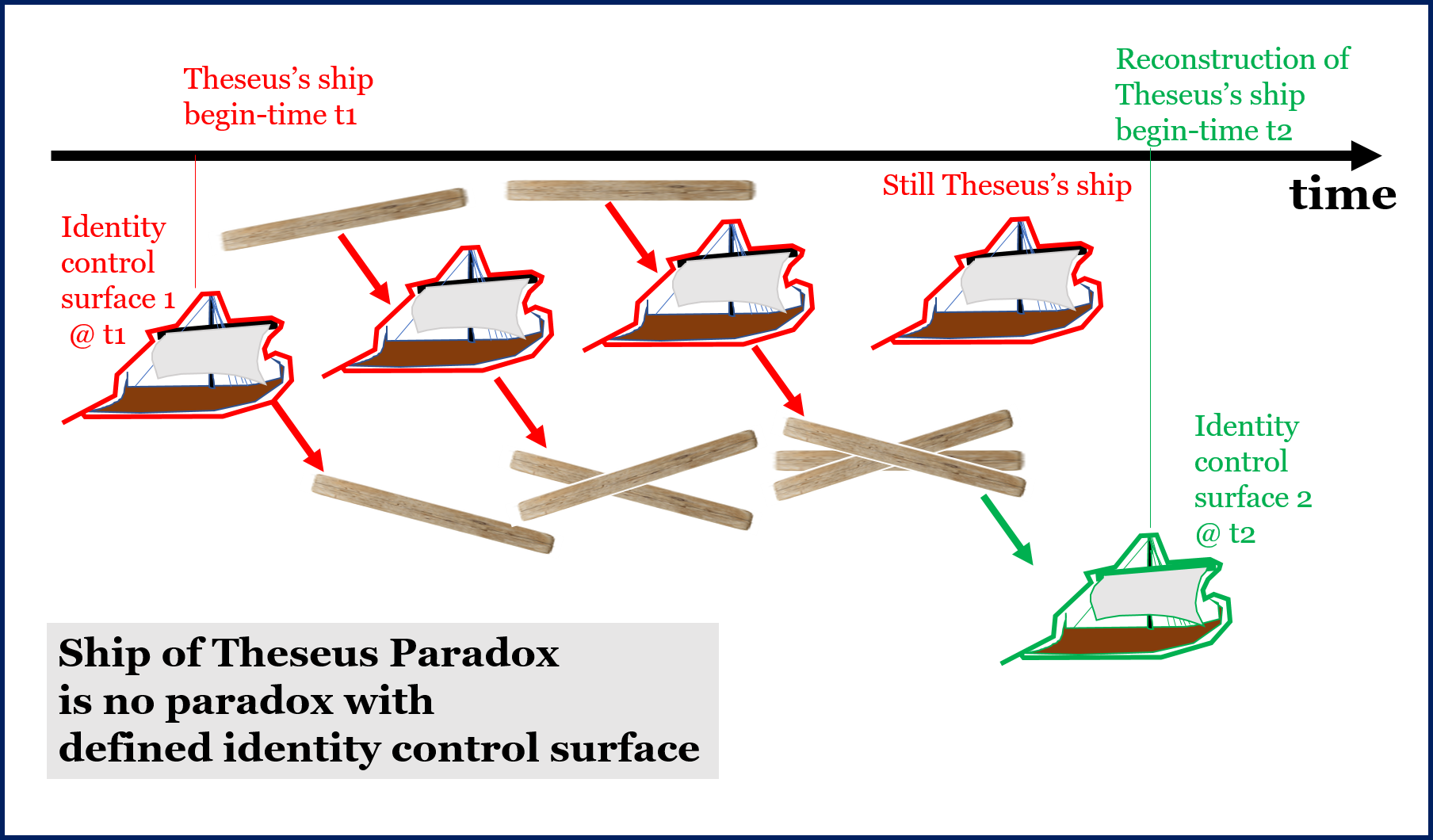
Analogous to a control surface, I define an identity control surface. It is abstract (no mass, no thickness, no volume, no energy) but it is definable in 3-dimensional physical space at any instant of time. Unlike in fluid dynamics, this control surface does not enclose a fixed control volume, but physically encloses that which has identity. Whenever that boulder was formed, it was physically enclosed within an elastic identity control surface. The identity control surface is dynamic, elastic and permeable. It is not however fixed in space along the time axis. Its permeability allows the flow of material in both directions, but the integrity of the identity within is not compromised as long as the flow is small relative to the material enclosed. The elastic identity control surface maintains the identity enclosed as it accommodates gradual growth or a shrinkage of the enclosed physical material. The dynamic ability of the identity control surface maintains the continuity over time of the identity enclosed. An identity control surface may be embedded within another identity control surface as would happen if our boulder was used in a building which had its own identity.

This now gives me the two characteristics necessary to define identity. A thing has an identity if it has:

  1. an identity control surface which is physically definable at any instant of time, and
  2. a discrete beginning for that identity control surface on the time line of the universe (a history)

Both are necessary and are together sufficient to define the identity of an inanimate thing. The Great Pyramid and the Empire State Building comply. Their identities will end when the identity control surface is breached sufficiently to create a death on the time line of the universe.

With an identifiable identity control surface and an identified begin-time, Theseus’s ship no longer presents a paradox. As long as the replacements to the ship are small relative to the whole, its identity continues. Even if 100% of the original ship’s timbers are eventually replaced it retains its identity. However another ship gradually built up from the original (discarded) timbers would have a new beginning and a new identity surface and a new identity. Note that each timber as it was discarded would no longer be a part of identity that was Theseus’s Ship. The rebuilt ship would be a reconstruction, albeit with the original materials, of Theseus’s ship but it could never have the identity of Theseus’s ship. There is no ambiguity about identity.

It seems to me that these two characteristics would also be necessary and sufficient to define the identity not only of inanimate things but also of all living things including humans.

For all living things the identity control surface would come into being when the unique genetic make up of that entity was established. For a tree it would enclose the seed or enclose the fertilised egg for a chicken or for a human. For humans, conception or the point at which a fertilised egg embeds itself in the uterus, would seem to be appropriate as the begin-time of that identity. Initially the newly created fetus identity would be enclosed within the identity control surface of the mother and would separate at birth. As humans grow, the elastic identity control surface expands to accommodate that growth. At any time this control surface can be physically defined. The identity within remains continuous, from its begin-time till that identity control surface ceases to exist (and of course that could be some little time after death). Suppose bodies could be put into cryo-storage. Mr. X’s frozen corpse would retains its identity (as Mr. X’s body), even if Mr. X was long since dead, until decomposition destroyed the identity control surface. There is no contradiction here. The fact of being alive or not is then merely a characteristic of the identity.

The brain is not then necessary for an identity to exist. After a brain transplant – if such was possible – the identity continuing would that of the person receiving the brain. Neither is a soul a necessary condition for an identity though that does not say anything about whether a soul exists or not. The identity of each living thing, and that includes the 7 billion humans on the planet, is each uniquely characterised by its identity control surface and its begin-time. This does not address what makes a living thing human, and that would surely involve the brain and whatever one may define as being soul.

There have been suggestions that identity is virtual and based on information (Budimir Zdravkovic in The Oxford Philosopher):

….. when an entire individual is cloned; not just their DNA but their memories and experiences, too. If we assume that a person’s memory and experience is just information stored in the human brain (and the rest of the human nervous system) then in theory it should be possible to completely clone an individual with all his or her experiences, habits and memories included, providing we can reconstruct their body and nervous system.

The concept of complete human cloning is very much in line with the idea that biological identity consists in virtual information as opposed to material constitution. Since information is virtual, a person can be reconstructed eons after his death and still continue to live his life. The person’s identity becomes a function of all the information stored in his DNA, brain, and the rest of the body. After we have sufficient knowledge of the entire human brain and nervous system, in principle we ought to be able to achieve immortality via this complete human cloning.

But this is about creating replicas and not really about identity. You may be able to create an identical, cloned human, but the clone would have a different begin-time and a different identity control surface. A clone might be identical to an original but would have a completely different identity. The clone and the original would have both different begin-times and different identity control surfaces. As identical twins also have completely different identities. Even if their begin-times are identical, they occupy separated physical spaces and different identity control surfaces.

So, the reconstruction of Theseus’s ship would give rise to a new identity with a different identity control surface and a different begin-time.