Archive for the ‘Philosophy’ Category

Arrogance of Ignorance: “I don’t know, but I know you’re wrong”

February 28, 2019

Physics has no clue as to where, how or why the universe began.

Yet, the only thing that all “scientific disciplines” are sure of is that the universe did not begin by any act of any god or on the back of a giant turtle.

There are only two kinds of creation myths that physics (and by that I mean all the “scientific” disciplines) eschew:

  1. The universe as matter and energy has always existed, or
  2. Something was created from nothing

Whether theories about the Big Bang (hot or cold) or cosmic inflation or the naturally occurring “something from nothing” events or loop quantum gravity, they are all creation myths. Just as theories of infinite parallel universes, or cyclic cosmology are also little more than wild speculation. The various mainstream theories of physics and cosmology are as diverse as the Creation Myths of the primitive (“pre-science”) world. And as far-fetched. Conservation of energy and matter have to be ditched – or allowed to vary. Time becomes a parameter emerging from the fabric of our particular universe. All events in the past, present and future exist simultaneously. What existence is becomes uncertain and physics has turned into metaphysics.

Scientific disciplines do not like to contemplate the reality of the unknowable because they would then have to admit that the “scientific method” has no tools to address the unknowable. Determinism has to allow the possibility of, if not the inevitability of, omniscience. (It could be argued that determinism starts of by denying the possibility of any divinity or divine intervention and then ends up having to admit that a god-like omniscience is real). Atheism lacks substance and is of no consequence. There is nothing wrong with speculation of course. Most of our scientific advances (albeit in the world of the knowable) have started of as speculation.

What becomes arrogant, but above all irrational, is when a state of ignorance, of not-knowing, is conflated with a state of knowing that “something is not”.

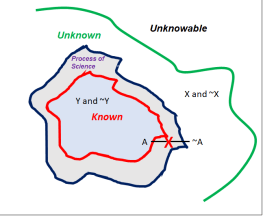
All beliefs by definition lie in the region of the unknown. Any statement and its negation ( X and not-X) must both either lie in the region of knowledge, or both in the region of the unknown. It is not possible for one to live in the realm of knowledge and its negation to live in the region of the unknown.

It is the arrogance of ignorance and pervades nearly all human activities. It is the breath of life for politicians, TV pundits and “celebrities”. It is the fall-back position for all weak leaders and managers.

“I don’t know, but I know you’re wrong”.


Physics cannot deal with nothingness

February 19, 2019

Physics (and all science) is about describing what can be observed and elucidating the causal relationships between observations. The process of science presupposes causality.  If causality is not always a fundamental and pervasive truth, the scientific method cannot elucidate anything. No system of reasoning can prove the assumptions the system itself is built upon. Science cannot, therefore, prove the existence of what it presupposes already exists.  Causality also implies the existence and the flow of time. Effect, it is assumed, can never precede cause. The process of science is necessarily blind to whatever may lie outside its suppositions. Which is why physics cannot deal with the non-existence of time (or space-time) where all the elucidated natural laws must be suspended.

Similarly, physics cannot allow of, or deal with, the unknowable. Many physicists merely deny the unknowable with the proposition that all things that have been, that are or that can be, are knowable and can – in principle – be explained by causality. But denying the unknowable leads to a deterministic world which, in turn, leads to the certainty of omniscience. It does not have to be human omniscience, but omniscience or any omniscient being becomes indistinguishable from a god. Determinism’s omniscience is nothing but divinity through the back door.

The unknowable lies outside the realm of science in general and of physics in particular. Unknowability applies not only to the existence of causality and time but also to the non-existence of nothingness. Clearly “empty” space which has dimensions and which allows the operation of natural laws is not nothing. Space which allows the passage of radiation or gravity waves cannot be nothing. Anything which has, or is attributed, any kind of property cannot be nothing. Our universe is expanding, it is said. It is also said that it is expanding into nothingness; where space and time emerge as the universe expands. But if the surroundings of the universe allow the expansion of the universe then such surroundings have a describable property and cannot be nothing. Nothingness is – and must be – unknowable.

Physics and philosophy both find defining nothingness a slippery business – but so they should, as they must for any unknowable thing.

What Is Nothing? Physicists Debate

…… The first, most basic idea of nothing — empty space with nothing in it — was quickly agreed not to be nothing. In our universe, even a dark, empty void of space, absent of all particles, is still something. “It has a topology, it has a shape, it’s a physical object,” philosopher Jim Holt said during the museum’s annual Isaac Asimov Memorial Debate, which this year was focused on the topic of “The Existence of Nothing.”

As moderator Neil deGrasse Tyson, ….. said, “If laws of physics still apply, the laws of physics are not nothing.”  …… But there is a deeper kind of nothing, argued theoretical physicist Lawrence Krauss of Arizona State University, which consists of no space at all, and no time, no particles, no fields, no laws of nature. “That to me is as close to nothing as you can get,” Krauss said.

Holt disagreed. “Is that really nothing?” he asked.”There’s no space and there’s no time. But what about physical laws, what about mathematical entities? What about consciousness? All the things that are non-spatial and non-temporal.”

Other speakers offered different ideas for nothing, such as a mathematical concept of nothing put forward by science journalist Charles Seife, author of “Zero: The Biography of a Dangerous Idea” (Penguin Books, 2000). He proposed starting with a set of numbers that included only the number zero, and then removing zero, leaving what’s called a null set. “It’s almost a Platonic nothing,” Seife said. The theoretical physicist Eva Silverstein of Stanford University suggested a highly technical nothing based on quantum field theory that involved a quantum system lacking degrees of freedom (dimensions). “The ground state of a gapped quantum system is my best answer,” she said.

Holt suggested another idea of nothing. “The only even remotely persuasive defintition of nothing I’ve heard form a physicist came from Alex Vilenkin,” a physicist at Tufts University, Holt said.”Imagine the surface of a ball. It’s a finite space but with no boundary. Then imagine it shrinking down to a point.” That would create a closed space-time with zero radius.

Every creation myth is about something appearing from nothingness. Even articulated by a physicist every theory about how things came to be, is just another creation myth. The Big Bang singularity is unknowable. I find many of the origin theories unconvincing where nothingness at the macro-level is allowed to produce somethings at the micro level, provided that not-somethings are also produced. Matter begets anti-matter and gravity (negative energy) begets positive energy, and the sum is zero. It is all very conveniently contrived except that why a particular something (and its negation) come to be, rather than some other something remains in the unknowable.

The Creation Hymn in the Rig Veda begins:

Then even nothingness was not, nor existence,
There was no air then, nor the heavens beyond it.
What covered it? Where was it? In whose keeping?

Nothingness is perhaps just where consciousness comes from – and where it goes.


Related:

First nothingness was not, then came the Big Bang and the Gods came later

If space is not empty, what is? The ultimate void?

Knowledge is not finite and some of it is unknowable

On the matter of matter (or how something came from nothing)


Living in time

January 24, 2019

Most fish are probably unaware that the water they are living in is a bounded environment. I write “most” because flying fish must have some notion of the surface and are able to break through it for short periods and small distances. Similarly, bottom-dwelling fish must have some notion of the boundary they burrow into, and all fish must have some notion of coastal or river boundaries. Nevertheless, we can conceive of fish completely surrounded and dominated and constrained by the watery environment they live in. They are completely powerless to change that environment.

And so it is with humans and time. The difference is that we perceive no boundaries to our time environment. Like fish in a river, we perceive only one direction for the flow. Unlike fish, we perceive no local eddies or reversals of the flow of time. Unlike salmon we cannot conceive of moving against the current. We perceive only a smooth, steady, implacable uni-directional flow.

We have no idea of the structure or the nature of time. The flow we perceive may just be a consequence of our language. We have no idea why the perceived flow should be steady. Could there be a condition where no flow occurs? Or where the flow is a different rate or in some other direction? Or even whether the flow itself is just illusion and does not exist at all. We are used to thinking of many futures but only one past. There is speculation of multiverses where every possible future exists. Why only one present?

From what I have read by physicist Carlo Rovelli (“the new Stephen Hawking”), he takes the view that time is an emergent property and the flow of time we perceive is an illusion. Past, present and future are all emergent. His book “The Order of Time” has received wonderful reviews even from those who do not agree with his views.

It is time to read his book and see if it stops me from staying awake at night trying to imagine many pasts and only one future.


Related:

The magical speed of an inconstant time

Idle thoughts: On time and change and states of stasis

Time precedes existence


Philosophy before physics

January 23, 2019

Stephen Hawking once said “Philosophy is dead”.

Speaking to Google’s Zeitgeist Conference in Hertfordshire, the author of ‘A Brief History of Time’ said that fundamental questions about the nature of the universe could not be resolved without hard data such as that currently being derived from the Large Hadron Collider and space research. “Most of us don’t worry about these questions most of the time. But almost all of us must sometimes wonder: Why are we here? Where do we come from? Traditionally, these are questions for philosophy, but philosophy is dead,” he said. “Philosophers have not kept up with modern developments in science. Particularly physics.”

But claiming that philosophy is dead is itself philosophy.

Hawking’s comment is remarkably like that of Isocrates who some 2,300 years ago followed the sophists. He taught rhetoric and oratory and did not much care for Plato’s new-fangled approach to thinking and education or his definition of philosophy. Isocrates certainly did not like Plato’s attacks on his school.

“Those who do philosophy, who determine the proofs and the arguments … and are accustomed to enquiring, but take part in none of their practical functions, … even if they happen to be capable of handling something, they automatically do it worse, whereas those who have no knowledge of the arguments [of philosophy], if they are trained [in concrete sciences] and have correct opinions, are altogether superior for all practical purposes. Hence for sciences, philosophy is entirely useless.”

Plato (428BCE – 348BCE)

But Plato prevailed even if he did make use of “fake news”.

Because of Plato’s attacks on the sophists, Isocrates’ school — having its roots, if not the entirety of its mission, in rhetoric, the domain of the sophists — came to be viewed as unethical and deceitful. Yet many of Plato’s criticisms are hard to substantiate in the actual work of Isocrates; at the end of Phaedrus, Plato even shows Socrates praising Isocrates (though some scholars have taken this to be sarcasm).

Part of the issue is semantics. Philosophical thinking by a physicist remains philosophy. (And observations and reasoning by philosophers would still be physics).

One cannot even begin to undertake the process called science without a philosophy. One can make observations and report them as perceptions but whether the perceived observations are valid or not are a matter of philosophy. Linking observations – or perceptions of observations – requires a philosophic acceptance of causality. Causality itself requires an acceptance of the flow of time which remains a philosophic question even when asked by a physicist. The languages used in describing observations (including mathematics) and in reasoning itself are underpinned by a philosophy of language. Even the simplest of observations requires the observer to have an underlying philosophy, just to be perceived as a relevant and valid observation. Communicating such observations are even more dependent upon the existence of language having a philosophy.

As Carlo Rovelli writes:

Here is a second argument due to Aristotle: Those who deny the utility of philosophy, are doing philosophy. The point is less trivial than it may sound at first. Weinberg and Hawking have obtained important scientific results. In doing this, they were doing science. In writing things like “philosophy is useless to physics,” or “philosophy is dead,” they were not doing physics. They were reflecting on the best way to develop science. The issue is the methodology of science: a central concern in the philosophy of science is to ask how science is done and how it could be done to be more effective. ….. They express a certain idea about the methodology of science. Is this the eternal truth about how science has always worked and should work? Is it the best understanding of science we have at present? It is neither. In fact, it is not difficult to trace the origins of their ideas. They arise from the background of logical positivism, corrected by Popper and Kuhn. The current dominant methodological ideology in theoretical physics relies on their notions of falsifiability and scientific revolution, which are popular among theoretical physicists; they are often referred to, and are used to orient research and evaluate scientific work.

….. They express a certain idea about the methodology of science. Is this the eternal truth about how science has always worked and should work? Is it the best understanding of science we have at present?

It is neither. In fact, it is not difficult to trace the origins of their ideas. They arise from the background of logical positivism, corrected by Popper and Kuhn. The current dominant methodological ideology in theoretical physics relies on their notions of falsifiability and scientific revolution, which are popular among theoretical physicists; they are often referred to, and are used to orient research and evaluate scientific work.

All of human thought builds on implied philosophies; on assumptions of reality and observations and on implicit philosophies embedded in the logic of our languages. There is no branch of science which does not need fundamental assumptions which are taken as being axiomatic. There is no branch of science which does not have fundamental “rules”. It is only the explicit questioning of the underlying assumptions which we label “philosophy”.  But the philosophies exist whether the assumptions are questioned or not. Physics of any kind is not possible without an underpinning philosophy of physics.

Philosophy is integral to science and to physics. There can never be a fundamental assumption made without there first being a philosophy.

And, of course, philosophy precedes physics in the dictionary.


Carlo Rovelli: Physics Needs Philosophy / Philosophy Needs Physics


The many, many gods of science

December 27, 2018

Many scientists (and all atheists) deny the gods of religions. Many also deny the existence of the unknowable but then illogically also deny that omniscience is unavoidable.

(Of course omniscience is one of the requirements to be a god).

But science does assume gods – in everything but name.

Many, many gods.


Creation Myths

December 7, 2018

Religions have no answer to the question and merely invoke God (or a god among a a pantheon of appropriate gods). Science has no answer either. No physicist or astrophysicist or cosmologist actually has the faintest idea about where energy and matter came from. The disingenuous claim that a smooth nothing suddenly and spontaneously produced clumps of matter and anti-matter (such that the total remained nothing) is just as far-fetched as any creation myth. Energy is handled similarly. The otherwise homogeneous universe is allowed to have clumps of “something” provided that they can be neutralised by equivalent amounts of “negative somethings”. The Big Bang is just a label for a Big Unknown.

Atheists, of course, don’t even try to answer the question. They are satisfied to say that the answer is unknown but they do know that it is not any kind of conception of God.

The other Big Question is : “How did life begin?”

Religions again have no answer and invoke God or gods. Science has no answer either and puts it down to random chemistry which became biochemistry and which, by accident, led to life.

Neither science nor religions nor philosophy have the faintest idea of what time is.

It’s all just Magic.


Boundaries of inexplicability

November 22, 2018

It is not difficult to imagine a time some 500,000 years ago when the first god was invented by one of our hominid ancestors. I have little doubt that the first god was the God of the Sun. It could be argued that a god of day and a god of night might have come first, but while the distinction between day and night was surely fundamental, the understanding that it is the Sun which causes night and day would have been evident even to most animals (as it is even now). The invention of a god requires an unanswerable question to be posed. Even a modicum of intelligence would find an explanation for day and night in the Sun. It is only when the question of why night would invariably follow day could be posed, that an inexplicable question arose. And the answer was found by invoking the Sun God.

Gods came long before religions. And every god that has ever been invented has been as an answer for an otherwise inexplicable question. Soon after the Sun God was invented came the inexplicable questions which created the need for a Moon God and a Rain God and a Wind God and a God of Thunder. Then came the gods of the seas and the rivers and the plains and the mountains and of earthquakes and of volcanoes. The gods were needed to explain all the easily and often observed, physical realities which surrounded our ancestors and controlled their survival but could not be predicted or explained. Gods were labels for magic. Somewhere along the way came the idea that the gods had discretion to act in a manner favourable or inimical to humans. And then came the giant leap of thought to the idea that human actions could induce the gods to intercede favourably. And so came the invention of prayer and of rain dances and of sacrifices and other ways of attracting first the attention, and then the intercession, of enormously powerful gods. It was then only a little step to praying for the intercession of the gods in matters inimical to enemies. Rationality plays no part, and can play no part, in invoking the irrational.

We need to distinguish between gods and religions. Whereas gods are a product of individual minds and are labels representing explanations for imponderable questions, religions are a societal construct for organising people. Irrational gods were invented by rational minds when faced with inexplicable questions. Religions merely organised these various irrational answers into structures of irrational belief for the “good of the society”. Religions provided lubrication for harnessing the actions of increasingly complex groupings of humans towards the pursuit of desired (sometimes perceived as common) goals. By definition, gods (and religions) operate – and can only operate – in the region of the inexplicable.

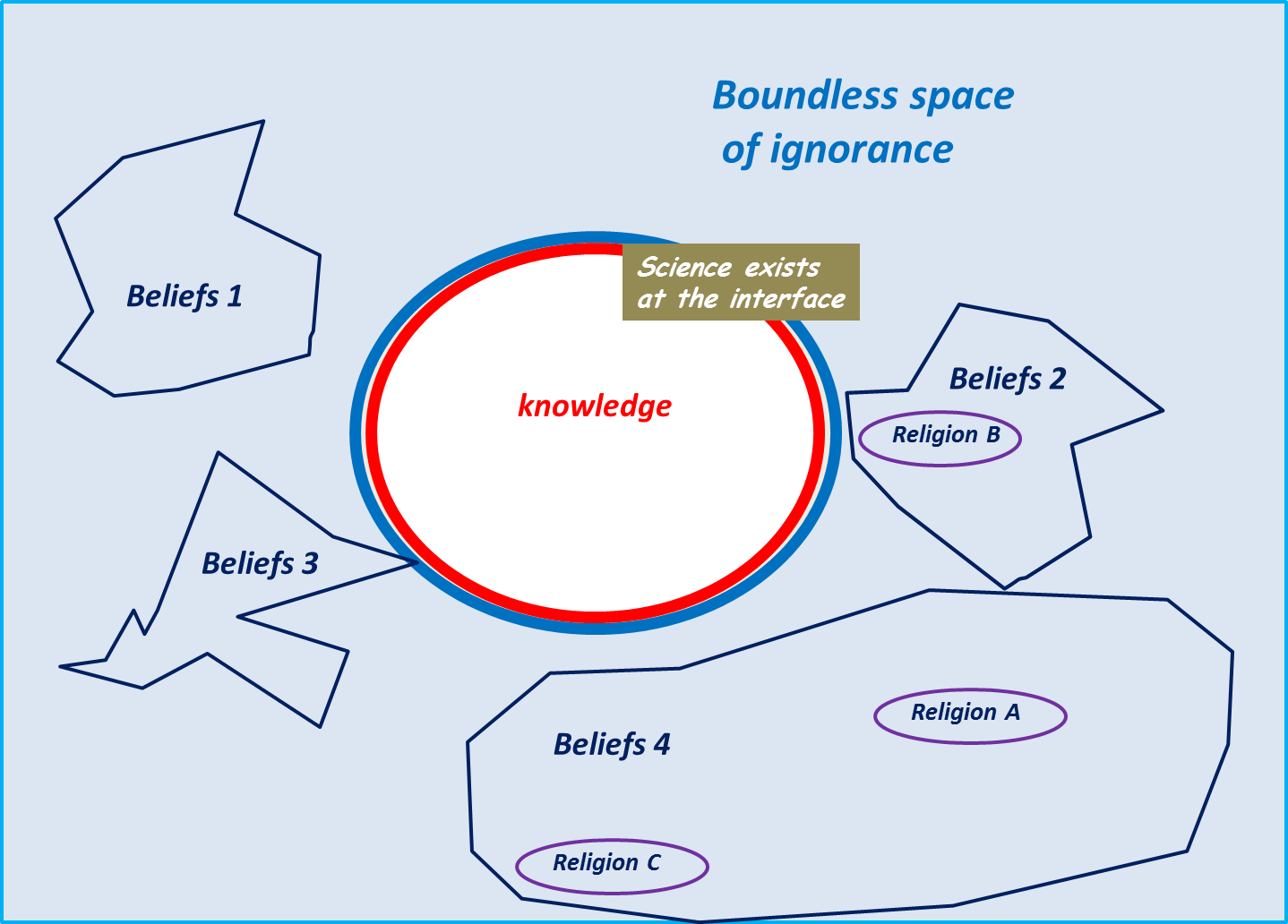
As knowledge has grown, some inexplicable questions have found rational explanations but new questions and new boundaries of inexplicability have always been found. In every field of thought humans came across – and continue to come across – boundaries of inexplicability. Knowledge has pushed back these boundaries, but every field of knowledge and thought is constrained within its boundaries of inexplicability. As the perimeter enclosing knowledge has expanded so has the length of the boundary of inexplicability and the volume of the unknown. In fact, every field of thought began  – and still begins – with an initial boundary of inexplicability; its initial fundamental assumptions. While the field of operation of the gods (the inexplicable) has receded, it has, paradoxically, grown in volume.

Gödel’s incompleteness theorems show that one cannot use the laws of arithmetic to prove the fundamental axioms that arithmetic is built upon. Hilbert’s attempts to try and show that all the branches of mathematics can be reduced to a single set of consistent (if unprovable) axioms have so far failed and some believe that Gödel’s theorems show that Hilbert’s program is unattainable. Our intuition suggests that no rational system of logic can be used to prove the very assumptions that the logic system is built upon. Equally the assumptions and rules of one system of logic cannot be used to prove the assumptions of a different system of logic. This applies as much to all branches of science as well as to mathematics and philosophy and to all rational thought. There is no branch of the sciences or mathematics or philosophy which can avoid – or will ever be able to avoid – the use of fundamental assumptions. Note that even assumptions which are taken to be self-evident are never proven and cannot be proved. They just are. When things are – without explanation and without being self-explanatory – they represent a boundary of inexplicability. The more we know, the more we know that we don’t know. Fitch’s Paradox of Knowability is sufficient to convince me that the Unknowable exists. The known, the unknown and the unknowable. What lies beyond a boundary of inexplicability may be unknown but knowable, or it may be unknowable.

The gods are irrational because they lie at or beyond the boundaries of inexplicability and all rational thought is bounded to lie within the bounds of inexplicability. No discipline of rational thought has the means with which to illuminate the regions beyond the boundaries of that system of rational thought. The process of science can push back the boundaries of inexplicability, but cannot illuminate the regions beyond. Science can push back the region where the gods operate but science cannot illuminate the operations of its own, or any other, irrational gods. The fundamental assumptions of all rational thought are invocations of “self-evident truths” which are no different to our ancestors invoking the Sun God as a self-evident truth. I dismiss atheism since it attacks the answers of others as being irrational, without ever addressing the questions. Atheism cannot cope with the unknowable.

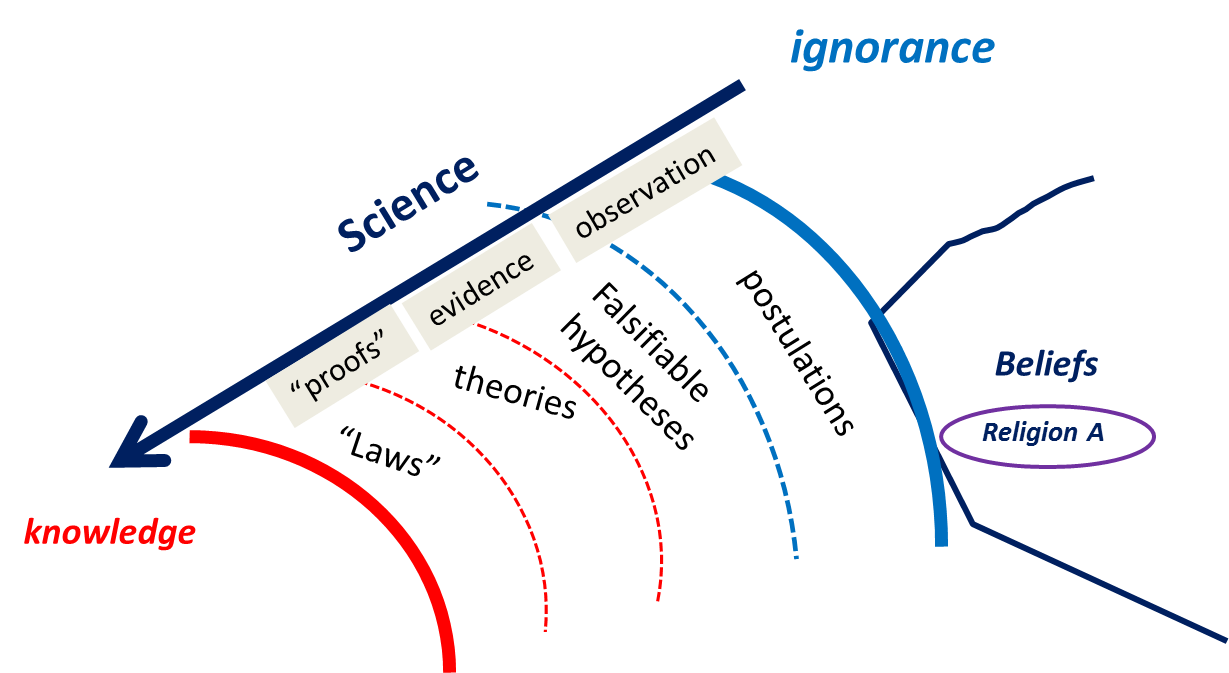
The known and the unknown are realms that are self-apparent. Science is the process at the interface of these regions which leads to the growth of the region of the known. All beliefs by definition lie in the region of the unknown. Any statement and its negation ( X and not-X) must both either lie in the region of knowledge, or both in the region of the unknown. It is not possible for one to live in the realm of knowledge and its negation to live in the region of the unknown. A belief in gods lies in the unknown. A lack of belief in gods (which is atheism) is not in itself a commentary on that belief. A denial of the belief in gods cannot then be anything other than belief and cannot shift into the realm of knowledge. A denial of a belief – which by definition lies in the unknown – is to claim knowledge of an unknown thing which is self-contradictory.

The God of the Big Bang and the gods of magnetism and gravitation and the weak nuclear force and the strong nuclear force lie at the edge of current inexplicability. The Religion of Science is replacing the old religions as a social construct for the supposed “common good”. The new gods of science and political correctness have replaced the gods of the sun and the moon and the waves and the wind. Instead of irrational animal gods we have the irrational gods of biodiversity and sustainability. The weather gods have been replaced by the gods of climate in the man-made global warming religion. But they too will be replaced by new gods with new labels when new boundaries of inexplicability are drawn.


Why the false god of liberalism is failing

October 29, 2018

Brazil has turned sharply right.

There is now a global move away from the sanctimonious form of “liberalism” which has prevailed since the late 60s. After more than half a century of pursuing a mirage a correction is taking place.  In the Philippines and Brazil it is a “law and order” label. In the US it is in addition the “illegal immigration” issue. For EU countries such as Austria and Poland and Hungary and the Czech Republic it is also the “sovereignty” battle. Brexit and the unholy alliance in Italy are further examples. While it is being manifested in different countries under different labels, the shift is actually about values.

Long before humans had speech, we had established the concepts of good and bad. It is not difficult to see how these fundamental values developed. Anything which helped survival was good and all that didn’t was bad. Every system of values starts here, with the distinction between good and bad. Every other value gets categorised into good and bad. With speech and language came the ability to describe the past and the future and more abstract concepts. But every concept carries with it a valuation of good and bad. Every individual has a fundamental and unique understanding of the difference between good and bad. It is part of his identity. What I consider good is what distinguishes me from others. Every collection of individuals develops a common understanding of the difference. An attack on an individual’s basic understanding of good and bad is an existential attack. It attacks his core identity.

The liberalism mirage is one where the most fundamental value of distinguishing between good and bad is ignored or has been forgotten. The most corrosive and corrupting notion of this liberalism has been the labeling of privileges as “human rights” and where such privileges are decoupled from behaviour. There is no “human right” which is not actually a privilege. It is inherent in the liberalism mirage that behaviour not be a qualifying factor for the privilege, yet there is no individual who does not moderate the privileges he grants to others based on their behaviour. Ther is no State or society which does not withhold privileges based on behaviour. To decouple privileges (rights) from behaviour tries to establish and legitimise a fantasy. The supposed “rights” to life and free speech and religion (which are all privileges) are severely curtailed everywhere. But it is perfectly logical and moral and correct that they be so restricted based on behaviour. It is the propagation of the fantasy that behaviour can be decoupled which is so corrosive. It is the fantasy that an individual’s core judgement of what is good and what is bad can be overridden by diktat which makes “liberalism” a mirage. There is now a reaction to the arrogance of the liberalism elite trying to force people to reverse their own judgements of good and bad.

This mirage is now becoming unsustainable in many parts of the world. That is not so surprising since it attacks the core identity of many people and of their notion of what is good and what is bad.


On the matter of matter (or how something came from nothing)

October 9, 2018

First you have nothing.

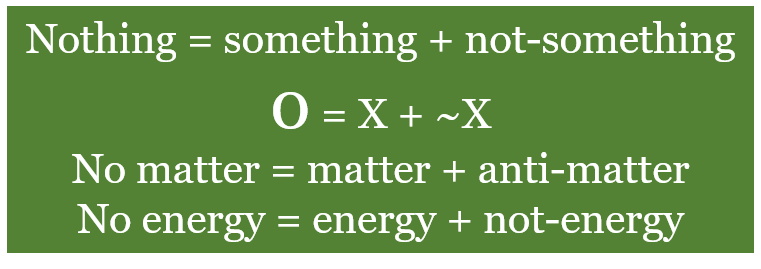
But let’s assume that a smooth and homogeneous “nothing” can spontaneously and inexplicably produce lumps of “something” provided it also produces equivalent amounts of “not-something”, where

something + not-something = nothing

On balance it would still be a global nothing but with local clumps of somethings and not-somethings.

This is a very handy subterfuge often used in science and mathematics. When looking for something unknown, zero can always be converted into the sum of something and not-something. So it is always possible to imagine what the something is, evoke it from zero and claim that the not-something exists but cannot be found.

0 = X + ~X

Anything can be derived from nothing provided its negative counter-part can also be tolerated (in absentia if necessary).

Nothing can be anything

We observe matter.

We haven’t a clue as to where this matter came from. So we devise the concept of matter and an equivalent amount of anti-matter at the origin of everything. But we cannot find this anti-matter in sufficient quantities to negate all the matter we observe. The global nothing is not preserved. That leads to the next subterfuge. It was all energy to begin with. Some of that energy converted itself into matter. That does not quite explain where that energy came from. Of course “nothing” might have decomposed into lumps of energy and of not-energy. The energy, it is then surmised, is that which is driving the expansion of the universe or the inflation of the universe or both. The lumps of not-energy are more elusive. Where that might be is not yet part of the next subterfuge.

It might be that matter has always existed, but in that case where did the energy moving that matter around come from? And why?

Where did all the antimatter go?

Scientists suspect that the Big Bang was a huge tear the fabric of space that ripped equal amounts of matter and antimatter into existence. But today, everything we see is made almost entirely of matter.

Physicists know that something must have happened to tip the balance in favor of matter during the formation of the universe. But the question remains, what was it? Antimatter particles are reflections of their matter counterparts. They are practically identical, except they have opposite electric charges. For instance, the antimatter twin of the negatively charged electron is the positively charged position. If an electron and positron were to meet and metaphorically ‘shake hands,’ they would annihilate each other into pure energy.

Scientists are left with this puzzle: If equal amounts of matter and antimatter were created in the Big Bang—and if matter and antimatter annihilate each other into a ball of pure energy on contact—then the universe should contain nothing but free, unorganized energy. But we exist, and therefore something must have happened to allow matter to survive and antimatter to all but disappear.

Scientists suspect that a tiny portion of matter—about one particle per billion—survived from the early universe to create all the planets, stars and galaxies we see today. And while matter and antimatter look almost identical, scientists discovered that the laws of nature do not apply to them equally.

Researchers found that some matter and antimatter particles can spontaneously transform into their matter and antimatter counterparts. They also found that matter and antimatter particles decay at slightly different rates. Scientists suspect that there is some hidden process influencing the behavior of matter and antimatter—a hidden process that could explain these puzzling observations. US scientists and our international collaborators study the subtle differences in the behavior of matter and antimatter particles at the LHC to paint a clearer picture of why our universe is matter-filled.

The bottom line is that modern physics hasn’t the faintest idea of where the matter and energy in the observable universe came from or why.

At least physics attempts to find answers. Religions brush aside the question and just assume a Creator where the question of where the Creator came from is disallowed.


The limits of science

September 25, 2018
  1. Reality is limited to what is detectable by human senses (and the instruments which extend our senses). What cannot be detected is assumed – but cannot be proven – not to exist. Science is limited to what is known to exist and what is unknown but assumed to be knowable. Science has no means to address what is unknown to be knowable.
  2. Time and causality. Science and its methods rely on causality which in turn relies on the existence of and the passage of time. But what time is and what actually passes, is unknown (being unknowable). Science cannot reach where causality does not exist.
  3. Boundary conditions. There is no branch of science (or philosophy) which does not rely on fundamental assumptions which are taken to be self-evident truths. But these assumptions cannot be proved and they cannot explain their own existence. Science and the methods of science cannot address anything outside their self-established boundary limits.
  4. Even the most fundamental and simple mathematics cannot prove its own axioms (Gödels Incompleteness Theorems). Science cannot address areas outside of the assumptions of mathematics.
  5. Value judgements are invisible to science. The appreciation of any art or music or even literature are not subject to logic or causality or any science. Even the beauty seen by some in mathematics or cosmology or biology is not amenable to scientific analysis. Moral or ethical judgements are beyond the capabilities of science.
  6. The existence of life is self-evident and inexplicable. It is a boundary condition where science has no explanation for why the boundary exists. To call the beginning of life a “random event” is a statement steeped in just as much ignorance as attributing it to a Creator.
  7. The boundaries of consciousness are neither known or understood. The perceptions of a consciousness of the surrounding universe define the universe. The perceptions form an impenetrable barrier beyond which science and the methods of science cannot reach.
  8. Fitch’s Knowability Paradox is sufficient to show the reality of the existence of the unknowable. Neither science nor philosophy or language or mathematics has the wherewithal to say anything about the unknowable. They have no light to shine in this area. An X-ray image cannot be seen in normal light.

Science is utterly dependent upon causality.

So is Determinism, where Determinism is the philosophical theory that all events, including moral choices, are completely determined by previously existing causes. Determinism can never look beyond or resolve the First Cause problem. Of course determinism falls immediately at the hurdle of infinite knowledge being knowable but proponents would counter that “unknown” does not invalidate causality. The First Cause is then merely shunted into the unknown – but knowable. Determinism would claim, by causality and the laws of the universe, that all that was unknown could potentially be known. Equally every event of the past could be traced back through causal relations and be knowable. In fact, determinism which shuns the need for religions and gods, actually claims the existence of Omniscience. More than that, determinism requires that omniscience be possible. Determinism is absurd. “There is no God but Omniscience must be possible”. Reductio ad absurdum.

Causality, determinism and science are all prisoners of, and restricted to, the knowable.